I am standing in a dark, silent room in Kalmar Konsthall, a local art gallery in a town in the south-east of Sweden. Around me are television screens with ‘talking heads’, but my attention is drawn to the large video screen on one of the walls. What I see on that screen is a high bridge in Stockholm and, on the sidewalk of the bridge, a young woman, carrying a plastic bag, pacing to and fro. She throws her jacket into the water and kicks off her boots; her T-shirt and bare feet are inappropriate for the cold winter night and her behaviour appears disturbed and disturbing. There are passers-by, some of whom stop to look at her, but all of whom walk on. Finally, someone stops and tries to talk to her, but she turns away and continues her frenzied walking.
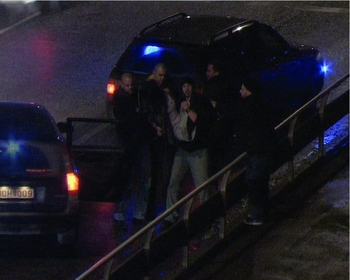
Finally, a passer-by takes out a mobile phone and makes a call. After quite a while, a police car with flickering blue lights appears on the scene. Two officers jump out of the car and try to take hold of the young woman, who strenuously tries to evade their grasp. But they manage to get hold of her, force her down on the pavement, bend her arms behind her back and handcuff her (see Fig. 1). Two more cars with flashing lights pull up and together the police manage to carry the woman over a traffic barrier and into one of the cars (see Fig. 2). When the police cars disappear, the video starts a new (seventeen-minute) loop.
The bridge on which Anna Odell re-enacted her suicide attempt. Police officers force her to the ground and handcuff her. Still from the installation video, courtesy of Anna Odell.

Police officers carry Anna Odell over the traffic barrier in order to take her to a psychiatric hospital. Still from the installation video, courtesy of Anna Odell.

To put on the headphones attached to each of the three television sets is to listen to various interviews: with two psychiatrists, a lawyer, and the staff of emergency stations at psychiatric hospitals. The interviews are conducted by the artist who is also the woman on the bridge (although making that connection depends on prior knowledge of the work). These conversations last between two and thirty minutes.
On a fourth television set a dialogue is recorded, which can be listened to and/or seen on the screen. This dialogue takes place in a hospital between a doctor and her patient (the artist). The patient tells the doctor that she is not ill at all but has staged the act on the bridge. The doctor leaves the room, comes back, swears and asks the patient to leave the hospital forthwith.
At the exit to the gallery there are four framed papers: two patient record entries from 1995 about Anna Odell, who at the time was treated for suicidal behaviour, and two entries from 21 and 22 January 2009 about an ‘Unknown Woman 34 97 01’. The ‘Unknown Woman’ with the six digits was the title of Anna Odell's artwork when she exhibited it for the first time in May 2009 as part of her examination at the University College of Arts, Crafts and Design in Stockholm. When I saw it in Kalmar in July, the title was Reconstruction.Footnote 1 For Odell as the artist, the intention behind the work was clear:
The main aim was to open up something that is extremely closed – psychiatry. They [medical authorities] have the power and there [the hospital] all your rights can be withdrawn from you. That's how it works, so one has also the right to investigate their activities.Footnote 2
Yet this extraordinary artwork – one newspaper declared Anna Odell the artist of the yearFootnote 3 – raises a number of complex theoretical questions about artistic creation and communication. In order to engage with these complexities, it is necessary to begin by clarifying the ‘story’, the events from the action on the bridge to the completed artwork, taking the genesis of the work as a route through to explaining its controversial reception and the questions it provokes about the artistic status of Odell's public (re)enactment, its legal consequences and the effects it had in the installation.
What happened?
1
On the cold and snowy evening of 21 January 2009, the young artist Anna Odell was on a high bridge in Stockholm, as recorded in the installation video as previously described. The police took Anna Odell to the nearest psychiatric hospital. There she was taken care of by four nurses and four policemen who took her straight to a room where she was immediately strapped down on a hospital bed. She received two tranquilizing shots and was left on her own.
The next morning she told the doctor that her behaviour on the bridge was a staged ‘performance’, or rather a re-enactment of a suicide attempt she had made on that same bridge thirteen years earlier. The reaction of the doctor is recorded in the installation.
2
Two days after Anna Odell left the hospital, an evening tabloid in Stockholm ran the story: art student Anna Odell pretended to commit suicide on a bridge and faked a psychotic condition.Footnote 4 She was said to have beaten and bitten the policemen and threatened hospital staff, and was generally misusing public resources. The accusations came from the chief physician of the hospital, who also filed a report to the police.
For weeks and months, public debate raged about Anna Odell's action on the bridge and in the hospital. Psychiatric experts were upset, a liberal politician demanded that she or her art school pay back the full costs of her treatment, the medical journal Dagens Medicin received many letters condemning Anna Odell's action as unethical, criminal or simply despicableFootnote 5 – except for one doctor, who reminded his colleagues that medical students had engaged in similar interventions thirty years earlier without public objection or protest.Footnote 6
3
On 12 May 2009 a first version of Anna Odell's installation Unknown Woman 34 97 01 was shown at the art school where she studied. During the summer an extended version was on exhibition in Kalmar. More versions were shown in Stockholm and elsewhere during the winter of 2009 and spring 2010.
4
A trial on 31 August 2009 concluded that Anna Odell's enactments were not legally justifiable. Although the public prosecutor had dismissed certain charges, she was still sentenced for fraudulent practice and for resisting the authorities. The fine was, however, the lowest possible – comparable to that imposed for failing to pay for a parking ticket.
This, then, is Odell's story, but it is useful to distinguish the different ‘narrative’ phases:
• the enactment (on the bridge and in the hospital),
• the debate in the media,
• the trial and the sentence,
• the artwork as it was exhibited (before and after the trial)
All of these phases trigger a number of important questions. In what terms can this enactment be described, since it is generically hard to define? How did the court arrive at a decision that neglected her re-enactment as part of an artistic process? In what ways were the live events reflected in the installation? In order to provide some answers to these questions I will look at Anna Odell's work from three perspectives: the enactment on the bridge, the legal procedure that followed, and the transformation of the events on the bridge and in the hospital into a complex and dynamic work of art.
The enactment
Concerning the enactment on the bridge, my first question is how to speak about Anna Odell's action: what terminology and what concepts might be used to describe and analyse this phenomenon? It appears difficult to find an adequate generic term to describe this. Augusto Boal's ‘invisible theatre’ has been suggested, but her action has very little to do with theatrical playing and it is absolutely not resolved in the way Boal had in mind (i.e. that participants would be drawn into a learning process) because the pedestrians on the bridge had nothing to learn from their experience.Footnote 7 I find it problematic to simply speak of acting, although it could easily qualify as such according to Michael Kirby's well-known distinction between ‘acting and not-acting’: ‘Acting can be said to exist in the smallest and simplest action that involves pretense.’Footnote 8 Nobody who actually saw and met Anna Odell on the bridge could sense any kind of ‘acting’, which makes it difficult to speak about the occasion in theatrical terms at all. Can the act be described as performative? Not in the sense of John Austin, nor in the way Judith Butler uses this term, because the re-enactment lacks both John Austin's adequate contextFootnote 9 – the pedestrians were in no position to realize the staging – and Butler's (unconscious) norms that would have been inherent, since the psychotic condition indeed was staged.Footnote 10 Of course it could be called a performance, but not without some qualification because the observers on the bridge had no way of knowing that a performance was being presented to them, i.e. the communicative aspect was not apparent. In other words, Anna Odell's enactment on the bridge cannot be described simply as an action, but needs to be understood in its communicative context.
I have long elaborated on a model of communication within the framework of the theatrical event.Footnote 11 In this scheme I distinguish between sensory, artistic and symbolic levels of communication. Although I have difficulties labelling Anna Odell's enactment a ‘theatrical’ event, this model (see Table 1) initially provides analytical tools that serve for a more detailed study of the event. In the following I will, however, substitute the relationship between performer and spectator with two more general terms, Agent (A) and Beholder (B) in order to use terminology that is not directly related to a theatrical situation.Footnote 12
Levels of communication in theatrical events

On the sensory level, the encounter seems to be quite straightforward. There is a woman who looks relatively young, dressed inappropriately for the season, who moves in a way that indicates a disturbed mind. She is restless, but in no way aggressive. The passers-by are people crossing the bridge, walking, cycling, heading off somewhere. The appearance and behaviour of the young woman are sufficiently unusual, if not somewhat alarming, to make the pedestrians aware of her. To a certain degree, the situation might not be out of place in a big city; nevertheless, the woman's behaviour suffices to trouble the cityscape.
The artistic level of communication raises some problems. Of course there is an artistic quality pertaining to the appearance of the woman, but the artistic signs of the enactment are not apparent to the beholders. The woman's behaviour and her inappropriate clothing mark her out as an agent – as would be the case in a street performance – but there is nothing in the context that makes her recognizable as an agent or protagonist of an organized event. One could call this appearance hyperrealism, seen as a complete expression of a psychotic state of mind. For the beholders this hyperrealism, however, is perceived as authentic behaviour. On the bridge the aesthetics of the agent have a non-artistic effect on the beholders.
The intentions of the agent set her further apart from the beholders. For the agent, the enactment on the bridge is not simply a freely invented story that she is ‘playing’ in front of an (unknowing) audience, but she is restaging an episode from her own life. Thirteen years earlier, she had attempted suicide on the very same bridge and was treated in the same way by the police and by the hospital. In other words, the situation constituted a re-enactment or a staging of Anna Odell's own life. Invisible to those for whom it was ‘performed’, however, her re-enactment was (mis)understood to be a life-threatening action in the ‘here and now’, eliciting authentic reactions from the beholders. In turn, these circumstances shaped the symbolic level of communication.
The symbolic level was clear for Anna Odell: for her, the enactment on the bridge, including the intervention of the police and the treatment in the hospital, were a ‘reconstruction’, more so than she could have expected: the treatment was identical to what had happened thirteen years earlier. For the people who met her on the bridge, police and passers-by, and subsequently at the hospital, the psychotic behaviour of the woman was deemed to be real, and the ‘reality factor’ determined their actions. This differs from a theatrical event where spectators, to some degree at least, have an awareness of the symbolic as theatrically framed. In Anna Odell's case, the emotional reactions of the beholders were, nevertheless, comparable to the empathetic reception a fictional character of this kind might find with a theatre audience. Yet in contrast to a theatrical performance, the beholders were not spectators but became (unknowingly) participants in an artistic event – the installation that would follow.
In the first phase of Anna Odell's work – the enactment on the bridge and in the hospital – the event modelling highlights certain issues. For the artist herself, there was a clear distinction between her as a person and the action she created, i.e. between the sensory and the artistic levels of communication. She is physically present on the bridge, but her appearance is made up for the occasion. Her outfit is a costume; her movements are deliberately staged; her plastic bag as a prop was thrown on the sidewalk, picked up again, tossed away and so on, meant to indicate a disturbed state of mind. The problem is that the ‘spectators’ are not able to distinguish the sensory and artistic levels of communication. For them, the artist is invisible, because what they see does not belong to any recognizable genre of art. One could also say that the artistic level of the presentation is hidden from the public. In consequence, also the symbolic level of communication has different implications for the agent and for the beholder. While Anna Odell staged ‘a portrait of the artist as a young woman’ (to borrow from James Joyce), the passers-by could identify no staging at all, saw no ‘performance’. So for the pedestrians on the bridge there were only two possibilities: either to ignore the action and walk on, or to become involved, thus becoming participants rather than observers. For the policemen and the personnel of the hospital, there was no choice – for them it was routine procedure, at least, that is, up until one of the doctors learned about the ‘performance’.
Even the public debate focused mainly on the ‘invisibility’ of Odell's artistry. Despite the fact that none of those writing about Odell's action had been present while it happened, debaters had strong opinions about the moral, artistic and juridical aspects of this ‘prank’ or ‘masquerade’ – terms frequently used in the press. The basis of the public debate was not the experience of an act or event, but the narrative of that event. No communicative levels were activated, but they were fiercely debated.
This, of course, contrasts with the experience of seeing the installed artwork which communicates on all levels – the sensory, artistic and symbolic. The sensory level now consists of a dark, silent room, including other (silent) visitors. We see the television sets with moving images and the large video screen that dominates the room. But there is no performer, so the artistic level is activated by another medium, the video installation. The artwork, especially the big screen, is characterized by its documentary format, the granular images, shot with immobile cameras. On the symbolic level, this vision suggests a direct relation to the occurrence on the bridge as an authentic event irrespective of the prior knowledge that the visitors have about the enactment.
The situation on the bridge, as projected in the installation, implies a complex interaction of (unequal) communicative positions. Anna Odell's enactment can certainly be described as a staged, site-specific performance, including artistic dimensions equal to (some) performance artists. But those drawn into the action – those I here call beholders – had no way of interpreting their own position. They were not just observers, they were certainly not spectators and they did not even know that they were (involuntary) participants in an installation. At the same time, they were not simply everyday passers-by, because they actually became co-agents in an event that would ultimately be included in the installation. Therefore I rule out the concept of performance art and elect instead to speak of a cultural or even a socio-political event.
Before I enter into a discussion of such events and their theoretical implications, I propose to follow Anna Odell's court case. Since this trial focused on the enactment on the bridge rather than on the artwork Anna Odell had created at the time, I hope that a closer look at the accusations and conclusions in court will further illuminate the theoretical problem posed here, namely the status of the enactment as an artistic endeavour aiming at another medium, the installation, this to be the intended ‘site’ of confrontation, as opposed to the controversy that the enactment produced, the extent of which was neither intended nor foreseeable.
Criminal art?
The crucial question under this heading is whether the court came to misunderstand the artist's intentions in a way comparable to how the case was debated in the media. Since it is difficult to understand the enactment on the bridge as such – both in theoretical and in legal terms – it is crucial to understand the accusations that were made against Anna Odell, the way in which the public prosecutor handled the case and the court's ultimate verdict.
The St Göran's Hospital that Anna Odell was taken to by the police belongs to the Northern Psychiatric Health District of Stockholm. This district – represented by seven employees of the hospital – filed a report to the police containing five indictments:
• violent resistance,
• fraudulent practice,
• damages (misuse of public resources),
• assault and battery (against police and health care personnel),
• unlawful threat.
These accusations were obviously the same as those the chief physician had leaked to the press long before anything was decided legally: he spread the news that Anna Odell had beaten, scratched and bitten the policemen and the nurses. Since no evidence for any such behaviour could be found, the public prosecutor dropped the charges of assault, battery and unlawful threat before the trial began. Nevertheless, the ‘news’ that was spread through the media was likely to severely damage Anna Odell's reputation.
The court also dismissed the claim of reparations, a sum of approximately €1,200, due to the damage caused to public institutions such as the police and the hospital. The court ruled that no extra resources were necessary to handle Anna Odell and the only direct costs were the two tranquilizing shots at the cost of €3.50.
Moreover, the charge of violent resistance hardly seems justifiable. However, according to legal experts, an act of very little resistance can be labelled ‘violent’. Anna Odell's unwillingness to be pushed into a police car can, therefore, be seen as violent resistance. Whether her behaviour warranted the use of handcuffs is, however, questionable: there seemed very little reason to take this measure immediately upon the arrival of the police. At the hospital, Anna Odell was carried from the police car to a room in the hospital, where she was laid out on a bed with restraints applied to her legs, waist and wrists. The doctor in charge was a witness at the trial and he was asked why he decided to use such a drastic method of restraint. He claimed that Anna Odell was very violent and aggressively waved her arms. Yet the nurses testified that Anna Odell was handcuffed while her legs and waist were firmly strapped to the bed and was, therefore, unable to make any violent arm movements during this procedure. In other words, the restraints were used as a matter of routine practice rather than as a last resort – which was one of the issues that Anna Odell wanted to bring to public attention.
‘Fraudulent practice’, therefore, remained the most severe charge. This accusation could be described as at the heart of the trial: Anna Odell misbehaved in terms of not being honest, since what she enacted on the bridge and in the hospital was not the result of real illness, but was staged, enacted, or – as her antagonists claimed – pretended, faked, imitated. Whatever term one prefers, the court found it legally unacceptable.
Why was Anna Odell sentenced? According to social norms, it is immoral to pretend to be ill (in general, in school, at work and so on). It is immoral to elicit help when you do not really need it. It is immoral to misuse public resources (although she was formally freed from that charge). It is (almost) immoral to question the medical treatment that is decided upon by a professional physician – doctors are thought not to make mistakes, nor should medical practices be deemed questionable. The distinction between social norms and the law was blurred, according to one analyst: ‘I read the sentence as a concession to populist wrath.’Footnote 13
Why could the court not see Anna Odell's enactment on 21 January 2009 as an artistic practice instead of defining it as fraudulent practice? In court procedures the aim is to clarify the intentions and motives of the accused. Many times, the gravity of a sentence is directly related to the degree of intentionality behind a criminal action. In the case of Anna Odell the court interpreted the intentions of the defendant in a very narrow sense. In the court's eyes, Anna Odell had purposefully deceived the police and the personnel of the hospital. That she succeeded in her deception was not rated as an artistic achievement but as a criminal action: her actions were judged to be legally unjustifiable. The court did, however, take into account that the enactment on the bridge and in the hospital was not an end in itself, but only part of a wider artistic plan – the installation. The court ruling stated the following:
Concerning the decision about the penalty, the court takes into account that she [Anna Odell] had no intentions to commit a crime in the first place, but only – within the frame of an art project – to call general attention to an issue, the compulsory institutional care in psychiatry, which she meant should be debated. Therefore, the penalty is kept lower than otherwise would be the case.Footnote 14
Within the larger project, the purpose of the enactment was not to deceive anybody, but to provoke authentic reactions towards the actions on the bridge. These real-time, authentic reactions of the pedestrians, the police and the hospital personnel were important to the art installation, which constituted the overall purpose of Anna Odell's work. The legal procedure in court was obviously not prepared to acknowledge the extended purpose as an excuse for her action. Like the theatre and performance theorist, the legal system did not have the terminology or the conceptual insight to fully understand the relationship between what was happening on the bridge and its artistic outcome.
One of the reasons why the court and the press were unable to distinguish between the alleged ‘fraudulent’ act on the bridge and its documentary function in the installation was certainly due to confusion about and conflation of artistic action and everyday occurrences. This problem did not exist for those who actually met Anna Odell on the bridge – for them it was nothing but a real-world experience. Only when it became known that the enactment was part of an artistic work did the problem of distinctions begin. As a real-world experience it was unusual but normal, as one of the witnesses of the enactment stated.Footnote 15 As an artistic enterprise it was unrecognizable due to its hidden artistic level. The hyperrealism of the enactment made the actions indistinguishable from the ‘real’. The paradox here is that Anna Odell carried out her actions too well – had she been less skilful in her acting out of a psychotic state of mind, it would have been detected as a performance and the whole scene would have collapsed.
Here the question of media comes into play. The actions on the bridge and in the hospital could, of course, not be identified as a proper medium. (By medium I mean a mode of expression, rather than mass media.) The court only referred to a public event as the medium of the enactment on the bridge. The enactment was, however, aiming at another medium, that of an installation, but the court was unwilling to understand this change of media. Furthermore, even the proceedings at the trial could be identified as a specific medium, i.e. the juridical interaction between defendant and public prosecutor. This change of media – from enactment to mass media, to legal proceedings, to installation art – made Anna Odell's staging instrumental and thus, in the end, morally and legally unjustifiable in the eyes of the public.
The mediation of life and art
The case of Anna Odell's artwork points to a number of similar occurrences in the past that can be related to her enactment. Earlier I referred to the one doctor who reminded his colleagues who objected to Odell's practice that medical students had got into a psychiatric hospital by adopting similar tactics. But since the students were considered future colleagues, no doctors were upset about the prank. In Germany, the journalist Günter Wallraff repeatedly used disguises to take up jobs in order to reveal the inhuman working conditions of his fellow workers. Although frequently brought to trial, he could always prove that he was employed on legal grounds and earned his money in an honest way.Footnote 16 Looking further back in history, in 1887 the American journalist Nellie Bly pretended psychiatric illness and was taken into the ill-famed ‘mad house’ on Blackwell Islands and the reports she wrote after her release shocked New York society – with far-reaching changes for the inmates as a consequence.Footnote 17 In all of these cases, the agents have been invisible as agents, irrespective of what precise purpose their actions were meant to serve.
Today, numerous artists and scholars deal with proactive, interventionist and relational art.Footnote 18 While direct interventions of the kind Anna Odell carried out are relatively rare, actors are frequently employed in medical education to play the role of difficult patients or to train doctors in coping with grave situations. Medical treatment of the artist's body appears time and again in performances and installations. Most famous in this respect are arguably the French body artist Orlan, who has surgically changed her physical appearance, and Stelios Arcadiou, alias Stelarc, known in the art world for his cell-cultivated third ear attached to his arm. In popular culture, makeover programmes on television attempt to change participants’ bodies in such a way that the outer beauty is supposed to equal the inner values of a person. These and similar medical interventions are designed to exhibit bodies to a public gaze, but in my view their political impact remains minimal.
Politically interactive artists, who seek to affect societal discourse, usually make use of their personas – with or without the disguise of a ‘role’ – at public gatherings in order to provoke and challenge audiences. Significant in this regard, for instance, is the late Christoph Schlingensief, who initiated numerous politically provocative actions in German-speaking countries. In 1998 he started a political party in Germany, Chance 2000, and rigged a circus tent for his campaign, launched with the slogan ‘Vote for Yourself’.Footnote 19 His party not only acted out central issues of post-Berlin Wall Germany, but also secured almost one per cent of the votes. During the Wiener Festwochen in 2000, Schlingensief performed an ironically styled campaign for expelling immigrants from Austria: spectators on the square outside the Opera House were engaged in a televisually conceived voting process to decide whether an individual foreigner should be sent back to their home country.
In her recent book Social Works, Shannon Jackson also presents a number of cases in which an interactive relation with the public is, to varying degrees, blurred.Footnote 20 Among her examples is, for instance, the way in which artist Andrea Fraser took a group of visitors on a tour through Philadelphia's Museum of Art to show them Museum Highlights (1989). These ‘highlights’ consisted of the admission desk, a drinking fountain, the cafeteria and so on, while the group passed by, or rather bypassed, the paintings and sculptures.Footnote 21 Further, Jackson offers the example of how in the early 1970s Mierle Laderman Ukeles carried out a series of Washing Tracks during which she literally scrubbed the floor of art institutions, kneeling on the flagstones, rubbing them inch by inch, while visitors passed her by. There was no physical interaction with visitors, but she could hardly be overlooked by whoever passed the showrooms or the stairs to the entrance where she was cleaning.Footnote 22 Equally, Jackson describes how the Spanish artist Santiago Sierra has repeatedly engaged and paid unemployed workers or refugees to participate in his installations. They were placed inside cardboard boxes (Berlin, 2000) or made to hold beams as part of an artwork entitled 9 Forms of 100 × 100 × 600 cm Each, Constructed to Be Supported Perpendicular to a Wall (New York, 2002). The workers holding the beams up against a wall while people were watching them in the Deitch Gallery revolted against what they considered to be a misuse of their labour and left the installation.Footnote 23
In the course of her analysis, Shannon Jackson presents these, along with many other examples, as interventions between the aesthetic and the social or the political in arts, and as the dissolution of the borders between spectatorship and participation. In her concluding remarks she argues,
The social here does not exist on the perimeter of an aesthetic act, waiting to feel its effects. Nor is the de-autonomizing of the art object a de-aestheticization. Rather the de-autonomizing of the artistic event is itself an artful gesture, more or less self-consciously creating an intermedial form that subtly challenges the lines that would demarcate where an art object ends and the world begins. It is to make art from, not despite, contingency.Footnote 24
More directly comparable to Anna Odell's enactment is an art form that has recently become popular: the so-called parcours. Participants decide on a straight line between two points in a city and then try to move exactly along this line, irrespective of possible obstacles such as houses, canals, railway tracks, and so forth. As Nicolas Whybrow explains, interactions are neither planned for nor expected, even while they might attract the bemused interest of the casual observer in whose gaze they may well be perceived as sport rather than art.Footnote 25 For Anna Odell, the engagement of accidental observers was, however, essential for her artwork.
While the varying degrees of socio-political impact consequent upon ‘acts’ such as those surveyed here are hard to fathom, brought together they evidence an increasingly complex relationship between agent and beholder. Sierra's workers did not care about audiences, but revolted against being exploited. The pedestrians in Stockholm were ‘used’ in a similar way, but did not object because they could not know about their future involvement in the installation. By setting apart the artwork from the creative event, Anna Odell has, I would argue, further complicated the relationship she has with her audience. She ‘uses’ the passers-by for the genesis of the work and ‘refigures’ her encounters on the bridge in the documentary of the final piece.
In search of authenticity
Anna Odell has not created a performance in the sense of a traditional or contemporary genre; not even the re-enactment on the bridge was a performance. The question is, what becomes of an event such as the re-enactment on the bridge and the authentic reactions this produced, when it is presented two-dimensionally in an installation? What remains of the authentic behaviour of the pedestrians and police officers that characterized the live event when the documents are displayed in a gallery, i.e. for the beholder of the installation?Footnote 26
The question of authenticity cannot be answered without considering the kind of authentic acts at hand. A distinction between the intentional authenticity of the creation of the artwork and the phenomenological authenticity of its experience in the art galleries seems advisable. As the artist, Anna Odell wanted to create a work that would capture the authenticity of the reactions of those involved in her enactment – pedestrians, police officers, nurses and doctors – thereby endorsing or authenticating her experientially formed view of how those in her situation are ‘treated’. She sees her work as an attack on routine treatments at psychiatric hospitals. In interviews, public debates and radio programmes she has emphasized this aspect again and again:
I wanted to show something that was very important to me; that it can look just like that. But I do not see myself as someone who can lead the debate about psychiatry. Others need to do that. My aim was to make people think and thus stimulate a debate.Footnote 27
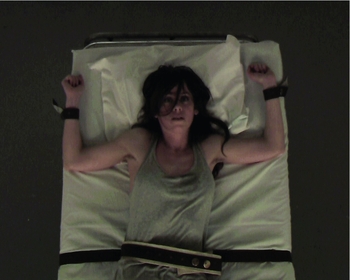
This focus on psychiatric treatment was not immediately obvious to me when I saw the installation the first time. The conversation with the doctor and the copies of the medical reports did not say much about her treatment. Anna Odell herself complained that the police investigation had prevented her from completing the installation on time.Footnote 28 In the next showing in the autumn of 2009, soon after the trial, the ‘fictional scene’ with the artist fighting against being strapped to the bed was added (see Fig. 4), but since it had no documentary qualities the psychiatric question was still only hinted at. In my view, the behaviour of the pedestrians was still very much foregrounded. Finally, the original recordings of the witnesses during the trial were added: made audible and visible, they pointed very clearly towards the practices of the hospital. Only then was the installation fully developed and able to achieve the socio-politicizing effects that Anna Odell had had in mind. I have underlined the importance of the documentary character of the video that is displayed in the installation because this served to create an authentic impression of the live event. Maybe the same impression could have been achieved by a skilful filmmaker, but the ‘air’ of authenticity would probably be missing. Would it matter?
As regards my own experience, the authentic reactions of the pedestrians on the bridge were extremely important. The situation and the behaviour of the passers-by touched me deeply and I found myself seriously wondering how I would have reacted in a similar situation. Had the images on the screen been produced in some other way, my reactions would most probably have been different. For instance, had someone filmed a real suicide attempt, I would have found it cynical that someone kept on filming. Had the scene been staged with actors and extras, like in a regular movie, it would have been a recognizable but constructed situation similar to a cinematic experience, allowing for both distance and empathy. On the level of the symbolic, authenticity was decisive for me as visitor to the art gallery. Both in the first encounter with the installation and on subsequent visits I was confronted with images which to varying degrees presented documents of live events. Can the authenticity of these events also be sensed by other visitors to the installation?
Of course, visitors might or might not experience what I think of as phenomenological authenticity. This kind of authenticity is not dependent on the images alone but on the contextual framings of the installation. The visitor is involved in a mediated experience of the artwork against a backdrop of rumours, newspaper reports and court rulings. Hardly any Swede visiting the installation in its various incarnations would have been unaware of the media hype surrounding the installation. Indeed, the heated public debate had made any potential visitor conscious of the ‘reality factor’ that preceded the installation. This more than likely had a strong impact on the beholder. The contextual frames were, hypothetically speaking, present in the exhibition hall.
Anna Odell reconstructing the moment of medicalized restraint. Courtesy of Anna Odell.

Concluding openings
In order to describe Anna Odell's enactment on the bridge, I have used the three levels of communication which are thought to be established between an agent and a beholder. This approach has served to disclose the disruption between the actions that A produced and the reactions that B reasonably could respond with. In the event, the court had considerable difficulties in accepting these actions as a means to making an artwork since the law could neither appreciate the aesthetic qualities, i.e. the hyperrealism of the enactment, nor accept the mediated transformation from enactment to installation. These shifts of media constitute, however, the expressive mode of Anna Odell's project in its entirety and thus its aesthetic basis. To be able to visualize these shifts and their significance for the artwork and its perception, I have described the installation as an interplay of various media. Furthermore, the artwork cannot be isolated from the genesis of the events. Through the documentary character of the videos, the installation points to the events that are documented: the enactment on the bridge, the hospital, the court proceedings, and – through the memory of the visitors in the hall – even the public debate. All of this becomes part of a chain of events that led up to the visitors’ encounter with the art work. Prior information and new impressions are synchronized with the momentary experience and create a sense of authentic presence, meaning that the artist's presence on the bridge still reverberates in the exhibition hall.
We are used to thinking about presence in terms of physical bodies in the same location, termed ‘co-presence’ by Erika Fischer-Lichte.Footnote 29 In relation to the multiple uses of media we might look to redefine presence from the viewpoint of non-bodily materiality. Some recent examples of similar events and their theoretical analysis – most insightfully engaged with by Jackson – prove inadequate to the task of fully capturing Odell's work, i.e. the tension between the process of re-enactment and the practice of re-presentation. The different moments of the genesis of materials and media shifts of the events become simultaneously present when we enter the exhibition hall. Even the artist is made ‘present’ through her documentary re-enactment. The levels of sensory, artistic and symbolic communication, as well as the artwork's transition from one medium to another, including the medialized discourse about it in the public sphere, were my analytical tools for clarifying some aspects of Anna Odell's work, but each explanation also points to the increasing complexity of the temporal and spatial transitions from act to object to perception. In the words of Odell,
Art is a kind of research, but more subtle and human than other research. Art contributes to human progress, but on its own terms. Art is necessary to make society function in a reasonable way, but of course society does not only need art.Footnote 30
The intensive attention that Anna Odell's work received at various stages of its ‘research’, its creation, eventually ignited the issues she had intended to raise: the conditions of psychiatric health care were seriously discussed in public, thereby exemplifying art's capacity to ‘contribute to human [social] progress’.
The exhibition room cannot be isolated from the complex circumstances that are stored in the artwork. The presence of the work also includes the genesis of its process. The encounter with Anna Odell's art requires theoretical reconsiderations, new models of thinking and openness towards the mediated world, in which the presence of the body evades material definitions. The court limited its view to the physical event. In the installation, a dialogue takes place, but the place extends beyond physical limitations. Even in a theoretical analysis, Anna Odell's Unknown Woman remains provoking and enigmatic.