Introduction
Stress in reaction to challenges in daily life is thought to be an important factor in the onset and relapse of major depressive disorder (MDD; Kessler, Reference Kessler2003; Melchior et al. Reference Melchior, Caspi, Milne, Danese, Poulton and Moffitt2007). It has been suggested that this increased stress reaction in depressed patients may result from an ineffective regulation of transient negative emotions following aversive events (Power & Dalgleish, Reference Power and Dalgleish1997; Stegge & Terwogt, Reference Stegge, Terwogt and Gross2007). Accordingly, depressed patients show impaired performance following negative feedback in several neurocognitive tasks (Elliott et al. Reference Elliott, Sahakian, McKay and Herrod1996, Reference Elliott, Sahakian, Herrod, Robbins and Paykel1997; Steffens et al. Reference Steffens, Wagner, Levy, Horn and Krishnan2001; Douglas et al. Reference Douglas, Porter, Framptom, Gallagher and Young2009). Beats et al. (Reference Beats, Sahakian and Levy1996), who first observed this response pattern in a sample of depressed patients, coined the term ‘catastrophic response’, implicating a pivotal role of affective processes during task performance. These authors suggested that affective processing of the failure feedback heightened the probability of committing an error immediately after an erroneous response. Further studies, comparing the performance of patients and healthy control subjects, confirmed the heightened probability of errors in the immediately following trial (Elliott et al. Reference Elliott, Sahakian, McKay and Herrod1996, Reference Elliott, Sahakian, Herrod, Robbins and Paykel1997; Douglas et al. Reference Douglas, Porter, Framptom, Gallagher and Young2009) or within the next three trials following failure feedback (Steffens et al. Reference Steffens, Wagner, Levy, Horn and Krishnan2001). Heightened probability of those ‘subsequent errors’ has been interpreted as an affective hypersensitivity to the negative feedback in depressed patients, which interferes with performance in subsequent trials (Elliott et al. Reference Elliott, Sahakian, Herrod, Robbins and Paykel1997; Santesso et al. Reference Santesso, Steele, Bogdan, Holmes, Deveney, Meites and Pizzagalli2008). In comparison to other neuropsychiatric patient groups, the effects of negative feedback in MDD were highly specific and were shown even in the recovered state, indicating a possible trait marker (Elliott et al. Reference Elliott, Sahakian, Herrod, Robbins and Paykel1997; Santesso et al. Reference Santesso, Steele, Bogdan, Holmes, Deveney, Meites and Pizzagalli2008). However, results are contradictory, as other studies did not find between-group differences in feedback-guided behavioural performance (Purcell et al. Reference Purcell, Maruff, Kyrios and Pantelis1997; Shah et al. Reference Shah, O'Carroll, Rogers, Moffoot and Ebmeier1999; Ruchsow et al. Reference Ruchsow, Herrnberger, Wiesend, Spitzer and Kiefer2004, Reference Ruchsow, Herrnberger, Beschoner, Grön, Spitzer and Kiefer2006; Chiu & Deldin, Reference Chiu and Deldin2007). Differences in strategies to regulate negative emotion following negative feedback could account for these conflicting results; in the context of repeated negative performance feedback, an adaptive strategy of emotion regulation is ‘cognitive reappraisal of the emotion-eliciting event’ (Kluger & DeNisi, Reference Kluger and DeNisi1996; Ochsner & Gross, Reference Ochsner and Gross2005). Cognitive reappraisal aims at the reduction of emotional impact of negative feedback when attending task-relevant information (e.g. the search for the correct response), whereas meta-task information (e.g. the significance of the error for self-perception and self-efficacy) is de-emphasized (Kluger & DeNisi, Reference Kluger and DeNisi1996). However, depressed patients generally rely less on cognitive reappraisal (Beck, Reference Beck2008). This may even be the case in response to negative performance feedback because patients often seem to focus on meta-task information, magnifying the impact of failure and dwelling on it (Murphy et al. Reference Murphy, Michael, Robbins and Sahakian2003).
In the present study we investigated the modulatory influence of reappraisal on cognitive performance following feedback in patients with MDD to further clarify emotional and cognitive processes underlying this impairment. To this end, we used a variant of the mental rotation paradigm (Shepard & Metzler, Reference Shepard and Metzler1971), which was modified to induce feedback-related processing during ongoing performance. The difficulty of mental rotation tasks was manipulated gradually, resulting in varying likelihood to commit an error. Subjects had to regulate affective reaction with regard to the immediately given emotional feedback after erroneous performance, to prevent subsequent errors. We predicted that depressed patients would commit more subsequent errors than controls (Elliott et al. Reference Elliott, Sahakian, McKay and Herrod1996, Reference Elliott, Sahakian, Herrod, Robbins and Paykel1997; Shah et al. Reference Shah, O'Carroll, Rogers, Moffoot and Ebmeier1999; Steffens et al. Reference Steffens, Wagner, Levy, Horn and Krishnan2001; Douglas et al. Reference Douglas, Porter, Framptom, Gallagher and Young2009). Thereby, habitual use of cognitive reappraisal to regulate negative emotion was assumed to differentiate between patients: depressed subjects, who habitually rely less on cognitive reappraisal, should make more subsequent errors in response to negative feedback than patients and healthy comparison subjects, who apply this strategy more often.
Method
Thirty-three in-patients (24 females) meeting DSM-IV (APA, 1994) criteria for MDD were recruited for the study. Psychiatric diagnoses were made by a senior resident supervised by a consultant based on the clinical interview for DSM-IV. Mean age was 39.33 years (range 20–59 years). Mean duration of illness including recurrent episodes was 3.71 years (range 1 month to 14 years). The mean score on the Hamilton Depression Rating Scale (HAMD; Hamilton, Reference Hamilton1960) was 21.24 [standard deviation (s.d.)=5.24]. Exclusion criteria were a lifetime diagnosis of schizophrenia, bipolar disorder and substance abuse or dependence, neurological or general medical disorder. All patients were medicated with antidepressants at the time of testing and were taking the following medications alone or in combination: serotonin and noradrenalin reuptake inhibitors (22 patients), selective serotonin reuptake inhibitors (18 patients), tricyclic antidepressants (two patients) and lithium (two patients). Patients treated with benzodiazepines 24 h before planned testing were not included. No subject had been treated with electroconvulsive therapy.
Thirty-three healthy controls (24 females) matched for age (mean 39.30 years, range 20–54 years) and education were recruited through local advertisements. They had no lifetime or concurrent diagnosis of any psychiatric, neurological or other serious medical illness and they were medication free. All methods and procedures used were approved by the human subjects committee of the University of Ulm, Germany, and conform to the Code of Ethics of the World Medical Association (Declaration of Helsinki). After complete description of the study, written informed consent was obtained.
Clinical assessment
All patients underwent a complete physical and mental state examination. A semi-structured diagnostic interview (Margraf & Schneider, Reference Margraf and Schneider2006), equivalent to the Structured Clinical Interview for DSM-IV (First et al. Reference First, Spitzer, Gibbon and Williams1997), was administered in patients and controls to diagnose major Axis I disorders and also borderline personality disorder for lifetime and point prevalence according to DSM-IV. Severity of depression was further evaluated with the 17-item version of the HAMD (Hamilton, Reference Hamilton1960). The test of reasoning ability was used as an index for general intelligence (Horn, Reference Horn1983). The habitual use of cognitive reappraisal of an emotion-eliciting event was assessed with the Emotion Regulation Questionnaire (ERQ; Gross & John, Reference Gross and John2003). The subjective affective reaction to negative feedback during the experiment was evaluated after completing the test using valence and arousal ratings of the Self-Assessment Manikin (SAM; Lang, Reference Lang, Sidowski, Johnson and Williams1980).
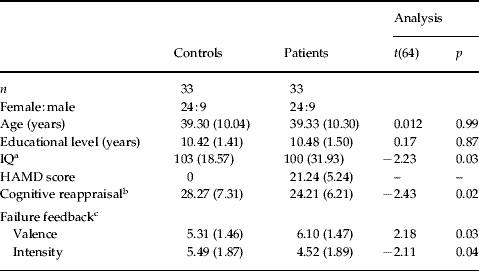
Groups did not differ in terms of gender ratio, age and educational level. Because we observed a significant between-group difference in the test of reasoning ability, all analyses were conducted using the corresponding test scores as covariate. Depressed patients had lower scores with regard to the habitual use of cognitive reappraisal compared to controls. Groups also differed in their subjective experience of failure feedback during the task, with depressed patients feeling worse and less excited than controls immediately after receiving the feedback. There was no difference regarding the subjective experience of success feedback (Table 1).
Demographic, clinical and feedback-related variables for healthy comparison subjects and subjects with major depressive disorder (MDD)

HAMD, 17-Item Hamilton Depression Rating Scale.
Data are given as absolute number or mean (standard deviation).
a Test of ability to reason.
b Total score subscale ‘cognitive reappraisal’ of the Emotion Regulation Questionnaire (ERQ).
c Self-Assessment Manikin (SAM) subscales ranging from 1 (positive valence/very excited) to 9 (negative valence/very calm).
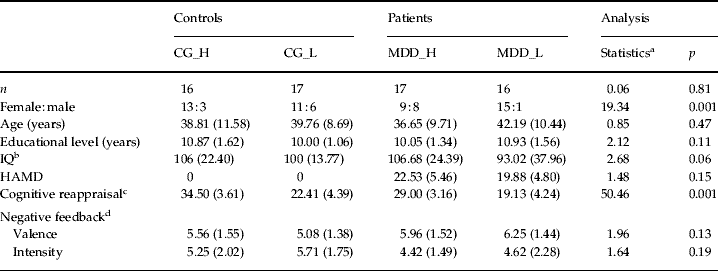
Both the patient and the control group were split by the within-group median of the total ‘cognitive reappraisal’ ERQ score. The resulting four groups were patients with MDD with high (MDD_H) or low (MDD_L) reappraisal scores and healthy control subjects with high (CG_H) or low (CG_L) reappraisal scores (Table 2). Both patient groups did not differ with respect to symptom severity [t(31)=1.48, p=0.15]. The four subgroups did not differ with respect to their subjective affective reaction to negative feedback (Table 2); however, they differed with regard to gender [χ2(3)=8.06, p=0.04]. To address the possibility that an unbalanced gender distribution in the high and low reappraising depressed patients could bias possible group differences, we assessed the influence of gender on task performance across the entire depressed group. An ANOVA including the between-group factor gender did not show a significant effect for reaction times and error measures (all F<2.69, all p>0.11). This analysis rules out the possibility that gender effects compromise any findings related to the different reappraisal groups.
Demographic, clinical and feedback-related variables for subgroups of high and low habitual users of cognitive reappraisal within healthy comparison subjects and subjects with major depressive disorder (MDD)

HAMD, 17-Item Hamilton Depression Rating Scale; CG, control group; suffix _H, high habitual use of cognitive reappraisal; suffix _L, low habitual use.
a χ2(3), t(31) or F(3, 62).
b Test of ability to reason.
c Total score subscale ‘cognitive reappraisal’ of the Emotion Regulation Questionnaire (ERQ).
d Self-Assessment Manikin (SAM) subscales ranging from 1 (positive valence/very excited) to 9 (negative valence/very calm).
Paradigm
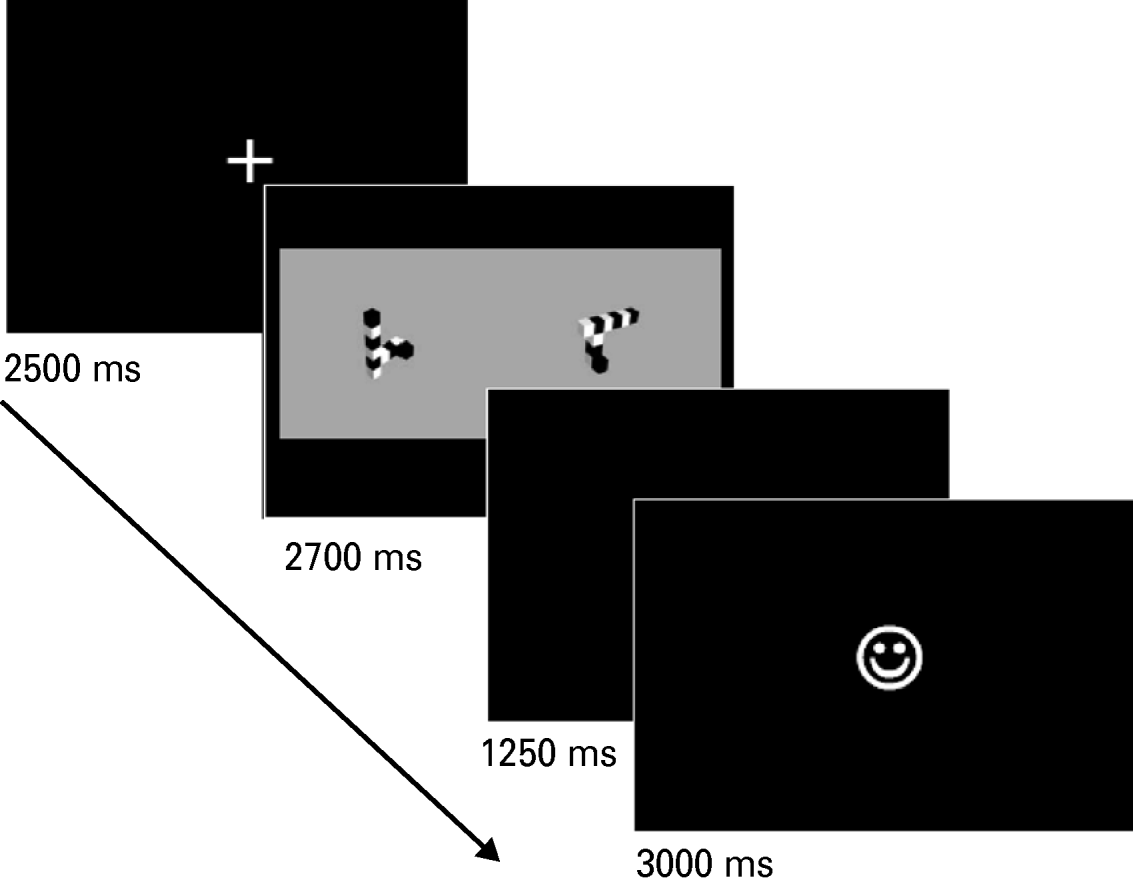
The achievement task was designed to assess the influence of negative feedback on cognitive performance. Consecutive trials of a mental rotation task started with a fixation cross centred on a computer screen (2500 ms). The cross was followed by an object on the left side and a transformed version of the same object on the right side, either (1) rotated or (2) rotated and mirrored (2700 ms, Fig. 1). Subjects were asked to decide whether the object on the left side could be transformed by rotation to the object on the right side or not (as this object was additionally mirrored). Subjects responded by using two response keys (‘yes’ or ‘no’). The time-frame for delivering the response was set to 3900 ms, starting with presentation of the stimulus, to impose a mild time pressure. Responses outside this time-window were counted as errors. After the expiration of the response window, a visual and auditory feedback was presented for a further 3000 ms and the next trial started after 50 ms. Visual feedback stimuli were presented depending on the choice for correct trials (face icon ☺ or icon  ) and incorrect trials (face icon ☹ or icon
 ). Auditory feedback was given simultaneously. Eight sentences for correct reactions and eight sentences for incorrect reactions were spoken each by a male and a female voice with emotional tone and brought into equal length (e.g. ‘Super! That was correct!’, ‘Oh dear! A mistake!’). Visual stimuli, sentences and male and female voices were balanced.
One trial of the feedback guided performance task, of moderate difficulty. Time for response (button press) was 3900 ms, starting with presentation of the stimulus. The inter-trial interval (ITI) was 50 ms. Auditory feedback accompanied the visual stimulus (e.g. ‘Super! That was correct!’).

Task difficulty was varied by manipulating the rotation angle of the reference stimulus from 20° to 180° in steps of 20° and by using two- and three-dimensional stimulus objects. It is known that the time for mental rotation of an object increases with increasing angle of rotation (Shepard & Metzler, Reference Shepard and Metzler1971). Furthermore, three-dimensional objects are more difficult to rotate than two-dimensional objects because rotation can occur in all three spatial planes (Bauer & Jolicoeur, Reference Bauer and Jolicoeur1996). The 96 trials of the rotation task were classified as being easy, moderate or difficult according to the reaction times obtained in a pretest (n=22). In the main experiment, the trials were assigned to blocks of different difficulty levels, comprising 16 trials each. There were two blocks at each difficulty level, which were run in two sessions. Within each session, the blocks were presented with increasing levels of difficulty (i.e. easy, moderate, difficult) so as to induce accumulating emotional stress as a function of task difficulty and corresponding failure feedback. Performance feedback was given after each trial depending on the correctness and promptness of the reaction. Subjects were not informed of the increasing difficulty of the blocks.
Statistical analyses
Median reaction times and number of errors in each condition were subjected to a three-way ANOVA with the between-subject factor group (depressed patients, controls) and the within-subject factors session (first, second) and task difficulty (easy, moderate, difficult). Responses were counted as incorrect if they were overtly wrong or outside the response time-frame. For the analysis of reaction times, reactions exceeding ±2 s.d. of the mean were excluded from the analysis as outliers (8.31% of the entire data set). Median reaction times for each of the six blocks were calculated from all correct responses. To control for a possible speed accuracy effect, median reaction times were included as covariates in all analyses of error rates.
We also analysed the number of errors immediately following errors (subsequent errors). Subsequent errors have been suggested to index the affective disturbance of cognitive processing following negative performance feedback (Beats et al. Reference Beats, Sahakian and Levy1996). However, because an increased number of errors also increases the probability of subsequent errors, the conditional probability (CP) of an error in the case that a previous response was also erroneous is usually calculated to assess affective influences on cognitive processing more precisely. Several earlier studies have shown that the CP score is a sensitive measure to reveal differences between depressed and healthy subjects in feedback processing (Elliott et al. Reference Elliott, Sahakian, McKay and Herrod1996, Reference Elliott, Sahakian, Herrod, Robbins and Paykel1997; Steffens et al. Reference Steffens, Wagner, Levy, Horn and Krishnan2001; Douglas et al. Reference Douglas, Porter, Framptom, Gallagher and Young2009). CP scores were calculated by the formula:

In a final analysis, the between-subject factor ‘cognitive reappraisal’ (high and low) according to the median split of the ERQ scores was included (see also the Method section). Interactions were further assessed using Fisher's least significant difference (LSD) post-hoc tests. Pearson's product moment correlations were calculated in the correlation analyses. Analyses were performed using Statistica version 6.0 (StatSoft Inc., USA).
Results
Differences between depressed patients and healthy control subjects in the achievement task
Overall, there was a significant group difference in reaction times [F(1, 63)=7.76, p=0.007], with patients reacting faster (mean=2.15 s, s.d.=0.47 ms) than controls (mean=2.45 s, s.d.=0.40 ms). With regard to the number of errors, an interaction effect of group and task difficulty was observed [F(2, 124)=3.32, p=0.039]. Post-hoc tests revealed significant differences between all levels of task difficulty within each group, but differences between groups were not statistically reliable.
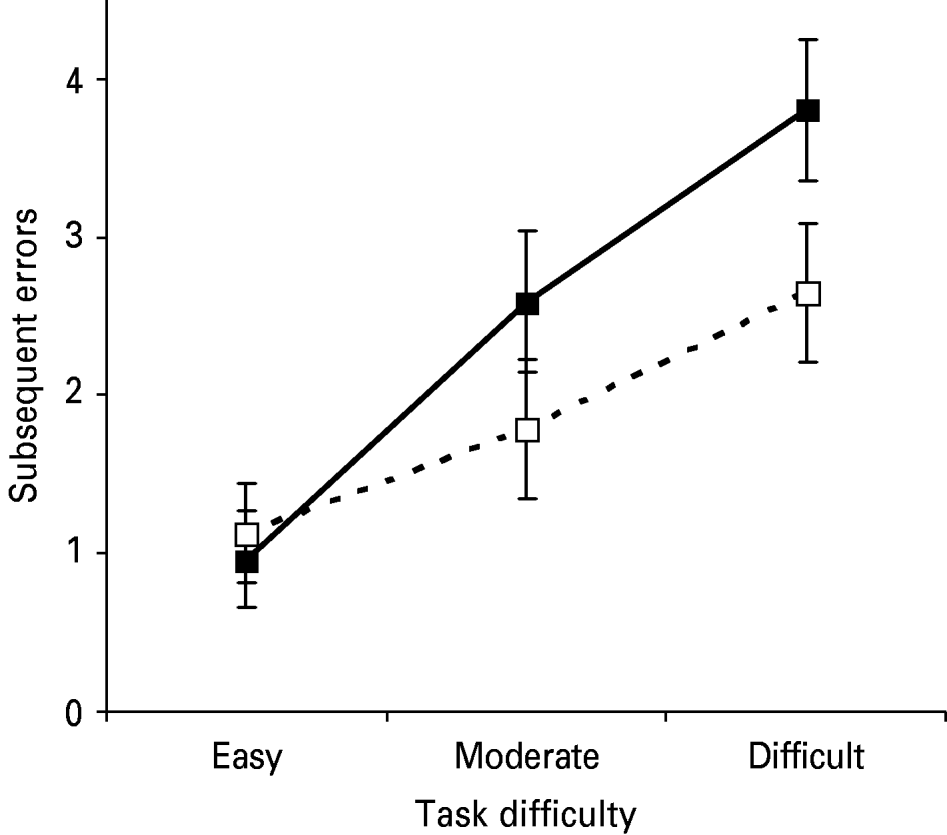
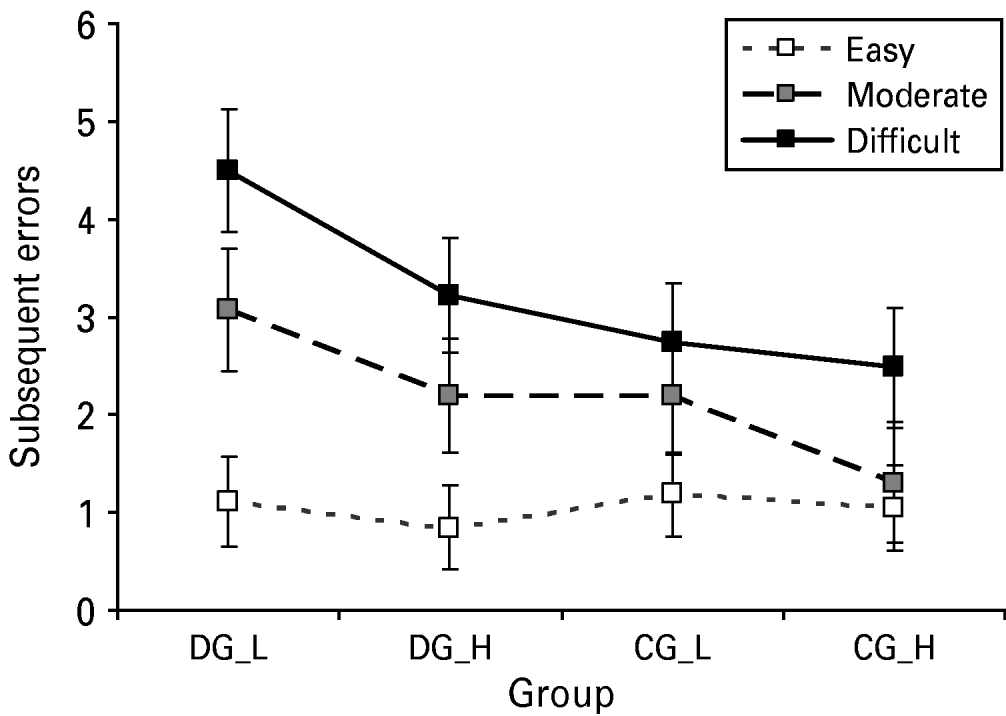
With regard to subsequent errors, an interaction between group and task difficulty was observed [F(2, 124)=4.82, p=0.009; Fig. 2]. Post-hoc tests revealed differences between all levels of task difficulty within each group. As expected, the number of subsequent errors increased with increasing task difficulty. Differences between groups were found in blocks with moderate and high difficulties, where patients committed more subsequent errors than controls.
Performance of patients (–▪–) and controls (- -□- -) referring to subsequent errors depending on difficulty of task. Bars represent standard errors of the mean (s.e.m.).

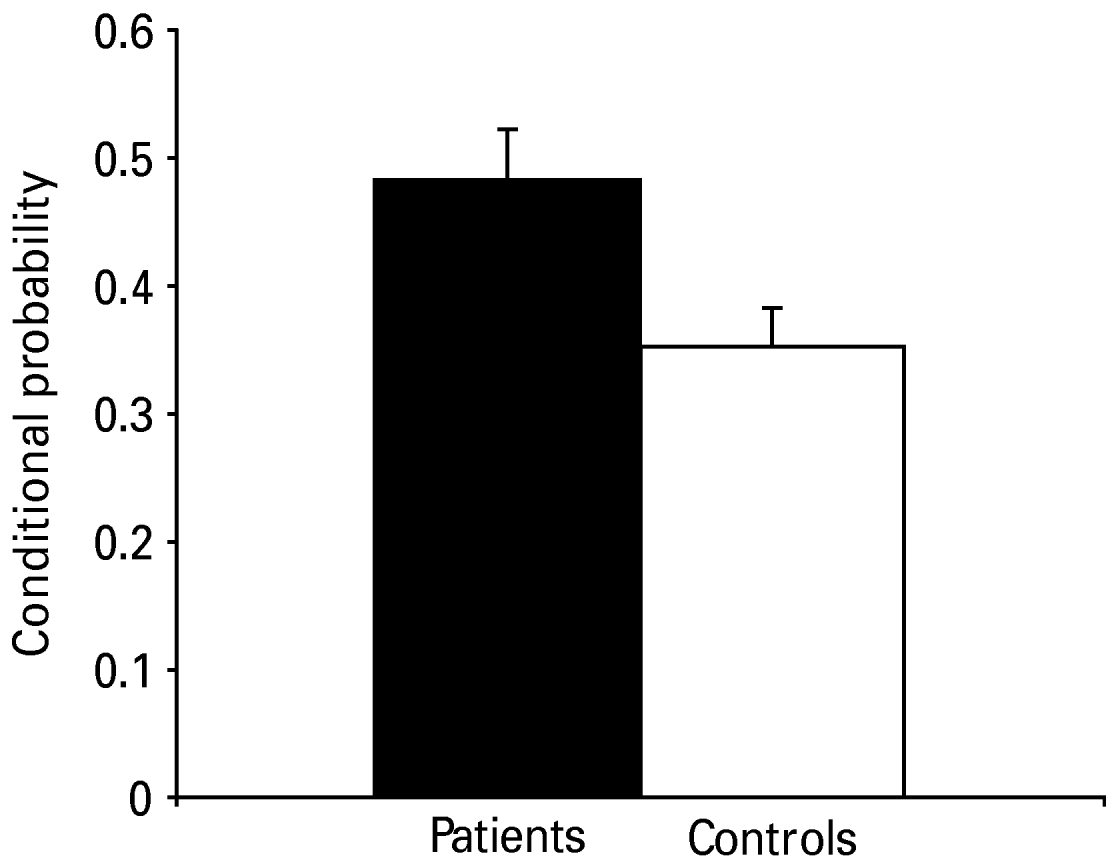
An ANOVA on CP scores revealed a main effect of group [F(1, 60)=5.21, p=0.03]. Patients had overall higher CP indices (Fig. 3).
Conditional probability of subsequent errors in the achievement task for depressed patients (▪) and controls (□).

Influence of cognitive reappraisal on performance
As expected, the groups differed in their extent of habitually using cognitive reappraisal [t(64)=−2.43, p=0.018], with patients showing a lower score on the ERQ scale. To analyse the influence of this variable on task performance, both the patient group and the control group were split by the median score for reappraisal (Table 2) and were analysed by means of an ANOVA, with the between-subject factor comprising four levels (patients scoring high on the cognitive reappraisal scale: MDD_H, patients scoring low: MDD_L, controls scoring high: CG_H, controls scoring low: CG_L). Comparison of these groups revealed no significant differences in reaction times and number of simple errors. Group differences were found in the analysis of subsequent errors, where a significant interaction between group and task difficulty on number of subsequent errors was found [F(6, 120)=2.47, p=0.03]. Post-hoc tests revealed within each group differences between easy and difficult blocks. Furthermore, a significant difference between easy and moderate tasks was found in the patient group, where the fewest subsequent errors occurred during the easy blocks in all subjects. Significant between-group differences were found between MDD_L and all other groups in task blocks of high difficulty: depressed patients with low reappraisal scores committed more subsequent errors in difficult blocks. The number of subsequent errors differed between this group and the control group, with high reappraisal scores in blocks of moderate difficulty (Fig. 4).
Subsequent errors in patients and controls, depending on habitual use of reappraisal of the situation and difficulty of the task. Bars represent standard error of the mean (s.e.m.). MDD, patient group; CG, control group; suffix _L, lower scores on the reappraisal subscale of the Emotion Regulation Questionnaire (ERQ); suffix _H, higher scores on the reappraisal subscale of the ERQ.

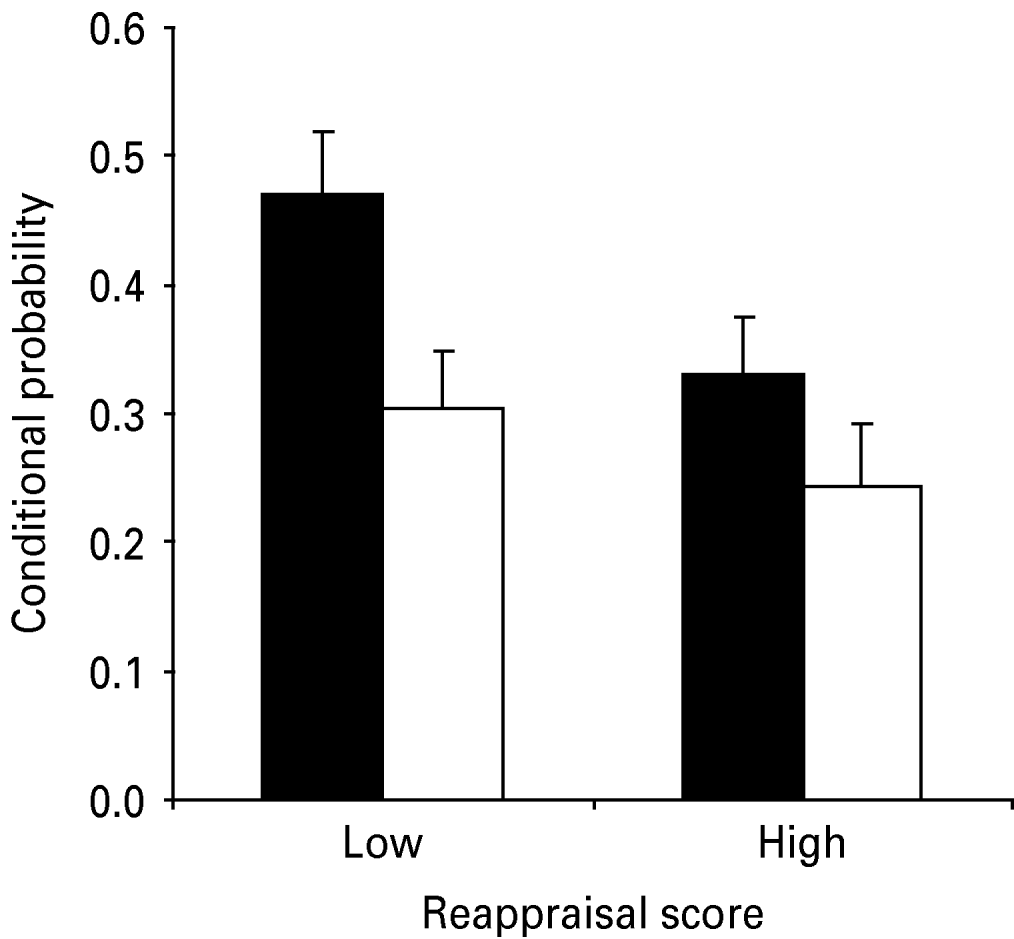
An ANOVA on CP scores revealed a main effect of group [F(3, 58)=5.53, p=0.02]. Patients scoring low on cognitive reappraisal had significantly higher overall CP scores when compared to all other groups (Fig. 5).
Conditional probability of subsequent errors for patients (▪) and controls (□) scoring high and low on cognitive reappraisal respectively. Post-hoc tests revealed differences between patients scoring low on cognitive reappraisal and all other groups. Bars show standard errors of the mean (s.e.m.).

Correlation analyses of clinical variables with task variables did not reveal significant correlations of reaction times, number of errors, absolute and conditional number of subsequent errors with the severity of symptoms, or with the duration of illness in the whole group of depressed patients or within the two patient subgroups.
Discussion
To test the impact of ongoing emotional stress following feedback on cognitive performance, we investigated patients with MDD over a prolonged time of task processing. Subjects were confronted with emotional performance-related feedback statements that aimed to induce affective meta-task processing, assumed to impair performance in the task (Kluger & DeNisi, Reference Kluger and DeNisi1996).
Compared to healthy controls, depressed patients showed overall faster reaction times and committed more errors with increasing task difficulty. However, between-group differences of this interaction with task difficulty were not statistically significant, excluding possible influences of unspecific cognitive impairments (Austin et al. Reference Austin, Ross, Murray, O'Carroll, Ebmeier and Goodwin1992, Reference Austin, Mitchell and Goodwin2001; Pálsson et al. Reference Pálsson, Johansson, Berg and Skoog2000). Decreased reaction times may reflect heightened sensitivity towards the time limit given to solve the task in the depressed group (Ben-Zur & Breznitz, Reference Ben-Zur and Breznitz1981), whereas there is no indication of a speed–accuracy trade-off regarding absolute number of errors.
Patients showed an increased number of subsequent errors during moderate and difficult tasks. Thus, intensified affective processing following frequently received negative feedback in the more difficult blocks may have interfered with task performance. As the number of subsequent errors committed by depressed patients was especially increased during difficult tasks, the detrimental effect of negative feedback may not be observed when the tasks are too easy (Shah et al. Reference Shah, O'Carroll, Rogers, Moffoot and Ebmeier1999; Ruchsow et al. Reference Ruchsow, Herrnberger, Wiesend, Spitzer and Kiefer2004, Reference Ruchsow, Herrnberger, Beschoner, Grön, Spitzer and Kiefer2006).
Overall, CP of a subsequent error was also increased in depressed patients. This suggests that, compared to controls, patients were more likely to commit an error after failure feedback even during easy tasks. This is in line with former studies showing CP indices being independent of task difficulty, and, as in the present sample, independent of symptom severity and duration of illness (Elliott et al. Reference Elliott, Sahakian, McKay and Herrod1996, Reference Elliott, Sahakian, Herrod, Robbins and Paykel1997; Purcell et al. Reference Purcell, Maruff, Kyrios and Pantelis1997; Steffens et al. Reference Steffens, Wagner, Levy, Horn and Krishnan2001; Santesso et al. Reference Santesso, Steele, Bogdan, Holmes, Deveney, Meites and Pizzagalli2008; Douglas et al. Reference Douglas, Porter, Framptom, Gallagher and Young2009).
Compared to healthy control subjects, the present sample of depressed patients reported having felt worse after receiving negative feedback and they generally made less habitual use of cognitive reappraisal to regulate aversive affect. This is in line with cognitive theories of MDD that assume that deficient reappraisal of negative cognitions and emotions is crucial in maintaining the disorder (Beck, Reference Beck2008). For the first time, we observed that the habitual use of this strategy significantly influenced performance. Depressed patients who did not habitually reappraise aversive events committed a larger absolute number of subsequent errors, particularly during difficult tasks, where reception of negative feedback and therefore feeling bad was more likely. Depressed patients who were used to reappraising aversive events committed fewer subsequent errors compared to the former group and did not significantly differ from the healthy control subjects. Furthermore, patients scoring low on cognitive reappraisal showed higher overall CP indices compared to patients scoring high and both control groups. The latter three groups exhibited comparable performance. Thus, cognitive reappraisal that is applied to regulate aversive affect reduced the detrimental effect of negative feedback on performance, at least in a subgroup of depressed patients.
Successful coping with negative events is part of everyday life. In depressed patients, when beneficial emotion regulation strategies after performance failure are not available, this may lead, at worst, to in-patient admission (Melchior et al. Reference Melchior, Caspi, Milne, Danese, Poulton and Moffitt2007). Consequently, CP indices are shown to be more reliable predictors for hospitalization than other clinical assessments (Elliott et al. Reference Elliott, Sahakian, McKay and Herrod1996). Out-patient status, in addition to state of remission after training, may be associated with increased use of cognitive reappraisal to cope with negative events and may account for comparable performance of patients and controls in some studies (Purcell et al. Reference Purcell, Maruff, Kyrios and Pantelis1997; Ruchsow et al. Reference Ruchsow, Herrnberger, Wiesend, Spitzer and Kiefer2004, Reference Ruchsow, Herrnberger, Beschoner, Grön, Spitzer and Kiefer2006).
Training of cognitive reappraisal is already a core component of intervention in MDD. However, training with the specific focus on ongoing stress due to failure feedback may optimize prevention of further relapses because of ongoing stress in daily routine (Melchior et al. Reference Melchior, Caspi, Milne, Danese, Poulton and Moffitt2007). As the absolute number of subsequent errors was especially evident in the processing of difficult tasks and the conditional probability to commit subsequent errors was independent of task difficulty, the results of the present study suggest that the reappraisal of failure feedback should be trained across all levels of task difficulty.
In conclusion, the detrimental effect of negative feedback on subsequent performance was replicated in the present sample of depressed patients. However, in this study detailed analysis shows, for the first time, a modulating influence of a strategy to regulate negative affect on performance. Patients habitually not using cognitive reappraisal of aversive events showed the typical impaired performance following negative feedback, whereas patients using this beneficial strategy to regulate emotion were not affected. Our findings suggest that training emotion regulation in achievement situations may be helpful to prevent future relapses.
Acknowledgements
We thank A. Sfärlea for her help during data collection. We are also grateful to C. Wolf and two anonymous reviewers for providing helpful comments on the manuscript.
Declaration of Interest
None.