
Introduction
The carcinogenic liver fluke Opisthorchis viverrini is distributed throughout the Mekong basin in Southeast Asia where more than 10 million people are infected (Sripa et al., Reference Sripa, Suwannatrai, Sayasone, Do, Khieu and Yang2021). Chronic infection is associated with several hepatobiliary diseases including a bile-duct cancer, cholangiocarcinoma (CCA) (Sithithaworn et al., Reference Sithithaworn, Yongvanit, Duenngai, Kiatsopit and Pairojkul2014). The life cycle of O. viverrini includes aquatic snails of the genus Bithynia as the first and cyprinid fish as the second intermediate hosts. Humans are considered to be the normal definitive host (Kaewkes, Reference Kaewkes2003).
It has been a long-standing assumption that cats and dogs act as reservoir hosts for O. viverrini and contribute to human transmission (Tangkawattana and Tangkawattana, Reference Tangkawattana and Tangkawattana2018; Sripa et al., Reference Sripa, Suwannatrai, Sayasone, Do, Khieu and Yang2021). This assumption is based on the morphological similarity and geographic proximity of adult worms found in humans and non-human animals (Kaewkes, Reference Kaewkes2003; Saijuntha et al., Reference Saijuntha, Sithithaworn, Wongkham, Laha, Chilton, Petney, Barton and Andrews2008). However, there is no molecular-genetic evidence supporting cross-over between O. viverrini populations in humans and the animal reservoir hosts. Previous population-genetic studies have demonstrated that at least 2 populations of O. viverrini are circulating in endemic areas (Saijuntha et al., Reference Saijuntha, Sithithaworn, Wongkham, Laha, Chilton, Petney, Barton and Andrews2008; Sithithaworn et al., Reference Sithithaworn, Andrews, Petney, Saijuntha and Laoprom2012; Petney et al., Reference Petney, Andrews, Saijuntha, Tesana, Prasopdee, Kiatsopit and Sithithaworn2018; Pitaksakulrat et al., Reference Pitaksakulrat, Webster, Webster, Laha, Saijuntha, Lamberton, Kiatsopit, Andrews, Petney and Sithithaworn2018; Namsanor et al., Reference Namsanor, Pitaksakulrat, Kopolrat, Kiatsopit, Webster, Gower, Webster, Laha, Saijuntha, Laoprom, Andrews, Petney, Blair and Sithithaworn2020). The results from these studies suggested that O. viverrini is not a single species but a complex of species whose genetic variability may have co-evolved with the snail populations (Saijuntha et al., Reference Saijuntha, Sithithaworn, Wongkham, Laha, Pipitgool, Tesana, Chilton, Petney and Andrews2007). Among previous studies, Namsanor et al. (Reference Namsanor, Pitaksakulrat, Kopolrat, Kiatsopit, Webster, Gower, Webster, Laha, Saijuntha, Laoprom, Andrews, Petney, Blair and Sithithaworn2020) is of particular interest. Using mitochondrial cytochrome c oxidase subunit 1 (cox1) sequences, Namsanor et al. (Reference Namsanor, Pitaksakulrat, Kopolrat, Kiatsopit, Webster, Gower, Webster, Laha, Saijuntha, Laoprom, Andrews, Petney, Blair and Sithithaworn2020) found 2 distinct O. viverrini clusters, one present at all localities surveyed across Thailand and Lao PDR and the other only at Phang Khon in Sakon Nakhon Province, Thailand. As the same area, Phang Khon cluster (SPk) was only represented in some sampling years while the other widespread cluster was present in the later years at the same locality.
Despite the demonstrated presence of different populations of O. viverrini, there has been no study of genetic relationships of O. viverrini sensu lato from humans and potential reservoir hosts (Echaubard et al., Reference Echaubard, Sripa, Mallory and Wilcox2016). Here, we test the long-held assumption, using population-genetic analyses on individuals from O. viverrini eggs recovered from the feces of infected humans and domestic cats, located in the same endemic area. The mitochondrial cox1 gene was used due to it having been informative in previous population-genetic analyses of O. viverrini populations (Saijuntha et al., Reference Saijuntha, Sithithaworn, Wongkham, Laha, Chilton, Petney, Barton and Andrews2008; Namsanor et al., Reference Namsanor, Pitaksakulrat, Kopolrat, Kiatsopit, Webster, Gower, Webster, Laha, Saijuntha, Laoprom, Andrews, Petney, Blair and Sithithaworn2020). Since the presence of animal reservoirs of infection has been cited as the reason why liver flukes could not feasibly be eradicated, the results from this study will provide evidence to support policy makers and public health authorities in planning effective control strategies for this highly carcinogenic liver fluke.
Materials and methods
Study design and population
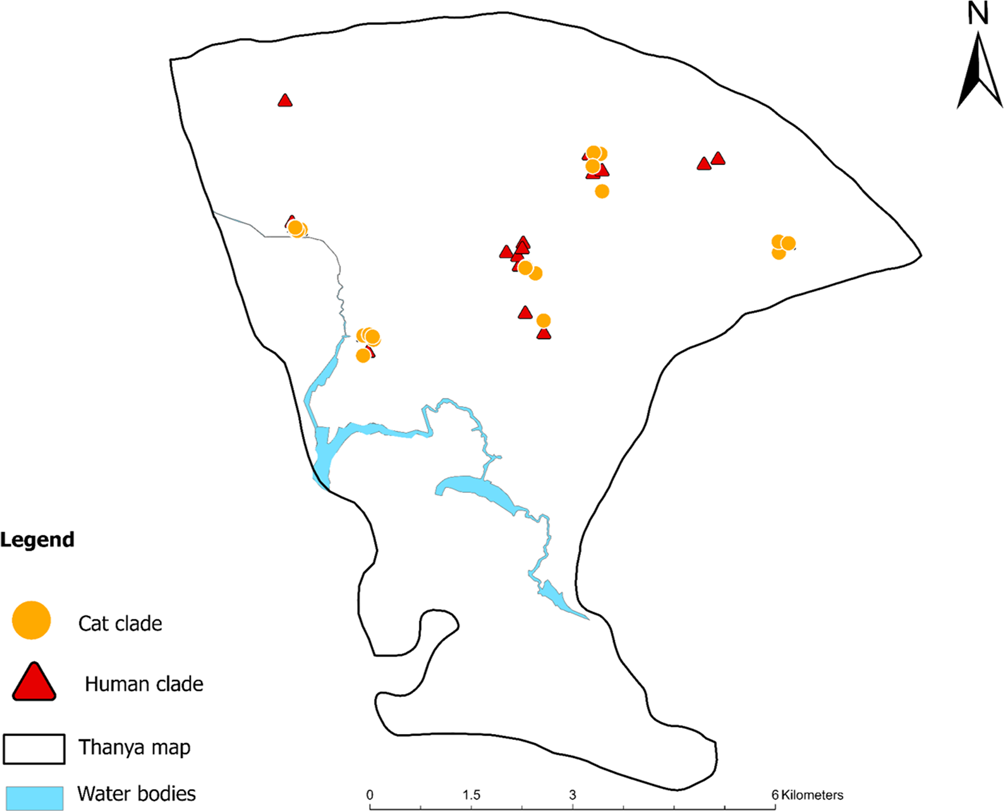
The parasitological survey was carried out in Thanya sub-district, Kalasin province, Thailand, an endemic area of O. viverrini (Fig. 1). Samples were collected from January 2016 to November 2018. The study included humans and cats from 15 villages. Cat stool samples were collected from family pets with consent from their owners. Samples were collected by a veterinarian following protocols approved by the Khon Kaen University, KKU Animal ethics committee (IACUC-KKU-29/61). Briefly, the cat was restrained from safety and care. Ten millilitres of 15% sodium chloride was administered into the rectum of the animal with petroleum jelly lubricant. The cat was kept in the cage until it defecated; then, the top of the stool free from contamination was collected by a pasteurized spoon and transferred into a plastic container. The stool containers were transported on ice to the Tropical Disease Research Laboratory (TDR), Faculty of Medicine, Khon Kaen University, Khon Kaen, Thailand. Human stool samples were received as part of the project Pathogenesis of Liver Fluke-Induced Cancer in Thailand, approved by the Khon Kaen University Ethics Committee for Human Research (reference number HE 480528). The infected people were treated by praziquantel after stool examination.
Map of households from which samples from cats and humans were collected in Kalasin, Thailand. The orange circles represent the locations from which cat fecal samples were analysed, the red triangle show the households from which human fecal samples were analysed.

Collection of samples and identification of O . viverrini eggs
Once arrived at TDR, the fresh stool samples were divided into 2 parts: (1) preserved in 70% alcohol in 1.5 ml microcentrifuge tubes for DNA extraction and (2) examined using the modified formalin-ether concentration technique (FECT) (Anamnart et al., Reference Anamnart, Intapan and Maleewong2013). One drop of stool from modified FECT was examined under the microscope to detect trematode eggs, which were identified to the species level according to morphologic characteristics (Kaewkes, Reference Kaewkes2003).
DNA extraction, amplification and sequencing
The stool samples were screened first for O. viverrini egg, and then egg-positive samples were followed up with molecular analysis. Prior to DNA extraction, stool material was washed by sterile water and phosphate-buffered saline (PBS) to remove ethanol from samples. DNA was extracted from 200 g of the O. viverrini egg-positive stool samples from each of 47 human and 47 cat stool samples using the TIANamp stool DNA kit (Tiangen Biotech, Beijing, China) according to the manufacturer's instructions (Haonon et al., Reference Haonon, Liu, Dangtakot, Intuyod, Pinlaor, Puapairoj, Cha'On, Sengthong, Pongking, Onsurathum, Yingklang, Phetcharaburanin, Li and Pinlaor2021). DNA concentrations were measured by Thermo Nanodrop 1000 to guide the volume that was added to the PCR reaction. Species-specific PCR primers for the amplification of 504 bp of the cox1 region of O. viverrini were used (Buathong et al., Reference Buathong, Leelayoova, Mungthin, Ruang-areerate, Naaglor, Suwannahitatorn, Piyaraj, Taamasri and Tan-ariya2017). The PCR was carried out in 25 μl of total volume containing PCR buffer (10 mm Tris-HCl, pH 9.0, 50 mm KCl, 105 mm MgCl2) (Vivantis Technologies, Selangor, Malaysia), 0.2 mm of each dNTPs, 0.5 μ m of each primer, 2.5 unit of Taq DNA polymerase and 2 μL of DNA sample. PCR conditions consisted of an initial denaturation at 95°C for 5 min, 29 cycles of denaturation at 95°C for 30 s, annealing at 58°C for 30 s, extension at 72°C for 30 s and final extension at 72°C for 7 min to complete the amplification. PCRs were visualized on a 1.5% agarose gel. PCR products of the positive clones were selected, purified and inserted into a cloning vector using a CloneJET PCR Cloning Kit (Thermo Fisher Scientific Inc., Waltham, MA, USA) according to manufacturer's instruction. The plasmids were isolated from the bacteria using the GeneJET Plasmid Miniprep Kit (Thermo Fisher Scientific Inc., Waltham, MA, USA) (Nguyen et al., Reference Nguyen, Arimatsu, Hong, Brindley, Blair, Laha and Sripa2015) and sent for DNA sequencing [U2Bio Co., Ltd. (Songpa-gu, South Korea and 1st BASE, Selangor, Malaysia) by the following sequencing primers, forward primer, COXI-OvF; 5′-TGATCCGTTGTTGTTTCA-3′ and reverse primer, COXI-OvR; 5′-ACGGATATAACCACCGTTCT-3′] (Buathong et al., Reference Buathong, Leelayoova, Mungthin, Ruang-areerate, Naaglor, Suwannahitatorn, Piyaraj, Taamasri and Tan-ariya2017).
The population-genetic comparison between O . viverrini samples from humans and cats
The DNA sequences from both forward and reverse sequencing were analysed and verified by DNA chromatogram to check for any errors. The cloning vector sequence, forward or reverse primer sequences, was removed. The sequences were assigned as cat (C) and human (H, HH) origins as indicated, along with the host number followed by the sequence clone number. Multiple sequence alignment was performed on a total of 30 humans and 36 cats forward and reverse sequencing consensus sequences using BioEdit software, version 7.2.0. Thereafter, the nucleotide sequences were grouped into those from human (30 sequences) and cats (36 sequences) in DnaSP, version 6.12.03 (Librado and Rozas, Reference Librado and Rozas2009). Population pairwise F st was calculated in Arlequin version 3.5.2.2 (Excoffier et al., Reference Excoffier, Laval and Schneider2005). An exact test of population differentiation was also done using Arlequin. Statistical significance was determined at P value <0.05. Haplotypes were determined and displayed in a network using Population Analysis with Reticulate Tree (PopART 1.7) (Leigh and Bryant, Reference Leigh and Bryant2015).
Phylogenetic tree of the cox1 data of O . viverrini
The cox1 data were aligned with previously published cox1 data for O. viverrini using ClustalW. A phylogenetic tree was constructed using the maximum likelihood method in MEGA 7 (Kumar et al., Reference Kumar, Stecher and Tamura2016) using the best-fit substitution model. HKY + G model determined using MEGA 7. The relative support for clades was determined by using 1000 bootstrap replicates. The cox1 data included from previous studies were from Cai et al. (Reference Cai, Liu, Song, Wu, Zou, Yan, Yuan, Lin and Zhu2012) (JF739555) and Namsanor et al. (Reference Namsanor, Pitaksakulrat, Kopolrat, Kiatsopit, Webster, Gower, Webster, Laha, Saijuntha, Laoprom, Andrews, Petney, Blair and Sithithaworn2020) (MN249179–MN249187, MN249189–MN249190, MN249194–MN249195, MN249199–MN249200, MN249204–MN249205, MN249212, MN249214–MN249227 and MN249236–MN249237) (Supplementary S1).
Results
Prevalence of Opisthorchis infection, determined by microscopic examination of stool samples
A total of 110 and 1480 fecal samples from cats and humans were obtained, respectively. Opisthorchis viverrini-like eggs were observed in 758 (51.20%) of human samples and 51 (47.60%) of the samples from the cats. The average intensity of O. viverrini egg per gram of feces in humans and cats was 88 and 476, respectively. Forty-seven cat fecal samples were available for DNA extraction and molecular analysis. An equal number (47) of egg-positive human samples was randomly selected for molecular analysis. Amplification of the partial cox1 region (405 bp) was successful for 30 cats and 26 human samples.
Genetic comparison of O . viverrini cox1 cats from the cat and human samples
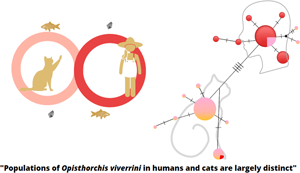
Thirty-six clones were successfully sequenced from cats, yielding 15 haplotypes, while 30 clones were sequenced from humans representing 11 haplotypes, 3 of which were shared between cats and humans (Supplementary S2 and S3). All the cox1 data obtained from this study have been deposited in GenBank data accession numbers OM424139–OM424204. The pairwise F st value between consensus sequences from humans and cats was 0.64 (P < 0.05), indicating that O. viverrini populations from these 2 hosts are genetically divergent. The exact test of population differentiation also yielded an F st value <0.05.
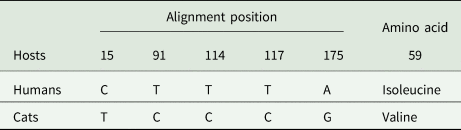
The most common haplotype from human samples and that from cats differed at 5 single-nucleotide polymorphisms, one of which led to a non-synonymous mutation (A in human and G in cat at nucleotide position 175, isoleucine in human and valine in cat at amino acid position 59) (Table 1 and Supplementary S4).
Nucleotide and amino-acid differences between the most common haplotypes from humans and from cats

Phylogenetic analysis
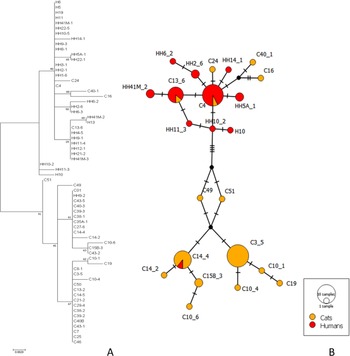
Sequences from humans and cats mostly segregated into different clades in the tree (Fig. 2). The human clade composed of 34 sequences, 29 from human samples and 5 from cat samples (C4, C13-6, C16, C24 and C40-1), while the cat clade consisted of 32 sequences, of which 31 were from cats and a single haplotype (HH9-2), from a human fecal sample. Two samples yielded multiple sequences: C13-2 and C13-6 in a cat sample, and HH9-1, HH9-2 and HH9-3 in a human sample (Supplementary S2). There are 7 pairs of cat and human from the same household (C8 and HH5A_1, C21-2 and H9, C40_1, 3 and H13, C43_1, 2 and 5 and H14, C4 and HH4_5, C46 and H19-H20, and C7 and H5-H6). Both of these samples thus included sequences from both clades, indicating that they contain both human-specific and cat-specific O. viverrini. The haplotype network analysis also showed 2 distinct clusters, one composed of cox1 data largely from the human samples and the other from cat samples (Fig. 2). To investigate the relationship between the cox1 sequences from this study and previous studies, we constructed another phylogenetic tree and haplotype network (Supplementary S5). The cox1 data from humans were grouped within the ‘widespread cluster’, while the sequences from cats were grouped in the ‘Phang-Khon cluster’ of Namsanor et al. (Reference Namsanor, Pitaksakulrat, Kopolrat, Kiatsopit, Webster, Gower, Webster, Laha, Saijuntha, Laoprom, Andrews, Petney, Blair and Sithithaworn2020) (Supplementary S5).
(A) Phylogenetic relationships of partial cox1 sequences (n = 66; 405 bp) of Opisthorchis viverrini collected from humans and cats based on a maximum likelihood analysis. Cat (C) and human (H, HH) origins are indicated, along with the host number followed by the sequence clone number. (B) Median-joining haplotype network constructed using the same haplotypes (n = 66). Each circle represents a single haplotype and the size of the circle is proportional to the number of times that haplotype was present. Host species are indicated with a red colour (human) and orange colour (cat). Black circles at nodes represent median vectors (i.e. haplotypes not sampled). Black lines indicate network connections. Five haplotypes of cat origin are found in the human cluster and 1 haplotype from a human sample is within the cat cluster.

Discussion
There is a long-held assumption that non-human animals, including cats and dogs, are reservoir hosts of O. viverrini infections in humans (Crellen et al., Reference Crellen, Sithithaworn, Pitaksakulrat, Khuntikeo, Medley and Hollingsworth2021). This study aimed to investigate the relationship between O. viverrini from humans and domestic cats using molecular data. We amplified a portion of the cox1 gene of O. viverrini from egg-positive stool samples from infected cats and humans in an endemic area. Our analysis rejected the null hypothesis that O. viverrini from cats and humans belonged to a single panmictic population. Data from these 2 hosts mostly fell into separate host-specific phylogenetic clades suggesting a degree of differentiation between the O. viverrini population occurring in humans and cats. However, 5 sequences from cats fell into the human cluster and 1 sequence from a human was grouped with the cat cluster, suggesting that the O. viverrini populations in these hosts are not absolutely host-specific.
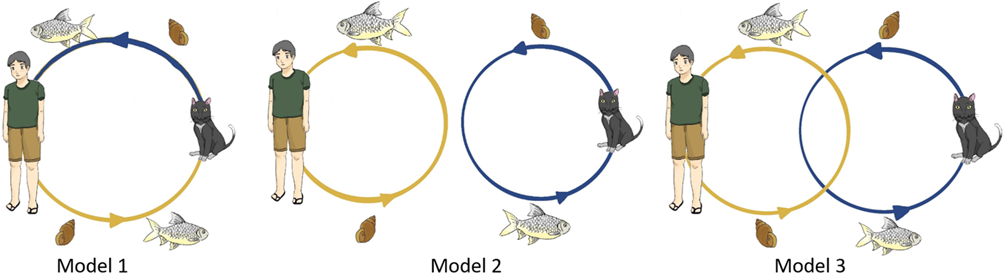
Crellen et al. proposed 3 possible models of zoonotic Opisthorchis transmission in regions where humans and non-human definitive hosts (cats, dogs, possibly others) are infected. Model 1 supposes complete transmissibility of a single population of O. viverrini between humans and cats. Model 2 supposes the presence of 2 genetically distinct populations of O. viverrini, each specific for a single mammalian host (human or cat). Model 3 supposes 2 genetically distinct populations of O. viverrini but with incomplete host specificity allowing some transmission between definitive host species (Fig. 3). This result from this study supports the zoonotic transmission model 3, which proposes separate life cycles with limited cross-over between hosts and gene flow (Crellen et al., Reference Crellen, Sithithaworn, Pitaksakulrat, Khuntikeo, Medley and Hollingsworth2021) (Fig. 3).
Three possible models of zoonotic Opisthorchis transmission. Model 1 supposes complete transmissibility of a single population of O. viverrini between humans and cats. Model 2 supposes the presence of 2 genetically distinct populations of O. viverrini, each specific for a single mammalian host (human or cat). Model 3 supposes 2 genetically distinct populations of O. viverrini but with incomplete host specificity allowing some transmission between definitive host species [modified from Crellen et al. (Reference Crellen, Sithithaworn, Pitaksakulrat, Khuntikeo, Medley and Hollingsworth2021)].

Previous studies demonstrated that there are 2 different populations of O. viverrini circulating in endemic areas (Saijuntha et al., Reference Saijuntha, Sithithaworn, Wongkham, Laha, Chilton, Petney, Barton and Andrews2008; Namsanor et al., Reference Namsanor, Pitaksakulrat, Kopolrat, Kiatsopit, Webster, Gower, Webster, Laha, Saijuntha, Laoprom, Andrews, Petney, Blair and Sithithaworn2020). Saijuntha et al. (Reference Saijuntha, Sithithaworn, Wongkham, Laha, Pipitgool, Tesana, Chilton, Petney and Andrews2007) proposed that these populations might have co-evolved together with populations of their intermediate snail hosts, Bithynia spp., which also fell into 2 different population clades. Furthermore, Namsanor et al. (Reference Namsanor, Pitaksakulrat, Kopolrat, Kiatsopit, Webster, Gower, Webster, Laha, Saijuntha, Laoprom, Andrews, Petney, Blair and Sithithaworn2020) found that the 2 populations of O. viverrini were grouped into the widespread cluster, which was widely distributed throughout Thailand and Laos PDR, and the Phang Khon cluster, which was localized in the Phang Khon district of Sakon Nakhon province, Thailand. Time and space analysis revealed that the local Phang Khon cluster was only present there in certain years, being largely replaced by the widespread cluster at other times. Specifically, Phang Khon cluster was found in Phang Khon District in 2012; however, in 2015 and 2018, most of the samples in Phang Khon were identified as a widespread cluster.
The present study found that the cat cluster was close to the Phang Khon cluster and the human cluster was within the widespread cluster. This result suggests that largely cat-specific and largely human-specific O. viverrini populations circulate in at least parts of Northeast Thailand and indicates that there is a different distribution pattern between these 2 populations. Given that the incidence of CCA is varied among O. viverrini endemic areas, this difference might be caused by the dynamic of the 2 parasite populations. The larger samples collected over several years may help elucidate these populations' dynamics and their association with the CCA incidence.
It is important to note that the number of eggs per gram of feces is much higher in cats than in humans, so a highly infected cat can infect many snails with its feces compared to those infected with human feces. Based on Saijuntha et al. (Reference Saijuntha, Sithithaworn, Wongkham, Laha, Chilton, Petney, Barton and Andrews2008) study, it can be hypothesized that the circulation of the different haplotypes changes from year to year based on the variation of the snail populations. Consequently, since O. viverrini lives several years in humans and the average human life is much longer than that of a cat, the presence of one haplotype rather than another may reflect annual variations.
Hamsters have been used as the animal model for O. viverrini research for several decades (Boonmars et al., Reference Boonmars, Boonjaraspinyo and Kaewsamut2009; Thaenkham et al., Reference Thaenkham, Nuamtanong, Vonghachack, Yoonuan, Sanguankiat, Dekumyoy, Prommasack, Kobayashi and Waikagul2011; Sanpool et al., Reference Sanpool, Aung, Rodpai, Maleewong and Intapan2018). Sequences from worms raised in hamsters by Namsanor et al. (Reference Namsanor, Pitaksakulrat, Kopolrat, Kiatsopit, Webster, Gower, Webster, Laha, Saijuntha, Laoprom, Andrews, Petney, Blair and Sithithaworn2020) belonged to both Phang Khon/cat and widespread/human clusters. This result indicated that the hamster is a suitable animal model for both cat- and human-specific O. viverrini.
Some cats and humans were infected by both human-specific and cat-specific O. viverrini, suggesting the possibility of gene flow between the 2 hosts. Namsanor et al. (Reference Namsanor, Pitaksakulrat, Kopolrat, Kiatsopit, Webster, Gower, Webster, Laha, Saijuntha, Laoprom, Andrews, Petney, Blair and Sithithaworn2020) found that nuclear genetic markers (microsatellites) also supported 2 distinct populations cluster from humans and cats. Further studies using whole-genome sequencing of human-specific and cat-specific O. viverrini will allow us to compare the overall gene numbers and genome structure of these 2 populations, which will help us address this hypothesis.
Different geographic distributions of particular O. viverrini populations and CCA incidence might be linked. One population might be able to cause more severe disease than the others. As suggested by Saijuntha et al. (Reference Saijuntha, Sithithaworn, Wongkham, Laha, Pipitgool, Tesana, Chilton, Petney and Andrews2007), O. viverrini populations might have co-evolved with each specific host so as to reduce their harmful effects on that host. Perhaps worms of the cat cluster establishing in a human host might cause more severe pathology, including promotion of CCA. This hypothesis warrants further investigation.
In conclusion, we have found 2 populations of O. viverrini, one infects cats, and another one infects humans. However, cross-transmission of these parasites between 2 hosts was also found. Therefore, this study supports the hypothesis that the cat is the reservoir host of O. viverrini. As mentioned earlier, further studies with a larger population in an extended period and the whole-genome sequencing of these 2 populations will help us understand the population dynamic and its link to the pathogenesis of O. viverrini-associated CCA.
Supplementary material
The supplementary material for this article can be found at https://doi.org/10.1017/S0031182022000646.
Data
All relevant data are within the paper. All sequences have been submitted to the GenBank database (GenBank accession no. OM424139–OM424204).
Acknowledgements
The authors would like to thank Dr Kantaphon Mitprasat for Fig. 3. B. S. is a Senior Research Scholar at Khon Kaen University.
Author contributions
P. S., S. S., S. T., M. S., D. B. and B. S. conceived and designed this study. P. S., S. T., M. S., S. S. and B. S. collected the data and performed the analysis. P. S. and S. S. wrote the draft manuscript. S. S., D. B., S. T. and B. S. critically revised the manuscript for intellectual content. B. S. obtained funding. All authors have been involved in reviewing and approving the final manuscript.
Financial support
This research was supported by the Royal Golden Jubilee Ph.D. Program (Grant PHD/0004/2559 to Pornphutthachat Sota), Khon Kaen University Research Program (Grant #RP64018) and National Research University Project of Thailand.
Conflict of interest
None.
Ethical standards
Cat owners gave written consent for collection of samples from their cats. Animal procedures complied with guidelines of the Guide for the Care and Use of Laboratory Animals by National Research Council, USA, 8th edition and the Thai Institutional Animal Care and Use Committee. Human procedures complied with the Declaration of Helsinki on ethical principles for medical research involving human subjects (2013).