

The Cantabrian Wars and the La Loma Siege
The Cantabrian Wars took place between 29 and 16 BCE and saw Rome fighting against the ethnic groups that populated the modern Asturias and Cantabria regions, as well as the northern parts of the provinces of Palencia, Burgos, and León in northern Spain. After Octavian Augustus prevailed over his political opponents to become the first emperor of Rome, he used the complaints of the Vacceos, Turmogos, and Autrigones, ethnic groups incorporated into the Empire and under constant attack by the Cantabrians, as an excuse to begin a long succession of military campaigns. His intention was to complete the conquest of the Iberian Peninsula by defeating the last two Celtic nations to remain outside the control of Rome in western continental Europe. He utilized some of his best generals, mobilized many of his legions, and made enormous investments of time, materials, and human lives in this effort.Footnote 1 In 26 BCE, he even went so far as to travel to Hispania to direct the operations himself. Since we no longer possess the books of Livy’s histories that deal with the Cantabrian Wars, we mainly know about them from later epitomes of Livy’s work by Orosius and Cassius Dio. These texts have served for two millennia as the best literary sources for understanding this conflict.
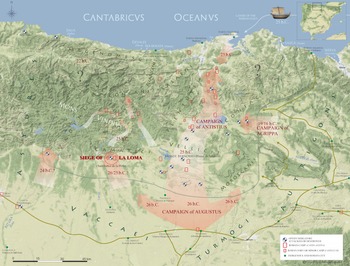
The archaeological site where the siege of La Loma (Santibáñez de la Peña) took place is a spectacular and very well-preserved complex formed by Roman attackers around an indigenous oppidum of the populi Camarici, a Cantabrian people who inhabited the mountainous northern territory of the modern Province of Palencia (Ptol. Geog. 3.4; Strabo, Geographica 3). According to numismatic evidence (see below), the destruction of the settlement can be dated to the 1st c. BCE. It occurred during the Cantabrian Wars, perhaps during the military campaigns led by Augustus himself, or during the subsequent campaign, commanded by Gaius Antistius Vetus after the emperor fell ill (26–25 BCE) (Fig. 1).
General map of the Cantabrian Wars and their hypothetical development, according to current archaeological and historical investigations. The location of the La Loma siege is highlighted. (Adapted from Peralta et al. Reference Peralta Labrador, Torres-Martínez and David Domínguez-Solera2022, 48.)

The Roman siege architecture consisted of a main camp (castra aestiva), several forts, and secondary camps (two castella were located prior to 2023), linked together by contra- and circumvallations. The archaeological record shows that the oppidum was eventually taken by an assault from the northwestern slope, after which it was looted, burned down, and occupied by the Romans, before finally being razed to the ground.Footnote 2
Fieldwork carried out between 2003 and 2007 by a team directed by Eduardo Peralta documented part of the defensive structures of the indigenous hillfort, as well as the main Roman camp and the two known secondary camps (Fig. 2).Footnote 3 Using battlefield archaeologyFootnote 4 methodologies and systematic electromagnetic survey, an abundance of military artifacts were also recovered, pertaining to both local and Roman combatants. This work has generated one of the most important assemblages of archaeological material relating to warfare in the Roman world to be discovered in recent decades.Footnote 5 A small sample of the collection is mapped and presented in figures 3 and 4. The interior of the oppidum was also excavated, yielding data on the way of life of its inhabitants.
3D model of the group of La Loma sites showing the location of the entrance bastion, where the human skull was found. (Javier Ruipérez and Santiago David Domínguez-Solera.)
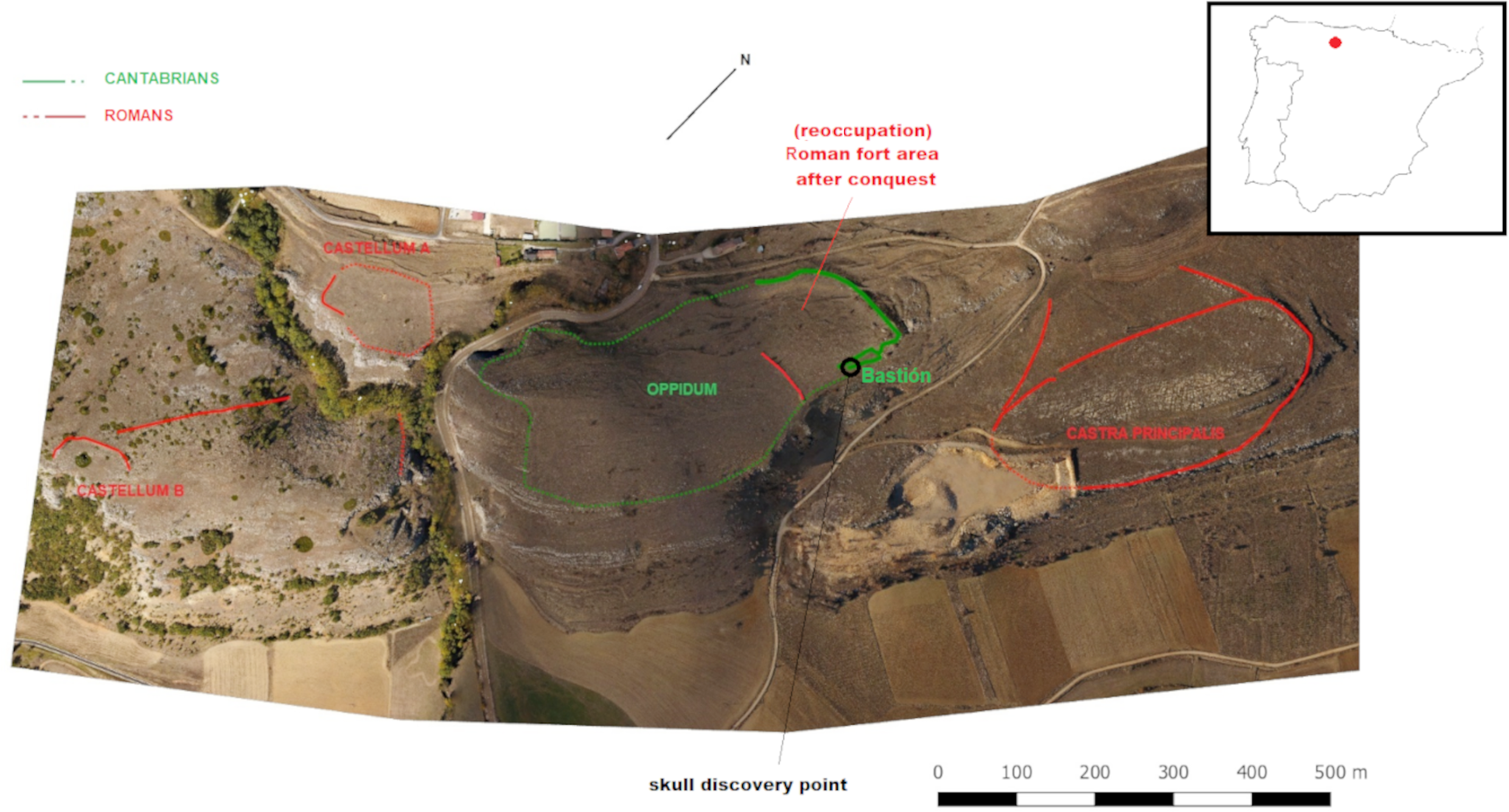
Plan of the Bastion area, with the distribution of materials found in the soil between 2019 and 2024. The area where the human skull fragments were dispersed is marked with a light blue box. (Santiago David Domínguez-Solera and Miguel Osma.)

Selection of metal objects from La Loma, organized by stratigraphic unit, that relate to the final attack on the oppidum entrance and appear in the same context as the human skull, on the floors and under the collapsed layer of the wall. (Santiago David Domínguez-Solera.)

A new research phase, starting in 2017, continues under the direction of Eduardo Peralta, Jesus Francisco Torres-Martínez, and Santiago David Domínguez-Solera with their teams from IMBEAC (Instituto Monte Bernorio de Estudios de la Antigüedad del Cantábrico), ARES Arqueología y Patrimonio Cultural, and HEROICA Arqueología y Patrimonio Cultural. New sectors of the outer perimeter of the hillfort walls, close to one of the entrances, have been excavated. This was where the greatest concentration of Roman arrowheads was found embedded in the ground surface pertaining to the final assault and conquest of the oppidum. It has also been possible to study the construction technique and evolution of the walls’ circuit (curtains formed by two parallel stone walls joined together without mortar and filled with stone rubble). It is evident that the Cantabrian cities had been growing for a century before the arrival of the Roman army, and this structure reflects political, social, and military developments pertaining to the cultures of the Second Iron Age in the Cantabrian Mountains before their conquest by Rome.Footnote 6 The objectives of this new stage of research also include the enhancement and promotion of the Archaeological Zone of La Loma as a cultural heritage site and tourist destination for the municipality and the area in which it is located.
In the following, we offer specific analysis of a human skull recovered in 2020 inside the collapse of the wall layers, starting with a presentation and interpretation of the archaeological context in which it was found.
The context of the find: archaeological description of the fortified oppidum entrance
Electromagnetic survey determined that the greatest concentration of arrowheads, caligae nails, and other military materials occurred on the northeastern side of the fortified town, where the presence of a moat and the ruins of walls had already been detected based on the surface topography. These data supported the hypothesis, later corroborated, that the final assault was mainly directed at this northeastern corner, although other areas also showed intense artillery damage of the kind detected, for example, at the settlement’s southern end. A segment of the northern moat or ditch, almost 5 m deep, was excavated, along with the corner of the wall that sat above it, which was reinforced with a defensive bastion. An access road (paved with gravel, like Roman roads) ran from the north to one side of the moat under the bastion. From there, it was enclosed between two lines of walls leading into a trap-yard or bottleneck where the assailants would find themselves surrounded and at the mercy of the defenders.
Hundreds of projectiles were found on both the paving of the access road and the exterior floor of the fortification, as well as in the small, enclosed area, and even among those stones that survived the destruction of the wall and were still in their original positions. Prior to the soldiers’ assault, the walls had been riddled by many shots or “storms” of arrows. There were also fragments of defensive equipment and bladed weapons on the floor, as well as belt buckles and jewelry accessories. Most of these pieces showed damaged from cuts or blows, probably testifying to hand-to-hand combat between Cantabrians and Roman legionnaires (Figs. 3 and 4).
These remnants of the assault were intermixed with a layer of ash from a subsequent fire. The top of the hill was occupied by a temporary Roman camp, then the wall and other fortifications were destroyed and pulled away, rendering the defenses useless. This was intended by the Romans to prevent the Cantabrians from reoccupying the position and threatening the legions’ rear when they continued their march north to the other side of the Cantabrian Mountains. These destructive actions generated a significant volume of debris, which sealed and protected the soil layer containing the remains of combat, fossilizing the moment of destruction. It was in the rubble of the walls and on the paving of the access road that the human skull that is the focus of this study was found during the summer campaign of 2020.
The recovery method
The remains of the skull were scattered, but they clearly belonged with the layer of debris associated with the collapse of the walls of the oppidum after Roman occupation (Fig. 5). There were no signs of a grave or similar deposition, and the way the pieces of the skull were dispersed most logically reflected the chaotic collapse of the defensive walls. In order to recover all the fragments of the fractured skull, the collapse stratum was excavated, then sifted manually until the level of the fire and the entrance pavement was reached. In the following fieldwork campaigns, it was verified that no further bone fragments associated with the skull existed. The absence of some fragments may be explained by erosion on the uneven slope. All the recovered fragments were scattered over an area of only ca. 1 m in diameter, near the corner of wall segment CF 6.
The area under the CF 6 wall module where items were discovered during the excavation campaign of 2020. The circle and arrows indicate the locations of several fragments of the human skull. (Santiago David Domínguez-Solera.)

Dating
Direct dating of the human head was carried out using AMS radiocarbon dating. A fragment of the basal or palatal part of the skull was sent to the Beta Analytic laboratory in Miami (reference LOMA02). The results show a 95.4% probability range of 171 cal BCE – 4 cal CE (2120 – 1946 cal BP). This chronology is compatible with the estimated date of the Roman assault during the Cantabrian Wars (29–16 BCE) and with the more specific period of 26–25 BCE for the siege of La Loma, based on the numismatic collection recovered from the main Roman camp.Footnote 7 Among the 23 coins comprising the complete assemblage, four were identified as having been minted in Calagurris before 27 BCE, as Octavian is depicted without the title of Augustus that was granted to him in January of that year. The title appears on two other specimens from this same mint, both dated precisely to the year 27 BCE. The coin evidence suggests that the siege must have occurred between 26 BCE (the campaign of Augustus) and 25–24 BCE (the campaigns of Gaius Antistius Vetus), since no later coins have been recovered.Footnote 8
Anthropological and taphonomic analysis
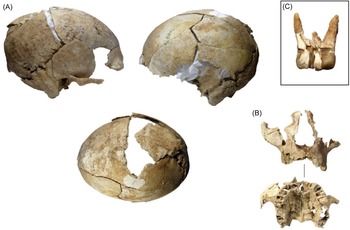
The human remains recovered in the wall collapse comprise cranial vault and some facial bones (maxillae, left zygomatic, and small fragments) from an adult subject (Fig. 6). No mandible, even fragmentary, was found, so it is assumed that it was not with the cranium at the time of the collapse.
(A) Views of the human skull once reconstituted; (B) Part of the face of the same individual; (C) Detail of the tooth with a cavity. (Silvia Carnicero.)

The degree of fragmentation of the bones makes it difficult to assess the age and traumatic pathology, if present, of this head. To evaluate the age, the cranial suture closureFootnote 9 and the wear pattern of the teeth were studied. The total score for the cranial vault sutures was 14, suggesting an estimated age of 45.2 years (range: 32–58 years). Only a complete third molar (18) and a fragmented second molar (27) were recovered. Tooth wear was scarce, with partial polishing of the enamel and no exposition of dentine. The corresponding age range suggested by this was 25–35 years.Footnote 10 Since many other factors independent of age can affect dental wear, the estimated age from the suture closure is assumed to be more accurate.
The absence of the bony pelvis and the fragmentation of the cranium also present obstacles to the determination of sex. Nevertheless, the prominent nuchal crest, mastoid process, and supraorbital margin (grade 4–5 of WalkerFootnote 11) point to the head belonging to a male individual, a view further supported by paleogenetics (see below).
The paleopathological study of the maxillae identified the antemortem loss of teeth 17 and 26 and postmortem loss of nine teeth, two of which (18 and 27) were recovered with the skeletal remains. Teeth 16, 15, 23, 24, and 25 were in situ but fragmented, with only the roots remaining. A cervical caries was identified in the recovered second molar (27), probably related to the antemortem loss of the adjacent tooth 26. No other pathological alterations were identified.
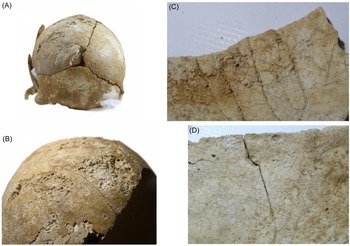
From a taphonomic perspective (Fig. 7),Footnote 12 the most relevant alteration is the multifragmentation of the cranium and teeth due to numerous direct high energy impacts. All the fragmentation surfaces are irregular, rough transverses with right angles, typical of dry bone fragmentation. The color of the fracture surfaces was similar to that of the rest of the bone. No signs of healing were present. Although perimortem blunt trauma is suspected, no typical indications were identifiable. All these characteristics point to an ancient trauma to the skeletonized cranium and are compatible with impacts from the walls collapsing. Apart from these marks, signs of corrosion and calcarean deposits related to water action and superficial linear marks with random patterns associated with trampling were documented. The grade of disturbance of fragments from the same bone is variable, corroborating the theory of the multifragmentation of the head at the time of the wall collapse. The facial bones showed flaking, cracking, splitting, and whitening of the bone surface, all characteristics related to weathering phenomena.
(A) Posterior view of the skull with clear erosion traces (weathering) and fractures; (B) Detail of the same traces in the parietal vault; (C) Detail of the trampling traces on the external surface of the cranial vault; (D) Detail of the trampling traces on the interior of the cranial vault, produced after the skull was broken. (Silvia Carnicero.)

It must be noted that additional research is possible in relation to this human head; for example, an isotopic study of the dental enamel. All such information will cast further light on the life of this man and, by extension, the characteristics of the social environment to which he belonged.
DNA characterization
The cochlea was removed from the temporal bone through sandblastingFootnote 13 and then milled. The resulting bone powder was incubated in lysis buffer and extracted with silica magnetic beadsFootnote 14 and Dabney Binding Buffer.Footnote 15 We built one double-stranded barcoded library with truncated adapters from the extract and subjected it to partial (“half”) uracil–DNA–glycosylase (UDG) treatment before blunt-end repair to significantly reduce the characteristic damage pattern of aDNA.Footnote 16 The DNA library was enriched for human DNA using probes that target 1,233,013 SNPs (“1240k capture”Footnote 17) and the mitochondrial genome and sequenced on an Illumina HiSeq X10 instrument.
After bioinformatic processing and mapping to the human genome, the sample yielded high human endogenous DNA content of 53%, indicating an optimal DNA preservation. This allowed the recovery of the whole mitochondrial genome at 170x coverage and genetic information at 809759 polymorphic positions in the nuclear genome.
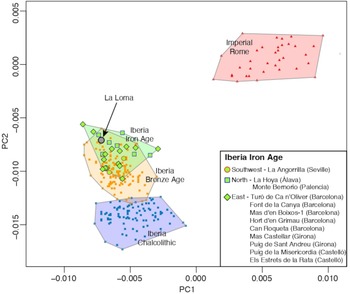
The genetic sex was clearly male based on a ratio of Y-chromosome to X- and Y-chromosome reads of 0.455. Both uniparental markers supported a local ancestral origin on the Iberian Peninsula. In the case of the maternally inherited mitochondrial lineage, the man belonged to haplogroup V20, but lacking the 8584A mutation, which according to Yfull Mtree is most common among present-day populations from Spain. The individual’s paternally inherited Y-chromosome haplogroup was R1b-DF27, the most frequent lineage in Iberia since the Early Bronze AgeFootnote 18 and still prevalent today, reaching peak frequencies in present-day populations from the Basque region.Footnote 19 The analysis of the autosomal data revealed that this man falls within the genetic range of Iron Age populations from the Iberian Peninsula (Fig. 8), close to other individuals from nearby areas in the north, such as Monte Bernorio and La Hoya. Together, these results strongly support a local ancestral origin for this individual, most likely in northern Iberia.
Principal component analysis on 591,642 autosomic SNPs (Single Nucleotide Polymorphisms) including ancient individuals from the Iberian Peninsula and from Imperial Rome (Antonio et al. Reference Antonio, Gao and Moots2019). Each symbol represents the genome of one ancient individual. Principal components were computed on a set of present-day populations from Europe and western Asia, and ancient individuals were projected onto these components. (Iñigo Olalde.)

Discussion and conclusions
To understand what this head was doing in its place of discovery, we need to expand further on the fortifications and how they were used by the Romans during and after their conquest of the oppidum. The excavations carried out since 2017 at La Loma around the northeastern walls of the oppidum and its entrance shed light on the fortifications’ construction. Dry-set stones were used to form independent but associated construction blocks (i.e., a “module” system) that constituted the line of the walls and associated bastions and towers. This technique and the use of bastions are well documented at Campa Torres, Llagú, Castro de Picu Castiellu, Castillo de San Martín, and other Asturian hillforts.Footnote 20 Excavations further confirmed that the Romans’ final assault took place at this point in the fort and have also suggested why the Romans chose this highly placed and heavily fortified side of the oppidum to install their own position following the conquest.
Once the oppidum had been conquered, its northern end was converted into a Roman fort, and a temporary wall (an agger with vallum) was erected over the ruins of the houses, conveniently reducing them.Footnote 21 This strategy is also well documented at other hillforts destroyed during the Cantabrian Wars, such as nearby Monte BernorioFootnote 22 and Cerro de la Maza in Valdeporres, Burgos.Footnote 23 At La Loma, however, the original fortifications represented by the moat and the reinforced entrance were maintained in the provisional legionary position.
According to the taphonomy of the human skull described above, the individual to whom it belonged died after the conquest of the hillfort, and his head was exposed on top of the wall maintained by the Romans during their occupation of the site. Afterwards, the head fell next to the wall and was buried in the rubble that was created when the Romans destroyed the fortifications and abandoned their position there. Enough of the entrance to La Loma has been excavated to rule out the possibility that the postcranial skeleton of the individual, a middle-aged, native male according to both aDNA and anthropological analysis, is buried nearby.
The skull cannot be older than the siege, ruling out, for example, the possibility that it belonged to some individual who died during one of the constant and habitual fights between the Cantabri and other Celtic peoples in this area, described by ancient sources (Strabo 3.3.8; Flor. 2.33.47; Oros. 5.21.3). The Celtic peoples, like many other peoples of Indo-European origin, would cut off the heads of some of their adversaries as a sign of victory or of respect for the enemy.Footnote 24 This custom was attested above all among people of the Celtic culture in Spain.Footnote 25 However, there are several reasons to rule out such a scenario here. First, the skull does not bear traces of the extremely intense fire that affected the remains of the battle and other archaeological materials, such as the bones of animals, found outside the walls and in the inhabited area.Footnote 26 Second, the bone appears to have been relatively fresh, possibly still with zonal soft tissue covering it, when it fell next to the wall to which it had been affixed; this is indicated by bone deformations and the zonal subaerial cortical deterioration (marks of weathering). In addition, there was evidence of trampling, a generic technical term for friction between abrasive terrain and bony surfaces (in this case, it does not mean that the skull was stepped on); this is taphonomically similar to and sometimes confused with parallel cut marks.Footnote 27 The trampling here was mainly produced by bone that was still recent, and not old and dry, rubbing against the ground or other stony surfaces. The dry fractures, certain erosion polish, traces of roots, and additional deterioration due to exposure to the sun and inclement weather would have been caused by the skull’s gravitational displacement within the rubble for 2,000 years following its deposition.
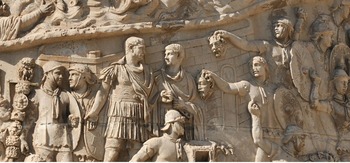
The Roman legions used to expose both the whole corpses of defeated enemies and parts of their bodies, including hands and especially heads. Some Roman auxiliary troops shared this custom, as can be very clearly seen in Trajan’s Column in Rome (Fig. 9), where we observe heads affixed to stakes or pikes. They were also hung in other ways, probably with ropes and other elements.Footnote 28
Detail of Trajan’s Column (Rome) built 106–113 CE, showing Roman soldiers offering the emperor the decapitated heads of Dacian enemies. (Photograph obtained from www.londonmuseum.org.uk.)

The human skull recovered in the entrance of La Loma must therefore be understood within the context of victory celebrations in Classical Antiquity.Footnote 29 The symbolism of the military trophy was materialized not only in the display of weapons taken from defeated foes, but also in acts of violence.Footnote 30 In Roman contexts, these punitive acts may have been part of strategies of intimidation rather than ritual practices related to victory or recognition of the courage of enemies as a form of warrior prestige. In addition to the famous Roman practices of crucifixion and impalement, this bloody gesture of celebratory decapitation and display as a symbol of victory and punishment was carried out not only against “barbarian” or foreign enemies, but also against internal rivals. The exhibition in Rome and other cities, on the rostral column, of the heads and hands of defeated enemies might serve as a comparison, including the display of the amputated head and hands of Marcus Tullius Cicero (Cass. Dio 47.3), or Pompey’s head and ring being presented as gifts to Julius Caesar by the Egyptians who murdered him (Plut. Pomp. 79). In London, illustrative anthropological traces of headhunting by the Roman army and/or remains of defeated gladiators have been found.Footnote 31
In addition to the skull of the indigenous male displayed by the Romans in victory, other human remains have been found at La Loma. These are mainly fetal and perinatal elements that were discovered among the ruins and floors of houses, the remains of corpses whose deposition reflects the cultural habit of burying infants in the living area, in contrast to the cremation ritual that was usual for adults and teenagers.Footnote 32 Bone fragments from human adults have also been found among the remains of battle, although these are often difficult to interpret with greater specificity than as the remains of amputations and dental avulsions caused by hand-to-hand combat. A partial skeleton found in 2004 is totally unrelated to the Cantabrian Wars, having been radiocarbon dated to the Middle Ages (LOMA01). In summary, only the mature human skull presented here belongs to a clear archaeological context and provides data that allows its antemortem and postmortem history to be interpreted.
Finally, one more reflection is necessary, on the fact that the head was still partially fresh, perhaps with soft matter attached, when it fell next to the walls demolished by the Romans after they abandoned their position – this is indicated by the traces of trampling and fresh deformations. This minor state of decay reinforces the hypothesis that the legionary fort remained standing for only a few months, through the late summer and fall or perhaps a winter. This observation about the short duration of Roman occupation of the site must, however, be tested by more evidence during future archaeological campaigns.
In a wider context, the Iron Age in northern Spain lacks human remains,Footnote 33 and an almost complete human skull is a find of great importance. It represents the biggest existing corporal sample from the inhabitants of the region.Footnote 34 We add to this the value of the skull as a source of anthropological information following its interpretation as a war trophy exposed on the walls of a hillfort conquered by the Romans during the Cantabrian Wars. It is, in short, another important acquisition from the archaeological complex of the siege of La Loma to shed light on the Roman military world at the beginning of the Empire and on the last Celtic people to live in the north of the Iberian Peninsula and western continental Europe before the advent of imperial rule.
Acknowledgments
The authors thank the Santibáñez de la Peña Council, promoter and main financier of the annual research campaigns, and the Provincial Council of Palencia for financing the field and laboratory work. Thanks also to the Junta de Castilla y León for their legal coverage. Thanks, above all, to Dr. Eduardo Peralta and our respective archaeological teams.