INTRODUCTION
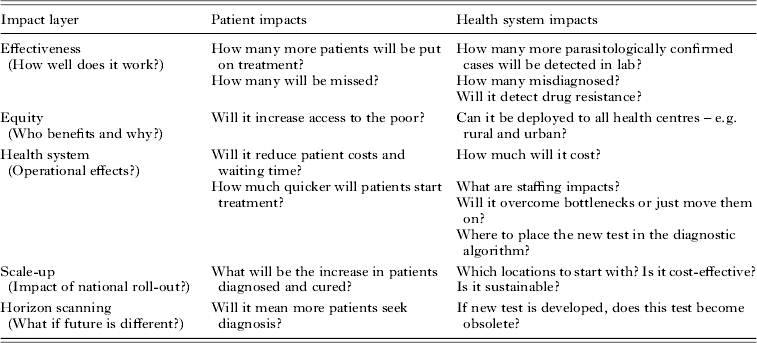
Investment in research is resulting in promising new tools and modifications of existing approaches for the diagnosis of human parasitic diseases. For example, the use of rapid diagnostic tests (RDTs) for malaria (Wongsrichanalai et al. Reference Wongsrichanalai, Barcus, Muth, Sutamihardja and Wernsdorfer2007) and schistosomiasis (Stothard, Reference Stothard2009), mini-FLOTAC for soil-transmitted helminths (STHs) (Barda et al. Reference Barda, Rinaldi, Ianniello, Zepherine, Salvo, Sadutshang, Cringoli, Clementi and Albonico2013) and loop-mediated isothermal amplification (LAMP) as a platform for malaria, human African trypanosomiasis (HAT) and leishmania detection (Adams et al. Reference Adams, Schoone, El Farazdag, El Safi and Schallig2010, Reference Adams, Mugasa, Boer, Dyserinck, Büscher, Schallig and Leeflang2012; Polley et al. Reference Polley, Mori, Watson, Perkins, González, Notomi, Chiodini and Sutherland2010). Policymakers have a growing number of new diagnostic options from which to choose. However, the decision on which new technologies to use and how to incorporate them into existing diagnostic algorithms is difficult. As an example, for malaria there is much discussion in the literature about whether, when, where and how best to use microscopy or RDTs in the diagnostic pathway of symptomatic patients (e.g. Bell et al. Reference Bell, Wongsrichanalai and Barnwell2006; Bailey et al. Reference Bailey, Williams, Bain, Parker-Williams and Chiodini2013; Mouatcho and Goldring, Reference Mouatcho and Goldring2013). The difficulty of these choices can be further compounded by an ever-changing policy environment, where investments made based on current recommendations might need to be modified in response to subsequent new developments in diagnostics and modified recommendations. There is a parallel situation in the field of tuberculosis (TB), which is a chronic infectious disease strongly associated with poverty and low access to health services. Many of the countries with highest incidence levels of TB are in sub-Saharan Africa particular where HIV rates are also high. Many countries still rely on a sputum smear microscopy to diagnose TB which is treatable, but several months of combination chemotherapy are required for cure. Interrupted or inappropriate treatment may lead to treatment failure or relapse. New molecular diagnostics for TB such as Xpert MTB/RIF® have recently been approved by the World Health Organization (WHO), as have new alternative approaches using light emitting diode (LED) fluorescence microscopy (WHO, 2011a, b) with improved sensitivity over light microscopy. Policymakers are asking ‘which new diagnostics for TB to implement, where in the diagnostic pathway, what will be the impact, and when to start?’ (Cobelens et al. Reference Cobelens, Van den Hof, Pai, Squire, Ramsay and Kimerling2012). Mann et al. (Reference Mann, Squire, Bissell, Eliseev, Du Toit, Hesseling, Nicol, Detjen and Kritski2010) proposed the use by policymakers of an impact assessment framework (IAF) to support the decision process for TB diagnostics. The proposed IAF suggests policy decisions need to incorporate not just the effectiveness of a new diagnostic algorithm (e.g. sensitivity and specificity), but also projections on equity (who benefits), health system effects, impacts of scale-up and a consideration of future developments (Horizon scanning). A similar approach could be useful for parasitic disease diagnostics. Table 1 shows the IAF populated with example questions that would be relevant in connection with the diagnosis of a human parasitic disease.
Impact Assessment Framework used to show example questions that policymakers considering the implementation of new diagnostic tools or approaches for parasites would want addressed

Decisions on new diagnostics require the comparison of different diagnostic strategies that incorporate consideration of both the technical characteristics of the tools and how these tools will actually be implemented within a health system, and at what cost. Modelling is an opportunity that can help to fill this gap in knowledge which has not previously been deployed for parasitic diseases (Ponder et al. Reference Ponder, Freundlich, Sarker and Ekins2014). We propose the use of operational modelling to assess the potential impact of new diagnostic strategies on health system costs, infrastructure, patient access and outcomes. We illustrate how such an approach from a different disease area – diagnosis of TB – has been used successfully and discuss how the same approach could be used to assist policy decisions for diagnosis of parasitic disease.
OPERATIONAL MODELLING OF OPTIONS FOR TB DIAGNOSIS IN TANZANIA
Background – TB diagnostics in Tanzania
Innovation in the process and technology of TB diagnosis, led by organizations such as the Stop-TB partnership and the Foundation for Innovative New Diagnostics (FIND), have resulted in the development of several new diagnostic tools and improved algorithms. Some of these optimize existing technologies e.g. using LED fluorescence microscopes with same-day sputum sample collection (Ramsay et al. Reference Ramsay, Yassin, Cambanis, Hirao, Almotawa, Gammo, Lawson, Arbide, Al-Aghbari, Al-Sonboli, Sherchand, Gauchan and Cuevas2009), whilst others involve introducing much more sensitive but expensive molecular technologies such as Xpert MTB/RIF® (Boehme et al. Reference Boehme, Nabeta, Hillemann, Nicol, Shenai, Krapp, Allen, Tahirli, Blakemore, Rustomjee, Milovic, Jones, O'Brien, Persing, Ruesch-Gerdes, Gotuzzo, Rodrigues, Alland and Perkins2010). These new technologies can replace light microscopy (e.g. Ziehl Neelsen (ZN)) as the primary tool for initial TB diagnosis, but involve significant investment in equipment (US$17 000 (£10 300) for a 4-cartridge machine in Tanzania), annual maintenance (US$1800 (£1090) per year), and expensive consumables for each individual test (US$9.98 (£6.05) per test cartridge). The WHO uses the GRADE process (Schünemann et al. Reference Schünemann, Oxman, Brozek, Glasziou, Jaeschke, Vist, Williams, Kunz, Craig, Montori, Bossuyt and Guyatt2008) to assess the evidence for the endorsement of any new diagnostic tool and to formulate guidelines and recommendations. The evidence required by this process is generally presented in the form of systematic reviews of accuracy based on demonstration studies (Steingart et al. Reference Steingart, Schiller, Horne, Pai, Boehme and Dendukuri2014). These summarize the quality of evidence about whether innovations can work based on observed sensitivity and specificity. Evidence about whether they will actually work or their likely impacts in different contexts is usually lacking (Squire et al. Reference Squire, Ramsay, Van den Hof, Millington, Langley, Bello, Kritski, Detjen, Thomson, Cobelens and Mann2011). For example, different diagnostic strategies could be more or less cost-effective in settings with different levels of HIV, drug resistance or access to other health facilities. A more complete comparison of the impacts of different diagnostic strategies is required by policymakers within resource-constrained developing countries if they are to successfully implement cost-effective solutions for their specific context.
Methodology applied in Tanzania
For a study in Tanzania an operational modelling approach linked to a transmission model was proposed to predict the health system, patient and community impacts of alternative diagnostic tools and algorithms for TB (Langley et al. Reference Langley, Doulla, Lin, Millington and Squire2012). Operational modelling using the WITNESS® Discrete Event Simulation (DES) software was chosen as it is: (1) flexible – allowing many diagnostic options to be modelled; (2) visual – provides a graphical representation of the process being modelled which engages policymakers (see Fig. 1); (3) detailed – taking account of the complex interactions that affect outcomes and cause bottlenecks; (4) powerful – enabling the rapid simulation of 10 years of diagnosis across a country in less than 30 min; and (5) output rich – making outcome data readily available using Excel® for further analysis. This modelling approach is frequently used in the developed world to evaluate impact in health systems (Günal and Pidd, Reference Günal and Pidd2010). The modelling approach used for Tanzania involved taking data about the performance of current diagnostic algorithms in the context being considered for the new diagnostic tool and algorithm alongside data from contexts where the new technology had been implemented. Through linking the operational model with a transmission modelling component, the approach was able to project the effects on patients, the health system and the community in the context being considered (Lin et al. Reference Lin, Langley, Mwenda, Doulla, Egwaga, Millington, Mann, Murray, Squire and Cohen2011).
Example snapshot screen view of the operational model. The screenshot shows the diagnostic laboratory process for TB sample testing using microscopy and Xpert MTB/RIF. Samples, slides and cartridges move through the process and the laboratory staff (illustrated by the person icon) move to where work is required. This screen snapshot shows four samples waiting for microscopy testing, three slides being prepared and three slides being stained. One slide is being examined and is indicated as smear positive by the red colour. Two samples are waiting for Xpert testing, two Xpert cartridges are being prepared and currently three cartridges are in the Xpert machine being tested. One laboratory technician is currently examining a slide and one is waiting for work. One laboratory assistant is preparing a cartridge. Sputum smear microscopy turnaround is generally 1 or 2 days whereas Xpert turnaround time can be 2–3 hours.
TB diagnostic options considered
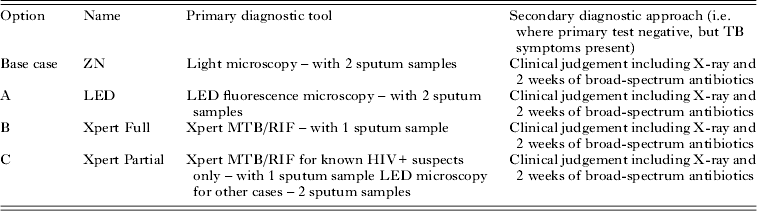
The model developed has been used to assess a number of different diagnostic options. Four of these options are shown in Table 2. The base case and option A use the diagnostic tools that are currently used throughout Tanzania i.e. ZN or LED microscopy. LED fluorescence microscopy is currently being rolled out to the larger centres and benefits from slightly improved sensitivity and reduced processing times. The patient pathway associated with this current diagnostic algorithm is illustrated in Fig. 2. Option B is the full roll-out of Xpert MTB/RIF with improved sensitivity, identification of resistance to a key drug used in the standard TB treatment regimen (rifampicin), reduced processing times, a requirement for just a single sputum sample, but also with substantially increased costs. These increased costs are despite a heavy subsidy to initial and on-going costs of Xpert MTB/RIF provided to those countries with the highest burden of TB through UNITAID (UNITAID is an organization hosted by the WHO which uses innovative financing to increase funding for greater access to treatments and diagnostics for HIV/AIDS, malaria and tuberculosis in low-income countries). Option C limits the use of Xpert to HIV-positive new cases and all retreatment cases. Retreatment cases are targeted due to the higher probability of drug resistance which the Xpert assay is likely to detect if present. Option C will also have lower cost than Option B as new HIV-negative cases will use microscopy rather than the much more expensive Xpert test.
Patient pathways for TB diagnosis and treatment in Tanzania. The figure shows the pathway for individuals with TB symptoms who first visit a health clinic where they will be directed to a district TB diagnostic centre if TB is suspected. At the diagnostic centre sputum will be collected and the individual will be asked to return the next day to provide a second sputum sample. The individual will then go home and return at a later date to receive diagnosis. If the sputum has tested positive the individual will become a smear-positive TB case and treatment can start, but this may require a further visit for drugs and directly observed treatment (DOTS) training for the patient and a relative. If the initial test is negative, but TB symptoms persist the individual will be required to visit a hospital to get an X-ray and a short course of broad-spectrum antibiotics may be prescribed. If after 2 weeks symptoms persist and the X-ray is consistent with TB the individual may start TB treatment – these are smear-negative TB cases. TB patients will require to take daily drugs, and in the first 2 months of treatment (the intensive phase) will return to the diagnostic centre every 2 weeks for more drugs and monitoring. The red arrows illustrate where patients might drop out of the diagnostic or treatment process and become lost to follow-up (LTFU).
TB diagnostic options considered using operational modelling
Results from operational modelling of TB diagnostics in Tanzania
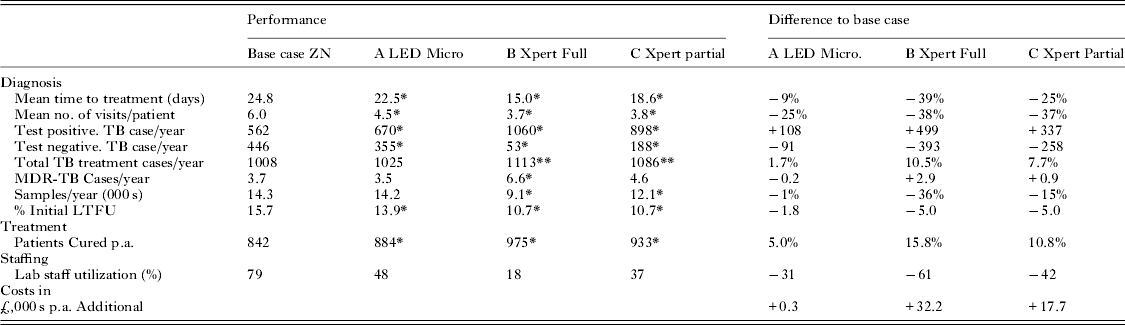
Projections of impact across many outcome variables were compared, including patient, health system and cost effects. Table 3 shows some example results for an individual diagnostic district in Tanzania.
Example results from operational modelling for a diagnostic district in Tanzania
* Significantly different from base case at 95% level.
The results demonstrate that useful projections of the effects on the health system, running costs and patient outcomes of alternative TB diagnostic strategies can be produced using operational modelling. In this resource-constrained setting, the models estimate a 5% increase in TB cures could be delivered at very low investment by the implementation of LED fluorescence microscopy (Option A). Xpert full implementation would require increased funding of £32 300 per annum. The benefits in patients cured would rise to around 16%; these benefits principally accruing from earlier case detection of smear-negative TB, reduced drop-out of patients during diagnosis and prior to treatment as illustrated by the percentage of initial lost to follow-up (LTFU), and a reduction in false positive diagnosis. The projected increase in the overall number of patients started on TB treatment is small. This is because, rather than identifying many new cases, Xpert is projected to bring forward many cases that are currently diagnosed as a result of clinical judgement following a negative smear test; a projection that has now been confirmed in field studies (Theron et al. Reference Theron, Peter, Dowdy, Langley, Squire and Dheda2014). Implementation of Xpert just for HIV-positive suspects would require a lower initial investment and reduced ongoing costs compared with full roll-out. However, the estimated increase in TB cures would be down to 11%.
In order to understand and compare the cost-effectiveness, benefits and financial sustainability of each intervention, the outputs from the model have been used to calculate the benefits measured in terms of Disability Adjusted Life Years (DALYs) averted (Fig. 3). The benefits, in terms of DALYs averted, are represented by the size of the circle and the financial sustainability by the incremental health system costs (horizontal axis). The incremental cost-effectiveness ratio (ICER) has been calculated using the incremental health system costs divided by incremental DALYs averted (vertical axis).
Incremental cost effectiveness, DALY and health system cost graph. The bubble graph shows for each option assessed the incremental health system costs above the base case on the x-axis, the incremental cost effectiveness ratio (ICER) on the y-axis, and the additional DALYs averted is represented by the size of the bubble. The output is for an example district diagnostic centre in Tanzania. This shows that Option B has the largest impact in DALYs averted (1220), but also the largest annual cost (£32 203) and an acceptable ICER of £39 per DALY averted. A possible upper limit to what might be affordable is shown by the vertical line at £25 000 p.a. All options are considered cost effective due to the ICER being well below a willingness to pay threshold set at the estimated Gross Domestic Product (GDP) per capita in Tanzania of £402.
In this example all interventions would be considered cost-effective if the threshold for cost-effectiveness is set above £30 per DALY averted. This figure is well below the Gross Domestic Product (GDP) per capita for Tanzania of US$663 (£402) (International Monetary Fund, 2013) which is often used as a benchmark for cost-effectiveness. However, cost-effectiveness is not the same as financially sustainable. In this example, if £25 000 per year was considered the maximum sustainable incremental expenditure then full roll-out of Xpert MTB/RIF (Option B) in this location would not be sustainable, whereas partial implementation of Xpert MTB/RIF for HIV-positive individuals seeking diagnosis (option C) would fall below the £25 000 per year cut-off. This option would deliver an estimated 843 DALYs averted per year which is more than double what implementing LED fluorescence microscopy would achieve, but substantially less than full roll-out of Xpert MTB/RIF (Option B). So if the higher expense of full roll-out is sustainable (£32 300 per year) then full roll-out of Xpert MTB/RIF would be the preferred option.
Observations from operational modelling of TB diagnosis in Tanzania
Operational modelling of TB diagnostics in Tanzania has provided valuable insight to help policymakers understand context-specific impacts of new tools and algorithms. The approach is now being used to assist the National TB programme in the development of a national strategy on the use of Xpert MTB/RIF, and to prioritize which diagnostics should be implemented in which districts (Langley et al. Reference Langley, Doulla, Lin, Millington and Squire2012). In addition the approach is now being explored as a tool to assist in important decisions concerning diagnosis of multi-drug resistant TB (MDR-TB) in Brazil and South Africa.
DISCUSSION
Based on our experiences from TB we consider that a similar operational modelling approach could provide valuable insights for policy decisions on the diagnostic approaches for human parasitic diseases. For example, the arrival of RDTs and molecular genotyping for diseases such as malaria (Hopkins et al. Reference Hopkins, González, Polley, Angutoko, Ategeka, Asiimwe, Agaba, Kyabayinze, Sutherland, Perkins and Bell2013; Mouatcho and Goldring, Reference Mouatcho and Goldring2013), HAT (Matovu et al. Reference Matovu, Kazibwe, Mugasa, Ndungu and Njiru2012; Buscher et al. Reference Buscher, Gilleman and Lejon2013), lymphatic filariasis (Koroma et al. Reference Koroma, Bangura, Hodges, Bah, Zhang and Bockarie2012), schistosomiasis (Stothard, Reference Stothard2009), and many others, present great opportunities as can also be seen from other articles in this issue (Bogoch et al. Reference Bogoch, Coulibaly, Andrews, Speich, Keiser, Stothard, N'Goran and Utzinger2014; Stothard et al. Reference Stothard, Nabatte, Sousa-Figueiredo and Kabatereine2014). However, with opportunities also comes an ever-increasing set of complex decisions on which diagnostic to use, in which context and how to incorporate them into the existing diagnostic algorithms. For example, recently novel RDTs have been developed for HAT to replace the Card Agglutination Test for Trypanosomiasis (CATT) (Buscher et al. Reference Buscher, Gilleman and Lejon2013). A WHO recommendation is not required for the implementation and uptake of tests for HAT, yet the community could benefit from modelling of the potential impacts of this diagnostic, including cost-effectiveness of different diagnostic algorithm scenarios. Fluorescent microscopy and the molecular test LAMP have also been developed for HAT and there is the potential for a complicated algorithm to ensue. Modelling of the diagnostic pathway for CATT, RDTs, LAMP and fluorescent microscopy may help to identify how best to integrate diagnostics in the pathway, and increase uptake of these novel tests. For diseases amenable to preventive chemotherapy such as lymphatic filariasis and schistosomiasis, the use of modelling to place new diagnostics in updated algorithms for Mass Drug Administration (MDA) approaches to the control is a specific area that needs attention (Koroma et al. 2012).
It is also essential to include the diagnostic horizon – what new tests are under development and how can healthcare providers anticipate their introduction?
The authors believe the operational modelling approach, as used in assisting policymakers address the issues with new TB diagnostics, could also be applied to the diagnostic challenges of human parasitic diseases. Impacts on patients, health systems and the scarce financial and human resources in LMIC are critical to the successful implementation of new diagnostic tools and algorithms. Using data from existing diagnostic tools for parasitic diseases, alongside the results from trials of new diagnostics, to populate operational models would enable the patient and health system impacts to be projected. This would provide comparisons of the alternative options and assist in identifying the priorities that support policy decisions.
ACKNOWLEDGEMENTS
The modelling research for TB was part of the TREAT TB initiative funded by USAID and led by the International Union against Tuberculosis and Lung Disease (The Union). The authors thank Y. Mukadi of USAID and I. D. Rusen of The Union for their support and direction. This document has been produced thanks to a grant from USAID. The contents of this document are the sole responsibility of the authors and can under no circumstances be regarded as reflecting the positions of The Union, nor those of its Donors. The authors thank J. R. Stothard from the Department of Parasitology at the Liverpool School of Tropical Medicine for his insight and encouragement in putting together this article. We also thank the British Society of Parasitology for their support in organizing the conference that led to this and other papers in this special issue.