A feeding disorder in infancy and childhood is a complex condition involving different symptoms, such as food refusal and faddiness, and leading to a decreased food intake.1 It often results from abnormal feeding development. A child's feeding development is determined by its constitution, the environment, and the child's learning process.Reference Lipsitt, Crook and Booth2 Pathology in one or more of these components can lead to a feeding disorder. Factors of constitutional origin can be organic diseases, such as the malformation of organs directly related to food intake or transport, or diseases of other organ systems that disturb the child's feeding and digestion process by impacting on its general health.Reference Dellert, Hyams and Treem3 Disorders of the central nervous system can also contribute to the development of feeding problems.Reference Reilly, Skuse and Poblete4 The child's environment is defined by the parents’ behaviour and the family's cultural and social background. Any imbalance between parental expectations and the child's feeding progress could cause an interaction problem, generating feeding disorders, such as food refusal, avoidance or aversion, on the part of the child. Parents with psychological disorders, or uncertainty regarding feeding style in families from other cultures, and also poverty and poor education can be contributory factors to feeding disorders. In most patients with feeding disorders, it is typically a combination of different factors that gives rise to the disorder.Reference Dahl and Sundelin5–Reference Stein and Barnes11 Although some children start with a purely organic problem, that is, constitutional, many will subsequently manifest a mixture of organic and non-organic components (influenced by their environment and learning processes).Reference Harris and Booth12
Recent advances in cardiac surgery techniques and progress in the pre- and post-operative care of newborns have substantially improved the survival of infants with congenital heart defects.Reference Morris and Maneshe13, Reference Boneva, Botto and Moore14 This trend is creating a growing “population at risk” for neurodevelopmental and behavioural problemsReference Majnemer, Limperopoulos and Shevell15 as well as for the development of feeding disorders. Feeding disorders tend to be increasingly common, since advances in technology are allowing more very ill children to survive.Reference Benoit16
The aim of this study was to describe the prevalence of feeding disorders in children aged 2 years following neonatal cardiac surgery. Special emphasis was placed on identifying factors permitting the early detection of patients at risk of developing feeding disorders.
Materials and methods
Design
This is a retrospective study taking in 82 consecutive neonates from a single tertiary referral centre undergoing surgery for congenital heart defects within the first 32 days of life between 1999 and 2002. Patients who did not survive the first 2 years of life were excluded.
Variables
The data collection involved a review of medical records, including surgery reports and outpatient correspondence, as well as a questionnaire that was sent to the treating paediatrician. We have chosen the age of 2 years to reassess the feeding behaviour because only severe and relevant feeding disorders persist until that age and because the prevalence of feeding disorders in the normal population has been well defined at the age of 2 years.Reference Dahl7 Missing data were established through a structured phone interview with the parents of 22 patients. A set of clinical data was obtained as follows: pre-operative data with the weight at birth, type of congenital heart disease, extra-cardiac anomalies and malformation syndromes, pre-operative oxygen saturation and clinical signs of cardiac failure, and basic socio-economic data including the age of the mother, the parents’ educational background, and the family size. The cardiac surgery data comprised the type of operation, the duration of extra-corporal bypass and the aortic cross clamp time, or the duration of the operation in off bypass operations. Post-operative data included the duration of mechanical ventilation, the intensive care-unit and total hospital stay, feeding behaviour during the first hospital stay and also at outpatient follow-up visits. In-hospital feeding parameters included the duration of tube feeding, the onset of oral food intake, and whether the child was referred to the speech pathologist on account of severe difficulties in swallowing or sucking (“early feeding disorders”). Relevant neurological findings documented on routine clinical examination during the first hospital stay, either before or after the operation, were labelled as neurologic abnormalities.
To simplify the different types of cardiac disease included in this study, these were divided into three subgroups based on intra-cardiac morphology and the extent of surgery: Group 1: cardiac diseases in which an anatomical repair is possible with a single operation. Group 2: cardiac diseases in which two or three operations are necessary to achieve an anatomical repair, and Group 3: cardiac diseases with functional repair resulting in a Fontan circulation. Most of the Group 3 patients underwent a three-stage palliation.
The questionnaire sent to the paediatrician was designed to obtain detailed information on feeding behaviour and food intake at the age of 2 years. We asked for the quality and quantity of the nutrition, whether it was appropriate for the child's age, and whether its energy content was adequate. We also asked for the body weight gain and the need for artificial feeding. Questions regarding gastro-oesophageal reflux and frequent pneumonia were also included. In the same questionnaire, information on the presence and extent of extra-cardiac anomalies and syndromes was established, and questions asked on developmental delay and the need for any specific therapy (physical therapy, early intervention programmes, and speech and language therapy).
Feeding disorder
Feeding disorder was defined as the presence of one or more of the following three criteria at the age of 2 years, as judged by the primary care provider: The child is still partially or completely dependent on tube feeding at the age of 2 years. Feeding behaviour is not age-adequate, that is, the child only drinks or takes puréed food. There is a failure to thrive, for example, the weight of the child is below the third percentile (where there was a malformation syndrome, this symptom was individually judged on the basis of the syndrome concerned).
The study was approved by the local ethics committee. Written parental informed consent was obtained.
Statistic analysis
Continuous variables are expressed as the median (range) and dichotomous variables as numbers and percentages. Univariate analyses were performed using the chi square test or Mann–Whitney U-test. Spearman's correlation coefficients were calculated to determine the correlations between different risk factors. Multivariate logistic regression analysis was performed to determine the independent influence of risk factors on abnormal feeding behaviour at 2 years. The variables included were those that were significantly associated with feeding disorders in the univariate analysis. A p-value of p less than 0.05 was considered the level of significance. Data were analysed using the SPSS 15.0 for Windows statistical software; SPSS Inc., Chicago, Illinois, United States of America.
Results
Study population
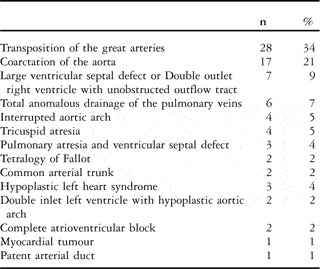
The study population consisted of 82 patients with a median birthweight of 3.2 kilograms with a range from 0.9 to 4.7 and a median gestational period of 39 weeks with a range from 25 to 42. The patients underwent surgery for congenital heart defects at a median age of 8 days ranging from 0 to 32 days. Malformation syndromes were present in 10/82 (12%) patients. Clinical signs of cardiac failure were diagnosed in 37/82 (45%) patients. Open-heart surgery with the use of a cardiopulmonary bypass was performed in 49/82 (69%) patients. The most frequent surgery overall was the arterial switch operation for transposing the great arteries (28/82) and the resection of coarctation of the aorta (17/82; Table 1).
Type of congenital cardiac defect.

Figures are given as number of patients and percentage of the total n = 82 patients
Initial feeding behaviour
Nasogastric tube feeding was initiated in 55/82 patients at the median age of 0 day ranging from 0 to 12 days. The remaining patients obtained a nasogastric tube on introduction of the anaesthesia as a routine procedure to start early feeding within the first few post-operative days. The patients were nurtured via gavage feed for a median duration of 23 days ranging from 0 to 730 days. A percutaneous endoscopic gastrostomy was necessary in five patients. Three children continued to be exclusively gavage-fed at the age of 24 months by gastrostomy feeding.
Feeding behaviour at the age of 2 years
Of the 82 study patients, 18 (22%) were diagnosed as having a feeding disorder at the age of 24 months. A strong relationship was seen between the duration of perioperative tube feeding, the duration of the first hospital stay, the duration of mechanical ventilation, and the duration of the intensive care unit stay, as is shown by a high correlation (all R > 0.6, p < 0.01).
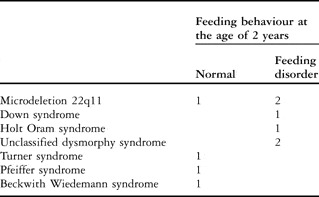
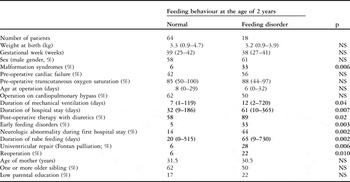
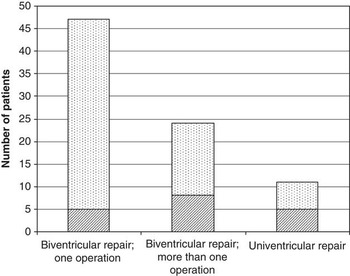
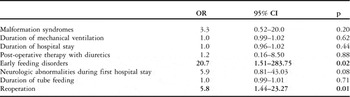
The comparison of patients with normal feeding behaviour to patients with abnormal feeding behaviour at the age of 2 years revealed the following findings (Tables 2 and 3; Fig 1): patients with malformation syndromes were more frequent in the group with abnormal feeding compared to those with normal feeding behaviour. Patients with abnormal feeding behaviour were mechanically ventilated longer and had a longer hospital stay, a higher rate of feeding disorders and neurologic abnormalities during the first hospital stay, and were more likely to undergo univentricular repair (Fontan type of palliation). The age of the mother and the presence of an older sibling, or a low socio-economic status were not associated with abnormal feeding behaviour at 2 years. The multivariate logistic regression analysis included the variables that were significant in the univariate analysis. Since there was a very high correlation between the two variables “reoperation” and “univentricular repair” (r = 0.95, p < 0.01), the latter was not included in the multivariate analysis. The multivariate analysis showed that feeding disorders observed during the first hospital stay and the need for multiple operations were independent predictors of abnormal feeding behaviour at the age of 2 years (Table 4). The presence of neurological abnormalities during the first hospital stay was also associated with a higher risk of later feeding problems; however, this was not statistically significant (Table 4).
Patients with malformation syndromes; number of patients (total n = 10).

Demographic characteristics and clinical data of all 82 patients of the study population.

NS = non-significant
Values are given as number of patients, median (range), or percentage of the respective group. The two groups, normal versus abnormal feeding behaviour at the age of 2 years were compared by univariate analysis
p < 0.05
Significant variables are indicated in bold
Number of patients in each operation group; patients with normal feeding behaviour (dotted columns) compared with patients with a feeding disorder (diagonally striped columns) at the age of 2 years; n = 82; p = 0.012.

Predictors for abnormal feeding behaviour at the age of 2 years.

CI = confidence interval; OR = odds ratio
Results of the multivariate logistic regression analysis: OR, CI, and level of significance (p)
Significant variables are indicated in bold
Discussion
This retrospective study confirms our clinical impression that feeding disorders are a relevant problem in the population of children with severe congenital heart defects. In the normal population, the prevalence of severe feeding disorders at the age of 2 years is described as 1.4%.Reference Dahl and Sundelin5 In our study population, using a similar definition of feeding disorders, the prevalence was 22%. This prevalence is almost as frequent as that in the well-known high-risk population of extremely premature patients, where feeding disorders are reported in 33% of the patients at the corrected age of 30 months.Reference Wood, Costeloe and Gibson17 There are, however, limitations regarding the comparability of the results of different studies due to the discrepancies in the descriptions and definition or classification systemReference Arts-Rodas and Benoit18 of feeding disorders.
In children born with congenital heart defects, the cardiac disease itself is a significant constitutional factor, which contributes to the development of a secondary feeding disorder. Interestingly enough, feeding disorders at the age of 2 years were not associated with birth weight, gestational age, or pre-operative haemodynamics, as manifested by symptoms of cardiac failure or pre-operative oxygen saturation. It was the infant's general medical condition that showed the greatest impact on the development of feeding disorders: the duration of mechanical ventilation, the duration of the hospital stay, and the post-operative need for diuretics were significantly associated with a feeding disorder at the age of 2 years. However, since these three variables were strongly interrelated, only early feeding disorders and multiple surgeries remained significantly associated with feeding disorders at 2 years of age in the multivariate regression analysis.
There was a high variability of the cardiac diagnoses in our study population. We thus classified the patients in either the univentricular or the biventricular repair group. We found that univentricular repair was associated with a higher risk of later feeding disorders than biventricular repair. Univentricular haemodynamics includes various degrees of intracardiac mixing and volume overload of the sole ventricle, which is particularly pronounced during the first few months of life. This results in various degrees of cyanosis and cardiac failure, with the concurrent need for medication. Patients with univentricular hearts often require palliative surgery within the first few days of life, followed by at least two open-heart surgeries up until completion of the Fontan circulation at the age of 2–4 years. These patients represent a population in a worse overall general medical state than patients with biventricular hearts. Their constitutional disadvantages are sufficiently large to explain the worse outcome in respect of feeding behaviour at the age of 2 years.
We also assessed the influence of the child's environmental factors on feeding behaviour by relating the age of the mother, the number of older siblings, and the parents’ education to the occurrence of feeding disorders. None of these revealed any correlation with feeding behaviour at the age of 2 years. This is in contrast to other studiesReference Rutter19, Reference Minde20 demonstrating that these environmental factors have a strong influence on both the general development and the psychological health of a child. From our clinical observations, we can confirm that parental stress and coping strategies have a powerful impact on the feeding process. The parameters we selected to describe the child's environment may have been inappropriate or too weak to depict the full range of the environmental factors on the development of a feeding disorder. This aspect can only be investigated in detail in a prospective study with more detailed assessment of these environmental factors by using standardised parental questionnaires assessing, for example, parental stress, coping strategies, family relationships.
The prevalence of feeding disorders among children with malformation syndromes is reported to be higher than in children without such syndromes due to the associated developmental delay, oral malformation, and neurological comorbidity, for example, poor lip closure, muscle rigidity or weakness, malocclusion, a high palate, and poor tongue movement, as well as aspiration and gastro-oesophageal reflux.Reference Cooper-Brown, Coperland and Dailey21 In most children with malformation syndromes, several of the above-listed risk factors co-occur, which enhances the probability of the manifestation and persistence of a feeding disorder. The group of malformation syndromes in our sample was heterogeneous. It is known that not all syndromes are associated with feeding disorders; in patients with microdeletion 22q11 or Down's syndrome, the prevalence of feeding disorders is high, whereas in other syndromes, such as Turner's syndrome, the prevalence is not increased. There is also considerable inter-individual variability in the manifestation of abnormal feeding development within one and the same syndrome category. In our study, patients with malformation syndromes had a higher prevalence of abnormal feeding behaviour at the age of 2 years. However, when controlled for other risk factors, this association was no longer significant. Hence, the effect of a malformation syndrome on later feeding disorders may be mediated by other factors, such as a longer hospital stay, more complex cardiac defects, or neurological comorbidity. Indeed, we found that neurological abnormalities at the time of surgery, as assessed by retrospective chart reviews, were associated with abnormal feeding behaviour at 2 years of age. This association persisted after correction for other factors: children with neurological abnormalities were almost six times more likely to manifest later feeding disorders than those without neurological abnormalities. The association between neurological disorders such as cerebral palsy and feeding problems is a well-known phenomenon.Reference Reilly, Skuse and Poblete4 Neurological abnormalities such as muscular hypotonia are frequent in children with congenital heart disease and are often diagnosed before cardiac surgery.Reference Limperopoulos, Majnemer and Shevell22 Among those neurobehavioural abnormalities was also an absent suck or poor feeding efficiency.Reference Majnemer, Limperopoulos and Shevell15, Reference Limperopoulos, Majnemer and Shevell22 Thus, concurrent perioperative neurological abnormalities can contribute to the development of feeding disorders as a constitutional, independent factor.
In conclusion, children born with a severe cardiac defect who require cardiac surgery within the first month of life are at increased risk of developing a feeding disorder at 2 years of age. The development of persistent feeding disorders in this population is the result of a complex multi-factorial process. Independent risk factors include disease severity, feeding disorders within the first weeks of life, and neurological abnormalities during the first hospital stay. These factors provide key evidence as to which children need to be referred to an early interdisciplinary feeding team.
Limitations
The results of this study are limited by the retrospective study design and the relatively small number of patients. Owing to the retrospective design, the developmental assessment was not standardised and we were unable to assess specific feeding characteristics, such as the sucking force, the feeding pattern, the individual abnormalities in the interaction between the parents and the child, and also parental anxiety and concern. The assessment of the risk of aspiration is another important element of the work – up in patients with feeding disorders. However, it was impossible to analyse this topic in detail because it was not documented well in all patients of our cohort. The definition of feeding disorders at the age of 2 years relied on the observations of the paediatrician and the parents and thus involves a subjective judgement, which could result in a bias. We included the total spectrum of congenital heart defects to represent the total patient population. This resulted in a heterogeneous group of patients with regard to the severity of the disease, the use of cardiopulmonary bypass, and the surgical technique. The sample size did not allow for subgroup analysis for specific cardiac diagnoses. We did, however, group the children into major cardiac diagnosis groups to represent disease severity.