Introduction
Low positive affect is a hallmark of depressive disorders and is reflected in key symptoms such as anhedonia, social withdrawal and reduced activity level. Alterations in reward processing may be an important mechanism underlying such disturbances (Naranjo et al. Reference Naranjo, Tremblay and Busto2001; Eshel & Roiser, Reference Eshel and Roiser2010). Lowered reward responsiveness may lead to diminished engagement in pleasurable activities and reduced motivation to pursue rewarding outcomes such as social events, sports and interpersonal relationships (Depue & Iacono, Reference Depue and Iacono1989; Forbes & Dahl, Reference Forbes and Dahl2005), suggesting that reward responsiveness may play an important role in the onset and maintenance of depression. Indeed, impaired reward processing has been postulated as a behavioural endophenotype in depression (Hasler et al. Reference Hasler, Drevets, Manji and Charney2004, Reference Hasler, Luckenbaugh, Snow, Meyers, Waldeck, Geraci, Roiser, Knutson, Charney and Drevets2009).
Brain structures involved in reward processing, such as the orbitofrontal cortex, amygdala, ventral striatum and medial prefrontal cortex (McClure et al. Reference McClure, York and Montague2004), function abnormally in depressed adults when anticipating and gaining monetary reward (Keedwell et al. Reference Keedwell, Andrew, Williams, Brammer and Phillips2005; Steele et al. Reference Steele, Kumar and Ebmeier2007; Pizzagalli et al. Reference Pizzagalli, Holmes, Dillon, Goetz, Birk, Bogdan, Dougherty, Iosifescu, Rauch and Fava2009; Smoski et al. Reference Smoski, Felder, Bizzell, Green, Ernst, Lynch and Dichter2009). On a behavioural level, depressed adults show impairments in changing responses as a function of reward (Henriques & Davidson, Reference Henriques and Davidson2000; Pizzagalli et al. Reference Pizzagalli, Jahn and O'Shea2005). Depressed individuals therefore appear hyposensitive to reward and may not develop preferences for behaviours associated with greater reward.
Although lack of reinforcing behaviour is associated with current depression, it is possible that this association may differ for impending depression. A major research aim is therefore to understand whether reward processing influences early vulnerability for depression. Psychiatric disorders frequently begin in adolescence, the incidence of depression is highest during this period and adolescent depression shows substantial continuity over time (Weissman et al. Reference Weissman, Wickramaratne, Nomura, Warner, Pilowsky and Verdeli2006). Early life has been considered a crucial period for the organization of affective systems (Nelson et al. Reference Nelson, Herman, Barrett, Noble, Wojteczko, Chisholm, Delaney, Ernst, Fox, Suomi, Winslow and Pine2009). The reward system undergoes substantial development in adolescence, with an increased sensitivity to, and seeking of, reward (Davey et al. Reference Davey, Yucel and Allen2008; Forbes & Dahl, Reference Forbes and Dahl2012). Understanding reward-related aberrations during this period may have important implications for the development of early vulnerability towards depression.
Only a few studies have examined reward processing in children and adolescents with depression. These studies have revealed attenuated neural activity in reward-related brain regions during reward anticipation and outcome compared to healthy controls (Forbes et al. Reference Forbes, Christopher May, Siegle, Ladouceur, Ryan, Carter, Birmaher, Axelson and Dahl2006, Reference Forbes, Hariri, Martin, Silk, Moyles, Fisher, Brown, Ryan, Birmaher, Axelson and Dahl2009) and found that reward-related activity correlated with positive affect in natural environments (Forbes et al. Reference Forbes, Hariri, Martin, Silk, Moyles, Fisher, Brown, Ryan, Birmaher, Axelson and Dahl2009). The two behavioural studies of depressed adolescents to date have shown conflicting findings. In a male sample, Forbes et al. (Reference Forbes, Shaw and Dahl2007) found that recently depressed boys failed to differentiate between small and large monetary rewards during high-probability reward conditions, thus showing behaviour reflecting diminished reward seeking. By contrast, on a gambling task that involved staking bets on one of two outcomes of varying probability, Kyte et al. (Reference Kyte, Goodyer and Sahakian2005) found no difference between depressed adolescents and controls at highly probably outcomes. However, at less probable reward outcomes, depressed adolescents bet more than controls, indicating a less conservative reward-seeking strategy.
Group differences in reward processing do not indicate that the association between reward processing and depression is causal. However, there is some evidence that deficits in reward responding could confer vulnerability to depression (McCabe et al. Reference McCabe, Cowen and Harmer2009). Gotlib et al. (Reference Gotlib, Hamilton, Cooney, Singh, Henry and Joormann2010) found attenuated neural activity during reward processing in adolescent girls free from psychopathology but at familial risk for depression compared to healthy controls. However, they did not examine the relationship between reward processing and subsequent depression. Forbes et al. (Reference Forbes, Shaw and Dahl2007) showed that choices during trials where both magnitude and probability of reward were high predicted depressive symptoms and the occurrence of depressive and anxiety disorders at 1-year follow-up. These initial findings highlight the role of reward processing as a potential vulnerability factor for adolescent depression.
Parental depression is the most robust risk factor for depression in young people, with around 40% of this group developing depressive disorder by early adulthood (Rice et al. Reference Rice, Harold and Thapar2002; Weissman et al. Reference Weissman, Wickramaratne, Nomura, Warner, Pilowsky and Verdeli2006). Studying adolescents at elevated risk for depression in a prospective research design provides an opportunity to examine whether behavioural alterations in reward responding are present before the onset of depression and could therefore potentially be targeted in preventive interventions (Gotlib et al. Reference Gotlib, Hamilton, Cooney, Singh, Henry and Joormann2010). Moreover, given the heterogeneity in outcome in offspring of depressed parents, this design also allows for a better characterization of risk.
We examined the role of reward processing in a 1-year longitudinal study of adolescents at risk for depression due to a parental history of depression. Specifically, we examined two aspects of reward responding: (1) reward seeking, measured by betting behaviour under a variety of odds when the more likely of two outcomes was chosen, and (2) risk adjustment, measured by the extent to which variation in odds affected betting. In addition to examining differences in overall levels of reward seeking, we were particularly interested in the relationship between depression and reward seeking at highly favourable reward conditions (i.e. when likelihood of reward is high) on the basis of Forbes et al.'s (Reference Forbes, Shaw and Dahl2007) findings. Adolescents were assessed for psychiatric disorder at baseline and follow-up and only a proportion of the cohort had a current psychiatric disorder during the study. This enabled prospective examination of the role of reward responding in depression in those adolescents without a prior depressive episode. First, we examined reward responding in adolescents with depressive disorder, and in those with no disorder or other psychiatric disorders (externalizing and anxiety disorders). This allowed us to identify whether a particular pattern of reward responding was specific to depression rather than simply a marker of current psychopathology or a general feature in offspring of depressed parents. We expected diminished reward seeking to be characteristic of depression, as externalizing disorders may involve increased reward seeking (Scheres et al. Reference Scheres, Milham, Knutson and Castellanos2007; Gatzke-Kopp et al. Reference Gatzke-Kopp, Beauchaine, Shannon, Chipman, Fleming, Crowell, Liang, Johnson and Aylward2009) and anhedonia is thought to be less typical of anxiety than depression (Clark & Watson, Reference Clark and Watson1991). Second, we examined whether reward responding was associated with indices of positive social/environmental functioning (friendships, use and appreciation of humour, engagement in extra-curricular activities). Depression is associated with reduced activity levels and social impairments, which are likely to result in negative psychosocial outcomes (Hirschfeld et al. Reference Hirschfeld, Montgomery, Keller, Kasper, Schatzberg, Moller, Healy, Baldwin, Humble, Versiani, Montenegro and Bourgeois2000; Weissman, Reference Weissman2000). Such disruptions may reflect reward-related alterations (Katz et al. Reference Katz, Roth and Carroll1981; Forbes & Dahl, Reference Forbes and Dahl2005; Brene et al. Reference Brene, Bjornebekk, Aberg, Mathe, Olson and Werme2007). Thus, we expected diminished reward responding to be associated with less positive affective functioning. Third, we examined whether reward responding predicted depressive symptoms and functional impairment over time in those adolescents free from depressive disorder at baseline. We also analysed whether reward responding predicted new-onset depressive disorder at follow-up.
Method
Participants
The current study was part of an ongoing longitudinal study of parents with recurrent unipolar depression and their biological adolescent offspring: the Early Prediction of Adolescent Depression (EPAD) study (Mars et al. Reference Mars, Collishaw, Smith, Thapar, Potter, Sellers, Harold, Craddock and Rice2012). A history of recurrent depression in the parent was verified using the Schedules for Clinical Assessment in Neuropsychiatry (SCAN; Wing et al. Reference Wing, Babor, Brugha, Burke, Cooper, Giel, Jablenski, Regier and Sartorius1990). Exclusion criteria were a diagnosis of bipolar disorder or a history of mania in the index parent, adolescent not living at home, or adolescent IQ <50. There were no diagnostic exclusion criteria for adolescents. One eligible adolescent per household participated. Parents were recruited from primary care in South Wales, UK (78%), from a previous community study of recurrent unipolar depression (19%), and from advertisements in primary care (3%).
Psychopathology data were available at baseline (when adolescents completed the reward task) and at follow-up (average = 12.5 months). Full psychopathology data were available for 277 adolescents at baseline and 251 adolescents at follow-up, 216 of whom also had reward task data. Non-completion of the task was due to: shortage of equipment (28), time limitations (17), participant refusal (7), other reasons (9), for example a fractured arm. For 19 participants, computer failure caused a loss of reward task data. Thus, 197 participants had complete reward task data and these did not differ on key study variables from those for whom reward data were unavailable: age (t = 0.97), gender (χ 2 = 0.64); depressive symptoms (t = 0.45), rates of depressive disorders (χ 2 = 0.23), anxiety disorders (χ 2 = 0.34), disruptive disorders (χ 2 = 0.29), or attention deficit hyperactivity disorder (ADHD; χ 2 = 0.31); all p values >0.33.
Measures
Psychiatric symptoms and disorder
Adolescent psychiatric symptoms and disorders (depressive disorders, anxiety disorders, eating disorders, conduct disorder, oppositional defiant disorder, ADHD, bipolar disorder and psychosis) were assessed on two occasions using the Child and Adolescent Psychiatric Assessment (CAPA; Angold et al. Reference Angold, Prendergast, Cox, Harrington, Simonoff and Rutter1995). The CAPA is a semi-structured interview that provides a detailed assessment of adolescent psychopathology over the preceding 3 months. Interviews were conducted separately with the parent and adolescent. Inter-rater reliability was excellent (κ = 0.9 for adolescent depression). All cases meeting DSM-IV diagnostic criteria and subthreshold cases were reviewed by two child psychiatrists and diagnoses were agreed by clinical consensus. A disorder was considered to be present if a diagnosis was made based on interview of either the parent or the adolescent (Angold & Costello, Reference Angold and Costello1995).
The severity of depressive symptomatology over the preceding 3 months was assessed with the 34-item version of the Mood and Feelings Questionnaire (MFQ; Costello & Angold, Reference Costello and Angold1988) at baseline and follow-up (score range: 0–68). The MFQ correlates highly with other measures of depressive symptoms and clinical interviews of depression (Angold et al. Reference Angold, Prendergast, Cox, Harrington, Simonoff and Rutter1995). Parents and adolescents completed the MFQ. If either informant endorsed a symptom it was counted as present. Evidence indicates that parents and adolescents offer complementary information (Costello & Angold, Reference Costello and Angold1988) and that combining child and parent ratings improves sensitivity in detecting depressive mood compared to the use of either score alone (Angold et al. Reference Angold, Prendergast, Cox, Harrington, Simonoff and Rutter1995; Daviss et al. Reference Daviss, Birmaher, Melhem, Axelson, Michaels and Brent2006). The MFQ showed high internal reliability (Cronbach's α = 0.96 at baseline and 0.95 at follow-up). An anhedonia score was calculated from items regarding loss of pleasure, loss of interest and loss of energy.
Functional impairment
Functional impairment was assessed at baseline and follow-up with the impact supplement of the Strengths and Difficulties Questionnaire (SDQ; Goodman, Reference Goodman1999). Parent and adolescent reports were combined, whereby if either informant endorsed a problem it was counted as present. The SDQ indexes the extent to which emotional and behavioural difficulties cause distress and social impairment and predicts psychiatric service use (Goodman, Reference Goodman1999; Ford et al. Reference Ford, Hamilton, Meltzer and Goodman2008). Cronbach's α = 0.78 at baseline and 0.77 at follow-up.
Peer relationship quality
This was assessed at baseline using 10 items that assess friendship quality (e.g. ‘Children in my class are friendly to me’). Cronbach's α = 0.87. This measure was devised for the study and was negatively correlated with the SDQ peer problems scale (r = − 0.69), indicating convergent validity.
Extra-curricular activities
A four-item checklist was used to assess frequency of exercise, sport and participation in clubs, groups or classes at baseline. Cronbach's α = 0.63.
Humour
Humour plays an important role in social interaction (Berns, Reference Berns2004). The Multidimensional Sense of Humour Scale (Dowling et al. Reference Dowling, Hockenberry and Gregory2003) assessed humour appreciation and creation (e.g. ‘I like a good joke’, ‘I can make other people laugh’) at baseline. Cronbach's α = 0.95.
Pubertal status
We assessed pubertal status at baseline using a self-report questionnaire (Petersen et al. Reference Petersen, Crockett, Richards and Boxer1988) that shows good validity in comparison to physician ratings (Brooks-Gunn et al. Reference Brooks-Gunn, Warren, Rosso and Gargiulo1987). Adolescents rated the extent to which their bodies had changed (from ‘not at all’ to ‘a lot’) on indices of pubertal development (e.g. height, facial and body hair) and reported whether each of these aspects of pubertal development was completed [e.g. ‘Are you as tall as an adult (have you finished growing)?’]. Participants indicating no change and no completion were defined as pre-pubertal, those indicating some change/completion as pubertal, and those indicating completed development on all indices as post-pubertal.
Full-scale IQ (FSIQ)
We assessed FSIQ on one occasion using 10 subscales of the Wechsler Intelligence Scale for Children – Fourth Edition (WISC-IV; Wechsler, Reference Wechsler2004).
Reward task
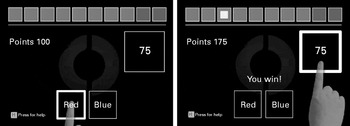
We used the Cambridge Gambling Task (CGT), a well-characterized reward task associated with neural substrates of reward processing (Clark et al. Reference Clark, Bechara, Damasio, Aitken, Sahakian and Robbins2008; CANTAB, www.camcog.com). On each trial, 10 coloured boxes (blue or red) are presented on screen and the ratio of blue to red boxes varies from 9:1 to 1:9, in pseudo-random order. In total, five possible probabilities occur in the task (9:1, 8:2, 7:3, 6:4, 5:5). Initially, the participant must decide under which colour (blue or red) a token has been hidden (Fig. 1, left; the numbers of red and blue boxes reflect the probability that the token is associated with a particular colour). This yields two indices of decision making: the proportion of times the more likely outcome is chosen (quality of decision making) and deliberation time. In the second phase of each trial, the participant must bet a proportion of their points on the chosen colour. Possible bets of varying magnitude are offered in a sequence (5, 25, 50, 75, 95% of points), in 2.5-s increments. In half the blocks, bets are presented in ascending order, in the other half in descending order (the order of condition was counterbalanced across participants). Subtraction of bets on ascending trials from descending trials measures impulsivity (indexed by low bets in the ascend condition coupled with high bets in the descend condition). Participants place their bet by touching an answer box on the screen (Fig. 1, right). The hidden token's location is subsequently revealed. The amount of the bet is then added to (if correct) or subtracted from (if incorrect) the total score. This second phase of the task yields two measures of reward responding: (1) reward seeking, which is conceptualized as motivation to risk already accumulated points to acquire further reward (measured by the proportion of points gambled on trials where the more likely outcome is selected); and (2) risk adjustment, which assesses the linear effect of probability on betting behaviour. As the ratio of blue to red boxes varies, this measures the extent to which participants adjust reward-seeking behaviour to changing context. Risk adjustment is calculated as: (2 a+b – c – 2d)/(average bet), where a represents the mean bet in the 9:1 ratio, b represents the mean bet at the 8:2 ratio, and so on (Clark et al. Reference Clark, Dombrovski, Siegle, Butters, Shollenberger, Sahakian and Szanto2011).
Screen display for the Cambridge Gambling Task (CGT), with the decision-making phase on the left and the betting phase on the right.

Participants began the task with 100 points. They were told: ‘The idea is to build up as many points as you can. Try not to let your score get as low as 1 point because then you will lose the game.’ Participants completed four practice trials, followed by eight blocks of nine trials. At the start of each block, the total was reset to 100 points. Analysis of betting behaviour was limited to trials where the more likely outcome was selected (i.e. the colour in the majority) to maintain independence of betting behaviour and decision making (Clark et al. Reference Clark, Bechara, Damasio, Aitken, Sahakian and Robbins2008). Trials where the ratio of boxes was equal (5:5) were included in the task but excluded from analysis.
Procedure
Assessments were conducted in families' homes. Parents and adolescents aged >16 years provided written informed consent, younger participants provided written assent. Ethical review and approval were provided by the Multi-Centre Research Ethics Committee for Wales.
Statistical analysis
Reward task data were transformed to approximate normality (latency data logarithmically, proportion data arcsine transformed; Howell, Reference Howell1997). Data presented in the text and figures correspond to untransformed means. Repeated-measures analysis of variance (ANOVA) was used to examine diagnostic group differences (no disorder, depressed, anxiety and externalizing) on reward measures. The ratio of coloured boxes (9:1, 8:2, 7:3 and 6:4) and the condition that bets were presented in (ascending or descending) were within-subjects factors. Pearson's r and linear regression were used to examine associations between continuous variables. Logistic regression was used to examine reward responding as a predictor of new-onset depression. The main predictor variables were overall reward seeking and reward seeking at high probability ratios (9:1 and 8:2).
Descriptive characteristics
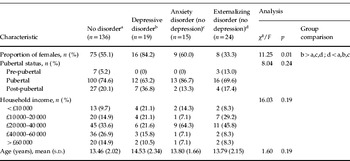
At baseline, participants were classified as having a depressive disorder (n = 19) if they received a diagnosis of major depressive disorder, dysthymia, minor depression, or depression not otherwise specified. Minor depression (n = 2) was defined as 2 weeks of low mood in addition to one other symptom and associated incapacity. Participants were classified as having an anxiety disorder (n = 15) if they received a diagnosis of generalized anxiety disorder, separation anxiety, social phobia, panic disorder, agoraphobia, or obsessive–compulsive disorder (but no diagnosis of depression). Externalizing disorders (n = 24) included diagnoses of oppositional defiant disorder, conduct disorder, disruptive disorder or ADHD (but no diagnosis of depression). Adolescents were assigned to the ‘no disorder’ group if they were free from psychopathology (n = 136). Three participants had other psychiatric disorders (eating disorders, adjustment disorder) and were excluded from analyses. The final sample consisted of 194 adolescents [108 females, 86 males; mean age = 13.63 years, s.d. = 2.06, range 10–18; mean IQ = 97.29, s.d. = 12.13, range 69 (n = 1) to 131 (n = 1)] at baseline, of whom 187 (96%) provided psychopathology data at follow-up. Table 1 presents demographic characteristics according to diagnostic status at baseline.
Baseline demographic characteristics by diagnostic status

No adolescent in the anxiety or externalizing groups had a co-morbid diagnosis of depressive disorder.
Results
Preliminary analyses
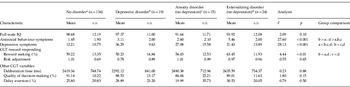
Repeated-measures ANOVAs showed no group differences in deliberation time, quality of decision making or delay aversion/impulsivity on the CGT (Table 2). There were within-subject effects of ratio on deliberation time, quality of decision making and delay aversion (F's >3.78, p's <0.02), showing that participants deliberated the least at 9:1, chose the more likely outcome more often at higher probabilities, and were less impulsive at higher probabilities. This did not differ by group.
Full-scale IQ, psychopathology symptoms and Cambridge Gambling Task (CGT) characteristics by diagnostic status

s.d., Standard deviation.
Reward seeking represents the proportion of points bet on trials where the more likely outcome was chosen. Risk adjustment reflects the tendency to stake higher bets on favourable compared to unfavourable trials. Antisocial behaviour symptoms were derived from the conduct disorder and oppositional defiant disorder sections of the Child and Adolescent Psychiatric Assessment (CAPA). Severity of depressive symptoms was measured with the Mood and Feelings Questionnaire (MFQ). No adolescent in the anxiety or externalizing groups had a co-morbid diagnosis of depressive disorder.
Reward responding and depressive disorder
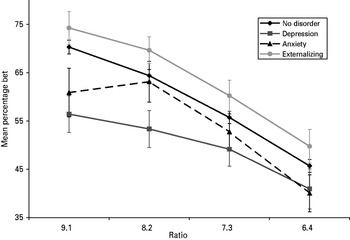
Overall reward seeking differed by diagnostic status (F 3,190 = 4.44, p = 0.01). The depressive disorder group bet less than the no-disorder and the externalizing group. The externalizing group bet more than the anxiety group (Table 2). These effects were qualified by a group × ratio interaction (F 9,184 = 2.13, p = 0.03). Follow-up univariate analyses showed that the depressive disorder group was less reward seeking than the no-disorder group and the externalizing group at the high probability ratios of 9:1 and 8:2 (F 3,190 >4.25, p < 0.01; Fig. 2). At 8:2, the difference between the depressive and anxiety group was significant at trend level (p = 0.06). At 7:3, the depressive disorder group bet significantly less than the externalizing group (p = 0.03) and the no-disorder group at trend level (p = 0.07). The interaction between group and ratio remained significant when depressive symptoms and antisocial behaviour symptoms were included as covariates and when cases with ADHD were excluded. These results were not influenced by condition (ascending or descending), pubertal status or gender (F's < 1.57, p's > 0.11). Eight depressed adolescents had a co-morbid anxiety disorder. The pattern of results was the same when these were excluded from analysis (data available from A.R.). There were no group differences in risk adjustment (F 3,190 = 52, p = 0.67), as indicated by the gradient of reward seeking across probability ratios (Fig. 2).
Reward seeking by ratio in no disorder (n = 136), depressive disorder (n = 19), anxiety disorder (n = 15) and externalizing disorder (n = 24) groups. The mean percentage bet represents the percentage of total points bet on trials where the more likely outcome was chosen. Error bars represent standard errors.

Reward responding and environmental/social functioning
Table 3 shows correlations between reward and environmental/social functioning measures. Overall reward seeking was correlated with humour and friendship quality. Both reward seeking at 9:1 and risk adjustment correlated with engagement in extra-curricular activities. Reward seeking at 8:2 also correlated with humour scores. Humour and friendship quality were substantially correlated, whereas extra-curricular activities showed a small correlation with humour and were not correlated with friendship quality. Associations between reward responding and environmental/social functioning were next examined using multiple regression to adjust for covariation between variables. Both reward seeking at 9:1 (β = 0.15, p = 0.05) and risk adjustment (β = 0.17, p = 0.02) were still associated with extra-curricular activities. Reward seeking at 8:2 was associated with humour at trend level (β = 0.11, p = 0.09). Overall reward seeking was no longer associated with humour and friendship (β's < 0.10, p's > 0.15) when adjusting for correlated social functioning variables. Anhedonia was negatively correlated with reward seeking and measures of environmental/social functioning (Table 3). Measures of environmental/social functioning were negatively correlated with depression severity (r's < −0.19, p's < 0.01).
Correlations (Pearson's r) between reward measures, indices of social/environmental functioning and anhedonia
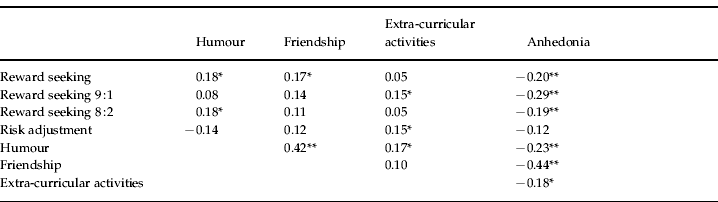
Anhedonia was derived from Mood and Feelings Questionnaire (MFQ) items associated with anhedonic symptoms.
* p < 0.05, ** p < 0.01.
Reward responding and impending depressive symptoms, functional impairment and new-onset depressive disorder
Only adolescents free from depressive disorder at baseline were included in the analyses. Both overall reward seeking (R 2 = 0.04, β = −0.22, p = 0.01) and reward seeking at 9:1 (R 2 = 0.05, β = −0.23, p < 0.01) were associated with severity of depressive symptoms at follow-up in adolescents free from depressive disorder at baseline. Depressive symptoms at baseline and follow-up were significantly correlated (r = 0.66, p < 0.001). When controlling for baseline depressive symptoms and pubertal development, both overall reward seeking (▵R 2 = 0.03, β = −0.17, p = 0.01) and reward seeking at 9:1 (▵R 2 = 0.02, β = −0.15, p = 0.02) were still associated with depressive symptoms at follow-up. Reward seeking at 8:2 was also associated with depressive symptoms at follow-up (▵R 2 = 0.02, β = −0.13, p = 0.03). There were no significant interactions between reward seeking and pubertal development (p's > 0.24; however, small cell sizes limited analysis). Additionally, both overall reward seeking (▵R 2 = 0.02, β = −0.14, p = 0.02) and reward seeking at 9:1 (▵R 2 = 0.02, β = −0.15, p = 0.01) were associated with functional impairment at follow-up after controlling for baseline functional impairment. Risk adjustment was not associated with depressive symptoms or functional impairment (β's < 0.11, p's > 0.09).
Given the small number of cases with new-onset depression at follow-up (n = 4, all female), secondary analysis examined whether reward seeking was associated with new-onset depressive disorder. Baseline reward seeking at ratios 9:1 (Nagelkerke R 2 = 0.15, B = − 0.48, s.e. = 0.23, p = 0.03) and 8:2 (Nagelkerke R 2 = 0.15, B = − 0.60, s.e. = 0.28, p = 0.03) were associated with new-onset depressive disorder at follow-up. Thus, adolescents with new-onset depression bet less at baseline at ratios 9:1 (mean = 0.50, s.d. = 0.13 v. mean = 0.71, s.d. = 0.17; p = 0.02, d = 1.38) and 8:2 (mean = 0.48, s.d. = 0.14 v. mean = 0.66, s.d. = 0.15; p = 0.02, d = 1.24). With baseline depressive symptoms in the model, reward seeking at 8:2 remained significantly associated with new-onset depressive disorder (Nagelkerke R 2 = 0.07, B = 0.06, s.e. = 0.03, p = 0.10 for depressive symptoms; Nagelkerke ▵R 2 = 0.12, B = − 0.51, s.e. = 0.27, p = 0.05 for reward seeking), and reward seeking at 9:1 was significantly associated with new-onset depressive disorder at trend level (Nagelkerke ▵R 2 = 0.11, B = − 0.41, s.e. = 0.23, p = 0.07). One adolescent with new-onset depression had an anxiety disorder at baseline. Excluding this participant did not alter the results. Adolescents with new-onset depression at follow-up were not significantly less risk adjusting at baseline (mean = 0.64, s.d. = 1.05 v. mean = 1.01, s.d. = 0.71; p = 0.31).
To test for the specificity of the reward seeking and new-onset depression association, we examined the association between reward seeking and new-onset anxiety or externalizing disorders when excluding those with baseline anxiety or externalizing disorders respectively. The analysis showed that reward seeking at baseline was not associated with new onset of anxiety disorders (n = 16; B = − 1.80, s.e. = 1.54, p = 0.24) or externalizing disorders (n = 7; B = 1.68, s.e. = 2.32, p = 0.47) at follow-up.
Discussion
We examined the association of reward responding with adolescent depression, measures of environmental/social functioning and impairment. Adolescents with current depressive disorder were less reward seeking than adolescents without psychopathology for trials where a positive outcome was very likely (at ratios 9:1 and 8:2). These findings are consistent with Forbes et al. (Reference Forbes, Shaw and Dahl2007) and with previous reports of depressed adults (Henriques & Davidson, Reference Henriques and Davidson2000; Pizzagalli et al. Reference Pizzagalli, Jahn and O'Shea2005). Moreover, the response profile at ratio 8:2 was specific to depressive disorder.
The current results did not differ when gender and pubertal status were entered as between-subject factors and diagnostic groups did not differ in age and IQ. Crucially, differences in reward seeking were apparent in the absence of group differences in the quality of decision making, impulsivity and deliberation time. Thus, deficits in reward seeking seem to represent a feature of adolescent depression that is not secondary to psychomotor impairment (a key symptom of adult depression). Depressed adolescents seem no worse at making decisions about, or identifying possibilities for, reward but are less likely to engage in reward-seeking behaviour and this seems unlikely to be attributable to impulsivity.
Diminished reward seeking under high-probability reward conditions may translate to low levels of positive environmental engagement (e.g. social relationships, education, activities), which over time is likely to impact on fundamental aspects of adolescent and adult life. Our results show that reward seeking at highly favourable ratios and risk adjustment (i.e. adjusting betting behaviour in line with the likelihood of reward) were correlated with indices of social/environmental functioning (e.g. humour, extra-curricular activities) and anhedonia. The relationship between reward processes, physical activity and social functioning is consistent with imaging studies. Humour, interaction with friends and exercise engage neural substrates of the reward network (Mobbs et al. Reference Mobbs, Greicius, Abdel-Azim, Menon and Reiss2003; Brene et al. Reference Brene, Bjornebekk, Aberg, Mathe, Olson and Werme2007; Guroglu et al. Reference Guroglu, Haselager, Van Lieshout, Takashima, Rijpkema and Fernandez2008). Changes in depressive symptoms do not fully explain changes in social functioning/activity level (Denninger et al. Reference Denninger, Van Nieuwenhuizen, Wisniewski, Luther, Trivedi, Rush, Gollan, Pizzagalli and Fava2011). Thus, a key question for future research is whether alterations in reward processes mediate impairments in positive affective functioning in depression (e.g. social withdrawal).
Our main aim was to test whether altered reward responding may constitute a risk factor for the onset of depression (Kraemer et al. Reference Kraemer, Stice, Kazdin, Offord and Kupfer2001). Our findings showed that reward seeking at highly favourable ratios was associated with depressive symptoms and new onset of depressive disorder at follow-up in adolescents free from depressive disorder at baseline. These findings remained significant when we controlled for pubertal development and depressive symptoms at baseline. Adolescents with new-onset depressive disorder were less reward seeking than adolescents who remained free from depression. Moreover, reward seeking predicted functional impairment at follow-up in adolescents free from depressive disorder at baseline. These findings illustrate that hypo-responsivity to reward is associated with the development of depression in adolescents at familial risk for affective disorder and that reward seeking predicts depression onset above and beyond baseline depressive symptoms. Reward seeking did not predict the onset of externalizing or anxiety disorders, suggesting that lowered reward responding represents a specific behavioural vulnerability marker for depression.
The limitations of this study merit consideration. The generalizability of the findings is limited by the small number of new-onset cases with depressive disorder at follow-up. Nevertheless, we chose a conservative approach for the longitudinal data analysis and excluded individuals with current depression. Moreover, the results converged with those from cross-sectional analysis of depressive disorder and longitudinal analysis of depressive symptoms. Although there were some missing data for the reward task, which reduced our sample size, missing data were not associated with psychopathology. One adolescent was receiving antidepressants at the time of reward task completion. Excluding this individual from analyses did not alter the results. The follow-up interval was approximately 1 year and it is not known how reward-seeking behaviour is related to depression over longer time periods. Reward processes in new-onset depression compared to recurrence require consideration as these may involve different processes (Kendler et al. Reference Kendler, Thornton and Gardner2000). The present sample comprised only adolescents at familial risk for depression. We were therefore unable to determine a potential influence of parental depression on adolescent reward seeking and whether diminished reward seeking predicts depression over time in the absence of familial risk. Replication in population-based studies is needed to assess the generalizability of these findings. Given the assessment time frame of the CAPA (the preceding 3 months), it is possible that some episodes of disorder may have been missed. However, this would probably have made analyses more conservative. Finally, reward seeking requires consideration within the context of other phases of reward processing (e.g. anticipation, outcome), processes of negative affect and regulatory strategies (Somerville et al. Reference Somerville, Jones and Casey2010). An understanding of their interplay should further advance risk characterization for depression and other psychiatric disorders.
In conclusion, the current findings show an association between abnormalities in reward processing and depressive disorder in a high-risk sample of adolescent males and females. The findings are novel in that they suggest that diminished reward seeking at highly favourable reward conditions is specific to current depressive disorder and is associated with future depressive symptoms, functional impairment and the onset of depressive disorder in adolescents without a diagnosis of depression at baseline. These findings illustrate that similar impairments in reward processing characterize both current and impending depression. Behavioural alterations in reward processing were also associated with social behaviour and engagement in everyday life. Thus, this is a potential mechanism through which reduced reward seeking confers risk for the development and maintenance of depressive disorder.
Several interventions based on cognitive behavioural therapy (CBT) have been found to prevent the onset of adolescent depression in a range of high-risk groups (Garber et al. Reference Garber, Clarke, Weersing, Beardslee, Brent, Gladstone, Debar, Lynch, D'Angelo, Hollon, Shamseddeen and Iyengar2009; Merry, Reference Merry2009; Stice et al. Reference Stice, Shaw, Bohon, Marti and Rohde2009). Initial evidence suggests it may be possible to alter reward processing with psychological therapies (Dichter et al. Reference Dichter, Felder, Petty, Bizzell, Ernst and Smoski2009; Geschwind et al. Reference Geschwind, Peeters, Drukker, van Os and Wichers2011). Incorporating strategies to boost effective reward responding into such preventive interventions may be worthwhile.
Acknowledgements
This research was supported by the Medical Research Council (G0802200), the British Academy (SG-50591), the Sir Jules Thorn Charitable Trust and the Waterloo Foundation. We thank N. Craddock, G. Harold, M. Owen, R. Potter, D. Smith and A. Muñoz-Solomando for their contributions to this study and A. Thapar, J. Roiser and E. Viding for helpful comments on an earlier version of the manuscript. Thanks are also due to the field team: B. Mars, C. Delduca, L. Barry, J. Hilgart, E. Kopsida, O. Eyre, R. Sellers, S. Thomas, S. Canton, G. Hammerton, S. Keates, G. Coy, R. Davis, K. Lewis, L. Kift and V. Russell.
Declaration of Interest
None.