Introduction
Cigarette smoking is one of the most preventable causes of premature death and poor health worldwide (Jha, & Chaloupka Reference Jha and Chaloupka2000). International evidence estimates that half of all long-term smokers will die from a smoking-related disease (Ministry of Health, 2008). Within New Zealand (NZ), cigarette smoking is a persistent contributor to the adverse mortality and morbidity rates affecting Pacific people. Whilst the smoking prevalence exhibited amongst Māori is highest (32.7%), current statistics indicate that one in four Pacific adults in NZ smoke (24.7%). This figure is markedly higher than the smoking prevalence among general NZ European (15.4%) and Asian (10.2%) populations (Ministry of Health, 2013).
Given Pacific people in NZ numbered 295,944 and comprised 7.4% of the population at the 2013 Census (Statistics New Zealand, 2013) the effects of social, health and economic inequalities may have profound societal impacts (Ministry of Health, 2005). Many of these inequalities are linked to smoking and consequently the smoking-related mortality burden is higher compared to non-Māori non-Pacific populations (Wilson, Blakely, & Tobias, Reference Wilson, Blakely and Tobias2006). Reducing this number of smoking-attributable deaths is a worthwhile endeavour and research into smoking prevalence and behaviours among Pacific peoples must be a priority. New Zealand's goal of becoming a smokefree nation by 2025 (defined as a smoking prevalence below five percent) heightens the urgency of research that understands the role of smoking in specific ethnic communities and informs measures that could bring about more effective smoking cessation.
International evidence indicates tobacco taxes are relatively more effective in reducing tobacco consumption among low-income groups (Townsend et al., Reference Townsend, Roderick and Cooper1994), with some NZ data also supporting this differential benefit for low-income groups and Māori (Thomson et al., Reference Thomson, O’Dea, Wilson, Reid and Howden-Chapman2000; Wilson, & Thomson, Reference Wilson and Thomson2005). Consequently, a series of tobacco excise tax increases applied by the NZ government from 2010–2012 implemented cumulative increases of 10% each year (CPI adjusted) on the cost of cigarettes and loose tobacco. Further legislation in 2012 instigated a further series of cumulative 10% increases in each of the next four years, 2013–2016 (CPI adjusted), lifting the price of a typical pack of cigarettes from about NZ$14.30 to potentially NZ$20 or more per pack in 2016. However, other researchers have questioned the unequal burden which tobacco excise tax increases may have on low-socioeconomic groups (O’Dea, & Thomson, Reference O’Dea and Thomson2007). This may be particularly relevant for Pacific communities as they are disproportionately represented within the lower socioeconomic strata of society (Statistics New Zealand, 2012).
The importance of research on fathers has been recognised as a key priority area by international bodies, including the World Health Organisation (2007), in order to investigate their health and behaviours and understand how they influence or impact the health of their children and families. However, there is currently little epidemiological information about Pacific fathers’ smoking status, despite evidence suggesting their actions and behaviour can have a profound effect on their children's health (Tautolo, Reference Tautolo2011; Tautolo, Schluter, & Sundborn, Reference Tautolo, Schluter and Sundborn2009; Tautolo, Schluter, & Tautolo et al Reference Tautolo, Schluter and Taylor2011a Tautolo, Schluter, Paterson, & McRobbie, Reference Tautolo, Schluter, Paterson and McRobbie2011b). More recent evidence from Glover et al. (Reference Glover, Nosa, Gentles, Watson and Paynter2014) found that children were a strong motivator for quitting amongst Pacific smokers, and emotionally important reasons were likely to be more effective at prompting quitting.
This paper draws on robust epidemiological information, provided by a large cohort study of Pacific families (Paterson et al., Reference Paterson, Percival, Schluter, Sundborn, Abbott and Carter2008), to determine the prevalence of smoking amongst Pacific fathers at the most recent measurement point, 11 years after the arrival of their child. We also examine motivations for cessation and the impact of tobacco tax increases amongst the three major Pacific ethnic groups within the cohort (Samoan, Tongan, & Cook Islands Māori).
Methods
Study Design
The PIF study follows a cohort of 1398 Pacific infants (and their parents) born at Middlemore Hospital, South Auckland, in the year 2000.
Participants
All potential participants were selected from births where at least one parent was identified as being of Pacific Island ethnicity and a NZ permanent resident. Recruitment occurred through the Birthing Unit, in conjunction with the Pacific Islands Cultural Resource Unit. Interviewers visited the potential participant in their own homes and fully described the study to the parent(s). At the time of the first, second, sixth, and 11th year interviews, mothers were asked to give permission for a male Pacific interviewer to contact and interview the father or other secondary caregiver of the child, including fathers who were no longer the mother's partner. If permission and paternal contact details were obtained, the interviewer contacted the father to discuss participation in the study. Once informed consent was obtained, fathers participated in one-hour interviews (using their preferred language) that explored the family's functioning, and the health and development of the child.
This study utilises paternal data for fathers involved in the care of the cohort child, whether or not he is resident in the home with the mother and child, with a primary focus on information from the 11-year measurement wave, collected during 2011 and 2012. Detailed information about the PIF Study and procedures has been described elsewhere (Paterson et al., Reference Paterson, Tukuitonga, Abbott, Feehan, Silva and Percival2006; Reference Paterson, Percival, Schluter, Sundborn, Abbott and Carter2008).
Smoking Status
At the 11-year measurement wave, smoking status was assessed using the following question from the survey: ‘Over the PAST WEEK, how many cigarettes on average did you smoke per day?’ Participants who answered with zero cigarettes are referred to as ‘non-smokers’, while those who gave an answer of more than zero cigarettes are referred to as ‘smokers’.
Smoking Cessation
At the 11-year measurement wave, the smoking cessation behaviour of participants was assessed using the following questions from the survey: ‘Do you want to quit smoking?’ Participants were able to answer ‘Yes’ or ‘No’. Participants were also asked ‘How many times have you attempted to quit smoking?’ and ‘If you have attempted to quit, what motivated you to do so?’ which was a closed question with specific response categories including my appearance, my child's health, cost, taking control, my health and other reasons. Participants were able to select multiple responses to describe their motivations for attempting to quit.
Impact of Tax Regulations
Smokers were asked: ‘Has the recent series of tax increases (2010-projected 2012) on cigarette sales in NZ caused you to reduce your smoking?’
Socio-Demographic Variables
Socio-demographic variables provide sample characteristics for the cohort of fathers including age, ethnicity and highest educational qualification. Ethnicity classifications included ‘Other’ for participants who identified equally with two or more Pacific Island groups or with a Pacific Island ethnic group that was not Samoan, Tongan or Cook Islands Māori.
Statistical Analysis
Prevalence of smoking behaviour and other associated variables was estimated using SPSS software version 18 (Argyrous, Reference Argyrous2011). Furthermore, some father participants were not seen at every measurement wave, and some new participants entered after baseline due to changes of paternal caregiver of the cohort child.
Ethical Clearance
Careful consideration is always applied to the ethical aspects of this longitudinal study with Pacific families. Ethical approval for the PIF study was obtained from the Northern Regional Ethics Committee for the 11-year phase.
Results
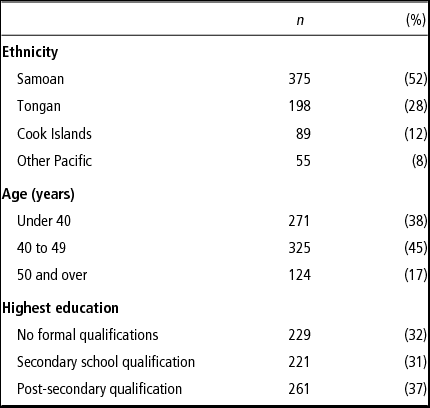
At the 11-year interview, 835 mothers identified a father or other secondary caregiver of the child who was able to act as father respondent, of whom 790 participated in the 11-year measurement wave. Only male respondents of Pacific ethnicity were included in the analysis (N = 723) of whom 663 (92%) were the birth father of the cohort child. Respondents’ socio-demographic characteristics are presented in Table 1.
Sample characteristics for pacific fathers (N = 723) at the 11-year measurement wave

*Note: missing values for some variables: ethnicity (6), age (3), education (12).
Prevalence of Smoking
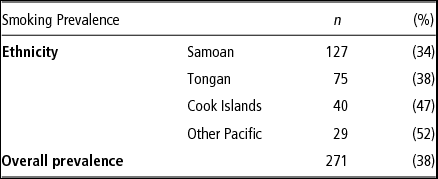
Smoking prevalence was recorded for 715 fathers, of whom 271 (38%) were smokers. Prevalence of smoking amongst different ethnic groups is reported in Table 2.
Smoking prevalence among pacific fathers by ethnicity (n = 715)

Motivations and Attempts to Quit Smoking
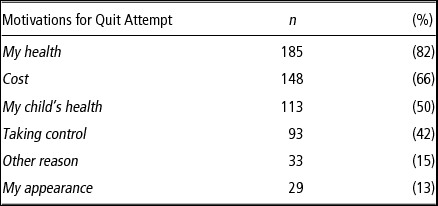
A desire to quit smoking was reported by 81% of smokers. In examining the key motivations to quit smoking, the strongest motivator for fathers was their own health, followed by the cost, the impact on their child's health, taking control, other reasons and least of all their appearance. Smokers also admitted their number of attempts to quit, with 31 (12%) having no attempts, 64 (25%) having one attempt and 159 (63%) having attempted multiple times.
Motivations for attempting to quit smoking amongst Pacific fathers who smoke

Impact of Tax Increases
Fathers that were current smokers were asked whether the 2010–2012 series of tobacco tax increases had caused them to reduce their smoking. Approximately 70% (n = 191) of smokers indicated that the tax increases had caused them to reduce their smoking.
Discussion
Smoking Prevalence and Ethnicity
Prevalence for smoking in fathers at the 11-year measurement wave (38%) was much higher than the 28% prevalence rate reported at a similar timepoint amongst Pacific males in the 2011/12 NZ Health Survey (Ministry of Health, 2012). Although the latest 2013 census statistics estimate the smoking prevalence for the NZ Pacific male population at 26% (Statistics New Zealand, 2013), our findings highlight very high levels of smoking amongst this cohort of Pacific fathers resident within the greater Auckland region. However, this is somewhat reflected in latest census statistics which highlight smoking rates being substantially higher than the national average amongst; people who live in highly deprived areas, Maori and Pacific peoples, and people with mental health disorders. Deprivation is strongly associated with smoking in NZ, and given that Pacific people are more likely to have high smoking rates and live in highly deprived areas, the results amongst Pacific fathers within this study may not be unexpected.
The high smoking prevalence rate amongst Cook Islands fathers (47%) compared to other ethnic groups is another finding of grave concern. Smoking is a significant cause of cardiovascular disease (hypertension, stroke, heart attacks), and previous research examining mortality rates for Samoan, Cook Islands, Tongan and Niuean people, reported elevated CVD mortality among Cook Islands people (Blakely et al., Reference Blakely, Richardson, Young, Graham, Tobias and Callister2009). Cook Islands people enjoy NZ citizenship and the opportunity for unencumbered migration from their traditional home islands. Consequently, they have undergone longer exposure and assimilation to NZ society compared to other Pacific ethnic groups (Ministry of Pacific Islands Affairs, 2002; Statistics New Zealand and Ministry of Pacific Island Affairs, 2010), and this decline in affinity with their Pacific traditions may make them more susceptible to engaging in risky health behaviours such as smoking (Tautolo et al., Reference Tautolo, Schluter and Taylor2011a; Reference Tautolo, Schluter, Paterson and McRobbie2011b). Similar research from Wong et al. (Reference Wong, Ameratunga, Garrett, Robinson and Watson2008) examining the influence of family and acculturation on smoking amongst Asian families in NZ highlighted a strong association between individuals with a high affinity for their traditional culture, and a lower likelihood of smoking uptake. These findings suggest a need for targeted, culturally specific approaches that prompt and support cessation amongst this Pacific population.
Motivations for Cessation
Our findings suggest a high proportion of Pacific fathers (81%) wish to quit, creating opportunities to take advantage of a motivation that already exists. Moreover, a number of Pacific fathers (82%) felt concerned about their own health and recognised their smoking may impact their children's health (50%), a finding echoed in research by Glover et al. (Reference Glover, Nosa, Gentles, Watson and Paynter2014). Previous research with this cohort identified at least half the children followed in the PIF study live in households where at least one parent smokes (Tautolo et al., Reference Tautolo, Schluter and Taylor2011a). Unless these parents proactively eliminate environmental tobacco smoke from their children's environment, or shield their children from this, a large proportion of these Pacific children are likely to be exposed to second-hand smoke and face the many risks such exposure brings (Ministry of Health, 2010).
Impact of Tobacco Tax Regulations
Alongside the impact on their own health, two-thirds (66%) of fathers wanted to quit smoking because of ‘the cost’, and nearly three quarters (74%) stated they had reduced their smoking as a result of the price increases following excise tax adjustments. These findings suggest current government legislation imposing incremental increases in excise tax for tobacco in NZ are likely to encourage Pacific fathers to at least reduce their smoking. In fact, similar research from Cowie et al. (Reference Cowie, Glover and Gentles2014) amongst socioeconomically disadvantaged groups in NZ including Pacific people, found that tobacco tax increases had not only led to a reduction in consumption but also an increased number of quit attempts. Advocating for continued tax increases is essential, and many Pacific Island countries have committed to adopting similar strategies to encourage smoking cessation (WHO Western Pacific Region & Secretariat of the Pacific Community, 2013).
However, despite strong evidence for high cigarette taxes as an effective method for reducing cigarette smoking, they can also impose a significant financial burden on low-income smokers, of which a high proportion are of Pacific ethnicity (Farrelly et al., Reference Farrelly, Nonnemaker and Watson2012; O’Dea, & Thomson Reference O’Dea and Thomson2007). Nevertheless, further research is needed to explore these underlying issues and their ongoing consequences within Pacific communities. Future research could also examine whether larger tax increases could more effectively stimulate quit attempts among Pacific fathers so that policy measures optimise the likely response from priority groups. Future studies could also examine whether messages featuring the cost savings from quitting could be targeted more specifically at Pacific fathers, and whether these would be more effective than health messages.
Developing Cessation Interventions
Health promotion programmes could use these findings in many ways. First, they could focus more specifically on fathers’ smoking, which receives less research and health promotion attention than mothers’ smoking e.g., focus amongst cessation services on pregnant women smokers as a priority for support. Future research could examine whether messages featuring personal risk and the risk posed to vulnerable family members would prompt quit attempts among Pacific fathers. Second, while family members are becoming smokefree, it will be important to protect infants and children from second-hand smoke. It is crucial that campaigns promoting smokefree homes and cars have media schedules that reach Pacific families and, ideally, use messages and role models that will resonate with Pacific fathers.
Strengths and Limitations
The PIF Study has many salient strengths, including that it follows a large birth cohort over time, it involves the family triad (mother, father and child) and it has had a relatively small attrition rate to date (Paterson et al., Reference Paterson, Tukuitonga, Abbott, Feehan, Silva and Percival2006; Reference Paterson, Percival, Schluter, Sundborn, Abbott and Carter2008). Arguably, the most important limitation of this study is the reliance on self-report of smoking, not validated by any biochemical tests. However, self-reported data on current smoking status can have high validity, demonstrated in previous research regarding the prevalence of smoking measured using self-report data (Patrick et al., Reference Patrick, Cheadle, Thompson, Diehr, Koepsell and Kinne1994). Furthermore, additional investigations have established the utility of self-report data as a reliable indicator of smoking status, particularly within population based studies (Rebagliato, Reference Rebagliato2002; Vartiainen et al., Reference Vartiainen, Seppala, Lillsunde and Puska2002). The question used in the PIF study – ‘Over the past week, how many cigarettes did you smoke on average per day?’, differs from the question used in other tobacco surveys in NZ e.g., ‘On a typical day how many cigarettes do you smoke?’ (Ministry of Health, 2009). While the PIF study question is likely to capture information on current smokers, it may not capture ‘intermittent’ or ‘social’ smokers, potentially underestimating the smoking prevalence within this cohort. Nevertheless, previous research has utilised this question (Tappin et al., Reference Tappin, Lumsden, McIntyre, McKay, Gilmour and Webber2000). In addition, the question ‘Has the recent series of tax increases (2010-projected 2012) on cigarette sales in NZ caused you to reduce your smoking?’ may be interpreted as a leading question and could potentially introduce social desirability bias within participant responses. Moreover, as there was no timeframe for the question about specific motivations to quit smoking, the respondent may be reporting on a quit attempt made some time in the past and not related to current policies and tobacco control interventions.
Conclusion
In summary, the high smoking prevalence amongst this cohort presents immediate risks to Pacific fathers, families and their communities and requires urgent attention. Pacific people now represent a sizeable proportion of the NZ population, and NZ has aid agreements and longstanding relationships with many Pacific nations. Both facts suggest NZ has a responsibility to develop and evaluate effective initiatives that will reduce smoking among Pacific communities. The NZ Government's goal of a Smokefree Aotearoa by 2025 adds new urgency to the creation and analysis of these initiatives, and utilising tobacco tax increases and promoting key motivators for cessation, may prove more successful in reducing smoking within Pacific communities.
Acknowledgements
The authors wish to acknowledge the funders and study participants for sharing their information for this study.
Financial Support
Funding for the study was provided by the Foundation for Research Science and Technology (CONC-12955-BIS-ait).
Conflict of Interest
The authors and research team have no conflicts or competing interests to declare.
Ethical Standards
Ethical approval for the study was obtained from the Northern Y Regional Ethics Committee for the 11-year phase (NTY/08/12/119).