INTRODUCTION
In this article, we review the literature on how meditation can comfort the terminally ill. This topic is potentially important to consider because meditation has proved very useful in comforting the non-terminally ill. However, the evidence for whether meditation could comfort the terminally ill is unclear. If we are to find something that could potentially comfort these patients, it is essential to review what aspects need to be examined further.
The meaning of the term “meditation” is much debated. Many scholars identify it as a process consciously focusing on either one's breathing, a particular word (mantra), or each present moment. Thus, the mind becomes empty of all thoughts, judgments, and past or future concerns (Krippner & Welch, Reference Krippner and Welch1992; Haynes & Kelly, Reference Haynes and Kelly2006; Koenig, Reference Koenig2008; Craigie, Reference Craigie2010; Young & Koopsen, Reference Young and Koopsen2011). Scholars disagree on its significance. Some argue that it is a means of directly experiencing God, the universe, ultimate reality, or a higher form of consciousness (Pargament, Reference Pargament2011; Young & Koopsen, Reference Young and Koopsen2011). Tina Posner argues that it is a means of purifying the mind, allowing a state of holiness, wholeness, integrity, and perfection (Posner, Reference Posner and Jones1985). Patricia Casey argues that it is a means for moving someone either emotionally or intellectually (Casey, Reference Casey2013). There are many different forms of meditation, including transcendental (associated with Hinduism) and mindfulness (Buddhism) (Koenig, Reference Koenig2007; Reference Koenig2008).
Meditation is reported to have numerous health benefits. First, meditation can produce a state of physical and mental relaxation. This promotes a sense of well-being that reduces anxiety and stress. This in turn helps the body repair damaged tissue. Second, meditation induces a state of calmness, which allows people to work through and look beyond life's difficulties. This gives them a deeper awareness of who they are and how to be in the world, particularly in relation to themselves and their gods (Wright & Sayre-Adams, Reference Wright and Sayre-Adams2009).
However, there are a number of variables that affect the quality of meditation. Serious illness causes a crisis of faith for some people. Weak belief is usually associated with depression (Holloway, Reference Holloway2007). In addition, meditation can be counterproductive if practiced improperly and for too long. For example, too much sitting is often enervating, and overzealous meditation leads to loss of sleep, and these contribute to low spirits (Austin, Reference Austin1998).
METHODS
The methodology for this review was a literature search. Our search involved typing keywords into a search engine (e.g., “spirituality,” “meditation,” “death,” and “palliative care”). The search engines we employed were Google Scholar and the Durham University Library. The survey included books, journals, papers in collections, and online databases. The databases consulted included the Christian Meditation Centre, Project Meditation, and Stress-Related Facts and Well-Being at Monash. Each was searched manually to identify research on how meditation affects patients. Areas that were of interest included how meditation affects patients physically, emotionally, and self-consciously. These arguments had to be based on qualitative and quantitative research, and the research had to have been gathered in a scientific context.
We were specifically interested in research gathered from clinical (including randomized control trials) and nonclinical trials on both terminally (TIPs) and non-terminally ill patients (NTIPs). The different types of meditation we focused on included mindfulness and transcendental. The papers were published during the period from 1985 to 2014. Once we accumulated all the papers, we divided the review into three subcategories: physical, emotional, and self-awareness. When reviewing each category, we put our results into tabular form. We made a note in each table of the percentage of patients affected and the percentage of TIPs and NTIPs patients who benefited.
After we recorded the results, we suggested areas for further research. These areas were suggested based on the following topics:
-
1. areas that had been covered for NTIPs but not TIPs,
-
2. areas that had been covered mainly for NTIPs but only partially for TIPs
If TIPs reacted differently, we suggested that comparisons be done based on the emotional state of the patients and the quality of the meditation.
RESULTS
There were 49 articles on the role of meditation. They focused specifically on the effects of meditation on perfectly healthy subjects and ill patients. Some 35% of articles featured healthy patients, while 70% featured ill patients. Some 15% of articles had data on how meditation affected TIPs; however, the vast majority of articles (85%) focused only on NTIPs.Footnote 1
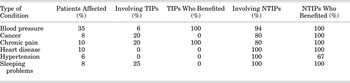
Some papers gathered their results through randomized control trials (33%); the others obtained their results through nonrandomized controlled trials (69%).Footnote 2 The vast majority of trials featured NTIPs (85%); only 15% featured TIPs. The majority of patients were not terminally ill; 35% of NTIPs were healthy. The remaining patients suffered from a wide range of conditions, including high blood pressure, cancer, chronic pain, and heart disease. Table 1 presents how meditation affected physical illness in both TIPs and NTIPs.
How meditation affected physical illness

TIPs = terminally ill patients; NTIPs = non-terminally ill patients.
Our results indicated that no work had been done on how meditation affects TIPs with heart disease and hypertension, whereas meditation had been found to have a clear impact on NTIPs suffering from heart disease and hypertension.
A very small amount of work appeared to have been done on how meditation affects blood pressure, chronic pain, and sleeping patterns in TIPs. These results indicated that meditation has little impact on such problems. However, meditation does appear to be more successful in helping the NTIPs who suffered from these problems. The mental problems included anxiety, compliance, depression, somatization, social dysfunction, and stress. Table 2 depicts how meditation affected emotional health in both TIPs and NTIPs.
How meditation affected emotional health

TIPs = terminally ill patients; NTIPs = non-terminally ill patients.
A large number of patients investigated suffered from mental health problems, and a small percentage of these were terminally ill. Unfortunately, few of these problems were ameliorated by meditation, whereas the vast majority of NTIPs experienced improvement. No formal research appeared to have been done on whether meditation increases brain activity in TIPs, but NTIPs experienced a significant increase in brain activity. No research appeared to have been done on whether meditation increases compliance in TIPs, but meditation does appear to enhance compliance in most NTIPs.
The only relevant piece on self-awareness was contributed by Stanley Krippner and Patrick Welch (Krippner & Welch, Reference Krippner and Welch1992), who argued that meditation increases self-awareness. In one experiment they conducted,
Meditators showed significant gains on half of the 12 scales of a measure of “self-actualization” when compared to the non-meditators. However, significant differences were not found in two studies using less highly motivated subjects, a shorter period of time and somewhat different meditative techniques.
We could not find any research on whether meditation increases self-awareness in TIPs.
DISCUSSION
There are several gaps in the contemporary research that must be addressed.
First, it would be beneficial if more work were done on how meditation affects the physical health of the terminally ill. Research should specifically focus on unexplored areas like heart disease and hypertension. Admittedly, one could base one's arguments on how meditation has affected NTIPs. However, these arguments would be theoretical at best. As mentioned earlier, a very small amount of research has been done on how meditation affects blood pressure, chronic pain, and sleeping patterns in TIPs. Though potentially promising, much more research is necessary in order to make a strong argument that meditation could help TIPs with these problems.
Second, more research should be conducted on how meditation affects the emotional health of the terminally ill. There was one case study on this subject, which showed that meditation did little to ease patients' quality of life and emotional mindset. However, more research needs to be conducted to reinforce these findings. Further research should be conducted specifically on whether meditation affects anxiety, compliance, depression, social dysfunction, somatization, stress, and increased activity in the prefrontal cortex of TIPs.
Third, more research should be undertaken on whether meditation can make both TIPs and NTIPs more self-aware. There has been a small amount of work done on whether meditation increases self-awareness in NTIPs, but it is too negligible to be taken seriously at this point.
Once more research has been done in these areas, comparisons should be made between terminally ill and non-terminally ill patients, and the comparisons should be made during the same experiments. This is because comparisons between patients from the same trial will be a fairer test, as it would be much easier to compare variables. When making comparisons, particular attention should be paid to each patient's beliefs and the quality of their meditation. As mentioned earlier, these are the main variables that affect how beneficial meditation is for each patient.