Introduction
It is widely agreed that spirituality is an important part of holistic, patient-centered care (World Health Organization, 2007; Puchalski et al., Reference Puchalski, Vitillo and Hull2014; Timmins and Caldeira, Reference Timmins and Caldeira2019; Best et al., Reference Best, Leget and Goodhead2020). Studies have shown that spirituality is closely associated with a range of positive health outcomes (Ahmadi et al., Reference Ahmadi, Darabzadeh and Nasiri2015; Jim et al., Reference Jim, Pustejovsky and Park2015; Jones et al., Reference Jones, Simpson and Briggs2016, Reference Jones, Pryor and Care-Unger2018) and an aspect of well-being that patients appreciate being asked about (Best et al., Reference Best, Butow and Olver2015). Although spiritual care practitioners (also known as chaplains or pastoral carers) are often available to discuss spiritual needs, any member of the multidisciplinary team might be approached to have an initial discussion with a patient (Hilbers et al., Reference Hilbers, Haynes and Kivikko2010; Best et al., Reference Best, Butow and Olver2016a; Jones et al., Reference Jones, Pryor and Care-Unger2020c). One study in Australia found that, although over 70% of patients or family members felt it was important for hospital staff to ask about their beliefs, less than 40% indicated they would like to speak to a chaplain (Hilbers et al., Reference Hilbers, Haynes and Kivikko2010). This finding suggests that patients may feel comfortable discussing spirituality with a range of hospital staff, and that a team approach to spiritual care is the best (Balboni et al., Reference Balboni, Puchalski and Peteet2014). Many healthcare professionals, however, can feel ill-equipped or uncomfortable to enquire about a patient's spiritual needs and would like further training (McSherry and Jamieson, Reference McSherry and Jamieson2011; Best et al., Reference Best, Butow and Olver2016b; Jones et al., Reference Jones, Pryor and Care-Unger2020b). Internationally, spiritual care training has been developed for healthcare professionals across a range of healthcare contexts and patient groups to address this need (Paal et al., Reference Paal, Helo and Frick2015).
Identification with traditional religious affiliations in Australia is in decline. According to national figures (Australian Bureau of Statistics, 2017a, 2017b), in 1991 over 76% of Australians identified as religious and 12% as nonreligious. By 2016, just over 60% of Australians identified as religious, and the number of those identifying as nonreligious had increased to 30%. In comparison, in the USA just under 20% did not hold a religious affiliation, and 68% of this group believed in God (Pew Research Center, 2012). At the same time, the diversity of religious faith in Australia is increasing with 2016 figures, reporting that 8.2% of Australians identify with a religion other than Christianity, compared to 2.6% in 1991. The multicultural profile of the country is well illustrated in one study about patient perspectives on spirituality and health, where the birthplace of participants included 35 different nations (Hilbers et al., Reference Hilbers, Haynes and Kivikko2010). Alongside this diversification of cultural and faith backgrounds is a growing recognition of the importance of spirituality to indigenous peoples (Isaacs, Reference Isaacs2009; Kingsley et al., Reference Kingsley, Townsend and Henderson-Wilson2013).
Kaldor et al. (Reference Kaldor, Hughes and Black2010) assert that spirituality is important but is reflected in a growing diversity of approaches to meaning-making that may not incorporate traditional religious views. Definitions adopted by peak spiritual care bodies reflect this broad approach to spirituality and spiritual care (Spiritual Care Australia, 2020). The definition of spirituality we have adopted is that “spirituality is the aspect of humanity that refers to the way individuals seek and express meaning and purpose and the way they experience their connectedness to the moment, to self, to others, to nature, and to the significant or sacred” (Puchalski et al., Reference Puchalski, Ferrell and Virani2009, p. 887). Spiritual care is described as person-centered care, which “makes no assumptions about personal conviction or life orientation” and “offers a way for people to experience and make meaning of their hopes and fears … . [it] may include presence, conversations, ritual, ceremonies, and the sharing of sacred texts and resources” (Spiritual Care Australia, 2020).
Several spiritual care programs have been developed for healthcare professionals in Australia (Meredith et al., Reference Meredith, Murray and Wilson2012; Bridge and Bennett, Reference Bridge and Bennett2014; Cooper and Chang, Reference Cooper and Chang2016; Jones et al., Reference Jones, Pryor and Care-Unger2020a). These have been conducted within the contexts of rehabilitation (Jones et al., Reference Jones, Pryor and Care-Unger2020a, Reference Jones, Pryor and Care-Unger2020c), palliative care (Meredith et al., Reference Meredith, Murray and Wilson2012; Bridge and Bennett, Reference Bridge and Bennett2014), and undergraduate nurse education (Cooper and Chang, Reference Cooper and Chang2016). Findings from these studies suggest that spiritual care training enabled healthcare professionals to view spirituality as something broader than religion (Cooper and Chang, Reference Cooper and Chang2016; Jones et al., Reference Jones, Pryor and Care-Unger2020c) to understand that they could address patient spiritual needs through listening and compassionate care (Bridge and Bennett, Reference Bridge and Bennett2014; Cooper and Chang, Reference Cooper and Chang2016) and to build levels of confidence, comfort, and competency in spiritual care delivery (Meredith et al., Reference Meredith, Murray and Wilson2012; Bridge and Bennett, Reference Bridge and Bennett2014; Jones et al., Reference Jones, Pryor and Care-Unger2020a).
This study aimed to undertake a formal consensus exercise to establish core components of a spiritual care training program for healthcare professionals. The opinions of a range of spiritual care experts working in health, education, and policy were sought. To the best of our knowledge, no studies have explored this question within an Australian healthcare context. Such research is important to ensure that spiritual care training reflects the needs of the local population.
Methods
Participants
Ethical approval was obtained from the University of Notre Dame Australia Human Research Ethics Committee (No. 2020-064S) and St Vincent's Hospital Sydney (No. 2020/ETH00870).
Eligible participants were required to have active research, educational, policy or practical experience in spiritual care, and work in a healthcare field such as palliative care, chronic noncommunicable diseases, aged or dementia care, rehabilitation, or pastoral care. A letter of invitation to participate in the study was sent out to the membership of Spiritual Care Australia, a national professional association of practitioners in chaplaincy, pastoral care, and spiritual care. Members were invited to participate and to forward the survey link to others they knew who worked in healthcare, education, or policy and who could contribute and would meet the eligibility criteria (snowballing) (Neuman and Kreuger, Reference Neuman and Kreuger2003).
Procedure
This study adopted the Delphi technique to survey participants about the topic. The Delphi technique is a multistage survey that aims to achieve consensus among a group of experts on an important issue (Keeney et al., Reference Keeney, Hasson and McKenna2011; Trevelyan and Robinson, Reference Trevelyan and Robinson2015). Four main characteristics define the Delphi technique: anonymity between participants, iteration with controlled feedback from group participants, statistical aggregation of group responses, and expert input (Trevelyan and Robinson, Reference Trevelyan and Robinson2015). There are no formal, universally agreed-upon guidelines for a Delphi study, and a number of modifications have emerged over time (Keeney et al., Reference Keeney, Hasson and McKenna2011; Trevelyan and Robinson, Reference Trevelyan and Robinson2015). The classical Delphi study involves administering a series of surveys to a panel of experts on a particular topic. Open-ended responses are collected in the first round. The responses are collated, and participants are invited to rank these responses in subsequent rounds, until consensus on a topic is achieved (Keeney et al., Reference Keeney, Hasson and McKenna2011).
This study consisted of three rounds, which is considered the optimal number of rounds in a Delphi study (Trevelyan and Robinson, Reference Trevelyan and Robinson2015). The first-round survey included study information and provided participants with the opportunity to indicate consent. Once consent was given, participants could proceed with the survey. Demographic details, including field of practice, discipline, years of experience, age, gender, and religious affiliation, were collected for each participant. The first-round survey then invited participants to respond to several open-ended questions. Participant opinions were sought on (i) the most important components to include in spiritual care training; (ii) preferred teaching methods; (iii) which clinical scenarios should be addressed in spiritual care training; and (iv) current spiritual assessment and referral procedures. Responses were analyzed and formed the basis of items, which were ranked in the two subsequent rounds.
Participants were emailed the survey link for each round. Data were collected using the Survey Monkey electronic platform. A period of six to eight weeks was provided for participants to respond to each round. Two follow-up reminder emails were sent during each period.
Data analysis
A qualitative content analysis (Hsieh and Shannon, Reference Hsieh and Shannon2005) was adopted to analyze open-ended responses from the first round. This was conducted by two of the researchers (K.F.J. and M.C.B.). Descriptive statistics were generated for all demographic variables. A descriptive analysis of the demographic data collected in the first round was conducted. The analysis of quantitative data collected in the second and third rounds involved computing the mean, standard deviation, and percentage of agreement for each item (IBM SPSS statistics package, version 26). Opinion varies on what level of agreement should be recorded for consensus to be achieved, with figures ranging between 50% and 80% (Hasson et al., Reference Hasson, Keeney and McKenna2000). Using the same approach as Attard et al. (Reference Attard, Ross and Weeks2019), consensus for this study was considered to be achieved if over 75% of the sample ranked an item as “desirable” or “essential” on a four-point Likert scale. A three-point Likert scale was used for two items, and for these items, consensus was reached if over 75% of the sample ranked an item as “sometimes” or “always.”
Results
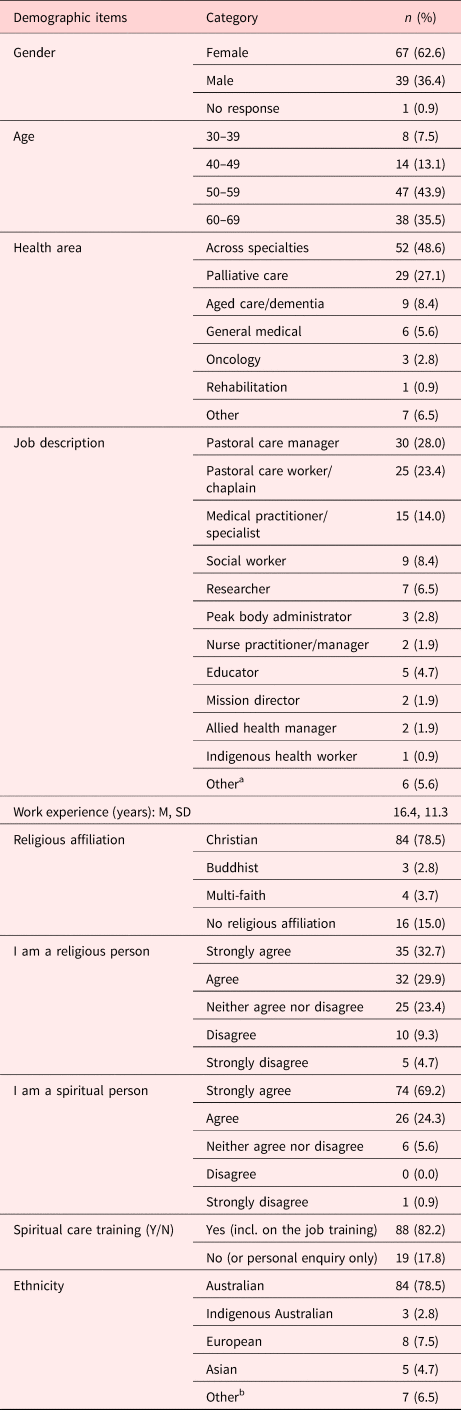
The first-round survey was completed by 107 participants (see Table 1). A total of 76 participants completed the second-round survey, and 73 completed the survey for the third round. Most participants were female, which is a typical representation of healthcare professionals in Australia (Australian Institute of Health and Welfare, 2020). Almost 80% were aged over 50, with an average of over 16 years’ experience. These figures indicate the significant life and work experience of the sample. Just over half of the participants worked in pastoral care or chaplaincy, with the remainder working as doctors, social workers, researchers, and in other health or education roles. By the third survey, the proportion of the total group working in pastoral care was slightly higher (59.7%). Although approximately one-third of the group strongly agreed they were a religious person, over two-thirds strongly agreed they were a spiritual person. Most of the participants identified as belonging to the Christian faith. Over 80% had received some form of spiritual care training, either through a course or degree, or through their employment (see Table 1).
Participant demographic details (N = 107)

a Other roles: business manager (1), bereavement co-ordinator (2), lifestyle officer (1), quality co-ordinator (1), site manager (1).
b Other ethnicity: New Zealand (not Maori) (2), North African (2), North American (1), South African (2).
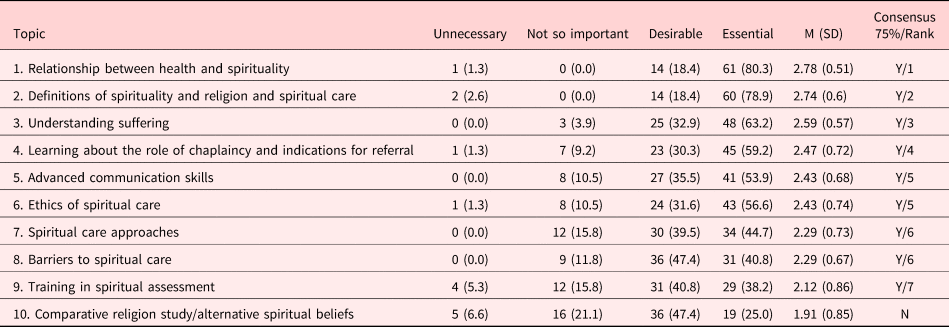
A wide range of topics were thought to be important to include in a spiritual care training program for healthcare professionals (see Table 2). Of all the identified topics, consensus was achieved on all but one; “comparative religions study/alternative spiritual beliefs,” where only 72.4% thought it was essential or desirable. The most highly ranked topic was “relationship between health and spirituality,” followed by “definitions of spirituality and spiritual care.” Other topics were highly ranked as well, indicating strong consensus.
What topics should be included in spiritual care training? (N = 76)
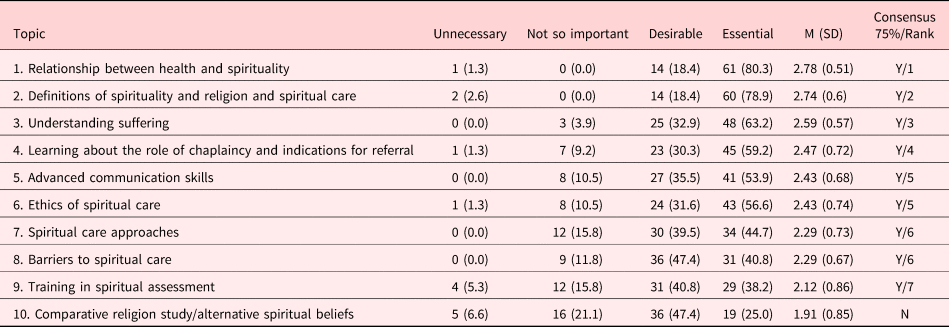
0 = “unnecessary,” 1 = “not so important,” 2 = “desirable,” and 3 = “essential.”
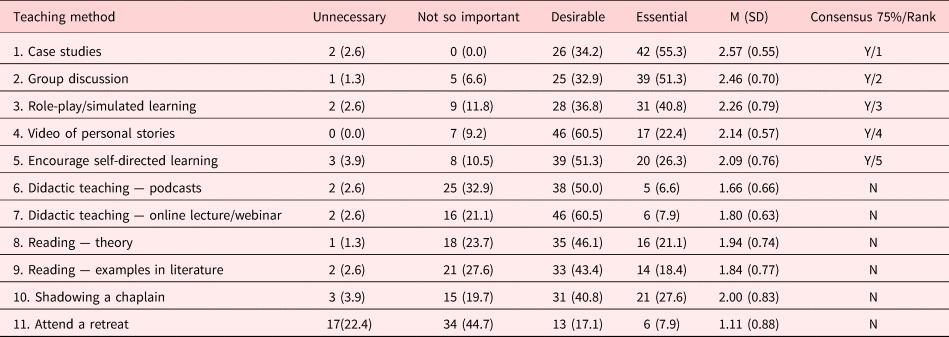
Of the ranked teaching methods (see Table 3), consensus was achieved on five items, including case studies, group discussion, role-plays and/or simulated learning, videos of personal stories, and self-directed learning. Consensus was not achieved on the items: didactic teaching (podcasts or online teaching), reading (theory or examples in the literature), shadowing a chaplain, or attending a retreat.
Which teaching methods are most appropriate for spiritual care training? (N = 70)
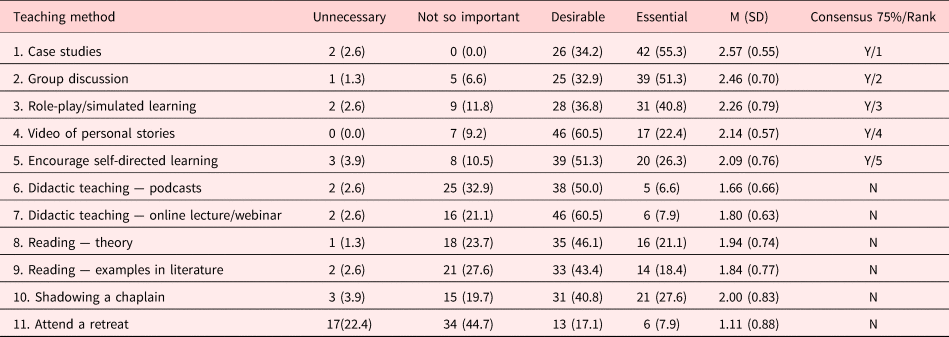
0 = “unnecessary,” 1 = “not so important,” 2 = “desirable,” and 3 = “essential.”
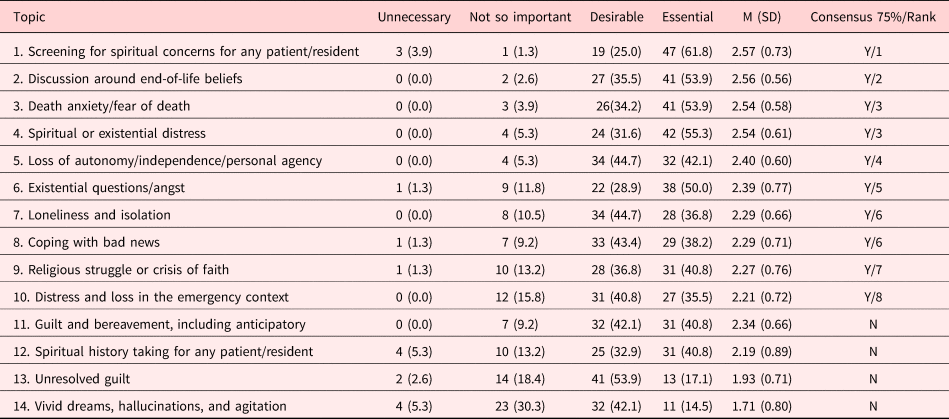
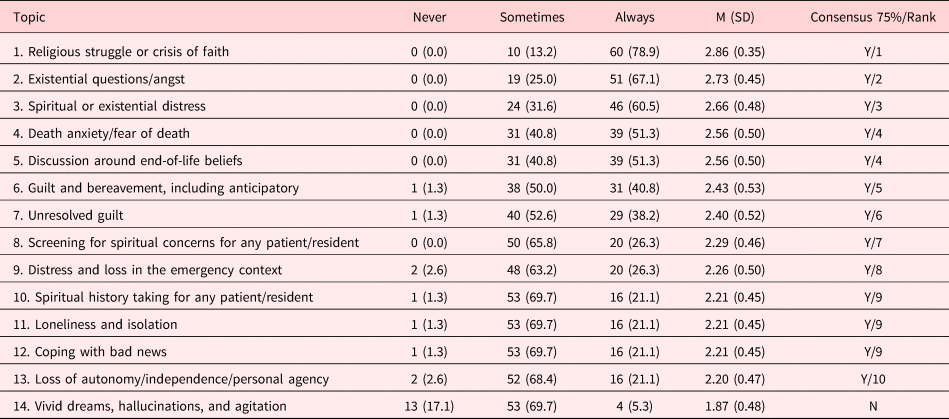
The most highly ranked clinical scenario to introduce into spiritual care training was screening for patients’ spiritual concerns, closely followed by discussions around end-of-life beliefs (see Table 4). Other highly ranked clinical scenarios to incorporate into training included those relating to existential distress and suffering, and loss of autonomy and independence. Scenarios relating to guilt, or bereavement, and experiences such as dreams and hallucinations did not achieve consensus.
Which clinical scenarios should be addressed in spiritual care training? (N = 70)
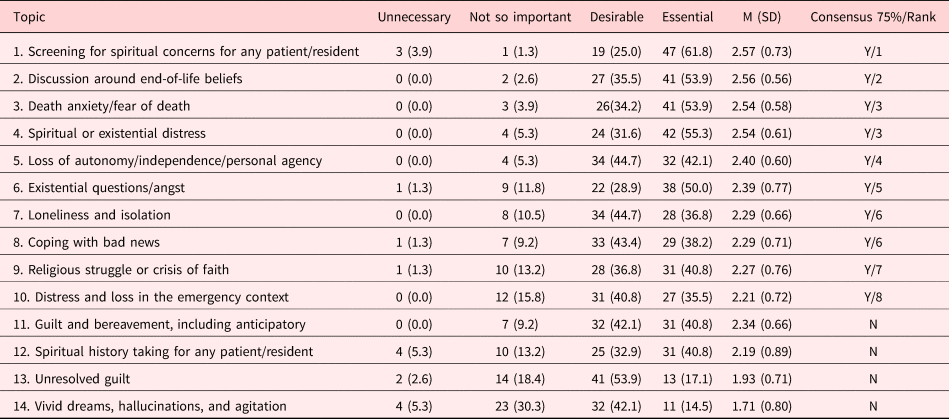
0 = “unnecessary,” 1 = “not so important,” 2 = “desirable,” and 3 = “essential.”
When asked about current assessment and referral practices in the first-round survey, participants shared a range of different spiritual history or assessment tools dependent upon their context and organization. These included the following spiritual history tools: Faith Importance Community Addressing (FICA) (Puchalski and Romer, Reference Puchalski and Romer2000), Hope Organised religion Personal Effects (HOPE) (Anandarajah and Hight, Reference Anandarajah and Hight2001), the Spiritual Personal Integration Ritualised Implications Terminal events (SPIRIT) (Maugans, Reference Maugans1996), and Faith/spiritual beliefs, Application, Influence/importance, Talk/terminal events planning, Help (FAITH) (Neely and Minford, Reference Neely and Minford2009). Also listed were the Spiritual Assessment Matrix (SAM) (Ross and McSherry, Reference Ross and McSherry2018), Ars Morendi (Leget, Reference Leget2007), and Level 1 and 2 assessments outlined by MacKinlay and Burns (Reference MacKinlay and Burns2017). When these were ranked in the second round, consensus was not achieved on any of the tools. The highest-ranked tools were HOPE and FICA, with 34 (44.7%) and 33 (43.4%) of the participants indicating that they thought they were desirable or essential to include in spiritual care training, respectively. However, approximately 40% of participants were not familiar with either tool. Other approaches did not achieve greater than 25% consensus on whether they should be included, and over half (56–72%) of the participants were not familiar with the tools.
When invited to consider which member of the multidisciplinary team should conduct the initial review of a patient or client's spirituality and assess for spiritual needs, consensus was reached on all disciplines listed (spiritual care practitioner/chaplain, nurse, social worker, doctor, psychologist, other members of allied health, whoever the patient feels comfortable with). While all participants (n = 73, 100%) indicated that a spiritual care practitioner or chaplain should undertake this review “sometimes” or “always,” the next closely ranked option was “whoever patient feels comfortable with” (n = 66, 86.8%).
When invited to rank which of the clinical scenarios listed in Table 4 should be an indication for referral to a chaplain, consensus was reached on all but one, on the basis of 75% selecting “sometimes” or “always” (see Table 5). Vivid dreams, hallucinations, and agitation were not viewed as an indication for referral to a chaplain. Strong consensus was achieved on the item “religious struggle or crisis of faith” with almost 80% agreeing that this should “always” be an indication for referral to a chaplain.
Which clinical scenarios should be an indication for referral to a chaplain? (N = 70)
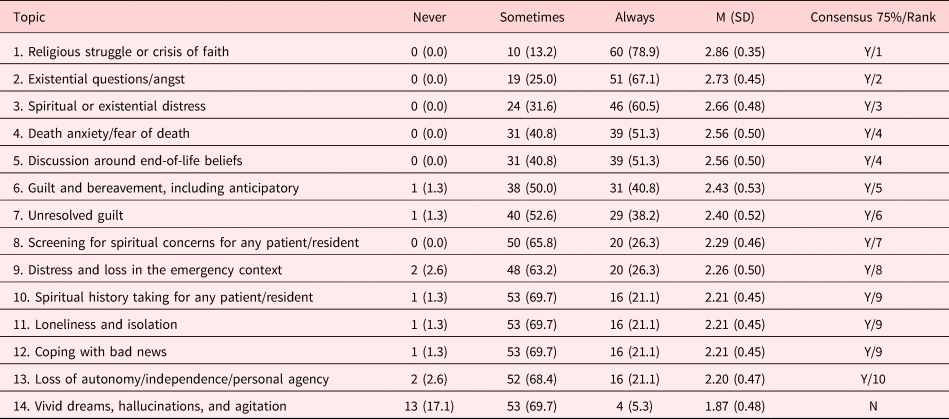
0 = “never,” 1 = “sometimes,” and 2 = “always.”
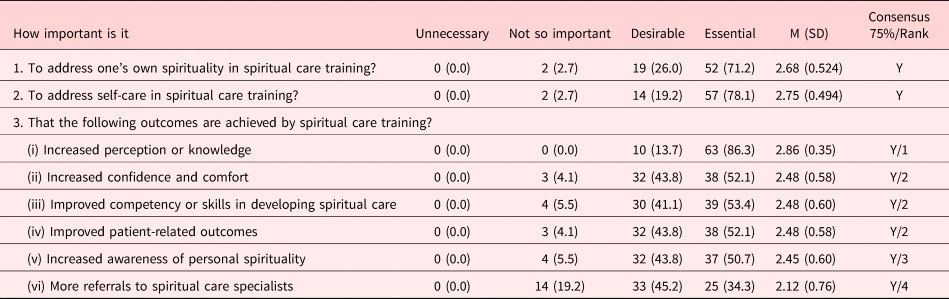
Four questions were added to the third-round survey after additional comments and responses were received in the second round. These questions invited participants to rank the importance of including one's own spirituality and self-care in spiritual care training, outcomes of spiritual care training, and the preferred duration of a spiritual care training program. Over 97% of participants indicated that addressing both one's own spirituality and self-care was desirable or essential to include in spiritual care training (see Table 6). The highest-ranked outcome for spiritual care training was perception and knowledge, followed by increased levels of confidence and comfort, and improved patient-related outcomes. All outcomes achieved consensus. Participants more frequently indicated that spiritual care training should be between 3 h and 1 week (n = 28, 38.4%), or more than 1 week but less than a year (n = 32, 43.8%). Only a few participants thought training should be less than 3 h (n = 3, 4.1%), or more than one year (n = 10, 13.7%).
How important is it to address one's own spirituality and self-care in spiritual care training? (N = 73, survey 3)

0 = “unnecessary,” 1 = “not so important,” 2 = “desirable,” and 3 = “essential.”
Discussion
We set out to identify what components should be included in a spiritual care training program for healthcare professionals. The opinions of spiritual care experts working in healthcare were sought. Strong consensus was reached on a range of components, teaching methods, and clinical scenarios to incorporate into training. Participants agreed that it was appropriate for all healthcare professionals to conduct an initial review of a patient's spirituality, with the strongest preference being spiritual care practitioners or “with whoever the patient feels comfortable.” Consensus was not achieved on what spiritual care history tools should be introduced into training.
Many of the components of spiritual care training identified in this study are similar to those identified internationally (Anandarajah et al., Reference Anandarajah, Craigie and Hatch2010; McSherry et al., Reference McSherry, Ross and Van Leeuwen2020). In a study with family medicine residents in the USA, Anandarajah et al. (Reference Anandarajah, Craigie and Hatch2010) identified a range of spiritual care competencies which included knowledge related to understanding spirituality and religion, spirituality and belief in patient care, resources, and literature; skills relating to both assessment and therapy, communication and listening, having a compassionate presence, providing spiritual whole-person care, and negotiating differences of belief; and attitudes including respect, spiritual self-awareness, spiritual self-care, and spiritual centeredness. In Europe, similar competencies have been identified encompassing intrapersonal spirituality, interpersonal spirituality, spiritual care assessment, and spiritual care interventions (McSherry et al., Reference McSherry, Ross and Van Leeuwen2020). More emphasis in this current study appeared to be placed on topics that increased healthcare professionals' understanding of spirituality and spiritual care (and ability to screen for spiritual needs), rather than specific skills in intervention. This is consistent with the preferred model of generalist–specialist spiritual care provision (Balboni et al., Reference Balboni, Puchalski and Peteet2014). This model of care recognizes that members of a clinical team have different levels of expertise. In the area of spiritual care, therefore, all members of a clinical team are able to “approach the patient as a whole person and to provide relational, dignity-based compassionate care” and can “assess the patient's physical, emotional, social and spiritual well-being and identify distress in these domains” (Balboni et al., Reference Balboni, Puchalski and Peteet2014, p. 1588). More in-depth interventions, however, are the role of the spiritual care specialist. This may vary according to context and organization. As demonstrated in a study with rehabilitation professionals, a dedicated chaplain is not always available or present on the team (Jones et al., Reference Jones, Pryor and Care-Unger2020c). In these cases, other members of the multidisciplinary team may take on a greater role (Best et al., Reference Best, Butow and Olver2016b).
Responses relating to which clinical scenarios should be incorporated into training also reflected a generalist–specialist model (Puchalski et al., Reference Puchalski, Ferrell and Virani2009, Reference Puchalski, Vitillo and Hull2014; Balboni et al., Reference Balboni, Puchalski and Peteet2014). The most highly ranked clinical scenario to include in training was a screening of spiritual concerns for any patient. Other clinical scenarios to be included were discussion around end-of-life beliefs and fear of death, which may commonly arise for all staff in the field of palliative care. Areas that did not reach consensus were unresolved guilt, guilt and bereavement, and vivid dreams and hallucinations, suggesting that these were either not considered to be associated with spiritual care, or considered to be a specialist area. This was reinforced later in the surveys when almost 80% of participants agreed that religious struggle or crisis of faith should always be an indication for referral to a chaplain.
A topic that did not receive consensus was “comparative religions study/alternative spiritual beliefs.” A recent systematic review found that this topic is not often included in spiritual care programs internationally, with only 14/55 studies incorporating such material (Reference Jones, Paal and SymonsJones et al., in press). Such findings suggest that there is a growing perception that spiritual care training should be person-centered, and that attitudes regarding understanding the person and skills in communication may be more important than learning the details of different faiths (Hilbers et al., Reference Hilbers, Haynes and Kivikko2010; Paal et al., Reference Paal, Helo and Frick2015). However, it can also be argued that for some disciplines and contexts, it is helpful for healthcare professionals to learn about different religions and cultures as part of spiritual care education. This was demonstrated in a study with undergraduate nurses (Cooper and Chang, Reference Cooper and Chang2016). The students reported benefiting from learning about the potential needs of patients from different religious and cultural backgrounds because of the multicultural nature of Australia. In another study from the UK, participants found it helpful to learn about the practices of different religions in relation to end-of-life care (O'Brien et al., Reference O'Brien, Kinloch and Groves2019). It has been suggested that it is also a topic that should be considered in countries with a high proportion of refugees (Best et al., Reference Best, Leget and Goodhead2020).
Teaching methods that were most highly ranked in this study were case studies, group discussion, role-plays or simulated learning, and videos of personal stories. A lack of emphasis on didactic teaching reveals the value placed upon interactive learning. The benefits of interactive learning have been known for some time (Knowles, Reference Knowles1990). This knowledge has been already applied to spiritual care training programs. A study with rehabilitation health professionals showed that videos of patient stories were one of the most valued components of the training (Jones et al., Reference Jones, Pryor and Care-Unger2020c). Likewise, training developed by Meredith et al. (Reference Meredith, Murray and Wilson2012) used a mix of case studies and reflection. The high ranking given to these learning approaches suggests that these teaching methods may be particularly appropriate for healthcare professionals who are accustomed to hands-on care. Furthermore, large amounts of theory may not be suitable for training healthcare professionals who are short of time.
An area where participants did not achieve consensus was regarding which spiritual care tool should be incorporated into training. The most likely reason for this is that most participants were not familiar with the list of spiritual tools generated from round one. The FICA spiritual history tool (Puchalski and Romer, Reference Puchalski and Romer2000) was ranked most highly, yet less than 50% of participants thought that including it in training was desirable or essential. Cultural variations also require consideration. FICA is a tool developed by researchers in the USA, where those reporting to hold a religious affiliation are of a higher proportion than in Australia (Pew Research Center, 2012; Australian Bureau of Statistics, 2017b). The FICA screening tool places a focus on “Faith” and may not be appropriate if patients strongly associate faith with religion. Other factors may also impact upon the willingness of practitioners to incorporate the tool into practice. In Belgium, general practitioners reported that the FICA tool was too structured and prescriptive, preferring to rely on more conversational approaches to spiritual history taking (Vermandere et al., Reference Vermandere, Choi and De Brabandere2012). This has also been identified in a study of palliative care physicians from Australia and New Zealand (Best et al., Reference Best, Butow and Olver2016a).
This study had several limitations. Over half of the sample worked in pastoral care, and almost 80% identified with the Christian faith. A greater range of disciplinary and faith backgrounds may have generated different responses in the first open-ended round. Furthermore, the response rates to the second and third surveys were considerably lower than the first survey.
Our findings suggest that spiritual care training for healthcare professionals should emphasize understanding over specific skills and seek to build strong relationships between generalist and specialist spiritual care providers. This may entail facilitating better partnerships between chaplains and other healthcare workers and enhancing awareness of the chaplaincy role. Furthermore, a range of teaching methods should be deployed. Future studies should focus upon the development and evaluation of spiritual care training to further explore these findings within a practice context.
Acknowledgment
The authors sincerely thank all those who participated in this study.
Conflict of interest
There are no conflicts of interest.