INTRODUCTION: THE ‘HYPE’ OF CREATIVE WORKSPACES
We live in an era where the primary asset of many organizations (Amabile, Reference Amabile, Conti, Coon, Lazenby and Herron1996), classes of people (Florida, Reference Florida2002), industries (Caves, Reference Caves2000; Hartley, Reference Hartley2004) and even economies (Howkins, Reference Howkins2001) is defined as creative, giving rise to categories such as ‘creative classes’, ‘creative industries’, ‘creative economies’ and ‘creative workspaces’. During the past decade, there has been increasing interest in designing the spatial context of organizations to nurture creative processes at work. Organizations strive to make their workspaces more creative with the help of consultants, architects and designers. According to Dale and Burrell (Reference Dale and Burrell2010), this is part of a common trend of companies seeking to reshape their workspaces to achieve organizational goals through spatial arrangements. Dale and Burrell (Reference Dale and Burrell2010: 19) go as far as to refer to this as ‘spatial manipulation’, which, apart from economics, also touches upon core organizational issues such as change management, communication and creativity, identifying the organization and communal spaces supporting team work and cooperation. Building workspaces that foster creativity and innovation is now used for branding purposes to attract clients, but also to appeal to potential employees and eventually, to gain competitive advantage through the spatial context.
The initial studies on space and organizational creativity were quite general, attempting to make a link between creativity and the built environment (Lindahl, Reference Lindahl2004; Lewis & Moultrie, Reference Lewis and Moultrie2005; McCoy, Reference McCoy2005) and claiming difficulty in terms of drawing any consistent conclusions. In the field of evidence-based architecture and evidence-based design (see Davis, Leach, & Clegg, Reference Davis, Leach and Clegg2011 for a review), the problem of drawing such conclusions is well recognized. In attempting to find which physical factors influence organizational creativity, the importance of open workspaces is highlighted in some studies (Kristensen, Reference Kristensen2004; Dul & Ceylan, Reference Dul and Ceylan2011; Sailer, Reference Sailer2011), while others focus more on the use of visual models, creative tools, and other material objects and artefacts influencing creativity (Carlsen, Clegg, & Gjersvik, Reference Carlsen, Clegg and Gjersvik2012; Doorley & Witthoft, Reference Doorley and Witthoft2012). Finally, studies on creativity and workspaces suggest that office design may stimulate creativity indirectly, thus creating a favourable organizational culture (Haner, Reference Haner2005; Kallio, Kallio, & Blomberg, Reference Kallio, Kallio and Blomberg2015). These studies examined employees’ or managers’ perceptions of their creativity in the designed workspaces.
Descriptions of the designs of creative workspaces are scarce, except for articles in popular magazines highlighting companies because of their ‘creative’ office designs. On the internet, many companies claim to have designed workspaces to enhance creativity. These corporations are in different fields, such as IT, law, advertising, software and games development, toys, beauty equipment, and sports and beverages, just to mention a few. It seems that building ‘creative workspaces’ has become a hype – at least for companies that wish to be perceived as creative and innovative. The purpose of this article is to critically explore these ‘creative workspaces’ to better understand what kind of symbolism and themes they entail and to discern the underlying assumptions of how workspace designs and organizational creativity are connected.
The following research questions guide our analysis: first, what kind of visual and symbolic cues and designs do the ‘creative workspaces’ entail, and second, how are these spatial designs connected to organizational creativity?
The exploration of space and organizational creativity draws on the recently revived interest in the spatial aspects of organizational life (Clegg & Kornberger, Reference Clegg and Kornberger2006; Dale & Burrell, Reference Dale and Burrell2008; van Marrewijk & Yanow, Reference van Marrewijk and Yanow2010) and more broadly to a ‘material turn’ in organization studies (Barad, Reference Barad2003; Dale, Reference Dale2005; Orlikowski, Reference Orlikowski2007; Carlile, Nicolini, Langley, & Tsoukas, Reference Carlile, Nicolini, Langley and Tsoukas2013). Dale and Burrell note that ‘in the recent years there has been a movement in the conscious design of workplaces to achieve certain values and business goals through the manipulation of space’ (Reference Dale and Burrell2008: 9). The study of physical space has a long and rich tradition in the field of organizational culture as an artefact (Gagliardi, Reference Gagliardi1990; Rafaeli & Vilnai-Yavetz, Reference Rafaeli and Vilnai-Yavetz2004; Vilnai-Yavetz, Rafaeli, & Schneider-Yaacov, Reference Vilnai-Yavetz, Rafaeli and Schneider-Yaacov2005). Spaces have been found to influence and shape behaviour through the structural qualities of office space used instrumentally, but also through the symbolic and cultural aspects of artefacts (Rafaeli & Vilnai-Yavetz, Reference Rafaeli and Vilnai-Yavetz2004) and through people’s subjective experiences of space (Ropo, Salovaara, Sauer, & De Paoli, Reference Ropo, Salovaara, Sauer and De Paoli2015).
Our study proceeded inductively by starting with empirical observations on what were claimed to be ‘creative workspaces’ on the internet, after which we descriptively analysed their symbolic and design elements. Our further analysis concerned what these designs would mean in relation to literature on space and organizational creativity, and what kinds of assumptions about space and organizational creativity the workspace arrangements might entail. We identified symbolic themes, such as home, sports and play, technology, nature, and symbolism, which were typically ingrained in the idea of a creative workspace. The themes were assumed to be connected to organizational creativity in different ways. Finally, we concluded to some contradictions on the assumptions on space and organizational creativity in relation to the current literature.
LITERATURE ON ORGANIZATIONAL CREATIVITY AND WORKSPACES
Organizational creativity refers to the production of novel, useful ideas or products that are more or less appropriate and useful in a given situation (e.g., Mumford & Gustafson, Reference Mumford and Gustafson1988; Amabile, Reference Amabile, Conti, Coon, Lazenby and Herron1996; Mumford, Reference Mumford2003) and for the process of producing something that is both original and worthwhile (Amabile, Reference Amabile, Conti, Coon, Lazenby and Herron1996; Csikszentmihalyi, Reference Csikszentmihalyi2007). Research on organizational creativity started with psychological studies of individuals’ creative minds and personality traits (see Amabile, Reference Amabile, Conti, Coon, Lazenby and Herron1996 for a comprehensive review). This stream of research can be categorized as the ‘person-centric creativity research’, which assumes that organizational creativity can be reduced to individual qualities. Gradually, the understanding of organizational creativity as a more multifaceted and complex phenomenon than that residing in talented personalities led to the application of contextual and environmental perspectives (Csikszentmihalyi & Sawyer, Reference Csikszentmihalyi and Sawyer1995). This latter stream of research, which is currently more dominant, can be defined as ‘contextually oriented creativity research’, which pays attention to the wider environment for stimulating creativity. Here, creativity occurs in the interaction between the individuals and a combination of a number of societal, cultural and organizational factors as well as between the individual, group and organizational levels (Amabile, Reference Amabile, Conti, Coon, Lazenby and Herron1996; Amabile, Conti, Coon, Lazenby, & Herron, Reference Amabile1996; Styhre & Sundgren, Reference Styhre and Sundgren2005; Csikszentmihalyi, Reference Csikszentmihalyi2007; Mumford, Reference Mumford2012). The few studies examining creativity from a spatial perspective belong to this latter contextually oriented creativity research.
The interest in workspace design has been growing and can be seen somewhat parallel to the emerging aesthetic approach to organizing that started to evolve in the late 1980s (Gagliardi, Reference Gagliardi1990; Strati, Reference Strati1992). While noting the increased interest in space as a contextual element influencing organizational behaviour (Orlikowski, Reference Orlikowski2007; Dale & Burrell, Reference Dale and Burrell2008; van Marrewijk & Yanow, Reference van Marrewijk and Yanow2010), Yanow (Reference Yanow2010) argues that space has still been largely neglected in organization and management studies, and she calls for heightened sensitivity towards spatial arrangements.
After organization researchers started to increasingly pay attention to space in the early 2000, the streams of research in facility management, architecture, environmental psychology and real estate have since been growing. Researchers studying the effects of office space design from a facility management perspective have predominantly investigated employee satisfaction, communication or knowledge sharing (Kampschroer & Heerwagen, Reference Kampschroer and Heerwagen2005; Maarleveld, Volker, & van der Voordt, Reference Maarleveld, Volker and van der Voordt2009; Appel-Meulenbroek, Reference Appel-Meulenbroek2013). Dul and Ceylan (Reference Dul and Ceylan2011) state in their review that workplace design has been analysed from the perspectives of workplace safety, well-being and ergonomics, mainly concerning physical factors such as indoor plants, windows, colours, lights, materials, physical arrangements, furniture and other artefacts. The study of organizational creativity from a spatial perspective is rather limited, maybe because of the difficulty in drawing conclusions on the design of workspaces linked to employee creativity (Lindahl, Reference Lindahl2004; Lewis & Moultrie, Reference Lewis and Moultrie2005; McCoy, Reference McCoy2005; Vischer & Zeisel, Reference Vischer and Zeisel2008).
There is, however, an increasing number of studies referring to the physical aspects of creativity (Kristensen, Reference Kristensen2004; Lindahl, Reference Lindahl2004; Shalley & Gilson, Reference Shalley and Gilson2004; Lewis & Moultrie, Reference Lewis and Moultrie2005; McCoy, Reference McCoy2005). Most studies arise from different fields of research, ranging from social psychology, environmental psychology and architecture to facility management and organizational research on creativity. This makes it difficult to compare previous research as the theoretical assumptions and methodological approaches vary.
Being aware of this heterogeneous background, we categorize the previous research into three groups: first, studies examining organizational creativity and space indirectly through the analysis of how space influences communication, social relations or organizational culture. These are factors that may all lead to higher levels of organizational creativity (Allen, Reference Allen1977; Kristensen, Reference Kristensen2004; Kallio, Kallio, & Blomberg, Reference Kallio, Kallio and Blomberg2015). Second, studies focussing on tools, visuals, furniture and other material elements inducing or stimulating organizational creativity (Haner, Reference Haner2005; Carlsen, Clegg, & Gjersvik, Reference Carlsen, Clegg and Gjersvik2012; Doorley & Witthoft, Reference Doorley and Witthoft2012), and third, studies examining specifically designed spaces for creativity such as ‘innovation labs’ and other kinds of especially ‘creative’ workspaces (Vithayathawornwong, Danko, & Tolbert, Reference Vithayathawornwong, Danko and Tolbert2003; Lindahl, Reference Lindahl2004; Lewis & Moultrie, Reference Lewis and Moultrie2005; McCoy, Reference McCoy2005; Magadley & Birdi, Reference Magadley and Birdi2009; Williams, Reference Williams2009; Martens, Reference Martens2011; Sailer, Reference Sailer2011; Bisadi, Mozaffar, & Hosseini, Reference Bisadi, Mozaffar and Hosseini2012). We will review these three streams of research in the following.
Group 1: Studies examining organizational creativity and space indirectly
From a contextual perspective on creativity, communication in teams or between multidisciplinary people is considered important for creativity and innovation (Amabile, Reference Amabile, Conti, Coon, Lazenby and Herron1996). This may be one of the reasons why both creative spaces and research on space and creativity focus on open, interactive office layouts and proximity between people. Studies on space and organizational communication have found that people are more likely to communicate with colleagues in their vicinity and that face-to-face interaction declines rapidly after a distance of 30 m (Allen, Reference Allen1977; Allen & Henn, Reference Allen and Henn2007). Perceived distance created by staircases also influences communication (Allen, Reference Allen1977). Allen and Henn (Reference Allen and Henn2007) describe the trumpet model of the product development process and the different spatial requirements, especially flexibility, through different phases (Allen & Henn, Reference Allen and Henn2007).
An extensive study on the relocation of a newspaper company (Kallio, Kallio, & Blomberg, Reference Kallio, Kallio and Blomberg2015) revealed that careful choice, planning and design of the organization’s location, layout and style can stimulate openness, equality and collectivity, all of which are found to be conducive to organizational creativity. The most important factor advancing openness seemed to have been the new division of space in the newspaper company. The fact that there were now only two floors and that all departments shared an open space instead of being physically separated by walls brought people physically closer together, resulting in increased interaction and knowledge creation. These are seen as prerequisites for creativity. A short description of their new facilities follows:
Compared to the old premises, one could point out that the customer entrance had undergone a considerable facelift. The previous, bank-like, timeworn and crowded desks were replaced with a trendy, hotel lobby feel through ever changing photograph exhibitions …. In between the ground floor and the first floor, with a view to the river, there is a ‘News Bistro’ – a smaller lounge area for employees. At the entrance to the first floor is the heart of the physical layout of the premises, ‘the Playground’. It is an inviting lounge where employees can gather for both formal and informal meetings, have coffee breaks, read newspapers and magazines, etc. The personnel working on the first floor recognised the importance of the Playground as a space that reduces barriers between groups and makes co-workers more familiar with each other, which, for its part, has had a positive effect on the organisational culture. (Kallio, Kallio, & Blomberg, Reference Kallio, Kallio and Blomberg2015: 398)
This comprehensive study on how a change of office space influences creativity indirectly by changing the organizational culture and practices shows that the physical work environment truly plays a significant role in promoting organizational creativity.
In conclusion, we can say that the examined studies hold a strong allusion that workspace arrangements that allow and encourage interaction and communication between people and that provide different kinds of spaces for different functions also afford organizational creativity to grow.
Group 2: Studies examining material elements to stimulate organizational creativity
According to Haner (Reference Haner2005), cognitively and perceptually stimulating workspace environments can enhance creativity. Furthermore, Csikszentmihalyi (Reference Csikszentmihalyi2007: 136) states that prepared minds in beautiful settings are more likely to find new connections amongst ideas and new perspectives on issues they are dealing with.
Recent studies on workspace design and creativity suggest that the use of visual models, creative tools, prototyping, and other material objects and artefacts influence creativity, as well as a multitude of fun, colourful tools to support creativity. These can be different kinds of tables, seating arrangements, whiteboards, screens, writeable surfaces, team spaces, toolkits and displays:
Regardless of whether it’s a classroom or the offices of a billion-dollar company, space is something to think of as an instrument for innovation and collaboration. It’s not an initial, given condition, something that should be accepted as is. Space is a valuable tool that can help you create deep and meaningful collaborations in your work and life. (Doorley & Witthoft, Reference Doorley and Witthoft2012: 5)
Kristensen (Reference Kristensen2004) illustrates this in a case study on how space can support the different stages of the creative process. An interdepartmental project team had a studio space available next to their departmental workstations. The studio space included a big room and clustered workshops. The study shows how the studio provided the opportunity for models and visualizations to be made on the spot.
There seems to be a common understanding that space and material tools matter in advancing creative processes. This needs to be considered, as noted in the studies in the field of design (Doorley & Witthoft, Reference Doorley and Witthoft2012) and in different knowledge-intensive industries (Carlsen, Clegg, & Gjersvik, Reference Carlsen, Clegg and Gjersvik2012). Doorley and Witthoft (Reference Doorley and Witthoft2012) write about how space can be staged for creative collaboration and they present alternative tools and arrangements to inspire creativity. Their overall idea is that space matters for creativity, but that it needs to be defined, shaped and decided upon by the people doing creative work. They believe creative processes need to be bottom-up by engaging the people to contribute and avoid managerial or authoritative steering, in classrooms as well as in organizations. Carlsen, Clegg, and Gjersvik. (Reference Carlsen, Clegg and Gjersvik2012) broaden the view on creative processes or ‘idea work’ to include both prepping, zooming out, wonder, drama, prototyping, laughter, shaping, resistance and lastly, also materializing the ideas and processes. The use of pictures or drawings, sketches, miniature models and other material tools are considered as an important aspect of creative work, whether it is engineering, architecture, design #or knowledge-based consulting, where their research was carried out.
Group 3: Studies examining specifically designed spaces for creativity
Studies examining specifically designed spaces for creativity such as ‘innovation labs’ are rather rare (Lewis & Moultrie, Reference Lewis and Moultrie2005; Magadley & Birdi, Reference Magadley and Birdi2009). Here, we need to bear in mind that studies emphasizing the role of various material elements in creative work (group 2 in our categorization) are mostly about organizations and fields that are commonly viewed as ‘creative’ such as the media, architecture and design, or consultancy, and where spaces may be especially designed for creative work. In this sense, studies in groups 2 and 3 are not quite exclusive. However, in addition to the more specific aesthetic and material aspects of workspaces and creativity discussed in group 2, we next address some more general considerations pointed out in studies on spaces designed especially for creative work.
Sailer (Reference Sailer2011) did a study on a media company before and after a relocation and refurbishment project. She developed two criteria for creativity in workplaces: first, spaces for chance encounters with people from different teams are needed for creativity, and second, a balance between spaces for communication and concentration is needed for creativity. Using a mixed-methods research design, the case study included structured interviews, satisfaction surveys, social network surveys, space observations and a Space Syntax analysis of floor plans. The study showed that only the first criterion was successfully met in the media company. She said that due to some situational industry-related pressures, the second criterion was not fully implemented. However, her study highlights the importance of bringing people together to enhance creativity and to balance spaces for communication and for concentration. The author is cautious about drawing any consistent conclusions on the relationship between designing spaces for creativity and calls for more research.
Bisadi, Mozaffar, and Hosseini (Reference Bisadi, Mozaffar and Hosseini2012) studied how architecture and urban design researchers would build an academic research centre while being aware that researchers in those fields are particularly sensitive to the physical environment. They were able to identify four influential spatial characteristics: privacy, beauty, spatial diversity and proximity. Their analysis suggests locating individual offices (to secure privacy) close to each other to increase chance interactions and communication on the stairs, in corridors and in elevators. They also found that natural elements in interior design were considered aesthetically pleasing and that they facilitate creative thinking. The diversity of spaces referred to having different furniture for different activities and spaces to work in the office: a desk, a sofa and a hammock. Bisadi, Mozaffar, and Hosseini. (Reference Bisadi, Mozaffar and Hosseini2012) also found that designed common spaces were perceived to increase creativity: connectedness and the continuity of open and closed spaces were found to enhance visibility and the sense of proximity. Furthermore, they recommend designing special places for ‘gathering, chatting, playing and exercising’ (Bisadi, Mozaffar, & Hosseini, Reference Bisadi, Mozaffar and Hosseini2012: 241).
In his review article, Martens (Reference Martens2011) has characterized the literature on space and creativity as fragmented and poorly developed. He found some connections between the physical workplace and creative processes, creative interactions, flow and creative thinking. He complemented the literature review with interviews of creative professionals that reinforced the literature on a number of occasions. One finding was that stimulating a creative culture through the organization’s identity seems important. Moreover, recognizing the symbolic dimension of the physical workplace for creativity as well as the importance of sharing and developing knowledge were noted. What was important was that managers worked in the same open-plan area, presented their work (visuals and models) and that there was a buzzing atmosphere with people interacting and moving around. The study also pointed out that the places for creative thinking were diverse. Most did their creative thinking during moments of relaxation: in the shower, while running, in the middle of the night, on the way home, on a train, on a bus or on a bicycle. Some would just think in the office while sketching or when away from their computer at an informal meeting table. The study emphasized that the relation between creativity and the physical workplace depends on individuals’ perceptions.
Our brief overview of a variety of studies examining the relationship between organizational creativity and physical space either indirectly or more directly does not warrant a causal or determined relationship. However, there seems to be a certain kind of consensus that spaces that allow frequent encounters with other people are beneficial for creativity and that it helps if the material tools needed for idea generation and sharing are readily available. Additionally, a stimulating and aesthetically pleasing environment is often mentioned in relation to creativity. Overall, physical space arrangements, their aesthetic aspects and material objects seem not only to afford concrete conditions for creative work, but also to carry symbolic values that are subjectively experienced and thus difficult to anticipate, control or manage (Dale & Burrell, Reference Dale and Burrell2008; van Marrewijk & Yanow, Reference van Marrewijk and Yanow2010; Ropo et al., Reference Ropo, Salovaara, Sauer and De Paoli2015).
RESEARCH METHOD AND EMPIRICAL MATERIALS
Many companies have built ‘creative workspaces’ to provoke and nurture creativity and innovation. During the past decade, this has become even a trend. To our surprise – and slight irritation – we found a certain kind of uniformity in these spatial settings.
The companies that occupy a carefully designed office space are typically well-off tech companies that need to compete for the best employees and hold on to the talent they already have. Another type of companies that typically pay attention to the office space and design are the so-called creative companies, such as advertising, branding and architecture.
Despite the variety of companies that have chosen to build creative workspaces, the aesthetics of the spaces seem to follow a standardized understanding of creativity. Pictures of company headquarters suggest that creative workspaces are typically designed to create moments of happy and playful community or team building, flexible and informal communication, and artful, childlike, fun and trendy work. We started to wonder why they looked the way they did and, furthermore, why this irritated us as scholars. Companies building creative workspaces often state that they want to enhance creativity, but little is explicated as to how this was supposed to happen through the spatial arrangements.
Our irritation stemmed from a preunderstanding of creativity as a broader social phenomenon that can occur in various environments and under various conditions. For example, an actor’s work in a theatre may be considered creative and still, the rehearsing most often takes place in a dark room backstage where the walls are covered with black materials and messy stuff lying around (Salovaara, Reference Salovaara2014, 26:26). Or, researchers’ most fruitful collegial communication may take place sitting on a worn-out sofa instead of in a newly designed ‘community room’ (Dale & Burrell, Reference Dale and Burrell2015). The workspaces displayed as creative on the internet were very different from these scholarly examples. The conformity of the internet images made us think that there had to be a somehow taken-for-granted managerial discourse that creativity blossoms in certain kinds of physical spaces. In methodological terms, our interest was not on ‘matters of fact’, but on ‘matters of concern’, as Kreiner (Reference Kreiner2010: 200) puts it. This means that our focus was not on creative spaces as a matter as such, but on their context and the multiplicity of meanings they render. We sensitized ourselves to holistic sensuous experiences and imagined how it might feel to work in the pictured workspaces. Strati (Reference Strati2007) calls this sensible knowledge development and argues for its scholarly relevance. Unlike Strati, who emphasized the sensory faculties of touch and hearing, we had to rely on our sight, imagination and empathy as well as on our own experiences in working in different spaces.
We decided to undertake a more systematic search on the internet with the keywords ‘creative workspace’ and ‘inspirational office’. As the reader can imagine, even the search engine Google provided a huge number of images (close to two million images in less than a second). We searched several internet pages (see references), and to create a reasonable sample for analysis, we finally chose 40 pictures. Our main criterion for choosing especially those 40 images was because the offices, typically company headquarters, were defined as creative on the internet page blurbs by the companies themselves. In addition, the images seemed to intuitively follow the same type of pattern.
When gazing at the images of the self-acclaimed creative spaces, saturation was reached at some point. Certain themes, designs and atmospheres kept on repeating. The images started to resemble each other in a way that we could not quite put our finger on and wanted to take a closer look.
Methodologically, our approach follows the ‘basic thrust of social constructionism’ as Hacking (Reference Hacking1999) and Alvesson and Sköldberg (Reference Alvesson and Sköldberg2009: 24) define it. First, social constructionist studies regularly begin with a self-evident truth. In this case, the empirical finding that certain kinds of designed creative spaces are believed to nurture employee creativity and foster innovation seems to be taken as rather self-evident. Second, social constructionist studies claim that things do not inevitably need to be that way. In this case, the proclaimed creative spaces (as is with any spaces) can also hinder creativity. More specifically, the notion of designed creative workspaces holds to the idea of creativity as something that can be deterministically influenced or ‘managed’ from outside the occupants of the space.
After colour-printing the internet images, we had a lengthy and vivid discussion on them. We paid attention to the size of the buildings or the spaces, to forms and materials used within, and to the decoration and artefacts (or the absence of them). Furthermore, we also considered how the pictures of the spaces made us feel and what kinds of emotions or memories they evoked. We tried to imagine ourselves in the spaces. We grouped the spaces into five distinct categories according to their appearance and what the spaces apparently signalled: (1) home; (2) sports and play; (3) technology; (4) nature and relaxation; and (5) symbolism, history and heritage. This categorization was our first round of analysis.
The five categories made us wonder why there was such uniformity in the spatial images. ‘Creativity’ seemed be located within rather limited boundaries. Problematizing this led us to the next phase, where we turned to the literature on creativity, space and organizing. This resulted in the second round of analysis, where we were able to see some contradictions in the creative space images, thus confronting the values and ideas that are supported and maintained through these particular constellations.
Dale and Burrell (Reference Dale and Burrell2008: 43) state that the ‘built world we inhabit tells us narratives, stories about ourselves and the societies that we live in’. In our study, theory and practice are linked in the ways in which space is displayed and utilized. Panayiotou and Kafiris (Reference Panayiotou and Kafiris2010) have analysed company spaces in films, and according to their study, the built environment and spatial practices tell a story about ‘power’. They came up with dimensions such as the geographic location (prominent–basic industrial), size, scale and the materials of the building (big–small, tall–small, expensive–modest), doors and windows (separating–connecting) décor and furnishings (style, colours).
We modified the dimensions slightly to see which dimensions tell a story of ‘creativity’ and if the dimensions render other aspirations or boundaries as well. Instead of spotting a gap in the existing literature, we rather view our research as having evolved through problematizing (Locke & Golden-Biddle, Reference Locke and Golden-Biddle1997; Alvesson & Sandberg, Reference Alvesson and Sandberg2011) and doubt (Locke, Golden-Biddle, & Feldman, Reference Locke, Golden-Biddle and Feldman2008). We reflected on our own cultural position, other stances and the literature. By looking at the images, we concluded that there seemed to be a consensus amongst architects, designers and managers that with distinct spatial solutions, one can influence and nurture creativity. However, the research literature is far more careful, claiming that the relationship between creativity and space is too complex to draw any causal relationships, but that some spatial solutions, such as enabling communication and interaction, may be beneficial for creativity.
We are aware that as seasoned organization scholars in a white European culture, we tend to interpret and understand the world around us in a certain way. We cannot claim that everyone and all the users or viewers of these workspace images would have the same connotations and come to the same conclusions as we have. We recognize that as scholars we have personal histories of studying leadership, organizational aesthetics, embodiment and creativity, and we understand that this background and our personal experiences influence our interpretations (van Marrewijk & Yanow, Reference van Marrewijk and Yanow2010: 8).
Another limitation of our study is that the sample of the images came from the internet. Now that our analysis is based on these images, they can be considered as indirect rather than direct observations by us. A further limitation is that even if the companies emphasized that they wanted to stimulate creativity through the designed spaces, they may have also other intentions that are difficult to discern with a short glance of the images.
Next, we will move to analyse the spatial elements and themes in the images of the designed creative spaces in more detail.
ANALYSIS OF THE SPATIAL ELEMENTS AND THEMES OF THE DESIGNED CREATIVE SPACES
Karaoke rooms, fire poles, slides and swings, aquariums, gyms, massage rooms and saunas. You name it. Modern office design is whimsical to say the least. As discussed, the logic behind this unprecedented attention to office design seems to arise from the assumption that creativity and the physical environment have a connection. To investigate this further, we looked at the images of modern offices. The images of the designed creative places taken from the internet were from different companies but displayed a certain kind of homogeneity, although the symbolic artefacts and interior decorations varied. One could easily see that the office images were different from regular offices as they were far more colourful, artistic, informal and playful, even childish. They could just as well have been pictures taken from homes, leisure or sports retreats, wellness centres, kindergartens or progressive schools. This seems to be an overall trend in office design according to Dale and Burrell (Reference Dale and Burrell2010), who have also noted how offices have lost their traditional workspace characteristics:
… The main themes include play or fun at work … the employee as consumer, the workplace as home and the workplace as community. These themes incorporate an aestheticization of the workspaces, consciously designing them to produce pleasurable and sometimes sensuous effects. This is combined, almost ironically, with the disappearance of the workplace itself as a workplace. (Dale & Burrell, Reference Dale and Burrell2010: 20)
Dale and Burrell (Reference Dale and Burrell2010) are critical organization scholars who view workspace from a power and control perspective: the employer provides certain kind of workspace to maintain control of workers. Following this line of thinking, building ‘creative workspaces’ may be considered as employer’s manipulation of workers’ behaviour. Our examination of the creative workspace images shows that certain elements and themes were repeated. We categorized these images as follows:
1. Home
2. Sports and play
3. Technology: imaginative future and past
4. Nature and relaxation
5. Symbolism, heritage and history
Several of these images seem to have lost, as Dale and Burrell (Reference Dale and Burrell2010) note, the traditional workspace looks. From a critical perspective one might see these spatial arrangements as various efforts of manipulation. From an aesthetic design perspective the creative workspace images convey an idea of freedom and spatial flexibility, a freedom from traditional workspace settings (Ropo et al., Reference Ropo, Salovaara, Sauer and De Paoli2015). In the next sections, we describe in more detail how the spatial designs were represented in the images and reflect on their connection to organizational creativity.
Home
The home theme came up often in the company blurb and images describing creative workspaces. One could see homemade traditional rugs on the floors and rocking chairs like in Norman Rockwell’s (en.wikipedia.org/wiki/Norman Rockwell) or Carl Larsson’s paintings (en.wikipedia.org/wiki/Carl Larsson). Some companies have hired an office grandma or an office grandpa to be present in the office (Online Appendix 1, Image No 1, http://lymed.fi/2016/02/17/toimistomummo). Her/his task is to make coffee, perhaps cook or bake cookies, and even take care of the children of the employees if needed. Her/his presence was said to bring warmth to the atmosphere and emphasize feelings of being nurtured and cared for. Somewhat ironically, this caring discourse may be seen to indicate that if there is enough ‘service’ people in the homey workplace, more time and energy is left for creative work. In fact, many of us have surely had the experience that doing mundane routines at home do the same trick: some enduring puzzles may be solved or new ideas surface.
We saw many huddle rooms where cosiness is central (Image No 2, https://x.smu.edu.sg/huddle-rooms-space). Cosiness and a homely feeling were created with baskets filled with different colours of wool yarn and knitting needles (Image No 4 in the Appendix, Picture 18 in the link http://www.designjuices.co.uk/2011/03/20-inspirational-office-workspace-designs). The images led us to believe that people were being encouraged to craft something during the workday if sitting in front of the computer became too tiring. Many times, especially for knowledge workers, doing something concrete with hands, like knitting, gardening or shovelling snow gives a quiet moment for brains (and body) to work on something else but intellectual tasks. This is not to say that the mentioned chores would not call for intellect, but connected to the use of physical body makes the effort more holistic and possibly fuels creativity in a different way than by just facing the computer screen.
The kitchen is traditionally constructed as the heart of the home, and the heart of the kitchen is a big kitchen table (Image No 3, https://www.bostonglobe.com/business/2012/05/09/office-renovations-feature-open-space-natural-light-play-areas/A55Xw4icRpp26cqFarMAuI/story.html). A communal kitchen table reflects a feeling of togetherness, warmth and mutual trust. The staff of companies such as Ammunition (http://www.ammunitiongroup.com) and the staff in the office of Louise Campbell (www.louisecampbell.com) (a designer) gather around a big table either to eat, work or both, at least once a week, some every day. In addition, in the architectural firm Snöhetta, people gather to eat lunch at a long communal table every day (Image No 18, http://www.metropolismag.com/Setting-the-Table/). Eating together is a homely ritual to build mutual dependence and trust, where the informal exchange of information and experiences takes place. In a small IT company, Frantic, 35 people gather around a long, massive wooden table on Mondays and Fridays. Monday morning breakfast serves the purpose of planning the week, whereas Friday is about getting off for the weekend and summarizing the week (Salovaara, Reference Salovaara2014, 4:57).
In addition to large tables and lounge areas, there are often shared workspaces, negotiation rooms or other spaces that are meant for being together and collaboration. They may have large whiteboards, comfortable soft chairs or beanbags, as in Pallotta Team Works (Image No 23, http://inhabitat.com/la-warehouse-office-is-a-shipping-container-city/pallotta-teamworks-6/) or as in Three Rings (Image No 24, http://www.becausewecan.org/Office_interior_with_custom_desks) or even a huge hammock, as in Google’s Pittsburgh office (Image No 25, https://www.pinterest.com/pin/162481499030349939/). The traditional offering for collaboration is a large table that has enough space for everyone in the organization, referring to inclusion like a home. A quite unique solution for gathering is a wide staircase that functions as an auditorium (Image No 26, https://www.pinterest.com/pin/421508846347561563/).
Another element for a comfortable and safe environment provided by a home like office is privacy, with the possibility of moving between interaction and solitude, as desired. Having one’s own room, cubicle, screen or at least one’s own desk traditionally offers some privacy. However, in the current open office concept, there are often no fixed workstations. People come to work and choose (if there are options left) where they want to work. Privacy is produced with a set of rules and behavioural codes, for example, by prohibiting people from talking to each other or using their phones in specific spaces.
A critical reflection to having home like workspaces concerns blurring work and free time. One might ask, if people are supposed to work longer hours in the spatial illusion of home although being still in fact in office. Also, the emphasis on having various spaces for meeting people and collaboration in a homey workspace raises questions, because for many professionals working on complex intellectual issues, socializing is rather a burden than a relaxing activity.
Sports and play
Play and playfulness add to the atmosphere of a carefree childhood or may refer to the rebellious teenage years. Imagine a space that looks like a fraternity house with all the cheerful noise (Image No 37, www.Uberflip.com). Flippers, skate ramps and computer games belong to a playful office. The Australian company SafetyCulture has a basketball court, swimming pool, animals and a cinema (Image No 5, https://safetyculture.com/files/newsroom/dailymail-article1.pdf). Google’s office in Amsterdam offers a room for gymnastics and for table football (Image No 6, https://www.fastcodesign.com/3039748/the-10-coolest-office-spaces-of-2014).
In the office of Missing Link, they have a fireman’s pole to quickly move from one floor to another (Image No 7, http://soyouknowbetter.com/2013/10/04/some-of-the-worlds-coolest-offices/) and in LinkedIn, Canada, there are scooters to literally surf around the large office (Image No 8, http://torontolife.com/style/toronto-coolest-office-spaces-linkedin-canada).
An interesting question arising from these office playgrounds is why there are more boys’ toys and activities than traditional girls’ toys such as dolls, Barbie dolls, ballerinas, dolls’ houses and cuddly animals.
The office space images support the idea that regular physical exercise is considered important (Image No 11, http://www.hometrendesign.com/cool-google-emea-engineering-hub-office-in-zurich-switzerland-architects-by-camezind-evolution; Image No 10, http://geek-mag.com/posts/144596/). Offices often have their own gym with treadmills or bicycles where the staff can exercise (Image No 9, https://www.fastcodesign.com/3038625/this-office-has-a-running-track).
Based on the images, the underlying discourse is that accomplishments in sports are not considered as a waste of time, but rather as a valuable asset to increase one’s value in the job market. As an example of this, one can constantly read stories of top managers having marathon running as their hobby. Physical conditioning and testing has become part of the regime. Whether this truly creates a community feeling and sense of belonging that would foster collaboration, knowledge sharing and thus creativity and innovation, or whether the sports enthusiasm merely enhances competition with no connection to creativity remains vague. Being in good shape and having a competitive mind in sports seem to equal being a good boss and a good worker, but what about the people who do not value physical exercise or are unable to perform it? What does it say about the organization’s attitude towards physically challenged or disabled individuals?
The sports- and play-inspired office space images make one assume that an underlying ancient Latin saying ‘mens sana in corpore sano’ (healthy mind in a healthy body) still remains valid: If you do not take care of your physical body, you may not be fit enough to produce creative thoughts. Fostering playfulness in workspace images, on the other hand, may be connected to creativity by letting people be childlike, less controlled and overcome rational reasoning, which are usually linked to creative thinking.
Technology: Imaginative future and the past
Another strong theme in creative office space images is an imaginative and technology-driven future, but also a romanticized past. Creative workplaces built on various technologically inspired elements – old or new, factual or imaginary – are built to fire creativity and innovation, such as in the games company Three Inks Design in San Francisco that created their office around the theme of Jules Verne’s Nautilus submarine (Image No 13, www.becausewecan.org/Office_interior_with_custom_desks). The design combines industrial romantic, steampunk themes, such as modified rusty steel beams and mechanical parts, old wooden carved screens and Victorian furniture with red velvet upholstery. The walls are covered with vintage dark green patterned wallpapers and the windows have brass curtain rods and red velvet window treatments. In this space, the staff has state-of-the-art technological equipment that is fitted to the old-fashioned surroundings. The office design combines SciFi-oriented romantic nostalgia from over a hundred years ago with the most recent and even future technologies.
There are several examples of office spaces that remind us of space stations or spacecraft such as the White Mountain Data Centre (Image No 14, http://royal.pingdom.com/2008/11/14/the-worlds-most-super-designed-data-center-fit-for-a-james-bond-villain). The designer of the space says that he got his inspiration from Star Wars and James Bond movies. Technology, both old and new, may provide inspirational tools for people interested in how different kinds of gadgets work, how they could be repaired through complex problem solving. It is quite plausible that figuring out the mechanics of an old machine brings joy and may open up a completely new way of looking at things. And even the cruel aesthetics of the old technology like the first cellular phones or computers compared to their polished contemporary counterparts may give rise to imagine what it has taken for the technology and design to develop.
The latest technology seems to be an integral part of a creative office image – the question is, what role does it play in the office? In the contemporary, sleek and light office space, the technological tools are visible and occupy most of the desk. In an office where the technology is strongly present, the other furniture gives way to it. The furniture seems to be nondescript or sparse by design, but very ergonomic. Michael Bilotta’s windowless room, lit with purple neon lights, with a tall brightly lit glass cabinet in the corner where the modem is in the spotlight is an example of this trend (Image No 15, http://www.apartmenttherapy.com/look-glowing-purple-moods-and-80932). The computer screen is vast, reflecting purple light on the shiny desk. The office is almost scary, gothic – like a cave with a feeling of a deep basement or a dungeon. For some people, the best place to work is a simple surrounding with nothing else but the necessary equipment, nothing else to distract from concentrating on the task at hand. For others, the technology geeks, the latest gadgets, whose characteristics may not be necessarily even used, boost their identity and self-esteem providing a fruitful soil for innovation bursts.
Nature and relaxation
Nature is often presented in contemporary offices as one of the elements making them comfortable and relaxing. The most traditional reminder of the natural environment is a green plant. Many offices have big trees or tree trunks, some even a private company garden (Image No 19, http://www.decoist.com/2013-06-18/creative-office-interior-design-california; Image No 17, http://www.clivewilkinson.com/portfolio_page/tbwa-chiat-day/; and Image No 16, http://www.designjuices.co.uk/2011/03/20-inspirational-office-workspace-designs/). HOK in London has something like a picnic lawn in their office (Image No 21, http://www.inc.com/articles/201110/coolest-offices-hok-architecture-london.html).
Wallpapers picturing landscapes or wooden building materials also depict connections to the natural environment (Image No 20, http://inoustudio.com/bright-green-office/bright-green-office-inspiring-creative-office-interior-design-with-green-sofa-and-carpet-and-black-table-chair-and-modern-office-interior-915×62). Plants have been argued to produce a positive effect on the air quality and greenery is meant to enhance relaxation and psychological restoration, both boosters of energy and, thus, maybe also of creativity. Greenhouse-like office spaces are seemingly becoming fashionable. These energy-neutral spaces are considered beautiful and healthy (Image No 22, http://inhabitat.com/abandoned-warehouse-to-be-transformed-into-lush-zero-energy-office-space-in-amsterdam/). Aesthetic pleasure combined with an impression of health may be considered to help one to relax and free up energy for creative thinking.
Both socializing and privacy are key elements in creativity enhancing workplaces, and often connected either to a home style office or a space resembling a quiet place in nature. Many companies nowadays feature café-like spaces often located in nature surroundings with small tables and three to four chairs. The atmosphere in these spaces is often either Zen-like, calm and slow, or lively with vibrant colours and brightness. Microsoft Finland has created an office space called the Bistro (Salovaara, Reference Salovaara2014, 21:09; Image No 38, www.microsoft.com/finland/yhteystiedot/default.htm). The Bistro is equipped with modern coffee machines and refrigerators filled with sodas. Small tables provide space for two to five people to get together and chat.
For many people creativity calls for silence and privacy that can be found in nature for example, by walking alone in the woods. Or, on the contrary, hiking with friends or colleagues, sweating together and reaching the peak of a mountain put the creative juices running. For some, listening to the sounds of nature, like purling water, rustling leaves of the trees, or the buzzing wind take the mind and thoughts to different spheres, maybe to pleasing memories, away from the present space and time. The nature element of creativity may take back to the times where people were more united with the surrounding nature, in good and bad, and where people learned to appreciate the nature and excel.
Symbolism, heritage and history
A meeting room filled with a helicopter cockpit, a hot air balloon basket and a spacecraft could mean that the sky actually is the limit when working at Google (Image No 32, http://www.dcgrealestate.com/blog/dcg-blog/business-private-entities/case-innovative-office-space-one-size-not-fit/). You can take whatever extreme transportation vehicle you desire to take you to a world of unlimited imagination.
Interestingly, some meeting rooms and huts inside the office were built in the form of traditional buildings such as yurts (Image No 27, http://www.contemporist.com/cisco-meraki-office-by-studio-oa/), wooden huts (Image No 31, http://www.topito.com/top-photos-bureaux-start-up-web) and igloos (Image No 28, http://spacesbyholmris.com/en/products/produkter/igloo).
Google’s office in Zurich offers old, nostalgic ski-lift cabins as a meeting space (Image No 33, https://www.pinterest.com/pin/344173596498907310/). The ski lifts have Swiss flags painted on them, the interiors are decorated with traditional red and green colours and the outside staging is finished with real old skies. The ski lifts are hung in a room with a floor that looks like snow and with mountain scenery painted on the wall.
Elements blown out of normal proportion is one trend in creative office decoration. Humongous beehives in Google’s Zurich office (Image No 30, http://www.livnn.com/ideas-detail/1279) may symbolize the importance of environmental consciousness. Oversized tea cups function as cosy, intimate meeting places and they might symbolize the whimsical imagination à la Alice in Wonderland as well as Dutch heritage (Image No 34, http://www.dyediet.com/wp-content/uploads/2012/08/Dutch-Kitchen-Bar-Coctails-cafe-in-Schiphol.jpg). The giant blue and white Delphi porcelain cups or endless, lush tulip beds construct a vivid bond between the place and the nationality (Image No 35, http://notablescents.net/2015/10/14/european-trip-2015-day-3-amsterdam/).
In the same vein, emphasizing national culture and tradition, the Finns have their saunas. In the construction company Fira’s office in Vantaa Finland, the meeting room looks like a sauna (Image No 29, http://www.technopolis.fi/2015/11/avajaistunnelmaa-ja-moderneja-tyotiloja/). In Finland, saunas have traditionally been a place of birth, either of ideas or of the new-borns in the olden times.
Distinctive decorative elements are often used to emphasize the origins of the company, or their current location, such as the heritage red telephone booths in England (Image No 36, http://www.startribune.com/what-s-up-with-those-british-red-telephone-booths/216196931/), in London or in Melbourne, or yellow cabs in New York or Zurich (Image No 39, http://www.boredpanda.com/the-best-place-to-work-google-and-their-office-in-zurich/). Geographic locations have different atmospheres, feelings and cultures. Companies make these connections through visual clues in their spatial arrangements. Symbolic artefacts and visuals reminding of one’s cultural history and roots are traditional sources for artistic works and may serve as such also for other type of creative work through the imaginary spatial arrangements.
Summary of the spatial themes and categories in designed creative workspaces
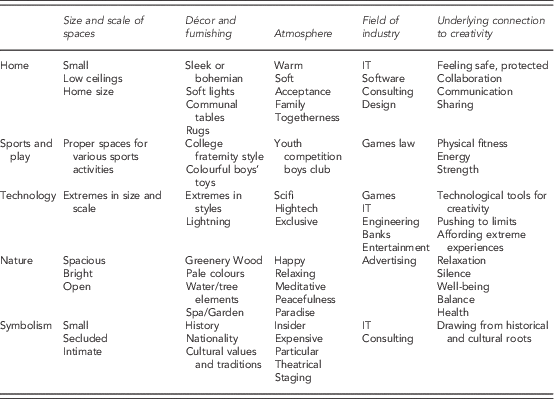
Inspired by Panayiotou and Kafiris (Reference Panayiotou and Kafiris2010), we conceptualized the images of creative workspaces as a story of social relations and spatially informed creativity. Panayiotou and Kafiris oriented particularly towards analysing the masculine constructs of power in terms of dominance, hierarchy, control and discipline, as well as rationality, order and the impersonal. We modified their approach in our analysis of designed creative spaces. We described the built environment of the workspace, such as its size and the scale of the spaces, the décor and furnishings, atmosphere and the field of industry that the company images represented. Furthermore, we make an effort to discern the underlying connection of these spatial arrangements with organizational creativity. Table 1 summarizes the identified themes and categories of the studied creative workspaces: home; sports and play; technology; nature and relaxation; and symbolism.
Thematic categories of creative workspaces

Home is represented as a warm and cosy space with a feeling of warmth, acceptance and togetherness. In this kind of space, one can feel safe and protected and let the creative juices flow. Also, a homely space entails the idea of communication, collaboration and mutual sharing, all of which are needed for creativity.
Sporty and playful company images are created with youthful spatial images. Bright workspace colours and the provision of facilities that can be used properly for a variety of sports activities are emphasized. Creativity is sought after taking care of the employees’ physical fitness, energy and strength.
Technologically influenced spatial arrangements reflect future and past images. They display both old-world equipment, state-of-the art technology and imaginary new worlds. The spatial work environment brings forth that creative work entails extremes, which calls for pushing to the limits, and the spaces provide opportunities to experience the extremes.
In companies that have nature as a central theme in their offices, harmony, peacefulness and well-being are emphasized in the spatial environment. Being relaxed and able to work in a nature-like space with the opportunity to enjoy silence and a meditative state are considered to foster creativity.
Symbolism and cultural heritage can be spatially used to convey the source of creativity. Exclusivity, being an insider and being particular are emphasized even by overdoing cultural symbols and traditions in the spatial solutions of the workspaces.
The companies in our analysis represented different fields of industry, most of which belong to the so-called knowledge-intensive industries: advertising, banking, design, consulting, engineering, entertainment, games, IT, law and software. As Table 1 shows, no specific spatial arrangement is typical for any of these industries. Advertising is the only one that stands out as it only emphasizes nature in its space design.
Next, we will discuss some of the contradictions we found as to how creativity was conceived in the workspace images.
DISCUSSION
A first glance at the creative workspace images displayed on the internet leads to the conclusion that the designed environments render embodied freedom and spatial flexibility with the association of creativity. The designed workspaces may be seen to free people from traditional workspace settings where people are confined to sit in their individual offices the whole day without having the opportunity or invitation to move around and do different things in different locations (cf. Ropo, Sauer, & Salovaara, Reference Ropo, Sauer and Salovaara2013 for traditional seating in schools). Other than sitting by the computer, various types of spaces give flexibility, such as the opportunity to lie down on a couch for a while or relax in an armchair, eat when and where you like, play and maybe even do some exercise. All this sets the body free from a stiff, controlled posture (for the embodiment and experience of built space, see Viljoen, Reference Viljoen2010). One would assume that the flexible workspace arrangements have the opportunity to energize and fuel creativity as well (McCoy, Reference McCoy2005; Dul & Ceylan, Reference Dul and Ceylan2011).
Second, from a critical perspective, the creative workspace images may give an impression of exclusiveness. The images of these specially designed workspaces could be interpreted to imply a subtle connotation of elite people, the ‘chosen ones’ with special skills and wisdom who deserve to have an extravagant work environment in contrast to the ‘ordinary ones’ who can settle with more mundane premises.
Third, the images can be read to represent what Lefebvre (Reference Lefebvre1991) conceptualizes as ‘conceived space’: as architectural abstractions that are linked with forms of managerial control (Dale & Burrell, Reference Dale and Burrell2010) and as ‘perceived space’: as concrete material features and as spatial practices. There is an underlying assumption in the discourse of creative workspaces that the physical spaces provoke the same types of emotional and behavioural reactions leading to creativity, thus suggesting that work processes and outcomes could be managed with certain spatial arrangements. However, empirical evidence shows otherwise (Elsbach & Pratt, Reference Elsbach and Pratt2007; Ropo, Sauer, & Salovaara, Reference Ropo, Sauer and Salovaara2013; Ropo et al., Reference Ropo, Salovaara, Sauer and De Paoli2015). Lefebvre (Reference Lefebvre1991) helps understand this by bringing forth a third concept, the ‘lived space’ that emphasizes the personal and embodied experience of space. The lived space is experienced through emotions, imagination and memories. These are subjective and difficult to control. From that perspective spaces designed for creativity could be considered as ‘managed spaces of creativity’ or as ‘creativity by command’.
Finally, we discuss some contradictions as to how organizational creativity is conceived in the creative workspace images.
Contradiction 1: Individually versus collectively produced creativity
The current company trend illustrated in our empirical material shows that creative workspaces are mostly designed for collective teamwork. Most of the studied workspaces illustrate open and informal office designs that are intended to stimulate social encounters, play, physical activities and communication. Many of them are designed as playgrounds, activity centres (kitchen, bowling green, gym, etc.), artful environments, natural habitats resembling nature or open, flexible fancy offices. The inherent premise in these spatial arrangements is that creativity is first and foremost a collective group phenomenon involving play, activity, fun, noise, dynamics and social interaction. The need to sit alone quietly and develop a creative idea is hardly considered. If there is a space for individual work, the room is typically designed for meditation, massage or for workouts. Additionally, office design development has moved from one extreme of individual small rooms or cubicles to open spaces.
The trend of designing creative workspaces has gone in the opposite direction compared to the traditional psychologically oriented individual research tradition (Shalley, Zhou, & Oldham, Reference Shalley, Zhou and Oldham2004; Hennessay & Amabile, Reference Hennessay and Amabile2016). Creative workspaces displayed on the internet are predominantly based on the model of open-plan office design that is typically meant to enhance collaboration. Individuality and different personalities are less emphasized. The current creative workspaces seem to be designed for extroverts with a high tolerance of noise and distraction. The main emphasis on creativity research until the 1990s has been on studies of creative individuals to demonstrate the importance of intellect, personality and cognitive skills for creativity (see Amabile, Reference Amabile, Conti, Coon, Lazenby and Herron1996 for a review). More recent research on creativity has demonstrated the importance of social and environmental factors for creative performance (e.g., Amabile et al., Reference Amabile1996; Oldham & Cummings, 1996; Amabile, Schatzel, Moneta, & Kramer, Reference Amabile2004; Shalley and Gilson, Reference Shalley and Gilson2004; Shalley, Zhou, & Oldham, Reference Shalley, Zhou and Oldham2004; Csikszentmihalyi, Reference Csikszentmihalyi2007). However, the importance of personal factors such as certain personality traits, intrinsic motivation and cognition or skills are still argued to be important for creative performance (Amabile, Reference Amabile, Schatzel, Moneta and Kramer2012; Hennessay & Amabile, Reference Hennessay and Amabile2016). There has also been discussed, not least sparked by the book ‘Quiet’ (Cain, Reference Cain2012) about how the extrovert, social, noisy dimension is dominating in many societies, with a claim that the individual and introvert aspects of the creative process have been downplayed. Considering also recent research on digital media at work (Derks & Bakker, Reference Derks and Bakker2013) about how digitalization leads to interruptions, multitasking and stress at work, the importance of protecting the sacred spaces of focussed, embodied creative work becomes even more important (De Paoli, Røyseng, & Wennes, Reference De Paoli, Røyseng and Wennes2017). At the same time as open-plan office designs are favoured, there is criticism towards thinking that creativity is only being nurtured by social encounters and team building (Shalley, Zhou, & Oldham, Reference Shalley, Zhou and Oldham2004; Bilton, Reference Bilton2007; Hennessay & Amabile, Reference Hennessay and Amabile2016). Creative workspaces based on teams and community-building through office design contain the premise ‘all together, altogether better’, which has largely been contested by Dale and Burrell (Reference Dale and Burrell2010) as creating a false illusion of a harmonious and committed work environment. We would exercise caution on unilaterally favouring the community-building aspect of open-plan creative workspaces that overlooks the consideration of individual differences.
Contradiction 2: Professionally designed workspaces versus workspaces created through participation
A whole industry has developed to support corporations in reshaping and redesigning their workspaces, as depicted in several books and articles on organization and space (e.g., Dale & Burrell, Reference Dale and Burrell2008; van Marrewijk & Yanow, Reference van Marrewijk and Yanow2010). Architects, interior designers, facility managers and consultants are deeply involved in the design and construction processes of new office spaces. Simply looking at the images of the creative workspaces reveals how they are professionally created by designers and architects, even if they have been initiated by the companies in the first place.
The coconstruction of organizational efforts, such as space construction together with employees, has been noted as important for better outcomes in several studies (e.g., Prahalad & Ramaswamy, Reference Prahalad and Ramaswamy2004; Emmitt & Ruikar, Reference Emmitt and Ruikar2013; Lundström, Savolainen, & Kostiainen, Reference Lundström, Savolainen and Kostiainen2016). The coconstruction of workspaces has been particularly emphasized by Doorley and Witthoft (Reference Doorley and Witthoft2012), who have experimented with space and their own creativity. They have experience as engineers, designers and teachers in working creatively. According to them, it is important to empower people to shape their own work environment:
One of our first challenges was to equalize the respective status of students and faculty. When you walk into one of our classes, it’s almost impossible to tell who’s teaching and who’s learning. Innovation thrives on this kind of equality. With a boss or a professor standing at the head of the room, it feels like a ‘sage on stage’ – people are reluctant to share their ideas. Reconfiguring the physical relationship is a powerful signal that participation is truly welcome. The result is that you get better ideas out in the open, where they can grow. But there’s not just one ideal design for a collaborative space. The people using it should be able to transform it themselves, move things around, and create what they need for the work they’re doing at the moment. (Doorley & Witthoft, Reference Doorley and Witthoft2012: 5)
The idea of professionally designed workspaces leading to organizational creativity rests on a rather deterministic and linear view of the relationship between space and human action, as if physical spaces could have an agency ‘in themselves’ to ‘do’ things. Recent research on this suggests otherwise. As Balogun and Johnson (Reference Balogun and Johnson2005) note, when end-users begin to make sense of their reality, intended strategies often lead to unintended outcomes. Elsbach and Pratt (Reference Elsbach and Pratt2007) have reached the same conclusion: the same material conditions produce different reactions. They add that more attention should be placed on the ‘senses and aesthetic sensibilities’ (Elsbach & Pratt, Reference Elsbach and Pratt2007: 212) of how people interact with their physical environment. This speaks for involving the users of the space more closely in the cocreation of their workspaces.
People’s subjective and sensuous (aesthetic) experiences have been found to be a key mediating mechanism in understanding how space and people relate to each other (e.g., Tuan, Reference Tuan1977; Warren, Reference Warren2002; Vilnai-Yavetz, Rafaeli, & Schneider-Yaacov, Reference Vilnai-Yavetz, Rafaeli and Schneider-Yaacov2005; Viljoen, Reference Viljoen2010; van Marrewijk, Reference van Marrewijk2011; Ropo, Sauer, & Salovaara, Reference Ropo, Sauer and Salovaara2013; Pallasmaa, Reference Pallasmaa2014; Ropo et al., Reference Ropo, Salovaara, Sauer and De Paoli2015). There is a whole stream of organization theory called organizational aesthetics (Gagliardi and Strati being the founding proponents of it), which emphasizes the importance of sense-based knowledge development in understanding organizational life. We argue that our analysis on the so-called designed creative workspaces also shows that the underlying assumptions of how spaces lead to creativity fall into the trap of ignoring the very basic means of knowledge production: the human body.
Contradiction 3: Planned versus emerging creativity
The images studied here emphasize a planned view of what kinds of spaces would produce creativity in people. As described, in the images, creativity is connected to a homely atmosphere, energetic and playful sports, technological extremes, nature’s calming effect and culturally drawn symbolic values. They suggest that creativity needs extraordinary spaces to occur. An example of urban planning points in the same direction. There is a tendency to build trendy, modern, creative and innovative cities and places (Florida, Reference Florida2002), as politicians and policymakers want to develop environments for artists, bohemians and the so-called creative class to induce and stimulate them to be creative.
Several biographies and accounts by creative people (e.g., Amabile, Reference Amabile, Conti, Coon, Lazenby and Herron1996) describe how creativity often emerges spontaneously in various kinds of places and is often unplanned. By looking into the life of art and artists, the field of work defined as the creative industries (Caves, Reference Caves2000, Bilton, Reference Bilton2007), it appears that their workspaces are typically neither rationally planned nor look particularly ‘creative’ (Carlsen, Clegg, & Gjersvik, Reference Carlsen, Clegg and Gjersvik2012). A theatre director, describing a rehearsal process, shows us around in the theatre green room and says: ‘Look, there is nothing inspirational here!’ (Salovaara, Reference Salovaara2014, 30:45). When taking a peak into the actors’ rehearsal room, this is what you see: a windowless space, tiny and worn out. A low ceiling and bright fluorescence lights, filled with boxes and cabinets where actors and directors keep their props, make up and dresses, heaps of clothes, shoes and accessories everywhere (Salovaara, Reference Salovaara2014, 30:25). The theatre director in the video (Salovaara, Reference Salovaara2014) does not think that the space is important for creativity at all, but rather the process. According to him, the workspace should allow and enable the free movement of ideas, but it is not an active agent for producing a creative atmosphere. Creativity is something that people do rather than a planned quality of the physical place.
We are critical towards intentionally planned workspaces for creativity, and assert that creative ideas can emerge and creative work can be done in unexpected places and spaces such as on a bus, in a café, airport, on a train, or while doing mundane activities. Creativity can occur everywhere, at any time. We do not deny that creativity could be enhanced by designed workspaces, but argue that this ‘planned creativity’ holds a rather shallow and managerially induced understanding of the relationship between people and spaces. Elsbach and Pratt (Reference Elsbach and Pratt2007) provide a systematic analysis of studies on the meaning and role of the physical environment in organizations. They refer to the complexity of the phenomenon and suggest that ‘the degree of manageability’ of spaces should be considered against this knowledge (Elsbach & Pratt, Reference Elsbach and Pratt2007: 216).
SUMMARY AND CONCLUSIONS
The article directs attention to a contemporary aspect of corporate life in its pursuit of creativity and innovation: the increasing interest in designing creative workspaces. We have problematized this ‘hype’ by critically describing and analysing images of ‘creative workspaces’ as so named by the respective companies on the internet.
The main contribution of the study is that the so-called creative workspace designs are based on unproblematic and rather standardized views of organizational creativity. First, we found recurrent patterns of constructing a workspace to produce creativity in physical settings that resemble home, sports and play, past and future technologies, nature and symbols aligned with cultural heritage. Following that, second, creativity is presented in the images as a joyful, fun and energetic activity in a relaxing homely atmosphere or in a peaceful nature-like environment. An overly positive view characterizes organizational creativity. Third, a further analysis pointed out three contradictions.
The first contradiction deals with the emphasis on collective versus individual creativity. In the workspace images, creativity occurs in close proximity and interaction with colleagues. Constant communication and collaboration is afforded by various spatial arrangements such as large communal tables, cafés and meetings spaces. There are no signs of the lonely, depressive or chaotic moments that many creative workers would surely recognize. There is no doubt that complex issues benefit from collective problem-solving in shared spaces, but maybe a more balanced view of creativity calling for both individual and collective spaces would serve a more realistic understanding of organizational life. This is better addressed in activity-based office solutions where different types of spaces are built for different functions and needs (e.g., Appel-Meulenbroek, Groenen, & Janssen, Reference Appel-Meulenbroek, Groenen and Janssen2011).
The second contradiction has to do with whose designs are supposed to produce creativity. The analysed images were clearly designed by professional designers and architects based on their views of what is best for creative work. We brought up how recent research has strongly challenged this view by pointing out that the end-users’ role in cocreating workspaces (e.g., Lundström, Savolainen, & Kostiainen, Reference Lundström, Savolainen and Kostiainen2016) is highly important because the connection between space and human action occurs through their aesthetic and sensuous experiences (e.g., Ropo, Sauer, & Salovaara, Reference Ropo, Sauer and Salovaara2013; Ropo et al., Reference Ropo, Salovaara, Sauer and De Paoli2015), not through the designers or the management in the first place.
The third contradiction addresses the extent to which creativity can be managed by spatial planning or to what extent creativity emerges in unexpected times and spaces that may have no inspirational qualities at all. We challenge the view that designed workspaces are imperative or that they are the ultimate source for nurturing and releasing organizational creativity.
In conclusion, the article provides a critical view on how space and organizational creativity are connected in corporate images on the internet and discusses those images in the light of recent literature in a way that has not been done so far. It highlights overseen aspects in the management and organization literature while the connection of space and creativity has been earlier addressed mainly in the fields of real estate management, environmental psychology and architecture. This means that space and organizational creativity have been mainly discussed by other than organization and management scholars and, with some exceptions, less critically. This may have led to what we have discussed here, a hype and a rather unproblematic conceptual treatment of the phenomenon.
We think that the hype is problematic because it leads to overly generalized and standardized views on space and organizational creativity. In practice, this may mean that differences in subjective preferences and experiences are overlooked while locating all employees to the same type of workspaces, which may turn out to be controversial in terms of creativity and innovation. Furthermore, building new spaces or renovating old ones is costly and companies make big investments under the belief that these will produce creativity. From this perspective, the hype of creative workspaces is a way of corporate control and ‘creativity by command’. Once the employer has invested a lot of money to the premises on the one hand and the overall trend and media support the fanciful designs on the other hand, who dares challenge or criticize? Furthermore, the hype of creative workspaces has given architects and designers supremacy over the expertise of the end-users of the space.
We have put forth a discussion on a seemingly common trend in today’s corporate life and discussed the complex connection of the physical environment and organizational creativity. While doing so, we wish to point out that this is an important issue for company management to both recognize, reflect on and learn about.
Acknowledgements
This article was developed in the Research Project ‘Leadership in Spaces and Places’ funded by the Academy of Finland 2011–2014.
Supplementary material
To view supplementary material for this article, please visit https://doi.org/10.1017/jmo.2017.46