Introduction
Production of high quantities of high-quality forage crops could be one of the alternatives to bridge the huge forage gap in Sudan (Khair, 2011). Despite the availability of several forage cereal crops for irrigated areas in Sudan, Abu Sabeen (Sorghum bicolor) is the predominant forage crop along the River Nile and its tributaries (Khair, Reference Khair1999). It is, however, non-tillering, non-juicy, with extremely limited regrowth capability, low leaf/stem ratio and hence low quality. Maize (Zea maize) is also grown but comparatively in limited areas in Khartoum and River Nile State, especially during winter. Sudan grass (Sorghum sudanense), despite its high potential (Ageeb, Reference Ageeb1977), is not commonly grown in Sudan. Hence, there is a pressing need for a high-yielding and high-quality forage crop suited to Sudan's condition with a good regenerative ability over a longer growing period.
Pearl millet [Pennisetum glaucum (L.) R. Br.], an indigenous crop to Sudan (Stapf and Hubbart, Reference Stapf, Hubbart and Prain1934), could be a good choice. Compared with maize, Sudan grass and S. bicolor (cv. Abu Sabeen), pearl millet has been characterized by some desirable forage attributes, such as more drought and salinity tolerant than maize (Hoffman et al., Reference Hoffman, Maas, Meyer, Pritchard and Lancoster1979), high leafiness, high crude protein percentage and high forage yields (Sedivec and Schatz, 1991), high tillering and excellent regenerative ability permitting multi-cut forage production and grazing and almost free from prussic acid (a toxic acid) at all stages of growth (Miller, Reference Miller1984; Idris et al., Reference Idris, Khair, Ahmed and Babiker2008). It is, therefore, more suitable for either grazing or cutting. Henceforth, it is currently a worldwide subtropical high-quality forage/stover crop (Miller, Reference Miller1984; Skerman and Riveros, Reference Skerman and Riveros1990; Sedivec and Schatz, 1991; Yadav and Bidinger, Reference Yadav and Bidinger2008).
All the above-mentioned attributes of pearl millet as a good forage crop (Hoffman et al., Reference Hoffman, Maas, Meyer, Pritchard and Lancoster1979; Miller, Reference Miller1984; Sedivec and Schatz, 1991) justify the development of forage varieties of pearl millet for irrigated areas in Sudan. The objectives of this study were, therefore, to explore the forage attribute-based variations among some accessions of Sudan pearl millet, to identify the top forage-yielding accessions in each of the summer, rainy and winter seasons and to detect any common high dry matter-yielding accessions across the three seasons or across any two consecutive seasons, for further evaluation as long season forage-suited varieties.
Materials and methods
The plant materials used in this study were provided by the Genetic Resources Unit (GRU) of the Agricultural Research Corporation (ARC), Sudan. A field study was conducted for three consecutive seasons, i.e. in the summer of 2008 at the Gezira University Experimental Farm and in the rainy and winter seasons of 2008 at the Gezira Research Station Farm, ARC, Wad Medani, Sudan (latitude 14°24′N, longitude 33°29′E and altitude 406.9 m above sea level). The soil of both experimental sites was heavy alkaline (pH 8.0–8.6) and cracking clay (40–65%) with less than 1% organic carbon and 0.03% total nitrogen and total phosphorus (406–700 ppm).
Land was prepared by disc ploughing, followed by disc harrowing, levelling and ridging to 60 cm. The sowing dates were 17 April (summer season), 6 July (rainy season) and 19 November (winter season) 2008. The experimental design was augmented whereby the 100 accessions were allotted to ten blocks such that, each of the ten accessions was randomly allotted to each block. Five checks were included and hence the number of entries in each block was ten accessions plus five checks. Each accession or check was planted on a 5 m-long row (ridge). The planting rate was five seeds/hole, thinned later to three seeds/hole. Fertilizer (187 kg urea/ha) was placed in the holes prior to seeding. Irrigation water was applied every 10–14 d according to weather conditions. The experiments were kept weed-free by hand weeding. Each accession was harvested at the flowering stage. The parameters measured included days to harvest, number of tillers/plant as an average per plant in an area of 0.6 m2 in each plot, plant height (cm) as a mean of five readings of the main shoot, leaf/stem ratio as an average of three plants on a dry matter basis. The accessions were cut from the ground level in an area of 2.4 m2, i.e. 0.6 × 4 m2, and the fresh matter yield was weighed immediately in the field and a subsample of 1 kg fresh matter was oven-dried at 85°C for 48 h for dry matter determination.
A standard analysis of variance was performed using the IRRISTAT for Windows (version 5.0) software. Data for each season were analysed separately. The mean values of traits were used to group the accessions based on a morphological similarity matrix. Hierarchical clustering was done following an unweighted pair group method with arithmetic mean based on the dissimilarities between the 100 accessions, and 1000 bootstrap replicates were performed using the DARwin software package (version 5.0 158; CIRAD Research Unit Genetic Improvement of Vegetatively Propagated Crops).
Results
Dry forage yield
The dry forage yield-based frequency distribution of the 100 pearl millet accessions for the three seasons (rainy, winter and summer) is shown in Table S1 (available online). The percentages of accessions that produced forage yield of more than 5 t/ha were 71, 56 and 33% during the rainy, winter and summer seasons, respectively.
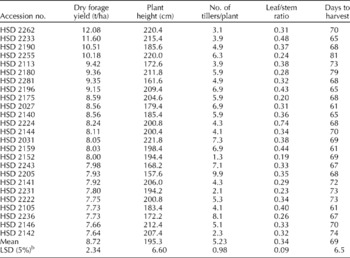
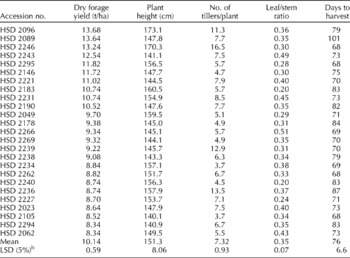
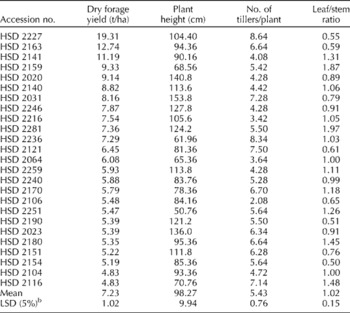
The mean dry matter yield across the top-ranking 25 accessions (TR 25 A) was highest in winter (10.14 t/ha) followed by the rainy season (8.72 t/ha) and lowest in summer (7.23 t/ha) (Tables 1–3). Inter-seasonal differences were observed in the distribution of the accessions across the TR 25 A in the three seasons. Apart from those accessions that showed inter-seasonal differences in their dry matter yields, the presence of some common accessions across the TR 25 A in more than one season was not unusual. Among the TR 25 A, two accessions were common in the three seasons, namely HSD 2190 and HSD 2236, six were common in the rainy and summer seasons, namely HSD 2180, HSD 2281, HSD 2140, HSD 2031, HSD 2159 and HSD 2141, and five were common in the rainy and winter seasons, namely HSD 2262, HSD 2243, HSD 2231, HSD 2105 and HSD 2146.
Dry forage yield (t/ha) and some important traits of the top-ranking 25 pearl millet accessions grown at Wad Medani during the rainy season of 2008a

a Accessions are arranged in the descending order of their dry forage yield.
b Least Significant Difference.
Dry forage yield (t/ha) and some important traits of the top-ranking 25 pearl millet accessions grown at Wad Medani during the winter season of 2008a

a Accessions are arranged in the descending order of their dry forage yield.
b Least Significant Difference.
Dry forage yield (t/ha) and some important traits of the top-ranking 25 pearl millet accessions grown at Wad Medani during the summer season of 2008a

a Accessions are arranged in the descending order of their dry forage yield.
b Least Significant Difference.
Number of days to harvest
The frequency distribution of the 100 accessions of pearl millet based on the number of days to harvest is shown in Table S1 (available online). About 84 and 98% of the accessions were harvested after 65 d in the rainy and winter seasons, respectively, while 100% of the accessions were harvested at 90 d in the summer season.
Among the TR 25 A, the accessions varied considerably until the stage of harvest. In the rainy season, only two accessions were harvested at ages ≥ 79 d, whereas 15 accessions were harvested at ages ranging between 68 and 74 d and eight accessions were harvested at ages < 67 d (Table 1). However, in the winter season, only one accession was harvested at the age of 101 d, six at the age of 83–87 d, seven at the age of 71–79 d and 11 at the age of 68–71 d (Table 2). In the summer season, however, all accessions failed to head and hence were harvested indiscriminately at the age of 90 d (Table 3).
Plant height
The frequency distribution of the 100 accessions of pearl millet for plant height is shown in Table S1 (available online). Apparently the tallest plants were associated with sowing in the rainy season, whereas the shortest plants were associated with sowing in the summer season. The percentages of the accessions that had plant heights of more than 100 cm were 99 and 94% in the rainy and winter seasons, respectively, while the percentage was only 23% in the summer season. However, in the rainy season, 98% of the accessions had plant heights of more than 140 cm. The mean plant height across the TR 25 A was 195.3 cm in the rainy season, 151.3 cm in the winter season and 98.3 cm in the summer season (Tables 1–3).
Number of tillers/plant
The frequency distribution of the 100 accessions of pearl millet for number of tillers/plant is shown in Table S1 (available online). The percentages of the accessions that produced more than three tillers were 77, 88 and 83% in the rainy, winter and summer seasons, respectively. The number of tillers per plant across the TR 25 A ranged from 1.3 to 9.9 in the rainy season, 3.7 to 16.5 in the winter season and 2.1 to 8.6 in the summer season (Tables 1–3). The mean numbers of tillers per plant across the TR 25 A were 5.2 in the rainy season, 7.3 in the winter season and 5.4 in the summer season (Tables 1–3).
Leaf/stem ratio
The frequency distribution of the 100 accessions of pearl millet for leaf/stem ratio is shown in Table S1 (available online). The percentages of the accessions that had a leaf/stem ratio of more than 0.2 were 93, 94 and 99% in the rainy, winter and summer seasons, respectively. However, in the summer season, 55% of the accessions had a leaf/stem ratio of more than 1.0. The mean leaf/stem ratio across the TR 25 A was highest in the summer season (1.02), compared with that in the rainy (0.34) and winter (0.35) seasons (Tables 1–3). The leaf/stem ratio across the TR 25 A ranged from 0.19 to 0.74 in the rainy season, 0.20 to 0.51 in the winter season and 0.50 to 1.97 in the summer season (Tables 1–3).
Morphological cluster analysis
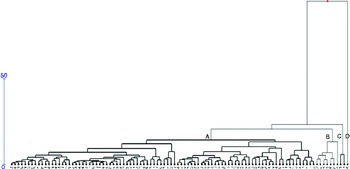
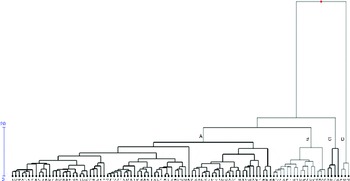
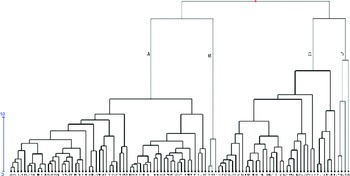
Clustering of the accessions of pearl millet on the basis of their similarity in morphological traits in this study reflected the intra- and inter-seasonal similarities among the accessions in each season as well as between the seasons (Figs 1–3). At a 100% similarity level, the 100 accessions in the three seasons appeared to be different from each other. At a similarity level of 80%, as shown from the dendrograms, all the accessions in the three seasons were clustered into four main groups, namely A, B, C and D. In the summer, winter and rainy seasons, 58, 77 and 90% of the accessions were clustered in group A, respectively. In contrast to those groups that comprised a large number of accessions, few of them (usually one to four) were found to be in two distinct groups in the three seasons. For instance, accession no. 83 stood by itself in a distinct group in the rainy season.
(colour online) Dendrogram of the phenotypic relationship among the 100 accessions of pearl millet using five morphological traits during the rainy season of 2008.

(colour online) Dendrogram of the phenotypic relationship among the 100 accessions of pearl millet using five morphological traits during the winter season of 2008.

(colour online) Dendrogram of the phenotypic relationship among the 100 accessions of pearl millet using five morphological traits during the summer season of 2008.

Discussion
Highly significant differences and diversity in each of the studied phenotypic traits were observed among the 100 pearl millet accessions in this study. Considerable variations have been observed among pearl millet accessions from different areas (Busso et al., Reference Busso, Devos, Ross, Mortimore, Adams, Ambrose, Alldrick and Gale2000; Reddy et al., Reference Reddy, Rao and Ahmed2004; Loumerem et al., Reference Loumerem, Van Damme, Reheul and Behaeghe2008). Such variations indicated the potentiality of using such accessions as breeding materials to develop forage varieties of pearl millet. The phenotype-based dendrograms in the three seasons reflected wide variations among the pearl millet accessions. For instance, at a 100% similarity level, each accession stood exclusively by itself, reflecting that none of the accessions had mutual phenotypic traits with any other. However, at about an 80% similarity level, the accessions were grouped into four groups in the rainy, winter and summer seasons. As shown from the dendrograms, more diversity among the accessions was evident in the summer season. However, the summer season is characterized by high temperature, long day and high evapotranspiration rates (Babiker, 2012). Hence, it is highly plausible to attribute the high diversity among the accessions in the summer season to the sensitivity to temperature and photoperiod (Upadhyaya et al., Reference Upadhyaya, Reddy, Ahmed, Dronavallia and Gowda2012). The clustering of the 100 accessions was not in parallel with their geographical distribution. This might indicate that informal exchanges of pearl millet germplasm might have been practised in the area of collection.
Significant differences in dry matter yields in this study further substantiate the existence of the variability among the accessions of pearl millet. The highest dry matter yield across the TR 25 A during the rainy, winter and summer seasons was higher than that reported by Douglas (Reference Douglas1974) in Australia, but lower than that reported by Skerman and Riveros (Reference Skerman and Riveros1990). Compared with other forage grasses in Sudan, the mean dry matter yield across the TR 25 A of pearl millet in this study in the winter, rainy and summer seasons was higher than that of sorghum cv. Abu Sabeen and maize (Kambal, Reference Kambal1983; Khair, Reference Khair, Salih, Elhag and Eltayeb2007).
All pearl millet accessions failed to flower in the summer season probably because of the photoperiod requirement (Skerman and Riveros, Reference Skerman and Riveros1990). Upadhyaya et al. (Reference Upadhyaya, Reddy, Ahmed, Dronavallia and Gowda2012) reported that most of the accessions from latitudes ranging from 10° to 20° on both sides of the equator were highly sensitive to a longer photoperiod.
Naeem et al. (Reference Naeem, Chohan, Khan and Salah-ud-Din2002, Reference Naeem, Chohan, Khan and Salah-ud-Din2003) found considerable variations in plant height among the genotypes of pearl millet. Likewise, highly significant differences in plant heights were found among the accessions of pearl millet in this study. The plant height across the TR 25 A in this study was shorter than that reported by Naeem et al. (Reference Naeem, Qadir, Hussain, Nasim and Shakoor1994) and Akmal et al. (Reference Akmal, Naeem, Nasim and Shakoor2002). Unlike those in the summer season, all the TR 25 A in the rainy and winter seasons exceeded 100 cm, probably due to the favourable conditions during the rainy and winter seasons.
The highly significant variations in the number of tillers/plant among the accessions in the three seasons in this study are consistent with a report by Naeem et al. (Reference Naeem, Chohan, Khan and Salah-ud-Din2002), but contradict with that reported by Naeem et al. (Reference Naeem, Chohan, Khan and Salah-ud-Din2003). The highest number of tillers per plant across the TR 25 A in this study during the rainy, winter and summer seasons was higher than that reported by Akmal et al. (Reference Akmal, Naeem, Nasim and Shakoor2002) and Naeem et al. (Reference Naeem, Chohan, Khan and Salah-ud-Din2002). The winter season showed to be the most conducive season for tillering, as it was associated with the highest mean number of tillers/plant.
The longevity of the growing season is very crucial for evaluating a forage crop for multiple cutting. In this context, the ability of pearl millet to produce a high dry matter yield in each of the three growing seasons is clearly manifested in this study. Despite the fact that the TR 25 A were not the same in the three seasons, the commonality of few accessions in more than one season is encouraging for the selection of accessions suitable for more than one season. For instance, accessions HSD 2190 and HSD 2236 with mean dry matter yields of 8.8 ± 1.71 and 7.9 ± 0.44 t/ha, respectively, across the three seasons were common among the TR 25 A in the three seasons. Accession HSD 2105 with a bi-seasonal mean of 8.1 ± 0.40 t/ha was common among the TR 25 A in the rainy and winter seasons, while accessions HSD 2140, HSD 2031 and HSD 2159 with bi-seasonal DM means of 8.7 ± 0.14, 8.1 ± 0.10 and 8.7 ± 0.66 t/ha, respectively, were common among the TR 25 A in the rainy and summer seasons. Other seven accessions were also common among the TR 25 A between consecutive seasons, but their dry matter yield patterns varied widely between the seasons. The inter-seasonal persistence of such accessions when subjected to multiple cutting is worth studying. These results indicated the possibility of the development of forage-suited varieties of pearl millet directly through further evaluation of those common accessions or indirectly through a breeding programme. Hybridization among such elite lines could be a useful strategy to further enhance dry matter production. Crossing landraces with elite composites resulted in significant improvement in grain yield and biomass production of pearl millet under drought as well as well-watered conditions (Bidinger et al., Reference Bidinger, Yadav, Sharma, van Oosterom and Yadav2003; Yadav, Reference Yadav2010; Yadav and Rai, Reference Yadav and Rai2011).
In summary, phenotypic variations among the pearl millet accessions studied here are well verified. Furthermore, the prevalence of some common accessions (based on dry matter yield) among the three or either of any two consecutive seasons is clearly pin-pointed. In conclusion, selection for high forage-yielding accessions that are suitable for a longer growing season of Sudan pearl millet collections is highly possible.
Supplementary material
To view supplementary material for this article, please visit http://dx.doi.org/10.1017/S1479262113000312
Acknowledgements
The authors thank Dr Eltahir Ibrahim and the rest of the GRU staff of the ARC, Sudan for generously providing the seeds of pearl millet accessions.