INTRODUCTION
Pigeonpea is grown for its food and economic value and is an important pulse crop in Africa, Asia and Latin America. It constitutes about 0·066 of the global pulses area (4·86 Mha) (FAOSTAT 2002). Since it is generally grown under rainfed conditions in the rainy season, it is often exposed to drought as well as extended episodes of transient waterlogging during the peak rainy days, leading to the loss of individuals in the plant stand. Global warming models predict not only a decrease in the number of rainy days across India but also an increase in the mean intensity of rainfall on any rainy day, as a consequence of increased temperature and greenhouse gas emissions (NATCOM 2003). Unpredictable extremes of rainfall can increase such episodes of waterlogging (Ceccarelli et al. Reference Ceccarelli, Grando, Maatougui, Michael, Slash, Haghparast, Rahmanian, Taheri, Al-Yassin, Benbelkacem, Labdi, Mimoun and Nachit2010). Pigeonpea crops are waterlogged temporarily, often for a period of 7–10 days during a single episode that includes the rainy days plus the days taken for the water to drain away, as seen in the Indo-Gangetic plains of India. Pigeonpea is highly sensitive to waterlogging (Chauhan et al. Reference Chauhan, Silim, Kumar Rao and Johansen1997; Perera et al. Reference Perera, Pooni and Saxena2001), as are soybeans (VanToai et al. Reference Vantoai, Beuerlein, Schmitthenner and St. Martin1994), chickpea (Cowie et al. Reference Cowie, Jessop and Macleod1996) and some of the pasture legumes (Whiteman et al. Reference Whiteman, Seitlheko, Siregar, Chudasama and Javier1984). However, genetic tolerances, if available, could help to increase the stability of pigeonpea production and productivity under waterlogging episodes that are expected to be increasingly unpredictable with global warming.
Despite the recognition of waterlogging as an important production constraint, few efforts have been made to identify germplasm that is adapted to this constraint. Wherever such efforts have been made, the numbers of genotypes tested were too few (Sarode et al. Reference Sarode, Singh and Singh2007) to confirm that the range of variation observed is the maximum and not skewed. Most of the previous works have concentrated on simulating the waterlogging environment and/or studied the mechanisms of tolerance (Takele & McDavid Reference Takele and McDavid1995; Chauhan et al. Reference Chauhan, Silim, Kumar Rao and Johansen1997; Sarode et al. Reference Sarode, Singh and Singh2007). A glasshouse screening procedure has been used to simulate the field flooding and to screen pigeonpea genotypes for their tolerance to waterlogging (Takele & McDavid Reference Takele and McDavid1995; Chauhan et al. Reference Chauhan, Silim, Kumar Rao and Johansen1997). A few contrasting genotypes in response to temporary waterlogging were identified. It was also observed that waterlogging caused a significant reduction in root dry mass of the susceptible cultivars (Dubey & Asthana Reference Dubey, Asthana, Wallis and Byth1987; Chauhan et al. Reference Chauhan, Silim, Kumar Rao and Johansen1997). Prominent symptoms of waterlogging response were listed as chlorosis and senescence of leaves, reduced root and shoot mass and yield loss. In another experiment, apparent photosynthetic rate, leaf stomatal conductance to water vapour and leaf N concentration of pigeonpea were also found to be reduced following 3 days of waterlogging (Matsunaga et al. Reference Matsunaga, Ito, Tobita, Rao, Johansen, Ito, Johansen, Adu-Gyamfi, Katayama, Kumar Rao and Rego1996). It was concluded that the photoassimilates temporarily stored in short-duration pigeonpea help the crop to survive the unfavourable conditions of waterlogging and that N top-dressing could promote better recovery. Antioxidant enzymes seemed to play a role in waterlogging tolerance of pigeonpea. These enzymes (superoxide dismutase, ascorbate, peroxidase, glutathione reductase and catalase) all increased in response to waterlogging, but to a greater extent in tolerant ICP 301 than in the sensitive Pusa 207 (Kumutha et al. Reference Kumutha, Sairam and Meena2008). However, in the past, no systematic efforts have been made to ascertain the range of variation available in the large germplasm collection. This was largely due to the size of the germplasm collection held in the genebanks. For instance, the ICRISAT genebank holds more than 13 000 accessions of pigeonpea germplasm. The development of a mini core collection of pigeonpea (c. 0·01 of the entire collection, 146 accessions), representing diversity of the collection (Upadhyaya et al. Reference Upadhyaya, Reddy, Gowda, Reddy and Singh2006), provides a systematic gateway to access variation in the germplasm. Recent exploration of such variation in the mini core germplasm has been very successful in the identification of highly tolerant sources and their use in stress-tolerance breeding programmes. For example, in crops such as chickpea, examination of the mini core collection yielded several highly useful accessions with drought tolerance-related root traits (Kashiwagi et al. Reference Kashiwagi, Krishnamurthy, Upadhyaya, Krishna, Chandra, Vadez and Serraj2005), drought tolerance and drought yield (Krishnamurthy et al. Reference Krishnamurthy, Kashiwagi, Gaur, Upadhyaya and Vadez2010), heat tolerance index (Krishnamurthy et al. Reference Krishnamurthy, Gaur, Basu, Chaturvedi, Tripathi, Vadez, Rathore, Varshney and Gowda2011), salinity-tolerant grain yield (Vadez et al. Reference Vadez, Krishnamurthy, Serraj, Gaur, Upadhyaya, Hoisington, Varshney, Turner and Siddique2007) and multiple disease resistance (Pande et al. Reference Pande, Gaur, Sharma, Rao, Rao and Krishna Kishore2007). Similarly, the mini core collection was successfully used for drought-related specific leaf area and soil plant analysis development (SPAD) and soil chlorophyll meter readings (SCMR) in groundnut (Upadhyaya Reference Upadhyaya2005). With the realization of the importance of climate change (Ceccarelli et al. Reference Ceccarelli, Grando, Maatougui, Michael, Slash, Haghparast, Rahmanian, Taheri, Al-Yassin, Benbelkacem, Labdi, Mimoun and Nachit2010), it became particularly important that the diverse sources of tolerance to waterlogging were identified and that stress tolerance breeding was undertaken using a systematic approach.
Therefore, the single objective of the present study was to ascertain the extent of phenotypic variation available for survival in the pigeonpea mini core collection accessions, after being submerged for 1 week. This required the development of a repeatable screening methodology that would permit selection of tolerant plants.
MATERIALS AND METHODS
Plant material
The screenings were performed during the rainy seasons of 2008 and 2009 at ICRISAT, Patancheru, in peninsular India (17°30′N; 78°16′E; 549 m asl). In 2008, 160 accessions were tested: 146 mini core pigeonpea germplasm accessions (Upadhyaya et al. Reference Upadhyaya, Reddy, Gowda, Reddy and Singh2006), 4 control entries and 10 previously tested (Chauhan et al. Reference Chauhan, Silim, Kumar Rao and Johansen1997) genotypes. In 2009, some of the promising pigeonpea hybrids (n=3), their maintainers (n=3) and restorers (n=2) with a maintainer and restorer involved with a hybrid ICPH 2438 (not included in the present study) were added.
Plant culture
To understand the influence of growth stage on waterlogging sensitivity, two trials in 2008 and three trails in 2009 were planted in 267 mm diameter pots containing 9 kg of Vertisol soil fertilized with 0.5 g pot−1 of N, 0.2 g pot−1 of P and 0.5 g pot−1 of K as urea, single super phosphate and muriate of potash, respectively. The soil was mixed with well-composted farmyard manure (FYM); soil to FYM ratio was 50:1 (v/v). Pots were sown on 9 Jul 2008 or 10 Jun 2009 with four seeds and the pots were thinned to two plants after 15 days after sowing (DAS). The experiment was laid out as a 16×10 alpha lattice with five replications in 2008 and as a 17×10 alpha lattice in 2009.
Waterlogging stress imposition and screening
Potted plants were moved into a 25×10 m well-levelled soil tank lined with polythene and filled with lake water; water level was replenished and adjusted to 30–50 mm above the brim of the pot every day. Two trials to screen the whole set were conducted in 2009: in the first, waterlogging started at 35 DAS while in the second waterlogging started at 50 DAS. During 2009, the screenings were carried out at three different stages by starting the waterlogging at 40, 62 and 76 DAS. These screens (hereafter referred to as trials) were carried out in two or three stages across 2 years. The plants in these trials were subjected to waterlogging for 7 days; after that time the pots with the plants were moved out of the pond. The plants that survived were counted 3 to 4 days later. The same sets of plants were screened at different stages of plant growth to see if any genotype×plant stage interaction in survival existed.
Statistical analysis
The replication-wise values of the number of surviving plants were used for statistical analysis for each trial using ReML (Genstat, Release 10.1), considering genotypes as random. Variance components due to genotypes (σ g2) and error (σ e2) and their standard errors were determined. Trial-wise best linear unbiased predictors (BLUPs) for the mini core accessions and others were calculated. Heritability index was estimated as h 2=σ g2/(σ g2+(σ e2/r)).
For the pooled analysis, homogeneity of variance was tested using Bartlett's test (Bartlett Reference Bartlett1937). Here, the trials (n=5) were treated as environments (E) and as a fixed effect and the genotype (G)×E interaction as random. The variance due to G (σ g2) and G×E interaction (σ gE2) and their standard error were determined. The significance of the fixed effect of the year was assessed using the Wald statistic that asymptotically follows a χ 2 distribution. Cluster analysis using the Ward's incremental sum of squares method was employed to group the genotypes over trials for plant survival counts.
RESULTS
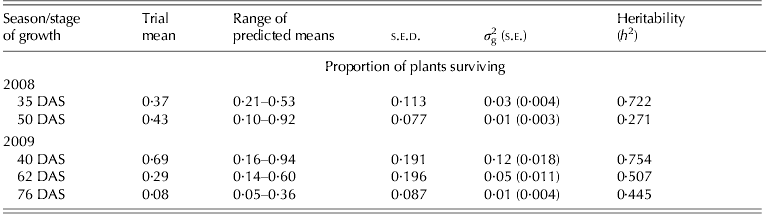
The genotypic effects of plant survival were significantly different in all the trials (years and stages) of testing. There was a wide range of variation in plant survival counts among the mini core pigeonpea germplasm accessions at all the plant stages and years (Table 1).
The proportion of plants surviving waterlogging (overall mean, range of best linear unbiased predicted means of accessions (BLUPs), standard error of difference (s.e.d.), genetic variance (σg2) and its standard error (s.e.) in parentheses) and heritability of 160 pigeon pea accessions in 2008 and 170 accessions in 2009
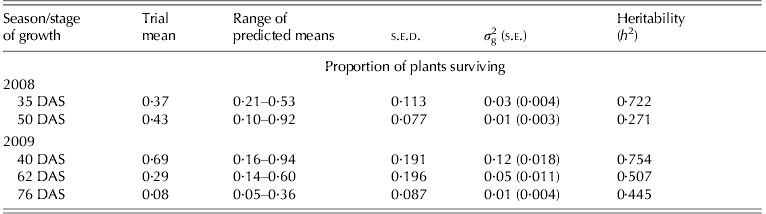
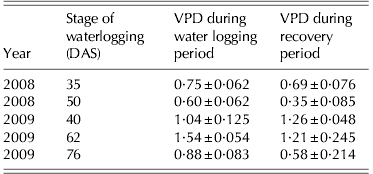
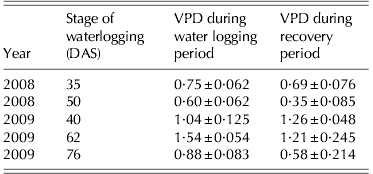
There were large differences in mean plant mortality differences among the trials within one season, when exposed to waterlogging (Table 1). These mortality differences seemed to be influenced by the vapour pressure deficits (VPD) prevailing at the time of waterlogging (rainy days v. clear and hot days) (Table 2) as well as the developmental stage of the plants (Chauhan et al. Reference Chauhan, Silim, Kumar Rao and Johansen1997).
The mean VPD (with their s.e.d. in parentheses) prevalent during the waterlogging (7 days) and recovery periods (3 days) during the various sets and years of waterlogging
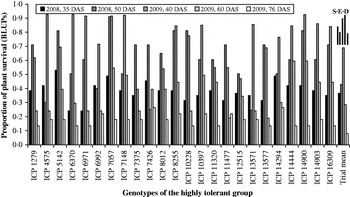
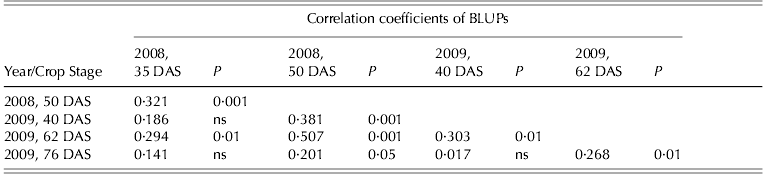
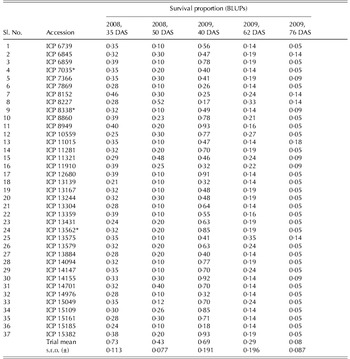
To check for the magnitude of interaction across stages and years, a pooled analysis was carried out. The pooled analysis of the 160 common accessions included in all the trials (n=5) showed a large and a highly significant genotypic variation (variance component 0·061±0·0109) compared to a relatively larger and significant trials×accessions interaction (0·093±0·0098) with a heritability of 0·396. The correlation of the BLUPs of 160 common accessions between the trials representing years and stages of crop growth showed that the genotypic performances were closely associated across stages or years in most cases (Table 3). The low plant mortality at 40 DAS during 2009 and high plant mortality at 76 DAS in 2009 brought about a skewed range of plant response or genotypic discrimination, probably leading to a poor relationship with other stages or years. However, as there was a significant interaction between accessions and the trials, the BLUPs were grouped into representative groups using a hierarchical cluster analysis (the Ward's incremental sum of squares method) and this analysis yielded five distinct groups. The highly tolerant group, with above-average survival means in all the five trials, comprised 24 accessions with none of the previously tested entries or control entries appearing among them (Fig. 1). Similarly, the sensitive entries comprised 37 accessions including ICP 7035, ICP 8338 and ICP 13562 previously identified as susceptible (Table 4). The tolerant group comprised 39 accessions, moderately tolerant 42 and moderately sensitive 18. The hybrids (ICPH 2671, ICPH 2740 and ICPH 3762) seemed to have shown good tolerance only at the early stage (40 DAS) but did not show such a degree of tolerance at later stages. However, ICPB 2092 (the maintainer for ICPH 3762 and ICPR 2671, and the restorer for hybrid ICPH 2671) were classed as tolerant in the three trials of 2009. Restorer ICPR 2438 exhibited the highest level of tolerance (1·56, 0·59 and 0·71 plants out of two in the 40, 62 and 76 DAS stages during 2009, respectively). It would be interesting to test this hybrid also (ICPH 2438) for its reaction to waterlogging.
The best linear unbiased predicted means (BLUPs) of survival proportions of the 24 highly water logging tolerant accessions contained in a set of 160 genotypes tested (the mini core pigeonpea germplasm and 14 other genotypes) together with the means from the five trials in 2008 and 2009. s.e.d. for comparing the BLUPs of the genotypes within each trial are given in the top right corner.

Correlation coefficients between the BLUPs of 160 common genotypes across years/stages of crop growth
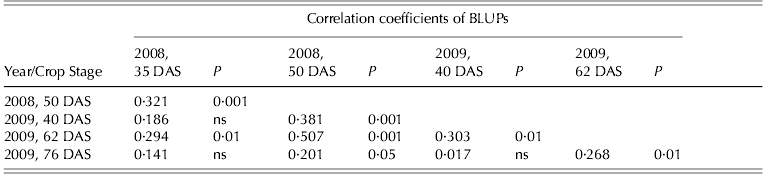
ns, Not significant.
The best linear unbiased predicted means (BLUPs) of survival proportion of the waterlogging sensitive accessions out of 160 genotypes (that included the mini core pigeonpea germplasm and 14 other genotypes) in the five trials in 2008 and 2009

* Accessions tested earlier and also confirmed as sensitive by Chauhan et al. (Reference Chauhan, Silim, Kumar Rao and Johansen1997).
DISCUSSION
Past efforts to identify highly diverse sources of contrast for waterlogging tolerance have been limited to the work of Chauhan et al. (Reference Chauhan, Silim, Kumar Rao and Johansen1997) with a group of 10 genotypes/accessions (eight from India and one each from Ethiopia and Jamaica). A complete range of distribution (ICP 8743 with 0·0 mortality and ICP 7035 with 1·00 mortality) was reported for the eight genotypes of Indian origin, while the Ethiopian one (ICP 13562) was tolerant and the Jamaican one (ICP 14114) was sensitive. Building comprehensively on that work, the current study considered the mini core collection of pigeonpea germplasm representing the global diversity of the cultivated gene pool and consisting of 146 accessions (Upadhyaya et al. Reference Upadhyaya, Reddy, Gowda, Reddy and Singh2006). Also, to compare the results with known controls, the set of 10 entries tested by Chauhan et al. (Reference Chauhan, Silim, Kumar Rao and Johansen1997), four control varieties such as UPAS 120 (ICP 6971), Gwalior 3 (ICP 7221), ICWR 6 (ICP 8863) and ICPL 87 (ICP 11543) were also included in the first year of the present work, while three hybrids and their parents were included in the second year. The present results gain greater significance not only due to the large list of entries that were screened but also because these were repeated in three different growth stages and in 2 years to capture the developmental stage, water and environmental (particularly VPD) variations and with five replications to increase the robustness of the evaluation. Also, these plants were grown in large pots to avoid confined root growth. The results are encouraging because they confirm the reactions previously reported by Chauhan et al. (Reference Chauhan, Silim, Kumar Rao and Johansen1997) of various genotypes. Those listed as sensitive by Chauhan et al. (Reference Chauhan, Silim, Kumar Rao and Johansen1997), such as ICP 7035 and ICP 8338, were reconfirmed as sensitive and the tolerant accessions, such as ICP 8743, ICP 14199 and ICP 8379, were confirmed to be either tolerant or moderately tolerant. One significant aspect of the present study is that all the highly tolerant genotypes listed in Fig. 1 are newer germplasm identifications and show increased levels of tolerance to waterlogging than the previously identified sources of tolerance (Chauhan et al. Reference Chauhan, Silim, Kumar Rao and Johansen1997) or the controls. This validates the germplasm subset of this mini core collection as representative of the global diversity.
This screening protocol had been used with some success in the past (Chauhan et al. Reference Chauhan, Silim, Kumar Rao and Johansen1997), but now needs further improvement. Subjecting the plants to waterlogging for a certain number of calendar days does not necessarily achieve the desired 0·50 mortality levels and the best genotypic discrimination. Therefore, there is still a need to identify critical environmental parameters such as cumulative VPD or thermal degree days and establish the critical level of stress through a modelling approach, as has been shown in the case of vernalization intensity prediction that is critical for bolting in different genotypes of sugar beet (Milford et al. Reference Milford, Jarvis and Walters2010). Establishing the proper extent of stress and termination of waterlogging treatment through various degrees of automation would seem to be possible, as currently done to monitor soil water through sensors and scheduling irrigation (Greenwood et al. Reference Greenwood, Zhang, Hilton and Thompson2010).
The pigeonpea mini core germplasm was also used to identify useful variations for salinity tolerance, another stress to which pigeonpea is highly sensitive (Srivastava et al. Reference Srivastava, Vadez, Upadhyaya and Saxena2006). In general, there was no correspondence between the reactions to these two stresses. Salt-tolerant accessions were ICP 7057, ICP 7426 and ICP 11477 from the highly waterlogging-tolerant group and ICP 6859, ICP 8860 and ICP 10559 from the highly sensitive group.
Identification of key mechanisms of tolerance is of paramount importance in pigeonpea to design simple screening protocols that would be useful in identification of tolerant sources as well as to propose molecular markers in certain and precise trait introgression efforts. The initial direct damage that is expected under waterlogging is asphyxiation and subsequent death of the roots, resulting in loss of water and reduced nutrient uptake. This in turn leads to impaired photosynthetic ability (Davies et al. Reference Davies, Turner and Dracup2000; Striker et al. Reference Striker, Insausti, Grimoldi, Ploschuk and Vasellati2005; Islam et al. Reference Islam, Hamid, Karim, Haque, Kaliq and Ahmed2008; Kumutha et al. Reference Kumutha, Sairam and Meena2008; Dickin et al. Reference Dickin, Bennett and Wright2009) and loss of nitrogen from the shoots as amino acids are remobilized to the roots to meet the anaerobic respiratory requirements. Other direct consequences include leaf drop and reduced resistance to diseases. The extent of prolonged plant survival in legumes can be expected to be facilitated by enhanced root/shoot ratio (Islam et al. Reference Islam, Hamid, Kaliq, Ahmed, Haque and Karim2007), efficient functioning of the respiratory organelles (Li Reference Li1998) or the roots’ capability to acquire oxygen from the oxygen-deprived water through a modified root anatomy (Gibberd et al. Reference Gibberd, Colmer and Cocks1999; Striker et al. Reference Striker, Insausti, Grimoldi, Ploschuk and Vasellati2005). This also includes the capability of the roots to provide a continuous supply of carbohydrate reserves and enzymes for anaerobic respiration activity or glycolytic activity and production of alcohol dehydrogenase (ADH) for the recycling of nicotine amide adenine dinucleotide-reduced (NADH) towards the continuation of glycolysis, the major source of energy under hypoxia (Kumutha et al. Reference Kumutha, Sairam and Meena2008). This would mean slow loss of photosynthetic reserves as well as slow movement of N from the shoot to facilitate this respiration. The environment at the time of waterlogging also affects plant survival. For example, higher root zone temperatures are known to kill the plants quicker in crops such as lucerne and sainfoin (Heinrichs Reference Heinrichs1972). Plants under less stress for transpiration and N depletion can remain alive for relatively longer periods of time (Islam et al. Reference Islam, Hamid, Kaliq, Ahmed, Haque and Karim2007, Reference Islam, Hamid, Karim, Haque, Kaliq and Ahmed2008).
It is well known that survival during episodes of waterlogging alone is not enough; host plant variation for successful recovery from this shock is also important (Setter & Waters Reference Setter and Waters2003). For example, yellow lupin (Lupinus luteus) has been found to tolerate waterlogging better than narrow-leafed lupin (Lupinus angustifolius), due not only to less reduction in leaf expansion or root and shoot growth while waterlogged but also to a quick recovery to normalcy in root growth status, within 2 weeks of the recovery period (Davies et al. Reference Davies, Turner and Dracup2000). In wheat, it has been suggested that several characteristics such as high tillering potential and high or fast growth rates may help rapid recovery (Dickin et al. Reference Dickin, Bennett and Wright2009). Therefore, along with better survival, rapid recovery also plays an equal role in waterlogging tolerance, and further work is needed towards identification of better host plant resistance for rapid recovery.
It can be concluded that the extent of variation available in the germplasm collection for waterlogging reaction is large and the findings reported in the present paper are repeatable. None of the breeding material (n=21) used in the present study ranked as highly tolerant, indicating that fresh tolerance traits need to be transgressed from the germplasm while breeding for this stress tolerance. Some of the accessions identified were confirmed to be tolerant to waterlogging and have a good potential for use in waterlogging tolerance breeding. However, more work is needed to understand the underlying mechanisms of tolerance to waterlogging and the post-waterlogging recovery.
This research was partly supported by the restricted core grant from the Indian Council of Agricultural Research for improving tolerance to major abiotic stresses in pulses (chickpea and pigeonpea). The technical assistance provided in conducting the experiments and collection of data by Mr B. Lakshminarayana Rao, Research Technician, Crop Physiology Laboratory, ICRISAT is gratefully acknowledged.