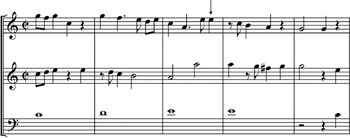
Guillaume de Machaut (c.1300–77) composed 143 musical works. Only one, the Hoquetus David, is untexted. Penned towards the end of Machaut's compositional career, the Hoquetus is even more remarkable since the hocket as a genre had largely died out by the beginning of the fourteenth-century;Footnote 1 the work actually represents the only extant hocket of the Ars Nova.Footnote 2 In light of its unique status, the Hoquetus David has received an ambivalent reception by modern performers and scholars. On the one hand, it has been recorded more than any motet, ballade or rondeau; only the Mass and two virelais have been recorded more frequently.Footnote 3 On the other hand, it has received significantly less scholarly attention than Machaut's compositions of other genres. No more than two studies discuss the Hoquetus David in great depth. In 1980, Daniel Leech-Wilkinson provided a detailed description of the work's rhythmic aspects and proposed a general outline for the Hoquetus's compositional procedure.Footnote 4 More recently, Anne Walters Robertson devoted a chapter of her book Guillaume de Machaut and Reims to a discussion of the Hoquetus's function, suggesting that its inception is related to the coronation of Charles V in 1364.Footnote 5 Other commentary even doubts the aesthetic value of the Hoquetus. Armand Machabey, for example, states that ‘it does not provide … the musical interest of a motet or the Mass, but instead comes across as a dictionary of rhythmic combinations realised in three voices that are cut up with apparently unexpected pauses. It's a rather curious game.’Footnote 6 To date, matters of pitch, sonority and syntax in the Hoquetus have thus gone largely unexplored.Footnote 7
What then is a useful approach in which to delve into the Hoquetus David's sonorous and musical features? Several scholars have likened the Hoquetus David to a motet without text. Leech-Wilkinson and Robertson both make brief use of this comparison in their respective studies, while Richard Hoppin maintains that the Hoquetus ‘is nothing more than a textless isorhythmic motet for three voices’.Footnote 8 Indeed, one can learn much about the Hoquetus's inner workings – and in turn discover that the Hoquetus does provide the ‘musical interest’ of a motet or the Mass – by comparing it with Machaut's motets (Part I of this article), considering its contrapuntal procedures (Part II), and exploring approaches to its performance (Part III).
I
As in Machaut's twenty motets with chant-based tenors, the foundational melody of the Hoquetus David is arranged isorhythmically and is drawn from a liturgical source: in this case, the melisma on ‘David’ from a chant for the feast of Mary's Nativity.Footnote 9 The length of the color (thirty-two pitches; Ex. 1, top staff) as well as its predominantly conjunct motion present nothing out of the ordinary when compared with his selected chant melodies for the motet tenors.Footnote 10 Five of Machaut's motet tenors share the same final, G (only F is more popular as a final).Footnote 11 Like all of his liturgical tenors, the Hoquetus's tenor melody concludes with a descending whole step, an important feature that allows for a common concluding cadential progression, to be discussed below.
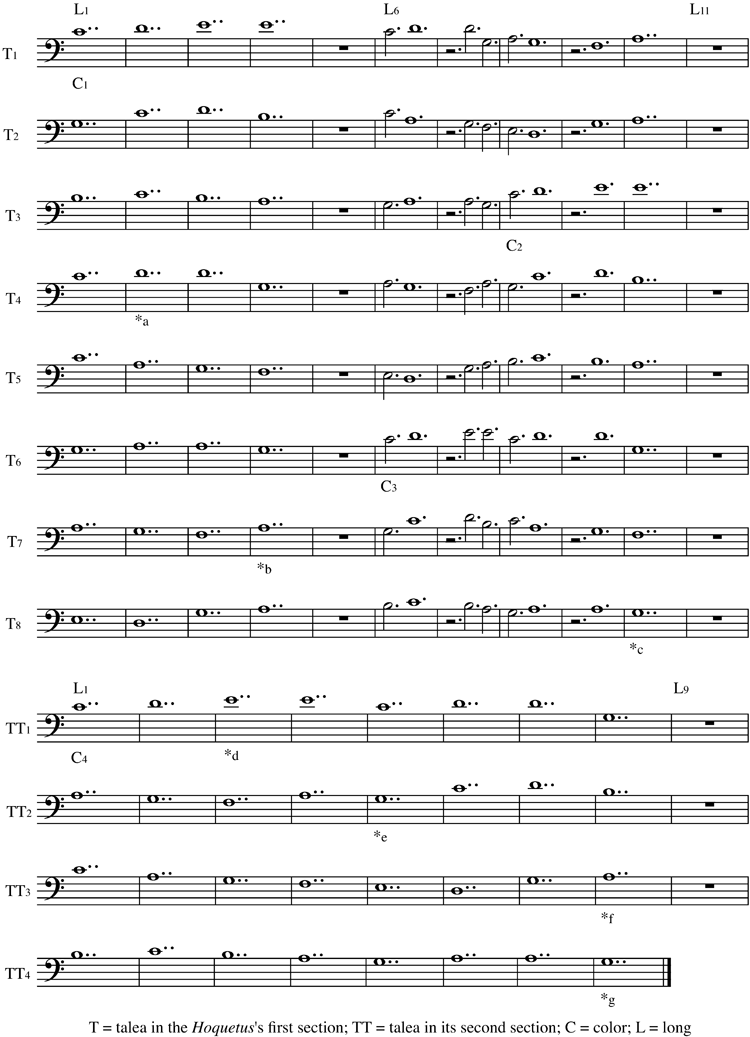
Organisation of the David tenor.

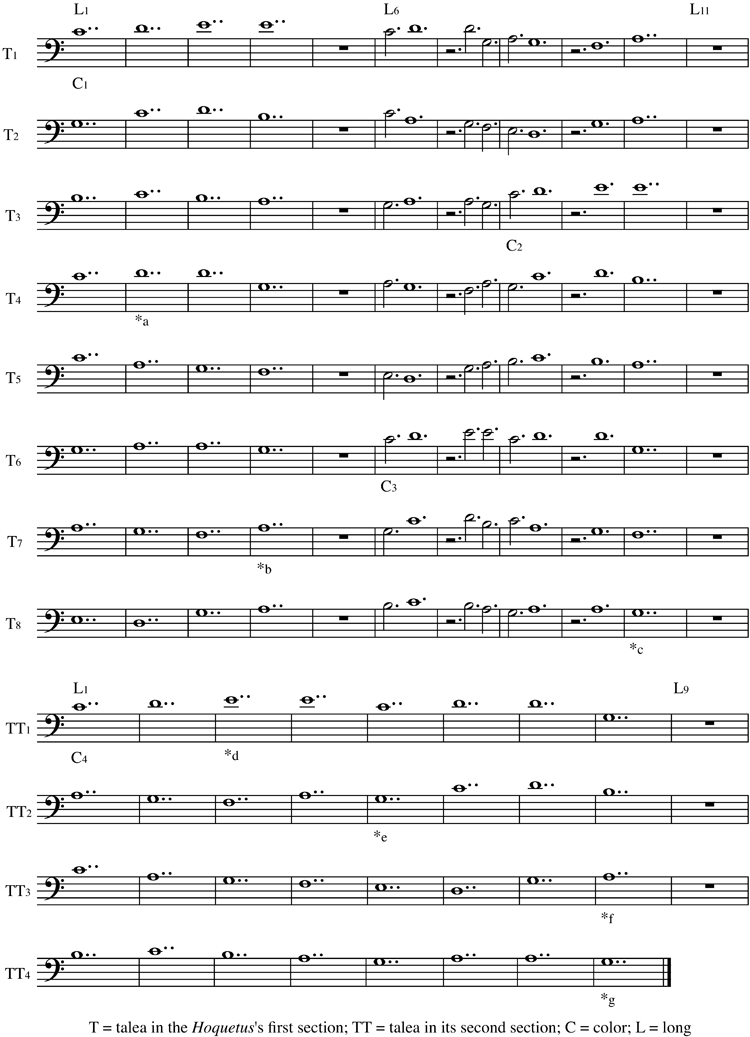
Machaut organises the David tenor in a bipartite fashion (as in eleven of the liturgical motet tenors). In the first section, he takes three colores (labelled C1–C3 in Ex. 1) and divides this body of notes into eight taleae (labelled T1–T8). While this manner of organisation may seem unusual – most often one color statement is divided equally into taleae in the motets – there are no new principles at work here: in Motet 14, Machaut likewise takes three color statements as the body of notes to be divided, but in turn divides it into two parts.Footnote 12 The Hoquetus's second section, however, is not a diminution of the first (as in ten of the chant-based tenors),Footnote 13 but is instead a new, extremely straightforward rhythm, in which each of the four taleae (TT1–TT4) consists of a series of eight longs (indicated with Ls in the example) followed by a rest. None of the motet tenors feature such a simple talea rhythm. This facile tenor rhythm, however, is reminiscent of many thirteenth-century works whose tenors are arranged in un-patterned successive longs.Footnote 14 Thus, while the David tenor's organisation into taleae is unremarkable in Machaut's output, the straightforward tenor rhythm used in its second section is unique to the Hoquetus.Footnote 15
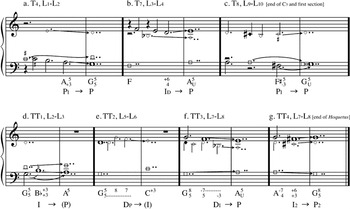
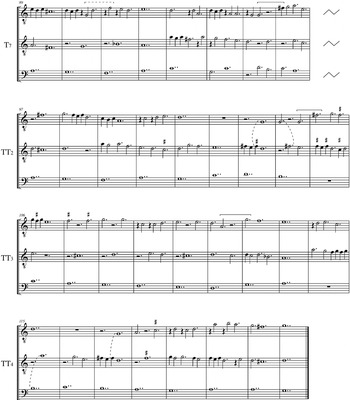
Also noteworthy in the Hoquetus is the lack of regular correlation between the tenor structure and the phrase structure of the three-voice texture. Whereas in the motets, major points of tonal articulation such as cadences typically occur at corresponding moments in each talea statement, in the Hoquetus, the major cadences are by no means accordingly placed; in fact, as shown by the asterisks labelled a–g in Ex. 1, the first major cadence (*a) does not appear until the fourth talea's second long, while the rest occur at different points within subsequent taleae.Footnote 16 Further, there is no recurring upper-voice isorhythm at corresponding moments from talea to talea, a salient feature of so many Machaut motets.
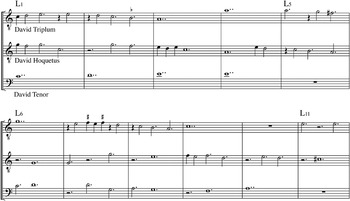
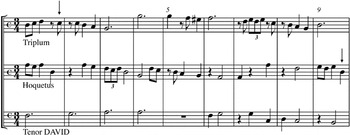
Ex. 2 provides the opening of the Hoquetus David.Footnote 17 In an analogous fashion to the motets whose voices are labelled as triplum, motetus and tenor in the Machaut manuscripts, Machaut designates the three parts of the Hoquetus David as David Triplum, David Hoquetus and David Tenor.Footnote 18 Each long (an entire bar in Ex. 2) divides into three breves (dotted minims in the transcription provided), and each breve divides into three semibreves (crotchets); the Hoquetus is thus set in modus perfectus – tempus perfectum throughout, but since the original notation does not employ minims (the smallest note value is a semibreve), there is no prolation. As Leech-Wilkinson reminds us, the note values of the upper voices in the Hoquetus are ‘twice as long as those of the upper voices of [Machaut's] motets’.Footnote 19 Since the note values employed in the Hoquetus are the same as those used in the thirteenth century (with the semibreve as the shortest note value), it seems that Machaut was deliberately mimicking (or paying homage to) the ‘older’ style. One should also recall the simple, archaic tenor rhythm of the Hoquetus's second section. At times, the value of a breve in the Hoquetus is rendered as three semibreves, for instance in L3 and L7. More often, however, a breve is divided into the old Franconian short–long figure (crotchet–minim), a rhythm that pervades the Hoquetus, but that is not found in the numerous hocketing passages in his motets. Indeed, the Hoquetus begins with this very figure stated simultaneously in the triplum and hoquetus. The short–long figure recurs on the third breve, but split between two voices, that is, it is stated ‘in hocket’: the hoquetus states c while the triplum follows on e. Yet another permutation of this same composite rhythm begins the second long, but now involving the tenor's d and triplum's d; again, it is stated in hocket since it is split between two voices.Footnote 20 An augmented version of the short–long rhythm is also used throughout the Hoquetus (see, for instance, L6, in which the perfect long is divided as such), and hocketing in longer, steady note values likewise occurs (for example, in L10–L11 in steady breves).
Hoquetus David, opening.

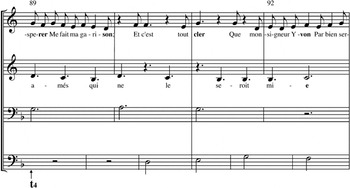
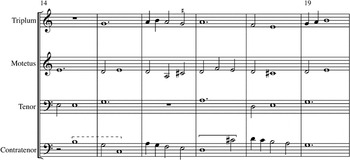
The hocketing differs in several respects from what is typically seen and heard in Machaut's motets: it most often appears at the same point in each talea; it often occurs in a long–short pattern but never in a short–long pattern; it is usually notated in shorter note values (semibreves and minims instead of breves and semibreves, for example); and it is most often interpreted by the modern analyst to serve one or more specific functions throughout the unfolding of a motet. For instance, in Motet 5 (Ex. 3a), the triplum and motetus alternate pitches in bars 90–1 in semibreves and minims, and at the beginning of bar 90 the motetus's d followed by the triplum's f yields a composite long–short rhythm of crotchet–quaver.Footnote 21 The poetry is set syllabically, thus each word (or syllable) may be heard with clarity in these two bars. Given the otherwise simultaneously stated poems in the upper voices, the improved text intelligibility indeed stands out in the texture.Footnote 22
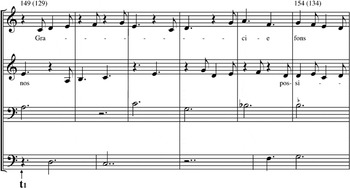
Hocketing passages in the motets.
Motet 5, beginning of the last diminished talea (bars 89–92).

Motet 23, beginning of the diminution section (bars 149–54 Schrade; 129–34 Ludwig).

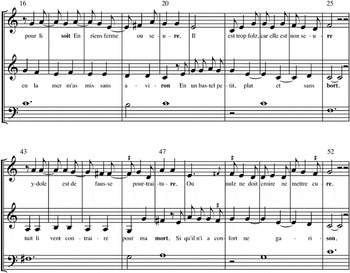
Motet 8, bars 16–25 and 43–52.

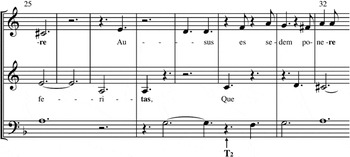
Motet 9, bars 25–32.

In Motet 23 (Ex. 3b), the hocketing again involves semibreves and minims and is set mostly in a long–short pattern, but the text setting is now melismatic: the upper voices hocket while each singing a single syllable. The analyst might interpret the function of the hocketing here as aurally articulating the motet's tenor structure, for it begins at the very moment of the onset of the diminution section. Similar hocket passages recur at the beginning of each of the motet's subsequent diminished taleae (t2 and t3), thereby continuing to mark structurally significant points as the motet unfolds.Footnote 23
The hocketing in the two illustrated passages from Motet 8 (Ex. 3c) involves steady, alternating semibreves. The syllabic setting of the upper voices again allows for greater text intelligibility. Note, however, the lack of rests in the upper voices, thereby demonstrating that hocketing need not necessarily involve rests. Whereas in the previous two examples there was only sometimes pitch overlap from one upper-voice pitch to the next, there is constant overlap here: the motetus continues to sustain as the triplum hockets the next pitch, then the triplum continues to sustain as the motetus hockets the next pitch, and so on.Footnote 24
In Motet 9 (Ex. 3d), the hocketing, first in constant semibreves then in a long–short rhythm with semibreves and minims, involves all three voices (e.g. the motetus–tenor–triplum succession of pitches in bars 28–9). Again, the hocketing recurs at corresponding moments – at the juncture of neighbouring talea statements – for the remainder of the motet.
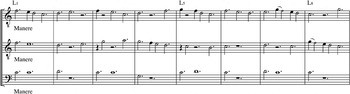
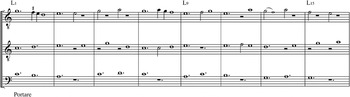
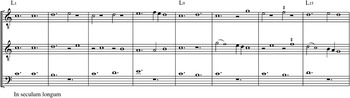
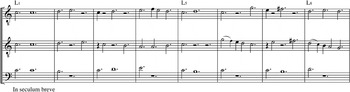
While the hocketing in the Hoquetus David and the motets therefore differs in several respects, a look back at several surviving thirteenth-century hockets reveals that the Hoquetus and the earlier examples share many rhythmic characteristics.Footnote 25 At least nine stand-alone hockets survive from towards the later part of the previous century.Footnote 26 Four of these, from four different mid- to late thirteenth-century sources, aptly characterise the earlier hocket tradition:Footnote 27 a hocket based on the tenor Manere (Ex. 4a), cited in Anonymous of St Emmeram's treatise of 1279 and recovered recently by Mary Wolinski, appears on a flyleaf of the Dijon manuscript; the Portare hocket (Ex. 4b) is notated in the first fascicle of the Montpellier Codex; and, the In seculum hockets (Exx. 4c and 4d) represent but two of five hockets based on the same tenor, four of which survive at the end of the Bamberg Codex. In seculum longum also appears in Montpellier, as well as in the Spanish manuscript, Madrid, with variants.
Perhaps the most straightforward feature shared in Machaut's Hoquetus and these examples is the note values employed throughout: longs, breves, and, the shortest value used in the thirteenth century, the semibreve. Again, that Machaut composed the Hoquetus in these longer note values surely suggests an homage to, if not blatant imitation of, the earlier style. A second shared characteristic concerns the short–long rhythm that pervaded the Hoquetus, which involves the division of a long, as well as the division of a breve. In the Manere and In seculum breve hockets, for instance (Exx. 4a and 4d), a perfection in the mode 2 tenor divides into a short–long pattern that alternates breves and longs. In the Portare and In seculum longum hockets (Exx. 4b and 4c), which are both composed on a mode 5 tenor (repeating longs), the upper voices likewise often divide a perfect long into such a pattern, but in hocket: one should note the identical rhythms found in L2–L3 in both of these works, a pattern also used in L6 of the Hoquetus's opening passage.
The opening passages of four thirteenth-century hockets.
Manere (Dijon).

Portare (Montpellier).

In seculum longum (Bamberg, Montpellier and Madrid).

In seculum breve (Bamberg).

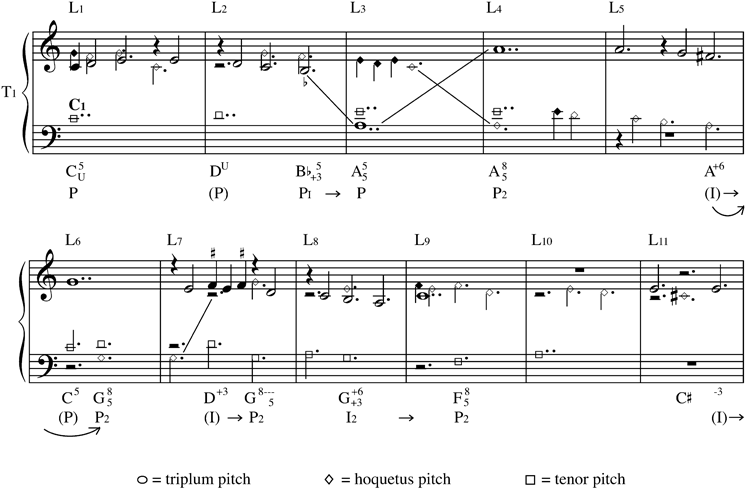
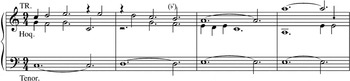
Dividing the breve into unequal semibreves is likewise a prominent feature in the Manere and In seculum breve hockets. In L1 of the Manere hocket, for instance, the triplum's e and d are rendered in a short–long pattern. This rhythm recurs at the beginning of the third long, but in hocket.Footnote 28 Again, Machaut's Hoquetus begins with this very rhythm, and soon after appears in hocket, yielding a short–long crotchet/minim composite rhythm (L3 of Ex. 5). A third shared characteristic involves a texture that features intermittent hocketing; in a manner similar to Machaut's Hoquetus, each of the earlier examples begins with simultaneous attacks in all three voices (L1 and L2 of Ex. 4b, for instance), which is followed by hocketing in the triplum and motetus (L2 and L3); the hocketing passage is in turn followed by simultaneous attacks (L4). The musical fabric of each of these hockets continues in this manner of intermittent hocketing for their duration. Finally, as in the Hoquetus, the earlier examples also feature hocketing in steady breves (see L2 of Exx. 4a and 4d and L10–11 of Ex. 5).Footnote 29
T1 of the Hoquetus David.
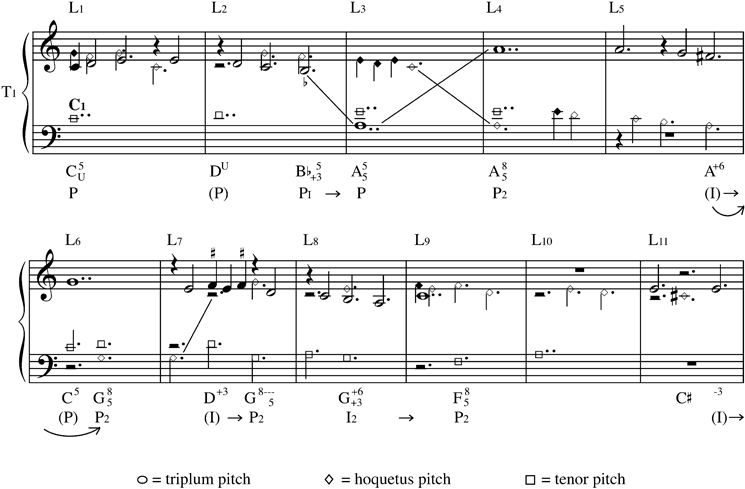
Another stylistic characteristic shared in the Hoquetus and the thirteenth-century examples involves their tight-knit textures that feature a great deal of voice crossing. In the In seculum breve hocket, for instance (Ex. 4d), the hoquetus voice first crosses below the tenor at the end of L3 with b, then continues to sound the lowest voice with a in L4, at which point the triplum and tenor both sound a fifth above. In the Hoquetus David (Ex. 5), at the end of L2, the b (which would be sung b♭ to yield a perfect fifth below the hoquetus's f) sounds below the tenor, as does the a at the beginning of the following long, while the other voices likewise both sound a fifth above. Voice crossing below the tenor is significant here because of its rarity in Machaut's motets with liturgical tenors.Footnote 30 In fact, it only occurs with any degree of regularity in the three motets with secular tenors when the (middle voice) motetus crosses below. Here, however, not only does the (middle voice) hoquetus often cross below the tenor (see the diamond-shaped a notehead in the bass clef of L4 for instance), but the triplum also crosses below, as is the case across L2–L3. The triplum never crosses below the tenor in any of the motets. While the frequent intermingling of voices is not a remarkable feature of thirteenth-century style in general, it is indeed a remarkable feature here, especially since it is not prevalent in Machaut's other works with chant-based tenors. Further, a consequence of the voice crossing involves the masking of the David tenor melody; instead of having the tenor pitches c–d–e–e as the lowest-sounding voice during the first four longs, the triplum dips below in L2–L3 (as we just saw), while the hoquetus reaches under beginning in L4. Machaut likewise makes frequent use of this same compositional move – disguising the tenor melody, albeit with the middle-voice motetus – in his three motets with secular tenors, but only rarely does so in his twenty isorhythmic motets on chant-based tenors.Footnote 31
Machaut probably modelled many of the Hoquetus's rhythmic characteristics on the hockets from the previous century. It is even possible that he modelled the aforementioned voice crossing on the earlier examples. Nonetheless, it is crucial to state that the overall sonorous language of the Hoquetus David is – not surprisingly – wildly different, as even a brief comparison of Exx. 4 and 5 illustrates. For instance, the opening sonority of both In seculum hockets consists of all three voices joining in unison on c. At no other point in the Hoquetus or his motets did Machaut compose such an ‘empty’ sonority, let alone as an initial concord.Footnote 32
Whereas the sonorous language of the Hoquetus is largely reminiscent of the three-voice motets,Footnote 33 the initial sonorities of the Hoquetus and the motets differ in at least two subtle, yet significant respects. First, in all motets that begin with a three-voice sonority, the triplum states the highest pitch, the tenor the lowest pitch, and the motetus a different pitch in between. As can be seen at the beginning of Ex. 5, rather than beginning the Hoquetus with each voice in its own usual and distinct register, the middle-voice hoquetus sounds the highest pitch of the sonority (see the diamond-shaped g notehead), while the triplum blends with the tenor to yield a c/c unison.Footnote 34 The typical registral identity of each voice part that is always maintained at the beginning of the motets is thus obscured from the outset in the Hoquetus.Footnote 35
Second, in all the motets with chant-based tenors that begin with a three-voice sonority, the initial concord always consists of three different pitches and two different perfect intervals with respect to the lowest-sounding voice; for example, Motet 17 (discussed later in Ex. 9) begins with a c/g/cc or C85 concord, and is labelled as P2 in type. (As a reference for the remainder of this article, a summary of all two- and three-voice consonant sonorities as well as a few dissonant sonorities employed by Machaut is provided in Ex. 6.Footnote 36) P2 concords have diversitas, a sonorous quality discussed in the early fourteenth-century treatise ‘Quicumque voluerit duos contrapuncti’. As a rule, in addition to beginning with three-voice P2 sonorities, Machaut concludes all sixteen of his three-voice motets with chant-based tenors with P2 sonorities. While the Hoquetus likewise concludes with a P2 sonority, its initial concord lacks diversitas: the C5U, P sonority consists of only two different pitches, thereby revealing yet another compositional difference between the Hoquetus and the motets.Footnote 37
Two- and three-voice sonority types.

A comparison of the Hoquetus David with the motets as well as with several representative thirteenth-century hockets has indeed shed further light on several of the Hoquetus's musical features. It is not, after all, merely a ‘textless isorhythmic motet’: while the Hoquetus shares some features with Machaut's motets with isorhythmic liturgical tenors (the manner of tenor organisation of its first section and the same type of concluding sonority, for instance), other features are shared specifically with the three non-isorhythmic motets with secular tenors (masking of the tenor melody). Still more of its salient characteristics are not distinctive of any of the motets (initial sonority type, triplum crossing below the tenor). Some features recall several thirteenth-century stylistic traits, and more specifically, the thirteenth-century double hocket tradition (the notated rhythmic values of the upper voices, the tight-knit texture with frequently overlapping voices, the short–long rhythmic motive in both the hocketing and the non-hocketing passages). It is this combination of characteristics exhibiting various traits of select thirteenth- and fourteenth-century genres that affords the Hoquetus David much of its unique character.
II
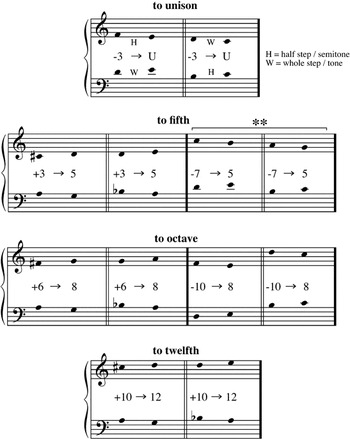
Many of the Hoquetus David's most interesting musical features may be discovered through a careful look at its syntax – how one sonority moves to the next. In order to provide the appropriate framework for a syntactic analysis, it is worth summarising some of the most basic fourteenth-century contrapuntal precepts. As has been well-documented by several scholars, the extant contrapunctus manuals limit contrapunctus to consonant intervals, which are identified as either perfect (unison, fifth, octave, twelfth) or imperfect (third, sixth, tenth).Footnote 38 Numerous manuals outline three paradigmatic interval progressions that feature contrary, conjunct motion from an unstable, imperfect interval to a stable, perfect interval: the minor third progresses to the unison, the major third to the fifth, the major sixth to the octave. When the unstable minor third contracts to a stable perfect unison, one voice moves by step and the other by half step (see the top of Ex. 7). The same can be said of the corresponding compound progression, minor tenth to perfect octave found on the right of the third staff. The stable perfect octave can also be approached from an unstable tendency interval and in conjunct motion from a major sixth, as shown on the left of the third staff. Similar expanding motion occurs in the major third to fifth progression just above in the example, as well as in its compound progression, the major tenth to twelfth notated on the bottom staff. Not included in Ex. 7 are intervals greater than a twelfth, as they are seldom found in Machaut's music.
Tendency progressions with contrary, conjunct motion to perfect intervals.

But what about approaching the stable perfect fifth in contrary, conjunct motion from a larger interval? If the same criteria are kept – one voice resolving by half step and the other by whole step – the progression would necessarily involve a minor seventh that contracts to a perfect fifth. Because the manuals regard the seventh as a dissonance, the seventh to fifth progression is naturally forbidden in contrapunctus.Footnote 39 This restriction applies, however, to note-against-note counterpoint, not the florid musical surface of the Hoquetus David or a motet, for instance. In fact, it is this minor seventh to fifth progression that Machaut employs on numerous occasions throughout his oeuvre; several examples shall be examined shortly.
As had been noted in reference to Ex. 1, the Hoquetus's seven major cadences do not recur at corresponding moments from talea to talea. Despite the absence of upper-voice poetry, which in Machaut's other compositions constitutes an important element in assessing and identifying major points of tonal articulation such as cadences, these seven moments shall be identified as being clearly cadential in nature by virtue of the simultaneous longs in each voice. Indeed, these moments of rhythmic rest (provided in Ex. 8) each stand out amid the flurry of activity and, as acknowledged by Leech-Wilkinson, likewise constitute important sonorous markers in the piece.Footnote 40 But the main interest here arguably lies in how each of these sonorities is approached.
Tendency progressions at the seven long moments of rhythmic rest.

Let us begin with a particularly straightforward progression, the succession of sonorities composed with the tenor's whole step that concludes the Hoquetus. As illustrated in Ex. 8g, the penultimate concord consists of a major sixth and major third above the tenor's a. Each of these tendency intervals resolves according to the precepts outlined above, in conjunct, contrary motion to a perfect octave and perfect fifth, respectively. This same type of progression, I2→P2, in fact concludes all the three-voice motets with chant-based tenors, and represents a typical three-voice directed progression, a concept first explored by Sarah Fuller, and subsequently by numerous other scholars.Footnote 41 Given the currently accepted definition of the directed progression that entails motion from imperfect to perfect, and given my consideration of the seventh that is dissonant in nature, I employ ‘tendency progression’ here in order to allow for the inclusion of all the aforementioned interval successions, including the 7–5 progression.
Exx. 8a and c likewise each involve two simultaneous interval progressions, but differ in sound from the concluding I2→P2 progression, largely on account of the outer voices. In Ex. 8a, the three voices combine on the third breve to yield an A5+3, PI sonority. When viewed solely with respect to the lowest-sounding voice, the concord's constituent intervals are a major third and a perfect fifth. The major third indeed resolves as expected to a G/d fifth in L2, but the a/e perfect fifth, having no tendency, moves in parallel motion to G/d, another perfect fifth. As is well documented in fourteenth-century manuals, parallel motion between identical perfect intervals is strictly forbidden. Yet in this case, there is an additional two-voice tendency progression: the c♯/e minor third found between the upper two voices resolves inward to a perfect unison. Thus, the major 3–5 progression between the lowest two voices and the 3–U progression between the upper voices, when coupled together, constitute the progression's driving force and, in effect, mitigate the outer-voice parallel motion.Footnote 42 The progression in Ex. 8c concludes the Hoquetus's first section (the end of talea 8), and likewise includes weakened parallel fifths in the outer voices. The tendency intervals here, however, consist of a minor third between the lowest two sounding voices and a major third between the upper two voices. Thus, when both resolve in conjunct motion, a 5U sonority necessarily results, rather than a 55 concord.Footnote 43
The progression in Ex. 8d is similar in that a fifth sounds for the entire long, but different in that only two voices are involved in the stable fifth. The tendency sonority, B♭+3+3, is labelled as I, in contrast to (I), which contains only two sounding voices. The major third between the triplum and tenor resolves as expected outward to an a/e perfect fifth. Perhaps to avoid parallel unisons between the tenor and hoquetus, the latter drops out for L3, leaving only the triplum and tenor on the fifth.Footnote 44 Remarkably, in this progression, however, as well as progressions 8a and 8c, it is not the tenor that serves as the lowest-sounding voice, nor even the hoquetus, but the triplum. This is especially noteworthy since in the motets, it is nearly always the case that the tenor serves as the lowest-sounding voice, and on the rare occasions that it does not, it is the middle-voice motetus that does, but never the triplum.
The three remaining progressions in Ex. 8 (b, e and f) are exceptional since they each involve dissonance. In progression b, which features hocketing in the prominent short–long rhythm, the triplum's d forms a consonant major sixth with respect to the tenor. This sixth, which seeks a perfect octave, resolves only partially: while d resolves as expected to e, the F skips up to a in the tenor. The hoquetus voice, however, boldly enters on b♭ to yield a dissonant fourth with respect to the tenor. The resulting +64 dissonant sonority, which, of course, is extremely unstable in nature, does not occur in cadential progressions in the motets. In addition to featuring a tendency interval of a major sixth in its outer voices, this dissonant sonority also contains a b♭/d major third tendency interval in the upper voices (hoquetus and triplum), which in turn resolves as expected to an a/e perfect fifth. Thus, a striking aspect of this cadential progression is that it features a typical major third to fifth progression in the upper voices, but one of these upper voices creates a dissonance with respect to the tenor. Again, this progression (as 8a and 8c before) points to the importance of recognising tendency intervals that do not necessarily involve the lowest-sounding voice – whether it be the tenor or not – in order to more fully understand the voice leading.Footnote 45
The other two progressions – 8e and 8f – both involve minor sevenths. It is Machaut's use of this dissonant interval in the Hoquetus, motets and Mass that shall be the focus of the remainder of this section. In progression f, the g/b♭ minor third between the lowest two voices resolves to a unison. The b♭/f perfect fifth between the upper voices has no particular tendency. The dissonant g/f minor seventh between outer voices, however, contracts to a perfect fifth. Thus, the penultimate tendency sonority of this progression contains a dissonance, not only with respect to the tenor, but also in its outermost, most audible voices. As previously mentioned, on account of the dissonant seventh, the contrapunctus manuals forbid such a progression. Yet it is important to remember that the extant manuals concern note-against-note counterpoint. Thus, the underlying note-against-note skeletal sonority does not contain the seventh, but instead consists of the preceding g that yields a consonant octave; the f that yields the seventh would then be interpreted as passing in nature. Similar reasoning could account for the dissonance in progression e.Footnote 46 Despite this interpretation, one should note the seventh in both of these progressions for three reasons. First, the 7–5 motion more fully describes what actually occurs on the musical surface itself. Second, Machaut not only composes this same minor 7–5 progression several more times throughout the Hoquetus David, but also does so on numerous occasions throughout his other works with chant-based tenors, the motets and the Mass. Third, in some of these cases, as we shall see later on, the seventh cannot be interpreted as passing. I propose that Machaut employed the 7–5 progression much in the same way as the three standard tendency progressions; in fact, in many respects, the 7–5 progression resembles, and is often paired with, the minor 3–U tendency progression. An examination of several relevant passages from the motets and the Mass will demonstrate.
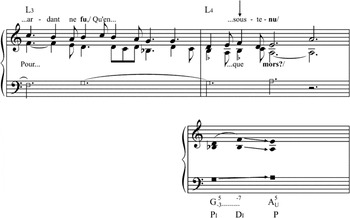
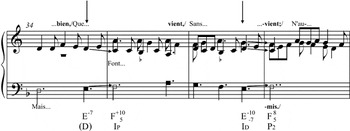
Ex. 9 provides two passages from Motet 17. The motet contains two statements of the tenor melody: Ex. 9a illustrates Machaut's setting of the beginning of the first color statement, and Ex. 9b the beginning of the second color statement. As mentioned above, Motet 17 begins with a stable P2 sonority: the c/cc tenor/triplum octave combines with the c/g tenor–motetus fifth to yield a C85 sonority. Looking ahead to the third long (L3) of the excerpt, one encounters another C sonority, but this time its intervallic configuration involves a fifth and a unison. This C5U, P sonority stands out in the motet's opening moments because of its attack at a strong mensural position and due to its long duration given the active rhythmic surface of the previous two longs. How then is this C5U sonority approached? Regarding the tenor–motetus pairing, the two lower voices yield an unstable b/d minor third on the last semibreve of L2. This minor third in turn resolves to a perfect unison, at which point the motetus concludes its first line of poetry (indicated by boldface text and a diagonal slash). Coinciding with the b/d minor third is a b/a minor seventh in the tenor–triplum duo; it in turn contracts to a perfect fifth. The triplum, however, does not conclude a line of poetry; instead, the 7–5 contraction coincides with the word desir.
Machaut, Motet 17.
T1, L1–L3, beginning of the first color statement.

T4, L1–L3, beginning of the second color statement.

At the corresponding moment in the second color statement (Ex. 9b), the sonority at L3 is also a C5U, P concord, and is likewise approached from a b/a minor seventh paired with a b/d minor third. Here, though, the minor seventh is more prominent, due to several reasons. First, the a is approached by skip from f♯ (the smooth linear connection to the seventh that occurred in the progression at the beginning of the motet is no longer present). Second, the seventh is first attacked at a mensurally stronger position, on the third breve instead of on the following semibreve. Third, the seventh is immediately repeated. Also striking is that both lines of upper-voice poetry conclude with the repetition of the unstable tendency sonority. This provides an interesting conflict between the poetic phrasing on the one hand, and musical phrasing on the other, since the DI sonority is clearly unstable, and seeks resolution, thereby propelling the musical motion ahead to the stable C5U sonority L3. In both of these progressions, the note-against-note skeletal background of the tendency sonority could consist of the b/d/f♯ sonority attacked on the second breve of each L2. Yet it is the seventh that immediately precedes and in turn resolves to the fifth in both cases.
While the seventh can be granted emphasis through repetition and in the manner it is approached – by skipping to it, for instance – another way in which the discord can be made prominent in a progression is in the manner in which it is left before it in turn resolves; see Ex. 10a. Machaut composes Motet 10's first cadence within the fourth long. The stable A5U, P sonority features rhythmic rest, relatively long note values in each voice, and the conclusion of both lines of upper-voice poetry. Again, how is the cadential sonority approached? As is made evident in the contrapunctus reduction immediately below, the tenor/motetus G/b♭ minor third contracts to an a/a unison. On the musical surface itself, however, the b♭ is decorated before it is granted resolution. The move to c – by step in the ‘wrong’ direction – resembles a so-called ‘Landini’ figure, only in reverse. The b♭ clearly constitutes the motetus's structural pitch of the minor 3–U progression. Similarly, the f that forms a minor seventh with the tenor's g and that is attacked at the exact same moment as the structural b♭ is decorated before progressing to e. As a result, at the level of the semibreve the cadence features a DI→P progression, much like in both cadences examined in Motet 17. Remarkably, a nearly identical progression, including a decorated DI tendency sonority, occurs soon afterwards in the motet, within L2 of the third talea, but a third higher – see Ex. 10b. This cadence does not occur at the corresponding moment in the talea, but takes place within L2 instead of L4. Moreover, the half step motion in the 7–5 progression appears in the tenor (between b and c) in contrast to earlier in the triplum (between f and e). A transposition of a three-voice texture such as this is an extremely rare move for Machaut. But a noteworthy consequence of this transposition is that we once again encounter a progression that features simultaneous intervallic contractions: minor 7–5 and minor 3–U.
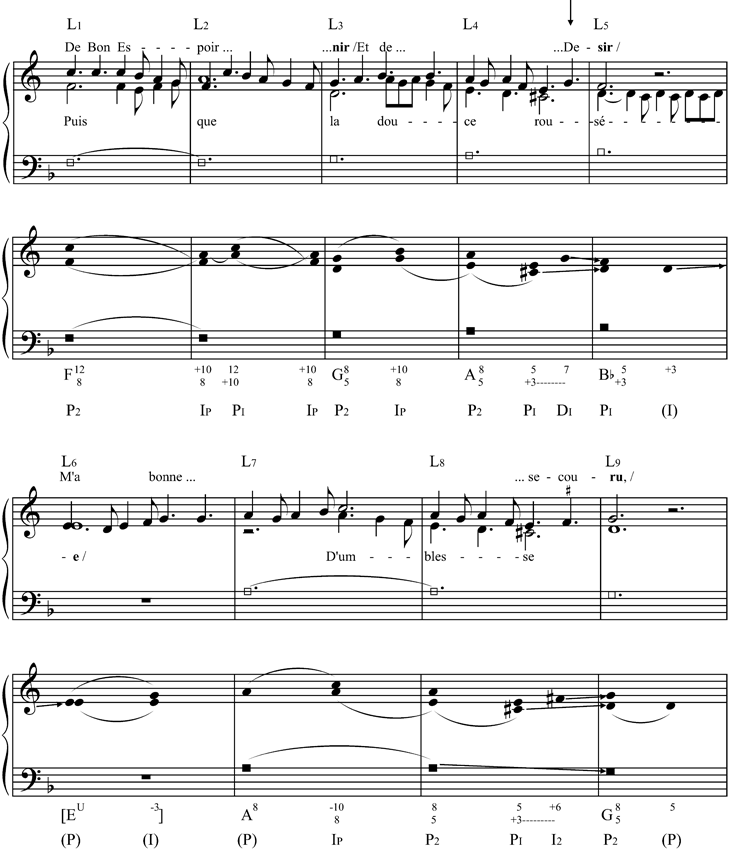
Although the minor seventh is most often paired with the minor third in a three-voice texture, and thus both intervals simultaneously resolve inward, sometimes Machaut pairs the minor seventh with a different interval: such is the case in Ex. 11, the beginning moments of Motet 4 in which the minor seventh combines with a major third.Footnote 47 Towards the end of L4 (see the downward pointing arrow), the triplum's g combines with the tenor's a and the motetus's c♯ to yield a DI sonority. The outer-voice a/g minor seventh resolves inward to a b♭/f perfect fifth. Given the b♭ in the chant-based tenor line, the immediately preceding a/c♯ major third found between the tenor and motetus cannot resolve outward to a perfect fifth; instead, only the motetus resolves as expected to d. Despite the pairing of the minor seventh with a major instead of minor third, Machaut's voicing of the progression still shares an important characteristic with the others examined thus far: the contracting 7–5 motion that occurs in the most easily-audible, outer voices.
Machaut, Motet 10.
T1, L3–L4.

T3, L1–L2.

Machaut, Motet 4, T1, L1–L9.

The approach to the cadence that occurs at the end of the following system in Ex. 11 draws further attention – at least in hindsight – to the seventh in L4. Towards the end of the L8, the tenor and motetus once again sound a and c♯, respectively, but when combined with the triplum's f♯, a very unstable I2 sonority results. All three voices in turn resolve as expected to a stable P2, G85 sonority. The f♯ clearly constitutes the triplum's salient pitch in the voice leading of the progression. Although the f♯ could be interpreted as a passing tone since it occurs between e and g, naturally, it is not interpreted as such, but instead is regarded as a functionally significant element in the I2→P2 progression. If one takes a similar approach to the analysis of the progression across L4–L5 – as suggested by the rhythmic and melodic parallelism of L4 and L8 – the g, further made prominent since it is skipped to, would constitute the triplum's salient pitch in the progression.
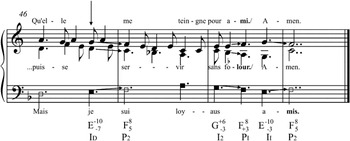
The examples of the 7–5 progression we have inspected thus far have largely stood out by virtue of relatively long note values, metric accentuation, placement at the end of a phrase or some combination thereof. But just as in the 3–U, 3–5 and 6–8 progressions, the 7–5 tendency progression likewise occurs in shorter note values and within the course of a phrase. Motet 20 features no less than ten instances of this progression at various points within the phrase, a remarkable fact given that it is by far the shortest of Machaut's motets, totalling only forty-nine breves. Ex. 12 provides four of the ten occurrences. In Ex. 12a, the outer-voice g/f minor seventh is paired with a g/b♭ minor third; the DI sonority in turn resolves to the A5U, P sonority that coincides with upper-voice poetry line endings; the tenor at this point, however, is mid-phrase. Exx. 12b and 12c show three different settings of a minor 7–5 progression that each involves an ascending half step, E-F, in the tenor. At the beginning of Ex. 12b, while the motetus rests for the entire breve, the triplum's d that yields a minor seventh with the tenor's E is decorated with a reverse Landini figure before resolving to c. This same decorated progression occurs across bars 36–7, this time paired with a minor 10–8 progression in the outer voices. In Ex. 12c, Machaut further decorates the progression by composing another reverse Landini figure with the minor 10–8 progression, but this time in a short–long rhythm.
Machaut, Motet 20.
bars 20–23, beginning of the second A phrase.

bars 34–37, penultimate B phrase.

bars 46–49, last B phrase, conclusion of motet.

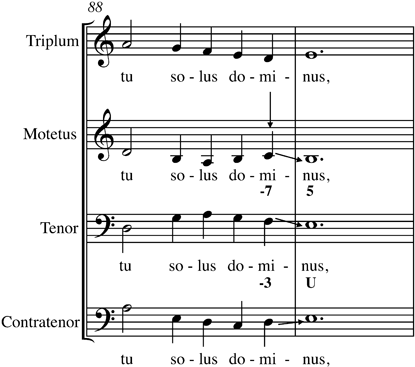
A discussion of the seventh in Machaut's music would be remiss without acknowledgement of his Messe de nostre dame. In reference to dissonant harmonies in the Mass, Leech-Wilkinson alludes to the resemblance that has been pointed out above between the minor 3–U, major 3–5, and major 6–8 tendency progressions on the one hand, and the 7–5 tendency progression on the other hand: ‘The most numerous are the 7th chords, so extensively used that they almost acquire the status of imperfect consonances, contributing vitally to the “sound” of Machaut's Mass.’Footnote 48Ex. 13 provides but two instances of the 7–5 progression from the Mass. In Ex. 13a, the contratenor/motetus seventh resolves to a fifth while the contratenor/tenor minor third contracts to the unison. I would argue that the octaves in the outer voices are largely overshadowed by these two simultaneous tendency progressions, one of which, significantly, involves a dissonance. Margaret Bent comments upon this very progression: ‘Although the short c/d dissonance between the triplum and motetus on the last beat of 88 could have been avoided with a motetus a instead of a c, it might be regarded as a cadential licence in approaching the following long note.’Footnote 49 While the dissonance may undoubtedly be regarded as ‘cadential licence’, I would like to invite the interpretation that the 7–5 motion composed throughout Machaut's oeuvre with relative frequency – even when not composed with respect to the tenor, as is the case here and elsewhere – may offer an explanation for the otherwise ‘problematic’ counterpoint in this progression. In Ex. 13b, from the Credo, the 7–5 contraction occurs with the tenor/contratenor pair, this time involving the tenor, and this time with the tenor as the lowest-sounding voice; once again, here, as in many of the examples we saw in the motets, the seventh is approached by skip, thereby granting it further prominence in the texture. Note that the tenor and contratenor staves have been swapped for ease of reading and interval labelling.
Machaut, Messe de nostre dame.
Gloria, bars 88–89.
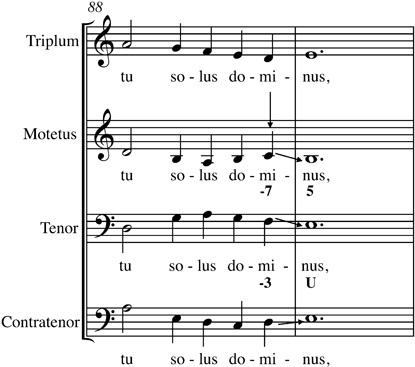
Credo, bars 55–58.

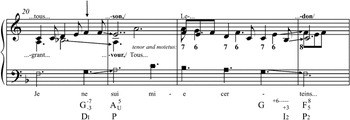
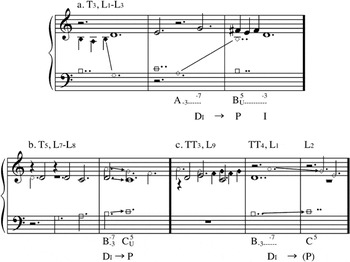
Some of the most audacious 7–5 progressions occur in the Hoquetus David itself. Ex. 14 illustrates three such passages. In the first progression (Ex. 14a), the seventh is especially audible in L2 of the third talea statement: not only is the dissonant g approached by skip, and also after a rest, but the a/g seventh is stated in hocket in a steady breve composite rhythm. It in turn resolves to a b/f♯ fifth. Progression 14b is particularly striking since the hoquetus voice, after resting for two-thirds of a bar, enters at the beginning of the long on a dissonant aa without any stepwise preparation. The hoquetus's previous pitch, d, lies a fifth away. The outer-voice, metrically accented, melodically unprepared b/aa seventh is indeed a bold move on Machaut's part, made all the more interesting since, in this particular case, it blatantly defies contrapunctus teachings. The note-against-note skeletal sonority clearly consists of the hoquetus's a and the triplum's d composed with the tenor's b. The DI sonority in turn resolves with the voice leading to which we have now become accustomed. In Progression 14c, we hear the 7–5 progression not only across a lengthy span of nearly two entire longs, not only on the same pitches, not only at the outset of the final talea statement, but also in hocket: the tenor sings b while the hoquetus hockets aa, then the tenor sings c while the hoquetus hockets g.Footnote 50
Additional tendency progressions involving the minor seventh.

To recapitulate: a composer who wishes to write one of the three paradigmatic tendency progressions described in the contrapunctus manuals with a tenor descending stepwise, has two options: major third to perfect fifth and major sixth to perfect octave. When faced with a tenor line, however, that ascends by step, the composer has only one option: minor third to unison. The seventh to fifth progression not only allows for another tension-resolution type progression to be counterpointed with an ascending step, but also allows for another way to approach the fifth. To be sure, as elucidated in the contrapunctus manuals, consonance (nearly always) governs the underlying texture, and the minor 3–U, major 3–5, and major 6–8 progressions comprise the bulk of the tendency-resolution type progressions that indeed play such a crucial role in the works of Machaut and many of his mostly anonymous Ars Nova contemporaries. But careful analysis of Machaut's music reveals that it is sometimes beneficial to look and think beyond these consonances in order to more readily uncover the intricacies of his compositional language. As Bent puts it so eloquently: ‘While the starting premise of analysis should include the relevant musical grammar, if it is found in practice that the composer departs from that grammar, in such a way that we are sure it is not simply a manuscript error with a ready solution, we may add it to a vocabulary of extended or exceptional usage.’Footnote 51 As the examples examined above – that is, based on Machaut's actual usage – make clear, the 7–5 progression can not only be added to Machaut's vocabulary of exceptional usage, but also constitutes a salient element of his compositional praxis.
III
This final section briefly considers the question of method of performance for the Hoquetus David. Most of the earliest transcriptions and editions of the Hoquetus David, as well as any associated commentary or scholarship to comment specifically upon its method of performance, appear to make the simplistic equation that untexted music indicates instrumental performance. Some scholars, such as Amédée Gastoué, even flat out state, but without any evidence, that the work is instrumental in nature: ‘Among his numerous compositions, we encounter an instrumental piece composed in “double hocket”.’Footnote 52 Gastoué's transcription of the Hoquetus's opening (which, to my knowledge, represents the work's first ‘modern’ transcription, albeit a partial one) is reproduced here as Ex. 15a. Not only are the triplum and hoquetus voices notated an octave too high, but the rhythm and note values are completely misrepresented throughout (compare, for instance, with the opening of the first complete edition of the Hoquetus edited by Guillaume de Van in Ex. 15b), which results in a piece that certainly would not sound much like it was intended.Footnote 53 Machabey, who also produced a transcription of the opening (Ex. 15d), criticises Gastoué for his errors (but without stating what they are), faults de Van for his ficta indication in the second bar, and claims that ‘the writing is extremely original and seems to suit instruments or an organ rather than voices.’Footnote 54 It is no wonder that Machabey cites instrumental or organ performance, since he notates the triplum an octave too high and the tenor an octave too low. Even some of the most recent, introduction-to-music type texts cite instrumental performance with no support; for instance, one source identifies the work as ‘Guillaume de Machaut's only instrumental composition’, going so far as to claim that ‘Machaut does not specify the instruments to be used in his Hoquetus, which is among the earliest known polyphonic instrumental pieces.’Footnote 55
The earliest transcriptions of the Hoquetus David's opening.
Gastoué (1921).

de Van (1938).

Ludwig (1943) (=Allaire, 1980, except Allaire notates in modern clefs).

Machabey (1955).

Friedrich Ludwig did not discuss questions of performance practice in his commentary. Still it is worth noting that, although his edition of Machaut's complete musical oeuvre is usually the most reliable, this is not the case for the Hoquetus David.Footnote 56 As shown in Ex. 15c, the opening alone contains two pitch errors (see the downward-pointing arrows, though he does correctly render d at the end of the third bar in the hoquetus part instead of the erroneous e found in the other three sources in Ex. 15). Further, he renders the long as a dotted minim, thereby notating the upper voices in the same note values as he does in the motets and in turn obscuring Machaut's deliberate homage to the thirteenth-century genre. More problematic, though, is that Ludwig opts to render the short–long rhythm as a pair of eighth notes.Footnote 57 Although he states in his commentary that the two semibreves in question are literally short–long in nature, he claims that ‘the theoretically prescribed alteration becomes meaningless’ because of the Hoquetus's ‘quick movement.’Footnote 58 The pervasive short–long rhythm is anything but meaningless, for it constitutes a decisive unifying element throughout the work, and it gives the Hoquetus much of its thirteenth-century flavour.
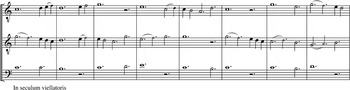
Grove's most up-to-date entry on ‘hocket’, a nearly verbatim reproduction of a 1974 article written by Ernest Sanders,Footnote 59 acknowledges that such a work ‘can, of course, also be performed vocally’, but also describes the untexted hocket in general as constituting ‘the earliest known instrumental (non-verbal) polyphony,’ thereby effectively equating its lack of poetry with instrumental origin. Additionally, the article indicates that the word viellatoris (vielle player) attached to one of the aforementioned thirteenth-century Bamberg hockets identifies the work ‘specifically as instrumental, at least in origin’ and immediately goes on to state that ‘a fourteenth-century specimen is Machaut's Hoquetus David’. A look at the opening of In seculum viellatoris (see Ex. 16), however, reveals that hocketing is not a prominent feature of the work; in fact, there is but one brief hocketing passage that occurs in bars 34–35 of the forty-six-bar composition.Footnote 60 The asserted relationship between double hocket and instrumental origin thus becomes greatly attenuated in this respect. In seculum viellatoris was likely grouped with the In seculum hockets in the manuscript simply because it is based on the same tenor.
In seculum viellatoris, opening.

More recent scholarship has rightfully debunked the claim that a lack of text necessarily equates instrumental performance. Peter Jeffery, for example, seriously questions the assumption of instrumental hocket performance in his discussion of the lone four-voice In seculum hocket.Footnote 61 As he points out, the myriad organa and clausulae are also textless, but no one would argue that they must or should be performed instrumentally. Moreover, the frequent use of hocketing in thirteenth- and fourteenth-century motets points decidedly to the fact that hocketing was obviously appropriate for singers. Indeed, as could be seen above, Machaut makes ample use of hocketing in his motets. Of particular interest in the passages we examined is the excerpt from Motet 23 (Ex. 3b), which features melismatic hocketing; that is, the upper voices engage in extended hocket passages while singing a single syllable, surely a practice that could be extended to the Hoquetus David. Jeffery also calls attention to the fact that, in the thirteenth century, hockets were sometimes transformed into motets, and vice versa, some motets were apparently made into hockets. One such example of the first process involves the In seculum longum hocket that appears in the first fascicle of Montpellier, discussed above in Ex. 4c. The work also appears later on in the same codex, but under the guise of a three-voice motet. As illustrated in Ex. 17, the tenor and hoquetus voices of the original remain intact, but the hoquetus is now set with poetry. The uppermost voice, which also appears as the quadruplum in yet another work in Montpellier that retains all three of In seculum longum voices as the lower three parts, is likewise set with poetry. These upper two voices (and perhaps the tenor, too) were thus clearly meant to be sung. While it is therefore clearly possible, if not probable, that the thirteenth-century hocket could be performed vocally, then surely Machaut's fourteenth-century hocket could also be performed vocally.Footnote 62
Je n'amerai / Sire Dieus / In seculum, opening.

But what about the individual musical lines of the Hoquetus itself? Are they conducive to vocal performance? An inspection of the range of each voice in the Hoquetus in relation to the vocal ranges in the motets, as well an examination of the Hoquetus's general melodic activity reveals the answer to be yes. As shown at the beginning of Ex. 18a, the range of the tenor is a ninth, the hoquetus a tenth and the triplum an eleventh.Footnote 63 While the triplum's range of an eleventh may appear to be a bit wide and its bottom point F♯ may seem a bit low, it is worth noting that each of the outer pitches of this eleventh are sung only once, and the F♯ lies only a half step lower than the bottom point of Motet 12's triplum range. Further, as illustrated in Ex. 18b, the vocal ranges and registral designations of the corresponding voices in the four-voice motets are likewise similar to those in the Hoquetus;Footnote 64 three of these motets (21–23) are roughly contemporaneous with the Hoquetus, likely dating from the 1360s.
Vocal ranges.
The Hoquetus David and the three-voice motets.

The four-voice motets.

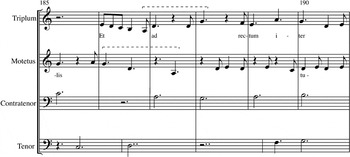
In terms of melodic intervals, the Hoquetus includes a handful of seemingly tricky leaps that involve either direct sevenths or outlined sevenths. Ex. 19 contains all instances of such leaps in the entire Hoquetus. As shown by the first dashed square bracket, the triplum outlines a seventh by moving up from G to d to f. A few longs later – see the solid square bracket – the triplum states G, and after and intervening rest, leaps up to f♯. The only time a leap of a seventh happens without an intervening rest occurs at the end of the next system with the same G–f♯ motion; here, however, the two immediately preceding pitch-specific f♯–G and G–f♯ motions between the hoquetus and triplum would doubtlessly make the ensuing G–f♯ motion in the triplum much less difficult to sing. Such leaps – either outlined or direct – are likewise found on occasion in the motets as well as in the roughly contemporaneous Messe de nostre dame. As shown in Ex. 20a – the Kyrie of the Messe – within the span of only a few bars, the contratenor not only features a downward skip of a major third followed by a leap of a perfect fifth in the same direction, thereby outlining a major seventh, but only two bars later sings a melodic major seventh with no intervening rests. Ex. 20b illustrates overlapping outlined sevenths in the texted upper voices of the roughly contemporaneous Motet 23.
Melodic sevenths (direct or outlined) in the Hoquetus David.

Melodic sevenths (direct or outlined) in roughly contemporaneous works.
Kyrie, Messe de nostre dame, bars 14–19.

Motet 23, bars 185–90.

The similarity of vocal ranges and melodic activity in the Hoquetus and the motets suggests that Machaut intended the former to be sung. That a hocket can be performed vocally is not out of the question. But how should the Hoquetus be sung? To broach the query, albeit in an admittedly preliminary fashion, one might inspect the various ways in which the untexted motet tenors and contratenors have been performed by several early music groups. Of all the available recordings of Motet 23 (the most recorded Machaut motet), the majority of the performers sing the untexted lines on open vowel sounds, a process known as textless vocalisation; such an approach is undertaken by the likes of the Ensemble Gilles Binchois, Opus Anglicanum, Ensemble musica nova, Liber unUsualis, and the Schola Gregoriana of Cambridge.Footnote 65 A different approach is taken by Christopher Page's Gothic Voices, in which the text of the pre-selected chant segment (Ad te suspiramus gementes) is underlaid for both voices of the tenor/contratenor foundation. The Clerks’ Group takes a hybrid approach – text underlay for the tenor and textless vocalisation for the contratenor – while the Hilliard Ensemble employs a self-identified ‘heterodox’ approach, in which they underlay the chant text for the tenor, but for the contratenor, although difficult to hear, they employ solmisation, that is, the line is sung on the syllables ut, re, mi, fa, sol, la, according to the various hexachords.Footnote 66 While any of these approaches – textless vocalisation, solmisation or underlying the chant text – would provide satisfactory results in a vocal performance of the Hoquetus, it is interesting to note that singing the chant text, David, throughout – and in all three voices – may even be suggested by the Machaut manuscripts themselves. As mentioned above, Machaut labels the Hoquetus's voices as David tenor, David hoquetus and David triplum. Why would Machaut include the text David in each voice in addition to the usual tenor, hoquetus and triplum designations? Anne Walters Robertson reminds us that ‘labeling upper voices in this way is highly unusual, if not unique’ and offers the possibility that ‘Machaut may even have meant to [have] David sung by all three voices’.Footnote 67 Especially since we know that Machaut oversaw the production of at least one of his complete manuscripts, I agree with Robertson that it is plausible to suggest that the inclusion of this text in each vocal part implies that the word David is meant to be sung throughout; each voice would hocket on a single syllable, ‘Da-’ throughout, and then conclude on ‘-vid’ with the final sonority. Further, the opening of the recently recovered thirteenth-century Manere hocket (Ex. 4a) also has Manere written underneath all three of its voices, suggesting potentially that Manere should be sung in all three voices. In the lone available vocal recording of Machaut's Hoquetus, sung by the French group Obsidienne under the direction of Emmanuel Bonnardot, it is precisely this approach that is taken, singing David throughout.Footnote 68 Looking ahead, one would hope to see (and hear) more vocal performances of the Hoquetus to complement the handful of existing enjoyable instrumental renditions. After all, its tight-knit texture in particular – featuring constantly overlapping melodic lines and wonderful dissonances – provides a markedly different aural effect when performed vocally as opposed to instrumentally.
* * *
In the absence of other extant contemporaneous examples of a double hocket, a comparison of the Hoquetus David with Machaut's motets has shown that while the two genres share a few similarities, the Hoquetus in fact differs significantly in several respects, and may instead be viewed as an amalgam of sorts. Its pervasive use of the short–long rhythmic pattern, its setting in longer note values and the simple tenor rhythm in its second section (features absent in Machaut's other compositions with chant-based tenors) all suggest undoubted familiarity with, and a likely homage to, thirteenth-century examples of the genre as well as thirteenth-century style in general. The Hoquetus's frequent use of voice crossing below the tenor, a rare move in his other works with chant-based tenors, is found in his motets with secular tenors, but is extended in the Hoquetus to encompass the triplum as the lowest-sounding voice; again, the constant intermingling of the three voices is akin to the thirteenth-century examples. Its overall sonorous language and musical syntax, while clearly Machautian and reflective of his three-voice motets, also includes relatively frequent use of the 7–5 progression, a progression found on occasion in his other works with chant-based tenors, but in none of which as prominently and frequently as in the Hoquetus.
The Hoquetus's lone status in the Ars Nova should perhaps not surprise us. The theorist Jacobus of Liège writes in the 1320s that composers left behind the genre that flourished in the previous century and instead composed hocket passages in motets.Footnote 69 Further, Anne Walters Robertson and Elizabeth Eva Leach remind us of Pope John XXII's decree of 1324–5, in which he prohibited the use of hocket in the church, criticising his musicians for ‘cutting apart the melodies with hocket.’Footnote 70 Yet the poet Gace de la Buigne, an almost exact contemporary of Machaut, mentions the genre on numerous occasions in his popular Le roman des deduis (1359–71), an allegory completed during the last decade of Machaut's life. In the following passage, a character called Amour des Chiens (Love of Dogs) describes the sounds of baying hounds on the hunt:Footnote 71

Later on in Le roman, we again encounter double-hocketing dogs: ‘He says that they are musicians / And sing songs and motets / And they create well double hockets.’Footnote 72 These delightful passages not only hint at the possibility that other fourteenth-century double hockets may exist (but have been since lost or have yet to be discovered),Footnote 73 but also suggest that the genre was popular in its day. The number of currently available recordings of the Hoquetus David certainly points to its popularity today (in terms of Machaut recordings, that is), even outnumbering the motet recordings. But because the Hoquetus has received much less scholarly attention than Machaut's other musical compositions, many of the works’ anomalous musical features have until now remained unexplored. In this light, Armand Machabey's verdict that the Hoquetus David lacks ‘musical interest’ proves false.