INTRODUCTION
Many general reviews on biodiversity are available including the global diversity assessment (Huston, Reference Huston1994). But there is scarce or no concise synthesis of marine biodiversity available in relation to conservation needs, only specific reviews as coastal zone biodiversity (Ray, Reference Ray1991). From India, a total of 3271 species of molluscs are known to occur, belonging to 220 families and 591 genera, of which 1900 are gastropods, 1100 bivalves, 210 cephalopods, 41 polyplacophorans and 20 scaphopods (Appukuttan, Reference Appukuttan2008). Mechanized trawlers contributed 46% to the catch. In Tamilnadu the maximum landings were at Tuticorin, Ramanathapuram and Nagappattinam followed by Cuddalore districts. The occurrence of molluscs in the trash fish have been surveyed at two stations along the Cuddalore coast region, Tamilnadu, south-east coast of India, viz., Mudasalodai and Cuddalore landing centres.
Station 1 (Mudasalodai)
Mudasalodai is a famous landing centre, located near Parangipettai biological station (11°29′N 79°46′E). This area lies between the mouth of the Vellar estuary and Killai backwaters. Two hundred mechanized boats (trawlers) have been engaged for fishing activities (Figure 1).
Showing Stations 1 and 2.

Station 2 (Cuddalore)
Cuddalore landing centre is situated at 11°42′N 79°46′E. The Rivers Pennaiyar, Gadilam, Paravanar and Uppanar merge with the Bay of Bengal near Cuddalore, forming a dynamic estuarine environment before discharging into the sea. Nearly 250 mechanized boats (trawlers) were involved in fishing activity (Figure 1).
MATERIALS AND METHODS
From the trash fish, the molluscs were collected from two stations namely Mudasalodai and Cuddalore landing centres from October 2007 to September 2008. The sampling was done randomly from five heaps contributing 100 kg (20 kg/heap) at both stations. The specimens were brought to the laboratory, cleaned with a brush and identified using appropriate literature (Satyamurty, Reference Satyamurti1952, Reference Satyamurti1956; Ramamoorthy & Fernando, Reference Ramamoorthi and Antony Fernando1987; Rajagopal et al., Reference Rajagopal, Ajmal Khan, Srinivasan and Shanmugam1998; Subba Rao, Reference Subba Rao2003). Data were collected fortnightly, pooled seasonally and this was repeated throughout the period.
Diversity measures
In the present study, the data on gastropods and bivalves from both stations were amalgamated together for the different seasons and subjected to various univariate methods such as species diversity, species richness and evenness, and graphical technique using the k-dominance curve.
RESULTS
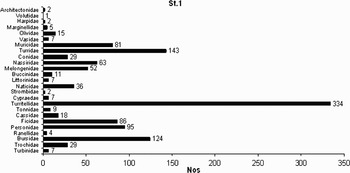
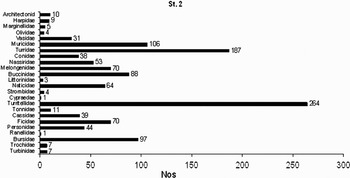
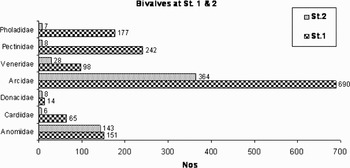
In the present study 59 species of gastropods belonging to 25 families and 35 genera (Figure 2), 11 species of bivalves belonging to 7 families and 9 genera were recorded in Mudasalodai (Station 1) (Figure 4), whereas 57 species of gastropods belonging to 25 families and 34 genera (Figure 3), 10 species of bivalves belonging to 7 families and 8 genera were observed from the trash landed at Cuddalore (Station 2) landing centre (Figure 4).
Numbers of individuals represented and list of gastropod families at Station 1.

Numbers of individuals represented and list of gastropod families at Station 2.

Numbers of individuals represented and list of bivalve families at Stations 1 and 2.

Diversity indices
Gastropods: Station 1
The Shannon index (Shannon & Wienner, Reference Shannon and Wienner1949) varied from 2.27 to 3.54 showing the minimum during post-monsoon and the maximum during pre-monsoon. The Margalef (Reference Margalef1958) richness ranged between 2.75 and 5.87 with the minimum values during summer and maximum during pre-monsoon. As observed in diversity, the Pielou's (Reference Pielou1969) evenness index varied from 0.58 to 0.75 with the minimum value during monsoon and the maximum value during post-monsoon season.
Bivalves: Station 1
The Shannon index varied from 2.13 to 2.52 with the minimum during the summer season and the maximum during pre-monsoon. The Margalef richness ranged between 1.44 and 1.75. The minimum values were recorded during monsoon season and maximum during pre-monsoon. As noticed in the Shannon diversity, the Pielou's evenness index varied from 0.62 to 0.73 with the minimum value during summer and the maximum value during pre-monsoon season.
Gastropods: Station 2
In Station 2, as an oddity, the Shannon index varied from 3.10 to 4.71 with less during summer and more during post-monsoon. The richness fluctuated from 3.87 to 6.27 with minimum during summer and maximum during post-monsoon. Species evenness values were observed to be from 0.67 to 0.90. The minimum being observed during the summer and the maximum being observed during post-monsoon.
Bivalves: Station 2
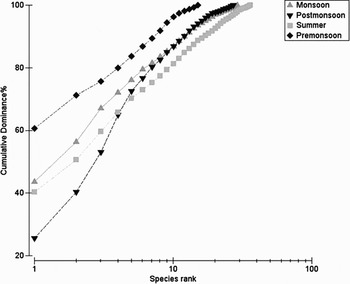
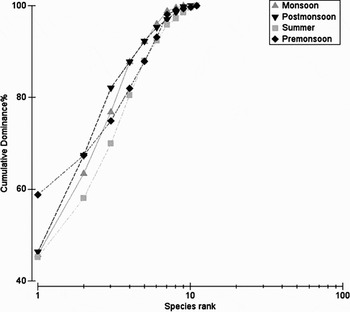
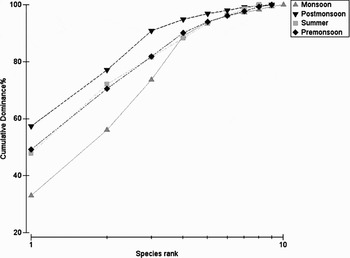
The Shannon diversity varied between 1.82 and 2.46 with the minimum during post-monsoon and the maximum during pre-monsoon. The richness ranged from 1.42 to 1.72 with the minimum during the summer and the maximum during monsoon. Species evenness varied from 0.57 to 0.74. The minimum was found during post-monsoon and maximum during pre-monsoon. As stated above, the data for both the regions were given as input for the k-dominance curve. At Station 1 (Mudasalodai) for gastropods, the curve for post-monsoon was lying below indicating the maximum diversity, and the curve for pre-monsoon was found to lie above all, signalling the minimum values (Figure 5). For bivalves, the curve for summer was lying below indicating the maximum diversity, and the curve for pre-monsoon was found to lie above all, signalling the minimum values (Figure 6). In Station 2 (Cuddalore) for gastropods, the curve for post-monsoon was lying below indicating the maximum diversity, and the curve for summer was found to lie above all, signalling the minimum values (Figure 7). For bivalves, the curve for monsoon was lying below indicating the maximum diversity, and the curve for post-monsoon was found to lie above all, signalling the minimum values (Figure 8).
The k-dominance curve of gastropods at Station 1 during various seasons.

The k-dominance curve of gastropods at Station 1 during various seasons.

The k-dominance curve of bivalves at Station 2 during various seasons.

The k-dominance curve of bivalves at Station 2 during various seasons.

DISCUSSION
Trawling in earlier times was not very harmful to organisms of no commercial value that were incidentally trapped in the trawl, as they were thrown back into the natural system. But now, due to extensive use of many organisms either as food or for ornamental purposes, all animals caught in the trawl whether they are edible or not, are brought back to shore where they are in high demand by the local market. The present observations focus on recording such indiscriminate harvest of lesser organisms trawled along with the shrimps and bottom fishers.
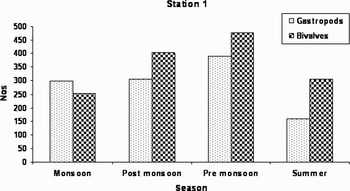
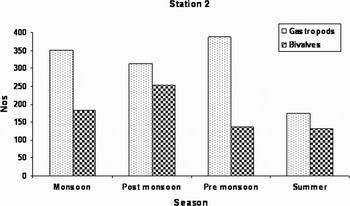
The results of the present study are in accordance with the earlier reports (Srinivasan, Reference Srinivasan1999). In Pazhayar, an adjacent landing centre, 37 species of gastropods and 14 species of bivalves were recorded. Mansingh (Reference Mansingh1994) recorded 36 species of gastropods and 19 species of bivalves from the coast line of Cuddalore. Murugan (Reference Murugan1998) recorded 30 species of gastropods from the Cuddalore coast. A total of 32 species of gastropods and bivalves were recorded from Pazhayar and Cuddalore by Sivakumar (Reference Sivakumar2001). In Mudasalodai, Sakthivel (Reference Sakthivel2000) recorded 75 species of gastropods and 33 species of bivalves. Among the gastropod diversity Nassarieus nivea, N. dorsata and bivalves such as Anadara rhombea and Paphia textile were the most abundant respectively. But in the present study N. nivea and N. dorsata are distributed significantly. In bivalves A. rhombea was the most abundant species and P. textile was distributed the least. In Nagappattinam 67 species of gastropod and 33 species of bivalve were recorded. Among them Turritella attenuata, N. dorsata, A. rhombea and P. textile were the most abundant molluscs. For Pazhayaru see Mohanasundaram (Reference Mohanasundaram1993); for Cuddalore see Mansingh (Reference Mansingh1994) and Murugan (Reference Murugan1998). For Mudasalodai and Nagapattinam see Sakthivel (Reference Sakthivel2000) who observed that Babylonia spirata dominated the gastropod shells. In the present study at Mudasalodai the gastropods were abundant during pre-monsoon (33.77%) and the least in summer (13.88%) (Figure 9). For bivalves, the maximum diversity and abundance was during pre-monsoon (33%) and the least during the season of monsoon (17.66%) (Figure 9). In the present study at Cuddalore, the gastropods were abundant during pre-monsoon (31.59%) and the least during the summer season (16.25%) (Figure 10). The bivalves were abundant during post-monsoon (35.98%) and the least diversity during summer (18.77%) (Figure 10). Maximum diversity was due to more fishing activity in the pre-monsoon season and the minimum fishing activity was in summer owing to the possible ban on fishing proposed by the government because of it being the breeding season of the marine organisms.
Gastropods and bivalves at Station 1 during various seasons.

Gastropods and bivalves at Station 2 during various seasons.

CONCLUSION
It can be concluded from the present study that the Cuddalore coastal waters are also rich in mollscan diversity where the fishing activity is likely to grow. In the near future the fishing activity and the molluscan trash landings will increase. At that time the dumping of this molluscan waste disturbed the environment and produced pungent odours. Hence it can be avoided in the future or it can be possibly utilized to prepare food for livestock like poultry and aquaculture.
ACKNOWLEDGEMENTS
The authors are thankful to the Director, CAS in Marine Biology, Annamalai University for providing the necessary facilities, and to the Ministry of the Environment and Forest, New Delhi for financial support.