INTRODUCTION
The genus Crambionella Stiasny, Reference Stiasny1921 belongs to the family Catostylidae Stiasny, Reference Stiasny1921, suborder Daktylophorae Stiasny, Reference Stiasny1921, order Rhizostomeae Cuvier (Reference Cuvier1799). The most distinct feature distinguishing the genus from other catostylid genera is that the oral-arms end in pyramidal and naked terminal clubs without whip-like filaments (Stiasny, Reference Stiasny1921; Rao, Reference Rao1931). Currently, three species are recognized in the genus, i.e. C. annandalei Rao, Reference Rao1931, C. orsini (Vanhöffen, Reference Vanhöffen1888) and C. stuhlmanni (Chun, Reference Chun1896) (Kramp, Reference Kramp1961).
Crambionella jellyfish are distributed in the Arabian Sea, the Indian Ocean and the Red Sea (e.g. Kramp, Reference Kramp1961). Crambionella orsini was first described from Assab in the Red Sea (Vanhöffen, Reference Vanhöffen1888), and was reported to be common in the waters off Madras (Menon, Reference Menon1930). Stiasny (Reference Stiasny1937) reported it in the Gulf of Oman and the Straits of Hormuz. Mass occurrences of this species were reported in the Gulf of Oman and the Persian Gulf in 2002–2003 (Daryanabard & Dawson, Reference Daryanabard and Dawson2008), and large aggregations of dead jellyfish, thought to be this species, have been observed on the seafloor deposited within canyons and on the continental rise and are considered to contribute significantly to the annual downward flux of organic carbon in that area (Billett et al., Reference Billett, Bett, Jacobs, Rouse and Wigham2006). Crambionella stuhlmanni was described based on a specimen collected from the mouth of the Quilimane River in south-east Africa (Chun, Reference Chun1896), and is also found in Madagascar (Ranson, Reference Ranson1945). Recently, C. stuhlmani from the east coast of South Africa was re-described with information on a molecular analysis (Neethling et al., Reference Neethling, Channing, Gershwin and Gibbons2011), and abundance information in the area was also reported (Perissinotto et al., Reference Perissinotto, Taylor, Carrasco and Fox2013). Crambionella annandalei was proposed as a new species based on specimens collected from the Andaman Sea (Rao, Reference Rao1931). The morphological differences between C. stuhlmanni and C. annandalei centre around ‘the great length of the terminal club and its tapering form and in having small foliaceous appendages among the mouth-frills’ (Rao, Reference Rao1931, p. 55). Stiasny (Reference Stiasny1937) suggested that C. annandalei is a doubtful species because the length of the terminal clubs exhibited high variability in C. orsini. Some following researchers, however, dealt with C. annandalei as a valid species due to its possession of foliaceous appendages on the oral-arms, and different distributions with the congeners (Kramp, Reference Kramp1961; Kitamura & Omori, Reference Kitamura and Omori2010).
In some cultures, jellyfish are used as food (e.g. Hon et al., Reference Hon, Chang and Wang1978; Omori & Nakano Reference Omori and Nakano2001). In south-east Asia, at least eight species of rhizostome jellyfishes have been commercially harvested (Kingsford et al., Reference Kingsford, Pitt, Gillanders, Gibson and Barnes2000; Omori & Nakano, Reference Omori and Nakano2001). They are caught by various kinds of fishing gear including setnets, drift-nets, hand-nets, scoop-nets, beach-seines and hooks. The fishery is characterized by large fluctuations in annual catch and a short fishing season (e.g. Nishikawa et al., Reference Nishikawa, Thu, Ha and Thu2008), but details of the economics in many areas is not well known. Nishikawa et al. (Reference Nishikawa, Thu, Yusoff, Lindsay, Mulyadi, Mujiono, Ohtsuka and Nishida2009) reported that a Crambionella species occurred abundantly and was commercially harvested in Karang Duwur, Kebumen, central Java, Indonesia. They mentioned that this species was ‘a possibly undescribed species’. After Nishikawa et al. (Reference Nishikawa, Thu, Yusoff, Lindsay, Mulyadi, Mujiono, Ohtsuka and Nishida2009), brief descriptions of this species and aspects of the fisheries were reported under the name of Crambionella sp. (Kitamura & Omori, Reference Kitamura and Omori2010; Nishida & Nishikawa, Reference Nishida, Nishikawa, Nishida, Fortes and Miyazaki2011; Omori & Kitamura, Reference Omori and Kitamura2011).
In this paper, we describe the new species of the genus Crambionella, based on animals collected from the Indian Ocean coast of Java Island, Indonesia, including information on molecular analyses, and introduce the commercial fisheries targeting this species in detail.
MATERIALS AND METHODS
Specimens
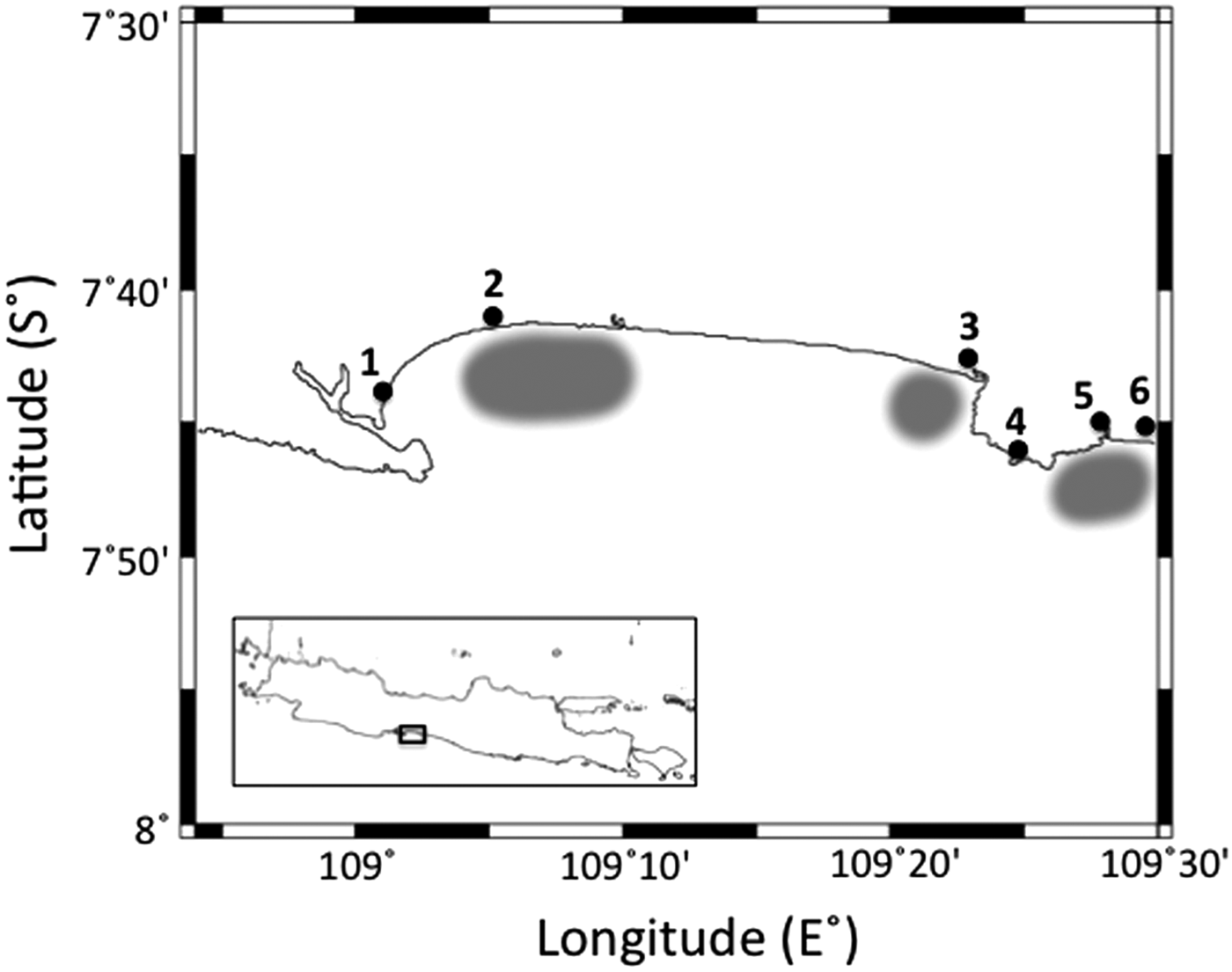
Specimens of the new species were originally collected at Turtle Bay (Teluk Penyu) on the Indian Ocean coast off Karang Kandri, central Java, Indonesia (the area around 7°42–45′S 109°03–12′E, Figure 1) by local fishermen. Specimens for the present study were collected by a fisherman's boat at the port in Cilacap, central Java, Indonesia (7°43′28″S 109°01′19″E) on 29 September 2009. Live specimens were photographed, measured for morphological features (see below), and then preserved either in 5% formalin-seawater for further morphological examinations or in 99.5% ethanol for DNA analysis and sequence comparisons.
Locations of the approximate jellyfish fishing grounds (grey areas) and the places mentioned in the text (numbers). 1. Cilacap Port (type locality), 2. Karang Kandri, 3. Jetis, 4. Karang Duwur. 5. Karang Bolong, 6. Petanahan.

The holotype and 14 paratype specimens have been deposited in the Division of Zoology, Research Centre for Biology, Indonesian Institute of Sciences (LIPI), Indonesia (MZC) and three further paratype specimens were deposited in the National Museum of Nature and Science, Japan (NSMT). New species name was registered in the Official Register of Zoological Nomenclature (ZooBank) followed with the amendment of the International Code of Zoological Nomenclature 4th edition.
Morphological data collection and analysis
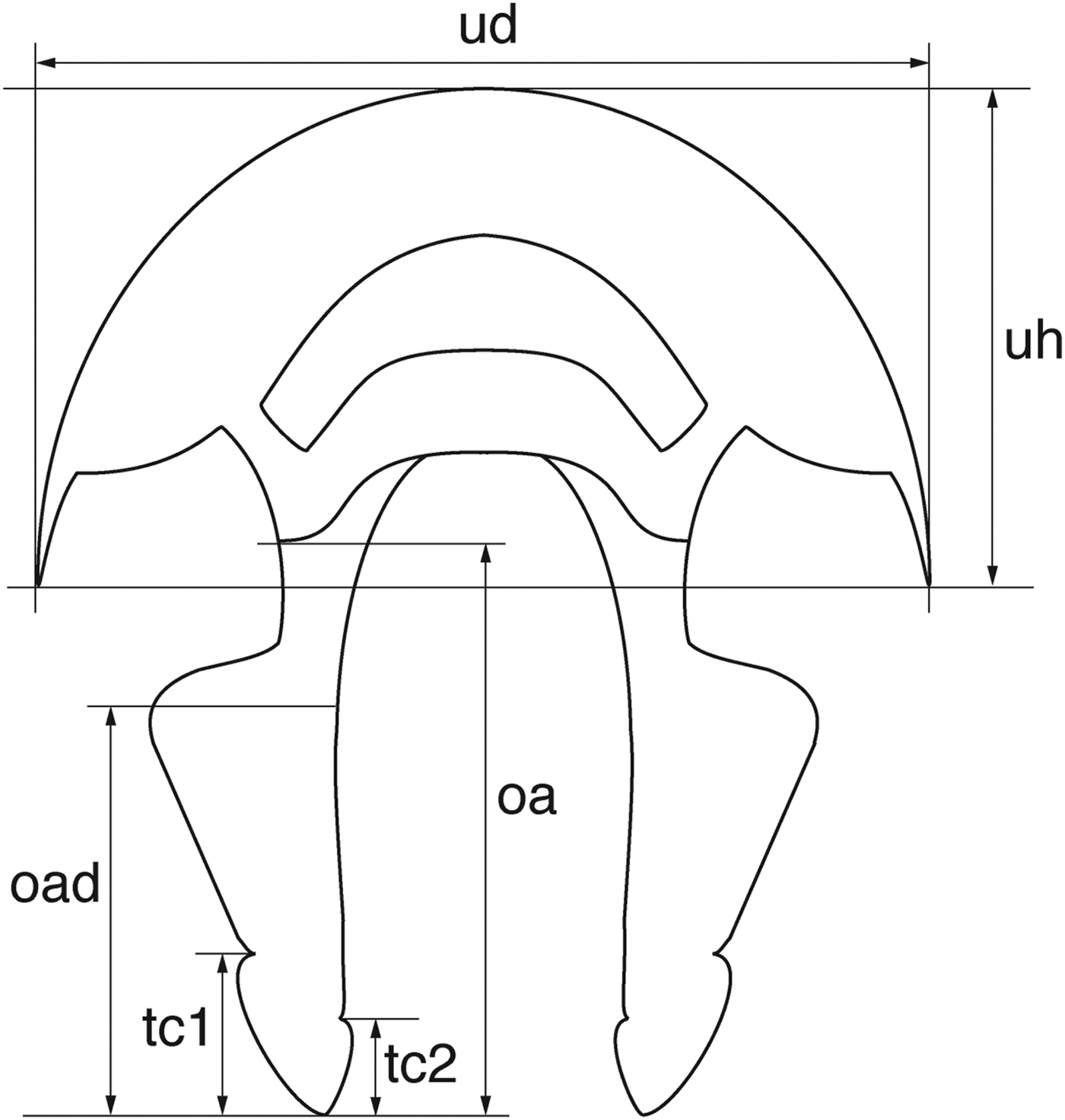
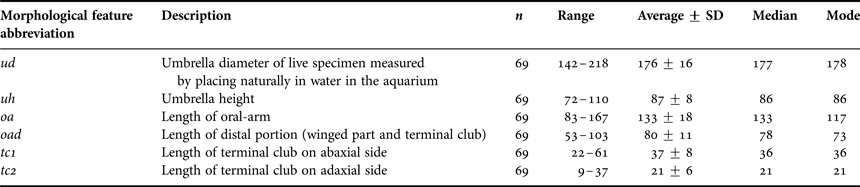
Six different morphological features were measured on a total of 69 live specimens (Figure 2, Table 1). Since we observed remarkable variations in the exumbrellar colour patterns of the jellyfish, morphological examinations were carried out to sample all of the colour types (basically classifiable into three types; see ‘Variation’). The number of velar lappets in each octant (VL) was also counted for five individuals of each colour type. During the counting, we found apparently abnormal development in the lappets of two individuals of the ‘common’ and ‘red spots’ colour types, which resulted in VL values that were unusually low (7, 9, 9) in three of the 120 octants counted. Hence, we excluded those values from the analysis.
A schematic diagram of a longitudinal section along the periradial axis of Crambionella showing umbrellar diameter (ud), umbrellar height (uh), length of oral-arm (oa), distal portion (winged and terminal club) of oral-arm (oad), lengths of abaxial (tc1) and adaxial (tc2) sides of terminal club (adapted from Dawson, Reference Dawson2005 and Neethling et al., Reference Neethling, Channing, Gershwin and Gibbons2011). See Table 1 for details.
Morphological features of Crambionella specimens used in the data analyses, and their measurements. All sizes expressed in mm. Abbreviations are described in the Methods section and Figure 2.
n, number; SD, standard deviations.
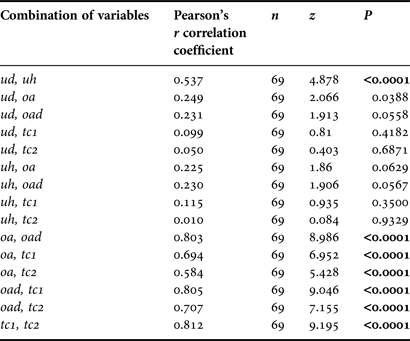
To determine the effect of an individual's size on the measured variables, Pearson's r correlations were computed using log10-transformed data for all combinations of variables (Table 2). Test results indicated that the following combinations were highly significant (P < 0.0001), following Bonferroni corrections for Type I errors (Quinn & Keough, Reference Quinn and Keough2002): (1) umbrella diameter (ud) and umbrella height (uh), (2) length of oral-arm (oa) and that of the distal portion of the oral-arm (oad), (3) oa and length of abaxial side of terminal club (tc1), (4) oa and length of adaxial side of terminal club (tc2), (5) oad and tc1, (6) oad and tc2, (7) tc1 and tc2 (Table 2, Figure 2). While relatively low P values were obtained for the combinations of ‘umbrella diameter or height’ and ‘the lengths of oral-arms’ (0.03 < P < 0.07), the correlations were not significant for the combinations of ‘umbrella diameter or height’ and ‘the lengths of terminal club’ (P > 0.1) (Table 2). By taking these results into account, the following ratios were chosen for comparisons of the morphology of the different colour types to eliminate size-dependent effects: uh:ud, oad:oa, tc1:oad, tc1:tc2.
Test of correlated variables in Crambionella helmbiru n. sp. from the Indian Ocean. See Figure 2 for abbreviations of each variable. Bold numbers for P values indicate that variables are correlated significantly at P<0.01, accepting Bonferroni correction.
VL was also compared between the three colour types. All comparisons were made applying the Kruskal–Wallis one-way analysis of variance. All statistical analyses were done using StatView 5.0.
To compare detailed morphological features between the various Crambionella species, ud was converted to ud′, expressed as π*ud/2 assuming that shape of the umbrella is hemispherical. This was considered justified because the umbrellar height (uh) was subequal to the umbrellar radius (ud/2, see Table 1).
DNA extraction, amplification, sequencing and data analysis
DNA was extracted from ethanol-preserved oral-arm tissues using a CTAB extraction protocol (Dawson et al., Reference Dawson, Raskoff and Jacobs1998; Dawson & Jacobs, Reference Dawson and Jacobs2001). Samples were placed in separate 1.7 ml microfuge tubes, to which was added 600 µl CTAB (0.1 M Tris [pH 8.0], 0.02 M EDTA [ph 8.0], 0.02% [wt/vol] CTAB, 0.8 M NaCl, 0.002% b-mercaptoethanol) and 9 µl proteinase K (20 mg ml−1). After digestion at 42 °C for 16 h, the digested sample was centrifuged for 1 min at 12,000 rcf (relative centrifugal force) and 600 µl of the DNA-containing supernatant was transferred to a new, sterile 1.7 ml microfuge tube. After the addition of 600 µl of CI (24:1) [chloroform:isoamylalcohol], the tube was inverted gently several times, and centrifuged for 10 min at 12,000 rcf at 20 °C. Supernatant (600 µl) was transferred into a new, sterile 1.7 ml microfuge tube, and an equal volume of PCI (25:24:1) [phenol:chloroform:isoamylalcohol] (~600 µl) was added. The tube was again inverted gently several times, and centrifuged for 10 min at 12,000 rcf at 20 °C. The PCI extraction was repeated until the interface between organic and aqueous phases was clean. The supernatant (~575 µl) was then pipetted into a sterile 1.7 ml microfuge tube, an equal volume of CI added, and the tube was inverted gently several times, before being centrifuged for 5 min at 12,000 rcf. The supernatant (~500 µl) was again pipetted into a sterile 1.7 ml microfuge tube, to which was added 1/10 volume of 3 M NaOAc (~50 µl), and 2 volumes of 100% EtOH (~1.5 ml) at −20 °C. The tube was inverted several times and then incubated at −20 °C for 1 h. Samples were then centrifuged at 12,000 rcf for 30 min at 4 °C and the supernatant discarded. The pellet was washed in 100 µl of 75% ethanol, centrifuged at 12,000 rcf for 3 min, and the liquid pipetted off. After repeating this step, the tube was inverted and dried at 37 °C for 30–40 min. Each DNA sample was finally resuspended in 100 µl of 10 mM Tris-HCl pH 8.3. DNA was rehydrated for 1–2 h at 4 °C before PCR amplification. Cytochrome c oxidase subunit I (COI) was amplified using primers LCOjf (5′-ggtcaacaaatcataaagatattggaac-3′; Dawson, Reference Dawson2005) and HCO2198 (5′-taaacttcagggtgaccaaaaaatca-3′; Folmer et al., Reference Folmer, Black, Hoeh, Lutz and Vrijenhoek1994). PCR reactions were composed of 1.25 µl 10 µm primers, 5 µl 10 × , 5 µl MgCl, 1 µl 10 mM dNTPs, and 0.1 µl Taq, in 50 µl final reaction volume made up with water. PCR conditions were (94 °C for 8 min, 46 °C for 2 min, 72 °C for 2 min) × 3 followed by (94 °C for 4 min, 47 °C for 2 min, 72 °C for 2 min) × 3 followed by (94 °C for 0.5 min, 46 °C for 1 min, 72 °C for 1.5 min) × 32. PCR products were purified and sequenced by Cogenics, Inc. (Houston, Texas) [presently part of Beckman Coulter Genomics]. Electropherograms were checked visually, misreads corrected and poorly resolved terminal portions of sequences were discarded using Sequencher 4.9. Forward and reverse sequences were then aligned, using default settings, in Sequencher 4.9. Sequence identifications were verified by BLAST in GenBank.
The mtCOI sequences of Crambionella sp. (sampled from Indonesia, Accession no. AB820008, AB820009, AB820010, AB820011, AB820012) were aligned with those of the other Crambionella spp. [Crambionella orsini (sampled from Iran, EU363343 and EU363344); Crambionella stuhlmanni (sampled from South Africa, HM348770, HM348771, HM348772), and Catostylus mosaicus (sampled from Australia, AY737184 and AY319476)] using CLUSTAL_X version 1.83 (Thompson et al., Reference Thompson, Gibson, Plewniak, Jeanmougin and Higgins1997) with the default setting. Phylogenetic analysis (Neighbour-joining and Minimum Evolution methods) and pairwise distance measurements were determined using the Molecular Evolutionary Genetic Analysis (MEGA) software package version 4.0 (Tamura et al., Reference Tamura, Dudley, Nei and Kumar2007). Intra- and inter-specific genetic variation was calculated as the Kimura 2 parameter (K2P) genetic distance. DNA sequences for mtCOI for Catostylus mosaicus (sampled from Australia, AY737184 and AY319476) were used as the outgroup for the phylogenetic analysis.
Description of the fisheries aspects
To describe the jellyfish fisheries and processing procedures, we phoned, visited and interviewed several times various people at the Ministry of Marine Affairs and Fisheries Cilacap Branch, the local fish market at Rawajarit, Cilacap, the fishermen's village at Karan Duwur, the jetty and processing factories at Jetis and Cilacap, and the jellyfish-commodity dealer, Kusuma Suisan Jaya PT, Jakarta, during the period from September 2008 to October 2009. For the detailed processing methods, the description was made based on those in Manuputty (Reference Manuputty1988) and the evidence obtained by the interviewees. To obtain the most accurate information possible, we repeated the same questions on different occasions, at different locations and/or to different people and accepted only those comments where the answers were consistent, following the methods of Nishikawa et al. (Reference Nishikawa, Thu, Ha and Thu2008). We also collected information on the jellyfish fisheries through local newspapers and internet media, such as ‘Suara Merdeka’ (www.suaramerdeka.com), ‘Antara Jateng’ (www.antarajateng.com), ‘Berita Satu’ (www.beritasatu.com), ‘Pikiran Rakyat’ (www.pikiran-rakyat.com), and ‘Pemerintah Kabupaten’ (www.cilacapkab.go.id). In this study, Indonesian Rupiah (Rp) were converted to US dollars (USD) using a factor of USD 1 = 9880 Rp.
RESULTS
SYSTEMATICS
Order RHIZOSTOMEAE Cuvier, Reference Cuvier1799
Suborder DAKTYLIOPHORAE Stiasny, Reference Stiasny1921
Family CATOSTYLIDAE Gegenbaur, 1857
Genus Crambionella Stiasny, Reference Stiasny1921
Crambionella helmbiru Nishikawa, Mulyadi and Ohtsuka sp. nov.
(Figure 3A–G)
urn: lsid:zoobank.org:act:962A6909-90C7-4312-A813-4CD8398F6078
SYNONYMY
Crambionella species: Nishikawa et al. (Reference Nishikawa, Thu, Yusoff, Lindsay, Mulyadi, Mujiono, Ohtsuka and Nishida2009), p. 404–406, figures 9, 10.
Crambionella species: Kitamura & Omori (Reference Kitamura and Omori2010), p. 110–111, figures 5, 6.
Crambionella species: Omori & Kitamura (Reference Omori and Kitamura2011), p. 3–4, figure 6.
TYPE MATERIAL
Holotype: MZB Coel.083 (Figure 3A): collected from a fisherman's boat at the port in Cilacap, central Java, Indonesia (7°43′28″S 109°01′19″E) on 29 September 2009; according to the fishermen, the jellyfish, including the holotype and paratypes, were harvested off Karang Kandri, the area around 7°42–45′S 109°03–12′E.
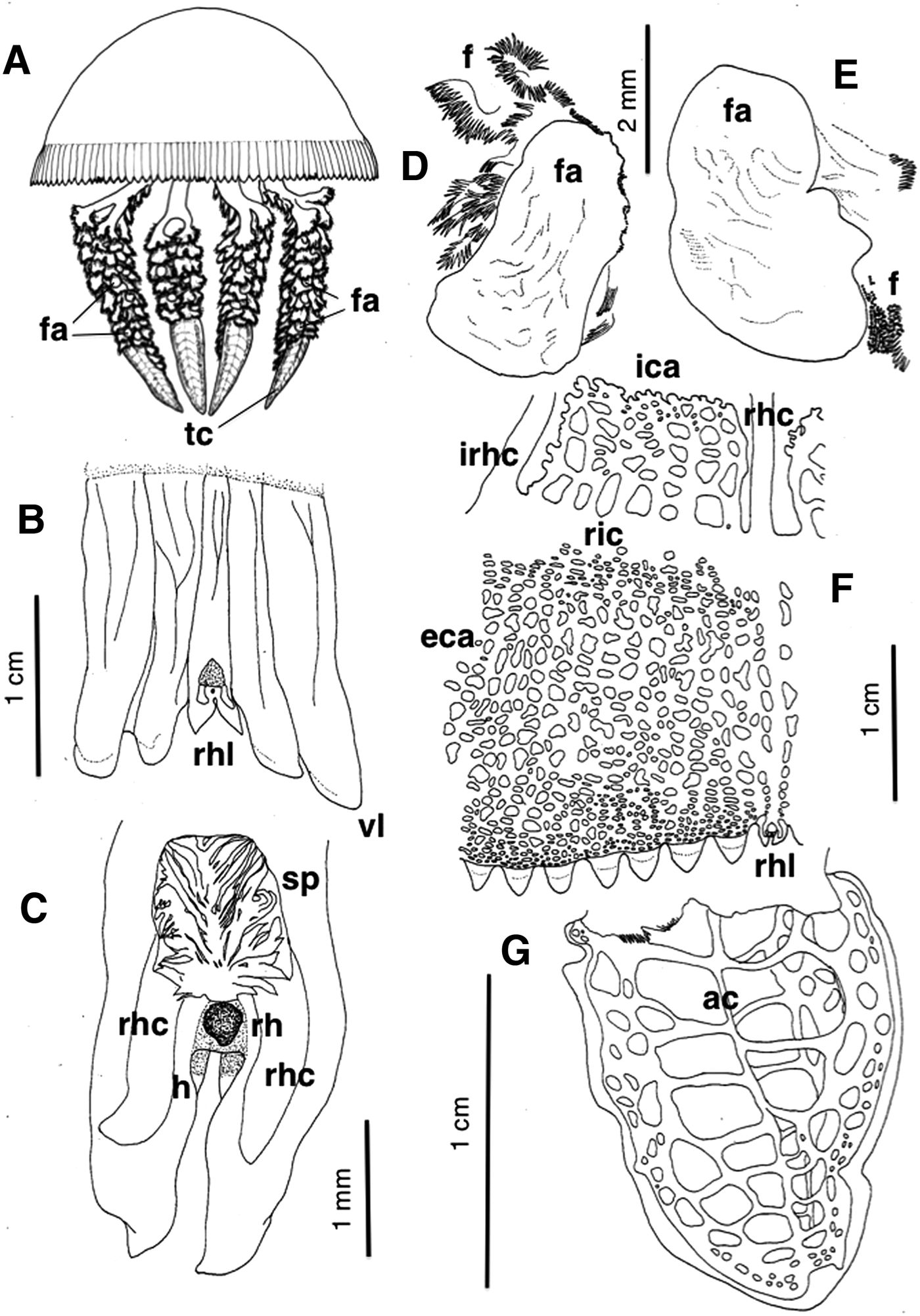
Crambionella helmbiru n. sp., holotype (A), paratype (B–G). A. Whole body, lateral view, schematically illustrated based on holotype (umbrellar diameter 17.7 cm, see ‘ud′ in Figure 2); (B) Rhopalar and velar lappets, exumbrellar view; (C) Rhopalium, exumbrellar view; (D, E) Foliaceous appendages on oral arms showing their morphological variations, outer view; (F) Canal system of subumbrella. ac, axial canal; eca, extra-circular anastomosing canal system; f, frills; fa, foliaceous appendage; h, hood; ica, intra-circular anastomosing canal system; irhc, interrhophalar canal; vl, velar lappet; rh, rhophalium; rhc, rhophalar canal; rhl, rhophalar lappet; ric, ring canal; sp, sensory pit; tc, terminal club.
Paratypes: MZB Coel.084 (common type, 4 individuals), MZB Coel.085 (red spots type, 5 individuals), MZB Coel.086 (red bands type, 5 individuals), NSMT-Co 1559, 1600, 1601 (common type, 3 individuals); the locality is the same as the holotype.
DIAGNOSIS
Umbrella (Figure 3A) hemispherical or dome-shaped with diameter of 140–220 mm. Umbrella apex becoming flat in some types preserved in formalin. Exumbrellar surface finely granulated, but smooth. Umbrella margin more or less incurved, relatively thin, and forming distinct region with its numerous radially directed ridges that lack tubercles. Velar lappets (Figure 3B) columnar with rounded corner terminally, usually triangular or trapeziform proximally in cross-section; basically 14 lappets per octant (varying from 12–18, see Table 4). Eight rhopalia on margin of umbrella in moderately deep notches (Figure 3B, C). Each rhopalium (Figure 3C) having two small rhopalar lappets with pointed tips. Sensory pit (Figure 3C) spade- or bell-shaped and located within flattened depression, radially furrowed; distal ends of furrows branched. Sensory club pigmented.
Oral-arms (Figure 3A) well developed, as long as umbrella height. Outer proximal margin of shaft cylindrical, without frills; middle part trifoliate-winged, bearing paired frills on outer surface. Terminal clubs (Figure 3A, G) translucent, tapering distally, terminated with rounded tips, about 1.8 times longer on abaxial side than on adaxial sides (range 1.3–2.4, see ‘tc1 : tc2’ in Table 3). Axial canal of terminal club giving rise to narrower transverse canals penetrating into each wing. Peripheral ends of transverse canals forming networks. Foliaceous appendages (Figure 3D, E) scattered amongst frills, more numerous on adaxial sides.
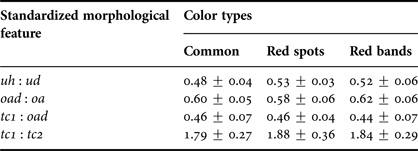
Comparison of four standardized morphological features (SMF) in three different colour types of Crambionella helmbiru n. sp. collected from the Indian Ocean. No significant differences were apparent in the SMFs between colour types (Kruskal–Wallis test, P > 0.1), except for the uh : ud. Abbreviations are described in the Methods section and Figure 2.
Each of four genital ostia crescent-shaped, elevated and thickened along edge.
Sixteen radial canals, eight rhopalar and eight interrhopalar. Intra-circular canals anastomosed and communicating only with ring canal, without rhopalar or interrhopalar canals (Figure 3F). Terminal end of rhopalar canals bifurcated and penetrating into about half of each rhopalar lappet (Figure 3B, C). Canal networks not penetrating into terminal parts of velar lappets (Figure 3F).
Subumbrellar muscle well-developed, interrupted on ring canal to form two distinct regions, less conspicuously on rhopalar and interrhopalar canals.
Colouration of holotype (Figure 4). Umbrella pale blue in apical part, cream in marginal part. The apparent blue colour of the exumbrella is actually the blue colour of the upper abaxial side of the oral-arm's shaft seen through the semi-transparent bell. Terminal club slightly tinged reddish-brown. Colour variations exist on exumbrella, terminal clubs and mouth-frills (see ‘Variation’, Figure 4).
Crambionella helmbiru n. sp., Colour variations in exumbrellar margin. (A) Pigmentless ‘common type’. Umbrella diameter (ud) = 17.7 cm, (B) ‘red-spots’ type exhibiting reddish-brown pigments in the regions of the rhopalia. The ud = 20.1 cm, (C) ‘red-bands’ type; two reddish-brown spots on each lappet, forming two bands of pigmentation on the exumbrellar margin. The ud = 18.0 cm, (D) and (E) intermediate types of colouration between red-spots and red-bands, i.e. an individual having a continuous upper band with spotted lower bands (D) and an individual showing a spotted upper band and spots on the rhopalia (E).
VARIATION
There are remarkable colour variations, particularly on the exumbrellar margin, which can be roughly divided into three types (Figure 4). In the pigmentless type, the colour is basically cream (‘common’ type, Figure 4A). However, some individuals exhibit reddish-brown pigments in the region of the eight rhopalia (‘red-spots’ type, Figure 4B). In the red-spots type, pigmentation sometimes also occurs on the lappets beside the rhopalia. Another typical type of colouration is cream with two reddish-brown spots on each lappet, forming two bands of pigmentation on the exumbrella margin (‘red-bands’ type, Figure 4C). In this type, pigmentation sometimes extends into the furrows between the lappets, forming a complete circum-umbrellar ring. The width of both bands is basically similar, but sometimes one of them, either inner or outer, is thicker. There was an intermediate type of colouration between red-spots and red-bands, i.e. single band with spotted band (Figure 4D) and single spotted band with spots on rhopalia (Figure 4E), although this type was extremely rare during our investigation. Frills of oral-arms also exhibited variation in colour: semi-transparent, pale blue or reddish brown. Terminal clubs were reddish brown along the inner part, or non-pigmented (transparent). There was no apparent relationship between the combination of colour patterns on the exumbrella, frills and/or terminal clubs.
ETYMOLOGY
The specific name is derived from ‘helm biru’, meaning ‘blue helmet’ in Bahasa Indonesia, referring to the beautiful blue colour of its body (Figure 6) and the nickname by which it is known to local fishermen ‘ubur-ubur helm’ (helmet jellyfish).
Morphological variation
Morphological features measured on 69 live specimens are shown in Table 1 and Figure 2. A comparison of standardized morphological features, uh : ud, oad : oa, tc1 : oad, tc1 : tc2 revealed no significant differences between colour types (Kruskal–Wallis test, P > 0.1), except for uh : ud (Tables 2 & 3). The number of velar lappets per octant (VL) in the three different types was 14 with respect to both median and mode values (Table 4). There were also no significant differences in the VLs between the three colour types (Kruskal–Wallis test).
The number of velar lappets per octant (VL) in the three different colour types of Crambionella collected from the Indian Ocean. There were no significant differences in the VL values between colour types (Kruskal–Wallis test, P>0.1).
Intra- and interspecific genetic distances
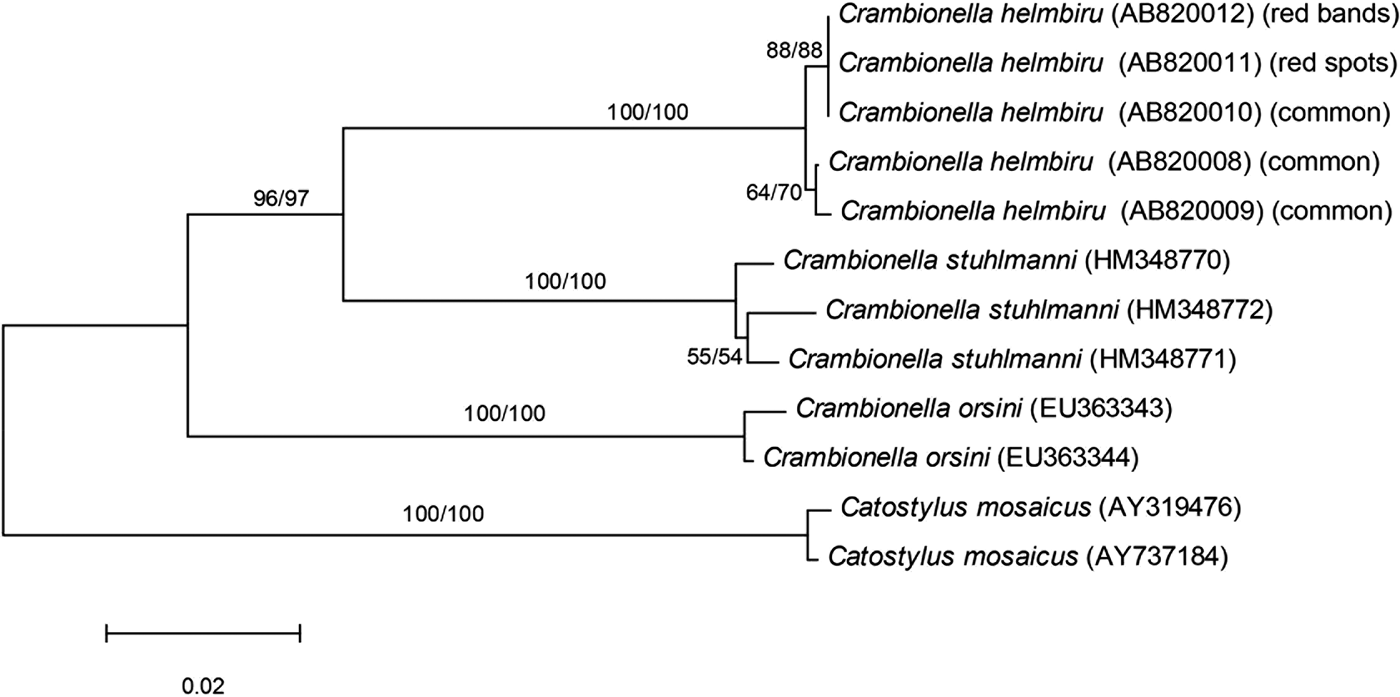
The pairwise genetic distances (K2P) between partial mtCOI sequences within each Crambionella species ranged from 0–0.014, and were smaller than those between Crambionella species (0.119 ± 0.026). The monophyly of C. helmbiru n. sp. was evident in the mtCOI phylogenetic tree with high bootstrap values for all analyses (Figure 5), strongly supporting the validity of the new species and that body colour is merely highly variable within the species.
Neighbour-joining tree of Crambionella species based on partial sequences of the mitochondrial COI gene. Codes following the species name denote accession numbers deposited in the GenBank/EMBL/DDBJ database. ‘Red-bands’, ‘red-spots’, and ‘common’ within parentheses represent the colour type of Crambionella helmbiru n. sp. Numbers at nodes are bootstrap values (%) based on 1000 replicates (Neighbour-joining method/Minimum Evolution method). The sequences of Catostylus mosaicus, belonging to the family Catostylidae, were used as an outgroup.
The genetic distance (K2P) between colour types in C. helmbiru n. sp. was 0.003 ± 0.002, and this was smaller than that in C. stuhlmanni (calculated as 0.004 ± 0.004, see Figure 5). Furthermore, monophyly of the ‘common’ type in C. helmbiru n. sp. was not supported by the present phylogenetic analysis, further suggesting that body colour variation is an intraspecific trait.
Commercial fisheries
Information on the jellyfish fishery targeting Crambionella helmbiru n. sp. is described in detail. According to the local fishermen, jellyfish fisheries in Cilacap started as early as 1989, which means the fishery has a history of more than 20 years (Suara Merdeka, 30 December 2004). The main fishing grounds for this jellyfish are located at Turtle Bay (Teluk Penyu) off Karang Kandri (the area around 7°42.45′S 109°03.12′E), off Jetis, and sometimes extending to off Karang Bolong and Petanahan on the Indian Ocean coast of Java Island, Indonesia (Figure 1). According to the local fishermen in Cilacap, the fishing season is usually from August to November. However, the main harvesting month varies year-to-year, e.g. August in 2003, November in 2004 and October in 2006. Fishermen in the village use small boats called ‘jukung’ (length 8.2 m, width 1.5 m, height 1.5 m) made of fibreglass and often painted blue (Figure 6A, B). A jukung can be loaded with 1–1.5 tonnes of jellyfish, with two persons onboard. Larger wooden boats called ‘compreng’ with a length of 14 m, width of 3.5 m and height of 2 m are also used. Five persons operate a compreng, which can hold about 5 tonnes of jellyfish. They use a drift net with a mesh size of 5 cm, specifically designed for jellyfish and with a larger mesh size than in nets for catching fish.
(A) Fishermen's village in Karang Duwur, Kebumen, central Java, Indonesia. There are about 100 boats on the beach, (B) Jellyfish fishing boat, ‘jukung’ with harvested jellyfish at Cilacap Port, (C) Jellyfish harvest in the baskets having weight measured by a worker, (D) Crambionella helmbiru n. sp. harvested and stored, (E) Oral disc with oral-arms being detached from the umbrella by workers, (F) soaking ponds in the processing factory at Jetis.
After harvesting jellyfish at sea, fishermen make contracts with jellyfish processing factories (JPFs) in Jetis or Cilacap, transport their harvests into baskets on the pier, and bring them into the factory. Workers in the JPF weigh the jellyfish and fishermen are paid depending on the amount of their catch (or are given a coupon) (Figure 6C). The price of raw jellyfish has varied over time, but is usually around 500–1000 Rp kg−1 (or USD 0.05–0.1 kg−1). According to the local news media (Antara Jateng, Berita Satu and Pikiran Rakyat), for example, they were bought from the fishermen at prices of 700–800 Rp kg−1 on 12 September 2012. There are no reliable statistics recording the amount of jellyfish catch in this area. A single local buyer, Ms Kasriyah told us that she bought about 20 tonnes of jellyfish each day in September 2012. During the same period, the local exporter, Kusuma Suisan Jaya PT, was able to buy up to 80 tonnes a day.
In the JPF, the umbrella and oral-arms are detached, one by one, by the workers using knives, and are separated into different processing ponds (Figure 6E, F). Umbrellas are then soaked in a small tank containing ~100 l of fresh water with 500 g of alum (AlK[SO4]2 12 H2O) and 200 g of calcium hypochlorite for 3–5 h. They are then taken from the tank, and muscles and subumbrellar tissues in the gastrovascular cavity, which become whitish during the soaking process, are removed carefully using knives or fingers. Umbrellas (mainly the mesoglea) are again soaked with ~100 l of fresh water with a mixture of 600 g alum and 800 g salt, and stored for 3 days. The same soaking process is then repeated in a mixture with a reduced concentration of chemicals (300 g alum and 400 g salt) and stored for another 4 days. During this process, umbrellas begin to develop wrinkles. They are then repeatedly washed in a salt solution of pH 4 to remove wrinkles and make them flatten. After this, umbrellas are coated with 3 kg of salt and preserved for 4 days. In the final stage, another 2 kg of salt is added and they are pressed using a weight placed on the top of the piled umbrellas for 2 days to squeeze any remaining water out of the umbrellas. They are then ready to be packed in plastic bags inside wooden boxes for shipment.
Oral-arms are soaked in 400 l of fresh water with a mixture of 700 g alum and 4 kg of salt. Approximately 1500 oral-arms can be processed at one time in a pond. They are pressed using a weight put on top of products, and then washed with fresh water. Oral-arms are then heaped one by one until a mound becomes 10–12 cm high, and then 2.5 kg salt and a little alum is added, whereupon they are stored for a day. After that, they are turned over and mixed, with more salt and alum, before being stored again for 3 days. This heaping, adding salt, mixing and storing process is repeated twice. Then, 1.6 kg of salt is added, the pH of the salt solution set to 4, and they are cured for 6 days. Oral-arms are transferred into another clean container, stored for a day, and are then ready to be packed. There are at most 500 persons working at the JPF in Jetis, and they each earn 10,000–18,000 Rp per day−1 (or USD 1.0–1.8 per day).
According to Mr Atas Munandar, the coordinator of the fishermen's association in Cilacap, the selling prices of processed jellyfish (semi-dry and salted) were 13,000 Rp kg−1 (or USD 1.3 kg−1) for umbrellas and 20,000 Rp kg−1 (or USD 2.0 kg−1) for oral-arms, on October 2009 (Pemerintah Kabupaten Cilacap).
DISCUSSION
Morphological and molecular features of Crambionella helmburi n. sp.
The new species was originally suggested to be a ‘possibly undescribed species of Crambionella’ by Nishikawa et al. (Reference Nishikawa, Thu, Yusoff, Lindsay, Mulyadi, Mujiono, Ohtsuka and Nishida2009), and was subsequently illustrated and described briefly as a ‘Crambionella species’ by Kitamura & Omori (Reference Kitamura and Omori2010) and Omori & Kitamura (Reference Omori and Kitamura2011). The collection site and the characters described in these two papers fit well with our descriptions, except for the umbrella shape as ‘a flattened apex’ in Kitamura & Omori (Reference Kitamura and Omori2010) rather than hemispherical in this study. This inconsistency may be attributed to a change in morphology after collection (Dr Minoru Kitamura, personal communication).
Our observations of morphology combined with a molecular analysis have confirmed that this species is new to science. Morphological and genetic comparisons between different colour types in the new species suggest that colour type is an intraspecific variation.
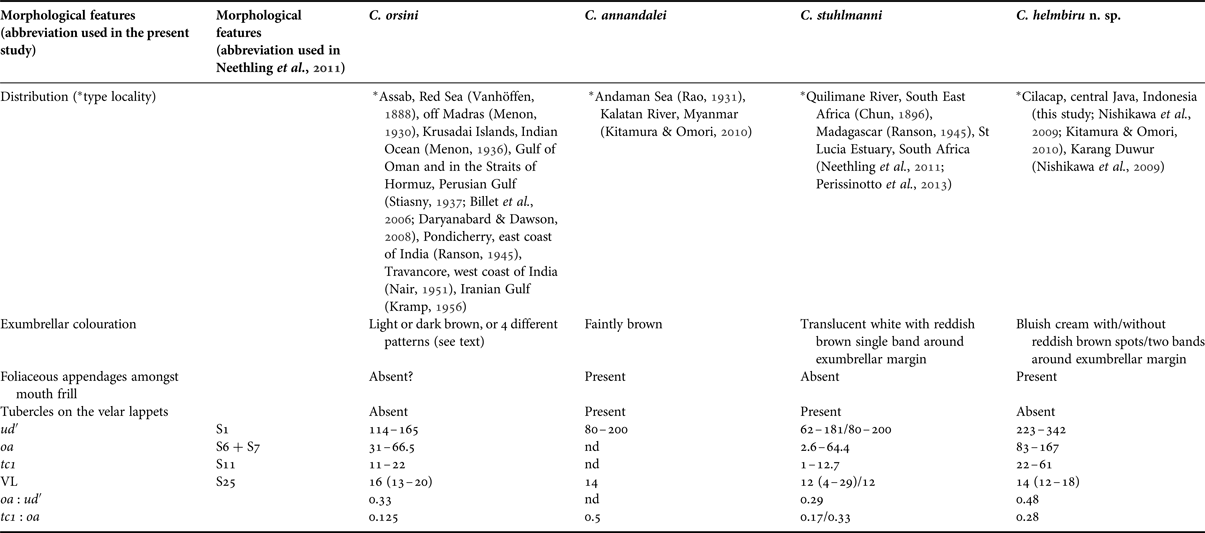
The new species is most similar to Crambionella orsini due to the absence of tubercles on the velar lappets. However, the former can be distinguished from the latter by the presence of foliaceous appendages on the frills (considered to be absent in the latter), the number of velar lappets per octant as usually 14 (16 in the latter), larger proportion of terminal club length to oral-arm length, the live colouration and the geographic distribution (see Table 5). It should be noted that there is uncertainty in the absence of foliaceous appendages in C. orsini. While some studies indicate the absence of appendages (Stiasny, Reference Stiasny1937; Kitamura & Omori, Reference Kitamura and Omori2010), ‘ungestielte Gallertknöpfe’ of C. orsini in Vanhöffen (Reference Vanhöffen1888) may correspond to the appendages (Rao, Reference Rao1931). Also, the number of velar lappets per octant can vary from 12–18 in the new species and this overlaps with the variation reported in C. orsini as 13–20 (Table 5). This evidence indicates that those two characters solely may not allow diagnosis of the species. However, the proportion of terminal club length to oral-arm length in the new species is more than twice that in C. orsini (0.28 in the former and 0.125 in the latter). Moreover, the live colourations in the new species are clearly different from C. orsini (and other congeners). Stiasny (Reference Stiasny1937) reported that there are four major colour patterns in C. orsini: ‘The ex-umbrella uniformly yellowish-brown with a broad dark brown band along the border, the ex-umbrella bluish-green with a broad dark violet zone along the border, the ex-umbrella pale yellowish-violet with a pale violet zone along the rim, the ex-umbrella uniformly pale violet with, towards the border, an upper narrow band of irregular, larger or smaller, deep violet or faded spots and a lower zone towards the lappets of a uniform dark violet colour’ (p. 236). Live individuals of C. orsini in the Gulf of Oman (Daryanabard & Dawson, Reference Daryanabard and Dawson2008) showed uniformly light or dark brown colour in its exumbrella (Dr Mary Field, personal communications). Together with those characters and the difference in distributions (Table 5), the new species can be distinguished from C. orsini.
Comparison of detailed morphological features in Crambionella species. Exumbrellar colouration of live individuals is described based on personal communication with Dr Mary Field, and Stiasny (Reference Stiasny1937) for C. orsini, Kitamura & Omori (Reference Kitamura and Omori2010) for C. annandalei, and Perissinotto et al. (Reference Perissinotto, Taylor, Carrasco and Fox2013) for C. stuhlmanni. Ranges for each morphological feature in the four species are shown with abbreviated characters. Abbreviations used in this study are shown in Table 1 and Figure 2, except for ud′ which is converted from original values (see text). Average values were used for the calculations of the proportion of oral-arm length to umbrella diameter (oa : ud) and the proportion of terminal club length to oral-arm length (tc1 : oa), except for the data from Table 5 in Neethling et al. (Reference Neethling, Channing, Gershwin and Gibbons2011). For C. stuhlmanni and C. orsini, published data summarized by Neethling et al. (Reference Neethling, Channing, Gershwin and Gibbons2011) were used. In C. stuhlmanni, values measured by Neethling et al. (Reference Neethling, Channing, Gershwin and Gibbons2011) and reported in previous literature are shown as ‘the former/the latter’. All sizes expressed in mm.
The new species has been recorded only from the type locality in the south-eastern Indian Ocean, relatively close to where Crambionella annandalei is distributed (the Andaman Sea, Bay of Bengal) (Rao, Reference Rao1931; Neethling et al., Reference Neethling, Channing, Gershwin and Gibbons2011). However, it is readily distinguishable from the latter by the absence of tubercles on the velar lappets as well as by the relative length of the terminal clubs to the entire oral arms (0.28 vs 0.5) (see Table 5, Rao, Reference Rao1931; Neethling et al., Reference Neethling, Channing, Gershwin and Gibbons2011). While, C. annandalei was described based on a preserved specimen (Rao, Reference Rao1931), Kitamura & Omori (Reference Kitamura and Omori2010) reported its live colour of umbrella and oral-arms as ‘faintly brown’ (Dr Minoru Kitamura, personal communication), which is also different to the new species.
The new species can be separated from C. stuhlmanni by the absence of tubercles on the velar lappets and the absence of foliaceous appendages amongst mouth frills. An individual of C. stuhlmanni photographed in the St Lucia Estuary, South Africa showed a single reddish brown band on its umbrellar margin (Perissinotto et al., Reference Perissinotto, Taylor, Carrasco and Fox2013). The colouration is relatively similar with the new species, but different in terms of the absence of the pale blue colour in the oral-arm shafts, and only a single band on the umbrellar margin (two bands in the new species).
The morphological features in Crambionella species are summarized in Table 5. It is evident that, compared with other species in the genus, the new species has features of (1) unique colouration (and its variation), (2) large body size (greater bell diameters and oral-arm/terminal club lengths), (3) relatively longer oral-arms (in proportion to bell diameter), and (4) intermediate length of terminal clubs relative to oral-arm length, i.e. >2 times longer than C. orsini, but 1.8 times shorter than C. annandalei.
As far as we observed, the ‘common’ colour type (no red pigments) was the most common in fisheries catches, followed by ‘red-bands’ and ‘red-spots’ types (see Figure 4). The pale blue colour of the exumbrella and arm pillars could be an adaptation for concealing these large gelatinous zooplankton from visual predators, as well as providing UV protection, as suggested for other surface dwellers (e.g. Herring, Reference Herring1965). However, the adaptive advantages of the brown red bands or spots on the exumbrellar margin are unclear. It would be interesting to clarify the reason why these unique colour variations are exhibited in this jellyfish. The possibility of colour variants being hybrids could be investigated through the sequencing of nuclear genes in the future.
Fisheries
Commercial fisheries targeting this formerly undescribed species have been reported (Nishikawa et al., Reference Nishikawa, Thu, Yusoff, Lindsay, Mulyadi, Mujiono, Ohtsuka and Nishida2009; Kitamura & Omori, Reference Kitamura and Omori2010; Nishida & Nishikawa, Reference Nishida, Nishikawa, Nishida, Fortes and Miyazaki2011). According to Omori & Nakano (Reference Omori and Nakano2001), the fishing season in Cilacap is from August to November. This coincides with our information based on the interviews with local fishermen. However, it was also evident that the month of greatest catches varies with year. Fishermen believe, based on their personal experiences, that jellyfish appear when there is no rainfall for relatively long periods (drought season), usually corresponding with the end of the east monsoon season, and when wave heights are low. Jellyfish disappear when high precipitation occurs.
Jellyfish processing methods in the factories in Cilacap and Jetis are basically similar to those applied throughout various parts of the world – using salt and alum (e.g. Kingsford et al., Reference Kingsford, Pitt, Gillanders, Gibson and Barnes2000). However, the methods are slightly modified, including more processes in the step-wise reduction of water content and putting weights on the products to squeeze remaining water from them, and this is probably due to the thick mesoglea of this species. Use of calcium hypochlorite in early treatment of umbrellas is also unique to this area. Calcium hypochlorite is commonly used for the disinfection of drinking water or in swimming pool water, as well as being an ingredient in bleaching powder that is used for bleaching cotton and linen. It makes removal of the gonads, material in the gastrovascular cavities, and the muscles easier, and also may have a disinfection effect that may be needed in the warm ambient temperatures at the processing factories.
While the selling price of Crambionella helmbiru n. sp. from fishermen to factory (USD 0.05–0.1 kg−1) is cheaper than for Rhopilema hispidum in Vietnam, USD 0.3–0.5 kg−1 (Nishikawa et al., Reference Nishikawa, Thu, Ha and Thu2008), the selling price of processed bells is similar to that for Rhopilema hispidum in Vietnam, Malaysia and Thailand ranging from USD 1.1–1.4 kg−1 (Nishida & Nishikawa, Reference Nishida, Nishikawa, Nishida, Fortes and Miyazaki2011). The higher price of oral-arms compared with umbrellas in Crambionella from Indonesia is in contrast with the situation in most other areas where the umbrellas command a higher price (Hsieh et al., Reference Hsieh, Leong and Rudloe2001; Omori & Nakano, Reference Omori and Nakano2001; Nishikawa et al., Reference Nishikawa, Thu, Ha and Thu2008).
Due to the lack of reliable data for the fishery statistics, it is difficult to assess precisely the number of jellyfish harvested in the water off Cilacap. However, assuming the daily catch of jellyfish to be 20–80 tonnes (see results) and the weight to be 1.5 kg per individual (equivalent to an animal of 18 cm in umbrellar height), about 10,000–50,000 individuals of Crambionella jellyfish are removed daily from the water column, and up to one million jellyfish are harvested monthly during the fishing period. This estimated stock is comparable to that of Rhopilema hispidum in northern Vietnam, 0.8–1.2 million individuals per fishing period (Nishikawa et al., Reference Nishikawa, Thu, Ha and Thu2008). Important roles of large jellyfishes such as these as hosts for various parasites or refuges for the early stages of fish have been suggested (e.g. Ohtsuka et al., Reference Ohtsuka, Koike, Lindsay, Nishikawa, Miyake, Kawahara, Mulyadi, Mujiono, Hiromi and Komatsu2009, Reference Ohtsuka, Kondo, Sakai, Shimazu, Shimomura, Komai, Yanagi, Fujita, Nishikawa, Miyake, Maran, Go, Nagaguchi, Yamaguchi, Dechsakulwatana, Srinui, Putchakarn, Mulyadi, Mujiono, Sutomo and Yusoff2010). It is essential to not only estimate more accurately the standing stocks of these jellyfish, but also to determine the life cycles and ecological roles, including the fate of symbionts, in order to realize a sustainable fishery and standing stocks for this formerly undescribed jellyfish.
ACKNOWLEDGEMENTS
We are grateful to the anonymous reviewers for the valuable comments on the draft. We also thank the following people who helped in various capacities during this study: Drs Juro Hiromi and Hiroshi Miyake for their support in conducting the field research; the interviewees in Indonesia for providing valuable information and specimens from their harvests. Special thanks are due to Drs Keith M. Bayha and Michael N. Dawson for extraction and sequencing of DNA for the molecular analysis.
FINANCIAL SUPPORT
This work was supported by grants from the Japanese Society for the Promotion of Science (JSPS) KAKENHI (J.N., grant numbers 23405031, 26304030), (S.O., grant numbers 20380110, 25304031), (D.L., grant number 24248032), a bilateral joint project between Japan and Indonesia (LIPI), and the JSPS for the Asian CORE Programme (Coastal Marine Science in Southeast Asia: COMSEA).