Introduction
Stapedectomy and stapedotomy are widely used surgical procedures capable of restoring hearing to individuals with hearing loss caused by otosclerosis. Testing of otoacoustic emissions (OAEs; defined as any acoustic energy produced by the cochlea and detectable in the ear canal) has been successfully applied to the study of cochlear outer hair cell function. We used this methodology to evaluate and compare the effect of two different surgical techniques on middle-ear dynamics.
The current paper reports our experience with 40 stapes procedures. To the best of our knowledge, this is the first report to compare stapedectomy and stapedotomy procedures as regards distortion product OAE results.
Method
A comparative, retrospective study was conducted on 40 patients who had undergone stapes surgery for otosclerosis in our department between 2005 and 2006. The study included 17 stapedectomy patients (six men and 11 women; age range 22–68 years, mean 45.3 years) and 23 stapedotomy patients (eight men and 15 women; age range 16–66 years, mean 47.3 years). The groups were well matched in terms of age, gender and pre-operative hearing loss.
The control group included 13 volunteers aged 18–50 years with normal hearing and normal otoscopic findings.
The surgical techniques were performed as described in the literature.Reference Herzog, Shehata-Dieler and Dieler1 The choice of surgical technique usually depended on the surgeon's preference. All patients were operated upon using the transcanal approach, under local anaesthesia. After removing the stapes suprastructure, the footplate was perforated using a manual perforator or a skeeter. A Robinson 4.5 mm prosthesis was inserted in the stapedectomy cases, while Teflon® wire prostheses of differing lengths (4.25–4.75 mm) were used for the stapedotomy cases. In stapedectomy procedures, the posterior part of the footplate was removed and the oval window was sealed with vein, before introduction of the prosthesis. In stapedotomy procedures, a single drop of the patient's own venous blood was dropped into the oval window niche around the prosthesis.
A normal tympanic membrane was observed on otoscopy in all study patients, pre-operatively and four weeks post-operatively.
Stimulus presentation, data recording and spectrum analysis of distortion product OAEs were conducted using the OtoRead device (Interacoustics, Assens, Denmark). The f1 and f2 levels were both delivered at 65 dB SPL and were constant for all tested frequencies. Distortion product OAEs were measured at 2, 3, 4 and 5 kHz (i.e. =f2, with 2f1 − f2 = 0.6f2, a standard program of the OtoRead device). Distortion product OAEs were tested pre-operatively and four weeks post-operatively. DPOAE were defined as recordable in presence of DPOAE on ≥1 tested frequencies. Patients' medical records were reviewed for age, gender, surgical technique and prosthesis used, and audiological outcome. The pre- and post-operative distortion product OAE amplitudes were compared within and between the two groups.
Statistical analysis was performed using analysis of variance for repeated measures (e.g. at multiple time points), and using the chi-square and Fisher's exact tests for cases in which the number of observations in a cell was less than five. Difference was considered to be statistically significant at a p value of less than 0.05.
Results
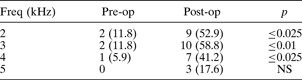
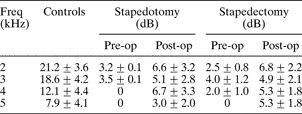
Tables I and II present the number of stapedotomy and stapedectomy patients in whom distortion product OAEs were recorded at the various frequencies. The differences between the stapedotomy and stapedectomy groups were statistically insignificant for each frequency, both pre- and post-operatively. The mean amplitudes of distortion product OAEs recorded in patients and controls are presented in Table III. In all patients, post-operative distortion product OAE amplitudes never recovered to the levels recorded in controls, even in patients with complete closure of the air–bone gap and meaningful hearing improvement.
Number of stapedotomy patients with detected DPOAE*

* n = 23. OAE = otoacoustic emission; freq = frequency; pre-op = pre-operatively; post-op = post-operatively; NS = not significant
Number of stapedectomy patients with detected DPOAE*

* n = 17. OAE = otoacoustic emission; freq = frequency; pre-op = pre-operatively; post-op = post-operatively
Distortion product OAE amplitudes in different patient groups

Data represent means ± standard deviation. OAE = otoacoustic emission; freq = frequency; pre-op = pre-operatively; post-op = post-operatively
The mean pre-operative air–bone gap at 0.5, 1, 2 and 3 kHz was 36.2 dB for the stapedotomy group and 35.8 dB for the stapedectomy group (mean bone conduction thresholds were 13.2 and 13.0 dB, respectively). The mean respective post-operative air–bone gaps were 11.8 and 12.5 dB (mean bone conduction thresholds were 13.6 and 13.6 dB, respectively). One month after surgery, improvement in conductive hearing loss was observed in all patients, with better results in the lower frequencies (i.e. 250, 500 and 1000 Hz). There were no statistically significant differences in this respect between the stapedectomy and stapedotomy groups.
Discussion
A search of the literature yielded conflicting information on distortion product OAE changes following stapes surgery. Distortion product OAEs were recordable in most of our patients following successful stapes surgery, and this was unrelated to the surgical technique or prosthesis used. However, these post-operative OAEs never reached the levels obtained in normal hearing individuals. Nevertheless, overall distortion product OAEs were recorded in 32.5 per cent of our patients pre-operatively and in 90 per cent post-operatively (p ≤ 0.001).
Lieberum et al. Reference Lieberum, Held and Schrader2 and Herzog et al. Reference Herzog, Shehata-Dieler and Dieler1 failed to obtain group data analysing distortion product OAE changes following stapes surgery, despite reporting good hearing results. Gierek and colleaguesReference Gierek, Klimczak-Gołab, Zbrowska-Bielska, Majzel, Smółka and Gawlicka3, Reference Gierek, Smolka, Zbrowska-Bielska, Klimczak-Golab and Majzel4 recorded distortion product OAEs in 23/34 patients at four months post-stapedotomy. They supposed that the occurrence of post-operative distortion product OAEs differed for each individual patient, perhaps due to differing surgical techniques, and that such OAEs could indicate successful ossicular chain restoration. In our series, mean distortion product OAE amplitudes were higher than those reported by Gierek et al. Reference Gierek, Klimczak-Gołab, Zbrowska-Bielska, Majzel, Smółka and Gawlicka3 for both their controls and study patients. Herzog et al. Reference Herzog, Shehata-Dieler and Dieler1 stressed that a clinically unapparent perilymphatic leak could result in failure to detect OAEs after successful stapes surgery. In our experience, perilymphatic leak after stapes surgery usually presents clinically with disequilibrium or hearing deterioration, and none of our currently reported patients exhibited either of these post-operative sequelae.
The distortion product OAE amplitudes of our otosclerosis patients were lower than those of the control group, both pre- and post-operatively (Table III). Similarly, Ralli et al. Reference Ralli, Cianfrone, Fabbricatore and Altissimi5 found lower distortion product OAE amplitudes at various frequencies in otosclerotic patients, compared with controls.
Filipo et al. Reference Filipo, Attanasio, Barbaro, Viccaro, Musacchio and Cappelli6 evaluated a group of 15 patients with advanced otosclerosis (mean air–bone gap 36.6 dB HL) who underwent stapedotomy. No distortion product OAEs were detected pre-operatively. Intra-operatively, distortion product OAEs with low amplitudes in a narrow frequency range were measured in two patients. No significant changes in distortion product OAEs were observed five days post-operatively; increased distortion product OAE amplitudes were recorded post-operatively in four patients, but this change did not reach statistical significance. Since the presence of blood in the middle ear limits ossicular chain movement, this study's findings are understandable.
• Stapedectomy and stapedotomy are widely used surgical procedures capable of restoring hearing to individuals with hearing loss caused by otosclerosis
• This study aimed to evaluate and compare the effect of two different surgical techniques on middle-ear dynamics, using otoacoustic emission (OAE) testing
• Outer hair cell damage secondary to inner-ear otosclerosis is a possible explanation for the decreased OAE amplitudes recorded despite optimal closure of the air–bone gap
• Stapes prostheses' differing distributions of footplate mass, compared with the normal, healthy stapes, may also affect post-operative distortion product OAEs
The current study focused on OAE measurements as related to the otosclerosis-induced conductive hearing loss caused by stapedial footplate fixation. However, although otosclerosis primarily causes a conductive hearing loss, it is not uncommonly associated with a progressive sensorineural hearing loss secondary to involvement of the otic capsule endosteal bone. Previous studies have shown that the existence of two or more sites of otosclerotic endosteal foci correlates with lower outer hair cell counts,Reference Kwok and Nadol7 and that depression of outer hair cell motility is associated with otosclerotic bone lesions.Reference Sziklai8
Outer hair cell damage secondary to inner-ear otosclerosis is a possible explanation for the decreased OAE amplitudes recorded despite optimal closure of the air–bone gap. Reduced distortion product OAE amplitudes may provide an early indication of cochlear damage, before the appearance of standard audiometric evidence of hearing loss.Reference Shupak, Tal, Sharoni, Oren, Ravid and Pratt9 Distortion product OAE measurements reflect outer hair cell function, and greatly depend upon both inward and outward transmission of acoustic energy through the middle ear. The absence of distortion product OAEs does not, however, indicate the absence of hearing restoration after stapes surgery. Since even an excellent prosthesis differs from a normally functioning stapes, it is to be expected that post-stapes surgery distortion product OAEs would never return to the normal range. A possible explanation of this phenomenon could be increased middle-ear stiffness due to small quantities of connective tissue around the prosthesis piston resulting in decreased vibration of the ossicles. We suppose that stapes prostheses' differing distributions of footplate mass, compared with the normal, healthy stapes, may also affect post-operative distortion product OAEs.