I. INTRODUCTION
On 16 January, 2013, about a month after the shooting at the Sandy Hook school in Newtown, Connecticut, the recently re-elected President Barack Obama and Vice President Joe Biden held a press conference announcing the launch of a nationwide gun control programme. The President declared that ‘[a]s soon as I finish speaking here I will sit at that desk and I will sign a directive giving law enforcement, schools, mental health professionals and the public health community some of the tools they need to help reduce gun violence’. President Obama further announced he was taking ‘23 executive actions', and urged Congress to act.Footnote 1 Media reports that 23 executive orders had been signed that day were greatly exaggerated, or published too soon. The president did sign three memoranda containing directions to the administration but no executive orders were issued, and none have been issued since. The memoranda did not directly affect the public, but their actual impact on the management of gun control, a cause that some considered to be deeply linked to individual autonomy, is yet to be measured.Footnote 2 The failure to pass a bi-partisan bill in the Senate that was to introduce some of these measuresFootnote 3 may lead to further presidential reliance on the unilateral option.
This event is not unique. Consider the British Bancoult affair, entirely generated by unilateral executive action. No statute directly authorizes the British government to enter into treaties. Under the British constitutional structure, this power is exercised by the government in the name of the Crown, as an exercise of the historical Royal Prerogative, the remaining field of unilateral extra-statutory action formally in the hands of the Monarch.Footnote 4 The affair concerns the British Indian Ocean Territory, an overseas territory consisting of several islands (also known as the Chagos Archipelago), located halfway between Africa and Indonesia. The archipelago's location at the centre of the Indian Ocean renders it a strategic asset in high international politics. In the 1960s, the British and American governments signed a bilateral agreement concerned with the future of the territory, under which the local inhabitants, of Mauritian and Seychellian origin, were to be removed from the territory to enable the United States to establish defence facilities on Diego Garcia, the largest island. The evacuation of all inhabitants was finalized by 1973; it was originally effected by an ordinance made under the local constitution, and was later ratified under a new constitution that squarely denied the inhabitants' right of abode. This constitution, and other constitutions penned by the British for colonies and other protectorates, were introduced by the British government as orders in council, semi-formal written measures made under the Royal Prerogative. The US facilities on the island, currently named Navy Support Facilities Diego Garcia, were extensively relied upon during the Gulf War and continue to play a role in US military post-9/11 operations.Footnote 5
Part of the struggle of a group of Chagossians to be reinstated in the territory was fought in courts. The challenge to the legality of the order and the evacuation reached the House of Lords in 2008. Deciding the appeal, the House of Lords was required to rule upon several difficult issues. The question of the government's authority to sign bilateral accords was not one of them, as the British constitutional structure enables this practice; but questions regarding the authority to deny abode by a unilaterally made order in council, and the subjection of this measure to judicial scrutiny, were central to the decision.Footnote 6
These examples raise questions that resonate across other systems. President Obama, the British government, and others, have drawn on traditions of unilateral making of measures in the foreign and domestic fields that have had at least a semi-legal impact, despite the absence of a clear authorization to do so. None of these traditions settles comfortably with modern constitutionalism. Framers and developers of constitutional frameworks confront an inherent tension between the need to grant powers to the executive and the competing interest in limiting the extent of such powers in the name of the rule of law. Solutions to this tension may differ, as do the lives of constitutions. Formal constitutional arrangements may evolve, through implementation, into materially different constructs; in a comparative context, convergence of constitutional solutions can occur, but it is not a necessary feature of the global constitutional sphere. This article treats the intersection of these two characteristics of constitutional life, design and evolution, through a study of solutions for this single constitutional problem: the shared need to both uphold and constrain unilateral, extra-statutory powers.
My comparative analysis addresses the following questions. How have systems approached the question of unilateral executive action? Can similarities be found, or has this issue, so strongly linked with domestic politics and power structures, developed independently, thereby challenging the discourse of globalized constitutionalism?
To address these questions, Part II provides a short exposé of the constitutional problem embodied in the invocation of non-statutory powers. Under a purist vision of the separation of powers ideal, the executive executes statutes enacted by the legislature and faithfully exercises only the additional powers granted to the office by the constitution; the government is thereby bound by the principles of legality and constitutionality, both embedded in the democratic values of representation and deliberation. Nevertheless, governments tend to invoke such powers on a regular basis under limited judicial and political constraints. This problem exemplifies the more general dilemma over the proper scope and limits of governmental power. Such power is justified in the liberal democratic context as a means for achieving the common good. Effective power, however, embodies a threat to the very ideals it is meant to serve. The subject of general powers thus proves to be a ‘hard case’ of the larger question of the legitimacy of government power.
This article offers a comparative analysis of three prototypical solutions that range from ambiguity to recognition, as adopted in the constitutional structures of the US, the UK, and Israel. Despite substantial structural differences at the design stage of these constitutional structures, the emerging frameworks recognize and uphold some forms of unilateral non-statutory powers, under similar constraints, reflecting a shared mixed vision of the executive as formally submissive to the legislature but simultaneously enjoying political dominance and some legal dominance.
The comparison is directed by a nuanced version of the well-worked distinction between convergence and divergence. First, I distinguish between functional convergence and transplant-derived convergence. Much of the attention to convergence is linked with transplantation processes, but convergence may be the result of independent, unlinked processes driven by shared exigencies. My findings in this case study point at the latter pattern. Further, attempting to explain these findings, I question the value of universal arguments for the globalization of constitutional law. Transplant-derived convergence may well have occurred in human-rights contexts, but the force of universalism in structural-institutional contexts requires further attention. A tentative explanation for the unique development of the treatment of non-statutory executive powers is advanced in the concluding part.
II. NON-STATUTORY POWERS: AN ACUTE DEMOCRATIC DEFICIT
Executive action in the absence of an authorizing statute challenges the democratic legitimacy of modern democratic government. Constitutions may grant the executive original, specific powers, but apart from such authorizations, the separation of powers principle in all its versions confers on the executive branch the role of executing statutes.Footnote 7 This secondary role, under which the executive branch is subject to the legislature, relies on two important democratic values: representation and deliberation.Footnote 8 Representing the people through elections, rules made by legislators are the result of a potentially lengthy deliberative process, often enabling participation of actors in the public sphere. Both elements are compromised when the executive is the rule-maker.Footnote 9
Despite their problematic nature, non-statutory powers have always been on the menus of executives in democratic Western States. Such powers have gone by different names: prerogative, residual, inherent, autonomous, general, unilateral presidential … . These names do not reflect distinctive and separate constructs, and are largely interchangeable (subject to necessary national adjustments). In this study of such powers I choose the neutral term ‘non-statutory powers' deliberately, as it does not reflect any a priori attitude towards the invocation of such powers, nor does it imply preconceptions about the supremacy of any of the two contesting sources of powers—legislative and non-legislative.
In constitutional monarchies, such powers may rely on historical constructs that are relics of former Crown omnipotence, as in the case of the United Kingdom. Further, written constitutions may be originally ambiguous, either due to disagreement on the proper extent of executive powers, lack of time or inattention; in any such case, the constitution provides a fertile, if fuzzy, ground for the growth of non-statutory executive powers doctrines, as in the United States. Such historical bases set the ground for the development of these doctrines, but the presence of such powers in modern democracies is ahistorical, and derives from several features of the modern State. The arguments for broad and flexible executive power draw on law's limitations and on expediency. Essentially, no text can supply a basis for all possible contingencies, unless its language is generalized to the point of loss of concrete meaning. Further, executives are best placed to respond to fast-moving, ever-changing realities; legislatures, in comparison, are too burdened by politics to answer pressing challenges.
Non-statutory powers can also be invoked in response to changes in politico-economic climates. Over the past century, States have broadened and diversified the range of their involvement in the social and economic spheres.Footnote 10 Executive power in the modern State necessarily requires constant retuning in order to accommodate rapid cultural and social changes and technological innovation. Thus, the ‘administrative state’ discourse stresses statutes' inadequacies as sole organizers of government action.Footnote 11 Indeed, literature on flexible and informal modes of policy implementation abounds.Footnote 12 These directions of research question the traditional views on the role of executives.
Finally, governments are often likely to prefer non-statutory powers to legislation. Informal rule-making bypasses the arduous legislative process that provides potential entry-points for interest groups and other participants in the public sphere. Non-statutory rules, independently formed by executives, are both more pliable and amenable to further change by the same informal measures. Once instated, an unwritten arrangement could be more elusive, rendering review and other modes of accountability more difficult to maintain.Footnote 13
Beyond war powers and powers in the international arena, non-statutory powers are regularly applied in domestic fields. British examples that have received judicial and academic attention include non-statutory ex gratia compensation schemes,Footnote 14 the passport regime,Footnote 15 contracts and other types of market transactions employed as policy instruments,Footnote 16 and dissemination of information.Footnote 17 Other legal systems provide their own examples. To name but a few: the use of ‘executive agreements’, international agreements signed by US Presidents in the absence of the advice and consent of the Senate, required in Article II's treaty-making clause; American temporary withdrawal of private use of oil-rich public lands due to the depletion of natural sources;Footnote 18 and government financing of municipal religious services in Israel.Footnote 19 All these were implemented in the absence of statute and were judicially upheld when challenged in court; they are analysed in Part IV in the context of their respective systems.
III. CASE SELECTION
This article compares non-statutory executive powers in three regimes: the United Kingdom, the United States and Israel. Each of these systems offers a different structural solution to the shared problem of the recognition of non-statutory powers. The combination of these prototypical cases offers a blueprint for the construction of a multidimensional study that addresses and tests entirely different frameworks against each other.Footnote 20
In line with comparative methodology, the analysis is not limited to constitutional design. Following the paradigm of a ‘living constitution’, the evolution of constitutional practice and its application over time are considered just as crucial to the understanding of the studied constitutional frameworks.Footnote 21
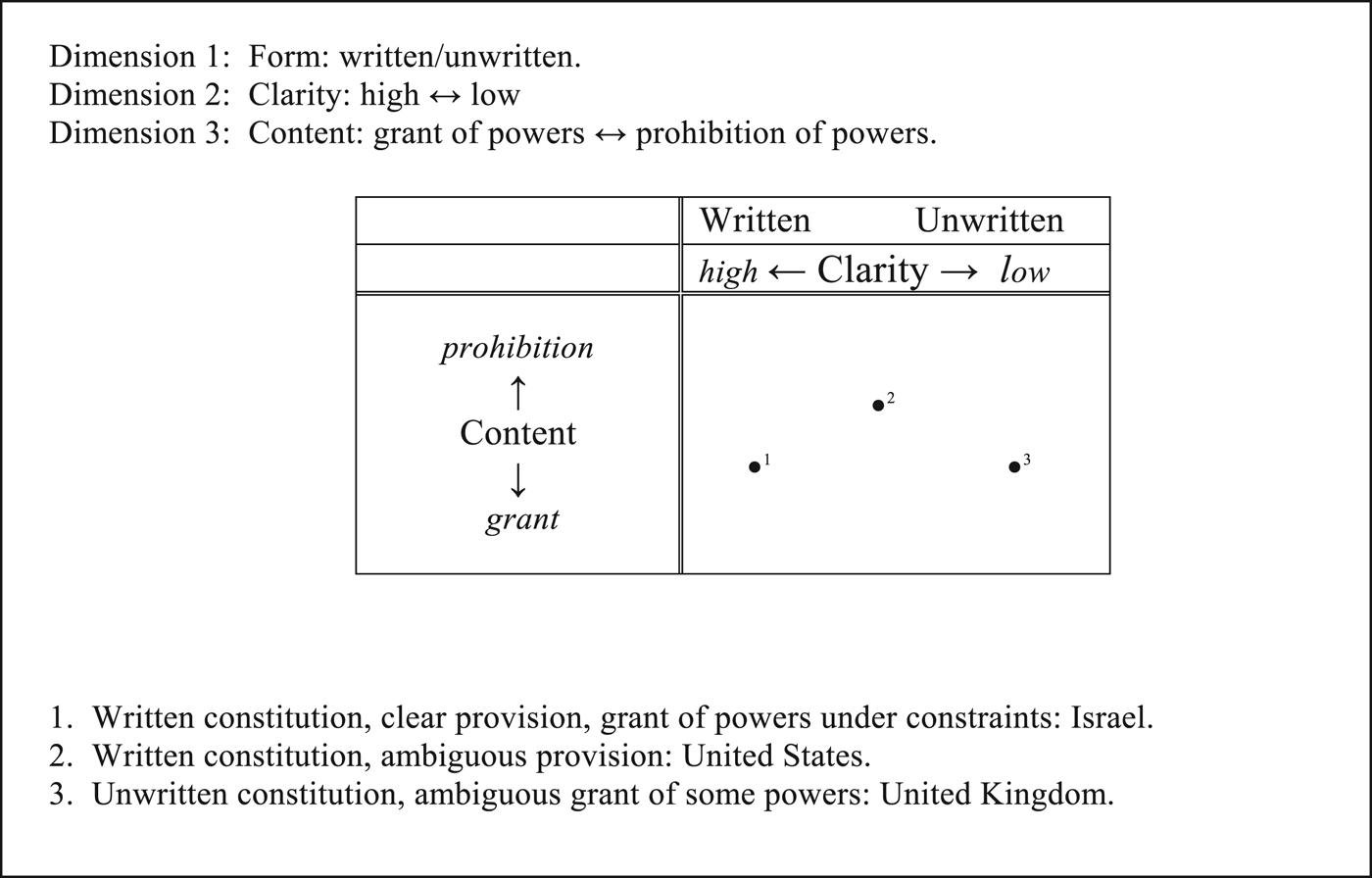
The choice of the systems was directed under three parameters. First is the familiar distinction between formal (written) and informal (unwritten) constitutions. The United States constitution, with its rigid and cumbersome process of amendment, is usually posited as the antithesis of the British collection of statutes and unwritten constitutional conventions which comprise an important part of its constitution. The impact of constitutional interpretation and judicially-led evolution on written constitutions cannot be ignored; yet the existence of a written text does reflect a distinct attitude towards constitutional-type issues, one that is seemingly committed to explicit, consensus-based and relatively rigid formulations of the tenets of the regime it creates.
The second parameter, applicable when the system contains a written constitution, pertains to the text of the constitutional solution. The language of constitutional provisions is typically open-ended, but different degrees of vagueness can be found. At one extreme are provisions intended to provide a clear, unambiguous framework, at the other, constitutional lacunas. Provisions vague enough to support competing, even contradictory, interpretations would be positioned closer to the latter pole.
The third parameter is concerned with content. In the context of allocation of powers, solutions can range from absolute prohibition of a certain power, through limited authorization, to a full grant of a broad ambit of powers.
Constitutional frameworks reflect a variety of combinations of these dimensions. This article discusses three distinct combinations. For a graphic representation of possible combinations, which also identifies the national arrangements discussed in this article, see Figure 1.
Constitutional Structural Solutions: A Three-Dimensional Grid

IV. CONSTITUTIONAL SOLUTIONS: THREE EXAMPLES
A. An Unwritten Ambiguous Arrangement: The United Kingdom
I begin with the oldest constitution, under which non-statutory powers seemingly receive full constitutional sanction through the Royal Prerogative, a long-standing tenet of the British constitutional framework. The Prerogative, as defined after the 1688 Glorious Revolution, pertains to those powers retained by the Crown and not taken away by Parliament, and is part of the compromise forced on the Monarchy at the end of the seventeenth century.Footnote 22
For centuries, prerogative powers remained strongly tied with the eminence of the Monarch, an attitude echoed in Blackstone's eighteenth-century definition:
By the word prerogative we usually understand that special pre-eminence which the King hath, over and above all other persons, and out of the ordinary course of the common law, in right of his regal dignity.Footnote 23
The rise of elected politics and parliamentary power, coupled with the gradual evolution of the Crown into a largely symbolical figurehead, are both expressed in Dicey's late nineteenth-century definition:
The prerogative appears to be both historically and as a matter of fact nothing else than the residue of discretionary or arbitrary authority, which at any given time is legally left in the hands of the Crown.Footnote 24
This definition emphasizes one important aspect of prerogative: its continuing existence depends on the absence of legislation: no non-statutory powers, even lofty prerogatives, can be exercised when a statute governs the same field. This residuality rule has retained its status as the principal constraint on the prerogative. Hence the idea of a ‘shrinking’ residue of powers.
Historically, ‘prerogative’ refers to a list of specific powers, largely acknowledged by courts but not dependent on their recognition. Some are irrelevant to this article—prerogatives pertaining to parliament and legislation, Crown immunities and Crown privileges.Footnote 25 I focus on prerogatives that are purely executive in nature, for example, the waging of war, the conduct of foreign affairs, the grant of pardon, the administration of the passport regime, and some high-level appointments.
In the British context of an unwritten constitution, almost no one (at least since Chitty)Footnote 26 has dared to present a complete list of prerogatives. Lists are carefully supplemented by a caveat such as ‘it is not possible to give a comprehensive catalogue of prerogative powers’, followed by a discussion of the classically acknowledged ones.Footnote 27 The legitimacy of its exercise remains a constitutional convention, one of the constitutional rules which are considered part of the unwritten constitution of the United Kingdom.
Despite the historical link to the Crown, all ‘executive’ prerogatives, from war powers via the pardon power to the grant of passports, are entrusted entirely in the hands of the executive, with a symbolic assertion of the Crown. Here, then, is the first constitutional source of current non-statutory powers.
The natural ‘shrinking’ of the prerogative due to the general expansion of legislation over the past two centuries has been twinned with a strengthened commitment to legality, under the principles of the sovereignty of parliament and the rule of law, all anathema to arbitrary prerogative. Dicey does hint at the problem of retention of the prerogative—it offers the government ‘large powers which … are constantly exercised free from Parliamentary control’,Footnote 28 but he refrains from calling for its removal. Instead, his emphasis is on constitutional conventions that determine, and constrain, the exercise of the prerogative.Footnote 29 Twentieth-century harsh criticism of executive discretion under legislation, notably Lord Hewart's influential The New Despotism,Footnote 30 has further strengthened the critical attitude, leading to modern-day escalation of reform.
Some prerogatives have thus been duly legislated, as in the earlier case of the Crown prerogative of coinage. Counterfeiting and other such offences were consolidated in the Coinage Offences Act 1832; the current Coinage Act 1971 replaces the Coinage Act 1870, which places all powers in this field in the hands of the Crown, but under statute.Footnote 31 The most recent reform, the Constitutional Reform and Governance Act 2010, regulates the civil service and legislates the Ponsonby rule. Still, the prerogative remains central in some fields: the passport regime remains prerogative-based, and the recently declared convention requiring a parliamentary debate and vote prior to committing troops to armed conflict has not fully removed government prerogative in this field.Footnote 32
The pairing of ‘non-statutory’ powers with ‘prerogative’ powers is unsurprising, since the prerogative does not derive from statute. Prerogative, nevertheless, is really something else. It connotes a shrinking reservoir of powers, deeply embedded in the unwritten framework of the English constitution, and should therefore be viewed as equivalent to powers that draw directly from a written constitution. In their true form, non-statutory powers feed on unexpected futures and statute's intrinsic eventual failings. Indeed, many non-statutory powers currently invoked in the United Kingdom cannot be linked to this historical source of power. Such identified powers include the creation and operation of ex gratia payment schemes,Footnote 33 the issue of governmental pamphlets,Footnote 34 and government policy-making by contract.Footnote 35
These powers have now been titled the ‘third source’ of power, but not all of those who recognize the existence of such powers have found a source of constitutional legitimacy for their exercise. Certain commentators revert—some with reservations, some quite happily—to an analogy between the State and the powers of a legal person.Footnote 36 The court has joined in,Footnote 37 while the government has unearthed a 1945 legal memorandum and argues that it has always provided a basis of power that is equivalent to these inhered in an individual.Footnote 38 Whether this indeed is the established understanding of such powers is a matter of debate.Footnote 39
Returning to the prerogative, the main constraint set on their invocation, mentioned above, is the residuality rule. Formalized in De Keyser's Royal Hotel, the rule was applied as the main ground for deciding that the prerogative powers to seize property in wartime without compensation could no longer be invoked, even if it had existed, since statutes in force granted compensation in such cases. The rule seems simple enough:
if the whole ground of something which could be done by prerogative is covered by statute, it is the statute that rules… [t]he Royal Prerogative has been gradually curtailed, as a settled rule of law has taken the place of an uncertain and arbitrary administrative discretion.Footnote 40
This constraint, however, has always been amenable to manipulation: statutes have been interpreted as open-ended enough to accommodate parallel arrangements, or were altogether ignored.Footnote 41
The most far-reaching reform in this field has been judicial readiness to subject the exercise of the traditional prerogative to review. Initially, the courts intervened only when the challenged executive action should have been exercised under existing statute, as in the De Keyser case.Footnote 42 In addition to the application of this residuality rule, the courts were only ready to decide the question of whether the challenged executive action was indeed part of the prerogative. If it were, that was the end of the matter: a general immunity from review derived from the remaining link between these powers and the Crown. The full subjection of the prerogative to run-of-the-mill judicial review was gradual. Initial judicial dicta, first expressed in the 1960s and 1970s,Footnote 43 were the harbingers of the House of Lords' groundbreaking declaration in the mid-1980s that prerogative powers, exercised under modern constitutional convention by the government rather than the Crown, were subject to the same review applied to statute-based power.Footnote 44 In GCHQ, the court was concerned with a delegated power under a prerogative-based order in council; the amenability of review of an order in council itself, the legal status of which remains unclear, was affirmed in Bancoult 2.
The reasoning in both decisions was functional rather than historical. Consider Lord Hoffman's opinion in the latter decision:
It is true that a prerogative Order in Council is primary legislation in the sense that the legislative power of the Crown is original and not subordinate … But … [t]he principle of the sovereignty of Parliament, as it has been developed by the courts over the past 350 years, is founded upon the unique authority Parliament derives from its representative character. An exercise of the prerogative lacks this quality; although it may be legislative in character, it is still an exercise of power by the executive alone … I see no reason why prerogative legislation should not be subject to review on ordinary principles of legality, rationality and procedural impropriety in the same way as any other executive action.Footnote 45
Still, both applications failed for non-justiciability. Since GCHQ, review of the prerogative, now seemingly equal to statute-based powers in this context, ‘depend(s) on the subject matter of the prerogative power which is exercised’.Footnote 46 In GCHQ, review of a decision concerning an intelligence agency was barred for national security reasons; Bancoult was inextricably linked with national security and foreign affairs elements, the two main fields deemed non-justiciable.
In sum, British courts no longer award non-statutory powers, even those with the ‘prerogative’ imprimatur, special immunity from review, but such powers remain one of the governance tools available to the executive. Some are granted the grand title of ‘prerogatives’, others may have a lesser pedigree. The residuality rule may limit their application, but in principle, the system recognises their existence. When pertaining to non-justiciable fields of action, judicial review will be barred, but this hurdle applies both to statute-based and non-statutory powers.
B. A Written Ambiguous Arrangement: The United States
As in the case of the UK, true US non-statutory powers are powers that derive neither from statute nor from a clear authorization in the constitution. While the main causes for ambiguity in the UK are history and the absence of a written constitution, in the US the vagueness is contained in Article II of the Constitution. This vagueness has helped to fuel a series of ongoing disputes, against which presidents have been able, legally or at least with sufficient political backing, to wield non-statutory powers in certain fields without paying a political price.
A survey of the rich literature on the framing process and the ratification years leads to one certain conclusion: beyond the commitment to the democratic ethos, no clear vision of the extent of such powers can be safely garnered. The shared allegiance to the constitution as the primary element of the new polity, and to the ideal of separation of powers in its checks and balances version was a constant guiding light, but the contours of the constitutional structure were originally fuzzy.
The Philadelphia Convention's mandate ‘to render the Constitution of the Federal Government adequate to the exigencies of the Union’Footnote 47 was directed by two forces. Looming in the background was the colonial legacy: in the newly independent nation, popular understandings found any form of monarchy abhorrent. However, the Annapolis resolution was generated by the virtual breakdown of the Confederation structure as a framework strong enough to resolve the problems facing the new nation in the absence of a national executive. The decision to move ahead was, thus, designed to resolve the domestic problems created by former arrangements.Footnote 48
Accounts of the long, sometimes tortuous weeks that led to the finalization of the text show that initial drafts were in fact starting points for the overturning, reintroducing, and otherwise turning around of the key elements of Article II. The framers argued long and hard over the Presidential election process, but the minutiae of Article II powers received much less attention and were finally settled by the Committee of Detail and Committee of Style. One telling example: the final wording of the vesting clauses, to which I return below, was the product of the committee of style.Footnote 49 The retention of an open-ended Article II may have been driven by certain members, generally supporting an ‘energetic’ executive, but the final version cannot be described as the product of open and detailed reasoning.Footnote 50
Underlying this seemingly surprising marginalization of the treatment of executive powers was deep ideological disagreement. The battle between Federalists and Anti-Federalists, who pushed for distinctly different constitutional structures,Footnote 51 was waged alongside a parallel dispute within the Federalists. Both factions, led by Hamilton on one side and Jefferson and Madison on the other, supported an executive that could rise above normal law in emergencies, but the differences between the theories on the nature of the constitution at large, and executive powers in particular, were far from marginal. These views were fully exposed during the post-ratification era in several famous disagreements. I focus on the 1793 Publius-Pacificus debate.Footnote 52 Hamilton strongly supported a powerful presidency: at an earlier point, he advocated the instatement of a hereditary monarch, a suggestion removed later, but his general support of a strong president remained.Footnote 53 In the debate over George Washington's neutrality proclamation, Hamilton found both functional and textual bases for his support of the legality of the proclamation, arguing inter alia that the enumeration of presidential powers in Article II did not derogate from the broad authority granted in the vesting clause; therefore, ‘the executive power of the nation is vested in the president; subject only to the exceptions and qualifications, which are expressed in the instrument’.Footnote 54 Madison's opposing, clause-bound interpretation led to the rejection of unilateral presidential power in the issues at stake, the signing of treaties and war powers; if at all, they could have been linked with prerogative, which was clearly not part of the constitutional framework.Footnote 55 Jefferson's strict constructionist stance was equally opposed to Hamilton's political theories.Footnote 56
These disagreements on function and text set the tone for the future. Indeed, each and every theory of the role of the presidency advanced since, from a limited vision of the president as presider/moderator to the full-fledged version of a post-9/11 imperial ruler, have found basis in the text, in different understandings of original intent, and in constitutional history. In addition to reliance on the vesting clause, echoing the 1793 debate, Sections 2 and 3 of Article II enumerate a renowned list of powers, including the command of the armed forces, the grant of pardons, the making of treaties under Senate advice and consent, and the ambiguous ‘take care that the laws are faithfully executed’ clause. All are open for interpretation, notably the ‘take-care’ and commander-in-chief clauses, which offer promising bases for expansionist visions.Footnote 57
Moving from textualism to original intent, the underlying disagreement on the nature of the executive, discussed above, belies any attempt to reach a clear answer. Supporters of both camps have relied on original intent to buttress their normative arguments;Footnote 58 original intent, then, also seems to lie in the eyes of the beholder.
A similar result emerges when history is chosen as the guiding methodology. Here, I do not refer to the evolution of executive powers via ‘historical gloss’—this is treated further below—but to reliance on history and practice to support normative arguments over the proper extent of unilateral presidential powers, by showing that the proposed vision is not only superior, but is in fact deeply embedded in the history of the nation. In this respect, too, interpretations of history seem to support members of all camps.Footnote 59
Beyond text, intent, and history, scholars have offered functionalist bases for the varying understandings of the nature of the executive in general. The constitution remains important here, though less as a clear authorization and more as a guiding light; a return to the basic reliance on democracy and the separation of powers is evident, alongside arguments concerned with the promotion of values such as accountability, effectiveness and consistency.Footnote 60 Yet the same arguments support various normative stances, from ambitious regime change proposals to calls for enhancing presidential centralism.Footnote 61
The general pattern on the ground has been that of aggrandizement. President Lincoln's actions during the Civil War were retrospectively approved by Congress; his, and President Theodore Roosevelt's ‘stewardship’ theory developed in 1913, laid the ground for subsequent calls for presidential dominance, particularly at times of grave national emergency.Footnote 62
Yet presidents have never limited invocation of non-statutory powers to emergencies. Non-statutory presidential impoundment of funds, used to impose policy directions through presidential refusal to activate budget items, was prohibited by statute in 1974, after a marked rise in the practice.Footnote 63 Signing statements, pronouncements of disagreement with elements of a statute signed into force, have replaced this practice.Footnote 64 Presidential executive agreements supplement, if not materially replace, the constitutional arrangement that involve the Congress in the process of treaty-making.Footnote 65 Presidents unilaterally requisitioned lands through the nineteenth century and the early twentieth-century.Footnote 66 Many of these actions were authorized by executive orders, a well-established semi-formal mode of presidential policy formation, which often does not rely on statute. Other forms, such as proclamations and the memoranda referred to in the introduction, grant the presidential message special weight, but when no statute is involved, they are pure expressions of unilateral power.Footnote 67
As for judicial stances towards such powers, it should first be noted that, in comparison with the other common law systems analysed in this article, the president of the United States enjoys exceptional insularity from review in all areas non-constitutional, (that is, when public acts are challenged at the administrative law level), an insularity supported by a strong culture of judicial deference. Paradoxically, despite the fact that, from inception, the president as the head of State was not protected by the aura of monarchy, no move for equating direct presidential action to run-of-the-mill output of administrative agencies, traced above in the context of the UK,Footnote 68 can be discerned.
This is not to say that courts have not reviewed presidential non-statutory powers. For some, the now-accepted maxim that ‘the president's power … must stem either from an act of Congress or from the Constitution’Footnote 69 reflects a general judicial tendency to invalidate presidential non-statutory power that cannot be linked with the constitution. However, a closer consideration of the jurisprudence shows that here, too, interplay between different attitudes exists; in fact, a general pattern of accommodation is dotted with singular cases that trace the limits of presidential power.
First, courts have sometimes found sufficient statutory basis for presidential action, even when no specific statute was originally cited, thereby fully legitimizing the challenged action and extracting it from the realm of the unilateral.Footnote 70
Moving to powers that found no statutory base, the spectrum of judicial stances leans towards endorsement of the president's powers. I begin with the restrictive end of this spectrum. Some cases involve the invalidation of unilateral action, as in the Hamdan affair, in which the court found that no statute authorized the government to convene the challenged military commissions, and that the rules governing those commissions violated the Uniform Code of Military Justice.Footnote 71 Further, the court's readiness to strike down statutes that were found to grant excessive powers to the president more than indicates that limits to presidential powers also draw on the separation of powers principle as designed in the constitution. In Clinton v New York, the Supreme Court invalidated the Line Item Veto Act, which empowered the president to cancel specific spending provisions, for violating the presentment clause, being in effect a grant of power to amend or repeal legislature.Footnote 72
Youngstown, the most famous decision in this context, should be positioned slightly closer to the accommodation pole of this spectrum. On its surface, the decision should be read as a reinforcement of the residuality principle. Rejecting arguments that relied on ‘the aggregate of the [president's] powers under the Constitution’, that is, the vesting clause, the take-care and the commander-in-chief clauses, Justice Black's ruling that the president could not seize steel mills in order to prevent an industrial action, since an impressive body of statute-law offered channels of action, is a clear expression of the residuality rule.Footnote 73 However, the complex web of opinions conveys more.
The most memorable and frequently used part of the decision is contained in Justice Jackson's concurring opinion. In the first of his three ‘practical situations’, Justice Jackson reminds his readers that executives often act under statute, a truism that could have been excluded from our analysis but for Justice Jackson's readiness to consider implied statutory authorization as a sufficient basis.Footnote 74 In his third category, Justice Jackson reiterates the residuality principle, but with a triple twist. His focus in this category is on action that is ‘incompatible with the expressed or implied will of Congress’, a formulation that may further constrain the president, when his actions only impliedly contradict statute. Yet, when such contradiction occurs, Justice Jackson considers the president's power to be ‘at its lowest ebb’, a sufficiently neat formulation for potential future manipulation. Finally, as befits the system, Justice Jackson returns to the possibility of direct authorization by the constitution, a parallel source of authority that offers a broad scope of interpretation that may accommodate presidential action.Footnote 75
Justice Jackson's second category offers a rich repository for potential aggrandizement of unilateral executive power. Alongside the president's own independent powers (under the constitution) there exists ‘a zone of twilight in which he and Congress may have concurrent authority, or in which its distribution is uncertain’. In these cases, acquiescence and other modes of Congressional inertia may ‘enable, if not invite’, independent presidential action.Footnote 76 Justice Frankfurter's equally famous reference to historical gloss further embeds this mode of aggrandizement:
a systematic, unbroken, executive practice, long pursued to the knowledge of the Congress and never before questioned, engaged in by Presidents who have also sworn to uphold the Constitution, making as it were such exercise of power part of the structure of our government, may be treated as a gloss on ‘executive power’ vested in the President by S.1 of Art. II.Footnote 77
In another concurring opinion, Justice Clark finds that the Constitution does grant the President unilateral powers ‘in times of grave and imperative emergency’;Footnote 78 in effect, he joins the dissenters in this matter. The decision, then, cannot support the rejection of all emergency powers. In conclusion, the overall meaning of this decision is, as many have noted, sufficiently open to accommodate differing applications.
Then there are cases in which the courts decide not to decide, using non-justiciability doctrines (such as the political questions doctrine, lack of standing, mootness and ripeness), often used in challenges to the exercise of war powers,Footnote 79 and by denying certiorari, which, inter alia, enabled the Supreme Court to remove itself from the debate over the constitutionality of the Vietnam war and participation in other hostilities, unilaterally initiated by the president.Footnote 80 In all of these cases, non-intervention in the decisions of lower courts that upheld the challenged measures could promote consecutive reliance on such modes of action. Other forms of non-interference are found in cases decided on the basis of non-reviewability due to the lack of ‘force of law’ of the challenged measures.Footnote 81
Nearer to the other end of the spectrum are decisions that uphold non-statutory presidential action by reference to sources beyond the text of the constitution. First in line are the ‘historical gloss’ decisions. Decades before Youngstown, the Supreme Court found long-standing practices, supported by judicially recognized congressional acquiescence evident in oblique references to the said practice, appropriation of funds for its continuation, or simple inaction, to be sufficient justification for upholding unilateral presidential action. In Midwest Oil, the court upheld the decision to temporarily deny access to and use of oil-rich public lands due to a shortage of natural sources, contrary to a statute that enabled free use of land. The court relied on the decades of practice, never challenged by Congress, to uphold this one example of a decades-long practice.Footnote 82 Upholding an action that contradicted statute, this decision, then, does not conform to the residuality principle. Subsequent decisions in this vein pertain to foreign affairs.Footnote 83
The most permissive decisions recognize inherent powers that do not directly originate in the constitution, and hence may be free of its constraints. The typical decision is Curtiss-Wright, decided in the 1920s. The case involved the presidential setting of an embargo under and in accordance with statute, but in his opinion, Justice Sutherland supported all forms of executive power in foreign affairs as sufficiently deriving from the sovereignty of the State.Footnote 84 Whether this stance would support similar action today is doubtful, but the above survey shows sufficient bases for accommodation.
In sum: without settling the ambiguity inherent to the text of the constitution, presidents continue to enjoy some freedom to act in the absence of statute. Nothing in the written constitution prohibits the exercise of such powers; the system more than tolerates some of them, and the limits on their exercise have yet to be doctrinalized. Two constraints on the exercise of these powers have emerged, albeit in a diluted form. A general residuality principle does exist, but exceptions and competing older rulings challenge its robustness. Secondly, the recent jurisprudence, mainly Hamdan, seem to constrain reliance on unilateral power in cases involving a direct breach of a human right.Footnote 85 These constraints, however, are at their lowest ebb in two contexts: when presidents are involved in the making of general social and economic policy, which, inter alia, limits if not eradicates standing of most, if not all, interested parties, and, very much like British courts, when subject-matter sensitivity is likely to enjoin courts from intervention by using non-justiciability doctrines.
C. A Written Balanced (?) Arrangement: Israel
On its establishment, Israel preserved former Mandate law,Footnote 86 and could have followed Great Britain in basing its solution to the question of non-statutory powers on the historical prerogative. The possible absorption of the Royal Prerogative by way of inheritance of colonial law was discussed in academic circles,Footnote 87 but was never judicially adopted. Non-statutory powers received a somewhat weak base of legitimacy, drawing on a functional basis, in the 1963 El Saruji case. Deciding upon the authority of the Minister of Religious Affairs to appoint and fund a religious Muslim committee in the town of Acre in the absence of an enabling statute, the High Court of Justice ruled that
in its activities, the Ministry of Religion does not act on the basis of an explicit statute, rather on the basis of the general governmental powers in the hands of the government and its ministries, within the confines of the national budget approved by the Knesset.Footnote 88
Using a similar functional reasoning a few years later, the court ruled that the government was empowered to ratify international treaties, again despite the absence of legislative (or constitution-based) authorization. The court relied on canons of international law and on a functionalist ruling that ‘the creation and existence of international relations … are a clear matter for the executive branch’.Footnote 89 Two Justices criticized arguments that based this power on Mandate law, emphasizing the independence of the State and its disassociation from the British constructs existing in this field. One of the justices opined that
[I] do not believe that in the matter of the general and basic powers of government authorities, it is required or necessary to search for parallel powers in the hands of British or Mandate rulers from the pre-State era and rely on their legacy – this would be wrong.Footnote 90
Formal treatment of the issue was introduced in 1968, in the Basic Law: The Government, a semi-constitutional statute that was later recognized judicially, with all other Basic Laws, as enjoying constitutional status.Footnote 91 The Basic Law includes a short provision that both allows and limits the invocation of non-statutory powers:
The Government is competent to do in the name of the State, subject to any law, any act the doing of which is not enjoined by law upon another authority.Footnote 92
The provision was intentionally designed to provide a final and definite answer to the problem of non-statutory powers. No information on the inspiration for the drafting is available.Footnote 93 Since 1968, then, non-statutory executive powers are exercised under a formal source that seems to offer a structured solution.
As in the other studied systems, reliance on non-statutory powers in Israel is not a rarity. State funding discussed in El-Saruji is but one example. Several government ministries rely extensively on non-statutory powers. For example, the Ministry of Immigrant Absorption, the Ministry of Housing and the Ministry of Foreign Affairs, largely allocate their resources without any legislative mandate.Footnote 94
Assessment of judicial treatment of the provision shows a gradual internalization of both the authorization to act and its restriction, but here, too, some weakening of the restrictions is evident. During its first two decades, the section was rarely relied upon and recognized only when transnational elements were involved: three decisions concerned disputes over religious sites, and one referred to section 28 as the source of the exercise of military power in the Occupied Territories, which did not rely on domestic statute-law.Footnote 95 Courts did not rely on the provision in the context of more mundane usages of non-statutory powers, such as those discussed in the pre-Basic Law El-Saruji. This changed in the early nineties: since then, courts have relied on the provision, recognizing the breadth of areas in which non-statutory powers are invoked.Footnote 96
Alongside the recognition of these powers, the court has developed five constraints on their exercise. First, the residuality principle, central to the law of the royal prerogative, was traced to the proviso ‘subject to any law’.Footnote 97 Yet the impact of the residuality constraint is limited. It has aided applicants only once, and then, in conjunction with the human rights constraint, discussed below. In some cases, the statute allegedly covering the subject matter was narrowly construed, excluding the challenged action from its remit.Footnote 98 The court has also been ready, in more than one case concerned with a statute granting benefits and subsidies, to recognize the legality of supplementary benefits and subsidies beyond statute, as well as interim benefits granted before the entry into force of the statutory arrangement. Both types of programmes were recognized as ‘parallel tracks’ available in addition to the statute-based payments.Footnote 99 This more than echoes other systems' readiness to uphold action beyond the law as long as it does not contradict statute law.
The second limit has been read into the text of section 28, but draws on Israel's well-established judge-made ‘principle of legality’, under which action affecting a right or a liberty must be based on a statutory authority that explicitly authorizes interference with the right; general statutory delegation does not suffice.Footnote 100 In Kiryat Gat, a case in which a nationwide non-statutory subsidy scheme was challenged, the court interpreted the term ‘law’ to include judge-made law, thus introducing the principle of legality in this context. In this case, the court invalidated the subsidy scheme for blatantly discriminating between Jewish and Arab settlements, in the absence of a clear statutory authorization.Footnote 101 Since 1992, the principle is also constitutionally embedded in two basic laws protecting human rights, under which interference with a protected right must be, inter alia, made ‘by law’ or ‘by regulation enacted by virtue of express authorisation in such law’.Footnote 102
A third substantive constraint relies on the recently developed doctrine of ‘primary arrangements’, under which long-standing arrangements that are socially important, publicly debated, involve a high public expense, or otherwise substantially impact on the public sphere, cannot be sustained under the provision and require legislation.Footnote 103 However, the post-decision dynamics of the two cases in which this rule was applied show weak promise: in our context, one non-statutory arrangement was replaced, after years of foot-dragging, by an open-ended empowering statute, which offers only nominal direction.Footnote 104
Finally, two other constraints on the exercise of non-statutory powers limit actions to those ‘administrative’ in nature, precluding exercise of inherent judicial-type action; and public expenditure under such powers require a basis in the annual appropriation law. Neither has been central to the limitation of non-statutory powers.Footnote 105
V. COMPARISON: A TEMPLATE FOR THE ANALYSIS OF CONVERGENCE/DIVERGENCE
… the process of comparison proper starts only when the reports on the different legal systems have been completed.Footnote 106 (K Zweigert and H Kötz, 43)
For Zweigert and Kötz, the authors of the definitive work on comparative law, comparison begins with the juxtaposition of the different solutions found in country studies through an analysis of differences and similarities, and leads to a normative assessment of the ‘best’ solution or solutions. Unlike Zweigert and Kötz, I do not enter normative waters; I am concerned with developing the conceptual framework of comparison. I advance a nuanced blueprint for comparison under the convergence/divergence template, a central stream in comparative law study. Rather than merely note similarities and differences under the convergence/divergence discourse, analysts should be aware of two further distinctions: the distinction between functional and transplant-derived convergence, and, in public law, the contextual distinction between human-rights and institutional fields of action. These additional levels of comparison offer a nuanced framework that can better support analyses of both the nature of national arrangements and the reasons for their evolution on the ground. At the end of this part, I tentatively consider the reasons for the type of divergence found in this case study.
One caveat: two of the three solutions analysed in this article, the UK and the US, are ‘ancestor systems’—members of a small group of legal systems that have inspired other, mostly newer, systems.Footnote 107 The findings may therefore not be indicative of the patterns found in other systems. Consider, for example, Günter Frankenberg's ‘IKEA theory’ of constitutional transfer, under which ‘standardized constitutional items’, stored in a sort of ‘supermarket’, are ‘available, prêt-à-porter, for purchase and reassembly by constitutional makers around the world’.Footnote 108 Following this image, the arrangements analysed in this article could in fact be the ‘constitutional items’ available for possible purchase and assembly by other systems. Therefore, a full consideration of cross-system influence requires the analysis of non-descendant systems, especially those that have no historical colonial link with an ancestor system. For example, the preservation of some form of the Royal Prerogative in Commonwealth countries is easy to explain as the outcome of the retention of the Crown; more to the point would be a study of constitutional monarchies that were never part of the British Empire. Only one of my studied systems, Israel, is a non-ancestor, post-colonial system, which rejected its British legacy; as a single example, the data cannot support a universal argument regarding the relatively limited transplantation processes in institutional-structural contexts.
Still, the three-system comparison to which this article is dedicated carries several benefits. I have chosen three dissimilar arrangements: the first is based on history; the second is the outcome of vague constitutional engineering; the third, an attempt to squarely address the issue. The emergence of similarity is, in itself, an interesting outcome that requires explanation. Further, the study offers insights on the types of items that can find themselves on the shelves of the law supermarket, ready to be picked and transplanted. Assuming that some of these items were not adopted by other systems—to the best of my knowledge, no other system has introduced an arrangement similar to the current Israeli formula—analysis of the reasons some arrangements have remained unique would contribute to the limited literature on this negative form of (non)transplantation. Finally, the three-system study offers sufficient ground for the conceptual analysis of the comparison stage, developed in this part.
A. Divergence or Convergence?
Comparison is concerned with identifying patterns of both similarity and diversity between compared units. The convergence thesis, central to comparative law scholarship, focuses on the similar, as in Zweigert and Kötz’ claim that
one can almost speak of a basic rule of comparative law: different legal systems give the same or very similar solutions, even as to detail, to the same problems of life, despite the great differences in their historical development, conceptual structure, and style of operation.Footnote 109
Under this thesis, legal systems tend to offer functionally similar legal solutions to shared problems. The similarity is found at the law-in-action level; formal solutions are only the starting point.
A competing important group of comparatists argues that the convergence thesis is a dangerous myth that plays into the hands of politicians who wish to present so-called ‘transition States’ as partaking in the Westernisation game. Frankenberg offers a scathing critique of classical comparatists who embrace a sunny, but false, view of the globalization of constitutional law. One of his examples is the futile comparison of the regulation of abortion in China and various Western States, which is influenced by culture and politics.
Frankenberg's call for forsaking ‘[a]nalogies and presumptions of similarity’ in favour of ‘a rigorous experience of distance and difference’Footnote 110 is echoed in Legrand's argument that law is a cultural (that is, domestic) construct, and that the classical comparatist's ‘inherence in his (domestic) law’ renders comparison-as-harmonization impossible.Footnote 111 Here, comparative study is not rejected, but difference is prioritized.
My analysis in Part IV offers a good example of convergence. Starting out from entirely different points of departure, three executives—a president and two prime ministers—exercise a similar non-statutory core of powers, supported, or at least tolerated by their systems. The discourses are clearly different, and some variations are evident, but the similarities are notable: despite substantial structural differences, the evolution of each of the solutions has led, to a great extent, to the convergence of a vision of an office that retains both its dominance, legal and political, but also a degree of submission to parliament and to judicial review.
First, the three examined regimes, as evolved, have never completely prohibited the invocation of non-statutory powers, despite their shared adherence to the rule of law. The core subject-matters recognized as legitimately regulable under unilateral action, or at least tolerated through the absence of judicial interdiction, are shared: emergency/national security, police, and the formation and implementation of economic policy which involves the powers of the purse. Recognition of powers in these subject matters has relied on explicit constitution-type texts, as in the case of Israel, on well-established but unwritten tenets of the constitution, as in the UK, or on open-ended interpretable constitutional provisions, as in the US. Judicial doctrines, built on the basis of texts or beyond them, have further supported the legitimacy of these powers. These include judicial recognition of inherent powers, as in early US and Israeli decisions;Footnote 112 the US recognition of ‘historical gloss’;Footnote 113 creative interpretation of statutes to ensure that the challenged action escapes the residuality net, as in some Israeli cases;Footnote 114 and a general legitimation of action beyond statute, as opposed to action that contradicts statute.Footnote 115 Finally, deference doctrines and denial of review for non-justiciability have been employed to block challenges to the invocation of some similar non-statutory powers.Footnote 116
Moving to the evolving constraints on the exercise of non-statutory powers, here, too, similarity can be discerned. Two constraints on the exercise of non-statutory powers seem to be shared: a doctrine of diluted or tempered residuality and a rule prohibiting action in human-rights contexts. The residuality principle has remained a key feature of the British prerogative since 1688; this mainstay of the British constitution also applies to so-called ‘third source’ powers.Footnote 117 Residuality is also central to Israel's written arrangement,Footnote 118 and is the cornerstone of Youngstown, the basis for the now-established US rule that the president must rely on either the constitution or statute to invoke enforceable powers, applied inter alia in Hamdan.Footnote 119
Still, when intent on upholding powers despite the parallel existence of statute, the courts of these three systems have created bypasses that weaken the residuality constraint. Parallel action beyond statute is allowed virtually universally in Israel, as long as no individual rights are affected.Footnote 120 Further, some statutes have been interpreted very broadly, to authorize action that initially did not rely on legislation, or narrowly, in order to classify the challenged action as pertaining to a different subject matter.Footnote 121 The outcome, then, is a shared commitment to the primacy of statute-law, but a far from absolute one, which is overtaken when so expedient.
The human rights constraint is only impliedly shared. Originally, only Israeli courts squarely require that an interference with rights and liberties must be authorized by a detailed, explicit statutory authorization; under this constraint, non-statutory powers affecting rights cannot be the source of such action. None of the other systems studied in this article expressly recognize this constraint; for this reason, this aspect is not discussed in detail in the respective analyses of the other two systems. Indications for the existence of such an implied constraint can be found in both systems. In the US, evidence to the contrary does exist: in Midwest Oil, the court upheld the withdrawal of access and use of lands by presidential order; in the 1980s, the ‘historical gloss’ doctrine, expressed in congressional inaction and some implied recognition, was still found sufficient to authorize the nullifying previous freezing of Iranian assets.Footnote 122 Yet the American system cannot be blamed for marginalizing the commitment of the system as a whole to the protection of recognized rights; since Hamdan, anti-terrorism measures are all legislated, and administrations now recognize that absent legislative or constitutional authority, the President cannot invade private rights.Footnote 123
In the UK, historically recognized prerogative powers can affect the rights of individuals, as in the case of the exercise of war powers and the issuance of passports. In Entick v Carrington (1765), Lord Camden famously ruled that the Earl of Halifax's messengers held no power to search and seize personal papers in the absence of law: ‘if this is law it would be found in our books, but no such law ever existed in this country’.Footnote 124 However, this decision, one of the mainstays of British constitutionalism, did not address prerogative powers, which were not affected by this ruling. Further, British governments were not enjoined from interfering with unrecognized rights, protected in other constitutional systems, as long as no statute prohibited such interference, as in the case of privacy, a right recognized only in 2000.Footnote 125
This is no longer the case. Domestic law was transformed after the entry into force of the Human Rights Act 1998, which incorporated substantive parts of the European Convention of Human Right into domestic law, and now offers British courts distinct mechanisms of review of statutes when a breach of Convention rights is found.Footnote 126
Most rights protected under the convention can be compromised if the conditions set in ‘limitation clauses’ are met. One of the conditions set in these clauses is that the interference be ‘in accordance with the law’ or ‘in conformity with the law’.Footnote 127 These interchangeable termsFootnote 128 could be read as requiring legislation for any breach of a protected right, but the European Court of Human Rights has advanced a different, looser interpretation. The ‘law’, under the Court's jurisprudence, must be sufficiently clear and accessible,Footnote 129 but this does not mean that it must be primary legislation. Inter alia, the Court has recognized, in suitable cases, common-law contempt of court rules and international communications agreements.Footnote 130 Still, some form of explicit authorization of a legal nature must be found.
Israel's additional constraint, under which primary arrangements are to be regulated under statute-law, has no equivalent in the other studied systems; applied only twice in its mother system, its actual force is challenged by the post-decision dynamics of these two affairs.Footnote 131
B. Two Further Distinctions: Functional/ Transplant-Derived Convergence in a Context-Based Framework
The juxtaposition of several solutions discussed in this article offers a pattern of convergence, but proper understanding of this convergence requires further analysis. Similarity on-the-ground can be the outcome of two parallel processes. A system may knowingly adopt a foreign legal construct, but similarity may also be the outcome of separate evolutionary processes, in the absence of trans-border influence. Advocates of transplantation obviously view the former as dominant, yet the coupling of convergence with transplantation is too easily made.
The study of legal transplants and the adoption of foreign law and legal constructs by legal systems worldwide has become one of the most influential streams of the comparative law discipline.Footnote 132 The early literature revolved around a controversy between ‘transferists’ and ‘culturalists’.Footnote 133 Heading the ‘transferist’ camp, Alan Watson celebrated the pervasiveness of legal transplants, a universal process repeatedly occurring since Roman times, irrespective of the possible ‘fit’ between the donor and receiver.Footnote 134 In the opposing camp, substantializing his theory of divergence, Pierre Legrand argued that transplantation is impossible, due to ingrained differences between the systems involved. A legal rule is ‘necessarily an incorporative cultural form’, and its meaning is found through essentially subjective interpretative processes, which are historically and culturally conditioned. Therefore, transplants do not occur at all: the product of moving a rule elsewhere is always something else, ‘not the same rule’.Footnote 135
The general tone of the literature is a shared wary recognition of transplantation processes: many authors reject both the sunny aspects of Watson's world of ever-flourishing transplants and Legrand's rejection of that vision. Yet much of the general transplant literature is not contextual: it rarely distinguishes between fields or sub-fields of law.Footnote 136
Celebrating the rise of global liberal democracy, many comparative constitutional studies focus on the judicial protection of rights under Bills of Rights. Public law comparatists usually point to the movement of the written constitution template between Western States, and from mature to new democracies, and at the global rise of judicial power and judicial review, both main elements of constitutionalism.Footnote 137 But are these insights valid in the context of the so-called minutiae of regime structures? Can the same pattern be found in institutional-structural contexts, and, particularly, in the context of executive powers?
Research in this direction is limited. Scholars of comparative politics focus on the global diffusion of the two distinct templates—presidentialism and parliamentarism and their hybrids—paying limited attention to the wedding of these two templates;Footnote 138 none are concerned with non-statutory powers and their transplantation. Comparative law studies of the executive branch are scarce.Footnote 139 This article thus enters relatively uncharted territory.
Searches for evidence of transplants should focus on two stages: design and evolution through interpretation and application. Transplantation during the design stage, either with the creation of a constitution or in a subsequent amendment, occurs when its designers are positively or negatively inspired by foreign designs. Post-design interpretation (by courts) and application (by governments) further shape the contours of the framework, and may be similarly influenced. During all stages, transplantation can be overt, expressed in explanatory documents and judicial decisions, or covert, in the absence of open evidence of reliance on foreign law.Footnote 140 In the context of this article, I assess the existence of transplantation by considering accessible and formal evidence; further study of the secret life of transplantations is required for a complete assessment.
I found no evidence of overt trans-border inspiration in this case study. In fact, a different pattern is evident here. The designers of the constitutional arrangements studied in this article were intent on rejecting previous domestic arrangements, considered as failed or lacking. Direct rejection of an external solution may be imputed to the Founding Fathers, committed to reject all notions monarchical. Yet even here, the US Convention's formal mandate was originally fuelled by the failure of the former domestic structure.Footnote 141 Israel and the UK offer different patterns, but in both, no direct external influence at the design stage is discernible. The British evolving law of the prerogative was, and remains, an innovation. As for Israel, the enaction of the Basic Law: The Government in 1968 was not part of a regime change; rather, the Basic Law aimed to codify and rationalize the law of the executive. The provision delineating executive powers was designed to fill a lacuna, which had been judicially filled in the early sixties by vague reference to ‘general government powers’.Footnote 142 Further down the constitutional history of the State, this lacuna emerged once the courts had rejected the adoption of the English prerogative; the design, then, was fuelled by an aversion to the prerogative, which had been removed from the constitutional framework.Footnote 143
Moving to the evolution stage, explicit evidence of transplantation could have been found in domestic courts' reliance on foreign sources.Footnote 144 Studies of judicial citation of foreign law have not been directly linked with the transplantation literature; many are part of the growing body of empirical research of the judiciary. Yet there is an obvious affinity between the study of citation practices and transplantation studies: the more common the citation of foreign sources, the higher the incidence of transplantation, at least on the record.
Consideration of this form of transplantation in the context of this article requires a comparison between the general citation practice in each of the studied systems and the particular pattern found in decisions concerned with non-statutory executive powers. A full appraisal of this aspect of transplantation requires sufficient quantitative-empirical data on the general systemic tendencies of foreign-source citation. Groppi and Ponthoreau's recent edited book offers a comparison of reliance on foreign precedents by the constitutional courts of 16 legal systems, distinguishing between national courts that often cite foreign precedents and those that rarely do so. In conclusion, the book offers an interesting insight: all studied constitutional courts cite foreign citations less frequently in institutional issues; judicial opinions on human-rights issues tend to be more reliant on foreign law.Footnote 145
Two of the systems analysed here, those of Israel and the US, are included in Groppi and Ponthoreau's collection, but the country analyses are general and do not offer direct evidence in the context of executive powers. I build on these analyses and on the few additional quantitative studies of citation practices in these systems, by comparing the reliance patterns in the context of non-statutory powers with the limited general findings.
The question of the constitutional propriety of citing foreign sources has been hotly debated in the United States,Footnote 146 but I am less concerned here with the normative aspects of this practice. US-centred empirical studies of judicial citation practices that have isolated foreign sources from domestic ones reach one conclusion: citation of foreign jurisprudence in US courts is negligible.Footnote 147 Only two of the key Supreme Court decisions on presidential unilateral power cite foreign sources; in both, the contexts have no bearing on the legitimacy or source of non-statutory powers.Footnote 148
The general citation practices in Israel are materially different. Two large-scale quantitative studies of thousands of Supreme Court decisions show a relatively high reliance on foreign precedents.Footnote 149 Against this pattern, eight of the thirteen Israeli decisions cited in this article that address the invocation of non-statutory government powers contain citations of foreign sources, but with the exception of one case, none of these foreign precedents are concerned at all with the source, legitimacy or nature of such powers. In Kiryat-Gat, Justice Goldberg curtly cited Youngstown to support his argument for the application of the residuality principle.Footnote 150 In all other decisions, citations support a variety of issues, from police powers to the political questions doctrine. Some of these decisions are laden with references to foreign jurisprudence; the silence in the context of the legitimacy of the Israeli solution is especially telling.Footnote 151
British large-scale quantitative study of citation practices is still lacking. In an admittedly small sample of cases concerned with the right to liberty and fair trial in the context of anti-terrorism measures, Ian Cram finds a recurring pattern of reliance on foreign sources. This indication of citation practices in a distinct human-rights context is currently the best available comparator.Footnote 152 By comparison, citation of foreign sources in key non-statutory powers decisions is limited: three of the nine decisions cited in this article contain references to foreign case-law, but once again, none of these sources are concerned with the source and nature of the challenged executive power.Footnote 153
As a final test of the extent of reliance on foreign precedents this field, I consider the number of times key US and UK non-statutory powers decisions were cited in the examined systems without limiting the search to decisions directly concerned with non-statutory powers.Footnote 154 No Federal US court has ever cited any of the key decisions delivered in the other systems.Footnote 155 British courts cited Dames & Moore in one decision and Hamdan in five, but all references are part of the factual background and are not linked with the judicial reasoning over challenges to domestic government action.Footnote 156De Keyser was cited six times by the Supreme Court of Israel, but only in the context of the law of confiscation.Footnote 157 The Israeli Supreme Court cited GCHQ in two decisions, and Youngstown in four; only one citation was used to support the court's ruling on the proper extent of non-statutory executive powers.Footnote 158
It would seem, then, that in the constitutional systems analysed in this article, the design and evolution of the distinct solutions to this shared problem show virtually no evidence of overt transplantation. Whether these findings reflect a global pattern, which challenges the discourse of world constitutionalism at least in structural-institutional contexts, requires further comparative study.
C. Assessing Functional Convergence
How can convergence, arrived at in the virtual absence of cross-border transplantation be explained in this case, and beyond? ‘Ancestor’ systems may have created their respective solutions independently, but should the dearth of explicit evidence of external influence during their evolution stages be imputed to their ‘ancestor’ status? Why do Israeli courts, operating in a non-ancestor system, show a similar marginalization of foreign law in this context, contrary to their general tendency to extensively rely on foreign sources in other constitutional matters?
The relative similarity of the contours of non-statutory executive powers in the three Western systems can be tentatively explained by their shared democratic ethos and the generally similar socio-economic climates. At the meta-level of the nature of these polities as democratic States, convergence can well be described as transplant-derived. The adherence to the rule of law, the primacy of individual liberty, and the establishment of some form of separation of powers have migrated from the ancestor democracies, England and the US, to Israel, among many nations. This shared, if vague, ethos has shaped public law in all democracies. Those countries also share, on a same general level, social and political realities that directly impact on the extent of executive powers. The separation of powers ideal infers subjection of the executive branch to statute, but the delineation of the powers of central government rests on an ingrained tension between the need to grant power to the government and the dangers of abuse of the granted power. Thus, strong forces supporting the enhancement of power, briefly addressed in Part II, compete with legality arguments, and have promoted the adoption, formal or de facto, of doctrines that uphold some of these powers, or at least doctrines of deference and non-intervention. Eventually, non-statutory powers are likely to be invoked in contexts that render them socially or politically expedient. But why is transnational transplantation missing in this institutional aspect of constitutional law?
Groppi and Pontoreau's distinction between overt reliance on foreign sources in human-rights and in institutional issues is an important starting point. The editors of this collection offer two explanations for the relative prevalence of foreign citation in human-rights contexts. First, similarities of constitutional bills of rights, which indicate transplantation at the design stage, enhance the tendency to consider foreign systems. This reason links with the second explanation, which I find stronger. The protection of human rights by law is essentially universal: Human rights treaties and other rules of international humanitarian law apply across borders as well as domestically.Footnote 159
Yet Groppi and Ponthoreau do not explain the lower incidence of visible cross-border influence in institutional-structural elements. Some of the reasons for the emergence of this pattern may be gleaned from general arguments that resist convergence in constitutional law, succinctly framed, but not followed as a call for rejection of comparison, by Professor Saunders:
Constitutional law … is deeply embedded in the politics of the polity; derives authority, theoretically and in some cases practically, from the support of the people; may be the product of a long and distinctive history; and may in this case have developed organically over time as an integrated, interdependent constitutional system of which the legal system itself is part.Footnote 160
This argument is strongest in the context of structural-institutional matters that pertain to the sovereignty of the nation, as in the case of executive powers. Courts deciding in such areas do not only settle disagreements that have reached the court; their output signals the unity of the State and its uniqueness as a separate and independent structural entity. I argue that the closer the issue set before constitution designers and courts to the core structural elements of the constitution, as in the issue studied in this article, the structure of executive power, the more likely the absence of development of domestic law by relying on other systems, unless strong external political pressure unsettles internal evolution. Development of this argument and assessment of its force in new democracies are relegated to further research.
VI. CONCLUSION
The exercise of unilateral, non-statutory executive powers in a democratic society directly challenges the basic democratic principles that justify exercise of force in the social and economic spheres. Two central values, representation and deliberation, are compromised. We may agree or disagree with the temporary denial of statutory rights of access and use oil-rich public lands due to the depletion of natural sources, with the suspension of claims of US nationals against Iran as part of an agreement to free the US hostages, with the subjection of government contractors to non-discrimination policies, or with the indefinite detention of suspected terrorists.Footnote 161 But, fundamentally, in these cases, the interests of individuals were affected without legislative authorization: in the first example, against its authorization, in the third, against the background of the inability to pass similar policies in Congress, and in all the above examples, due to the convenience of reliance on this nebulous source of power.
Despite the evident constitutional problem, this article shows that such powers have long pedigrees and are well-embedded in the constitutional practice of at least three Western democracies. The incompleteness of law, supplemented by the political expediency of reliance on non-statutory rules—especially when the executive is challenged by a relatively hostile legislature—virtually guarantees their use. Three different arrangements have contained such powers, using a variety of mechanisms, from pure history, as in the UK, through an explicit authorization in a constitution-type measure, as in Israel.
I have also shown that the systems share, to a degree, two central constraints, the first subjecting non-statutory powers to statute under a residuality rule, the second constraining their exercise in human-rights contexts. Yet, in all these systems, these constraints have been judicially diluted, either actively, by creating doctrines that uphold some of these powers, or passively, by refusing to review the decision-making process.
The picture of functional convergence-in-action, drawn in Part V, presents an opportunity to reconsider visions of the global diffusion of constitutionalism. Most diffusion analyses in constitutional law are concerned with the adoption of human-rights protection through judicial review under a written constitution. Yet in the structural-institutional context analysed in this article, there is no direct evidence that this convergence is the result of conscious decisions to emulate or even reject foreign constructs. Further, little evidence of cross-country citations by courts concerned with the nature and extent of non-statutory powers was traced. The recently published comparison between the citation practices of 16 different systems, which finds less reliance on foreign law in institutional contexts, supports my findings.Footnote 162
Since two of the three examined solutions were adopted by ancestor systems, one could argue that the lack of transnational influence may be indicative of the protean nature of such systems, not of a general global trend. For a well-rounded analysis of the global element in structural issues, further study of so-called secondary systems is required. For example, presidential systems influenced by the US may have adopted US-type non-statutory arrangements.
Whether global or simply typical to ancestor systems, the absence of transnational influence in the context studied in this article can be tentatively explained in several ways. First, transplantation of the negative variety, that is, rejection of foreign constructs, cannot be ruled out simply due to the absence of open evidence. Transplantation could have occurred covertly during the design process. The study of legislative history and other secondary sources is therefore required to fully assess the true influence of foreign sources.
Beyond this, the findings assert the distinction between human-rights and institutional-structural aspects of constitutional law. While the globalization of the protection of human rights cannot be disputed, international law is less concerned with institutional aspects, and for a reason. Structural constructs are often left to States, since they constitute key symbols of national identity and are influenced by domestic politics and climates. In this context, then, the arguments of the culturalist, divergence-focused camp may be correct. Internal politics, in addition to history and culture, may be influential to the development of certain fields, much more than internal and external pressures to go global. The evolution of non-statutory powers in the three studied systems supports this argument. Further study of this, and other institutional-structural fields such as federalism and parliamentary immunity, is required to fully assess its force.