INTRODUCTION
The pseudophyllidean cestode Ligula intestinalis L. has a complex life cycle with 2 intermediate aquatic hosts and a final piscivorous host (Arme, Reference Arme1968). Fish are the second intermediate host of L. intestinalis and get infected as a result of eating infected copepods in which the parasite is at the procercoid stage (Brown et al. Reference Brown, Loot, Grenfell and Guégan2001). Then, the parasite develops into plerocercoid stages in the peritoneal fish cavity (Brown et al. Reference Brown, Loot, Grenfell and Guégan2001). Ligula intestinalis has been found in the body cavity of numerous freshwater species in many parts of the Northern Hemisphere (Arme and Owen, Reference Arme and Owen1968), mainly in the Cyprinidae family but also to a lesser extent in some Percidae, Catastomidae, Cibitidae, Galaxidae, Gobiidae, Siluridae and Esocidae. Hosts recorded within Cyprinid fish are numerous and include roach (Rutilus rutilus), dace (Leuciscus leuciscus), rudd (Scardinius erythophthalmus), bleak (Alburnus alburnus), minnow (Phoxinus phoxinus), common bream (Abramis brama), silver bream (Blicca bjoerkna), barbel (Barbus barbus), gudgeon (Gobio gobio), tench (Tinca tinca), common carp (Cyprinus carpio), spottail (Notropis hudsonius), crucian (Carassius carassius) and nase (Chondrostoma nasus) (Bouzid Lamine, 2008). Second intermediate hosts are the most impacted by L. intestinalis plerocercoids, which keep growing during the whole host life (Dubinina, Reference Dubinina1980; Brown et al. Reference Brown, Loot, Grenfell and Guégan2001; Baruš and Prokeš, Reference Baruš and Prokeš2002; Shargh et al. 2002). Furthermore, the host may be infected by a single or several plerocercoids. In larger and older fish, they can attain considerable lengths and weights (Baruš and Prokeš, Reference Baruš and Prokeš2002). In extreme infestation cases, the total weight of plerocercoids present in the host peritoneal cavity may equal or exceed the host weight, but these cases are fatal for the fish and, consequently, for the parasite as well (Loot et al. 2001b).
The presence of large plerocercoids in a fish cavity influences the placing of many organs such as the liver, the intestines, the reproductive glands or the swim bladders (Arme, Reference Arme1968; Dubinina, Reference Dubinina1980; Loot et al. Reference Loot, Lek, Dejean and Guégan2001b; Trubiroha et al. Reference Trubiroha, Wuertz, Frank, Sures and Kloas2009). Plerocercoids divert energy from the host for their own growth, and the most impacted host organs are the gonads. Ligula intestinalis is indeed well known to inhibit sexual development in males as well as in females (Carter et al. Reference Carter, Pierce, Dufour, Arme and Hoole2005). In fact, the effects of L. intestinalis on the gonadal development may be mediated through the pituitary gland by the inhibition of gonadotropin hormone (Arme, Reference Arme1968; Carter et al. Reference Carter, Pierce, Dufour, Arme and Hoole2005). The gonads remain at an immature stage and most plerocercoid-infected fish cannot breed (Carter et al. Reference Carter, Pierce, Dufour, Arme and Hoole2005). L. intestinalis may also alter the fat content (Kosheva, Reference Kosheva1956; Dubinina, Reference Dubinina1980) used for the regulation of gonad maturation (Geraudie et al. Reference Geraudie, Gerbron, Hill and Minier2010). An impact on host development has already been observed, with a lower condition index (CI) in infected individuals (Carter et al. Reference Carter, Pierce, Dufour, Arme and Hoole2005; Loot et al. Reference Loot, Poulin, Lek and Guégan2002; Trubiroha et al. Reference Trubiroha, Wuertz, Frank, Sures and Kloas2009). Furthermore, L. intestinalis is known as a manipulative parasite that alters host behaviour in a way that increases its vulnerability to avian predators (Brown et al. Reference Brown, Loot, Grenfell and Guégan2001; Carter et al. Reference Carter, Pierce, Dufour, Arme and Hoole2005; Museth, Reference Museth2001; Loot et al. Reference Loot, Poulin, Lek and Guégan2002), which favours the trophic transmission of the parasite to its final host and increases its fitness (Brown et al. Reference Brown, Loot, Grenfell and Guégan2001; Loot et al. Reference Loot, Lek, Dejean and Guégan2001b).
The Mirgenbach reservoir was created in 1986 in the North-East of France for buffering the water discharges of a nuclear power station (Vein et al. 1990). Fish studies in this system started in 1987 (Flesch et al. Reference Flesch, Masson and Moreteau1994, Reference Flesch, Masson and Moreteau1995) and the same yearly sampling has been performed since 1991 (Dembski, Reference Dembski2005; Masson et al. Reference Masson, Dembski, Staffolani, Wagner, Valente, Maazouzi, Banas, Poinsaint and Pihan2008). Roach (Rutilus rutilus) was the main cyprinid fish encountered during the first years and then silver bream (Blicca bjoerkna) succeeded to roach (Masson et al. Reference Masson, Dembski, Staffolani, Wagner, Valente, Maazouzi, Banas, Poinsaint and Pihan2008). Data about fish parasitism have been recorded since 1991. They were optimized after 1997 by adding a precise counting and weighing of parasites. The main observation is that Ligula parasitism has remained globally steady over the last decades. Mainly 2 species, i.e. roach (Rutilus rutilus) and silver bream (Blicca bjoerkna), were infected by L. intestinalis, while other cyprinids such as rudd (Scardinius erythrophthalmus), and bream (Abramis brama) also present in the waterbody, were only sporadically infected. Although roach is the most common intermediate host of L. intestinalis in Europe (Loot et al. Reference Loot, Park, Lek and Brosse2006), the infection of silver bream has rarely been reported, which makes this ecosystem study original.
The novelty of this paper lies in the interest of a long-term infestation study about a little-known host, silver bream. Only 2 studies, to our knowledge, have reported the effects of L. intestinalis in a silver bream population so far (Baruš and Prokeš, Reference Baruš and Prokeš1994, 2002). Furthermore, Kennedy et al. (Reference Kennedy, Shears and Shears2001) and Izumova (1987) are the only authors who described a long-term infestation by L. intestinalis. Thus, the aims of our study were (1) to report Ligula intestinalis infestation in roach and silver bream populations over the 20 years of our study, (2) to describe the pathological effects of the parasite on the silver bream population. To this end, parasite load (PI), gonadosomatic index (GSI) and condition index (CI) in the silver bream population were studied and discussed in detail.
MATERIALS AND METHODS
Study area
The Mirgenbach reservoir is located in North-Eastern France (49°25′N, 06°13′E), nearby the borders with Germany and Luxemburg. It covers a surface area of 0·95 km2, has a mean depth of 7·68 m and a maximum depth of 20 m. The water body receives cooling water from the Cattenom nuclear power station and acts primarily as a back-up reservoir, allowing the power station to function in a closed circuit if necessary. It also serves as a cooling reservoir prior to discharge of excess waters into the Moselle River (Maazouzi et al. Reference Maazouzi, Masson, Izquierdo and Pihan2007; Masson et al. Reference Masson, Dembski, Staffolani, Wagner, Valente, Maazouzi, Banas, Poinsaint and Pihan2008). The physico-chemical characteristics of the Mirgenbach Reservoir have been described previously (Vein et al. 1990; Vinot and Pihan, Reference Vinot and Pihan2005). As the reservoir is not stratified, fish are submitted to the same conditions (temperature, pH, conductivity and dissolved oxygen) through the water column. The shore area is composed of macrophytes (reed bed, pondweed, milfoil), rocks (in the dam and nearby) and open water (Dembski et al. Reference Dembski, Masson, Wagner and Pihan2008).
Other host populations in the reservoir
Monthly observations of zooplankton were carried out between 1988 and 1992, and since 2005 (unpublished data). The zooplankton composition changed between these two periods, with a decrease of the copepod richness. Eight species have been identified between 1988 and 1992, 6 species between 2005 and 2008, and since 2009 only 2 species were collected. Before 1991, the calanoid species Eudiaptomus gracilis was the dominant copepod species. Later, it remains present but never reached its initial densities. The number of the cyclopoid species, Acanthocyclops robustus, always increased during the summer season but it did not achieve the same densities as in the initial period, and its decline was marked since 2006. With the same pattern, the presence of the calanoid copepod Thermocyclops crassus was maximal from 1988 to 1992 during the summer season, and has been observed in 2005 and 2006, and thereafter declined. Eurytemora velox was observed in 1991, 1992, 2005 and 2006, but has never been collected since then. However, while the diversity of copepod species decreased, the copepod density did not change between the studied periods (Marzou, Reference Marzou1996; Dembski, Reference Dembski2005; Maazouzi et al. Reference Maazouzi, Masson, Izquierdo and Pihan2008 and unpublished data).
Concerning the final hosts, 3 main piscivorous birds were encountered in the Mirgenbach Reservoir and were numbered yearly on the area of the reservoir during the corresponding period (>150 personal observations) from 1991 to 2010. Less than 10 grey herons (Ardea cinerea) and black kites (Milvus migrans) were counted around the year. As for great cormorants (Phallacrocorax carbo), they were mainly present in autumn and winter, mostly when the migration of northern populations occurred. They were numbered between November and February, from 2001 to 2010, in a night-perch situated along the Mirgenbach reservoir. Maximal numbers were observed in 2003 (450 in December), in 2004 (750 in November, and 480 in January), and in February 2006 (180). On average, cormorants were in their highest numbers in November, and then their numbers decreased down to February (Collas, personal data). The maximum number of cormorants present in the reservoir at a given time was never more than 50 individuals.
Singular biological traits of roach and silver bream in the Mirgenbach reservoir
Roach and silver bream are considered as cool and warm water species respectively (Billard et al. Reference Billard, Bry and Gillet1981). They have group-synchronous (roach) or asynchronous (silver bream) ovary developments (Murua and Saborido-Rey, Reference Murua and Saborido-Rey2003). In a context of high temperatures in winter and early spring, these reproductive strategies lead to species-specific differences in spawning calendar and ontogenetic development. Differences were also observed in the spatial distribution of the young born in the year and in individual total length dispersion at each age (Table 1). Roach reproduced early in the Mirgenbach reservoir. They spawned in late winter while silver bream spawned during late spring and in the early summertime (Table 1) (Dembski et al. Reference Dembski, Masson, Wagner and Pihan2008). Because of the high temperature, ontogenic development was rapid, so that the young born in the year were encountered in the shore area (<1·5 m in depth) until July for roach and October for silver bream. Roach were spotted in the pelagic area for the first time in June and silver bream in July and August (Dembski, Reference Dembski2005, Dembski et al. Reference Dembski, Masson, Wagner and Pihan2008, Masson et al. Reference Masson, Dembski, Staffolani, Wagner, Valente, Maazouzi, Banas, Poinsaint and Pihan2008). Recruitment started when both roach and silver bream were 2 years old (Dembski, Reference Dembski2005, Masson et al. Reference Masson, Dembski, Staffolani, Wagner, Valente, Maazouzi, Banas, Poinsaint and Pihan2008). Furthermore, in the 1990s roach were the most abundant species in the reservoir thanks to the waterbody characteristics. During that period, the reservoir was more oligotrophic with huge catches of perch and roach (Flesh et al. Reference Flesch, Masson and Moreteau1994, Reference Flesch, Masson and Moreteau1995; Masson et al. Reference Masson, Dembski, Staffolani, Wagner, Valente, Maazouzi, Banas, Poinsaint and Pihan2008). In the following years, the waterbody became more eutrophic, and roach and perch were then replaced by common bream, silver bream and sander (Masson et al. Reference Masson, Dembski, Staffolani, Wagner, Valente, Maazouzi, Banas, Poinsaint and Pihan2008).
Some life-history traits of roach and silver bream caught from 1991 to 2006 in the Mirgenbach reservoir from different sources: (1) Dembski (Reference Dembski2005) and Dembski et al. (Reference Dembski, Masson, Wagner and Pihan2008), (2) Marzou (Reference Marzou1996) and Masson et al. (Reference Masson, Dembski, Staffolani, Wagner, Valente, Maazouzi, Banas, Poinsaint and Pihan2008), (3) unpublished data

Fish sampling and data collection for plerocercoids
Fish were collected yearly between 1991 and 2010 in the pelagic area of the Mirgenbach Reservoir. Fishing gear and procedures were previously described by Flesch et al. (Reference Flesch, Masson and Moreteau1994, Reference Flesch, Masson and Moreteau1995), and Masson et al. (Reference Masson, Dembski, Staffolani, Wagner, Valente, Maazouzi, Banas, Poinsaint and Pihan2008). The yearly unit effort (UE) consists in fishing twice a year with 6 vertical gillnets during 24 h. The nets were spread out from the surface to the bottom in each of the 4 stations of different depths (two 5 m deep stations, one 12 m deep one and one 15 m deep one). The first sampling was performed between mid-June and mid-July, the second one between mid-October and mid-November. At each station for each date, a set of 6 nets with different mesh sizes was used (10, 20, 30, 40, 50 and 60 mm). The abundance index (or biomass index) of a species corresponds to the number (or total weight) of fish collected per UE. Nordic survey nets have been used since October 2006 according to the CEN & AFNOR standard (2005).
After sampling, fish were immediately analysed or frozen at −20°C, waiting to be dissected. The identification of cyprinid fish was based on the observation of morphological characteristics and of pharyngeal teeth (Spillmann, Reference Spillman and Lechevallier1961; Pinder, Reference Pinder2001). Before dissection, the fish were measured (TL) and weighed to the nearest millimetre and centigram, respectively. For the fish whose caudal fin made it impossible to measure TL, standard length (SL) was measured and a relationship between TL and SL (TL=1·2809×SL, n=204, R2=0·9955) allowed us to estimate each missing TL value. Several scales were removed for age estimation and examined using a Motic SMZ 168 BL stereomicroscope. The age of 30% of the fish was determined by counting the number of scale annuli (Baglinière and Le Louarn, Reference Baglinière and Le Louarn1987). The age of the others, with a lot of young-of-the-year (YOY) was extrapolated according to age-total length distribution. For each individual, macro-parasite and perivisceral fat abundance were notified, gonads were removed from the fish to be weighed to the nearest mg and sex was macroscopically determined. In infected fish, gonads usually remained at an immature stage but the sex can be determined macroscopically. On the contrary, in young fish (YOY) very few have been sexually identified (39 individuals) because macroscopic observation did not allow accurate determination of sex. When the gonad mass was below 0·005 g (threshold for detectable gonads), IGS has not been calculated to preserve the reliability of the data set. Finally, 39 YOY, 336 fish aged of 1-year-old, 360 fish aged of 2-year-old and 160 fish aged of 3-year-old were studied for the analysis of biological parameters.
At the beginning of our study period, only the absence or the presence of parasites was recorded. The number of plerocercoids and their total weight were only recorded after 1997. The individual weight of pleroceroids during multiple infections has been recorded since 2004. In 1996 and 1994, no data about infected fish was recorded, due to the lack of dissected fish. Many young roach were caught during these 2 years, but only a few individuals were dissected. In this study, only autumn data are detailed in order to rule out a potential seasonal effect. Moreover, autumn was the most successful season in terms of infected fish sampling.
Biological parameters used to study the effects of parasitism
The perivisceral fat abundance (PFA) was quantified from 0 to III according to the increase of fat along fish viscera; class 0 for no PFA at all or a PFA less than 1/10 of the diameter of the digestive tract (DT); class I: 1/10 DT<PFA<1/2 DT; class II: 1/2 DT<PFA<DT; class III: PFA>DT.
Different biological parameters were assayed, such as the gonadosomatic index (GSI) and the condition index (CI). GSI was calculated in infected and uninfected fish sexually determined. GSI corresponds to the ratio of the gonad mass to the total fish weight (including the parasite mass) (Carter et al. Reference Carter, Pierce, Dufour, Arme and Hoole2005; Trubiroha et al. Reference Trubiroha, Wuertz, Frank, Sures and Kloas2009):

The condition index (CI), also called Fulton's condition factor, was calculated using the following powered regression (Simpkins and Hubert, Reference Simpkins and Hubert1996; Carter et al. Reference Carter, Pierce, Dufour, Arme and Hoole2005; Trubiroha et al. Reference Trubiroha, Wuertz, Frank, Sures and Kloas2009):

To describe Ligula infection in the Mirgenbach reservoir, prevalence and mean intensity were calculated. To quantify the parasitic mass in each fish, we used the parasitism index (PI), one of the most frequently used parameters for assaying parasite-host relationships (Arme and Owen, Reference Arme and Owen1968), calculated using the following formula:

Statistical tests
GSI, CI and PI were transformed to arcsin values and these were subjected to two-way analysis of variance (infection×age), followed by Tukey's HSD post-hoc test. This approach was also used to test the potential differences of PI and parasite weight between genders and fish ages. PFAs across sexes were compared using a chi-square test. All differences were considered significant at a P-value <0·05.
RESULTS
Host switch
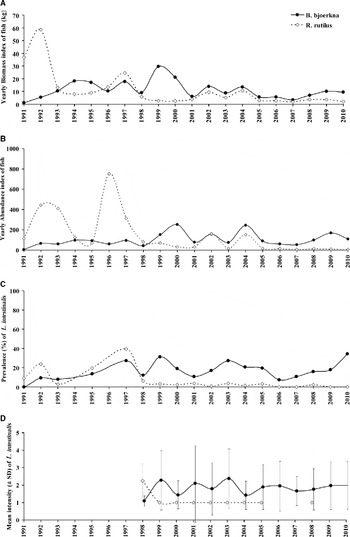
For the 2 decades of our study, roach and silver bream were the most severely infected fish with 259 and 596 individuals infected by Ligula intestinalis, respectively. However, other species were sporadically infected, e.g. common bream (35 individuals), rudd and white bleak (4 and 1 fish respectively). At the beginning of the study, roach was the main species in the water body but from 1993 onward its abundance considerably dropped (Fig. 1A and B). Two increases in its abundance in 2002 and 2004 correspond to support stocks added for anglers. The prevalence of L. intestinalis was not constant and followed the general trend of the respective abundances of the 2 species. In the early 1990s, prevalence was low compared to the abundance of sampled roach (Fig. 1C). There was a drop in prevalence in roach in 1993 potentially explained by the presence of a huge quantity of young born in the year. Two increases of L. intestinalis prevalence were observed in the roach population, from 1991 to 1992 (9·1 to 23·7%) and from 1995 to 1997 (2·9 to 39·5%). Then the population decreased, along with L. intestinalis prevalence. Before 1995, prevalence of L. intestinalis in silver bream population was under the threshold of 10%. Nevertheless, in 1991 no infected silver bream was found. Then, the prevalence varied with maximal values recorded in 1997 (27·1%), in 1999 (31·1%), in 2003 (27·13%) and in 2010 (34·2%), and minimal values in 1998, in 2001 and in 2006 (12·2, 10·71 and 7·5% respectively). The presence of plerocercoids in roach dropped and it increased considerably in silver bream along with their increasing numbers. At the beginning of the study, prevalence of Ligula in silver bream increased until 1997. In 1998, host switch was evident, with a higher prevalence in silver bream than in roach (Fig. 1). A mean intensity of more than 2 plerocercoids was observed in the roach population in 1998, and later, only 1 average plerocercoid was found in the peritoneal cavity of infected individuals (Fig. 1D). Mean intensity in silver bream for the same period varied between 1·4 and 2·3 plerocercoids per individual. It should also be noted that the number of plerocercoids per host decreased when the number of silver bream increased.
Biomass index (A) and abundance index (B) are the yearly total fish number and weight, sampled with the same yearly effort: twice a year×4 sites×6 fishing gears of different mesh sizes×24 h. Prevalence (C) and mean intensity (D) of Ligula intestinalis in roach Rutilus rutilus and silver bream Blicca bjoerkna populations over the years during the 4 seasons. No fish was dissected in 1994 and 1996. No data concerning the number of plerocercoids were collected before 1998 (D).

Effects of parasitism in the silver bream population
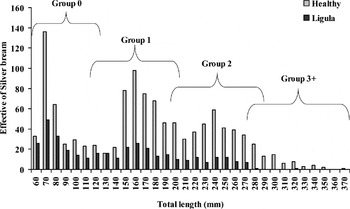
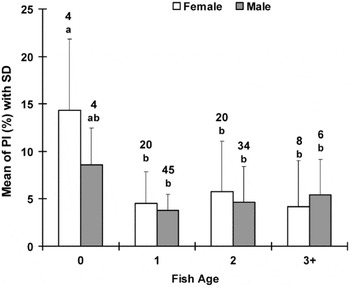
The number of caught fish measuring over 30 cm decreased. The largest individual, caught in 2006, was 375 mm long. L. intestinalis was present in nearly all size classes but, in larger fish, a decrease in the number of infected individuals was observed (Fig. 2). The largest silver breams were not infected (38 individuals), except for 1 fish measuring 320 mm (Fig. 2). The most severely infected silver bream age class was the young born in the year (group 0) with the highest value of prevalence (34·04% – Table 2). They were also the most impacted by L. intestinalis, with the highest values of average PI: 6·58% in the case of single infestation, 11·66% in multi-infestations. PI was significantly different in YOY of both genders than in adult fish (Fig. 3). Compared to this group, the prevalence decreased to 23·17% for 1-year-old bream, 20·20% in 2-year-olds, and down to 9·50% among those older than 3 years (Table 2). Thus, parasitism decreased significantly with fish size.
Length distribution of healthy and infected silver bream in each size class during the whole period of the study (1991–2010). The main modal distributions roughly corresponded to increasing cohorts (Group 0 to Group 3+).

Mean values of parasite load (PI) depending on silver bream sex and age classes (0 to 3+). s.d. Designates the standard deviation. Numbers above histograms correspond to the number of fish in each sample. Different letters above the bars denote significantly different values between fish ages (Tukey's HSD test, P-values <0·05). No significant difference was observed between genders.

Prevalence, mean intensity, parasitism index (PI), number of plerocercoids and PI range in the silver bream population depending on fish age

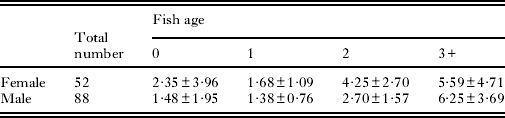
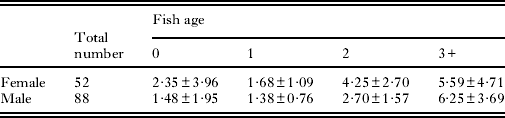
In each age class, both small and large parasites were found, but whole plerocercoid mass increased significantly with fish age (P<0·001), and the lowest parasite weight was observed in youngest fish (Table 3). No significant difference in terms of plerocercoid mass was found between genders (P>0·05). However, the number of parasites did not really vary with fish age and fish could be multi-infected from a young age. Only group 2 fish (aged 2 years) generally harboured more than 2 parasites. Furthermore, multi-infected fish had a significantly higher PI value (P<0·001) than mono-infected fish harbouring only 1 plerocercoid (Table 2). PI was nearly constant between females and males whatever the fish age (Fig. 3), and there was no significant difference (two-way ANOVA, P> 0·05).
Mean values±s.d. of parasite weight in each age class of each silver bream sex
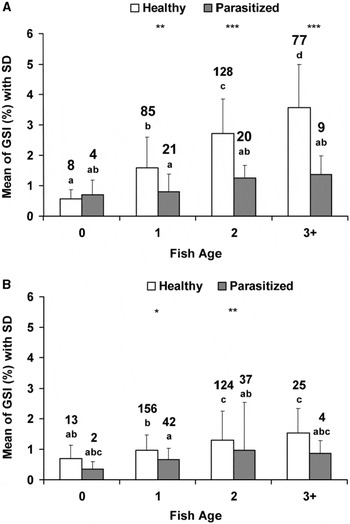
Uninfected adult females had GSIs significantly different from infected females, especially the oldest ones (3+; P<0·001), with a mean GSI of 1·37 in infected fish versus 3·56 in the others (Fig. 4A). The mean GSI of the young born in the year was very low (<1·00) and no significant difference was noted between non-infected and infected fish for both sexes. Significant decreases of GSI were also found in males in 1-year-old silver bream (P<0·05) and in 2-year-olds (P<0·01) (Fig. 4B.). In the oldest males (3+), GSI was clearly lower in infected fish (0·86%) than in healthy fish (1·53%), but no significant difference was found due to the low number of infected fish (4 individuals).
Mean values (with s.d.) of GSI (%) for females (A) and males (B). Numbers 0 to 3+ correspond to the age of the silver bream. Numbers above histograms refer to the sample size. Different letters above the bars denote significantly different values (Tukey's HSD test, P-values <0·05). Asterisks show significant differences between uninfected and infected fish (*P<0·05, **P<0·01 and ***P<0·001).

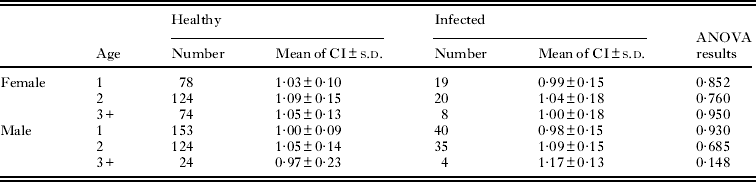
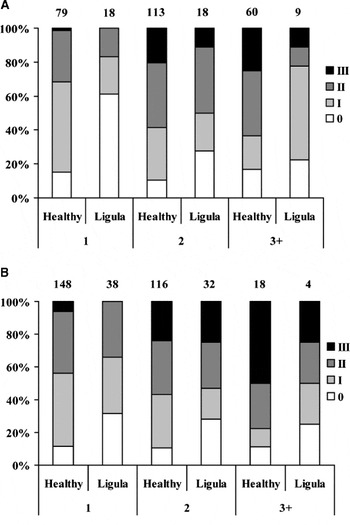
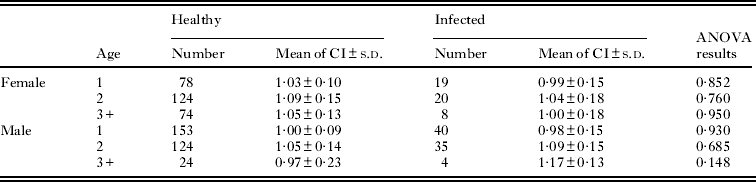
Older fish were generally fatter than younger fish. Moreover, males were generally fatter than females. About 50% of older fish had a huge fat quantity in their body cavity, which reached about 50% (Fig. 5A and B). Infected silver bream had significantly lower PFA values than non-infected ones, whether they were male (P<0·001) or female (P<0·05). Thus, although infected bream generally showed lower PFA values, parasitism had no effect on their CI. Infected bream had the same somatic development than non-infected ones for both sex and all ages (Table 4).
DISCUSSION
Host switch from roach to silver bream
At the beginning of this 20-year-long study, roach was both the main fish species sampled in the Mirgenbach reservoir and the main host infected by Ligula intestinalis. Silver bream was also present but with a lower prevalence of L. intestinalis than in the roach population. After 1999, there was a drop of L. intestinalis prevalence and roach was only occasionally infected. In the silver bream population, before 1995 prevalence of L. intestinalis was under the threshold of 10% and then varied with a maximal value of 34·2% recorded in 2010. In the UK, L. intestinalis exhibited epizootic cycles over periods of 4–5 years in roach populations, and disappeared when the number of roach fell below a critical threshold (Kennedy et al. Reference Kennedy, Shears and Shears2001). They also found that the L. intestinalis cycle was shorter when the parasite impact (PI) was very high. During very severe infestations, fish of all ages were infected, but the prevalence was generally higher in smaller fish (Kennedy et al. Reference Kennedy, Shears and Shears2001), as in our study. The evolution of environmental characteristics, such as the gradual rise of winter temperatures and eutrophication on the one hand, and the decrease in longevity and maximal total length of the present fish with a resulting reduced fecundity on the other hand could explain why roach numbers plummeted in the Mirgenbach reservoir (Masson et al. Reference Masson, Dembski, Staffolani, Wagner, Valente, Maazouzi, Banas, Poinsaint and Pihan2008). Kennedy et al. (Reference Kennedy, Shears and Shears2001) pointed out that the disappearance of young roach could result from a fall in the recruitment of roach as a consequence of the castration observed in infected individuals. In the Mirgenbach reservoir, the prolonged infestation of L. intestinalis probably played a minor role in the collapse of the roach by comparison with other stressors weakening this species. The host switch observed in 1998 corresponds to the collapse of roach, when the indices of biomass and abundance of silver bream became superior to those of roach. We observed a prevalence rise for silver bream and a prevalence drop for roach. With silver bream, plerocercoids infested a species that was less susceptible to the environmental change in this reservoir, and also the most abundant species. Silver bream has an asynchronous development and a spawning period that lasts from late spring throughout summer. No significant impact of thermal effluents, as in the Mirgenbach reservoir, has been reported on silver bream which seems to be well adapted to thermal effluents (Lukšiené et al. Reference Lukšiené, Sandström, Lounasheimo and Andersson2000).
Mean±s.d. of condition index (CI) between uninfected and infected silver breams collected each autumn from 1991 to 2000, and P-values obtained with ANOVA tests perfomed between healthy and infected fish
PFA (Perivisceral Fat Abundance) found in the viscera of silver breams depending on age and sex: female (A) and male (B). Numbers above histograms refer to the sample size. Numbers 0 to 3+ correspond to the age group of the silver bream and 0 to III correspond to the increasing quantities of PFA found: 0, no fat; III maximum fat quantity.

Parasite abundance and host population density are positively correlated and host population density increases the probability for a parasite transmission stage to encounter a potential host (Loot et al. Reference Loot, Park, Lek and Brosse2006). Hence, Loot et al. (Reference Loot, Park, Lek and Brosse2006) showed that abundant intermediate hosts (fish and copepods) and the final host (birds) had similar temporal dynamics and frequent associations between them. Glaznova and Polunina (Reference Glazunova and Polunina2009) found a massive infestation of bream by L. intestinalis when copepods such as Cyclopoidae species were very abundant. In the Mirgenbach reservoir, the diversity of copepod species decreased during the study period while the density did not really vary, and currently the dominant species was the calanoid Eudiaptomus gracilis. This copepod diversity decrease may be one cause of the roach disappearance, and we cannot exclude that the host switch could be due to a prey change. Furthermore, in autumn, when cormorants were the most abundant around the Mirgenbach reservoir, an important quantity of silver bream was observed due to the presence of the young born in the year. The presence of these hosts provided a stable environment that promoted the accomplishment of the parasite's life cycle.
The prevalence values of L. intestinalis in roach and silver bream were lower than those reported in other studies, and never exceeded 45%. In the Tsimlyansk reservoir (Russia), fish infestation reached about 96%, and in the Samarskii reservoir, the infestation of bream often reached 100%, and 87% for silver bream (Izyumova, Reference Izumova1987). To fight this huge infestation, a large quantity of sanders, a paratenic host, was released to control ligulosis by consuming infected fry. After the release of sanders, infestation dropped to 23% in bream and 5–12% in silver bream (Izyumova, Reference Izumova1987). Comparable prevalence values were observed in the Mirgenbach reservoir. Sander was the second most abundant species in terms of biomass in the reservoir, but in recent years their numbers began to collapse (Masson et al. Reference Masson, Dembski, Staffolani, Wagner, Valente, Maazouzi, Banas, Poinsaint and Pihan2008), and in 2009 and 2010, only a few were caught (unpublished data). The decrease in the numbers of this key population for ligulosis regulation was perhaps responsible for the rise in prevalence in 2010. However, the mean intensity of plerocercoids in the silver bream population was relatively constant over the same time-period, while the number of plerocercoids per roach evolved from more than 2 in 1998 to 1 plerocercoid later.
Infestation in the Blicca bjoerkna population
Plerocercoids were found in silver bream whatever their size, but the young born in the year had the highest prevalence (34·04%) while older fish were only occasionally infected (9·50%). Therefore, prevalence tended to decrease with fish age. Baruš and Prokeš (Reference Baruš and Prokeš1994) showed the same results in silver bream. Museth (2001) showed that the phenomenon suggests a selective mortality among infected individuals. In addition, smaller fish are also more susceptible to piscivorous bird predation than larger fish, often too large to be caught (Loot et al. Reference Loot, Lek, Dejean and Guégan2001b). On the contrary, Korkmaz and Zencir (Reference Korkmaz and Zencir2009), who studied a tench (Tinca tinca) population, showed an increase in prevalence when the fish grew up due to the feeding behaviour of tench, and an accumulation of plerocercoids in larger fish.
Prevalence values in the Mirgenbach reservoir were very high (more than 20%) in adult fish, except in older fish. Baruš and Prokeš (Reference Baruš and Prokeš1994) recorded lower mean values of prevalence (generally no more than 15%) in adult silver bream. High values in the Mirgenbach reservoir may be due both to the environment and the presence of pollutants rejected by the nuclear plant. Hecker and Karbe (Reference Hecker and Karbe2005) showed that prevalence in bream (Abramis brama) populations was highest in areas characterized by higher pollutant loads. Additional data will be necessary to better understand the effect of pollutants.
Maximum intensity of L. intestinalis was found in young fish, with 9 plerocercoids, perhaps because fish were infected very early by L. intestinalis as shown by the prevalence in young individuals in the study by Korkmaz and Zencir (Reference Korkmaz and Zencir2009). Except in 2-year-old fish where more than 2 plerocercoids were recorded, the mean intensity ranged between 1 and 2 plerocercoids for all ages in our study. Similar results have been found elsewhere in silver bream and bream populations (Baruš and Prokeš, Reference Baruš and Prokeš1994; Hecker and Karbe, Reference Hecker and Karbe2005), with mean intensities never higher than 2 plerocercoids. However, Korkmaz and Zencir (Reference Korkmaz and Zencir2009) showed a positive correlation between mean intensity and fish size in a tench population.
The distribution of plerocercoid weight was heterogeneous with small and large weights sometimes being present in the same host. Similar results have been found in silver bream (Baruš and Prokeš, Reference Baruš and Prokeš1994, 2002) and in farm salmon (Shargh et al. Reference Shargh, Shamsaii and Karamini2008). However, plerocercoid weight increased significantly with fish size (Trubiroha et al. Reference Trubiroha, Wuertz, Frank, Sures and Kloas2009). In fact, it has been demonstrated that plerocercoid growth rate depends on the host growth rate (Arme and Owen, Reference Arme and Owen1968; Baruš and Prokeš, Reference Baruš and Prokeš2002). If a fish is infected in the early stages of its life, the plerocercoid will continue to grow in the peritoneal cavity for the rest of the host life (Baruš and Prokeš, Reference Baruš and Prokeš2002; Shargh et al. Reference Shargh, Shamsaii and Karamini2008), and thus the parasite may be present for a longer time with sufficient resources supplied. Moreover, in multiple infestations, parasites are smaller than in single infestations (Baruš and Prokeš, Reference Baruš and Prokeš2002) but there is no evidence that plerocercoid growth is inhibited by the presence of older worms already present in the body cavity (Arme and Owen, Reference Arme and Owen1968).
Plerocercoids were not found within a particular silver bream category: no significant difference was found in parasitism load (PI) between sexes and fish ages, which has already been the case in roach populations (Carter et al. Reference Carter, Pierce, Dufour, Arme and Hoole2005; Ergonul and Altindag, Reference Ergonul and Altindag2005; Minier et al. Reference Minier, Maltret, Monsinjon, Knigge, Leray, Lecomte, Barka, Denier, Amara, Selleslagh, Hill, Rotchell, Cubero, Ciocan, Dussart, Trigwell, St Pierre, Pringle and Pepper2009). However, young fish in the Mirgenbach reservoir presented both a significantly higher PI than any other age class, and a higher prevalence of L. intestinalis. The highest PI values were recorded in young fish and in 2-year-old fish, with values up to 37%. These values are relatively high compared to other studies; a maximum of 21·7% was recorded in silver bream aged between 3 and 5 years (Baruš and Prokeš, Reference Baruš and Prokeš2002) and 10% in fry infected in their second year (Arme and Owen, Reference Arme and Owen1968). A PI value of 43·66% was also recorded in roach in the UK where the mean parasite load was about 19% (Carter et al. Reference Carter, Pierce, Dufour, Arme and Hoole2005). In tench populations, parasite load was very low due to the resistance of this species to infestation (Ergonul and Altindag, Reference Ergonul and Altindag2005; Korkmaz and Zencir, Reference Korkmaz and Zencir2009). Even if the fish was infected by only 1 big parasite, parasite load was significantly higher in the case of multi-infestation, as shown by Baruš and Prokeš (Reference Baruš and Prokeš2002).
Biological parameters
A significant drop in GSI (gonadosomatic index) values was reported in infected females as compared to non-infected ones in the course of sexual maturing (from 1-year-old onwards). In males, gonadal development was less impacted and significant GSI decreases were recorded in 1- and 2-year-old fish. These results are similar to previous studies in which authors reported a significant inhibition of reproduction in both sexes in roach (Carter et al. Reference Carter, Pierce, Dufour, Arme and Hoole2005) and bream (Hecker and Karbe, Reference Hecker and Karbe2005). The presence of L. intestinalis in the fish body induces a stagnation of gonad development at the early gametogenesis stage (Arme, Reference Arme1968; Carter et al. Reference Carter, Pierce, Dufour, Arme and Hoole2005; Trubiroha et al. Reference Trubiroha, Wuertz, Frank, Sures and Kloas2009) through the secretion of a compound that decreases gonadotrophin hormone production (Arme, Reference Arme1968; Carter et al. Reference Carter, Pierce, Dufour, Arme and Hoole2005; Hecker and Karbe, Reference Hecker and Karbe2005; Hecker et al. Reference Hecker, Sanderson and Karbe2007). Hecker and Karbe (Reference Hecker and Karbe2005) also showed that the high energy production required for fish reproduction is available for the parasite. Thus, L. intestinalis does not need to draw other resources from the host, which could decrease the fish's health status and be lethal for it. This would also decrease the parasite's fitness as L. intestinalis survival directly depends on the good health of its second intermediate host to infect the final host and achieve its biological cycle (Hecker and Karbe, Reference Hecker and Karbe2005). Thereby, plerocercoids severely inhibit gonadal maturation, but they do not fully castrate their hosts (Loot et al. Reference Loot, Poulin, Lek and Guégan2002).
As cestode parasites do not possess a mouth or an intestine, they take up nutrient via their tegument (Zimmermann et al. Reference Zimmermann, Sures and Taraschewski1999; Sures, Reference Sures2001). Cestodes situated in the host's intestinal lumen (Malek et al. Reference Malek, Haseli, Mobedi, Ganjali and MacKenzie2007) and acanthocephalans (Sures, Reference Sures2001) obtain cholesterols and fatty acids from their host, because they cannot synthesize them. The same is probably the case for L. intestinalis plerocercoids, which have an important surface area-to-volume ratio in their host, thus facilitating the absorption of many nutrients (Oyoo-Okoth et al. Reference Oyoo-Okoth, Admiraal, Osano, Kraak, Ngure, Makwali and Orina2010) as fat content. Perivisceral fat abundance (PFA) significantly decreased in infected male and female fish as compared to non-infected ones. A decrease in fat content has already been reported in bream (Kosheva, Reference Kosheva1956; Dubinina, Reference Dubinina1980) and also in three-spined sticklebacks Gasterosteus aculeatus L. infected by the pseudophyllidean Schistocephalus solidus (Barber and Svensson, 2003). In fact, perivisceral fat bodies are developed as a lipid reserve in healthy fish, and are used in times of nutritional stress (Barber and Svensson, 2003). They are also used as fat storage for the regulation of gonad maturation (Geraudie et al. Reference Geraudie, Gerbron, Hill and Minier2010) and fish consume the fat reserve during the peak of the gonad maturation (Maghalaes et al. Reference Magalhaes, Bazzoli, Santos and Rizzo2004). When fat reserves are totally depleted, gonads provide the metabolites that allow the animal to survive (Barnabé, Reference Barnabé and Barnabé1994), thereby resulting in poor gonadal development, or an arrest of maturation if energy reserves are too low (Barnabé, Reference Barnabé and Barnabé1994; Giraudie et al. Reference Geraudie, Gerbron, Hill and Minier2010). In the Mirgenbach reservoir, males were fatter than females and PFA in males was more impacted by plerocercoids. We can hypothesize that plerocercoids diverted a large part of their energy from perivisceral fat reserves in male silver bream, and gonadal maturation was less impacted. On the contrary, in females energy was diverted from gonad maturation rather than from fat reserves. Moreover, as females became mature in autumn, they needed energy and were likely to have already used part of their fat content. Thus, this resulted in a small difference between the fat content of infected and non-infected females. Further studies on the effect of Ligula in silver bream will concern the relationship between somatic growth, fat content, GSI and reproductive effort for a whole year.
No significant difference was observed between the CIs of infected and healthy silver bream in the Mirgenbach reservoir. Infected fish had the same body development as healthy fish, indicating that the growth of plerocercoids had no effect on host health. However, the impact on CI may vary depending on species, age classes, seasons and environmental conditions (Trubiroha et al. Reference Trubiroha, Wuertz, Frank, Sures and Kloas2009). For example, in some roach populations the presence of plerocercoids had a significant negative impact on CI for both males and females (Trubiroha et al. Reference Trubiroha, Wuertz, Frank, Sures and Kloas2009), in young roach (Carter et al. Reference Carter, Pierce, Dufour, Arme and Hoole2005), or in only 1 site in 2-year-old fish (Loot et al. Reference Loot, Poulin, Lek and Guégan2002). Moreover, there was no effect on the CI of bream (Hecker and Karbe, Reference Hecker and Karbe2005) and in largescale sucker Castotumus macrocheilus (Shields et al. Reference Shields, Groves, Rombauch and Bellmore2002) populations. It is rare to find a relationship in terms of CI in adult fish due to the inhibition of sexual maturation (Carter et al. Reference Carter, Pierce, Dufour, Arme and Hoole2005). There is a tolerance threshold for the individuals not to be too heavily impacted so that they can live with a certain plerocercoid mass.
Parasite survival depends directly on host health (Hecker and Karbe, Reference Hecker and Karbe2005), but the impact appeared to be different depending on host sex. In male silver bream in the Mirgenbach reservoir, plerocercoids drew energy from fat reserves, and GSI was less impacted. On the contrary, in females energy was drawn from gonad maturation rather than from fat reserves. The impact of L. intestinalis on gonad maturation appeared to be independent of parasite burden and condition, pointing to a manipulation strategy by the parasite to minimize its own virulence, keeping the host alive until transmission could occur (Trubiroha et al. Reference Trubiroha, Wuertz, Frank, Sures and Kloas2009). Infected young silver bream were drastically affected by the presence of plerocercoids due to their abundance in autumn. Thus, the chances for plerocercoids to encounter cormorants, a final host regularly present in autumn along the waterbody, are very high (Brown et al. Reference Brown, Loot, Grenfell and Guégan2001; Loot et al. Reference Loot, Park, Lek and Brosse2006). There is therefore a biological amplification of plerocercoids in the food chain and the prevalence in birds is higher than in cyprinid fish (Brown et al. Reference Brown, Loot, Grenfell and Guégan2001; Museth, 2001).
ACKNOWLEDGEMENTS
Over the study period many people have helped with fishing and dissection (more than 60 people in 20 years). We would like to thank S. Dembski, N. Dubost, C. Maazouzi, P. Mangeot, L. Masson, R. Marzou, A. Pedon Flesh, J.-C, Pihan, and F. Staffolani for their studies on the Mirgenbach reservoir. The authors thank P. Wagner, the technician in the LIEBE laboratory, and E. Valente the senior research engineer, for their help with fishing. The manuscript was checked for spelling by A. Buchwalter.
FINANCIAL SUPPORT
This study was achieved with our own funding. Fish sampling was supported by the Nuclear Power Production Plant of Cattenom (EDF) and CNPE until 2005, and the Direction Recherche et Développement (Electricité de France, Chatou) in 2006. From 2007 to 2011, different funds were obtained for sampling and for data processing.