


Over the past two decades there has been increasing research into the antecedents, prevalence and consequences of depression in adolescence and early adulthood (Reference Petersen, Compas and Brooks-GunnPetersen et al, 1993; Reference Cicchetti and TothCicchetti & Toth, 1998; Reference Lewinsohn, Rohde and SeeleyLewinsohn et al, 1998; Reference Fergusson and WoodwardFergusson & Woodward, 2002; Reference Glied and PineGlied & Pine, 2002). This research has established that depression is relatively common among adolescent and early adult populations (Reference Fleming and OffordFleming & Offord, 1990; Reference Lewinsohn, Hops and RobertsLewinsohn et al, 1993; Reference Silverman, Reinherz and GiaconiaSilverman et al, 1996), and that many of those becoming depressed will experience recurrent episodes of depression over the period of adolescence and early adulthood (Reference Rao, Hammen and DaleyRao et al, 1999; Reference Lewinsohn, Solomon and SeeleyLewinsohn et al, 2000). For example, Lewinsohn et al (Reference Lewinsohn, Hops and Roberts1993) found that 18.4% of a random community sample of adolescents experienced at least one recurrent episode of major depression. Also, there has been growing evidence to suggest that depression in adolescence and early adulthood is associated with longer-term adverse consequences, including increased risks of later depression (Reference Lewinsohn, Solomon and SeeleyLewinsohn et al, 2000; Reference Fergusson and WoodwardFergusson & Woodward, 2002), anxiety (Reference Fergusson and WoodwardFergusson & Woodward, 2002), suicidal behaviours (Reference Kovacs, Goldston and GatsonisKovacs et al, 1993; Reference Fergusson and WoodwardFergusson & Woodward, 2002; Reference Glied and PineGlied & Pine, 2002), and educational underachievement (Reference Fergusson and WoodwardFergusson & Woodward, 2002; Reference Andrews and WildingAndrews & Wilding, 2004; Reference Hysenbegasi, Hass and RowlandHysenbegasi et al, 2005). For example, Fergusson and Woodward (Reference Fergusson and Woodward2002), using a longitudinal sample, found that depression at ages 14–16 years was associated with increased risk of major depression, anxiety disorder, suicide attempts and educational underachievement by age 21 years.
Although it has been well established that depression in adolescence and early adulthood is often a recurrent condition, and that depression is also associated with adverse longer-term outcomes, there appears to have been little research examining the linkages between recurrent depression in adolescence and early adulthood and long-term outcomes. A study by Rao et al (Reference Rao, Hammen and Daley1999) examined the recurrence of depression in a community sample of late-adolescent girls, but did not specifically link recurrence to later outcomes. More relevant is a recent study by Colman et al (Reference Colman, Wadsworth and Croudace2007), which found that individuals who reported an internalising disorder at ages 13 and 15 years were more likely than either mentally healthy individuals, or individuals who reported an internalising disorder at either age 13 or age 15, to report a mental disorder at ages 36, 43 or 53 years. It seems reasonable to conjecture that the long-term prognosis of recurrence and psychosocial impairment caused by adolescent and early-adult depression will increase with the increasing frequency of depression, but this remains to be demonstrated.
Against this background, we report the results of a longitudinal study of depression in adolescence and early adulthood, and subsequent outcomes. The aims of this study were to document the frequency of depressive episodes during later adolescence and early adulthood (ages 16–21 years); to examine linkages between extent of depression in adolescence and outcomes in young adulthood (ages 21–25 years) including depression, anxiety, suicidal behaviours, educational achievement and economic circumstances; and to adjust the associations between extent of adolescent and early-adult depression and later outcomes for potentially confounding factors, including family and individual factors, and psychiatric disorders co-occurring with major depression in adolescence. More generally, the aims of the study were to document the extent to which the frequency of depressive episodes in adolescence and early adulthood was associated with longer-term psychiatric morbidity and life-course adversity.
METHOD
Participants
The data were gathered during the course of the Christchurch Health and Development Study. In this study a birth cohort of 1265 children (635 boys, 630 girls) born in the Christchurch (New Zealand) urban region in mid-1977 has been studied at birth, 4 months, 1 year and annually to age 16 years, and again at ages 18, 21 and 25 years (Reference Fergusson, Horwood and ShannonFergusson et al, 1989; Reference Fergusson and HorwoodFergusson & Horwood, 2001). All study information was collected on the basis of signed and informed consent from study participants.
Episodes of major depression at ages 16–21 years
At ages 18 and 21 years, study participants underwent a structured mental health interview designed to assess aspects of mental health and psychosocial adjustment since the previous assessment. All interviews were conducted in private by trained lay interviewers at a location convenient to the respondent, with the interviewer unaware of the previous assessments of the cohort member. As part of the mental health assessment at each age, components of the Composite International Diagnostic Interview (CIDI; World Health Organization, 1993) were used to assess DSM–IV symptom criteria for a range of disorders including major depression (American Psychiatric Association, 1994). Participants were questioned about symptoms of major depression occurring in the past month, the past 12 months and the period following the previous assessment, as well as any associated impairment of functioning. In doing so, participants were asked to base their answers on an index episode of depression occurring during the specified period. Those meeting diagnostic criteria for an episode of major depression during any interval were further questioned about the number of depressive episodes like the index episode they had experienced during the period since the previous interview. For the purposes of the present analysis, these report data were summed over the period from age 16 to age 21 years to provide an estimate of the total number of depressive episodes experienced during this interval.
Mental health outcomes at ages 21–25 years
At age 25 years, cohort members were administered a comprehensive interview designed to assess aspects of mental health and psychosocial adjustment over the period since the previous assessment at age 21 years. As part of this interview, components of the CIDI were used to assess DSM–IV symptom criteria for major depression and anxiety disorders (including generalised anxiety disorder, specific phobia, social phobia, agoraphobia and panic disorder). For the purposes of this analysis participants were classified as having major depression if they met DSM–IV diagnostic criteria for a major depressive episode at any time between the ages of 21 and 25 years, independently of any earlier assessments. Similarly, participants were classified as having anxiety disorder if they met criteria for any anxiety disorder during this period. On the basis of this questioning, 21.6% of the cohort met diagnostic criteria for major depression and 18.2% met criteria for anxiety disorder during the period 21–25 years of age. These prevalence estimates appear to be consistent with those from a similar birth cohort being studied in the Dunedin Multidisciplinary Health and Development Study. In the Dunedin study estimates of the 12-month point prevalence of major depression in young adulthood were in the region of 17%, and for anxiety disorder ranged between 18% and 24% (Reference Jaffee, Moffitt and CaspiJaffee et al, 2002; Reference Fergusson, Poulton and HorwoodFergusson et al, 2004)
Suicidal behaviour during the period 21–25 years of age was assessed by asking sample members whether they had ever thought about killing themselves or had attempted suicide during the assessment period, and the frequency of such thoughts or attempts. Individuals who reported having any suicidal thoughts or who reported having attempted suicide at least once in the assessment interval were classified as having suicidal ideation (12.5% of the sample at ages 21–25 years) or having attempted suicide (2.1% of the sample at ages 21–25 years).
Education outcomes at ages 21–25 years
At age 25 years cohort members were questioned concerning their history of enrolment in tertiary education and training and any educational or vocational qualifications obtained since age 21 years. This information was used to classify participants on two dichotomous measures of educational achievement over this interval: completion of a university degree (Bachelor level or above) or attainment of any tertiary educational or vocational qualification. On the basis of this questioning 22.2% of the sample reported completing a university degree during the period and 58.8% reported completing any tertiary educational or vocational qualification.
Economic outcomes at ages 21–25 years
At age 25 years sample members were questioned about their receipt of social welfare benefits since age 21 years. The percentage of cohort members who reported receiving unemployment benefit, domestic purposes benefit (available to single parents with dependent children) or sickness or invalid benefit at any point in this period served as the outcome measure (34.4% of the sample). In addition, participants were questioned as to the extent of any period of unemployment since age 21 years. Participants who reported at least 1 month of unemployment during this period were classified as having been unemployed (27.1% of the sample). Sample members were also asked to estimate their personal gross income from all sources over the previous 12 months. This estimate served as the measure of personal income (in New Zealand dollars) at age 25 years (mean NZ$31 391, s.d.= 20 177).
Covariate factors
A wide array of social, family and individual factors available from the study database were considered for inclusion as covariates in the analysis. The following covariate factors were selected on the basis that they were significantly associated with the frequency of major depressive episodes between ages 16 and 21 years, and were found in preliminary analyses to act as a significant confounder of the association between number of depressive episodes and at least one outcome measure. These covariate factors included the following.
Family living standards
A measure of family material living standards from birth to age 10 years was obtained using a global assessment made by interviewer rating. Ratings were made on a five-point scale ranging from 1 (very good) to 5 (very poor). These ratings were summed over the 10-year period and divided by 10 to give a measure of typical family living standards during this period.
Change of parents
At each assessment from birth to age 15 years, comprehensive information was gathered on changes in the child's family situation since the previous assessment. Using this information an overall measure of family instability was constructed on the basis of a count of the number of changes of parent experienced by the child up to age 15 years. Changes of parent included all changes resulting from parental separation or divorce, reconciliation, remarriage, death of a parent, fostering and other changes of custodial parents.
Exposure to childhood physical punishment
At ages 18 and 21 years sample members were asked to describe the extent to which their parents used physical punishment during childhood (<16 years) (Reference Fergusson and LynskeyFergusson & Lynskey, 1997). Separate questioning was conducted for mothers and fathers. This information was used to create a four-level scale reflecting the most severe form of physical punishment reported for either parent: parents never used physical punishment; parents rarely used physical punishment; at least one parent used physical punishment on a regular basis; at least one parent used physical punishment too often or too severely, or treated the respondent in a harsh or abusive manner.
Exposure to childhood sexual abuse
Also at ages 18 and 21 years, sample members were questioned about their experience of sexual abuse during childhood (<16 years) (Reference Fergusson, Lynskey and HorwoodFergusson et al, 1996). Questioning spanned an array of abusive experiences from episodes involving non-contact abuse (e.g. indecent exposure) to episodes involving attempted or completed intercourse. Sample members who reported an abusive episode were then questioned further about the nature and context of the abuse. Using this information a four-level scale was devised reflecting the most extreme form of sexual abuse reported by the young person at either age: no sexual abuse; non-contact abuse only; contact sexual abuse not involving attempted or completed intercourse; attempted/completed oral, anal or vaginal intercourse.
Gender
Gender was recorded at birth.
Parental attachment
Attachment to parents was assessed using the scale developed by Armsden & Greenberg (Reference Armsden and Greenberg1987) and administered when sample members were aged 15 years. The full parental attachment scale was used in this analysis (α=0.87).
Neuroticism
Neuroticism was assessed using a short-form version of the neuroticism scale of the Eysenck Personality Inventory (Reference Eysenck and EysenckEysenck & Eysenck, 1964), administered when cohort members were 14 years old (α= 0.80).
Self-esteem
Self-esteem was assessed at age 15 years using the global measure from the Coopersmith Self Esteem Inventory (Reference CoopersmithCoopersmith, 1981). The global measure of self-esteem was obtained by summing the four subscale scores (general, academic, social and home; full scale α=0.87).
Association with deviant peers
At age 14 years sample members and their parents were questioned as to the extent to which the young person's friends were involved in a range of behaviours, including the use of tobacco, alcohol or illicit drugs or substances, criminal offending and related behaviours. Most of the items were based on custom-written survey questions, but several of the parental items were based on items from the Revised Behavior Problem Checklist (Reference Quay and PetersonQuay & Peterson, 1987). Six self-report and eight parental report items were summed to generate the measure of total deviant peer affiliation (α=0.76).
Co-occurring psychiatric disorders
As part of the mental health interviews at ages 18 and 21 years, participants were also assessed on DSM–IV symptom criteria for a range of other psychiatric disorders occurring over the intervals 16–18 years and 18–21 years respectively, including anxiety disorders (generalised anxiety disorder, social phobia, specific phobia, agoraphobia and panic disorders), alcohol and illicit drug dependence, conduct disorder and antisocial personality disorder. The assessment of anxiety disorders and the measures of substance dependence were based on the relevant items from the CIDI. The assessment of conduct disorder was based upon items from the Self Report Delinquency Inventory (SRDI; Reference Elliott, Huizinga and KleinElliott & Huizinga, 1989). At age 21 years this questioning was supplemented by additional items written especially for the survey to assess diagnostic criteria for antisocial personality disorder. The diagnostic information was combined over the two assessment periods to obtain the following measures of psychiatric disorder occurring during the age interval 16–21 years. A measure of the extent of anxiety disorders was based upon a count of the number of different anxiety disorders for which the participant met diagnostic criteria at any time during this period. Participants who met diagnostic criteria for alcohol dependence or illicit drug dependence at either assessment were classified as having alcohol dependence (9.4% of the sample) or illicit drug dependence (9.9% of the sample) respectively. Similarly, participants who met criteria for conduct disorder or antisocial personality disorder at either assessment were classified on a combined measure of conduct and antisocial personality disorder (8.6% of the sample).
Statistical analysis
The analysis was conducted in several stages. In the first stage gender differences in the rate of depressive episodes during the period 16–21 years of age were tested for statistical significance using both the t-test for independent samples and the non-parametric Wilcoxon test (Reference HaysHays, 1988) in order to account for the possibility that the data on depressive episodes were not normally distributed. Next, the bivariate associations between the estimated number of major depressive episodes (classified into four levels: none; one to four; five to nine; ten or more) and later outcomes were tested for significance using the Mantel–Haenszel chi-squared test of linearity (Reference AgrestiAgresti, 2002) for dichotomous outcomes (mental health, education, unemployment, welfare dependence), and one-way analysis of variance for the continuous outcome (income).
In the third stage a series of regression models were developed to compare the associations between the frequency of major depressive episodes and later outcomes before and after adjustment for family background and individual characteristic covariate factors. For dichotomous outcomes logistic regression models were fitted, whereas for income ordinary least-squares linear regression models were used. In all cases the regression models were fitted using the four-level classification of number of depressive episodes described above. However, it should be noted that identical conclusions resulted when the models were fitted using a continuous count measure of number of depressive episodes. In the next step of the analyses, the covariate-adjusted regression models were extended to include the measures of co-occurring psychiatric disorders during the period 16–21 years of age.
The adjusted parameter estimates from the original fitted regression models were used to calculate estimates of effect size (odds ratios) for associations that remained significant after adjustment for confounding factors. Also, to test for gender differences in the association between number of depressive episodes and outcomes, the regression models were extended to include gender by number of depressive episodes interactions.
In order to examine the sensitivity of the analyses to the way in which the measure of number of depressive episodes had been derived, the data were re-analysed using three alternative approaches to defining the relative burden of depression during the period 16–21 years of age:
-
(a) a measure of the duration (in weeks) of the longest period of major depression during this period;
-
(b) a categorical measure of the number of times the participant reported being ‘currently depressed’ at the age 16, 18 and 21 years assessments, resulting in a variable with four values (0, 1, 2, 3);
-
a categorical measure of the number of times the participant reported being depressed during the 12 months prior to the assessment at ages 16, 18 and 21 years, again resulting in a variable with four values (0, 1, 2, 3).
Sample size and sample bias
The analyses presented here are based on the sample of 982 study participants who were interviewed on measures of major depression at ages 18 and 21 years. This sample represented 78% of the initial cohort of 1265 participants enrolled in the study. To examine the effects of sample losses on its representativeness, the obtained sample was compared with the remaining sample members on a series of socio-demographic measures collected at birth. This analysis suggested that there were statistically significant (P<0.01) tendencies for the obtained sample to underrepresent individuals from disadvantaged backgrounds, characterised by low parental education, low socio-economic status and single parenthood. To address this issue, the data weighting methods described by Carlin et al (Reference Carlin, Wolfe and Coffey1999) were used to examine the possible implications of selection effects arising from the pattern of missing data. These analyses produced essentially the same pattern of results to those reported here, suggesting that the conclusions of this study were unlikely to have been influenced by selection bias.
In addition, it could be argued that the conclusions of this study might have been influenced by the fact that individuals who were depressed during adolescence and early adulthood might have been more likely to withdraw from the study. To address this issue, scores on the number of depressive episodes measure (ages 16–21 years) were compared between those who completed the mental health items in the age 25 years assessment, and those who did not complete these items at age 25 years. The results of this analysis suggested that there was no difference between the groups in terms of the number of depressive episodes experienced between ages 16 and 21 years (P>0.80) and that the conclusions of this study were unlikely to have been influenced by non-random sample loss due to depression.
RESULTS
Frequency of depressive episodes
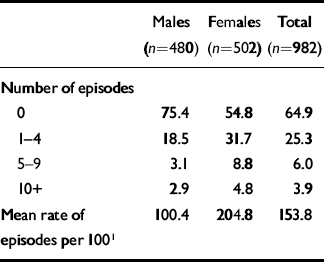
Overall, 35.1% of the cohort met criteria for major depression on at least one occasion during the age period 16–21 years, and 3.9% reported ten or more episodes (Table 1). Female participants had a significantly and substantially higher rate of episodes than males (204.8 per 100 v. 100.4 per 100; P<0.0001). The gender difference proved statistically significant using either the t-test or the non-parametric Wilcoxon test.
Frequency of major depressive episodes for male and female participants between the ages of 16 and 21 years
| Males (n=480) | Females (n=502) | Total (n=982) | |
|---|---|---|---|
| Number of episodes | |||
| 0 | 75.4 | 54.8 | 64.9 |
| 1-4 | 18.5 | 31.7 | 25.3 |
| 5-9 | 3.1 | 8.8 | 6.0 |
| 10+ | 2.9 | 4.8 | 3.9 |
| Mean rate of episodes per 1001 | 100.4 | 204.8 | 153.8 |
Depression in adolescence and early adulthood and subsequent outcomes
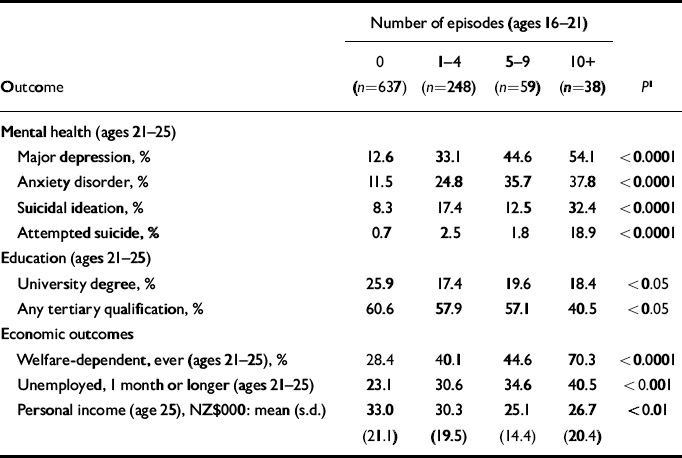
Table 2 shows the sample classified into four groups representing the number of depressive episodes in adolescence and early adulthood. This classification is related to a series of outcomes (mental health, education and economic) observed over the period from age 21 to age 25 years. An increasing number of depressive episodes from ages 16 to 21 years was significantly associated with higher rates of adverse mental health outcomes at ages 21–25 years, including major depression (P< 0.0001), anxiety disorder (P<0.0001), suicidal ideation (P<0.0001) and suicide attempt (P<0.0001). Increasing frequency of depression at ages 21–25 was significantly associated with declining education and economic outcomes at ages 21–25 years, including lower rates of degree attainment (P<0.05), lower rates of any tertiary qualification attainment (P<0.05), being welfare-dependent (P<0.0001), being unemployed (P<0.001), and income at age 25 years (P<0.01). These findings suggest that increasing number of depressive episodes from ages 16 to 21 was associated with poorer mental health, educational and economic outcomes at ages 21–25 years.
Associations between estimated number of depressive episodes, age 16-21 years, and mental health, education and socio-economic outcomes, age 21-25 years
| Number of episodes (ages 16-21) | |||||
|---|---|---|---|---|---|
| Outcome | 0 (n=637) | 1-4 (n=248) | 5-9 (n=59) | 10+ (n=38) | p 1 |
| Mental health (ages 21-25) | |||||
| Major depression, % | 12.6 | 33.1 | 44.6 | 54.1 | <0.0001 |
| Anxiety disorder, % | 11.5 | 24.8 | 35.7 | 37.8 | <0.0001 |
| Suicidal ideation, % | 8.3 | 17.4 | 12.5 | 32.4 | <0.0001 |
| Attempted suicide, % | 0.7 | 2.5 | 1.8 | 18.9 | <0.0001 |
| Education (ages 21-25) | |||||
| University degree, % | 25.9 | 17.4 | 19.6 | 18.4 | <0.05 |
| Any tertiary qualification, % | 60.6 | 57.9 | 57.1 | 40.5 | <0.05 |
| Economic outcomes | |||||
| Welfare-dependent, ever (ages 21-25), % | 28.4 | 40.1 | 44.6 | 70.3 | <0.0001 |
| Unemployed, 1 month or longer (ages 21-25) | 23.1 | 30.6 | 34.6 | 40.5 | <0.001 |
| Personal income (age 25), NZ$000: mean (s.d.) | 33.0 (21.1) | 30.3 (19.5) | 25.1 (14.4) | 26.7 (20.4) | <0.01 |
Adjustment for confounding factors
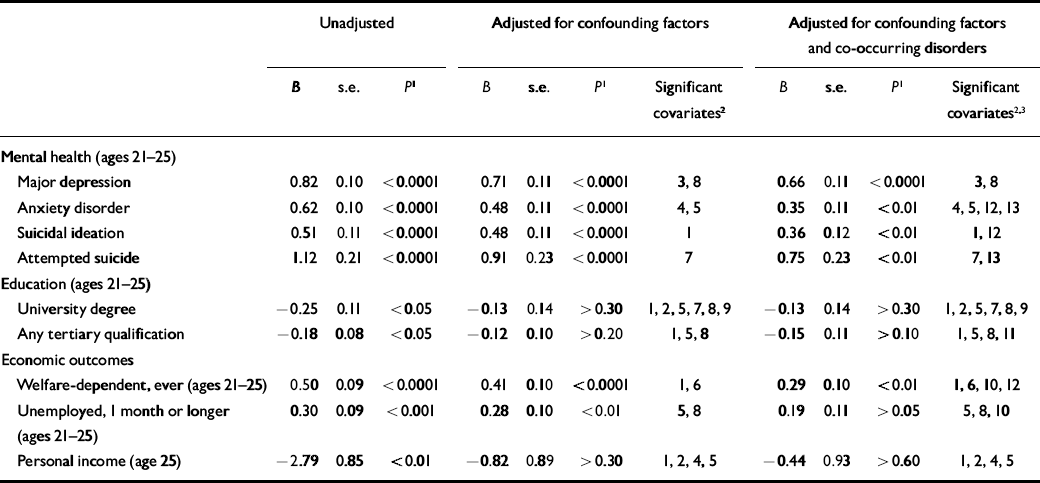
A possible limitation on the results in Table 2 is that the apparent associations between frequency of depression in adolescence and early adulthood and later outcomes could be due to third or confounding factors that were related to both adolescent and early adult depression and later outcomes. To address this issue, the results in Table 2 were adjusted for a series of confounding factors using logistic and least-squares regression. The adjustment for confounding factors was performed in two steps: first, the findings were adjusted for family background and individual factors up to age 16 years. These confounding factors included family living standards (ages 0–10 years); the number of family changes to age 15 years; exposure to childhood physical abuse; exposure to childhood sexual abuse; gender; parental attachment at age 14 years; neuroticism at age 14 years; self-esteem at age 15 years; and deviant peer affiliation at age 14 years. In the second step the regression models were extended in order to adjust for the presence of co-occurring mental disorders between the ages of 16 and 21 years, including alcohol and illicit drug dependence, anxiety disorders and conduct/antisocial personality disorder. Table 3 compares the parameter estimates of the effect of major depressive episodes on later outcomes before adjustment, and after adjustment for family background and individual factors and then co-occurring disorders, and lists significant (P<0.05) confounding factors for each outcome. The results show:
Associations between number of depressive episodes, age 16-21 and outcomes, age 21-25 years, before and after adjustment for covariates
| Unadjusted | Adjusted for confounding factors | Adjusted for confounding factors and co-occurring disorders | |||||||||
|---|---|---|---|---|---|---|---|---|---|---|---|
| B | s.e. | p 1 | B | s.e. | p 1 | Significant covariates2 | B | s.e. | p 1 | Significant covariates2,3 | |
| Mental health (ages 21-25) | |||||||||||
| Major depression | 0.82 | 0.10 | <0.0001 | 0.71 | 0.11 | <0.0001 | 3, 8 | 0.66 | 0.11 | <0.0001 | 3, 8 |
| Anxiety disorder | 0.62 | 0.10 | <0.0001 | 0.48 | 0.11 | <0.0001 | 4, 5 | 0.35 | 0.11 | <0.01 | 4, 5, 12, 13 |
| Suicidal ideation | 0.51 | 0.11 | <0.0001 | 0.48 | 0.11 | <0.0001 | 1 | 0.36 | 0.12 | <0.01 | 1, 12 |
| Attempted suicide | 1.12 | 0.21 | <0.0001 | 0.91 | 0.23 | <0.0001 | 7 | 0.75 | 0.23 | <0.01 | 7, 13 |
| Education (ages 21-25) | |||||||||||
| University degree | -0.25 | 0.11 | <0.05 | -0.13 | 0.14 | >0.30 | 1, 2, 5, 7, 8, 9 | -0.13 | 0.14 | >0.30 | 1, 2, 5, 7, 8, 9 |
| Any tertiary qualification | -0.18 | 0.08 | <0.05 | -0.12 | 0.10 | >0.20 | 1, 5, 8 | -0.15 | 0.11 | >0.10 | 1, 5, 8, 11 |
| Economic outcomes | |||||||||||
| Welfare-dependent, ever (ages 21-25) | 0.50 | 0.09 | <0.0001 | 0.41 | 0.10 | <0.0001 | 1, 6 | 0.29 | 0.10 | <0.01 | 1, 6, 10, 12 |
| Unemployed, 1 month or longer (ages 21-25) | 0.30 | 0.09 | <0.001 | 0.28 | 0.10 | <0.01 | 5, 8 | 0.19 | 0.11 | >0.05 | 5, 8, 10 |
| Personal income (age 25) | -2.79 | 0.85 | <0.01 | -0.82 | 0.89 | >0.30 | 1, 2, 4, 5 | -0.44 | 0.93 | >0.60 | 1, 2, 4, 5 |
-
(a) for all mental health outcomes, the association between frequency of depression at age 16–21 years and later outcomes remained statistically significant (P<0.0001) after controlling for both confounding factors and co-occurring disorders;
-
(b) the associations between frequency of depression (ages 16–21 years) and later educational outcomes (ages 21–25 years) were no longer statistically significant (P>0.20) after controlling for confounding factors;
-
(c) the associations between frequency of depression (ages 16–21 years) and later welfare dependence remained statistically significant (P<0.01) after controlling for both confounding factors and co-occurring disorders. However, the association between frequency of depression and income at age 25 years was no longer statistically significant (P>0.05) after controlling for confounding. Also, the association between frequency of depression and unemployment remained statistically significant (P<0.05) after controlling for confounding factors, but was no longer statistically significant after controlling for co-occurring disorders (P>0.05).
In addition, tests of frequency of depression by gender interaction terms revealed no evidence of significant interactions between frequency of depression and gender for any of the outcomes, suggesting that the associations between frequency of depression in adolescence and early adulthood and later outcomes did not differ for male and female participants.
Overall, the findings suggest that the associations between frequency of depression in adolescence and early adulthood and later mental health and welfare dependence were robust, and could not be accounted for by the effects of confounding factors and co-occurring psychiatric disorders. However, the associations between frequency of depression in adolescence and early adulthood and later education outcomes, and between frequency of depression and unemployment and personal income, could be attributed to the influence of both co-occurring psychiatric disorders, and factors confounded with the frequency of adolescent depression.
Odds ratio estimates for outcomes
In order to illustrate the effect size of the frequency of depression in adolescence and early adulthood, Table 4 presents odds ratios for the associations between frequency of depression in adolescence and early adulthood and later mental health and welfare dependence after adjustment for covariate factors and co-occurring disorders, for those associations that remained statistically significant after adjustment. Individuals with ten or more episodes of depression in the age period 16–21 years had odds of adverse mental health outcomes at ages 21–25 years that ranged from 2.86 (95% CI 1.46–5.60) to 9.57 (95% CI 2.10–43.64) times higher than those experiencing no episode of major depression at ages 16–21 years. Also, those reporting ten or more episodes of depression at ages 16–21 years had odds of welfare dependence during the period 21–25 years of age that were 2.42 (95% CI 1.31–4.45) times higher than those reporting no episode of major depression during the period 16–21 years of age.
Estimated odds ratios between number of major depressive episodes, ages 16-21 years, and mental health, welfare dependence and unemployment, ages 21-25 years, after adjustment for confounding factors and co-occurring disorders

| Number of depressive episodes | ||||
|---|---|---|---|---|
| 0 | 1-4 | 5-9 | 10+ | |
| OR | OR (95% CI) | OR (95% CI) | OR (95% CI) | |
| Major depression | 1 | 1.93 (1.55-2.40) | 3.72 (2.40-5.77) | 7.18 (3.72-13.87) |
| Anxiety disorder | 1 | 1.42 (1.13-1.76) | 2.01 (1.29-3.15) | 2.86 (1.46-5.60) |
| Suicidal ideation | 1 | 1.43 (1.13-1.81) | 2.04 (1.27-3.29) | 2.91 (1.43-5.96) |
| Attempted suicide | 1 | 2.12 (1.28-3.52) | 4.51 (1.64-12.40) | 9.57 (2.10-43.64) |
| Welfare dependence | 1 | 1.34 (1.09-1.64) | 1.80 (1.20-2.70) | 2.42 (1.31-4.45) |
Supplementary analyses
It could be argued that the measure of number of depressive episodes was somewhat imprecise, and may not provide an accurate picture of the relative burden of depression experienced by participants aged 16–21 years. In order to address this issue, analyses were carried out using a series of alternative predictor measures (see Method), which included the following: a measure of the duration (in weeks) of the longest episode of major depression reported during the period 16–21 years of age; a categorical measure of the number of times the participant reported being ‘currently depressed’ at the age 16, 18 and 21 years assessments; and a categorical measure of the number of times the participant reported being depressed during the 12 months prior to the assessment at ages 16, 18 and 21 years. The analyses described above were repeated using each of these alternative variables, with the following results.
For each of the alternative depression measures, increasing burden of depression (ages 16–21 years) was associated with increasing levels of major depression, anxiety disorder, suicidal ideation and suicide attempt at ages 21–25 years (all P<0.0001). Also, increasing burden of major depression (ages 16–21 years) was associated with lower levels of university degree and tertiary qualification attainment (all P<0.05), higher levels of welfare dependence (all P<0.0001), higher levels of unemployment (all P<0.01) and lower levels of personal income (all P<0.05).
Adjustment for confounding factors and co-occurring disorders reduced the associations between each of the measures of depression at 16–21 years of age and later university degree and tertiary qualification attainment to statistical non-significance (all P<0.20). Also, adjustment for confounding factors and co-occurring disorders reduced the associations between each of the measures of depression at 16–21 years of age and later unemployment and income to statistical non-significance (all P>0.20).
Adjustment for confounding factors and co-occurring disorders reduced the magnitude of the association between each of the measures of depression at 16–21 years of age and later mental health disorders and welfare dependence; however, each of the associations remained statistically significant (all P<0.05).
The results of these analyses show a similar pattern of results to the analyses that employed the measure of number of episodes of major depression at ages 16–21 years, suggesting that the results were robust to alternative classifications of the relative burden of major depression during this age period.
DISCUSSION
Findings of the present study
In this paper we have used data gathered over the course of a 25-year longitudinal study to examine the linkages between frequency of depressive episodes in adolescence and early adulthood and outcomes in young adulthood. The study led to the following conclusions.
First, the results make it clear that depression in adolescence and early adulthood is often recurrent, with 22.7% of cohort members reporting two or more episodes of major depression in the period 16–21 years of age. Furthermore, it is clear that there is a minority of young people who experience a high frequency of depressive episodes; 3.9% of the cohort reported ten or more episodes of major depression at 16–21 years of age.
Second, the findings suggest that the frequency of depression in adolescence and early adulthood was prognostic of later psychiatric and life-course outcomes, including subsequent depression, anxiety, suicidal behaviours and welfare dependence, even after controlling for confounding factors and co-occurring psychiatric disorders. These findings clearly suggest that for a substantial minority of this cohort, depression was a recurrent psychiatric condition that increased the risks of psychopathology and self-harm and reduced life opportunities. Odds ratio estimates suggested that individuals reporting ten or more episodes of major depression in adolescence and early adulthood had odds of later adverse mental health outcomes that were at least 2.8 times those of individuals who reported no major depression in adolescence and early adulthood. Similarly, those reporting ten or more episodes of depression in adolescence and early adulthood had odds of later welfare dependence that were 2.4 times those of individuals who reported no major depression in adolescence and early adulthood. Exceptions to these findings were that depression in adolescence and early adulthood was not associated with reduced educational achievement or income at age 25 years after adjustment for confounding. In addition, depression in adolescence and early adulthood was not associated with unemployment after adjustment for confounding factors and co-occurring disorders. Any association between depression and educational achievement, depression and unemployment, and depression and income, was explained by the effects of both a series of confounding factors that included family background and individual factors related to the experience of depressive episodes in adolescence and early adulthood, and other psychiatric disorders co-occurring with major depression in adolescence and early adulthood.
It should also be noted that the findings were robust to a series of alternative classifications of the recurrence of depression during adolescence and young adulthood. A series of analyses using alternative classifications revealed a similar pattern of results to those employing number of episodes as the depression measure. These findings imply that number of episodes of depression might serve as an ordinal measure corresponding to the relative burden of depression experienced by cohort members during adolescence and young adulthood.
Implications
The findings of this study underline the importance of developing effective methods for identifying, managing and treating depressive episodes in adolescence and early adulthood. It is well documented that major depression in adolescence and early adulthood is associated with adverse outcomes in adulthood (Reference Kovacs, Goldston and GatsonisKovacs et al, 1993; Reference Lewinsohn, Solomon and SeeleyLewinsohn et al, 2000; Reference Fergusson and WoodwardFergusson & Woodward, 2002; Reference Glied and PineGlied & Pine, 2002; Reference Andrews and WildingAndrews & Wilding, 2004; Reference Hysenbegasi, Hass and RowlandHysenbegasi et al, 2005; Reference Colman, Wadsworth and CroudaceColman et al, 2007). Our findings suggest that depression in adolescence and young adulthood may have an aetiological role in a range of later adverse mental health and economic outcomes. The collective findings of this study clearly indicate that, for a minority of young people, major depression will be a chronic and recurrent condition that both reduces their psychological well-being and limits their life opportunities. In addition, our findings suggest that the treatment of depression in adolescence and early adulthood might serve to reduce risks of later mental health disorders other than depression, and might also have the effect of reducing levels of welfare dependence.
Limitations
These conclusions need to be considered in the light of possible limitations of the study. First, the study was based on a specific cohort studied in a specific social context, which may limit the generalisability of the findings. Also, it is possible that the measure of frequency of major depression may be considered somewhat crude; however, this approximation would most probably lead to an attenuation of the associations between frequency of depression and later outcomes. It could be argued that the use of a more refined measure of frequency of depression would lead to stronger associations, both before and after controlling for confounding factors. In addition, it should be noted that the relatively high rates of depression observed in the study may be a consequence of the instrument used to measure depression (CIDI). Finally, it is possible that the study has undercontrolled associations between frequency of depression and later outcomes owing to the omission of relevant covariate factors. Notwithstanding these limitations, our findings clearly suggest that depression in adolescence and early adulthood is often recurrent, and may have far-reaching consequences for both psychiatric well-being and life course opportunities.
Acknowledgements
This research was funded by grants from the Health Research Council of New Zealand, the National Child Health Research Foundation, the Canterbury Medical Research Foundation and the New Zealand Lottery Grants Board.




eLetters
No eLetters have been published for this article.