E anche con teatro a gran proscenio, non mi pare gran male che l'azione rimanga a distanza. È solo per un atto. E può essere un'idea originale. Pensaci.Footnote 1
[And even in a theatre with a large proscenium, it wouldn't strike me as a great misfortune if the action remained in the distance. It's only for one act. And it could be an original idea. Think about it.]
What happened to verismo? It is easy enough to narrate the origins of the movement: the Sonzogno competition of 1888, the triumphant première of Cavalleria rusticana that resulted two years later, the rash of imitations that exploded in its wake. It is much harder, though, to pinpoint the moment when the excitement faded. In part, this is because Italian composers produced no ‘next big thing’, no coherent movement to challenge the premises of realist opera. Another reason is that many stars of the giovane scuola remained haunted by their first successes, watching their works become canonical – indeed, watching themselves become monuments – as they experimented with new themes and styles and then returned, inevitably and with what often sounds like increasing desperation, to the ideas that made them famous. Verismo, like so many relics of the Italian liberal state, persisted, however unnaturally, throughout the fascist period.
It is with one of these untimely remnants that I should like to launch an investigation into the ghostly afterlife of the verismo movement.Footnote 2 Puccini's Il tabarro – the first ‘panel’ in his triptych of one-act operas, all of which premièred together at the Metropolitan Opera in New York in 1918 – is easily described as an envoi or homage to the giovane scuola. The connection is clearest in terms of dramaturgy: the grim, working-class milieu in which the plot unfolds, the gruesome and sadistic denouement. More striking, though, are the ways in which Puccini reconfigures a variety of realist musical techniques that he and his contemporaries had developed some 30 years before. Central here is a process that might be termed spatialisation – the reduction of all musical parameters to a cold and eerie stasis. It is a kind of negative ekphrasis in which music, instead of enlivening the painted backdrop, aspires to its stillness. Famous examples of the technique include the unrelenting tonic–dominant ostinato that structures the first act finale of Tosca and the 112-bar-long pedal point that supports what Eduard Hanslick described, despairingly, as ‘columns of ascending and descending parallel fifths’, ‘ghastly fifth-rods’ that beat the characters into submission, during the start of the third act of La bohème.Footnote 3 More sympathetically, these static passages might be praised as effective evocations of tomb-like spaces: an old, marble basilica, dense with corpses, a frozen corner of Paris before the break of dawn.
The first eight bars of Il tabarro employ similar techniques: ticking quavers, parallel fourths and fifths and a melody, full of internal repetitions, that floats in some modal netherworld, suggesting but never quite settling on a tonal centre. Encouraged by the compound metre and barcarolle-like affect, commentators have described this passage as painting the ebb and flow of the Seine; but in so doing they miss something of the music's stasis. Puccini repeats this eight-bar unit twice more during the opening moments of the opera, at rehearsal numbers 1 and 2. And, while he allows himself a little climax halfway through the process, this glimmer of conventional development and forward motion does little more than enforce the underlying sameness of the passage as a whole.
The most striking aspect of this acoustic backcloth is what Puccini layers on top of it: the two long tugboat whistles – carefully located at different distances from the audience – and staccato car horn. Realistic sound was, of course, a major feature of Puccini's ambient style in the 1890s: Tosca's ostinatos support a riot of church bells, organs and ‘authentic’ plainsong, and La bohème's distant workers echo through the hollows of the Barrière d'Enfer. The combination of repetitive and inexpressive orchestral music with ‘objective’ diegetic noise was designed to support a fiction of authorial abdication, inviting us to believe that we are hearing nothing more – and nothing less – than the unmediated resonance of the fictional world.Footnote 4 This dream of facticity seems inseparable from the documentary claims of early sound recording; it also brings to mind Jonathan Sterne's description of the strange temporality of an Edison cylinder, ‘a little piece of repeatable time within a carefully bounded frame’.Footnote 5
Reviewing Tosca's American première, Life magazine complained about its ‘ultra modern style, with bells and cannons thrown in left and right’.Footnote 6 But those bells, however new, were still pitched and carefully integrated into the harmonic and melodic fabric: not thrown in at all. In contrast, the industrial sounds of Il tabarro stand out, almost bathetically, from their more delicate surroundings. They resemble less the visceral noise-music prophesied by the Italian futurists, more the poignantly inarticulate typewriters in Satie's Parade, premièred one year before in 1917. If Puccini was indeed looking back to his earlier style, it was with a note of scepticism, an almost melancholy acknowledgement that the aims of empiricist realism and operatic composition would never quite add up.
Il tabarro's opening music returns some 20 minutes later (see Reh. 56, bars 1–11). The music is nearly identical, save for a change of key and one other difference: two wordless, off-stage voices accompany the tune. It should be stressed that these are only voices: although numerous characters enter and exit the stage while singing, the ‘sopranino’ and ‘tenorino’ designated here are not among them. One could invent a variety of explanations for this effect – Rhinemaidens, the ineffable magic of Paris, a fantasy projection of the protagonists’ prohibited affair – but all would unsettle the realist pretensions of the opera as a whole. Up to this point, the off-stage world has functioned as an extension of the visible one – the car horn is there, after all, to insist on a reality beyond the confines of the stage. Now, in contrast, the space beyond the flats appears mysterious and inscrutable. You can have tugboat sirens or you can have Homeric sirens; but in a work of realist theatre you should not have both.
Wordless off-stage singing is a feature of all of Puccini's later operas. The humming chorus in Madama Butterfly is the first and most famous example of the device; the penumbra of sound added by fifteen tenors to the final bars of the first act of La fanciulla del West is perhaps the strangest.Footnote 7 These mysterious sounds suggest the existence of a second, only dimly perceptible acoustic reality, one inconceivable in Puccini's earlier style. His new fascination with musical effects of echoing and distance is refracted on multiple thematic planes. Most obvious is a move away from the familiar urban locales of Manon Lescaut, La bohème and Tosca, and towards remote, exotic landscapes: imperial Japan, Gold Rush California, ancient China. This large-scale interest in temporal and geographical distance is restaged, within Puccini's operas, in numerous songs of nostalgic longing: for rural Hunan in Turandot; for suburban Belleville in Il tabarro; for the soon-to-be-forsaken Florence of Gianni Schicchi; for the elusive ‘lontano’ of La fanciulla. Also relevant here is a sense in which many of Puccini's later works are themselves echoes of distant masterpieces: La rondine updates and rewrites the plot of La traviata (to say nothing of his own, already citational, Manon Lescaut); Gianni Schicchi is modelled on Verdi's Falstaff; and, as Emanuele Senici has shown, La fanciulla is a disillusioned look back at the pastoral mountain operas of Donizetti and Bellini.Footnote 8 Finally, it may be worth mentioning an element of ironic self-parody within Puccini's music itself – one seen, for example, in the knowing quotations of ‘Mi chiamano Mimì’ that pepper Il tabarro. If Puccini's operas from the 1890s aspire to a phonographic objectivity, his later works approach reality more circumspectly, as if through a cloak.
This admittedly breathless survey of Puccini's seconda prattica has avoided mention of one work – Suor Angelica, the second panel of Il trittico. In many ways it fits awkwardly into the story told above. The opera is not especially exotic, nor overtly nostalgic, nor based on any clear operatic precedent.Footnote 9 Indeed, its world of oppressively cloistered ritual seems designed to efface all specificities of geography and history. However, of all Puccini's operas Suor Angelica is the most indebted to both his realist experiments of the 1890s and to the poetics of distance explored in his later works. It might in this sense be described as an attempt to thematise and so work through a crisis in Puccini's style, a crisis that speaks to a ripple of sorts within modernity, one that musicological accounts of modernism have largely overlooked.
I
Puccini approached Suor Angelica with the same positivist zeal that had been his trademark since the time of Tosca. He wrote to the priest and scholar Don Pietro Panichelli asking for appropriate litanies, and petitioned his sister, the mother superior at an Augustinian convent outside Lucca, for access to its secret rites.Footnote 10 While no one would describe the resulting work as documentary, its opening scene does contain the most explicit catalogue of verismo musical devices the composer ever wrote. Even before the curtain rises, the audience is greeted by the sound of off-stage bells, playing a simple four-bar melody. Then, as the stage is revealed, this tune transforms into an unceasing ostinato figure, played by the strings and celesta, a static effect intensified, as in Il tabarro, by improper voice-leading, quasi-modal harmony and internal melodic repetitions. One by one, a parade of off-stage, diegetic noises enter the texture: the sisters in their chapel, a bird in the trees, a church organ and, finally, Angelica herself. For the first three minutes of the opera, the audience does not see a single person singing. The normal priorities of operatic spectacle are submerged behind the mise-en-scène.
But then, as in Il tabarro, the opera's closing scene presents an effect of magical distance that utterly contradicts these realist expectations.
Suor Angelica vede il miracolo compiersi: la chiesetta sfolgora di mistica luce, la porta si apre: apparisce la Regina del conforto, solenne, dolcissima e, avanti a Lei, un bimbo biondo, tutto bianco … La Vergine, con un gesto dolcissimo, senza toccarlo, sospinge il bimbo verso la moribonda.
[Suor Angelica sees the miracle achieved: the chapel blazes with mystic light, the door is opened: the Queen of Solace appears, solemn, very gentle and, in front of Her, a blond little boy, all in white. The Virgin, with a very gentle gesture, without touching him, urges the child towards the dying woman.]
The music that accompanies this apparition emanates from behind the flats, just like the opening music, and uses many of the same forces: choir, organ, bells. After having been taught that these off-stage sounds signified a concrete place within the fictional world, we are now asked to believe that they are echoing from another place entirely.
It is very difficult to bring this last scene off. Gary Tomlinson has claimed that Puccini's operas ‘bring us face to face with a force we can believe only through a wilfully nostalgic engagement’, and, at least in the case of Suor Angelica, most critics would agree with him that ‘a part of us knows better … than to trust a pushy salesman’.Footnote 11 ‘The apparition is an illuminated Christmas card’, exclaimed James Huenecker after the première, sounding quite a bit like Tomlinson in his anxious conflation of Puccini's miracle with the commodified circuitry of mass culture.Footnote 12 A critic at the work's first Italian performances made a similar point when he suggested that Suor Angelica was ‘more cinematographic than mystical’.Footnote 13
More recently, it has become common to defend the apparition, but only by redefining it as a hallucination, the product of Angelica's fevered mind. There are problems with this psychological approach, though, including the fact that the event is unambiguously labelled ‘Il miracolo’ in the score and libretto. In the most nuanced discussion of the issue, James Hepokoski proposes that the events of Suor Angelica can only be made sense of within the context of Il trittico as a whole. Il tabarro, he notes, ‘had presented the gritty, urban material world already fallen away from spiritual illusions and securities. There had been no deus ex machina in that brittle arena of things now abandoned by the once-held comforts of religion.’Footnote 14 With this contemporary framework in mind, listeners can choose either to interpret Angelica's vision as madness, or – through that act of wilfully nostalgic engagement – participate in her self-deception. To make his argument, Hepokoski, like Tomlinson, relies on a characterisation of Puccini's era as one in which ‘the once-held comforts of religion’ were located firmly in the past. But is it fair to assume that listeners in 1918 would have understood their world as one bereft of magic?
It should be noted first of all that, at least from an anthropological perspective, the Virgin Mary was actually appearing with increasing frequency throughout the nineteenth century. While the eighteenth century has been described as the one true lull in the history of Marian apparitions, something began to change after the Revolution. There was the miracle at Rue du Bac in 1830, followed by apparitions at La Salette in 1846, Lourdes in 1858 and Pontmain in 1870. The trend seems to have culminated with the six apparitions of the Virgin at Fatima in Portugal – the last witnessed by a crowd of 70,000 spectators – in 1917, one year before the première of Suor Angelica.Footnote 15 These apparitions fuelled a vogue for monasteries and miracles on the European stage, as evidenced by works like Massenet's Le Jongleur de Notre Dame (1902); Maeterlink's Sœur Béatrice (1901), itself the subject of four operatic adaptations between 1912 and 1944;Footnote 16 and Max Reinhardt's ‘grand pageant’ The Miracle, with music by Engelbert Humperdinck, described by the New York Times as ‘the most profoundly moving thing ever seen in London’ when it was presented to rapturous crowds in 1912.Footnote 17 None of this is to say that Marian apparitions were not debated, discredited, experienced and interpreted differently by different parties, nor that Puccini, an arch-cynic, would have believed them. Nonetheless, it would be a mistake to cordon off the world of Catholic credulity, safely placing it in some distant moment prior to the opera's composition.
Furthermore, and this may bring us closer to understanding the apparent tension between realism and magic in Suor Angelica's dramaturgy, many of the most sober men of Puccini's generation trained their gaze not just on the brittle arena of things, but also on the occult. The names of distinguished scientists and thinkers drawn to the spiritualist movement at the turn of the century are legion, but it will be most instructive to concentrate on two.Footnote 18 The first is Cesare Lombroso (1835–1909), the militantly positivist criminologist whose conversion to spiritualism is documented in his final book, a nearly 500-page tome published in English in 1909 under the title After Death – What? Footnote 19 In it, he describes, clearly and dispassionately, a series of transformative meetings with the Neapolitan medium Eusapia Palladino, which began in 1891.Footnote 20 Hands appeared, a mandolin flew across the room and started to play, and, in one of ‘the most important and significant of the occurrences’, Palladino ‘was lifted up in her chair bodily, amid groans and lamentations on her part, and placed (still seated) on the table, then returned to the same position as before’.Footnote 21 Alessandra Violi suggests that Lombroso's embrace of Palladino represents less a rejection of positivism than its triumph, describing the ‘emergence of an imaginary that is already inscribed in the project of the positivist sciences, an imaginary that Lombroso pushes to its extreme consequences, rendering unto it the contours and character of a phantasmatic revelation’.Footnote 22
Lombroso's new interests also brought him into contact with my second figure, the novelist Luigi Capuana (1839–1915).Footnote 23 Along with Giovanni Verga, Capuana had been one of the lions of the verismo movement until he too underwent a conversion of sorts. The advocate of narrative impersonalità and what he termed the ‘science of literature’ now began to conduct more practical experiments, building a laboratory in his home and hypnotising local peasants (hoping, in one case, to contact spirits that would help him complete a biography of Ugo Foscolo). Capuana's research also signalled the beginning of a second literary practice, one that critics have politely labelled ‘originale e segreto’ and have allowed to languish at the margins of the canon.Footnote 24 Those attempting to rehabilitate these texts have, like Violi, stressed their ‘phantasmatic’ relationship with Capuana's earlier project. Paul Barnaby reads his novel Profumo as allegorising the proposition that ‘the institutional positivism of post-Risorgimento Italy is itself haunted by the self-torturing asceticism of the medieval Church’.Footnote 25
Barnaby and Violi's emphasis on the uncanny underside of Italian positivism offers a new way to think about the place of Suor Angelica within the larger framework of Il trittico, and the place of Il trittico within the larger context of Italian liberalism. Poised awkwardly between the gritty realism of Il tabarro and the equally authenticist historicism of Gianni Schicchi, this perennially maligned opera is itself a sort of phantom. The aesthetic discomfort it provokes may also inscribe a political dilemma. Considered (like Profumo) as an intervention into the ideology of post-Unification Italy, Il trittico seems to imagine two futures for the fledgling nation: either the nightmare of urban disenchantment presented in Il tabarro or a return to the glories of trecento Florence evoked in Gianni Schicchi. These were compelling fantasies, yet Suor Angelica emerges as a symptomatic remainder of the unassimilated legacies of official and popular Catholicism, repressed and left unresolved by both.
II
A spectre lingering at the margins of realist dramaturgy, Suor Angelica is itself a haunted work. At three moments there emerge strong occultist undercurrents, ones that have never been described as such. When taken together, these moments help tug the opera away from the pieties of sentimental Catholicism, and ground it firmly in the world of Lombroso and Capuana.
The first and simplest of the three scenes occurs early in the opera, when the nuns' thoughts turn to a departed sister.
Un silenzio doloroso è nel chiostro; le suore assorte in un atteggiamento di muta preghiera sembrano rievocare l'immagine della sorella che non è più.
[A dolorous silence is in the cloister; the sisters, pensive in an attitude of silent prayer, seem to summon up the image of the sister who is no more.]
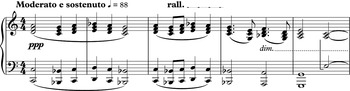
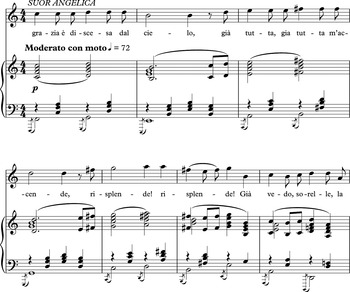
The tempo slows dramatically to mark this action, and a series of parallel-seventh chords, played on the bridge by muted strings, adds to the sense of mystery (see Ex. 1). A simple melodic figure that had accompanied the nuns' earlier conversation suddenly appears as strange and luminous.
Suor Angelica, Reh. 14, bars 1–5

There's nothing unduly weird about this passage – no ghost appears on stage – but Puccini would invoke a similar sound-world during a more disturbing scene of conjuring later in his work. At the heart of the great duet between Suor Angelica and her imposing aunt, the Zia Principessa describes a series of colloquies she held with her dead sister.
This monologue reads like a textbook account of fin-de-siècle séances: the domestic interior, the out-of-body experience, the contact with a departed family member, the physical manifestations of cries and sobs, the prophetic message from the beyond. While the Zia Principessa's vocabulary of meditation and ecstasy might seem to draw on a longer tradition of Catholic visions, it is striking that none of the actual nuns in the opera uses anything like this language. This is one of the most telling ironies of Suor Angelica: the opera's most credulous account of mystical experience is placed in the mouth of the sole representative of secular society.
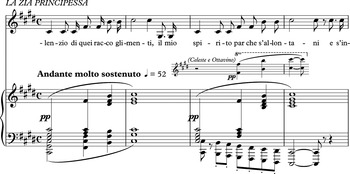
Puccini's music for this scene draws on many techniques encountered earlier. Here, too, are the muted, ponticello strings, now made more mysterious through the addition of muted brass, a celesta doubled by a ghostly piccolo and a remarkably low harp. The clearest echo of the earlier scene comes in the form of three, just-barely functional, parallel triads (F-sharp minor, B major, C-sharp minor: iv–VII–i in the home key) that sound at the beginning, the climax and the conclusion of the monologue (see Ex. 2). (If Puccini had previously reserved ‘impressionist’ voice-leading for ekphrastic landscape music, in Suor Angelica he seems to associate it with visions of a different sort.) Against this spectral backdrop, the contralto's line leaps by fourths from the lowest to the highest extremes of its range. It would be hard to think of a melodic style further removed from the little declamatory arcs through which Puccini normally constructs his vocal lines. In many performances, it sounds as if the Zia Principessa's voice is being pulled upwards by a magnetism beyond its control.
Suor Angelica, Reh. 50, bars 4–7

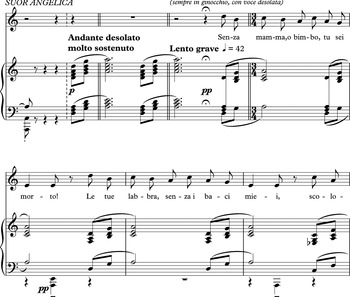
The parallel triads that structure ‘Di frequente, la sera’ will return once more after the conclusion of the duet, as an ostinato that accompanies the opening section of Angelica's aria ‘Senza mamma’ (see Ex. 3).Footnote 26 Although the tonality has been shifted from C-sharp minor to A minor, and the metre from 4/4 to 3/4, the connection between the two passages is highly audible and alerts us to other resonances between the scenes. The Zia Principessa's phrase ‘estasi mistica’ is echoed in a stage direction that describes Angelica's ‘esaltazione mistica’, and the Gothic ambience of her narration anticipates another stage direction, which calls for an effect that would not have been out of place at one of Palladino's séances.
I lumi del cimitero sono tutti accesi; il chiostro è ormai quasi oscuro. Le suore escono dal cimitero e si avviano verso Suor Angelica che è come in estasi. Il gruppo delle suore si avvicina in silenzio. Nella semioscurità sembra che le figure bianche, camminando, non tocchino terra.
[The lights of the cemetery are all illuminated; the cloister is now almost dark. The nuns come from the cemetery and head for Suor Angelica, who is as if in ecstasy. The group of nuns approaches in silence. In the semi-darkness it seems that the white forms, as they walk, do not touch the ground.]
Suor Angelica, Reh. 60, bars 1–5

This occult backdrop – flickering candles, levitating nuns – sets the stage for the climax of ‘Senza mamma’, where Angelica initiates a mystical conversation of her own.
These lines have been interpreted as marking the onset of Angelica's derangement, and their overt eroticism and desperate demand for prophetic knowledge are certainly unnerving. If Angelica is mad, however, the connections between ‘Senza mamma’, ‘Di frequente la sera’ and the nuns' earlier scene suggest that there is nothing singular about her condition. Indeed, it seems a default mode for women in this opera.Footnote 27
III
Although Suor Angelica and the Zia Principessa draw on the discourse of fin-de-siècle spiritualism, they part company with it in one key regard: both women imagine the dead contacting them directly, without the aid of a medium. Jeffrey Sconce has suggested that, as a cultural fantasy, the idea of unmediated auditory contact with the beyond emerged only at the beginning of the twentieth century, where it helped make sense of a fundamental shift in mass communication technology. Victorian spiritualists, he argues, imagined ‘streams’ and ‘wires’ that linked mundane and transcendental spheres – one way of thinking through the networked cables of Morse's telegraph. With the advent of Marconi (whose first overseas transmission was broadcast in 1897), however,
Wireless replaced this comforting and often utopian ideal of extraordinary interconnection with a more bittersweet presence, one that evoked a no less marvelous yet somehow more melancholy realm of abandoned bodies and dispersed consciousness. In this respect, wireless was not a technology that stood as an analog to the body, but an apparatus that possessed the power to atomize and disperse both body and consciousness across the vast expanses of the universe.Footnote 28
This more ethereal, mysterious form of communication gave rise to an unsettling new soundscape, ‘a lonely realm of distant and estranged consciousnesses, a vast ocean where the very act of communication reminded the operator of his or her profound isolation’.Footnote 29 They also inspired the emergence of a peculiar narrative genre: ‘tales [that] frequently centered on lovers separated by death but reunited through wireless [communication]’.Footnote 30
So much of the world of Suor Angelica is present in Sconce's essay: from the opera's basic narrative structure and pervasive emphasis on alienation and the impossibility of physical contact to its vocabulary of ether and disembodiment. Furthermore, a convent – or, at least, this convent – provides a remarkably useful figure for thinking about the ‘realm of distant and estranged consciousnesses’ described by Sconce: not an intimate community as much as an atomised field of solitary women, all waiting anxiously for messages from beyond their cells. This is a feeling that Puccini would have encountered first-hand in his sister's convent. As she later recounted to a television interviewer,
He came many times here to Vicopelago. I've been here for 47 years and I remember it well. One day he arrived and sat right there at the harmonium – that very one, it's still the same – and he began to play. We nuns stood listening from behind the iron grate.Footnote 31
Igenia's narrative breaks off here, although other versions of the story report the sisters all bursting into tears.Footnote 32 I wonder if this experience – the experience of playing for countless hidden ears, ears that would carry the memory with them decades after the event – left a greater mark on Suor Angelica than any specific prayer or ritual.
At the centre of the convent's aural architecture sits Mary, silently. ‘Every word is heard by the Blessed Virgin’, the Abbess warns Angelica before her fateful reunion with her aunt. ‘May the Virgin listen to me’, Angelica responds. Later, she will repeat this warning to the Zia Principessa:
These lines seem to imagine the Virgin as the ultimate radio operator – a figure of ‘electronic omniscience’, in Sconce's formulation – and the withholding of sound as the gravest sin.Footnote 33 Their fantasy of divine audition also brings to mind a recent claim by Emanuele Senici:
What Puccini attempts in La fanciulla, and specifically in the man-hunt scene, is an expansion and internal articulation of the fixed space of the theatre by means of a multiplication and strategic placement of the sound sources. In the impossibility of moving the ear to follow the sources of sound as a way of substituting for a movable eye, Puccini tries to create a particularly powerful ear, a giant one, capable of hearing the action beyond the fixed field of visibility – an ear capable of ‘seeing’ the action that the eye cannot see.Footnote 34
Senici connects La fanciulla's staging of an impossibly vast acoustic terrain to Italian fantasies of the American landscape, ‘the sonic equivalent of what is known as the “big sky” of the West’.Footnote 35 The affinity between his image of a giant, all-powerful ear and the terms through which the Virgin is described in Suor Angelica might also direct our attention beyond the immediate purview of La fanciulla, though, suggesting the contours of a broader poetics of radiophonic listening in Puccini's later style.
IV
Although musicologists have devoted considerable effort in the last ten years to exploring the influence of the phonograph on modernist composition, they have paid significantly less attention to the impact of the wireless.Footnote 36 But are there any distinctive tropes – analogues to mechanicity, deadness and other signifiers of the phonographic uncanny – that might alert us to the presence of a competing radio discourse in early twentieth-century music?
When national broadcasting networks began to take form in the 1920s (the BBC was founded in 1922, the Unione radiofonica italiana, a precursor to the RAI, in 1924), many musicians embraced the possibilities promised by the ‘new electronic community’ of mass communication. Edgard Varèse began drafting a global successor to Beethoven's Ninth Symphony, which ‘would be timed precisely in seconds so that choral entries in Paris, Moscow, Peking or New York could be exactly synchronised, creating a vast song of liberation for all the peoples of the world’.Footnote 37 Leopold Stokowski anticipated the construction of vast pleasure gardens devoted to electric listening.
In one part of the gardens might be a high tower from which at night colored light would be diffused, which in time would create a new art of color in motion and form. From this tower music of several kinds might be sent out over this part of the gardens … Perhaps every day two periods of jazz for dancing, both open-air and under cover; about three times a week the finest symphony concerts; at other times singers, violinists, pianists of the highest order.Footnote 38
These dreams of cohesion are reflected in the music Kurt Weill wrote for Bertolt Brecht's radio play Der Lindberghflug (1929), a work in which Charles Lindbergh's literal transversal of physical space is conflated with the radio's more metaphoric powers. Although the recalcitrant natural elements in the story, personifications of fog and wind, are assigned neo-Bachian fugues, what would seem to be the actual polyphonic voices in the drama – isolated wireless operators in New York and at sea, dispersed communities of newspaper readers in America and Paris – sing in a style that is unremittingly homophonic.
A similar optimism motivated musical experiments before the 1920s, but it was often undermined by the material realities of wireless transmission. When the Metropolitan Opera attempted its first live operatic broadcast in 1910 (a double-bill of Cavalleria rusticana and Pagliacci, perhaps not incidentally), it promised an acoustic miracle – the voices of Enrico Caruso and Emmy Destinn ‘borne by wireless Hertzian waves over the turbulent waters of the sea to transcontinental and coastwise ships, and over the mountainous peaks and undulating valleys of the country’. But, as the New York Times reported, ‘the homeless song waves were kept from finding themselves by constant interruptions said to come from the Manhattan Beach station’.Footnote 39 The only voice the reporters could make out seemed to be talking about beer. As even Stokowski conceded: ‘physicists have not found a way to protect music that is conveyed by space radio against these extraneous sounds … fading, static, and disturbances of every kind’.Footnote 40
Static, fading, voices coming in and out of focus: these are the new structural principles that organise the prelude to Joaquin Turina's piano suite Radio Madrid (1931), one of the first pieces written explicitly for a wireless broadcast. Glancing at it may give us insight into how disorientating the new medium was. The piece opens with three ‘uncanny’ parallel triads (B-flat minor, E major, C minor), sounded slowly;Footnote 41 this unholy chorale then comes into conflict with a series of genuinely dissonant improvisatory flourishes: arpeggios, accented appoggiaturas, trills. Out of this music of mystery and interference, a Satie-like waltz (ppp and marked ‘lontano’) emerges, only to pause on a dominant-seventh chord, at which point the opening music returns. A loud galop is sounded – the result of a stronger signal, perhaps – until it too vanishes into the ether; the chorale theme and the appoggiatura gesture return once more. Now a staccato fugal exposition (identified as ‘los locutores de la Radio’ – the radio announcers) begins but, quickly and surprisingly, it bleeds back into the earlier waltz tune. Finally, and as before, the waltz breaks apart on a dominant-seventh chord and the opening chorale, now hushed, re-emerges as the substitute for a clear conclusion. We are used to hearing splices, fade-outs and ‘white noise’ effects like these in the compositions for radio of a later generation: Cage's Williams Mix, Berio's Visage. But to encounter them in an obscure and unassuming character piece by a composer known more for Sevillian grace than modernist fragmentation is even more remarkable. Radio Madrid reminds us that the unsettling implications of new technologies were not only a subject for the avant-garde.
Puccini produced no composition as schematic as Turina's prelude: the closest he came was ‘Scossa elettrica’ (Electric Shock, 1896), a jaunty march for piano commissioned by a committee of telegraph operators to celebrate the centennial of Alessandro Volta's invention of the electric battery. Nonetheless, what might be described as the two musics of the wireless imagination – sounds that transcend the normal limits of the human body and fragile, unmoored voices that emerge like phantoms – both leave a mark on Puccini's later operas. On the one hand, as we have seen, they give rise to fantasies of aural omniscience: Suor Angelica's all-hearing Virgin, La fanciulla's giant ear. On the other hand, they motivate the strange passages of wordless, off-stage singing discussed at the beginning of this essay: moments in which we seem suddenly to ‘tune in’ to voices – indistinct, bodiless, dispersed, ethereal – that will soon fade away. Nor are Puccini's the only operas of their time that engage with these themes. For an example of listening to ‘homeless song waves’, think of the protagonist of Franz Schreker's Der ferne Klang (1912), grasping at a melody forever just out of reach. For an example of omnipotent hearing, recall those notorious lines given to Strauss and Hofmannstahl's Elektra: ‘How should I not hear? How should I not hear the music? It comes from me.’
The aural effects in Strauss and Schreker have been described as ‘post-Wagnerian’, in the sense that they thematise the ‘phantasmagoric’ occlusion of time and space that Adorno identified as one of the more dubious features of music drama.Footnote 42 For Adorno, however, the real inheritor of Wagner's phantasmagoria – acoustic tricks in which ‘the near and the far are deceptively merged, like the comforting Fata Morgana that brings the mirage of cities and caravans within reach’ – was the wireless itself.Footnote 43 What radio accomplished, he suggested, was the creation of a truly invisible orchestra, one that produced music that sounded neither identical to a live performance nor like a second-order, phonographic reproduction of it. The result was a sort of acoustic dizziness:
The listener feels as if presented with something totally familiar, and familiar it may be indeed, yet in such a manner that it assumes an air of strangeness … The strangeness of the phenomenon expresses itself in the somewhat vague and half-conscious awareness of being at home with it and yet quite far away.Footnote 44
Searching for a metaphor to describe this paradox of proximity and distance, Adorno proposed the echo, a sound that ‘possesses not only the characteristic of remoteness but also of derivation’.Footnote 45
Adorno's notion of echoic estrangement might be used to describe, quite precisely, the relationship between the two passages in Il tabarro discussed at the beginning of this essay. The first is an example of ‘realistic’ aural presence, the second sounds both ‘totally familiar’ and, at the same time, mysterious, oblique. We listen to the first passage the way we listen to any music in the opera house. The second, however, invites us to step outside normal theatrical space, listening as if from a distance, or at home. Perhaps this explains why Puccini's first wordless, off-stage chorus was invented to depict Cio-Cio San as she sat waiting for Pinkerton's ship to arrive at port. In this scene she appears like one of the nuns in Suor Angelica (or one of the bereaved wireless operators described by Sconce): lonely, isolated, ears trained on the beyond.
V
A process of rehearing similar to the one in Il tabarro is at play, much more elaborately, in Suor Angelica. As Hepokoski has argued, the last fifteen minutes of Puccini's opera are structured around two ‘rotational cycles’, in which four distinct musical ideas – each assigned a fixed tonality, harmonisation and melodic profile – appear twice, in the same order.Footnote 46 (These ‘full rotations’ are preceded by a third, ‘partial’ rotation, in which only the first three elements appear.) For Hepokoski, this formal conceit performs an essentially symbolic function: Angelica's increasing alienation from the world around her is depicted through her progressive separation from the normal flow of Western music. Although his analysis is compelling, there may be other ways to account for Puccini's use of this technique. Adorno's theory of wireless listening allows us to explore a different question: not what rotational form ‘means’ in Suor Angelica, but what effect its highly audible repetitions might have on an audience in the theatre.
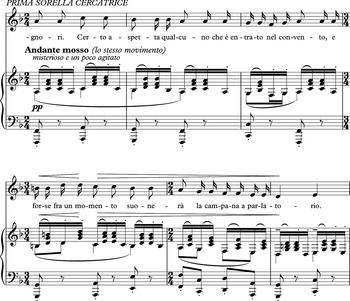
It may be helpful to begin by focusing on the first of the four elements identified by Hepokoski.Footnote 47 We hear this music for the first time in a short scene that immediately precedes the central duet, as Angelica presses an alms-collector for information on the carriage that has just arrived (see Ex. 4). If the simple F-major melody suggests the alms-collector's naivety, her obliviousness to the tragedy about to unfold, the frequent shifts of metre capture something of Angelica's anxiety.
Suor Angelica, Reh. 36, bars 2–7

At the climax of ‘Senza mamma’ – the moment that signals the beginning of Angelica's mystical conversation or, for other critics, the onset of her madness – Angelica sings this music again, initiating the second (and first complete) rotational cycle (see Ex. 5). The melody and harmonisation are unchanged, although the tempo has been slowed drastically and the jumpy metre smoothed out into a more even duple, alterations that serve to make the music calmer, more incantatory and less physical. The orchestration is more distant too, a conventional battery of strings and winds replaced by a more ethereal palette: muted stings, one muted horn (instructed to play con voce velata) and harp.
Suor Angelica, Reh. 61, bars 1–5

The libretto suggests an intriguing link between these passages. The first occurrence of the F-major melody accompanies an image of mundane human connection: the arrival of the carriage at the convent. The second, in contrast, describes a rather more impressive scene of transportation: ‘Now that you are an angel in heaven … you can come down [scendere giù] from the firmament’. Fittingly, then, the third rotational cycle begins with the most miraculous moment of contact yet. ‘Grace has descended [discesa] from heaven’, Angelica proclaims, before falling silent, for the last iteration of the F-major melody is purely instrumental (see Reh. 66, bars 3–13). Just as the three visitors that greet Angelica – the carriage, the angel, grace itself – have less and less purchase on physical reality, so too her melody is made to sound ever more disembodied and distant from the world on stage. The orchestration of the third, instrumental version of the F-major melody is identical to its previous iteration in ‘Senza mamma’. It is as if we were looking at Angelica's shadow, but now without Angelica herself.
Although Hepokoski imagines a moment of formal elucidation here, describing the ‘slow-churning deep structure of Suor Angelica, where … rotations successively “grow” in clarity of statement’, the preceding discussion suggests that Puccini's use of rotational form might alternatively be described as a process of dematerialisation, of music echoed, loosened, blurred.Footnote 48 From this perspective, the real model for Puccini's use of rotational form in Suor Angelica might be something more modest than late nineteenth-century symphonic music: it might be that hackneyed strategy, inherited from Ponchielli, of reiterating a readily identifiable sung melody in purely instrumental form at the conclusion of an act. (The bombastic restatement of ‘E lucevan le stelle’ in the final moments of Tosca is the most notorious example.) Or, then again, maybe not so hackneyed. Gary Tomlinson has suggested that there is an almost Nietzschean dimension to orchestral groundswells in late Romantic Italian opera – Dionysiac moments when music breaks free from the words that had confined it. To describe these passages, Tomlinson invokes a series of astronomical metaphors that could not be more relevant to the subject of Suor Angelica: ‘Verdi uncovered in his new practice a potential leverage of Archimedean dimensions … one that could move the whole opera, wrenching it out of one orbit and into a new one’. And again, quoting Franco Faccio: ‘Heaven seems to open up’.Footnote 49
VI
When heaven opens up at the end of Suor Angelica, we are greeted not, as might be expected, with the voice of absolute acoustic alterity, but with sounds already heard in human form.Footnote 50 The music intoned by the angelic choir during the climactic miracle is based on the fourth (and final) element in the rotational cycle. The first time we heard this music was immediately after the conclusion of ‘Senza mamma’ (see Ex. 6). ‘Grace has descended from heaven’, Angelica sang, anticipating the line that would soon mark the start of the third cycle, accompanied by an off-stage chorus of nuns intoning hymns to the Virgin. Puccini's music for this passage – much more elaborate than the F-major melody that begins the cycles – is constructed from three parallel triads that are sequenced up by thirds – a ‘non-progression’, in Hepokoski's phrase, giving rise to a ‘ritualized, circular processional’.Footnote 51 The sequence is then itself cycled through twice more; cadences are deferred again and again until finally we settle into the implied tonic of C major.Footnote 52
Suor Angelica, Reh. 64, bars 1–7

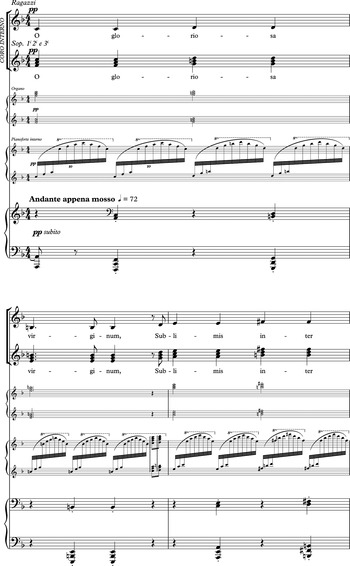
Nothing changes during the miracle scene except the orchestration and the placement of the sound source (see Ex. 7). The music previously assigned to Angelica and the orchestra is now taken over by an off-stage ensemble: children's voices supported by sopranos and later a full choir (including the only male voices in this opera) plus a coldly virginal instrumental group: two pianos playing arpeggios in their highest register, organ, hushed cymbals, muted trumpets. Angelica remains silent during the start of the miracle music, and the orchestra drops out too, save for a few plucked string chords. This decision emphasises the remoteness of the new sound-world but it also suggests that Angelica's voice has quite literally been taken away from her, wrested from her body and allowed to echo through the atmosphere. When Angelica re-enters at the start of the second iteration of the sequence, she may be able to muster the force for a final high C, but she is also no longer singing ‘her’ melody, only one of the inner voices of its harmonisation (see Reh. 82, bars 1–8). At the start of the third iteration, she emits two horrible unpitched moans. They are, to return to Sconce's formulation, the sounds of a body being atomised and dispersed and (unless you count the chilling, wordless high C the off-stage sopranos unleash in the final four bars: chilling because it is calibrated so precisely to echo – or, as if by some electric force, prolong – the voice of a now-dead woman) the last ones she will ever make (see Reh. 84, bars 7–9).
Suor Angelica, Reh. 81, bars 1–3

VII
There are, then, two new ways one might describe this final miracle. On the one hand, it seems to appropriate both the actual sound of early wireless transmissions and the magical effect they had on many listeners. On the other hand, remembering that radiophonic communication was still, in the early twentieth century, a two-way process, we can also hear the protagonist desperately broadcasting her own voice into the ether as we listen to the ever-more-distant echo of her cry. Choosing between these options is less important than observing how far, in either case, we have moved from the aims of realist opera.
And so, to return to our initial question, what happened to verismo? What Puccini's later career suggests – and Suor Angelica, in its move from convent bells to heavenly ones, narrativises – is that a phonographic regime ceded to, or came into conflict with, a radiophonic one. A movement founded on objective transcription and unmediated presence became haunted by echoes, unreal voices, distant sounds.
This shift was noted by Ferruccio Busoni, who made it the subject of a short fable published as an April Fool's Day joke (the author is listed as ‘Aprilus Fischer’) in 1911. Framed as an urgent dispatch from New York, the story centres on one Kennelton Humphrey Happenziegh, a conscientious positivist who ‘has devoted the greatest part of his studies to the experimental criticism of acoustic phenomena’. His great invention is a ‘super-sensitive apparatus (intended for phonographic discs)’, a device that can record sounds beyond the range of normal human hearing.Footnote 53
As the story begins, Happenziegh has accidentally left his device turned on and, after a short nap, has returned to discover ‘certain impressions which he could not account for … an accumulation of obscure diagrams which were systematic, complicated, and at first unintelligible’.Footnote 54 Has Happenziegh's disc recorded sounds from the surrounding area? All restaurants were closed, no parties hosted, and yet the disc, when played back, seems to have transcribed the sounds of music. There is only one explanation.
As the air needs an instrument to make its vibrations perceptible to our ear, so the air itself is only an instrument which transmits the not yet fully fathomed wave-lengths. These original wave-lengths … have the characteristic quality of being similarly effective in a time-sphere, as, for instance, wireless telegraphy in that of space … Thus, through a chance not yet cleared up, a demonstration of music in the future seems to have found its way on to the super-sensitive disc and to have impressed itself there.Footnote 55
Just as the wireless can tune into sounds from far-flung locations, that is to say, Happenziegh's device has picked up the noise of some future epoch. (The years around 2050 are presented as a plausible point of origin.) Seemingly objective and impersonal recording techniques have yielded results that defy all logic. In a concrete demonstration of Adorno's theory of phantasmagoria, time and space have fused.
As for the music itself, it sounds not unlike the final miracle in Suor Angelica. ‘One might almost suppose that all the instruments, which one knows of or can guess at, play muted and that in addition to this the space in which they are placed is sharply separated from the listener.’Footnote 56 The implication here – that we are not just listening to an orchestra from the future, but to an off-stage orchestra from the future – is astonishing, and suggests how elaborate fantasies of musical disembodiment had become in the aftermath of Wagner and Marconi. It is telling, though, that Busoni himself would soon flee from this world of dangerous enchantments, embracing the cooler verities of neo-classicism (a stylistic shift marked, as it was for Puccini, by a sudden interest in Carlo Gozzi's Turandot). Neo-classicism, of course, is the movement usually associated with the impersonality of the phonograph. The triumph of musical objectivity in the 1920s should not, though, be understood as the inevitable by-product of technological innovation, but rather as the return to an earlier dream of acoustic certainty, one that had been unsettled, if only briefly, by the amorphous voices of the wireless and the even more haunting music of the First World War.Footnote 57