Mangroves are characterized by conservative strategies, such as high nutrient resorption, sclerophyllous leaves, long leaf lifespan, high root:shoot biomass ratios, high photosynthetic nitrogen-use efficiency and slow growth rate due to living under stressful conditions in the long term (Reef et al. Reference Reef, Feller and Lovelock2010). Because of such mechanisms, mangroves can reduce their dependence on external nutrient availability (Dwyer et al. Reference Dwyer, Hobbs and Mayfield2013). Nutrient conservation strategies are associated with important ecological functions, such as water purification and carbon stock. If nutrient conservation strategies are sensitive to nutrient availability, changes in leaf traits could profoundly impact ecosystem functions and services. Previous studies have focused on how plant nutrient conservation responds to nutrient-poor environments. However, many coastal environments have changed substantially and nutrient enrichment has occurred worldwide. There is a need to understand how plant nutrient conservation strategies respond to nutrient enrichment.
Leaf nutrient resorption efficiency (RE) is defined as the percentage of the nutrient difference between mature and senescent leaves (Van Heerwaarden et al. Reference Van Heerwaarden, Toet and Aerts2003). The average nutrient RE of global perennials is ∼50% for nitrogen (N) and ∼52% for phosphorus (P) (Aerts Reference Aerts1996). Leaf RE of mangroves is commonly high and can be as high as ∼95.36% for N and ∼82% for P (Lin et al. Reference Lin, Liu, Zhang, Fan and Lin2010, Lovelock et al. Reference Lovelock, Feller, McKee, Engelbrecht and Ball2004). The response of nutrient resorption to nutrient availability has shown mixed results, including negative (Kobe et al. Reference Kobe, Lepczyk and Iyer2005), positive (Sabaté et al. Reference Sabaté, Sala and Gracia1995) and no response (Lin et al. Reference Lin, Liu, Zhang, Fan and Lin2010). For example, a meta-analysis based on a global data set of perennial species (9703 observations at 306 sites from 508 publications) showed a negative relationship between nutrient availability and plant resorption efficiency (Kobe et al. Reference Kobe, Lepczyk and Iyer2005, Yuan & Chen Reference Yuan and Chen2015). However, if the meta-analysis includes only evergreen plants, most examined species did not show variations of RE with nutrient availability (Yuan & Chen Reference Yuan and Chen2015). Mangroves are evergreen plants and have conservative strategies. Reich (Reference Reich2014) proposed that 'being fast in one respect generally requires being fast in others', implying that conservative species (i.e. slow-growing species) respond slowly to environmental changes. We therefore predicted that mangrove species would maintain constant RE under nutrient enrichment.
To investigate the variations in RE of mangroves under eutrophic conditions, a mangrove species that is commonly found in China, Aegiceras corniculatum (L) Blanco (black mangrove or river mangrove), was selected, and saplings were cultivated in nutrient-enriched soils for one year. Soils for glasshouse cultivation were collected from a constructed mangrove wetland in the city of Xiamen, Fujian, China. The C, N and P concentrations of collected soils were 12.06 g kg−1, 1.14 g kg−1 and 0.62 g kg−1, respectively. Nitrogen enrichment was simulated by fertilizing with urea and the final concentrations were 1.14 g kg−1, 2 g kg−1 and 3 g kg−1. Phosphorus enrichment was simulated by fertilizing with triple superphosphate (P2O5) and the final concentrations were 0.62 g kg−1, 0.90 g kg−1, 1.2 g kg−1, 2 g kg−1 and 3 g kg−1. Salinity was established using deionized water and seawater and maintained at around 15–20‰ (the salinity range of A. corniculatum in natural forest). Fresh deionized water was added daily to replenish water lost through respiration and transpiration. Ten one-year-old A. corniculatum saplings were planted in each unit. Leaves were sampled irregularly over one year after nutrient addition, and mature and senescent leaves were collected from the same sapling. Three to five replications were obtained for each treatment. Oven-dried leaf samples were ground to fine powder for the analysis of isotope abundance (δ13C) and nutrient concentrations. These analyses were conducted by the State Key Laboratory of Marine Environmental Science, Xiamen University. RE was calculated following the formula (Killingbeck Reference Killingbeck1996):
 $$\eqalign{	{\rm{Resorption}}\,{\rm{efficiency}}\left( {\rm{\% }} \right) \cr	\,\,\,\,= \bigg(1 - {{{\rm{Nutrient}}\,{\rm{concentration}}\,{\rm{in}}\,{\rm{senescent}}\,{\rm{leaf}}} \over {{\rm{Nutrient \, concentration}}\,{\rm{in}}\,{\rm{mature}}\,{\rm{leaf}}}}\bigg) \times 100}}\vskip 22pt$$
Resorption proficiency (RP) was defined as the nutrient concentration reduction in senescent leaves (Killingbeck Reference Killingbeck1996).
Independent paired t-tests revealed no difference between treatments in nutrient concentrations, then the data from N- and P-fertilized treatments were combined for statistical analyses. An independent paired t-test was also used to compare the difference in leaf traits between mature and senescent leaves irrespective of treatments. The differences of leaf nutrient concentration, N:P ratio, RE and RP among nutrient levels were tested with a one-way ANOVA. All data analyses were run using SPSS 16.0 for Windows.
The nutrient concentrations in the soils used for cultivation were 1.14–3 g kg−1 for N and 0.62–3 g kg−1 for P, these being substantially higher than the levels in natural mangrove forests (0.36–0.58 g kg−1 for N and 0.16–0.19 g kg−1 for P) (He et al. Reference He, Wen, Yuan, Liang and Liu2002). Mass-based leaf N:P ratio is a sensitive indicator of the relative deficiency of nutrients in a plant (Güsewell & Koerselman Reference Güsewell and Koerselman2002). In general, an N:P ratio <13:1 indicates N limitation for plants, and a ratio >16:1 indicates P limitation. If the N:P ratio is between 13:1 and 16:1, either, both or neither may be limiting (Güsewell Reference Güsewell2004, Güsewell & Koerselman Reference Güsewell and Koerselman2002). The N:P ratio of our plants averaged 14.05 ± 0.76, indicating a non-limited nutrient status.
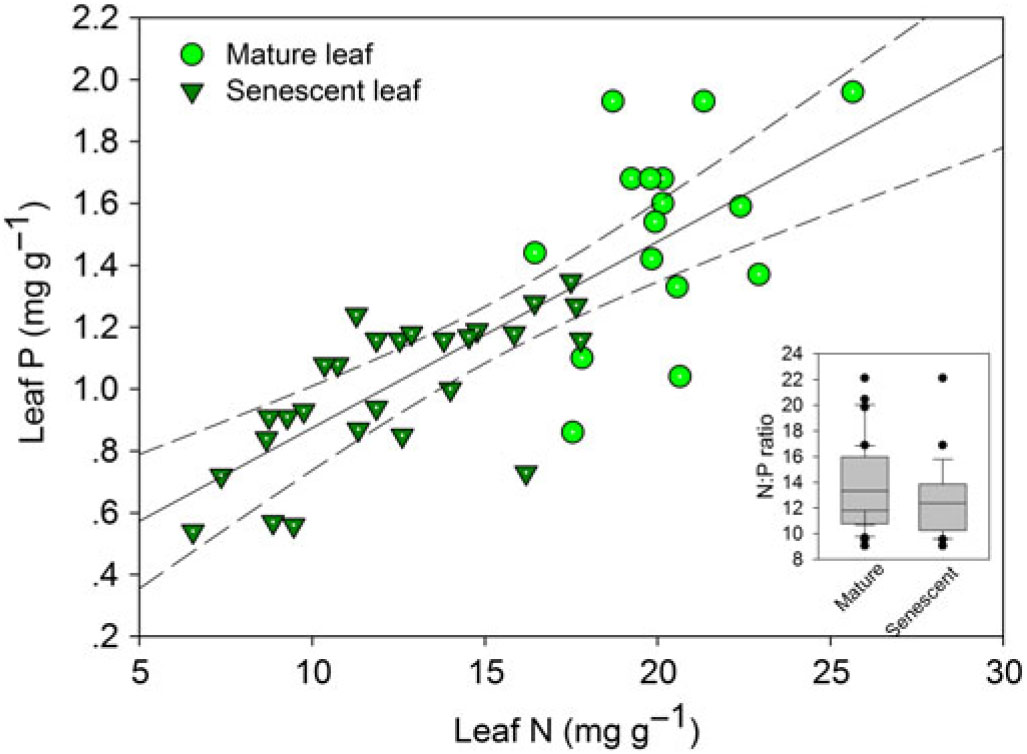
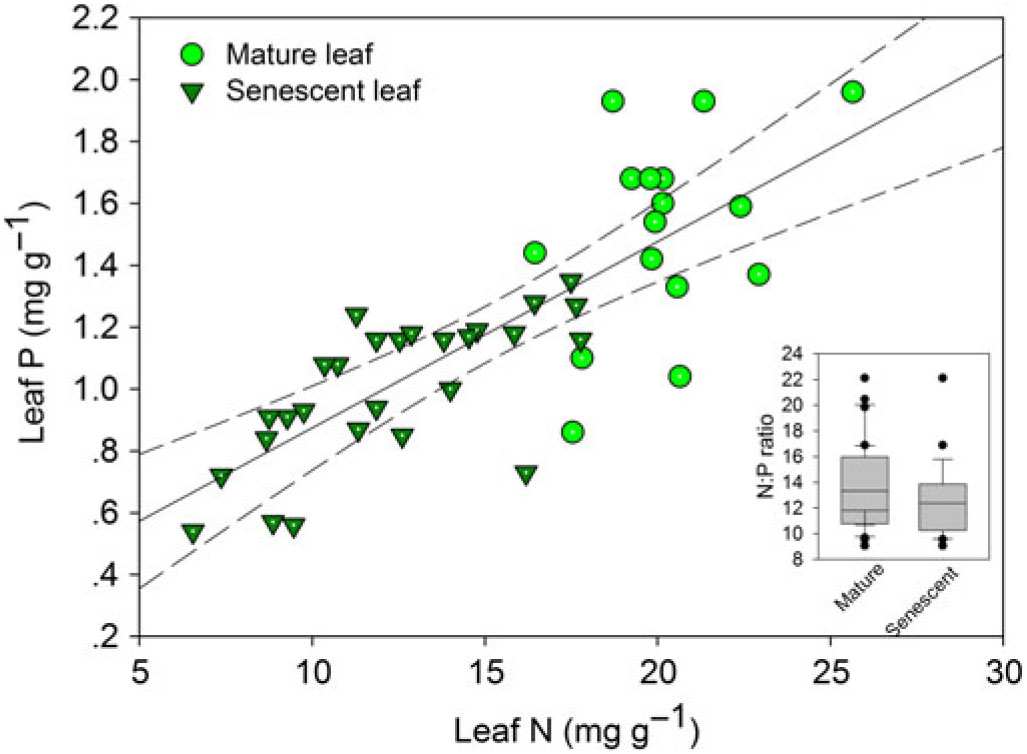
Distinct differences were found between mature and senescent leaves in δ13C and nutrient concentrations (P < 0.001), but no difference was detected in the N:P ratio (P > 0.05, Figure 1). Leaf δ13C was used to check leaf types (mature or senescent) because δ13C values are distinctly different between mature and senescent leaves (Kao et al. Reference Kao, Tsai, Shih, Tsai and Handley2002). Mature leaves were 0.62‰ more negative in δ13C (−29.64‰) than senescent leaves (−28.97‰, P = 0.008) regardless of fertilizer types. There was no difference between N-fertilized plants and P-fertilized plants (P = 0.806). The less negative δ13C of senescent leaves could be due to the differences of δ13C between the C pools in leaves: the structural C is less negative for δ13C than are starch, sugar or fats, which are commonly easily mobilized during senescence (Brendel Reference Brendel2001).
Relationship between N and P in leaves (mature and senescent leaves). The solid line is the correlation between N and P and the dashed lines represent 99% confidential interval.
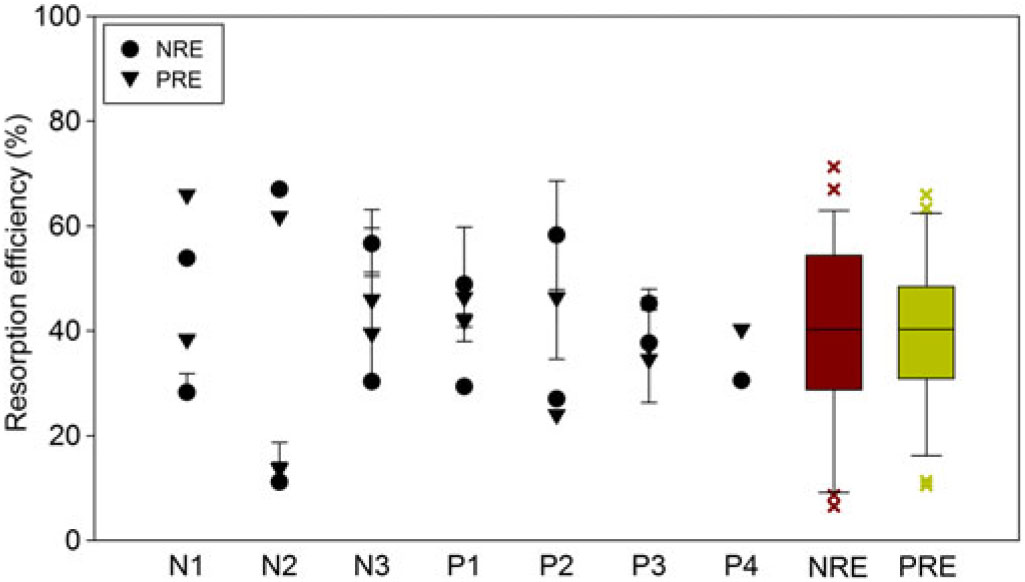
The difference in nutrient concentrations between mature and senescent leaves reflected the RE of nutrients. Mature leaves had 20.20 ± 0.56 mg g−1 (mean ± SE) of N and 1.55 ± 0.08 mg g−1 of P, while senescent leaves had 12.32 ± 0.62 mg g−1 of N and 1.00 ± 0.04 mg g−1 of P. The average RE was 39.86 ± 3.47% for N and 39.58 ± 2.90 % for P (Figure 2). Therefore, there was no difference in RE between N and P (P < 0.05).
Nutrient resorption efficiency across treatments. N1, N2 and N3 refer to nitrogen treatments and P1, P2, P3 and P4 refer to phosphorus treatments. NRE and PRE represent the resorption efficiency of nitrogen and phosphorus respectively.
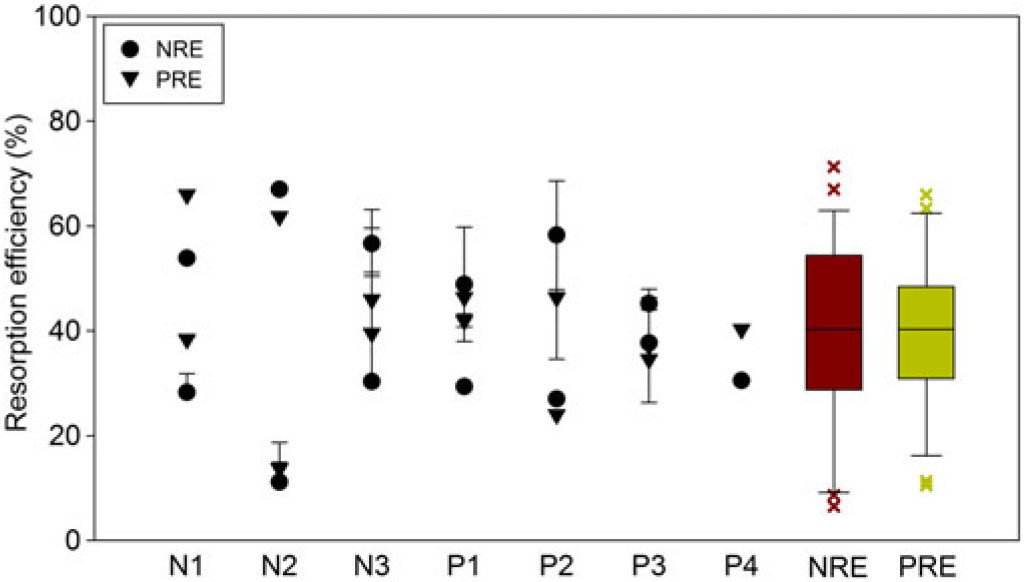
As predicted, the RE of A. corniculatum did not vary with increased nutrient availability (Figure 2). The average RE (∼40%) was lower than the global means (50% for N and 52% for P; Aerts Reference Aerts1996), indicating incomplete nutrient resorption by the plants. Unchanged RE in response to nutrient increase has been observed in other mangrove sites, such as Indian River Lagoon and Twin Cays, but in those sites, plant growth is limited by nutrient availability, and thus the unchanged RE may be due to the limited physiological capacity of plants to conserve nutrients during leaf senescence under nutrient stress (Feller et al. Reference Feller, Lovelock and Piou2009). In contrast, the plants in our study were under eutrophic conditions, so the non-response of RE to nutrient increase was more likely explained by the invulnerability of RE to nutrient enrichment.
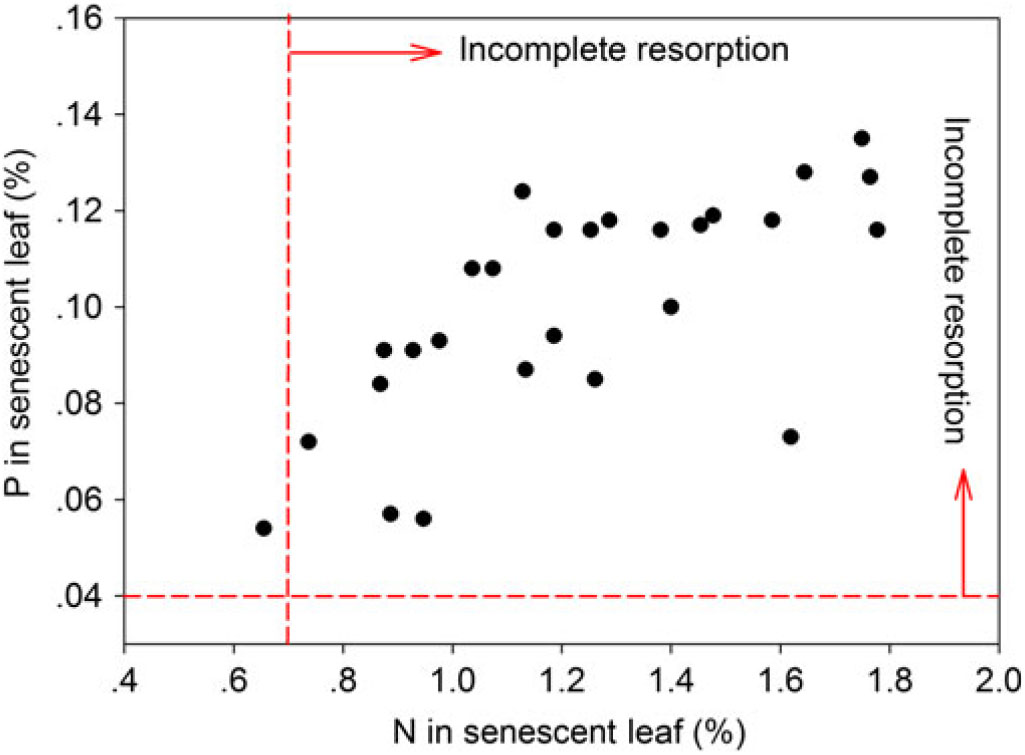
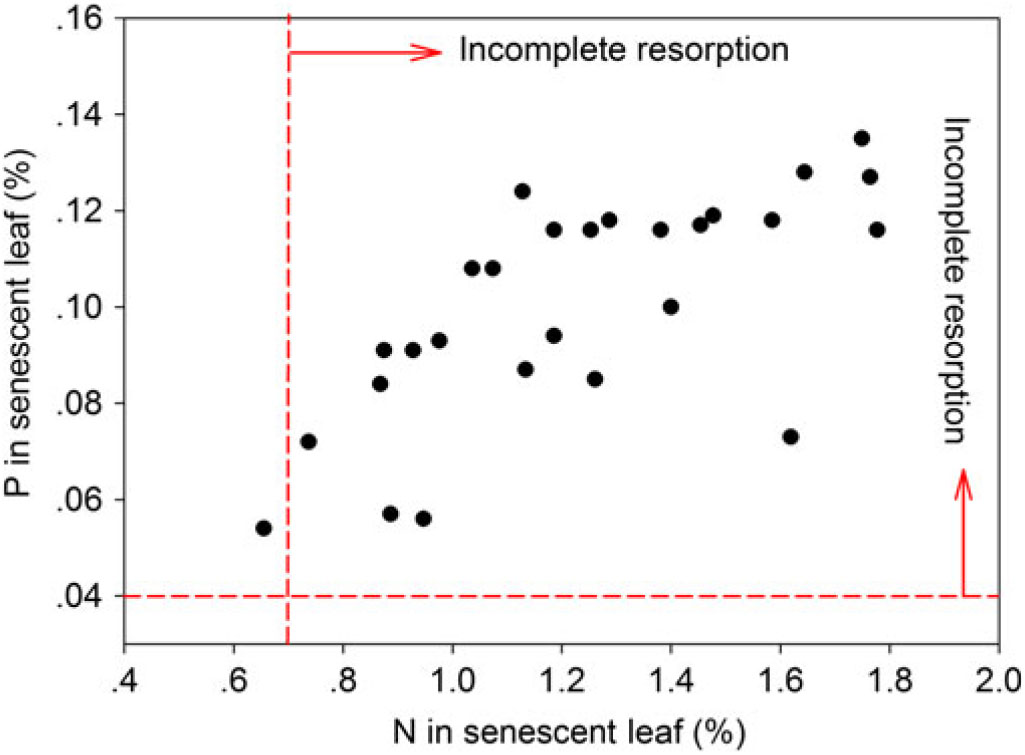
In addition to RE, RP is a particularly sensitive indicator of nutrient availability in wetlands (Rejmánková Reference Rejmánková2005). For evergreen plants, RP less than 0.7% for N and 0.04% for P indicates complete resorption (Killingbeck Reference Killingbeck1996). In our study, all data except one exceeded these values (0.66–1.78% for N and 0.05–0.14% for P, Figure 3), indicating incomplete resorption of N and P. Further evidence of incomplete resorption of A. corniculatum can be derived from its comparison with other mangrove species. For instance, the RP of A. corniculatum in our study was much higher than that of Rhizophora stylosa at Guangxi, China; its RP (0.15% for N and 0.06% for P) showed complete resorption of N and incomplete resorption of P (Lin et al. Reference Lin, Liu, Zhang, Fan and Lin2010). Rhizophora mangle at Twin Cays, Belize, showed unlimited P (RP was 0.011) in the fringe stand (seaward) and unlimited N (RP was 0.49 for N) in the dwarf stand (interior), respectively (Feller et al. Reference Feller, McKee, Whigham and O’Neill2003), and these levels of RP were substantially lower than the RP of A. corniculatum in our study.
Nutrient resorption proficiency across treatments. The red dashed lines highlight the values of 0.04% and 0.7% for the resorption proficiency of P and N respectively.
In conclusion, although the nutrient resorption efficiency was reduced under nutrient enrichment, indicated by the lower values than global means, the unchanged RE across the nutrient gradient suggests that black mangrove has a certain amount of resistance to eutrophication.
Acknowledgements
We thank National Natural Science Foundation of China (31570400) and The State Key Laboratory of Marine Environmental Science (MEL) at Xiamen University (MEL Visiting Fellowship, MELRS1312) for their financial support.