Introduction
Schizophrenia affects around 1% of the population and is among the most disabling and costly long-term conditions worldwide (Schizophrenia Commission, 2012). The mainstay of treatment is antipsychotic medications (NICE, 2014). Although patients typically experience remission of ‘positive symptoms’ (such as hallucinations and delusions) within the first few months of treatment, long-term outcomes are poor, as 80% of patients relapse within 5 years (Álvarez-Jiménez et al. Reference Álvarez-Jiménez, Parker, Hetrick, McGorry and Gleeson2011). Additionally, ‘negative symptoms’ (e.g. anhedonia and amotivation) are largely unresponsive to antipsychotic treatment but have a strong influence on functional outcomes (Kirkpatrick et al. Reference Kirkpatrick, Fenton, Carpenter and Marder2006; Alvarez-Jimenez et al. Reference Alvarez-Jimenez, Gleeson, Henry, Harrigan, Harris, Killackey, Bendall, Amminger, Yung and Herrman2012). Although psychosocial interventions (such as CBT) are effective for reducing residual symptoms in people with schizophrenia (Jauhar et al. Reference Jauhar, McKenna, Radua, Fung, Salvador and Laws2014), these are costly and inaccessible for the majority of patients (Schizophrenia Commission, 2012). Thus, novel interventions which can provide feasible adjunctive treatment are needed to support and sustain full psychosocial recovery.
It has been suggested that adjunctive treatment with certain vitamins and minerals may benefit people with psychiatric disorders (Rucklidge & Kaplan, Reference Rucklidge and Kaplan2013; Kaplan et al. Reference Kaplan, Rucklidge, Romijn and McLeod2015), as there are plausible biological mechanisms through which these nutrients may exert positive effects. Improvements may occur from resolving nutritional deficits, as diet quality is increasingly recognised as a risk for many psychiatric disorders (Sarris et al. Reference Sarris, Logan, Akbaraly, Amminger, Balanzá-Martínez, Freeman, Hibbeln, Matsuoka, Mischoulon and Mizoue2015), and people with schizophrenia are at much greater risk of poor diet (Dipasquale et al. Reference Dipasquale, Pariante, Dazzan, Aguglia, McGuire and Mondelli2013; Heald et al. Reference Heald, Sein, Anderson, Pendlebury, Guy, Narayan, Gibson, Haddad and Livingston2015). Consequently, patients often have a spectrum of vitamin and mineral deficiencies (Yanik et al. Reference Yanik, Kocyigit, Tutkun, Vural and Herken2004; Kale et al. Reference Kale, Naphade, Sapkale, Kamaraju, Pillai, Joshi and Mahadik2010; Valipour et al. Reference Valipour, Saneei and Esmaillzadeh2014), even prior to antipsychotic treatment. Serum indicators of reduced D and B vitamins have been found to hold significant associations with illness severity, particularly with regards to negative symptoms (Kale et al. Reference Kale, Naphade, Sapkale, Kamaraju, Pillai, Joshi and Mahadik2010; Graham et al. Reference Graham, Keefe, Lieberman, Calikoglu, Lansing and Perkins2015). Furthermore, these vitamin deficiencies are associated with neurological abnormalities observed in schizophrenia; such as hippocampal deterioration and cognitive impairments (Graham et al. Reference Graham, Keefe, Lieberman, Calikoglu, Lansing and Perkins2015; Shivakumar et al. Reference Shivakumar, Kalmady, Amaresha, Jose, Narayanaswamy, Agarwal, Joseph, Venkatasubramanian, Ravi, Keshavan and Gangadhar2015), perhaps due to the essential role these vitamins play in the biosynthesis of proteins which promote neuronal growth and repair.
Clinical benefits may also result from the anti-inflammatory and antioxidant properties of certain vitamins/minerals (Kaplan et al. Reference Kaplan, Rucklidge, Romijn and McLeod2015), as neuroinflammation and oxidative stress are increasingly implicated in schizophrenia onset and relapse (Miller et al. Reference Miller, Buckley, Seabolt, Mellor and Kirkpatrick2011; van Berckel et al. Reference Van Berckel, Bossong, Boellaard, Kloet, Schuitemaker, Caspers, Luurtsema, Windhorst, Cahn, Lammertsma and Kahn2011). These are potentially treatable conditions, which have been linked to negative symptoms and cognitive deficits in schizophrenia and may drive some of the neurological abnormalities which arise in schizophrenia (Meyer et al. Reference Meyer, Schwarz and Müller2011; Mondelli et al. Reference Mondelli, Cattaneo, Murri, Di Forti, Handley, Hepgul, Miorelli, Navari, Papadopoulos and Aitchison2011). Indeed, certain anti-inflammatory medications (Chaudhry et al. 2012) and even antioxidant nutrients (Berk et al. Reference Berk, Copolov, Dean, Lu, Jeavons, Schapkaitz, Anderson-Hunt, Judd, Katz, Katz and Ording-Jespersen2008) have already demonstrated some efficacy as adjunctive treatments for schizophrenia.
Recent narrative reviews have presented a strong case for the use of adjunctive nutrient treatments in people with schizophrenia (Arroll et al. Reference Arroll, Wilder and Neil2014; Brown et al. Reference Brown, Roffman and Wood2016). A 2016 meta-analysis of adjunctive treatments for depression found that certain vitamins and other nutrients can reduce clinical symptoms (Sarris et al. Reference Sarris, Murphy, Mischoulon, Papakostas, Fava, Berk and Ng2016). However, there is currently no systematic evaluation or meta-analytic evidence for the efficacy of vitamin and mineral supplementation in the treatment of schizophrenia.
Thus, the aim of this systematic review and meta-analysis is to establish the efficacy of vitamin and mineral supplements for people with schizophrenia; examining the effects on total symptom scores, along with positive and negative symptom domains. We also aimed to use meta-regression analyses to explore which nutrient strategies may be most effective, and how various patient characteristics may influence nutrient effectiveness.
Method
This meta-analysis followed the PRISMA statement (Moher et al. Reference Moher, Liberati, Tetzlaff and Altman2009) for transparent and comprehensive reporting.
Search strategy
We conducted an electronic database search of Cochrane Central Register of Controlled Trials, Health Technology Assessment Database, AMED (Allied and Complementary Medicine), HMIC Health Management Information Consortium, Ovid MEDLINE, PsycINFO, EMBASE from inception to July 2016. We structured our search according to the PICO framework (Schardt et al. Reference Schardt, Adams, Owens, Keitz and Fontelo2007), using search terms relevant to schizophrenia, along with 44 nutrient terms, in order to return all potentially eligible studies (see Supplement 1). A search of Google Scholar was conducted to identify any additional relevant articles, and reference lists of retrieved articles were also searched.
Eligibility criteria
Articles were screened by two independent reviewers (J.F. and B.S.). Disagreements were resolved through discussion until consensus was reached. We included all randomized controlled trials (RCTs) reporting psychiatric outcomes of vitamin and/or mineral supplements for people with schizophrenia from database inception to June 2016. Eligible samples were those in which >90% of participants had a diagnosis of a non-affective psychotic disorder (such as schizophrenia, schizoaffective or schizophreniform disorder), regardless of age, ethnicity or sample size. Studies in which <90% of the sample had a non-affective psychotic disorder were only eligible if the data specifically for the non-affective psychosis subgroup was reported separately. Only English-language research articles were included in the review.
Eligible interventions were those which administered any vitamins and/or essential mineral supplements (hereafter referred to as ‘nutrient supplements’) as an adjunctive to usual medication regimens, and compared this to placebo nutrients (plus usual medication), or usual medication alone. Studies which compared nutrient supplements to antipsychotic medications were not eligible for inclusion. Both studies which used single-nutrient supplements and those which combined two or more nutrients were eligible, provided that the specific individual ingredients (and dosage) were reported. However, only studies lasting ⩾5 days were included. Where reported study data was insufficient to determine eligibility, the corresponding authors were contacted twice over a period of 8 weeks to request the necessary information. Additional information was obtained for one study via this method (Bentsen et al. Reference Bentsen, Osnes, Refsum, Solberg and Bohmer2013).
Data extraction
A systematic data extraction form was used to extract the following from each study:
-
(1) Primary outcome: Total psychiatric symptoms. This was defined as total score on any clinically validated rating scale used for assessing the severity of psychiatric symptoms in people with schizophrenia. All psychiatric outcome measures are shown in Table 1. For studies which applied more than one relevant measure, the average change across all measures used for the pooled analysis. For studies which did not use a total score but instead reported changes in positive, negative and general symptoms separately, these were also pooled to calculate an average overall change score.
-
(2) Secondary outcomes: Individual symptom domains. Changes in individual symptom domains were also examined separately to establish the discrete effects of nutrient supplements on positive symptoms, negative symptoms and general symptoms of schizophrenia.
-
(3) Potential moderators. Factors which may moderate the effectiveness of nutrient supplements for schizophrenia were also extracted from each study, including intervention details (nutrients used, daily dosage, intervention length), study design (cross-over v. parallel designs, control condition used, trial quality) and sample characteristics (mean age, years of illness, % male, antipsychotic dosage in chlorpromazine equivalents; Woods, Reference Woods1899).
-
(4) Adverse events. Any information on adverse events which occurred during the trials or side-effects of treatment reported by participants was extracted for narrative synthesis.
Details of included studies

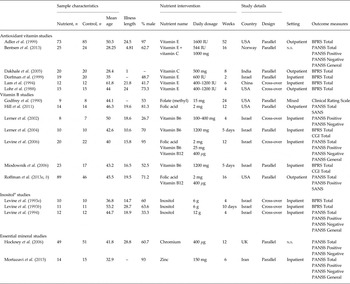
BPRS, Brief Psychiatric Rating Scale; CGI, Clinical Global Impressions Scale; IU, international units; n.s., not specified; PANSS, Positive and Negative Syndrome Scale; SANS, Scale for the Assessment of Negative Symptoms.
a Previously considered vitamin B8.
Statistical analyses
Meta-analyses were conducted in Comprehensive Meta-Analysis 2.0 (Borenstein et al. Reference Borenstein, Hedges, Higgins and Rothstein2005) using a DerSimonian–Laird random-effects model (van der Kemp et al. Reference van der Kemp, Klomp, Kahn, Luijten and Hulshoff Pol2012) to account for heterogeneity between studies. The mean change in total symptom scores were pooled using a DerSimonian–Laird random-effects model (van der Kemp et al. Reference van der Kemp, Klomp, Kahn, Luijten and Hulshoff Pol2012) to calculate a standardized mean difference (as Hedges’ g) with 95% confidence intervals (CI) for nutrient and placebo conditions. In cases where raw change scores were unavailable, t values or F statistics were used instead. Where sufficient data was available (i.e. >2 studies), effect sizes were also calculated for individual measures of total symptoms, and subdomains of positive symptoms, negative symptoms and general symptoms individually.
Between-study heterogeneity was assessed using Cochran's Q and I 2 estimates, both of which quantify the amount of statistical heterogeneity due to variance between studies, rather than by arising by chance. The Cochrane Collaboration's risk of bias tool (Higgins et al. Reference Higgins, Altman, Gøtzsche, Jüni, Moher, Oxman, Savović, Schulz, Weeks and Sterne2011) was applied for determining the quality of each included study, through assessing six aspects of trial design that could introduce different sources of bias. Sensitivity analyses were then used to investigate if significant effects were still present after removing low-quality trials. To examine the potential of publication bias influencing results, Eggers’ t test used. Where a significant risk of publication bias was detected, a ‘file draw analysis’ was conducted to calculate a ‘fail-safe N’ (Orwin, Reference Orwin1983); the approximate number of unpublished studies which must exist to invalidate the results of the meta-analysis (i.e. the number of null studies required to cause the p value to exceed 0.05). Additionally, a funnel plot for assessing risk of bias was generated for each analysis to inspect asymmetry of effect sizes (Duval & Tweedie, Reference Duval and Tweedie2000), and Duval & Tweedie's trim-and-fill analysis was applied to recalculate the effect size after removing any extreme small studies from the positive side of the funnel plot.
Subgroup analyses were conducted for different nutrient types, in order to examine relative effectiveness of nutrients within the classes of; (i) trace minerals, (ii) major minerals, (iii) B vitamins, (iv) antioxidant vitamins and (v) other vitamins. Subgroup analyses were also applied to compare intervention effectiveness in inpatient v. outpatient settings. Additionally, meta-regression analyses were used to examine the relationship between study effect sizes and continuous moderators which may impact upon the outcomes of nutrient interventions.
Results
Search results
The initial database search was performed on 24 July 2016. The search returned 2217 results reduced to 1510 after duplicates were removed. A further 1445 articles were excluded after reviewing the titles and abstracts for eligibility. Full versions were retrieved for 68 articles, of which 18 articles with unique samples were eligible for inclusion. The full article screening and selection process is detailed in Fig. 1.
PRISMA flow diagram of study selection.

Included studies and participant details
Study details are displayed in Table 1. Eight studies were conducted in Israel, five in the USA, and one each in India, China, UK, Iran and Norway. For assessing total symptoms, eight studies used the Positive and Negative Syndrome Scale (PANSS; Kay et al. Reference Kay, Flszbein and Opfer1987), nine used the Brief Psychiatric Rating Scale (BPRS; Overall & Gorham, Reference Overall and Gorham1962) and two used the Clinical Global Impressions scale (CGI; Guy, Reference Guy1976). Individual domains of positive and negative symptoms were assessed using the PANSS subscales in seven studies, and the Scale for the Assessment Negative Symptoms (SANS) in two studies (Andreasen, Reference Andreasen1989). Outcome data for was available for 433 patients in nutrient treatments, and 399 patients in control conditions. In the eligible samples, 99.5% had a diagnosis of schizophrenia/schizoaffective disorder, and 0.5% had bipolar disorder. The mean age was 42.8 years (range 28–53 years) and 70.2% were male. Duration of illness was reported in 15 studies (n = 747), with a mean duration of 17.2 years (range 1–28.8 years). Antipsychotic dosage was reported in 12 studies (n = 473), with a mean chlorpromazine-equivalent dose of 423.7 mg per day (166–900 mg). No studies reported significant differences in antipsychotic medications at baseline between active and placebo conditions. No studies selectively recruited participants on the basis of diet quality at baseline. However, one study selectively recruited participants by blood-folate levels (Godfrey et al. Reference Godfrey, Toone, Bottiglien, Laundy, Reynolds, Carney, Flynn and Chanarin1990), and another by elevated homocysteine (Levine et al. Reference Levine, Stahl, Sela, Ruderman, Shumaico, Babushkin, Osher, Bersudsky and Belmaker2006).
Nutrient treatments lasted an average of 10.3 weeks (range 5 days to 1 year). All nutrient treatments were administered as an adjunctive to antipsychotic medications. Results of bias assessment are presented in Supplement 2. The most common risk of bias was due to missing outcome data with lack of intention-to-treat (ITT) analyses (seven studies).
Effects of B vitamins on psychiatric symptoms
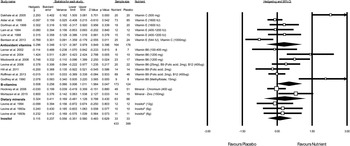
Seven studies examined the effects of vitamin B supplementation in schizophrenia: vitamin B6 alone (Lerner et al. Reference Lerner, Miodownik, Kaptsan, Cohen, Loewenthal and Kotler2002, Reference Lerner, Bergman, Statsenko and Miodownik2004; Miodownik et al. Reference Miodownik, Lerner, Statsenko, Dwolatzky, Nemets, Berzak and Bergman2006), folate supplement alone (Godfrey et al. Reference Godfrey, Toone, Bottiglien, Laundy, Reynolds, Carney, Flynn and Chanarin1990; Hill et al. Reference Hill, Shannahan, Jasinski, Macklin, Raeke, Roffman and Goff2011), folic acid with vitamin B12 (Roffman et al. Reference Roffman, Lamberti, Achtyes, Macklin, Galendez, Raeke, Silverstein, Smoller, Hill and Goff2013b ) or folic acid with vitamins B6 and B12 (Levine et al. Reference Levine, Stahl, Sela, Ruderman, Shumaico, Babushkin, Osher, Bersudsky and Belmaker2006). Dosages are displayed in Table 1. Psychiatric outcome data from seven pooled vitamin B RCTs (n = 297) found a significant positive effect on total symptom scores (g = 0.51, 95% CI 0.01–1.01, p = 0.047). However, there was significant statistical heterogeneity across the study data (Q = 21.6, p < 0.01, I 2 = 72.3%). Fig. 2 displays the effectiveness of vitamin B supplements for reducing psychiatric symptoms in schizophrenia at each dosage studied. Eggers’ regression test found no evidence of publication bias (p = 0.11), and the fail-safe N was 14, indicating that 14 additional ‘null’ studies would be needed for the observed p value to exceed 0.05. The results remained unchanged after applying the trim-and-fill analysis, as this did not identify any extreme small studies affecting results.
Meta-analysis of the effects of vitamin and mineral supplements on psychiatric symptoms of schizophrenia. Box size represents study weighting. Diamond represents overall effect size and 95% confidence intervals. * Previously considered vitamin B8.

Sensitivity analyses were performed to examine effects of vitamin B supplements among the high-quality RCTs which used ITT analyses (or had complete outcome data). In these high-quality trials (N = 5, n = 227), there was a moderate-to-large positive effect of B vitamins on total symptom scores (g = 0.734), although the p value fell short of statistical significance (p = 0.051, 95% CI 0.00–1.49), again with significant heterogeneity across studies (Q = 19.6, p < 0.01, I 2 = 79.6). Eggers’ test provided no evidence of publication bias influencing this analysis (p = 0.13).
The effects of B vitamins in individual domains of positive and negative symptoms were reported in three (n = 192) and four (n = 220) studies, respectively. Meta-analyses found no significant effect of B vitamins on either positive symptoms (g = 0.26, 95% CI −0.24 to 0.76, p = 0.31) or negative symptoms (g = 0.154, 95% CI −0.12 to 0.42, p = 0.26). Furthermore, no significant effects of B vitamins were observed when restricting analyses to include only those studies which measured total psychiatric symptoms using the PANSS total scale (N = 3, n = 247, g = 0.320, 95% CI −0.5 to 1.14, p = 0.45).
Vitamin B6 was the only B vitamin to be examined alone in two or more studies (N = 3, n = 75), and thus suitable for individual meta-analysis. The effect of vitamin B6 alone on psychiatric symptoms did not reach statistical significance (g = 0.682, 95% CI −0.09 to 1.45, p = 0.08). There was also no effect of vitamin B6 on positive and negative symptom subdomains (Lerner et al. Reference Lerner, Miodownik, Kaptsan, Cohen, Loewenthal and Kotler2002).
Vitamin B9 (folate) was used in four studies, although was not suitable for individual meta-analysis as it was administered in combination with other B vitamins. Individual studies found that there were no benefits of folic acid alone (2 mg) or folic acid plus B12 (2 mg and 400 µg) for either PANSS total scores, the PANSS positive subscale, or SANS scores (Hill et al. Reference Hill, Shannahan, Jasinski, Macklin, Raeke, Roffman and Goff2011; Roffman et al. Reference Roffman, Brohawn, Nitenson, MacKlin, Smoller and Goff2013a ). However, in the study which selected participants with low blood-folate at baseline, 15 mg methylfolate daily for 6 months significantly reduced total symptom scores (Godfrey et al. Reference Godfrey, Toone, Bottiglien, Laundy, Reynolds, Carney, Flynn and Chanarin1990). Additionally, a vitamin B combination supplement (2 mg folic acid, 400 μg B12, 25 mg B6) significantly reduced PANSS total scores after 3 months among 42 patients with schizophrenia who had elevated homocysteine (p = 0.019) (Levine et al. Reference Levine, Stahl, Sela, Ruderman, Shumaico, Babushkin, Osher, Bersudsky and Belmaker2006).
Subgroup analyses showed that effects of B vitamins on total symptom scores of inpatients (N = 4, n = 117, g = 0.584, 95% CI 0.06 to 1.11, p = 0.03) were significantly greater than effects for outpatients (N = 2, n = 163, g = −0.051, 95% CI −0.37 to 0.27, p = 0.75). Meta-regression found that publication year was negatively associated with observed effect size (Supplement 3); as effects of vitamin B interventions on total symptom scores decreased in more recent studies (B = −0.086, s.e. = 0.028, Z = −3.08, p = 0.002). Vitamin B effectiveness was also significantly correlated with illness duration, as B vitamins reduced symptoms to a greater extent when used in earlier years of illness (N = 6, n = 280, B = −0.166, s.e. = 0.052, Z = −3.2, p = 0.001). However, there were no associations of effectiveness with sample size, age, study duration or gender (all p > 0.01). There was insufficient study data to examine relationship between antipsychotic dose and treatment effect size.
Three studies (n = 66) examined the effects of inositol supplementation on psychiatric symptoms in schizophrenia (Levine et al. Reference Levine, Gonsalves, Babur, Stier, Elizur, Kofman and Belmaker1993a , Reference Levine, Umansky, Ezrielev and Belmaker b , Reference Levine, Goldberger, Rapaport, Schwartz, Schield, Elizur, Belmaker, Shapiro and Agam1994). These were analysed separately, but still included in this review section since inositol was previously considered vitamin B8 and is still used as a nutritional supplement. Meta-analyses found no overall effect of 6–12 g daily inositol on total symptoms scores (g = 0.115, 95% CI −0.35 to 0.58, p = 0.63).
Effects of antioxidant vitamins on psychiatric symptoms
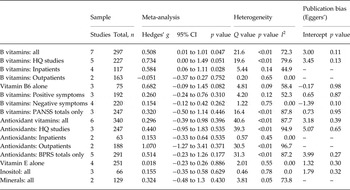
Six studies used antioxidant vitamins: vitamin E and vitamin C combined (Bentsen et al. Reference Bentsen, Osnes, Refsum, Solberg and Bohmer2013), vitamin E alone (Lohr et al. Reference Lohr, Cadet, Lohr, Larson, Wasli, Wade, Hylton, Vidoni, Jeste and Wyatt1988; Lam et al. Reference Lam, Chiu and Hung1994, Adler et al. Reference Adler, Rotrosen, Edson, Lavori, Lohr, Hitzemann, Raisch, Caligiuri and Tracy1999; Dorfman-Etrog et al. Reference Dorfman-Etrog, Hermesh, Prilipko, Weizman and Munitz1999), or vitamin C alone (Dakhale et al. Reference Dakhale, Khanzode, Khanzode and Saoji2005). As shown in Table 2 and Fig. 2, there was no effect from antioxidant vitamins on total symptom scores across all trials (N = 6, n = 340, g = 0.296, 95% CI −0.39 to 0.98, p = 0.40, Q = 40.6, I 2 = 87.7), or in high-quality trials (N = 3, n = 247, g = 0.44, 95% CI −0.95 to 1.83, p = 0.54, Q = 39.3, I 2 = 94.9).
Meta-analyses of vitamin and mineral supplements on psychiatric symptoms in people with schizophrenia

CI, Confidence interval; BPRS, Brief Psychiatric Rating Scale; HQ, high quality; PANSS, Positive and Negative Syndrome Scale.
The four studies examining vitamin E alone primarily aimed to reduce extrapyramidal side-effects of medications, however there was no effect on total psychiatric symptoms (n = 251, g = 0.018, 95% CI −0.23 to 0.26, p = 0.89). The sole study of vitamin C alone observed significantly greater reductions in BPRS symptom scores in the nutrient group (n = 20) than the placebo condition (n = 20) after 8 weeks of treatment with 500 mg vitamin C daily (p < 0.01).
Effects of antioxidant vitamins on total symptoms scored using the BPRS were reported in five studies, and found no overall effect (n = 291, g = 0.514, 95% CI −0.23 to 1.26, p = 0.18). PANSS symptom domains were only reported one study, which combined vitamin E (544 IU daily) with vitamin C (1000 mg daily) in acute psychosis patients (Bentsen et al. Reference Bentsen, Osnes, Refsum, Solberg and Bohmer2013). The study observed significant negative effects from vitamin treatment in positive and negative symptoms in comparison to placebo conditions.
Antioxidant supplementation was equally ineffective in both inpatient and outpatient studies (Table 2). Meta-regression analyses found no relationship between antioxidant effectiveness with age, sample size, illness duration, study duration or year of publication (all p > 0.1). However, among the four studies which reported chlorpromazine-equivalent antipsychotic dosages, lower doses were associated greater symptomatic improvements following antioxidant supplementation (N = 4, n = 221, B = −0.009, s.e. = 0.003, Z = −2.84, p = 0.004) (Supplement 3).
Effects of mineral supplements on psychiatric symptoms
Two studies investigated the effects of mineral supplements (zinc and chromium) on psychiatric symptoms (Hockney et al. Reference Hockney, Montgomery, Williams, Geddes and Cowen2006; Mortazavi et al. Reference Mortazavi, Farzin, Zarhghami, Hosseini, Mansoori and Nateghi2015). Random-effects meta-analyses found no overall effect (N = 2, n = 129, g = 0.324, 95% CI −0.48 to 1.30, p = 0.430), although there was significant heterogeneity between studies (Q = 3.81, p = 0.05, I 2 = 73.8%). Specifically, 150 mg zinc per day significantly reduced total PANSS scores after 6 weeks in comparison to placebo treatment (n = 29, p = 0.003), with significant benefits also evident in individual domains of positive (p = 0.04) and negative (p = 0.02) symptom subscales, but not for general symptoms (Mortazavi et al. Reference Mortazavi, Farzin, Zarhghami, Hosseini, Mansoori and Nateghi2015). Conversely, there were no significant differences across 100 patients with schizophrenia after 12 weeks of receiving either 400 µg chromium daily or placebo supplements in PANSS total scores (p = 0.88), or positive and negative symptoms (Hockney et al. Reference Hockney, Montgomery, Williams, Geddes and Cowen2006).
Adverse effects of nutrient interventions
Ten of the 18 studies reported on side-effects and/or adverse events during the trial. Six studies observed no side-effects/adverse events at all. Two studies did observe serious adverse events during the trials (hospitalization due to psychosis), but determined that these were unrelated to the treatment and did not differ between nutrient and placebo conditions (Bentsen et al. Reference Bentsen, Osnes, Refsum, Solberg and Bohmer2013; Roffman et al. Reference Roffman, Lamberti, Achtyes, Macklin, Galendez, Raeke, Silverstein, Smoller, Hill and Goff2013b ). One study withdrew a single participant from zinc treatment following a maculopapular reaction, although causality was unclear (Mortazavi et al. Reference Mortazavi, Farzin, Zarhghami, Hosseini, Mansoori and Nateghi2015). Furthermore, one vitamin E study observed minor side-effects (including flu-like symptoms and stomach complaints) in 11–22% of patients over 12 months of treatment, but reported that no serious adverse events occurred during the trial (Adler et al. Reference Adler, Rotrosen, Edson, Lavori, Lohr, Hitzemann, Raisch, Caligiuri and Tracy1999).
Discussion
This is the first meta-analysis to examine the effects of vitamin and mineral supplements as an adjunctive treatment for people with schizophrenia. The systematic search identified 18 RCTs with a combined sample size of 832 patients receiving antipsychotic treatment for schizophrenia (Table 1). Overall, antioxidant vitamins, inositol, and minerals were no more effective than placebo treatments for reducing psychiatric symptoms. On the other hand, pooled effects of vitamin B interventions showed these were moderately more effective than placebo treatments.
However, there was significant heterogeneity among trial outcomes, as data from different types, doses and durations of vitamin B treatment were pooled for this analysis, which limits the strength of these findings. Nonetheless, systematic review of individual study findings provides some further insight into which vitamin B interventions may be most effective. Vitamin B interventions which used higher dosages (Godfrey et al. Reference Godfrey, Toone, Bottiglien, Laundy, Reynolds, Carney, Flynn and Chanarin1990; Lerner et al. Reference Lerner, Bergman, Statsenko and Miodownik2004; Miodownik et al. Reference Miodownik, Lerner, Statsenko, Dwolatzky, Nemets, Berzak and Bergman2006) or combined several vitamins (Levine et al. Reference Levine, Stahl, Sela, Ruderman, Shumaico, Babushkin, Osher, Bersudsky and Belmaker2006) were consistently effective for reducing psychiatric symptoms, whereas those which used lower doses were ineffective (Lerner et al. Reference Lerner, Miodownik, Kaptsan, Cohen, Loewenthal and Kotler2002; Hill et al. Reference Hill, Shannahan, Jasinski, Macklin, Raeke, Roffman and Goff2011; Roffman et al. Reference Roffman, Lamberti, Achtyes, Macklin, Galendez, Raeke, Silverstein, Smoller, Hill and Goff2013b ). The hypothesized mechanisms for these improvements is the reduction of folate deficiencies and hyperhomocysteinaemia, as both of these are prevalent among people with schizophrenia, and could contributed to impaired mental health and brain functioning in this population (Misiak et al. Reference Misiak, Frydecka, Slezak, Piotrowski and Kiejna2014; Moustafa et al. Reference Moustafa, Hewedi, Eissa, Frydecka and Misiak2014). Indeed, the two trials which selected participants on the basis of indicated nutritional deficits (i.e. elevated homocysteine or low blood-folate) found that reductions in psychiatric symptoms where accompanied by improvements in these variables (Godfrey et al. Reference Godfrey, Toone, Bottiglien, Laundy, Reynolds, Carney, Flynn and Chanarin1990; Levine et al. Reference Levine, Stahl, Sela, Ruderman, Shumaico, Babushkin, Osher, Bersudsky and Belmaker2006). It makes intuitive sense that a nutrient is likely to be of greater value in the presence of insufficiency. However, the role of genetic variation should also be considered, since two folate supplementation studies which found no overall effects (Hill et al. Reference Hill, Shannahan, Jasinski, Macklin, Raeke, Roffman and Goff2011; Roffman et al. Reference Roffman, Brohawn, Nitenson, MacKlin, Smoller and Goff2013a ) did observe significantly reduced symptoms when stratifying the sample by genotype; as participants with low-functioning variants of a gene which regulates folate metabolism benefitted most from vitamin B supplementation (Hill et al. Reference Hill, Shannahan, Jasinski, Macklin, Raeke, Roffman and Goff2011; Roffman et al. Reference Roffman, Brohawn, Nitenson, MacKlin, Smoller and Goff2013a ). This is the premise of biomarker stratification of therapy and personalised medicine, and the next generation of nutritional interventions may well need to index baseline diet quality, nutritional status and genotype as entry criterions.
The available evidence also suggests that vitamin B supplements may be most beneficial when implemented early on, as duration of illness was negatively correlated with treatment effectiveness. Studies of fish oils have also reported benefits for people with first-episode psychosis (Pawelczyk et al. Reference Pawelczyk, Grancow-Grabka, Kotlicka-Antczak, Trafalska and Pawelczyk2016), as opposed to the lack of efficacy observed in long-term patients (Fusar-Poli & Berger, Reference Fusar-Poli and Berger2012). The first-episode phase may present an optimal period for using adjunctive nutrient supplements to improve mental health, as antipsychotics also work better during the early stages of illness (Barnes, Reference Barnes2011; Berk et al. Reference Berk, Brnabic, Dodd, Kelin, Tohen, Malhi, Berk, Conus and McGorry2011; NICE, 2010), and there is the possibility of maximising functional recovery during this time (Alvarez-Jimenez et al. Reference Alvarez-Jimenez, Gleeson, Henry, Harrigan, Harris, Killackey, Bendall, Amminger, Yung and Herrman2012).
Although certain antioxidants (such as vitamin E) may be beneficial for reducing extrapyramidal side-effects of antipsychotic treatments (Soares & McGrath, Reference Soares and McGrath1999), this meta-analysis found no significant effects on psychiatric symptoms. Vitamin E alone was consistently ineffective (Lohr et al. Reference Lohr, Cadet, Lohr, Larson, Wasli, Wade, Hylton, Vidoni, Jeste and Wyatt1988; Adler et al. Reference Adler, Rotrosen, Edson, Lavori, Lohr, Hitzemann, Raisch, Caligiuri and Tracy1999; Dorfman-Etrog et al. Reference Dorfman-Etrog, Hermesh, Prilipko, Weizman and Munitz1999; Lam et al. Reference Lam, Chiu and Hung1994), whereas vitamin C alone had a large positive effect (Dakhale et al. Reference Dakhale, Khanzode, Khanzode and Saoji2005). Meta-regression analyses indicated that antioxidant vitamins were most effective among patients taking lower doses of antipsychotic treatment. Although there is insufficient data to determine why this is the case, it is possible this may be due to a ‘ceiling-limit’ effect, as antipsychotics such as clozapine have antioxidant properties (Libera et al. 1998) which, at higher doses, may prevent any observable benefits from further antioxidant supplementation.
It should be also noted that significant negative effects of antioxidant supplementation was observed by one study; which combined high-dose vitamin C (1000 mg daily) with vitamin E (544 IU daily) as an adjunctive intervention for acute patients (Bentsen et al. Reference Bentsen, Osnes, Refsum, Solberg and Bohmer2013). The authors suggest this may be due to the vitamin E acting as a pro-oxidant among acute patients when administered alongside high-dose vitamin C, and thus exacerbating symptoms. Research in other populations has also raised concerns around antioxidant vitamins, as over-supplementation may induce further oxidative damage and even increase mortality risk (Rietjens et al. Reference Rietjens, Boersma, de Haan, Spenkelink, Awad, Cnubben, van Zanden, van der Woude, Alink and Koeman2002; Guallar et al. Reference Guallar, Stranges, Mulrow, Appel and Miller2013). Interestingly however, the Bentsen et al. (Bentsen et al. Reference Bentsen, Osnes, Refsum, Solberg and Bohmer2013) study additionally found that adding EPA (2 g daily) to the vitamin E + C combination ameliorated the negative effects (Bentsen et al. Reference Bentsen, Osnes, Refsum, Solberg and Bohmer2013). Previous open-label studies which combined vitamins E and C with EPA have also shown significant positive effects on psychiatric outcomes among stabilized patients with residual symptoms (Arvindakshan et al. Reference Arvindakshan, Ghate, Ranjekar, Evans and Mahadik2003; Sivrioglu et al. Reference Sivrioglu, Kirli, Sipahioglu, Gursoy and Sarandol2007).
Several limitations must be considered when interpreting the findings of this meta-analysis. First, although vitamin interventions reduced total symptoms, we were unable to provide any meta-analytic evidence of significant benefits within any individual measure (i.e. PANSS totals or BPRS totals alone), or in any specific subdomain of positive/negative symptoms (all p > 0.1) (Table 2). These null effects may be due to the smaller sample sizes available for these analyses. Future trials should aim to establish which vitamins and minerals interventions (if any) can be used to treat specific symptoms of schizophrenia. For instance, individual trials to date have shown significant reductions in residual positive symptoms from a combination vitamin B supplement (Levine et al. Reference Levine, Stahl, Sela, Ruderman, Shumaico, Babushkin, Osher, Bersudsky and Belmaker2006) and zinc (Mortazavi et al. Reference Mortazavi, Farzin, Zarhghami, Hosseini, Mansoori and Nateghi2015), whereas folic acid has been found to be effective in reducing negative symptoms among patients with genetic variations which inhibit folate absorption (Hill et al. Reference Hill, Shannahan, Jasinski, Macklin, Raeke, Roffman and Goff2011; Roffman et al. Reference Roffman, Lamberti, Achtyes, Macklin, Galendez, Raeke, Silverstein, Smoller, Hill and Goff2013b ). Further research in this area this would increase our understanding of using nutrients for targeting residual symptoms on a patient-by-patient basis.
The positive results of the vitamin B meta-analysis may also have been influenced by a lack of ITT analyses, publication bias, and the heterogeneity between included studies. However, there was no evidence of publication bias, and no alteration of effect size after applying a trim-and-fill analysis. Furthermore, we used sensitivity analyses to show that benefits of B vitamins were still indicated by five high-quality RCTs with complete outcome data (g = 0.734, p = 0.051). Although subgroup and regression analyses were conducted to investigate the possible sources of heterogeneity, there was insufficient data reported to examine other putative factors which may influence nutrient effectiveness, including the presence of metabolic syndrome, obesity, diabetes and smoking.
In conclusion, high-dose B vitamins may be useful for reducing residual symptoms in people with schizophrenia, although there was significant heterogeneity among study findings, and some indication that these overall effects may be driven by larger benefits among subgroups of patients who have relevant genetic or dietary nutritional deficiencies. Vitamin C and zinc have also been found to reduce symptoms of schizophrenia, although both of these effects have only been observed in single studies to date, which have yet to be replicated. Additionally, despite the growing evidence base for neonatal vitamin D deficiency and developmental onset of psychosis (McGrath et al. Reference McGrath, Burne, Féron, Mackay-Sim and Eyles2010a , Reference McGrath, Eyles, Pedersen, Anderson, Ko, Burne, Norgaard-Pedersen, Hougaard and Mortensen b ) along with the evidence for considerable vitamin D deficiency in FEP (Graham et al. Reference Graham, Keefe, Lieberman, Calikoglu, Lansing and Perkins2015) and established schizophrenia (Lally et al. Reference Lally, Gardner-Sood, Firdosi, Iyegbe, Stubbs, Greenwood, Murray, Smith, Howes and Gaughran2016), we found no RCT that investigated the influence of vitamin D on psychiatric symptoms. Clearly, this is an area which warrants future research (McGrath, Reference McGrath2010).
While determining the relative effectiveness of individual nutrients for schizophrenia is important, large-scale RCTs in other populations have shown that general broad-spectrum micronutrient formulas can improve various aspects of mental health and functioning, including; treating symptoms of ADHD in adults (Rucklidge et al. Reference Rucklidge, Frampton, Gorman and Boggis2014), reducing psychological distress following traumatic events (Rucklidge et al. Reference Rucklidge, Andridge, Gorman, Blampied, Gordon and Boggis2012), and lowering risk of criminal behaviour (Gesch et al. Reference Gesch, Hammond, Hampson, Eves and Crowder2002). Furthermore, this approach may be less likely to result in imbalances which can occur from single-nutrient treatments (Rucklidge & Kaplan, Reference Rucklidge and Kaplan2013; Rucklidge et al. Reference Rucklidge, Johnstone and Kaplan2013). It should also be considered that dietary interventions, which address whole diet quality, may be more able to treat the range of deficiencies which may affect patients, while also reducing the excessive consumption of high-calorie foods (Dipasquale et al. Reference Dipasquale, Pariante, Dazzan, Aguglia, McGuire and Mondelli2013; Heald et al. Reference Heald, Sein, Anderson, Pendlebury, Guy, Narayan, Gibson, Haddad and Livingston2015). As indicated by our meta-regression, nutritional supplements may be most effective among patients in the earlier stages of illness. Dietary interventions may also be most effective during this time, and would confer the additional benefit of reducing the weight-gain and metabolic dysfunction associated with the initiation of antipsychotic treatment (Teasdale et al. Reference Teasdale, Ward, Rosenbaum, Watkins, Curtis, Kalucy and Samaras2016).
Further efforts should also be made to establish the mechanisms by which nutrients improve mental health in schizophrenia, and to measure effects on other outcomes such as neurocognition and metabolic health. Increasing our understanding of nutrients’ effects will help to develop optimal dietary regimes and even supplement formulas for schizophrenia, which may in turn present a novel adjunctive intervention for reducing residual symptoms and improving long-term recovery. All of the studies to date have only examined the benefits of nutrient treatments as an adjunctive to antipsychotic medications. However, future research could also explore the feasibility of combining key vitamins/minerals with other beneficial nutrients, such as certain amino acids (Berk et al. Reference Berk, Copolov, Dean, Lu, Jeavons, Schapkaitz, Anderson-Hunt, Judd, Katz, Katz and Ording-Jespersen2008; O'Donnell et al. Reference O'Donnell, Allott, Murphy, Yuen, Proffitt, Papas, Moral, Pham, O'Regan, Phassouliotis and Simpson2016), and comparing these multi-nutrient treatments to sustained antipsychotic treatment as stand-alone maintenance therapy in stabilised patients.
Supplementary material
The supplementary material for this article can be found at https://doi.org/10.1017/S0033291717000022.
Acknowledgements
J.F. is funded by an MRC Doctoral Training Grant. S.R. is funded by a Society for Mental Health Research Early Career Fellowship (Australia). J.S. is supported by a C. R. Roper Fellowship. M.B. is supported by a NHMRC Senior Principal Research Fellowship 1059660. B.S. is supported by Stanley Medical Research Institute Grant 13T-006.
Declaration of Interest
J.S. has received either presentation honoraria, travel support, clinical trial grants, book royalties from Integria Healthcare & MediHerb, Pfizer, Taki Mai, Bioceuticals & Blackmores, Soho-Flordis, Healthworld, HealthEd, Elsevier, Chaminade University, International Society for Affective Disorders, ANS, Society for Medicinal Plant and Natural Product Research, the National Health and Medical Research Council.All authors declare no conflict of interests. MB has received Grant/Research Support from the NIH, Cooperative Research Centre, Simons Autism Foundation, Cancer Council of Victoria, Stanley Medical Research Foundation, MBF, NHMRC, Beyond Blue, Rotary Health, Geelong Medical Research Foundation, Bristol Myers Squibb, Eli Lilly, GlaxoSmithKline, Meat and Livestock Board, Organon, Novartis, Mayne Pharma, Servier and Woolworths, has been a speaker for AstraZeneca, Bristol Myers Squibb, Eli Lilly, GlaxoSmithKline, Janssen Cilag, Lundbeck, Merck, Pfizer, Sanofi Synthelabo, Servier, Solvay and Wyeth, and served as a consultant to Allergan, Astra Zeneca, Bioadvantex, Bionomics, Collaborative Medicinal Development, Eli Lilly, GlaxoSmithKline, Janssen Cilag, Lundbeck Merck, Pfizer and Servier. A.R.Y. has previously received unrestricted research grant support from Janssen Cilag and honoraria from Janssen Cilag and Autifony Therapeutics. All other authors declare no competing financial interests.