1. Evidence concerning centenaria and their function
The neuter substantive centenarium appears in a series of documents to designate a particular type of building. The etymology and precise meaning of this word have long been debated by scholars, who have proposed a wide range of explanations, none of which appears to be entirely satisfactory. In this paper, we want to put forward a different solution, taking into account the textual, archaeological and linguistic aspects of the problem.
1.1. Geographical distribution (IT)
Evidence for centenaria is geographically concentrated in the African provincesFootnote 1 (Fig. 1).
The geographical distribution of centenaria (M. Munzi, background image: Google Earth).

There are eight inscriptions, six in Latin and two in neo-Punic, commemorating the building or the restoration of centenaria; four of them (including both neo-Punic texts) come from Tripolitania, two from Mauretania Sitifensis, one from Mauretania Caesariensis, and one from Numidia. Further indirect evidence concerns the province of Numidia: the Tabula Peutingeriana records a post called Ad Centenarium between Thigisi and Gadiaufila (IV, I; possibly this is the same place mentioned by the Geogr. Rav. III, 6 p. 149 centenarias: Gauckler Reference Gauckler1903, 126 nt. 6); another Ad Centenarium is attested by the Tabula on the road between Lambaesis and Zarai (II, V; cf. also RE III, 2 col. 1926 [Schmidt 1899]). In addition to this, a community called Centenarienses – implying the existence of a place named Centenarium or Ad Centenarium – must also have existed in Numidia, as its bishops took part in the African concilia of 411 and 484 (RE III, 2, col. 1924 [Dessau 1899]); this may refer either to one of the two above mentioned Ad Centenarium in the Tabula, or to another unknown place. One of the parcels of land mentioned in the Tablettes Albertini (found on the Algero-Tunisian border, c. 100 km south of Theveste) is said to be located post Centenarium, i.e. to a building called centenarium (VIII [AD 493], 1, 4, 6; Courtois et al.
Reference Courtois, Leschi, Perrat and Saumagne1952, 195). Finally, it may be added that Arab medieval sources register the presence near Tozeur, in southern Tunisia, of a place whose name they transcribe as
 .nṭ.nâr /
.nṭ.râr /
.nṭ.rârh (Lewicki Reference Lewicki1951–1952, 466–67; cf. 463; Lewicki explains this occurrence by connecting it to the Roman centenaria).
Evidence for centenaria outside of Africa is extremely meagre. The burgus centenarius listed in Valeria (Pannonia) by NDOcc. 33, 62 (tribunus cohortis, ad burgum centenarium) may constitute a slightly different case: as observed by Leschi (Reference Leschi1941), the African centenarium is a neuter substantive, while in the Pannonian case centenarius is just qualificatory of burgus: this adjective could thus refer to many different things.Footnote 2 More interesting – since Gauckler (Reference Gauckler1903, 127) seems to use it for arguing the connection between centenarium (building) and centenarius (officer in the Late Roman army): see infra – is the case of a place on the road that crossed the Pyrenees located between Illiberri and in summo Pyreneo: this is called by the Tabula Peutingeriana (LV) Ad Centenarium and by the Itinerarium Antonini (397, 6) – which places it between Ruscino and in summo Pyreneo – Ad Centuriones. It could actually be the only non-African example of such a neuter noun.Footnote 3
1.2. Chronology (IT)
The oldest inscription referring to a centenarium comes from Gasr Duib – a small fort on the Tripolitanian limes – and dates back to AD 244/247 (no. 1, see Catalogue). According to Smith (Reference Smith and Gadallah1968) the expression novum centenarium alludes to a building built to replace an older one: Smith postulated that structures of this type and their name could date back to the Severan reorganisation of the African limes (and had their antecedents in a second-century outpost in Scotland). Against this interpretation, Di Vita-Evrard (Reference Di Vita-Evrard1991) has convincingly argued that both the formula of this inscription and archaeological evidence fit better an ex novo built structure.Footnote 4 The other dated inscriptions concerning centenaria are of Tetrarchic and Constantinian age (nos 3–6, apparently referring to ex novo foundations; no. 2 is a Tetrarchic restoration of an already existing structure). Concerning the remaining two texts, some arguments recommend a date in the fourth or in the early fifth century: no. 8 shows clear palaeographical analogies with texts dated to the fourth/fifth centuries; as for no. 7, in addition to its late palaeographic features, the dedicator bears the name Flavius, which may indicate a Constantinian or post-Constantinian date (see 1.3). More generally, the gasr-type structures of the pre-desert area are considered to be not earlier than the mid-third century AD (Elmayer Reference Elmayer1985; Munzi Reference Munzi, Tantillo and Bigi2010). A rather late appearance of the neuter word centenarium is not at odds with literary records: the Tabula Peutingeriana dates from the fourth century, while the presence of centenarium in the Itinerarium Antonini can be explained as a later, maybe Tetrarchic, addition (see Leschi Reference Leschi1941, 172 n. 1; 1943, 18 n. 44).
1.3. The defensive purpose of centenaria: textual evidence (IT)
Both inscriptions and archaeology show that centenaria were conceived as defensive, fortified structures. It is important to note that their foundation can either be linked to regular army programmes, or to private, unofficial initiative (especially Elmayer Reference Elmayer1985, 79).
The military nature and function of centenaria is explicitly stated at least in one of the inscriptions (no. 1): incursib(us) Barba[ro]rum constituto novo centenario ... prae[cl]useru[nt]; an allusion to the defensive role of the centenarium could be found in no. 7, if one accepts Elmayer's interpretation of its neo-Punic inscription (“Flavius Dasama and his son Macrinus, landowners, have made (this) centenarium to guard and protect the whole zone”). In any case, the military origin and role of other centenaria (nos 1–5) is indirectly proved by the fact they were either restored or built by Roman military authorities, or by governors with military powers.Footnote 5
While the above mentioned centenaria are undoubtedly official buildings (with the exception of no. 7), the centenarium referred to in no. 6 was erected by an ex-prefect, perhaps a praefectus gentis or a military officer – ex pr(a)ef(ecto) v(eteranus?) – but suis sumptibus, which suggests that in doing so he acted as a private individual, probably on his own personal estates (as already recognised by Berbrugger Reference Berbrugger1861). In number 7 and number 8, no direct or indirect connection of the builders to the army or with official posts is detectable. The lack of any allusion to official initiative or patronage, and the use of the Punic language, confirm that they were private buildings. Such ‘private’ centenaria (nos 6, 7 and 8) may easily be compared to other private fortified edifices of the African frontier area (which are also called turres,Footnote 6 munitiones,Footnote 7 or simply loca,Footnote 8 in Arabic gsur) whose formal features and construction typology does not substantially diverge from that of our no. 8.Footnote 9 This is an important point to stress: even if it is possible that their owners had previous experience in the army (the name Flavius carried by Dasama in no. 7 may derive from former service as an officer in Constantinian or post-Constantinian times: cf. the case of Bir ed-Dreder: Goodchild Reference Goodchild1954b), we can no longer follow Goodchild's theory about their role in the defensive system of later Roman Tripolitania. Goodchild was the first to propose a derivation of smaller and ‘not regular’ military structures form the official ones;Footnote 10 unfortunately he thought that these edifices, like dozens of similar ones, were occupied by limitanei, whom he considered to be a militia of soldier-farmers: this view was based on a misunderstanding of the role and significance of limitanei (and was thus rejected by Jones Reference Jones and Gadallah1968; now Isaac Reference Isaac1988 and Le Bohec Reference Le Bohec2007). In a more recent reappraisal David Mattingly (see 1995, 103, with reference to several previous studies) has correctly set the centenaria in the context of Tripolitanian border society.Footnote 11 It should be remembered that at some point in the third century, the defence of some sectors of the frontier was assigned to local tribes (later called gentiles) of the pre-desert – who in principle acted on behalf of the Empire but sometimes came to terms with raiders from outside – and a reorganisation of the countryside (centred on fortified structures) was undertaken by Roman private landowners. Local landlords and chieftains thus assumed an active role in shaping the landscape of this area.Footnote 12
1.4 Defensive purpose of centenaria: archaeological evidence (MM)
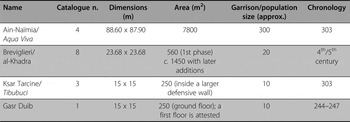
Of the eight centenaria known in Africa through textual evidence, only four are, to date, archaeologically documented (Table 1): those of Gasr Duib (no. 1), Ksar Tarcine (centenarium Tibubuci, no. 3), Ain-Naïmia (centenarium quod appellatur Aqua Viva, no. 4) and Breviglieri/al-Khadra (no. 8). They may be divided, according to size, in two groups, corresponding to two types of buildings, hierarchically well distinguished. The centenaria of Gasr Duib, Ksar Tarcine and Breviglieri are small square buildings, ranging from 225 m2 in the case Gasr Duib and Ksar Tarcine (though the latter is placed within a broader defensive circuit) and the 560 m2 covered by Breviglieri in its first construction phase. If Gasr Duib and Ksar Tarcine were clearly small military outposts for a garrison of minimum size (around 10–20 people), the case of Breviglieri is more uncertain. It seems rather to have been a non-official outpost and/or a fortified farm. Only the centenarium Aqua Viva belongs to the second group: with its 7800 m2 it was clearly a small fort, able to accommodate a substantial military detachment of around 300 men, comparable with the Tripolitanian fort of Ras el-Ain, built in AD 263, measuring 8600 m2, for which David Mattingly (Reference Mattingly1995, 98) estimates a garrison of 300–400 men (the Cohors VIII Fida).
The four centenaria documented archaeologically.

The archaeological reading of the landscape could be of crucial importance for the interpretation of the function of the centenaria. Since the question arises for Tripolitania, where the highest concentration of centenaria is recorded, the data collected by the systematic surveys conducted in the Tripolitanian pre-desert, in the Syrtic region and in the territory of Lepcis Magna, appear to be of fundamental relevance.Footnote 13 According to the survey data, between the middle of the third century AD and the fourth century AD, in connection with the partial dismantling of the Tripolitanian limes which exposed the eastern region to the raids of the nomads coming from the Syrtic oases, the countryside witnessed an extensive defensive restructuration, substantially on private initiative. Fortified buildings, identifiable as fortified farms, were built ex novo or realised by restructuring previous open villas or farms. Judging by their plans and tower-like shape, it seems probable that their prototypes were the military outposts and fortlets which, between the Severan years to the middle of the third century, were built to strengthen the limes.
The fortified farms were normally small quadrangular buildings, measuring between 8 to 25 m per side; Mattingly estimates that in the pre-desert the great majority of their ground plans fall under 300 m2. The masonry of the strong perimeter walls ranges from ashlar or semi-ashlar to coursed or poorly coursed medium–small block-work. The buildings were often surrounded by a defensive ditch. Some of them were tower-like buildings with one to three storeys of rooms, arranged around a central court or light-well.Footnote 14
We have already discussed that in Tripolitania as well in Mauretaniae Caesariensis and Sitifensis some military fortlets or outposts, between the middle of the third century AD and the Constantinian age, were called centenaria. In the same manner of their prototypes, also some of the private fortified structures could have been named by their owners, as indicated by the Latino-Punic inscriptions of Shemech (no. 7) and Breviglieri (no. 8). The same sculpted eagles and Victoriae which decorated these inscriptions were probably meant to echo the official military iconography (see the description of nos 7 and 8).
The fortified farms marked the Tripolitanian landscape for centuries. When the Arab conquerors arrived, they called these structures and the military fortlets (or their ruins) with the same word: gasr/gsur from the Latin castrum, through a Greek mediation.Footnote 15 The fortified farm could be considered as the Tripolitanian version of the pyrgos of the Romano-Byzantine Levant (there in Arabic bordj), a rural building with a double function, residential and defensive, equipped to cope with low-level dangers such as those represented by nomadic raids (Decker Reference Decker2006).
2. Origin of the name
2.1. Current explanations (IT)
As already observed, scholars have long debated the origin and the exact meaning of ‘centenaria’. The earliest epigraphic occurrences of it puzzled the commentators, who suggested some manifestly incorrect interpretations, such as ‘element of a bath complex’, ‘monument of a hundred gold pounds’ value', ‘edifice of a hundred feet long side’.Footnote 16
The fundamental military significance of the term was firstly recognised by Paul Gauckler (Reference Gauckler1903) who, after discarding previous solutions, concluded that the only possibility was that centenaria drew their name from their commander, i.e. the centenarius, an officer of the Late Roman army considered equivalent to a centurion by Vegetius on the grounds of a false etymology (II, 8; Southern and Dixon Reference Southern and Dixon1996, 62). This interpretation has been largely endorsed and repeated in highly authoritative works, such as Cagnat's book on L'armée romaine d'Afrique, Grosse's Römische Militärgeschichte von Gallienus bis zum Beginn der Byzantinischen Themenverfassung (both make reference to Gauckler's explanation without further discussion), Leschi's article on the centenarium Aqua Viva and the pioneering research of Goodchild and Ward-Perkins in the eastern Tripolitanian pre-desert.Footnote 17 The possibility of a derivation from centuria, that is from the strength of the garrison, already taken into account by Gauckler (Reference Gauckler1903, 129), was not completely discarded (especially Elmayer Reference Elmayer1985; Smith Reference Smith and Gadallah1968). This, despite that it was early on observed that a considerable difference in size exists between structures such as Aqua Viva (no. 4) and, for example, Tibubuci (no. 3), and that the garrisons were hardly of the same size, so that consequently the commanders would have held different ranks.Footnote 18 Others scholars have been more cautious, or have not committed themselves.Footnote 19
2.2. A different solution (GS)
A different etymology of the word has already been proposed by J.N. Adams (Reference Adams2007, 550–54): centenarium may be derived from the Latin centenum, which means a kind of cereal (on the semantics see below). Adams observed about such a solution: “it is linguistically impeccable, but I must leave it to archaeologists to determine whether it is appropriate to the structures that have been found” (Adams Reference Adams2007, 553). The proposition is largely plausible from the linguistic point of view.
Adams' reconstruction can be summarised in the following way: the basis of derivation, represented by the word centenum, is clearly attested in the ancient documentation. The Edict on Prices of Diocletian records “centenum siue sicale” (Edictum de pretiis, I 1 3);Footnote
20
Isidore of Seville provides an etymology for this word: “centenum appellatum eo quod in plerisque locis iactus seminis eius in incrementum frugis centesimum renascatur” (XVII 3 12); this explication of the noun seems to make reference to a passage in Pliny where concerning secale is written: “nascitur qualicumque solo cum centesimo grano” (Naturalis Historia XVIII, 141). A derivation of the word centenarium from centenum is supported by two main arguments. First of all, the word formation process is very likely: from the basis centenum the word centenārium can be derived by means of the suffix -ārium, by the same process which can be seen in granum ‘grain’ > granārium ‘granary’. The suffix is well attested as a means to form denominations of rural buildings (or parts of them), with reference to farm activities: e.g. paleārium ‘chaff loft’ (< palea ‘chaff’); carnārium ‘meat deposit’ (< carō ‘meat’); auiārium ‘enclosure for birds’ (< auis ‘bird’); columbārium ‘pigeon nesting box’ (< columba ‘pigeon’); alueārium ‘beehive, structure in which hives are kept’ (< alueus ‘hive’ in apiculture).Footnote
21
A second argument is of a geo-linguistic order: as already shown, the word centenarium is testified in African epigraphy, with some further attestations in Hiberia (Tabula Peutingeriana).Footnote
22
The lexeme centenum was probably popular at that time in the same area. First of all, there is definite evidence for it in Hiberia: it is attested by Isidore, and has Romance reflexes in Spanish and Portuguese, respectively centeno and centeio with the meaning of ‘rye’. But the word is also the model of loanwords in Berber (tāšę
 tīθ, tīšĕntīt, āšĕntīt išenti) and Maghrib Arabic (ašę
ṭil,
 ššę
ti). Following Georges Colin, Berber forms are attested in Arabic sources since the fifteenth century in the Branes Mountains; now they are widely spread in the different varieties of Moroccan Berber. These data can be interpreted as the result of a Latin loanword from Antiquity.Footnote
23
For that reasons, there can be a coextension of the documentation area of the Latin word centenarium, and the areal diffusion of the modern linguistic testimonies (Romance continuations and loanwords) of the Latin word centenum.
Some further observations may be added to those by Adams. Firstly, such a solution does not need a reference to the Latin word centenarius, with its meaning of army officer, which gives some chronological difficulties: the rank of centenarius for a centurion seems not to be positively attested before the reign of Gallienus (Speidel Reference Speidel2005, 206): and even if it may have been introduced some time earlier, it is extremely improbable that a building in the reign of Philip the Arab (no. 1: our first dated evidence of centenarium) would draw its name from a recently added officer rank.
Furthermore, a semantic consideration is necessary. Diocletian's Edict on Prices' attestation of the word centenum, where it is presented as a synonym of sicale and an equivalent of the word βρίζη used in the Greek version of the text, allows a precise interpretation of the word as ‘rye’: the same meaning can be assigned to the Romance reflexes in Spanish (centeno) and Portuguese (centeio). This fact can not justify the postulation of a strong link between a linguistic expression (the word centenum) and a referent represented by a precise biological variety (the cereal ‘rye’): modern scientific taxonomy can not be attributed to ancient world and to common language classification; moreover, botanical and zoological denominations frequently shift their content and can be used as indications of different referents.Footnote 24 The meaning of the word centenum could be wider, more generic than a precise variety of cereals; the diffusion of the word is not necessarily linked with a parallel difusion of the thing. For instance, in a Greek-Latin glossary the word is presented as a synonym of scandula (Hermeneumata vaticana, 429 64); the latter term (scandula/scandala, which has a meaning comprehensive of ‘barley’ and ‘spelt’), is discussed by Isidore just before centenum, as a variety of ‘barley’. These observations are consistent with the Arabic references collected by Colin (Reference Colin1926) on the meaning of Berber loanwords, which seem to include ‘rye’, ‘barley’ and ‘spelt’. Therefore, although rye was introduced in North Africa from Europe, the term centenum could be diffused in this region with a more generic meaning of ‘grain’ or ‘cereal’, or with reference to other varieties of cereals. In this context, the semantics of centenarium can be easily reconstructed, and the word can be interpreted as having an original meaning of ‘deposit of grains’, ‘granary’, which can be directly applied to the North African fortified farms. Adams (Reference Adams2007, 314–15) interpreted it as a regional synonym of spicārium ‘corn store, granary’, ascribable to Gaul; a similar semantic evolution of a derived noun, initially represented by the denomination of a vegetable to the generic meaning of ‘depository’ is attested for horreum.
Moreover, a comment can be added to the Punic epigraph of Gasr el-Azaiz,Footnote 25 where the word naṣiba is interpreted by Robert Kerr (Reference Kerr2005) as an equivalent of the Latin ‘centenarium’.Footnote 26 Kerr intends the Punic noun (probably a feminine) as a calque of the Latin centenarium, through the mediation of the Latin noun centenarius ‘officer’, and a presumed equivalent Punic word *naṣib ‘officer’ (masculine) which is reconstructed on the basis of a comparison with Biblical Hebrew *nāṣīβ ‘military commander, official’ (the Punic gender shift form masculine to feminine would be calqued from the relationship between masculine and neuter in Latin: centenarium < centenarius = *naṣib > naṣiba). Nevertheless, the semantic equivalence between Punic naṣiba and Latin centenarium can be preserved even without reference to an etymology of the Latin word based on its derivation from the military term centenarius. The Punic word could have had the intended meaning of ‘settlement, plantation’, also attested in Aramaic, as Kerr recognises (Reference Kerr2005, 496 n. 81). He rejected this hypothesis because of the lack of attestation of such a meaning in the Canaanite branch of North-West Semitic; but it seems to be a common semantic development for a noun derived from the widely attested Semitic base √nṣb ‘situate, set up, raise, erect’ and thus ‘plant’. Kerr's only (Reference Kerr2010, 194 n. 3) criticism of Adams' reconstruction is that “such a neologism [centenarium] would be better suited in Northern Europe”, and that “rye […] was not farmed in the pre-desert”. Whatever should be the cereal intended by the Latin noun centenum (a topic already discussed), this latter word, with the meaning of a kind of grain, is clearly reflected in Romance, Berber and Arabic lexicon of North Africa and Iberian Peninsula: therefore, it is a sure basis for an etymology.
A second observation concerns the expression ad burgum centenarium displayed by the Notitia Dignitatum as a place name of the province of Pannonia Valeria (NDOcc. 33, 62). As we already noted, it is not clear if it could be a geographical spreading of the same word attested in Africa. Neither is it clear if centenarium in this instance is a noun of neuter gender, or an adjective inflected in the masculine accusative. In any case, the expression finds an exact equivalent in a late Greek inscription (eighth century) from Nicaea, attesting the phrase πύργον κεντινάριον in the accusative case.Footnote 27 It should be emphasised that the three words, the Latin centenarium and burgus, and the Greek πύργος, are all used to indicate a fortified tower in Late Antiquity. The semantic equivalence is reflected by the late gloss ‘πύργος haec turris, bu<r>gus’ (CGL II 426 46). In particular, the Greek word seems to be used in the East with reference to the same kind of rural building named centenarium in Roman Africa.Footnote 28 Thus, it can be easily imagined that the word burgus, regardless of its origin,Footnote 29 might be determined by the noun centenarium, or by an adjective developed from it. Similar constructions are very common in late Latin: a combination with an adjective can be found, e.g., in burgum speculatorium, in the accusative case (CIL VIII 2494; CIL VIII 2495), or in Burgo Nouo, in the ablative (NDOr. 42, 36); a determination made by a noun in the genitive case is displayed in Burgo Severi (NDOr. 31, 63). The same patterns are attested, in Greek transliteration, as denominations of military buildings in the writings of Procopius of Caesarea (e.g. Βουγουάλτου, De Aedificiis IV 6 22; Στιλιβούργου, Aed. IV 6 18), where constructions of two nouns juxtaposed can also be found: e.g. Λακκοβούργο (Aed. IV 6 20); Μαρεβούργου (Aed. IV 6 18);Footnote 30 these expressions can be compared with others displaying the Greek πύργος, instead of burgus, combined with a Latin noun: Σαλτουπύργος (Aed. IV 7 10) and πυργοκάστελλον, in the accusative (Aed. II 5 8). The latter is very close, semantically (and perhaps syntactically as well), to the already cited πύργον κεντινάριον.
The circulation of the term centenarium in the Greek world with the meaning of ‘fortified tower’ may be related to the denomination Κεντηνάριον, which is attested in Constantinople by historians of the Late Byzantine age: a great tower (μέγιστος πύργος) of the Imperial Palace, and dividing it from the Hippodrome, so called (“ὅς κικλήσκεται Κεντηνάριον”), is mentioned by Nicetas Choniates (Historia XI 8 1); the same information is given by Nicholas Mesarites, who records a fortress (πυργόβαρις) having the name of Κεντηνάριον (“Κεντηνάριον τὸ ἐπωνύμιον”, Nikolaos Mesarites Palastrevolution 27, 25).Footnote 31 This building does not seem to be identifiable with the tower on the maritime walls, located on the Bosphorus just in front of Galata, where one end of the iron chain of the Golden Horn was set (“ἐπὶ τὸν πύργον [...] ὅν Κεντηνάριον κικλήσκειν εἰώθασιν”), following the account of Leo Diaconus (Historia, V 2, 78–79). The same tower is recorded by the late anonymous Patria Konstantinupoleos (“τὸ Κεντηνάριν τὸν πύργον”, Origines 150, 264), where it is stated that it was built by Constantinus, and rebuilt by Theophilus.Footnote 32
3. Conclusions (MM, GS, IT)
It seems probable that the original centenaria were regular military structures, albeit of different shape and size – first created in the third century and then spreading in the Tetrarchic period. They appear to be distinctive of the African provinces, from which comes most of the evidence; however, one cannot exclude that the same name was applied to similar military structures in other parts of the Empire (such as the Iberian Peninsula, for instance). The military centenaria were later imitated by private landlords – maybe even indigenous chieftains in charge of the defence of sectors of the frontier – who transferred the name to their unofficial or quasi-official defensive structures (which in other cases could be referred to with other names, also of military origin, such as turris). This process of emulation was already advanced in the Constantinian age (to which no. 6 is dated).
Concerning the etymology, in our opinion, the word centenarium comes from centenum, which means a kind of a cereal; thus, centenarium indicates a ‘fortified grain-house’.Footnote 33 It was not its shape, its size or the name of its garrison or commander that gave the centenarium its name but, at least originally, its purpose.
4. Catalogue of inscriptions (IT) and related archaeological remains (MM)
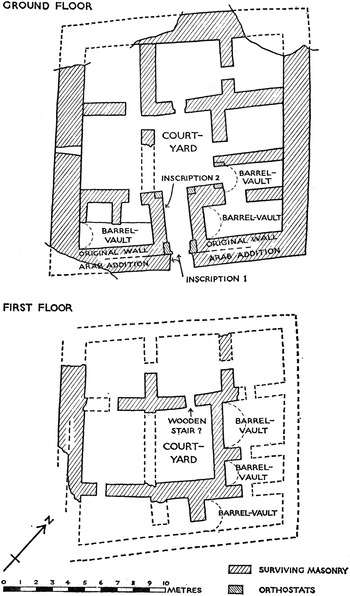
1. Gasr Duib; Tripolitania (Libya). Figure 2.
Novum centenarium of Gasr Duib: plans of the ground floor and first floor (Goodchild and Ward-Perkins Reference Goodchild and Ward-Perkins1949; Goodchild Reference Goodchild and Reynolds1976, 25).

IRT 880 = AE 1950, 128 = 1951, 149 = 1991, 1621.
Date: 244/247 (Di Vita-Evrard Reference Di Vita-Evrard1991, 434 with note 17)
Imp(erator) Caes(ar) [[[M(arcus) Iulius Ph]ilippus]] Invictu[s Aug(ustus)] / [[et M(arcus) Iul(ius) Philippus]] [Ca]es(ar) n(obilissimus) regionem limi-[tis Ten]/theitani partitam et [finitam?] incursib(us) Barba[ro]/rum constituto novo centenario [- - -] / SAS prae[cl]useru[nt] Cominio Cassiano leg(ato) Augg(ustorum) / pr(o) pr(aetore) c(larissimo) v(iro) Lic(inio) An[- - - v(iro) e(gregio) pr]oc(uratore) e-(orum) praep(osito) limitis cura / Numisii Maximi domo [- - -]SIA trib(uni).
Gasr Duib is located along the Wadi Duib in the upper basin of the Wadi Sofeggin (Barrington Atlas, 35 E3). The Arabic toponym identifies a small square building, measuring 15 × 15 m (225 m2), without angle towers but with a central tower above the entrance. The dedicatory inscription IRT 880 is carved on the arched lintel of the door, while a second inscription is placed in the entrance hall. The building is composed of a series of rooms, some vaulted, others with flat wooden ceilings, overlooking a small central courtyard; the first floor, still partially preserved, shows the same distribution of rooms as the ground-floor, but with the particularity that the rooms are connected in circuit with only a door into the central courtyard, placed in front of the main entrance; from that door a wooden staircase led to the ground-floor.
The building was re-used and partially restructured in the Islamic period: a vaulted ceiling in the entrance corridor replaced an earlier wooden ceiling, and the outer wall, flanking the entrance, was refaced and some stucco decorations were added.
Bibliography: Di Vita-Evrard Reference Di Vita-Evrard1991; Goodchild and Ward-Perkins Reference Goodchild and Ward-Perkins1949 (Goodchild Reference Goodchild and Reynolds1976, 24–29); Lenoir Reference Lenoir2011, 364; Mattingly Reference Mattingly1991; Scott et al. Reference Scott, Dore and Mattingly1996, 76; Smith Reference Smith and Gadallah1968.
2. Centenarium Aqua Frigida, Tala Aïzraren / Tala K'frida; Mauretania Sitifensis (Algeria).
CIL VIII 20215 = ILS 6886 (= EE 5, 932).
Date: AD 293/305 (probably 293, or shortly after since Litua was already in charge as praeses in 290: CIL VIII 9041 = ILS 627; PLRE I, 511, s.v. Litua).
Impp(eratoribus) Caess(aribus) C(aio) Aurel(io) Val(erio) Di[o]cletian[o] / et M(arco) Aurel(io) Val(erio) Maximiano In/victis Piis ff(elicibus) Augg(ustis) et Constan[tio] / et Maximiano nobilissi/mis Caesaribus T(itus) Aurel(ius) Litua / v(ir) p(erfectissimus) p(raeses) p(rovinciae) M(auretaniae) Caes(ariensis) centenarium / Aqua Frigida restituit a[t/qu]e ad meliorem faciem reforma/[vit- - -]is feliciter.
The centenarium Aqua Frigida is known only through epigraphic evidence. The inscription was recovered near the source called Tala Kafrida/K'frida or Tala Aïzraren, 300 m south-west from the hilltop of Tizi Kafrida/K'frida (in the Kabylie de Babors/Petite Kabylie), where the ruins of two forts were still visible (Atlas archéologique, f. 7, no. 61; cf. Barrington Atlas, 31 C3). The toponym Kafrida has been considered as a corruption of the ancient Aqua Frigida (Poulle Reference Poulle1880, 258).
Bibliography: Poulle Reference Poulle1880.
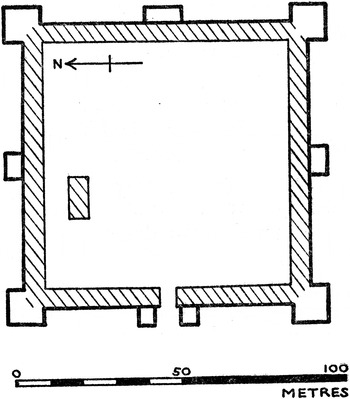
3. Centenarium Tibubuci, Ksar Tarcine; Tripolitania (Tunisia). Figure 3.
Centenarium Tibubuci (Ksar Tarcine): plan (Gauckler Reference Gauckler1902, 327).

AE 1902, 47 = CIL VIII 22763 = ILTun 5 = ILS 9352 = ILPBardo 21.
Date: c.AD 303 (Tantillo et al. Reference Tantillo, Bigi, del Corso, Tantillo and Bigi2010, 373).
Centenarium Tibubuci / quod Valerius Vibianus / v(ir) p(erfectissimus) initiari(t!) / Aurelius Quintianus v(ir) p(erfectissimus) / praeses provinciae Tri/politanae perfici curavit.
The small outpost (Barrington Atlas, 35 B1), situated between Bir Sultane and Ksar Ghilane in Southern Tunisia (Western Tripolitania in Late Roman times), consists of a square building of 15 × 15 m (225 m2) surrounded by a polygonal defensive wall circuit. The centenarium was at the service of the western sector of the limes Tripolitanus. Still in use in the 390s, according to the numismatic evidence (the last coin attested is a nummus of the emperor Eugenius), its abandonment has been related to the revolt of Gildo in 396 (Gauckler Reference Gauckler1902, 326).
Bibliography: Gauckler Reference Gauckler1902; Reference Gauckler1903; Lenoir Reference Lenoir2011, 364; Mattingly Reference Mattingly1995, 103–104, 106, 191; Trousset Reference Trousset1974, 90–92.
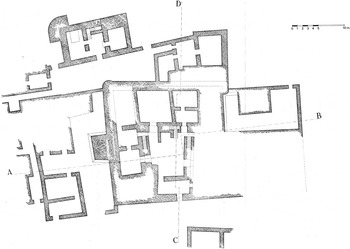
4. Centenarium Aqua Viva, Ain-Naïmia/M'Doukal; Numidia (Algeria). Figure 4.
Centenarium Aqua Viva (Ain-Naïmia/M'Doukal): plan (Goodchild [Reference Goodchild1950] 1976, 40 fig. 9).

AE 1942/43, 81.
Date: AD 303 (Kolbe Reference Kolbe1962, 48–49).
Impp(eratoribus) dd(ominis) nn(ostris) Diocletiano et Maximiano aeternis Augg(ustis) et / Constantio et Maximiano fortissimis Caesaribus principib(us) / iuventutis centenarium quod Aqua Viva appellatur ex praecepto / Val(eri) Alexandri v(iri) p(erfectissimi) agent(is) vic(es) praeff(ectorum) praet(orio) et Val(eri) Flori v(iri) p(erfectissimi) p(raesidis) p(rovinciae) N(umidiae) a solo / fabricatum curante Val(erio) Ingenuo praep(osito) limit(is) dedicatum / dd(ominis) nn(ostris) Diocletiano VIII et Maximiano VII Augg(ustis) conss(ulibus).
The site of Ain-Naïmia is located at the edge of the Hodna plain, at the foot of the Djebel Ahmar, 35 km south-west of Tobna and around 60 km north-west of Gemellae (Atlas archéologique, f. 37, n. 37; Barrington Atlas, 34 D2). The complex is a nearly square fortlet measuring 88.60 × 87.90 m (0.78 ha) (86.80 × 85.90 m measured inside the perimeter wall) with angular towers 3.80/4.40 m wide. Inside only one building is visible, the only one brought to light; its identification as the praetorium is highly doubtful. According to Baradez the fortlet was built for the commander of the limes Tubunensis.
Bibliography: Baradez Reference Baradez1949, 137, 140, 159, 297; L'Année épigraphique 1942/1943, 81; Lenoir Reference Lenoir2011, 220–21, 364 fig. 125; Leschi Reference Leschi1941; Reference Leschi1943 and Reference Leschi1957, 47–55.
5. Centenarium Solis, Bir Haddada; Mauretania Sitifensis (Algeria).
CIL VIII 8712–8713 (p. 1934).
Date: AD 315 (cf. PLRE I, 349 s.v. Flavianus 16).
[Impp(eratoribus) Caess(aribus) Fl]avio Val(erio) Constantino / [[[et Va]l(erio) Liciniano Licinio]] Invictis / semper Aug[[g]](ustis) centenarium / Solis a solo construxit et dedicavit / Septimius Flavianus v(ir) p(erfectissimus) p(raeses) p(rovinciae) Maur(etaniae) Sitif(ensis) / numini maiestatiq(ue) eorum semper dicatissimus.
The inscription was found at Bir Haddada, a rural and military settlement, more than 20 hectares in size according to Féraud (Reference Féraud1860) or c. 60 hectares according the Atlas Archéologique (f. 16, n. 372; cf. Barrington Atlas, 34 D2), located on the ancient Sitifis–Perdices–Zaraï road. At the same site many other inscriptions have been documented (Pelletier 1861, 447–452; CIL VIII 8710–31; 20490–4) one of them being a dedication by K(astellani) B(...) to Gordian III (CIL VIII 8710); others clearly belong to the Christian period. The settlement is reported to be encompassed by a wall-circuit, and it is possible that the centenarium was a fortified quarter located inside it.
Bibliography: Baradez Reference Baradez1949, 333; Berbrugger Reference Berbrugger1861, 184–85; Féraud 1860, 188–89; Pelletier 1861; Poulle Reference Poulle1874, 393–412, esp. 402–404.
6. Ourtin (or Ourthi n) Taroummant / Aguemmoun Abekkar (Aguemoun Oubekkar); Mauretania Caesariensis (Algeria).
CIL VIII 9010.
Date: AD 328 (provincial year)
M(arcus) Au[r(elius) - - -] / MM[- - -]en[.] / ex pr(a)ef(ecto) v(eteranus?) cen/tenarium a fu/ndamenta su-/is sum(p)tibus fe/cit et dedicavit / p(rovinciae) CCLXXXVIIII.
Judging by the paper squeeze in the CIL archives, a full restoration of the second line is impossible. Nonetheless, Gsell (Reference Gsell1902, 30 with n. 3) claims to have been able to read as follows: M(arcus) Au[reliu]s / Masaisilen / ex pr(a)ef(ecto) V... Concerning the last extant letter he wrote: “lire peut-être quinque : conf. les Quinquegentanei, qui vivaient en Kabylie”. This hypothesis was further developed by Courtois (Reference Courtois1955, 120 n. 2) through comparison with the corrupted form Mauri Gentiani in the Laterculus Veronensis, which would be an incorrect interpretation by the scribe of an original V Iensani = (Quinque)iensani. Leveau (Reference Leveau1973, 184) rightly considers this supposition weak and doubts are also voiced by Modéran (2003, 90, n. 127). Even if the identification of the builder with a praefectus gentis remains likely, one cannot exclude that he could have been a former army officer. In any case, note that this praefectus was no longer in charge when he built this centenarium and would thus have been acting as a private citizen.
This centenarium is known only through epigraphic evidence. According to the editor (Hanoteau Reference Hanoteau1861), the inscription was found east of Bou-Atelli (Atlas archéologique, f. 6, n. 99; Barrington Atlas, 30 H3), in the territory of Aït Iratem (or Beni Raten in the Kabylie Djurdjura/Grande Kabylie), in the locality named Ourthi n Taroummant (“le Jardin du Grenadier”). Leschi (Reference Leschi1941, 172; Reference Leschi1943, 16) mentioned it as the centenarium of Aguemmoun Abekkar / Aguemoun Oubekkar (Atlas archéologique, f. 6, n. 97). The building where the inscription was recovered was interpreted as a tomb (Bibesco Reference Bibesco1865 considered the inscription to be an epitaph).Footnote 34
Bibliography: Berbrugger Reference Berbrugger1861, 184; Bibesco Reference Bibesco1865, 888–89; De Vigneral Reference De Vigneral1868, 88; Hanoteau Reference Hanoteau1861, 175–77.
7. Wadi el-Bir, near Shemech (Shumaykh), Wadi Soffegin basin; Tripolitania (Libya). Figure 5.
Wadi El-Bir, near Shemech/Shumaykh: inscription IRT 889 (British School at Rome archive).

IRT 889 = Elmayer Reference Elmayer1983, 90–91= Elmayer Reference Elmayer1984, 149–50 = Elmayer Reference Elmayer1985, 82–83 = KAI 5 179 = Jongeling and Kerr Reference Jongeling and Kerr2005, 62–63 = Kerr Reference Kerr2010, 185–89.
Date: probably fourth century (Elmayer Reference Elmayer1983, 92)
Flabi Dasama vy binim / Macrine felv centenari balars / Sumar nar sabare s/avn.
“Flavius Dasama and his son Macrinus, landowners, have made (this) centenarium to guard and protect the whole zone” (Elmayer Reference Elmayer1985)
Flabi Dasama vybinim / Macrine felv centeinari bal ars / σymarnar sabare σ/avn.
“Flavius Dasama and his son Macrinus made (this) centenarium, (the) architect who [made it was] Sabarrus ...” (Jongeling and Kerr Reference Jongeling and Kerr2005).
The epigraphic text is flanked by two Victoriae, facing one another, holding one wreath between them, exactly as in the Theodosian bronze coins VICTORIA AVGGG, minted in the years 383–387 in Rome and Aquileia (LRBC II, 62 and 68, nos 782–93, 1091–94) and well diffused in Tripolitania. Similar Victoriae (this time each holding a wreath and a palm branch) decorated the keystone of the tomb North B at Ghirza (Brogan and Smith Reference Brogan and Smith1984, 136, 216–17, pls 60a, 61a), but also the north gate of the Gheriat el-Gharbia fort (Goodchild Reference Goodchild1954a, 66; Mackensen Reference Mackensen2012) and the obelisk tomb of Wadi Taghiggia.
The inscription was found in situ, above the entrance of an ancient building, probably a fortified farm, evidently the centenarium mentioned in the text. The site is located along the Wadi el-Bir, near Shemech (Shumaykh), in the Wadi Soffegin basin (Tripolitania).
Bibliography: Elmayer Reference Elmayer1983, 90–91; Reference Elmayer1985, 78, 82 ff.; Petragnani Reference Petragnani1928, photos between pages 80 and 81.
8. Gasr Sidi Ali ben Zaid, near Breviglieri/al-Khadra; Tripolitania (Libya). Figures 6 and 7.
Gasr Sidi Ali ben Zaid, near Breviglieri/al-Khadra: inscription IRT 877 (photo: J.B. Ward-Perkins in Goodchild [1951]1976, pl. 39).

Gasr Sidi Ali ben Zaid, near Breviglieri/al-Khadra: plan (De Angelis D'Ossat and Farioli Reference De Angelis D'Ossat and Farioli1975, plate I).

IRT 877 = Goodchild Reference Goodchild1951 (Reference Goodchild and Reynolds1976, 101, pl. 39) = Elmayer Reference Elmayer1983, 87–88 = KAI 5 304 = Jongeling and Kerr Reference Jongeling and Kerr2005, 63–64 = Kerr Reference Kerr2010, 189–91.
Date: fourth/fifth century (lettering comparable to that of IRT 874 and IRT 875: Goodchild Reference Goodchild1951 (Reference Goodchild and Reynolds1976, 101).
Centenari(um) / mu felthi a/na Marci Cae/cili Bymu/pal fesem a/pero y nban/em bucu buo/ms ayo nema.
“A centenarium which Thiana Marcius Caecilius has made with a marble panel and a small altar was built. He lived in grace” (Elmayer Reference Elmayer1983)
Centenari / mv felthi a/na marci ce/cili bymv/pal fesem a/pero y nban/em bvcv bvo/ms ayo nema.
“Centenarium which I Ana Marcius Caecili(us) (made)...” (Jongeling and Kerr Reference Jongeling and Kerr2005)
The epigraphic text is significantly flanked by an eagle and a lion. This kind of decoration is similar to that used in the gasr of Wadi el-Amud, where the epigraphic tabula is flanked by two eagles carrying hares in their claws (Brogan Reference Brogan1964, 52–53, pl. 33c), and in tomb North A at Ghirza, where two eagles with hares flanked the tabula, placed above the doorway, and an impressive lion with front-facing head appears in the frieze of the cella wall (Brogan and Smith Reference Brogan and Smith1984, 123 and 216, pls 51, 52a–b, d).
The inscription was found in the doorway of a gasr located on a hill-top 8 km east of the Breviglieri/al-Khadra village (Barrington Atlas, 35 F2). This is a fortified building, approximately square in plan, without protruding angle towers; the sides are c. 80 Roman feet long, corresponding to 23.68 m (surface area approx. 560 m2). The building is made of blocks of local limestone, of medium and small sizes. The discovery of a coin in the fallen debris, identified as Vandalic by F. Panvini Rosati (quoted by De Angelis D'Ossat and Farioli Reference De Angelis D'Ossat and Farioli1975, 35) and considered as originally nestled into the masonry, was used as evidence for the late date of the building, which should not be earlier than the fifth century. It should be said that this numismatic find cannot be considered as incontrovertible evidence for dating the construction of the building. Inside, the rooms are articulated around a central hall, with the external and internal doors staggered for safety reasons. The Latino-Punic inscription IRT 877 was found just outside the door. The stairs which radiate from the courtyard indicate that at the four corners of the building there probably were towers, each one served by a staircase.
At a later date other buildings with various functions (collective housing and storage) arose around the fortified core, forming with their outer walls a new defensive perimeter, this time equipped with protruding towers. The complex, thus extended, covered an area of approximately 1450 m2.
Bibliography: De Angelis D'Ossat and Farioli Reference De Angelis D'Ossat and Farioli1975, 34–41, 115–17; Elmayer Reference Elmayer1983, 87–88; Goodchild Reference Goodchild1951 (Reference Goodchild and Reynolds1976, 101, n. 7, pl. 39); IRT 877.
 ), plur. gsur, from castrum via the Byzantine Greek kastron, according to Shahid