Published in 2009, the edited volume Music and the Play of Power in the Middle East, North Africa and Central Asia represents one of the most important English-language resources for the study of music’s entanglement in the workings of power and power struggles in the modern Middle East and beyond. In the introduction, the editing author and British Iranian ethnomusicologist Laudan Nooshin identifies three “axes of difference” that organize the production of social divisions and hierarchies in the region: (1) gender, (2) religion, and (3) nationhood.Footnote 1 Class, although stated as intersecting with these categories, is not explicitly listed. This absence is illustrative of a tendency that can be observed across much of contemporary scholarship on musical cultures in Egypt and the broader Middle East and North Africa (MENA)/Southwest Asia and North Africa (SWANA) region, in which class is regularly mentioned but, in contrast to questions of gender, religion, and nationhood, has remained underexplored.
This roundtable aims to contribute to filling this gap by exploring the complex and multidimensional relationship between music and class in Egypt throughout the 20th and 21st centuries. It draws on our shared belief in the illuminating potential of popular culture for Egyptian historiography.Footnote 2 It is inspired by a mode of thinking about class that developed around Pierre Bourdieu and considers class as shaped and enacted by cultural, symbolic practices (as opposed to being exclusively economically defined).Footnote 3 And it joins scholarly efforts to foreground class as both a distinct and intersectional mode of analyzing Egyptian society and culture.Footnote 4
More concretely, this roundtable grew out of a workshop held at the Schelling-Forum in Würzburg, Germany, in December 2024, organised with the support of the Department of Ethnomusicology at the Institute of Music Research, University of Würzburg. The workshop brought together scholars from diverse disciplines and career levels, including the contributors to this roundtable and other colleagues, to discuss the intersection of a variety of different musical cultures with socioeconomic class dynamics in Egypt. Among the questions that guided our discussion were the following: In what ways can Egypt’s diverse musical and singing cultures, ranging from football chants to urban art music, be read as an index of contemporary and historical class formations and class performativity? Which implicit ideologies or practices of class have historically taken shape around different music technologies, from 78 rpm records to cassette tapes? What motivates cultural gatekeepers’ ongoing marginalization of certain musical repertoires and performance practices, including shaʿbi music, mahraganat, and zār rituals? And, importantly, what is it that we mean when we write or talk about class? How applicable is the term to modern Egyptian society? And how useful is it for the study of music, a medium so fluid and elusive that it often traverses through different socioeconomic worlds?
The different contributions to this roundtable offer no definitive or monolithic answers to these questions. With the definition of “class” intentionally left open to be developed and scrutinized (see especially Hammad) through a grounded theory approach, they spotlight a variety of different topics, themes, and case studies: the desires of mandate Lebanon’s rising middle classes to distinguish cosmopolitan Beirut from Cairo’s cultural dominance (Abbani); the impact of early 20th-century recording technology on the development of the dawr (an Egyptian vocal genre of Arab art music) and the role of Zakariya Ahmad in preserving it (Hamoud); Layla Murad and Umm Kulthum’s techniques to maintain cross-class social respectability (satr; Hammad); the postcolonial transformation of Arab music (al‑Mūsīqā al‑ʿArabiyya) into a high-brow musical heritage (Castelo-Branco); a probe into the different publics associated with “artist of the people” Shaykh Imam (Simon); the entanglement of a nonhuman, musical agent, the hantūr (horse carriage), with different class-belongings (Wenz); and the sounds of Egyptian football fandom in the stadium, a classed masculine space (Abdelazim).
The authors of this roundtable employ diverse approaches to studying music and class, offering insights into various periods in Egypt’s modern history. Above all, they expose the complexity of their subject matter. Class is a notoriously complex subject. So is music, and so is Egypt’s modern history. The basic assumption of this roundtable is that these three subjects can be mutually enlightening, underscoring the fluid and ever-changing forms of sociocultural performance in a dynamic society. In a classed society in which social hierarchy plays a central—whether subtle or overt—role in daily interactions, most sounds and acoustic performances, including music and songs, are intimately tied to and often serve as an expression of social status. The remaining part of this essay sketches out how and why this may be the case.
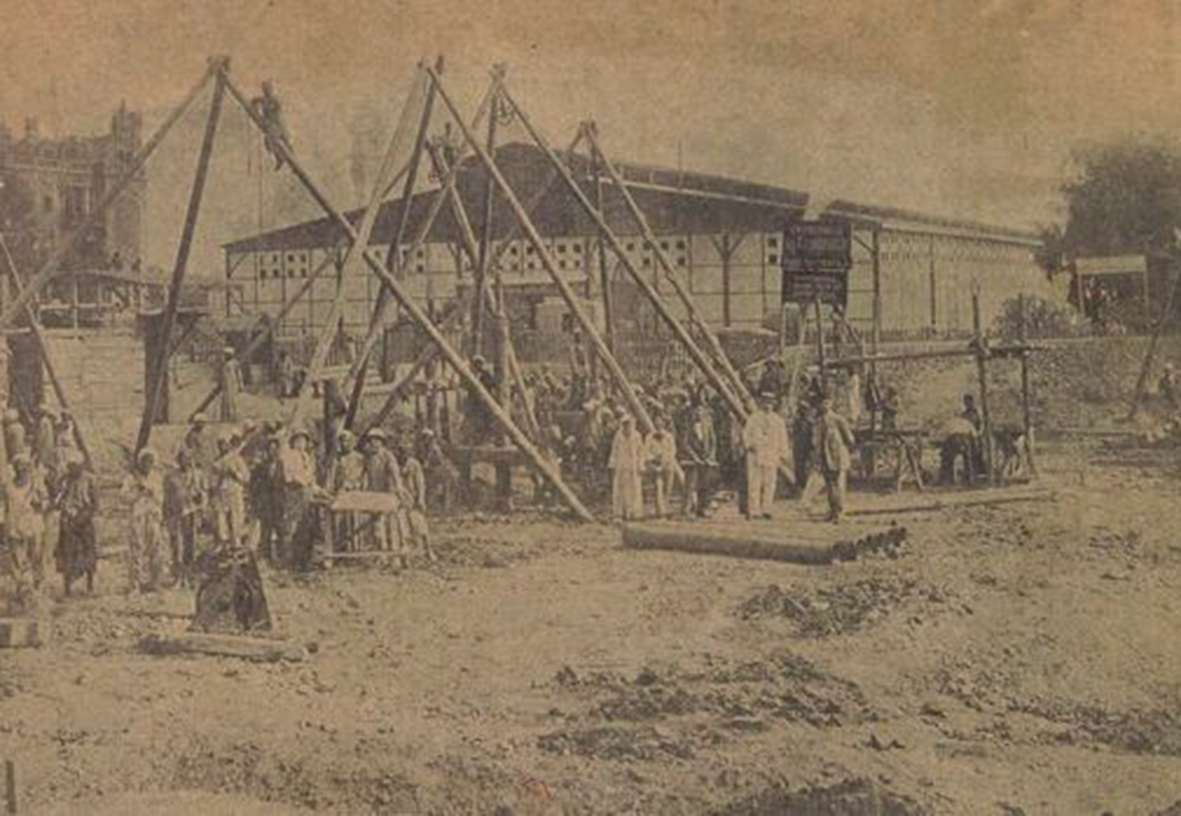
The first entry point into our workshop discussion was a photograph (Fig. 1) published in a recent blog entry by Adam Mestyan, a historian of the modern Arab world based at Duke University. Taken in 1921, the photograph shows the construction of Cairo’s Eastern Music Club (Nadi al-Musiqa al-Sharqi), the site of the famous 1932 Cairo Congress of Arab Music, an international gathering of musicians and musicologists that had a lasting impact on Egypt’s and the broader Arab world’s music history.
Construction of Cairo’s Eastern Music Club (Nadi al-Musiqa al-Sharqi), 1921. Source: gallica.bnf.fr (Bibliothèque nationale de France).

As one of the few historic photographs of construction workers in Egypt, the image served as an entry point for Mestyan into what he calls “Cairo’s missing history of construction workers.”Footnote 5 But the image also compels one to consider the class divides that literally form the basis of Egypt’s modern music history. So do snapshots from the biographies of some of Egypt’s most popular singers: young Muhammad ʿAbd al-Wahhab was pushed off the private horse carriage of high society singer Salih ʿAbd al-Hayy after having jumped on board to kiss his hand in admiration.Footnote 6 ʿAbd al-Wahhab also, early in his career, had to borrow money to pay for his public concert fees after his impresario cheated him and disappeared.Footnote 7 Early urban critics of Umm Kulthum disparaged her companions as unrefined, “crude” peasants, while elite circles in Syria marked their own refinement by favoring her early rather than her later, mass-consumed recordings.Footnote 8 ʿAbd al-Halim Hafiz’s crooner identity appealed to women from an educated middle-class background, but his early death of schistosomiasis, caused by a parasitic infection he contracted as an underprivileged, orphaned child in the Nile Delta, linked him to the millions of Egypt’s rural poor who, in the 20th century, died from the same disease.Footnote 9 And then there is shaʿbī superstar Ahmad ʿAdawiyya, whom cultural gatekeepers once accused of “corrupting” the taste of “the masses,” although his tapes can be found today on the same shelves that sell the music of some of the state-sanctioned musicians mentioned above.Footnote 10
The above insights and anecdotes not only invite a class-based reading of Egypt’s music history; we also view them as a corrective to the idea that music takes place in a sphere removed from people’s socioeconomic realities and anxieties. Indeed, the title of this roundtable retains the term class instead of using terms like “social division” or “social hierarchies” to foreground music’s material conditions and focus on labor. This includes the labor that went into Egypt’s musical sites and monuments, such as the Eastern Music Club and Cairo’s Khedivial Opera House (ten workers reportedly died during its construction), the extra labor that women need to perform to participate in male-dominated music economies, and the interconnections of labor with noneconomic forms of value.Footnote 11 As Ali Jihad Racy has documented, Egypt’s urban art musicians have historically spoken about their performances in terms of work (shughl); nevertheless, the listening public would expect them to uphold the virtue (and privilege) of generosity and cherish stories about them donating their incomes to humanitarian causes.Footnote 12
Insights into Egypt’s music (past and present) also can teach us something about the sensory and performative dimensions of social status and class. In other words, it may not only be occupation, wealth, or income that signals one’s membership in a certain socioeconomic group, but also forms of musical behavior, such as the mastery of a certain repertoire or the display of a particular music taste or ideal. Music lessons at the Catholic school prepared Layla Murad for her public music career, but initially they were meant as a medium to increase her household value and equip her, like many women from her background and generation, with the desirable traits of a modern, upper-middle-class housewife.Footnote 13 In contemporary Egypt, elite audiences consume a “sanitized” version of shaʿbī music —stripped of its lower-class associations, performed indoors with a polished, “soft” vocal style and a Hollywood smile, accompanied not by female but by male dancers, and circulated in professional sound and video quality.Footnote 14
Music can articulate class conflict and signal one’s social status, but it also frequently travels across class divides. The songs of Sayyid Darwish, Shaykh Imam, and Ahmad ʿAdawiyya have, albeit in very distinct ways, shaped the consciousness of Egypt’s popular classes and a transnational Arab cultural left, found their way to becoming nationalist icons—as in the case of Darwish’s current Egyptian anthem—and expressions of the middle- and upper-class revolutionary participation—as in the case of Shaykh Imam’s songs in the Tahrir uprising (see Simon). The same music that subaltern groups associate as “theirs” may be consumed, cherished, and co-opted by (global) cultural elites. In 2017, a three-minute videoclip narrating the origins of mahraganat (a music style that is produced in Cairo’s and Alexandria’s informal, low-class urban peripheries) was published by NOWNESS, a luxury online video channel and brand of LVMH (Moët Hennessy Louis Vuitton SE).Footnote 15
Money, labor, economic precarity, urban–rural divides, elite tastes and values, cultural capital, and material environments: the themes attached to the notions of class and music in modern Egypt are numerous. Those who investigate their relationship are faced with ambiguities, ambivalence, seeming contradictions, alongside constantly changing social dynamics. This roundtable seeks to foreground that complexity. We hope it stimulates further, much-needed research on the subject.
Acknowledgements
This roundtable is based on a workshop funded by the Young Academy of the Bavarian Academy of Sciences and the Department of Ethnomusicology at the Institute of Music Research, University of Würzburg. We would like to thank all workshop participants for their efforts, as well as Joel Gordon, the former editor of IJMES, for his enthusiasm, guidance, and constructive comments. Among the workshop participants who did not contribute to this roundtable were Gisela Kitzler (University of Vienna), with a paper on mahraganat music, and Kawkab Tawfiq (Tuscia University), whose talk explored memories of class subjugation preserved in contemporary zār music. We would like to thank them for their valuable contributions.