The major verbal inflectional affixes in English are -s, -ed, -ing. In addition, however, there are many irregularly inflected past tense forms (fell, taught). There is considerable debate about whether native speakers understand and produce regular and irregular inflected verb forms in the same way. Less frequently investigated is how non-native speakers process the regular and irregular inflectional morphology of their second language (L2). The present study compares how native and non-native speakers of English recognize English verb forms. Non-native speakers were native language learners of Serbian, which is a highly inflected language with a rich morphology.Footnote 1
Native and non-native processing of inflectional morphology
The processing of inflectional morphology has served as a focus for debates about the dominance of rule- or instance-based performance. According to the dual mechanism account, recognition entails rules for breaking down a word into stem + affix but, because all words cannot be thus decomposed, a second non-combinatorial (instance-based) associative mechanism must exist as well. Recognition of regulars entails decomposition and activation of a shared stem in present and past tense forms, whereas recognition of irregulars is based on non-combinatorial association between past and present forms. For morphologically simple and for irregular forms, decision latencies among native speakers tend to vary with printed frequency across a wide range of values and frequency effects provide support for non-combinatorial association. In contrast for regular inflections, Alegre and Gordon (Reference Alegre and Gordon1999) observed frequency effects only when frequencies (Francis and Kucera, Reference Francis and Kucera1982) were greater than six words per million (but see Baayen, Wurm and Aycock, Reference Baayen, Wurm and Aycock2007; Schreuder and Baayen, Reference Schreuder and Baayen1997; Stemberger and MacWhinney, Reference Stemberger and MacWhinney1986). If effects of whole word frequency reflect storage of whole forms in the lexicon then, like morphologically simple and irregular inflected forms, higher-frequency regularly inflected forms may be stored as full forms in the lexicon, leaving only lower-frequency regularly inflected forms as candidates for decomposition into stem plus affix. Non-native speakers have limited experience in the L2, a lexicon that generally is less densely populated and are less familiar with the grammar (syntax and morphology) of the L2. According to the dual mechanism account, therefore, one consequence of an underspecified L2 grammar is impaired inflectional processing based on decomposition and combinatorial rules and greater reliance on non-combinatorial association (Clahsen and Felser, Reference Clahsen and Felser2006; Parodi, Schwartz and Clahsen, Reference Parodi, Schwartz and Clahsen2004; Pinker and Ullman, Reference Pinker and Ullman2000a, Reference Pinker and Ullmanb; Ullman, Reference Ullman2001).
Those who ascribe to the alternative singular mechanism account have argued that combinatorial rules that apply to stems provide an inadequate characterization of morphological knowledge, that inflectional morphology need not be represented by linguistic rules that combine stem and affix and, most importantly, that there is no “dichotomy” in processing between regulars that preserve the stem and irregulars that do not (Gonnerman, Reference Gonnerman1999; Gonnerman, Seidenberg and Andersen, Reference Gonnerman, Seidenberg and Andersen2007; Rueckl and Raveh, Reference Rueckl and Raveh1999; Seidenberg and Elman, Reference Seidenberg and Elman1999). Not only do frequency effects arise for regularly as well as irregularly inflected forms, but also degree of form similarity between morphological relatives plays a critical role and contributes to processing differences between regular and irregular verb forms (Feldman, Rueckl, Pastizzo, Diliberto and Vellutino, Reference Feldman, Rueckl, Pastizzo, Diliberto and Vellutino2002; Kielar, Joanisse and Hare, Reference Kielar, Joanisse and Hare2007; Rueckl, Mikolinski, Raveh, Miner and Mars, Reference Rueckl, Mikolinski, Raveh, Miner and Mars1997; Rueckl and Raveh, Reference Rueckl and Raveh1999). Further, there is corpus-based (Baayen and Moscoso del Prado Martín, Reference Baayen and Moscoso del Prado Martín2005) as well as experimental (Davis, Meunier and Marslen-Wilson, Reference Davis, Meunier and Marslen-Wilson2004; Ramscar, Reference Ramscar2002) evidence that regulars and irregulars differ not only with respect to potential decomposability by rule but also with respect to a host of dimensions that reflect semantic richness based on the number of associations (resonance) and the interconnections among them (connectivity). The single mechanism claim is that, when left uncontrolled, semantic properties of the stem, as well as form similarity with other words, may contribute to alleged differences in processing for regular and irregular verbs.
In the L2, more words will fall into the low-frequency “decomposable” range as compared to native speakers, but the tendency to decompose words in the L2 or treat them as wholes seems to depend on more than just frequency of the inflected form (Lehtonen and Laine, Reference Lehtonen and Laine2003). For example, in the tradition of transfer from first to second language and the extent to which first language plays a role in the processing of the L2, some invoke the more complex inflectional morphology in Finnish, as compared to Swedish, to account for the differing prominence of base morpheme frequency (a marker for decomposition) relative to whole word frequency in Finnish–Swedish and Swedish–Finnish bilinguals (Lehtonen and Laine, Reference Lehtonen and Laine2003; Lehtonen, Niska, Wande, Niemi and Laine, Reference Lehtonen, Niska, Wande, Niemi and Laine2006; Portin, Lehtonen and Laine, Reference Portin, Lehtonen and Laine2007). Stated generally, similar structures in first and second language can benefit L2 processing whereas “difficulties are likely to arise if the skills used in the first language are inadequate or inappropriate for the second language” (Holm and Dodd, Reference Holm and Dodd1996, p. 121). With respect to the present study, the inflectional morphology of Serbian is substantially more complex than that of English and, as with Finnish–Swedish bilinguals, morphological richness in L1 may benefit inflectional processing in L2.
Priming paradigms reveal the processing of inflectional morphology
Arguably, the most well-established way to test for the decomposition of inflected forms into stem plus affix is to compare the differences in target decision latencies after morphologically related as compared to unrelated primes (e.g., Sonnenstuhl, Eisenbeiss and Clahsen, Reference Sonnenstuhl, Eisenbeiss and Clahsen1999; Stanners, Neiser, Hernon and Hall, Reference Stanners, Neiser, Hernon and Hall1979; Stolz and Feldman, Reference Stolz, Feldman and Feldman1995). In the forward masked priming variant of the lexical decision task (Forster and Azuma, Reference Forster and Azuma2000; Forster and Davis, Reference Forster and Davis1984; Masson and Isaak, Reference Masson and Isaak1999; Tsapkini, Kehayia and Jarema, Reference Tsapkini, Kehayia and Jarema1999), a mask of hash marks (#####) appears for 500 milliseconds (ms), after which a prime appears for a duration that ranges between 40 and 60 ms, followed by the target word or nonword. Primes appear in lowercase letters. Targets appear in uppercase letters in the same position as the prime. The change in letter case together with superposition of the target on the prime serve to backward mask the prime. On most trials, participants report no awareness of the prime so it is unlikely that priming effects are confounded with conscious processes (Forster, Reference Forster1999). Researchers typically interpret facilitation for regular forms as evidence that words are decomposed into morphological constituents (i.e., stem + affix) in the course of lexical retrieval (e.g., Clahsen, Sonnenstuhl and Blevins, Reference Clahsen, Sonnenstuhl, Blevins, Baayen and Schreuder2003). Further, they interpret differences in the magnitude of facilitation for visually presented identity (pray–pray) and inflected (prayed–pray) pairs as evidence of insensitivity to a word's internal morphological structure (Silva and Clahsen, Reference Silva and Clahsen2008), postulating instead that those inflected items are stored as whole words in associative memory (Pinker, Reference Pinker1991). The classic dual mechanism prediction about inflectional processing, with non-native proficiency, is that facilitation between regularly inflected inflectionally related pairs will fail to occur whereas facilitation for irregularly inflected past tense formations is reliable (e.g., Clahsen and Felser, Reference Clahsen and Felser2006). Specifically, a pattern whereby regularly inflected pairs tend to show less morphological facilitation than do identity pairs, while magnitudes of facilitation for irregularly inflected pairs (or derivationally related pairs) and for identity pairs do not differ, provide an empirical foundation for the dual mechanism account.
Generally in priming studies, researchers evaluate morphological facilitation relative to either an orthographically similar baseline (Forster and Davis, Reference Forster and Davis1984; Frost, Forster and Deutsch, Reference Frost, Forster and Deutsch1997), or to one that is orthographically as well as morphologically dissimilar (Feldman and Soltano, Reference Feldman and Soltano1999; Marslen-Wilson, Tyler, Waksler and Older, Reference Marslen-Wilson, Tyler, Waksler and Older1994). Because the masked priming procedure is particularly sensitive to shared form (Davis and Lupker, Reference Davis and Lupker2006; Forster, Davis, Schoknecht and Carter, Reference Forster, Davis, Schoknecht and Carter1987), it is not surprising that results assessed against an orthographic baseline can differ relative to a purely unrelated baseline (Grainger, Colé and Segui, Reference Grainger, Colé and Segui1991; Masson and Isaak, Reference Masson and Isaak1999). Any discrepancy between orthographic and unrelated baselines is especially relevant to comparisons of morphological facilitation cross verb types where form similarity among relatives is variable. For example, irregular inflected forms such as fell overlap more with their uninflected stem (e.g., fall) than do items such as taught with their uninflected stem (e.g., teach). When Pastizzo and Feldman (Reference Pastizzo and Feldman2002a) investigated morphological facilitation for regular and two types of irregular past tense inflected forms in English, they therefore evaluated facilitation against both an orthographic and an unrelated baseline. Effects of orthographic similarity between prime and target were once thought to be less of a problem when unmasked primes and targets appear in different modalities and differ in length (Pastizzo and Feldman, Reference Pastizzo and Feldman2002b; Tsapkini, Jarema and Kehayia, Reference Tsapkini, Jarema and Kehayia2004), although there is evidence that when presentations are cross-modal, primes that are similar in form (e.g., stale–stole) slow target latencies relative to unrelated primes (Allen and Badecker, Reference Allen and Badecker2002).
One challenge to a dual route interpretation of morphological facilitation based on decomposition and activation of a shared stem is that irregular forms also can produce morphological facilitation (Pastizzo and Feldman, Reference Pastizzo and Feldman2002a, Reference Pastizzo and Feldmanb). Comparisons across languages suggest more variable patterns of facilitation for irregular than for regular verbs in English than in Italian or French, and some interpret the finding as evidence of cross-language variation in language processing (see Meunier and Marslen-Wilson, Reference Meunier and Marslen-Wilson2004). As noted above, however, regular and irregular verbs differ along many dimensions, therefore magnitudes of facilitation that vary with regularity are difficult to interpret unequivocally. Most generally, morphological facilitation tends to be greater when baseline latencies are long, and, as baselines decrease, typically so does facilitation. Several properties of the stem (that typically serves as the target), including not only frequency but also orthographic neighborhood size, semantic richness and morphological family size, can influence baseline response times (Baayen, Feldman and Schreuder, Reference Baayen, Feldman and Schreuder2006). In essence, attenuated morphological facilitation with increasing irregularity could reflect graded properties of the stem rather than a mechanism of decomposition of regulars and a mechanism of decomposition of non-combinatorial association among irregulars. Notably, facilitation for regulars as well as irregulars that covaries with degree of similarity along semantic or form dimensions is anticipated by a single mechanism account (e.g., Gonnerman, Reference Gonnerman1999; Gonnerman et al., Reference Gonnerman, Seidenberg and Andersen2007; Kielar et al., Reference Kielar, Joanisse and Hare2007; Rueckl and Raveh, Reference Rueckl and Raveh1999; Seidenberg and Gonnerman, Reference Seidenberg and Gonnerman2000), but not by a dual mechanism (decomposition, non-combinatorial association) account.
Morphological processing in a second language
With the exception of a few studies like those described above, most of the work on word recognition in a second language has focused on the semantic properties of nouns such as abstractness (Van Hell, Reference Van Hell1998) or count–mass meaning (Healy et al., Reference Healy, Barshi, Crutcher, Tao, Rickard, Marmie, Schneider, Feldman, Buck-Gengler, Romero, Sherrod, Parker, Bourne, Healy and Bourne1998), and has ignored morphological as well as other dimensions that may be more typical of other grammatical classes (Sunderman and Kroll, Reference Sunderman and Kroll2006). Further, early claims that semantic effects become stronger as proficiency in a second language increases (Kroll and Stewart, Reference Kroll and Stewart1994; Talamas, Kroll and Dufour, Reference Talamas, Kroll and Dufour1999) are being refined to differentiate among dimensions of semantic similarity (Bueno and Frenck-Mestre, Reference Bueno and Frenck-Mestre2002; Kotz, and Elston-Guttler, Reference Kotz and Elston-Guttler2004; Sánchez-Casas, Davis and García-Albea, Reference Sánchez-Casas, Davis and García-Albea1992), and also among conditions of second language acquisition (Silverberg and Samuel, Reference Silverberg and Samuel2004) and task (Duyck and De Houwer, Reference Duyck and De Houwer2008; Duyck, Vanderelst, Desmet and Hartsuiker, Reference Duyck, Vanderelst, Desmet and Hartsuiker2008. In fact, under conditions where semantic facilitation fails to arise, inhibitory form effects have been documented, even in bilinguals of higher levels of proficiency, if acquisition of the second language was relatively late (Silverberg and Samuel, Reference Silverberg and Samuel2004). Therefore, deeper insights into the characterization of less proficient non-native speakers as depending more on associations between forms, and less on elaborated semantic connections, may arise from examining performance in morphological tasks. Specifically, depending on proficiency, bilinguals may find it difficult to differentiate between prime target pairs in their second language that are related morphologically, so that they share form and meaning (billed–bill), and pairs that share only form (billion–bill). Accordingly, L2 performance on morphologically related and form-similar pairs may fail to differ in experimental tasks, especially for non-native participants whose L2 lexical knowledge reflects low proficiency.
In the past decade, researchers have used the forward masked priming task to explore bilingual semantic memory (Finkbeiner, Forster, Nicol and Nakamura, Reference Finkbeiner, Forster, Nicol and Nakamura2004; Jiang, Reference Jiang1999; Jiang and Forster, Reference Jiang and Forster2001), but its use in L2 inflectional (morphological) processing is less widely applied. Conversely, researchers frequently use the cross-modal priming task and graded patterns of facilitation to explore monolingual morphological processing (Gonnerman et al., Reference Gonnerman, Seidenberg and Andersen2007; Kielar et al., Reference Kielar, Joanisse and Hare2007). Nonetheless, the influence that prime modality and awareness can have on bilingual language processing has not been systematically explored, although it is well documented that mastery of phonology and understanding spoken language pose special problems in an L2 (e.g., Bradlow and Bent, Reference Bradlow and Bent2008). Of particular interest in the present study are potential commonalities among the lexical structures that underlie native and non-native verb processing when findings from two experimental paradigms and modalities are coordinated in the investigation of language processing.
The present study
The present study is motivated by the claim that differences in inflectional facilitation between identity (pray–pray) and regularly inflected verbs (prayed–pray) in speakers of English as a second language, but not in native speakers of English, reflect the dominance in non-native speakers of storage as contrasted with combinatorial processes (Silva and Clahsen, Reference Silva and Clahsen2008). Non-native speakers of English were native speakers of Serbian. The Serbian language is of particular value to explore the influence of one's first language on mastery of L2 inflectional morphology because of its structure. Serbian is a highly inflected language when compared to English or German. At the same time, the Serbian writing system was reformed in the last century so it maintains a particularly regular mapping between letter and phoneme, although Serbian, like English, tends to devoice consonants in the syllable coda or at the end of a word. These L1 characteristics allow one to focus on how native speakers of a language that promotes both morphological and phonological analysis transfer that combinatorial processing style to the recognition of English verb forms (Lehtonen et al., Reference Lehtonen, Niska, Wande, Niemi and Laine2006). To anticipate, we seek evidence that the complex inflectional morphology of an L1 can offset any vulnerability to impaired inflectional processing in the L2.
We present the Pastizzo and Feldman (Reference Pastizzo and Feldman2002a) materials to non-native speakers of English so as to assess their command of regular and irregular inflectional morphology and compare the outcome to that of the Pastizzo and Feldman (Reference Pastizzo and Feldman2002a) data when low accuracy items as defined by Serbian performance were deleted. Primes with a forward mask at a stimulus onset asynchrony of 48 ms appear in Experiment 1, and in Experiment 2 the primes are auditory. In both contexts, the same targets are presented visually to native (Experiment 1a, 2a) and non-native (Experiment 1b, 2b) speakers of English. In light of the varying degree of form overlap that is characteristic of regular (pushed–push) and irregular (fell–fall) inflected verb pairs, and to distinguish morphological facilitation from a form effect, we include an unrelated as well as an orthographic baseline.
Building on Silva and Clahsen's (Reference Silva and Clahsen2008) forward masked priming study with regular verbs, in addition to comparing how native and non-native speakers of English process regular verb types we: (1) include irregular verbs; (2) construct an orthographic as well as an unrelated baseline; (3) control the orthographic similarity of regular and irregular verb types to their related primes and to other words in the lexicon (neighborhood size); and (4) examine proficiency within non-native speakers.
Methods
Participants
Fifty-three students recruited from the University at Albany, SUNY, participated in Experiment 1a (data reanalyzed from Pastizzo and Feldman, Reference Pastizzo and Feldman2002a) and 45 participated in Experiment 2a. All participants were native speakers of English with normal or corrected-to-normal vision and no known reading disorders.
One hundred and forty-eight students recruited from the University of Belgrade, Republic of Serbia, participated in Experiment 1b and 99 participated in 2b. All had begun to study English in middle school (for four years) at about eleven years of age and continued (for four years) in high school and one year at the university. Instruction in English was based primarily on classroom repetition. None had lived in an English-speaking country for more than four weeks. All who registered for the study rated themselves as “good” or “very good” in reading English and as fair or good in listening to English.Footnote 2 All participants were native speakers of Serbian with normal or corrected-to-normal vision and no known reading disorders. No one participated in both experiments.
Materials
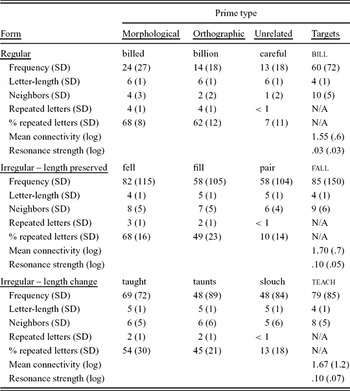
Sixty-three morphologically simple, present tense English verbs served as target words. Importantly across lists, the same target appeared after three different prime words: (1) a morphological relative; (2) an orthographically similar form; and (3) a morphologically and orthographically unrelated control. Past tense forms served as morphological relatives. Twenty-one targets had regular morphological primes and 42 had irregular primes. Affixation of -ed to form regular past tense morphological primes meant that they were longer than their respective targets (e.g., billed–bill). For the irregular pairs, the letter-length of the past tense forms varied. Half had morphological primes whose length was the same as their respective target (e.g., fell–fall) and half had primes of a different length (e.g., taught–teach). The percent of letter overlap (SD) for irregular-length preserved pairs was 68 (16)% and matched that of regular pairs (68 (8)%) but not that of irregular-length varying pairs (54 (30)%). As is typical in Germanic languages, regular and irregular verbs differed significantly on two dimensions of semantic richness (Nelson, McEvoy and Schreiber, Reference Nelson, McEvoy and Schreiber1998). Specifically, connectivity among associates and resonance strength based on average (forward and backward) strength summed over associates differed. As summarized in Table 1, the three types of targets (e.g., regular, irregular length preserved, irregular length varying) did not differ with respect to written frequency, letter-length or number of neighbors. None of the verbs with regular past tense forms had stems that ended in a voiced stem final consonant.
Attributes of word stimuli (taken from Pastizzo and Feldman, Reference Pastizzo and Feldman2002a).

Note. For connectivity and resonance strength (from Nelson et al. (Reference Nelson, McEvoy and Schreiber1998), bill ≠ fall = teach.
Both the orthographic and unrelated control primes were designed to serve as baselines for the morphological condition and they matched each other with respect to frequency (Kucera and Francis, Reference Kucera and Francis1967), letter-length and number of neighbors. Prime types varied with respect to word class (e.g., noun, adjective) and morphological complexity (simple, affixed). Orthographic primes were as similar to their targets as were morphological primes. That is, orthographic primes (e.g. billion–billed; fill–fell; taunts–taught) and morphological primes were selected for maximum similarity in letter-length and total number of neighbors that differed from the prime word by one letter (see Table 1).Footnote 3 Matching along these dimensions took priority over perfect matching on other attributes including orthographic overlap (number and proportion of letters in prime repeated in target), although the initial letter and phoneme of the target always recurred in the orthographically similar as well as the morphologically related prime.
Sixty-three word–nonword pairs were constructed to mimic the conditions among word–word pairs. Word primes for nonword targets resembled the structure of word–word items, 42 pairs (e.g., glimmer–glim; bloom–blome; wonder–wend) shared orthography (to varying degrees), and 21 pairs were unrelated (e.g., pollen–rance). Note that because primes were always words that overlapped in form with a nonword target, truly affixed words could not appear in the regular condition, but did appear in the nonword analogs of the “irregular” conditions. Primes for nonwords likewise varied with respect to word class.
Design
We created three counterbalanced lists that consisted of 126 trials each (63 word targets, 63 nonword targets). Each participant viewed one list. Targets appeared only once per list and across lists each target appeared after each of the three prime types. Inclusion of the same targets with all three prime types [morphological (billed–bill), orthographic (billion–bill) and unrelated (careful–bill)] served to minimize baseline differences across different prime types. Within a list, all prime types were present and words were never repeated. Nonword pairs were not counterbalanced across lists. Verb type (regular, irregular length preserved, irregular length varying) was a repeated factor in the analysis by participants and a between-items factor in the analysis by items. Prime type (morphological, orthographic, unrelated) was a repeated factor in the analyses by participants and by items.
Procedure
When presentations were forward masked (Experiments 1a and 1b), materials appeared in a random order using SuperLab experimental software on a Power Macintosh 6100/60AV computer. Each trial began with a 450 ms “+” fixation followed by a 50 ms blank. A masking pattern (######), matched in length to each prime word, then appeared for 500 ms. Prime words appeared for 48 ms and superimposed targets immediately followed and remained visible until participants responded or 3000 ms had elapsed. All stimuli were center-justified at the same central location on the screen. Stimuli were presented in 18 point Courier font. Primes were lowercase and targets were uppercase. Participants made lexical decision responses to each target by pressing the left key (red) for nonwords and the right key (green) for words. The inter-trial interval was 1000 ms. There was no reaction time or accuracy feedback.
When presentations were cross-modal (Experiments 2a and 2b), primes were auditory and targets were visual. Primes were individually recorded by a male native English speaker at a sampling rate of 44.1 kHz and were edited into separate files for playback using GoldWave software. The cross-modal procedure was similar to that of Experiment 1a with the following exceptions. Auditory primes were presented after a 250 ms fixation “+” and a 50 ms blank. (There was no auditory warning signal.) The ITI was 1000 ms. All other aspects of the experiments were identical. In particular, targets appeared at the offset of the prime with an inter stimulus interval of 0 ms.
Results
To index proficiency in a manner that captured both speed and accuracy, but was unconfounded with magnitudes of facilitation, proficiency was assessed from the ratio of average reaction time to targets in the unrelated conditions divided by the percentage of words classified correctly. Not surprisingly, this measure correlated strongly with both accuracy (r = .49) and unrelated decision latency (r = .96, p < .001) as measures of proficiency. Then participants were rank ordered based on the ratio measure and the 60 most proficient and the 60 least proficient non-native speakers of English were included in the analyses. Nine targets were removed from all analyses because, across the 120 non-native speakers of English, response accuracy was below 60% in one or more conditions of Experiment 1b or 2b. With respect to formation of the past tense, six of the deleted targets were regular (ban, hatch, paw, opt, stun, swell), one was irregular with stem length preserved (cling) and two were irregular with a length change relative to the stem (bind, weave). After items were deleted, no participants from Experiment 1a or 1b were removed from the analyses because of high error rates (word accuracy below 60%). Following the same criterion, data from one participant were deleted from the analyses of Experiment 2a and data from five participants were deleted from the analyses of Experiment 2b. To clarify, in order to standardize the experimental materials, the error-prone items from Serbian speakers were deleted from the forward masked data for American college students (Experiment 1a) first reported in Pastizzo and Feldman (Reference Pastizzo and Feldman2002a) and from the same materials presented cross-modally (Experiment 2a).
Experiments 1a and 1b: Forward masked presentations
Latency and accuracy data were entered into a 3 (verb type: regular, irregular length preserved, irregular length varying) × 3 (prime type: morphological, orthographic, unrelated) analysis of variance. Analyses on logged response latencies and arcsined accuracy were performed across participants (F 1) and items (F 2), and in the following analyses only results that reached significance are reported. An analysis combining the Serbian L1 and English L1 language groups data revealed significant main effects of prime type [F 1(1,170) = 24.364, p < .001; F 2(2,154) = 15.230, p < .001], of first language [F 1(1,171) = 42.713, p < .001; F 2(1,155) = 54.229, p < .001] and of verb type (for participants only) [F 1(2,170) = 16.639, p < .001]. In addition, interactions of language by prime type [F 1(2,170) = 4.002, p < .05; F 2(2,154) = 4.909, p < .01] and of language by verb type were also significant [F 1(1,170) = 7.165, p < .01]. The interaction of language by verb type and prime type was not significant.
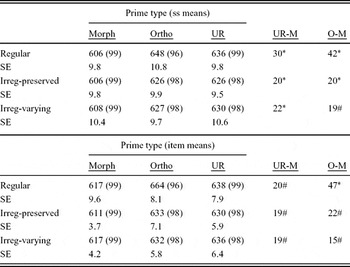
For the native English speakers alone, the logged RT data revealed a significant main effect of prime type [F 1(2,51) = 12.785, p < .01; F 2(2,50) = 7.650, p < .001], where targets preceded by a morphologically related prime word were recognized faster than by the orthographic and unrelated primes. Neither a main effect of verb type [F 1(2,51) = 1.160; F 2 < 1] or an interaction of prime type by verb type was observed (F s < 1.0). Differences (mean ± SE) between decision latencies after orthographic and morphological primes were statistically equivalent for regular pairs (42 ± 11), for irregular length preserved (20 ± 10) and for irregular length varying type pairs (15 ± 11). Although a debatable practice given the absence of a reliable interaction of verb type by prime type, given the centrality of regular inflectional facilitation to accounts of L1 and L2 inflectional processing, planned comparisons restricted to individual verb types were conducted. regular verbs revealed significant morphological facilitation relative to the orthographic condition [t 1(52) = 3.745, p < .001; t 2(14) = 2.849, p = .01] and by participants relative to the unrelated condition [t 1(52) = 2.719, p < .01; t 2(14) = 1.597, p = .13]. Similarly, irregular length preserved and irregular length varying verbs both revealed significant facilitation (by participants) when compared, respectively, to both the orthographic [t 1(52) = 2.040, p < .05; t 2(19) = 1.794, p = .08; t 1(52) = 1.901, p = .06; t 2(18) = 1.500, p = .15] and unrelated conditions [t 1(52) = 2.295, p < .03; t 2(19) = 1.746, p < .10; t 1(52) = 2.265, p < .05; t 2(18) = 1.643, p = .10]. To reiterate, magnitudes of facilitation were significant but failed to differ statistically across regular and irregular verb types. Accuracy data that were arcsine transformed from the native English speakers revealed no significant effects (see Table 2).
Decision latencies (in milliseconds, converted from logged means), accuracies (in parentheses) and standard error for native speakers of English under forward masked presentation conditions (Exp. 1a) (data adapted from Pastizzo & Feldman (Reference Pastizzo and Feldman2002a) by deleting items to match the Serbian accuracy criterion).
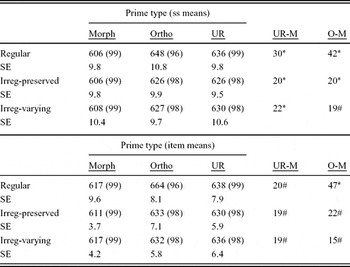
*significant in logged RT analysis p < .05; # p < .15.
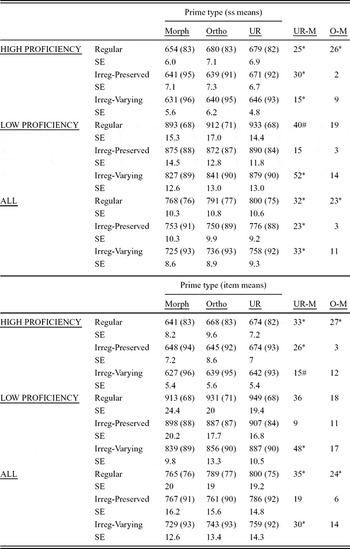
For the non-native speakers of English, the logged forward masked priming data revealed a main effect of verb type [F 1(2,117) = 36.320, p < .001; F 2(2,101) = 3.598, p < .03], of prime type [F 1(2,117) = 20.589, p < .001; F 2(2,100) = 11.786, p < .001] and of proficiency [F 1(1,118) = 161.882, p < .001; F 2(1,101) = 335.982, p < .001] that were significant. Non-native speakers of English were able to recognize the irregular length varying verbs more quickly than the regular inflected or irregular length preserved verbs, and targets preceded by a morphologically related prime were faster than those preceded by an unrelated prime. Differences (mean ± SE) between decision latencies after orthographic and morphological primes were statistically equivalent for regular pairs (23 ± 11), for irregular length preserved (3 ± 10) and for irregular length varying type pairs (11 ± 11). In an attempt to maximize the evidence for an interaction of verb type by prime type, a series of subanalyses were performed. Relative to an orthographic baseline, forward masked regular inflected facilitation [t 1(119) = 2.071, p < .05; t 2(28) = 2.304, p < .05] was significant, while irregular length preserved and irregular length varying facilitation were not. Here, in contradiction to the dual route account, the absence of a verb by prime type interaction provided no evidence that magnitudes of facilitation differed for regular and irregular length preserved pairs when primes were forward masked. In summary, facilitation was at least as reliable for regular as for irregular verbs. In subsequent analyses, patterns of facilitation were examined separately at two levels of proficiency even though the interaction of verb type by prime type by proficiency failed to reach significance [F s < 1.67]. Our interest was in whether or not there was any indication that the difference between latencies to targets after morphologically and orthographically related primes with forward masks varied with proficiency.
For the higher-proficiency non-native speakers of English, the logged RT data revealed a significant main effect of verb type by participants [F 1(2,58) = 22.061, p < .001; F 2(2,51) = 1.77, p < .18], of prime type [F 1(2,58) = 12.941, p < .001; F 2(2,50) = 12.397, p < .001] and an interaction [F 1(4,56) = 2.859, p < .05; F 2(4,102) = 2.524, p < .05]. For higher-proficiency non-native speakers relative to an orthographic baseline, forward masked regular inflected facilitation [t 1(59) = 2.955, p < .01; t 2(14) = 3.929, p < .01] was present, whereas irregular length preserved and irregular length varying facilitation were not [F s < 1]. In contrast, the more proficient group revealed significant facilitation for all three verb types when compared to the unrelated baseline [regular inflected: t1(59) = 3.114, p < .01; t 2(14) = 3.715, p < .01; irregular length preserved: t1(59) = 3.067, p < .01; t 2(19) = 2.944, p < .01; irregular length varying: t1(59) = 2.585, p = .01; t 2(18) = 1.876, p = .07].
For the lower-proficiency non-native speakers of English, the data revealed a significant main effect of verb type by participants [F 1(2,58) = 17.679, p < .001; F 2(2,50) = 2.042, p = .14] and of prime type [F 1(2,58) = 9.331, p < .001; F 2(2,49) = 4.322, p < .05], but no interaction [F s < 1.0]. Planned comparisons on target latencies for each verb type failed to reveal a reliable difference between morphological and orthographic primes [F s < 1]. Interestingly, the difference in target latencies after morphological and unrelated primes in the forward masked priming paradigm with less-proficient speakers of English revealed significant facilitation only for irregular length varying pairs [t 1(59) = 4.112, p < .001; t 2(18) = 3.100, p < .01]. This pattern is consistent with the pattern reported by Silva and Clahsen (Reference Silva and Clahsen2008), namely significant facilitation for irregular length preserved pairs, and the absence of regular inflectional facilitation. In that study, facilitation was absent after regularly inflected primes, whereas derivational facilitation was robust for non-native speakers of English whose L1 was Chinese, German or Japanese. This is the outcome that led those authors to conclude that L2 speakers of English showed only non-combinatorial facilitation.
Arcsined accuracy data for the non-native speakers revealed a main effect of verb type [F 1(2,117) = 216.349, p < .001; F 2(2,101) = 3.598, p < .05], such that there were more errors for regular inflected, as compared to both types of irregular verbs (see Table 3). In addition, there was a main effect of proficiency type [F 1(1,118) = 56.630, p < .001; F 2 (1,101) = 335.98, p < .001]. Lastly, verb type interacted with proficiency type for participants only [F 1(2,117) = 3.569, p < .05]. The main effect of prime type was not significant, nor did it interact significantly with verb type. Accordingly, target accuracy failed to differ after morphological and orthographic primes for any of the three verb types.
Decision latencies (in milliseconds, converted from logged means), accuracies (in parentheses) and standard error for non-native speakers of English under forward masked presentation conditions (Exp. 1b).

*significant in logged RT analysis p < .05; # p < .15.
In Experiment 1, there were no fully reliable differences in facilitation across regular and irregular verb types for native or for non-native speakers. Regulars, but not irregulars, are decomposable into stem and affix, and therefore have the potential to activate a stem. Therefore, the absence of reliable differences in facilitation across verb types fails to provide compelling evidence that decomposition and activation among stems is the mechanism that underlies morphological facilitation for regularly inflected forms, while association produces facilitation for irregularly inflected forms. Finally, while results (viz., facilitation only for teach-type irregulars) relative to an unrelated prime condition with less-proficient speakers replicate those of Silva and Clahsen (Reference Silva and Clahsen2008), the finding failed to generalize to more proficient speakers or to non-native speakers overall.
Shorter target latencies after morphological than after unrelated primes for non-native speakers in Experiment 1 seem consistent with the data from native speakers. More problematic are the implications of comparable latencies after morphological and orthographic primes for low-proficiency non-native speakers; in particular, although the forward masked priming paradigm has been successful at capturing translation priming across languages, it appears to be a less-than-ideal task with which to investigate inflectional processing in non-native speakers. While we observed facilitation for all inflected verbs relative to the unrelated prime condition in Experiment 1, we could not be convinced that it was evidence of morphological processing, because orthographic and morphological primes produced patterns that were statistically indistinguishable. When primes are forward masked, non-native speakers found word form similarity to be facilitative, but non-native reliance on form similarity has been documented even when it is detrimental to performance (Silverberg and Samuel, Reference Silverberg and Samuel2004). Therefore, to gain a second perspective on morphological processing in native and non-native speakers and to further circumscribe the contribution of prime–target form overlap, we introduced another variant of the priming task that allegedly is more semantically attuned and less dominated by word form similarity.
Experiments 2a and 2b: Cross-modal presentations
Consistent with the analyses conducted on the forward masked data, data were logged and analyses were conducted collectively and then separately for each language group (see Table 4). An analysis combining the Serbian L1 and English L1 language groups’ data revealed a significant main effect of first language [F 1(1,136) = 58.307, p < .001; F 2(1,50) = 120.499, p < .001] and an interaction of language by prime type [F 1(2,272) = 9.816, p < .001; F 2(2,100) = 4.710, p < .01], whereby orthographic primes inhibited English L1 but not Serbian L1 speakers. The main effect of prime type [F 1(2,272) = 48.168, p < .001; F 2(2,100) = 17.227, p < .001] also was significant. The arcsined accuracy data also revealed a significant main effect of first language [F 1(1,130) = 3.904, p < .05; F 2(2,100) = 22.401, p < .0001], as well as an interaction of prime type by verb type [F 1(4,520) = 2.887, p < .02; F 2(2,100) = 4.706, p < .01].
Decision latencies (in milliseconds, converted from logged means), accuracies (in parentheses) and standard error for native speakers of English under cross-modal presentation conditions (Exp. 2a).

*significant in logged RT analysis p < .05.
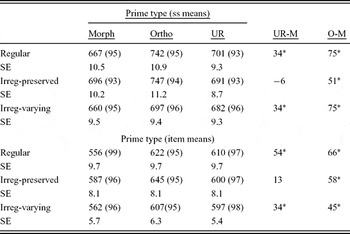
Analyses conducted on the native English speaker logged latency data revealed a main effect of verb type that was significant only by participants [F 1(2,86) = 6.85, p < .002; F 2(2,50) < 1.2] and a significant effect of prime type [F 1(2,86) = 19.30, p < .0001; F 2(2,100) = 13.36, p < .0001]. Planned comparisons revealed significant morphological facilitation compared to either the orthographic [F 1(1,86) = 38.05, p < .0001; F 2(1,50) = 26.44, p < .0001] or the unrelated [F 1(1,86) = 13.84, p < .0005; F 2(1,50) = 9.2, p < .003] prime condition, along with significant orthographic inhibition relative to the unrelated prime condition [F 1(1,86) = 5.99, p < .02; F 2(1,50) = 4.46, p < .04]. Participants were fastest to recognize target words preceded by a morphologically related prime word and slowest to recognize targets after an orthographically similar prime. Under cross-modal presentation conditions, the interaction between verb type and prime type failed to reach significance for native speakers [F 1(4,172) = 1.97, p < .10; F 2 < 1]. Stated succinctly, native facilitation (mean ± SE) relative to an orthographic baseline was significant and statistically equivalent for regular pairs (75 ± 10.9), for irregular length preserved (51 ± 11.2) and for irregular length varying type pairs (36 ± 9.4). If anything, numerically, facilitation was greater for regular verbs. Likewise, orthographic inhibition relative to the unrelated baseline failed to differ statistically for regular (–41 ± 10.9) and irregular length preserved (–57 ± 10) pairs and for irregular length varying type pairs (–14 ± 9.4). Analyses conducted on the native English speaker arcsined accuracy data failed to reveal a main effect of verb type [F 1(2,86) = 2.40, p < .10; F 2(2,50) < 1.3], but the effect of prime type was significant [F 1(2,86) = 4.03, p < .02; F 2 (2,100) = 6.08, p < .003]. Again, the interaction between verb type and prime type failed to reach significance [F s < 1.4].
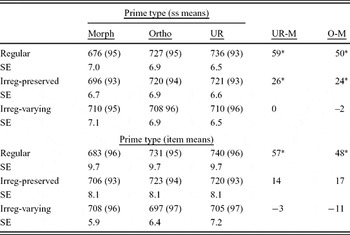
The English verb data from Serbian speakers revealed a main effect of prime type [F 1(2,186) = 20.70, p < .0001; F 2(2,50) = 4.96, p < .01], where participants were again fastest to recognize target words preceded by a morphologically related prime word. Unrelated and orthographic primes did not differ, meaning that there was no slowing from orthographically similar primes. Here, orthographic primes and morphological primes did differ. Further, the interaction between prime type and verb type was significant [F 1(4,372) = 6.52, p < .0001; F 2(4,50) = 2.54, p < .05]. Means for non-native cross-modal morphological facilitation relative to the unrelated prime condition were (59 ± 7) for regular pairs, (26 ± 7) for irregular length preserved and (0 ± 7) for irregular length change type pairs. Only facilitation for regularly inflected past tense forms was fully reliable. Thus, results fail to support claims that Serbian speakers are not able to distinguish regularly affixed verb forms from those of orthographic controls. Arcsined accuracy rates for the non-native speakers revealed an effect of verb type in the participants’ analysis only, but neither differences between prime conditions nor its interaction with verb type were significant (see Table 5).
Decision latencies (in milliseconds, converted from logged means), accuracies (in parentheses) and standard error for non-native speakers of English under cross-modal presentation conditions (Exp. 2b).

*significant in logged RT analysis p < .05.
In a study where orthographic and morphological relatedness were manipulated on different targets and in different experiments, it was suggested that cross-modal orthographic similarity could offset morphological relatedness so as to attenuate facilitation for irregular inflected prime–target pairs with a high, but not with a low, degree of form overlap (Allen and Bedecker, Reference Allen and Badecker2002). The inclusion of an unrelated, as well as an orthographic, prime for the same target allowed us to probe this finding further. Consistent with Allen and Badecker's (Reference Allen and Badecker2002) account, for irregular length preserved (fall) type verbs, orthographic inhibition for native speakers relative to the unrelated baseline was reliable in the analysis by participants. Counter to the Allen and Badecker (Reference Allen and Badecker2002) account, however, not only length preserved irregular (fall), but especially regular (bill) type verbs were subject to inhibition. Thus, similar patterns of facilitation and inhibition for length preserved irregular and regular targets by native speakers fail to support differential processing for regular and irregular verb forms. Evidently, participants can activate competing alternatives based on orthographic similarity for regular as well as irregular (length preserved) targets. Failure of length-varying irregulars to pattern similarly negates an interpretation based on a general strategy for all materials in the cross-modal priming task.
In summary, cross-modal regular morphological facilitation was reliable not only for native speakers of English but for non-native speakers as well. Results fail to support the claim that L2 speakers lack the grammar to decompose regular past tense forms. The most novel outcome however, in our estimation, is that while native speakers showed cross-modal form inhibition, non-native speakers did not. Results suggest that morphologically unrelated word primes similar in form to the target failed to generate either competition or facilitation in L2 speakers. Collectively, effects of form facilitation on non-native recognition were present under forward masked but not cross-modal presentation conditions. Insofar as the latter preserve phonological but not orthographic form, the outcome suggests that shared phonology between primes spoken by a native speaker and visually presented targets failed to influence L2 target processing when prime–target pairs were neither morphologically nor semantically similar.
Discussion
We investigated morphological processing in native speakers and in non-native speakers of English whose native language was Serbian. With two priming methodologies, we examined facilitation for regular (billed–bill) past tense formations and for two types of irregular past tense forms (fell–fall; taught–teach) that varied on degree of form similarity between inflectionally related forms. We constructed irregular verb types so as to differ with respect to preservation or non-preservation of target length and degree of overlap between present and past tense forms. Percent letter overlap was comparable for irregular length preserved (fell–fall) pairs (68%) and regular (billed–bill) pairs (68%), but was reduced (54%) for irregular length change (taught–teach) type pairs.
Facilitation was numerically most robust for regular (billed–bill) type pairs but the absence of an interaction of verb type by prime type in native speakers failed to provide evidence for a dichotomy as predicted by a dual mechanism account.
Our outcome replicates that reported with Italian and French speakers under forward masked and cross-modal presentation conditions (Meunier and Marslen-Wilson, Reference Meunier and Marslen-Wilson2004). In effect, magnitudes of facilitation across regular and irregular verb types in the present study were numerically graded. Although effects were systematically largest for regularly inflected prime–target pairs, numerical differences could not be confirmed statistically because verb type and prime type interacted inconsistently. To reiterate, reliable facilitation for regular prime–target pairs and the absence of facilitation for irregular pairs under forward masked and cross-modal presentation conditions would be consistent with an account of morphological facilitation based solely on decomposition but, in the present study, facilitation was present across all verb types and differences in facilitation were not reliable for native speakers. In conclusion, in English, as in French and Italian, patterns of facilitation for native speakers fail to support claims for a processing dichotomy that entails a mechanism based on decomposition for regulars and a second based on non-combinatorial association for irregulars.
The interaction of verb type by prime type was significant for non-native speakers when presentations were cross-modal and for high-proficiency non-native speakers when presentations were forward masked. Crucially, regular verbs showed numerically greater facilitation than irregulars in L2 speakers. Given the general acceptance of the dual mechanism claim that regular facilitation is absent in L2 speakers, an outcome that demonstrates reliable facilitation for regular verbs, whether it is greater than or equal to reliable facilitation for irregular verbs, constitutes an empirical contribution to our understanding of L2 inflectional verb processing.
With regard to non-native speakers, the result when primes were forward masked contrasts with that of Silva and Clahsen (Reference Silva and Clahsen2008), who failed to observed inflectional facilitation for regularly inflected verb forms relative to an unrelated baseline. However, analyses that included proficiency as a factor showed that speakers with low, but not high, proficiency in English replicated the finding of facilitation for irregular length varying but not for regular past tense–present tense (or irregular length preserved) pairs. Although non-native accuracy rates for regular verbs in Experiment 1b were low (75%) compared to those (88% or better) of Silva and Clahsen (Reference Silva and Clahsen2008), we emphasize that it was our speakers with lower non-native proficiency who replicated the Silva and Clahsen pattern. The absence of regular facilitation for low-proficiency speakers makes it implausible that all L2 facilitation for regular inflections in the present study can be attributed to reliance on form because of lower proficiency. On the other hand, it is very unlikely that the psychology students who studied English in Serbia are more proficient than those in the Silva and Clahsen study (Reference Silva and Clahsen2008) who had been living in the UK for an average of more than ten years. More plausibly, because Serbian is a highly inflected language, the combinatorial habit may transfer from L1 to L2 (Portin et al., Reference Portin, Lehtonen and Laine2007). At this point, any interpretation of L2 facilitation for regularly inflected verb forms remains speculative insofar as the experimental design (viz., no identity fillers or derivationally related pairs) and baseline (viz., orthographically similar) differed across studies as well. Nonetheless, we have documented facilitation for regularly inflected English verb forms in native speakers of a language with a rich inflectional morphology both when prime presentations are forward masked and when they are auditory.
In the remaining sections, coordinated comparisons of native and non-native morphological processing across forward masked and then cross-modal presentation conditions provide insights into how language background influences morphological processing when processing time for the prime is temporally limited and potentially influenced by similar orthographic form (Experiments 1a and 1b), and when it is extended and potentially influenced by phonological but not orthographic similarity (Experiments 2a and 2b).
Influences of proficiency on forward masked morphological facilitation
For native speakers of English, forward masked inflectional facilitation was significant relative to both the orthographic and the unrelated baseline, whereas for non-native speakers of English, morphological and orthographic primes produced equivalent facilitation. The outcome suggests that non-native speakers failed to differentiate prime–target pairs that shared morphology from pairs that shared only form. Comparable latencies after morphological and orthographic primes in the lexical decision task are consistent with over-reliance on word form and the relative inaccessibility of semantics as a characterization of processing by less-proficient non-native speakers of a language.
Participants for whom English was their second language showed latency differences across regular and irregular verb types that varied with proficiency. Specifically, at the lower level of proficiency, verbs with regular past tense forms tended to be slower and more difficult to recognize than those that included irregular forms. An effect of verb type could signal that conventional frequency estimates are distorted in second language learners of English such that verb types were not truly matched on frequency (Duyck et al., Reference Duyck, Vanderelst, Desmet and Hartsuiker2008). Another possibility is that estimates of the frequency with which speakers living in non-English settings encounter particular English words is biased more at the low end of the frequency distribution. Finally, the frequency with which speakers living in non-English settings encounter particular English words may be biased more toward visual and less toward spoken experience relative to native English environments. Across experiments in the present study, differences across verb types were more prominent when prime presentations were visual than auditory, especially for non-native speakers. Future research will determine whether modality-specific exposure to a language (viz., written, spoken) may mitigate verb recognition in non-native speakers as it does for native speakers (Baayen, Feldman and Schreuder, Reference Baayen, Feldman and Schreuder2006).
A potentially more general difference among verb types that previously has been documented in corpora-based studies derives from semantic richness of targets defined in terms of their patterns of co-occurrence with other words. Semantic properties can be defined in terms of the contexts in which a word appears – words with similar meanings tend to appear in similar contexts and words with greater richness appear in more diverse contexts. As noted above, regular verbs in English are generally less semantically rich than are the irregular verb types (Baayen and Moscoso del Prado Martín, Reference Baayen and Moscoso del Prado Martín2005), and the verbs in the present study are consistent with this characterization. Furthermore, word knowledge tends to be less semantically elaborated for non-native speakers, and richness based on connectivity among semantic associates has been documented to influence non-native performance in the cross-modal lexical decision task (Basnight-Brown, Chen, Shu, Kostić and Feldman, Reference Basnight-Brown, Chen, Shu, Kostić and Feldman2007). If the absence of semantic detail affects less relative to more elaborated word forms disproportionately (Finkbeiner et al., Reference Finkbeiner, Forster, Nicol and Nakamura2004), it is possible that semantic factors also contribute to processing differences between regular and irregular verbs. Finally, semantic richness may function with word class so as to influence non-native performance in word recognition tasks (Kotz and Elston-Guttler, Reference Kotz and Elston-Guttler2004; Sunderman and Kroll, Reference Sunderman and Kroll2006), especially at lower levels of L2 proficiency. Of course, unlike in Basnight-Brown et al. (Reference Basnight-Brown, Chen, Shu, Kostić and Feldman2007), variation in semantic richness was not systematically treated in those earlier studies that reported magnitudes of facilitation that differed for regularly and irregularly inflected verbs.
The difference in decision latencies to targets after morphological and orthographic primes was not reliable for non-native speakers in the forward masked priming task where both tended to facilitate. Indeed, comparable non-native target latencies after morphological and orthographic prime types in Experiment 1 challenge the utility of depending on patterns of facilitation from the forward masked priming task to inform us about whether regular and irregular past tense inflections are processed in the same manner when there is no orthographic baseline. For native speakers, by contrast, comparable latencies after orthographic and unrelated primes indicated that form similarity in the absence of semantic similarity had little effect. Comparisons of forward masked priming results across non-native and native speakers capture the transition from reliance on form toward greater reliance on semantics, as proficiency in the second language improves (Kroll and Stewart, Reference Kroll and Stewart1994, Talamas et al., Reference Talamas, Kroll and Dufour1999). Because morphological and orthographic primes were matched on form overlap but differed with respect to semantic similarity with the target, we interpret faster latencies after morphological than orthographic primes, both of which share form with the target, as evidence that forward masking of the prime does not always eliminate semantic aspects of prime processing for native speakers (see also Feldman and Basnight-Brown, Reference Feldman and Basnight-Brown2008; Feldman, O'Connor and Moscoso del Prado Martín, Reference Feldman, O'Connor and Martín2009).
By the most conservative interpretation of Experiment 1, there is no justification to examine prime type separately for the various types of verbs, as the interaction was not fully reliable. Nonetheless, in an attempt to support a classical perspective of dual (viz., decomposition and non-combinatorial association) mechanisms, one might argue to ignore the orthographic baseline condition, interpret native and non-native forward masked irregular morphological facilitation as support for non-combinatorial association between forms of irregularly inflected verbs and dismiss the finding of facilitation for regularly inflected verb forms because accuracy was lower that usual. Even in the extreme, however, current dual mechanism accounts based on the absence of non-combinatorial association in the non-native lexicon cannot accommodate the outcome under cross-modal presentation conditions.
Influences of language background on cross-modal morphological facilitation
Inhibition after orthographic primes presented cross-modally to native speakers indicated that orthographically similar, but morphologically unrelated, primes interfered with recognition of the target. One interpretation is that candidate words that are similar in form but unrelated morphologically and semantically are activated and compete with recognition of the target. By contrast, for non-native speakers, decision latencies after orthographic and unrelated cross-modal primes did not differ. Not only was there no evidence that formal similarity with the prime in the absence of shared meaning impaired recognition of the target, but also there were hints of facilitation. Unlike for native speakers, it appears that for non-native speakers auditory primes do not compete with visual targets even when they share form.
The present results with non-native speakers replicate those in Basnight-Brown et al. (Reference Basnight-Brown, Chen, Shu, Kostić and Feldman2007) for regulars, but contrast with the outcome for irregulars in that they reported an absence of facilitation relative to a baseline defined by a shared initial phoneme for non-native speakers (11 ms) and the presence of facilitation for native speakers (38 ms). It is unlikely that the differing L2 outcomes reflect the structure of the unrelated prime, because in the present study with cross-modal presentations to non-native speakers, orthographic primes clustered with unrelated primes so that the two baselines to index morphological facilitation were consistent. We suspect that Serbian speakers in the Basnight-Brown et al. study were less proficient in English than those in the present study because they were matched to Chinese speakers on picture naming ability. To clarify the Basnight-Brown et al. design, matching across different L1s entailed deleting the best Serbian speakers of English, and it was at a lower level of proficiency that irregular length preserved primes failed to produce cross-modal facilitation. In essence, in both studies with non-native speakers, morphological facilitation for regularly inflected prime–target pairs was at least as strong as for irregularly inflected pairs.
Cross-modal facilitation based on form overlap did not arise for non-native speakers, as they did not easily benefit from shared form between an auditory prime and a visual target. However, presentation of the prime is temporally extended when presented auditorily (Experiment 2), as compared to when it follows a forward mask (Experiment 1). If L2 differences between unrelated and orthographic forward masked primes provide a marker for access based on form when semantics differ, and the failure to detect L2 differences between unrelated and orthographic primes under cross-modal conditions reflects limitation on access based on the form, then variation in patterns of non-native inflectional facilitation across modality can be characterized in terms of the availability of shared semantics in conjunction with shared form. Specifically, shared form governs L2 forward masked facilitation whereas shared semantics governs cross-modal L2 facilitation. If morphological facilitation reflects the convergent effects of shared meaning and shared form (e.g., Gonnerman et al., Reference Gonnerman, Seidenberg and Andersen2007), a further implication is that degree of form overlap may influence the magnitude of morphological facilitation more when semantics plays a secondary role. This characterization could apply to non-native speakers in the forward masked priming task when morphological facilitation is assessed by comparing decision latencies after a morphologically related prime and after a prime that is identical to the target (e.g., Silva and Clahsen, Reference Silva and Clahsen2008). For native speakers, by contrast, semantic similarity can also play a role so that effects of form overlap are attenuated. Collectively, differential contributions of semantics and form across tasks and across proficiency provide an alternative to claims for qualitative differences in the L1 and L2 processing of regular inflectional morphology.
Morphological facilitation for regular inflections: Is it evidence of decomposition?
Comparisons between the recognition of regular and irregular forms in isolation and in primed variants of the lexical decision task are central to our understanding of morphological processing and are at the core of debates concerned with whether or not different mechanisms underlie recognition of regular and irregular forms. The dual mechanism interpretation was straightforward when facilitation was evident for regular, but not for irregular, inflected word pairs. However, recent findings about unrelated as contrasted with orthographic baselines, along with documentation of facilitation for verbs with regular as well as irregular past tense forms, introduce considerable complexity, as effects are no longer all-or-none. In the present study, regular pairs tended to produce greater facilitation, although the interaction of verb type by prime type was unreliable overall. Collectively, results fail to provide compelling evidence that L1 speakers process regular and irregular verbs by distinct mechanisms, or that L1 and L2 speakers differentially engage decompositional and non-combinatorial associative morphological processes.
In conclusion, across both the forward masked and cross-modal priming tasks, effects of morphological relatedness between prime and target are most easy to document when there is a high degree of shared form between prime and target, and this tends to arise among verbs whose inflectional morphology is regular. Plausibly, facilitation for irregulars generally is more similar among native and among non-native speakers because degree of form overlap is attenuated and facilitation is less overall. In summary, the failure to detect reliable differences in magnitudes of facilitation across regular and irregular verb types pose challenges to the explanatory adequacy of a decomposition vs. non-combinatorial association processing dichotomy based on inflectional regularity in either native or non-native speakers of English. Throughout, patterns of facilitation raise the possibility that prime–target similarity figures in the recognition process. In conclusion, results of the present study seem more compatible with an account of morphological processing based on a single mechanism for processing morphologically regular and irregular whole-word forms, one that considers jointly their formal and semantic similarity to other words.