Household surveys to determine needs and measure health-seeking behavior are common among displaced populations, particularly when persons become settled in the post-emergency phase.Reference Doocy, Lyles and Akhu-Zaheya 1 – Reference Cetorelli, Burnham and Shabila 4 Population surveys during or immediately following a conflict and that attempt to understand behavior and events at a time when the access to a population is limited are less common. 5 – Reference Lett, Kobusingye and Ekwaru 7 In this paper, we report health-seeking behavior among resident populations in Mosul during the period of ISIS control and during the time of the military campaign to drive ISIS from the city.
During December 2013, there were increasing clashes in Iraq’s Al Anbar governorate between ISIS forces entering from Syria and the Iraqi army. In January 2014, ISIS forces seized control of the cities of Ramadi and Fallujah. From June 4–10, 2014, an estimated 1500 ISIS fighters overran Mosul, Iraq’s second city.Reference Al-Salh and Arango 8 Initially, some 500,000 persons fled Mosul going elsewhere in the Nineveh governorate or into Kurdistan. 9 The population remaining in Mosul under ISIS control was thought to be about 1.5 million, compared with somewhere over 2 million before June 2014.Reference White 10 As ISIS consolidated its control of Mosul, it began restricting movements out of the city and introducing strict control of nearly every aspect of life. The omnipresent Hesba, or morality police, patrolled the city streets, offices, schools, and hospitals issuing citations to persons not observing the ISIS dress and behavior codes. Female doctors were required to work with a full body covering of thick black material, gloves to cover all skin. They were allowed to lift the gauze covering eyes only while fixing an intravenous line. Working after dark was forbidden for female health workers. Male health providers were not allowed to speak with female patients nor could female providers speak with male patients.Reference Gradham 11 Mosul health care workers speak of at least 2 health professionals being executed by ISIS for violating this rule. Health workers were forbidden to speak with colleagues of the opposite sex.Reference Cunningham 12 Doctors were also executed for a perceived reluctance to prioritize treatment of ISIS fighters.Reference Rudaw 13 Initially, ISIS authorities had promised that high quality health services would be an ISIS priority. However, gradually, services deteriorated as access to supplies and services decreased, and wounded ISIS fighters were given preference.Reference Baskaran 14 People were hesitant to venture far from their houses to seek care lest they run afoul of the ever-present Hesba.
The first phase of the attack against ISIS in Mosul by Iraqi forces, known as the liberation, began on October 17, 2016. The initial targets were the villages to the east of Mosul. This displaced populations to the east and southeast of the city. The army reached the east edge of the city at the end of October. Phase 2 of the military operation began on November 1, when Iraqi forces reached Kokjali, an urban suburb of east Mosul (also called left Mosul), and moved into more densely populated urban areas. On January 24, 2017, Prime Minister Haider Al-Abadi declared the east side of Mosul liberated. Phase 3 of the military campaign for the liberation of the portion of Mosul lying to the west of the Tigris river began on February 19. Some residents of west Mosul had moved to east Mosul (before its liberation) anticipating the fighting; the few who could fled the city starting in December 2016, but many others remained. West Mosul, particularly the old city, was densely populated. When fighting began, military progress was slow, with widescale damage, obliterating whole neighborhoods. ISIS fighters retreating from east Mosul had fortified the area. Civilian populations were used as human shields by ISIS fighters, and those trying to flee were often picked off by snipers. Persons seeking safety in the basements of houses were systematically killed. The flight from west Mosul dramatically increased the number of displaced persons in Nineveh governorate to over 800,000. On June 29, Prime Minister Haider Al-Abadi declared West Mosul liberated, marking the end of military activities in Mosul.
To document the impact of the ISIS occupation on the health of Mosul’s population and to provide information to address the health needs of Mosul, this study was conducted. The extent of deaths and injuries during control by ISIS and during the liberation had been reported by us elsewhere.Reference Lafta, Al-Nuaimi and Burnham 15 It received approval from the Scientific and Technical Committee of Al-Mustansiriya University, and the Institutional Review Board at Johns Hopkins Bloomberg School of Public Health declared that analysis of data without personal identifiers as exempt.
METHODS
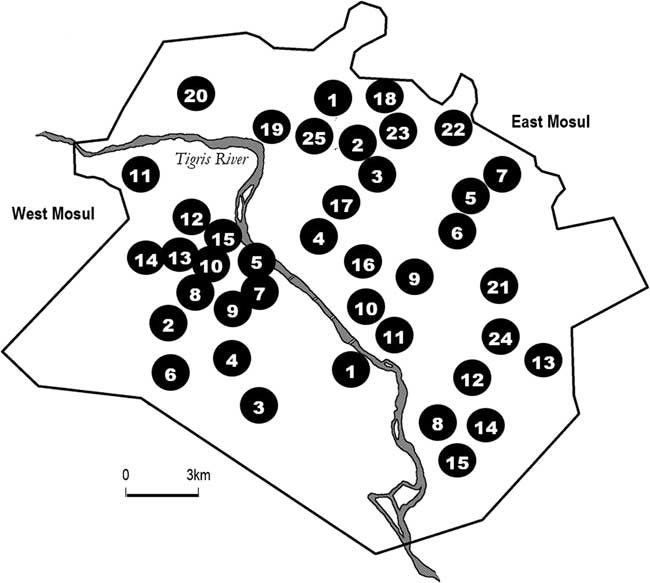
This survey was carried out as soon as entry to Mosul was permitted by security forces and before further substantial population movement began. Even then, the situation was unsettled with precarious security. Forty clusters were randomly selected from a listing of the residential administrative units or neighborhoods of Mosul. Before ISIS control, these residential administrative units would commonly contain around 400 households. From this listing, 25 neighborhoods were randomly selected on the east side of the Tigris river and 15 on the west side, representing the population distribution of pre-ISIS Mosul (Figure 1). The neighborhoods where clusters were located are found in Supplemental Table 1. No information on population shifts under ISIS was available for Mosul. For each cluster, 30 houses were visited. The “start house” for each cluster was selected at random using a 10-m grid overlay of an aerial map of Mosul. Reserve clusters with start houses were identified in case the selected cluster was inaccessible. A questionnaire addressing multiple aspects of the population health and experiences was developed, based on previous survey work in Iraq. The health section is found in the supplemental materials to this paper.
Location of Sampled Clusters in Residential Areas of West and East Mosul.

Four interviewers worked in teams of 2. Interviewers were physicians with a doctoral degree in community medicine. Three interviewers were female, and all were natives of Mosul but had left as ISIS seized Mosul. Training prior to the survey was provided, and field testing was carried out in an area not to be included in the survey. Security measures for the interviewers were developed and included safe houses and regular communications among the interviewers with cell phones during the field work. For this survey, a household was defined as a group of people living together, eating from a common kitchen, and living in a structure with a separate entrance from the street.
After interviewing the start house, interviewers moved to the next house to the right. At intersections, they turned to the right. Where a house had been destroyed or was unoccupied, the interviewers continued in the same direction to the next occupied house. The interview teams used caution moving between houses to avoid attracting attention. The only dwellings included were those where the household had been present during the entire period from June 2014. At each house, verbal informed consent was secured from the head of the household. The head of the household or the senior female was interviewed. Demographic details of the household since June 2014 were recorded. Illness, pregnancies, and sources of health care and household circumstances were recorded on paper forms. An interview required approximately 1 hour and was conducted in privacy. At the beginning of a cluster, there was sometimes suspicion of the interviewers. As interviewers gained confidence of the householders, they were subsequently passed between houses in the cluster in an inconspicuous way to not draw attention. No household declined to be interviewed.
The survey of east Mosul was conducted between March 13 and 31, 2017. With the slow military progress in west Mosul, the survey could not be started until July 18 and concluded on July 31, 2017. All selected clusters in east Mosul were surveyed as planned, without replacing with reserve clusters. However, the extensive destruction and depopulation of parts of west Mosul required a new sampling frame. For this, the team determined which neighborhoods were still inhabited, and 15 clusters were randomly selected from among these neighborhoods. Of the 5 reserve clusters set aside for west Mosul, 2 were eventually used; 1 because of insecurity and a second one as to replace a selected cluster which had few occupied households remaining.
Interviewers used paper forms, and these were inspected for completeness before leaving a household. Data from completed forms were computer-entered in SPSS in Baghdad and preliminary analysis conducted there. Further analysis using Stata (StataCorp, College Station, TX) was conducted in Baltimore and elsewhere.
RESULTS
A total of 1202 Mosul households were interviewed: 751 in east Mosul and 451 in west Mosul. This represented a total of 7559 persons – 4867 living in east Mosul and 2692 in west Mosul, which includes 2635 children under the age of 15 years and 1643 women of childbearing age (Table 1). The average household size was 6.5 persons in east Mosul and 6.0 in west Mosul. The population distribution of the sample is shown in Supplemental Figure 1.
Demographic Characteristics of Surveyed Households

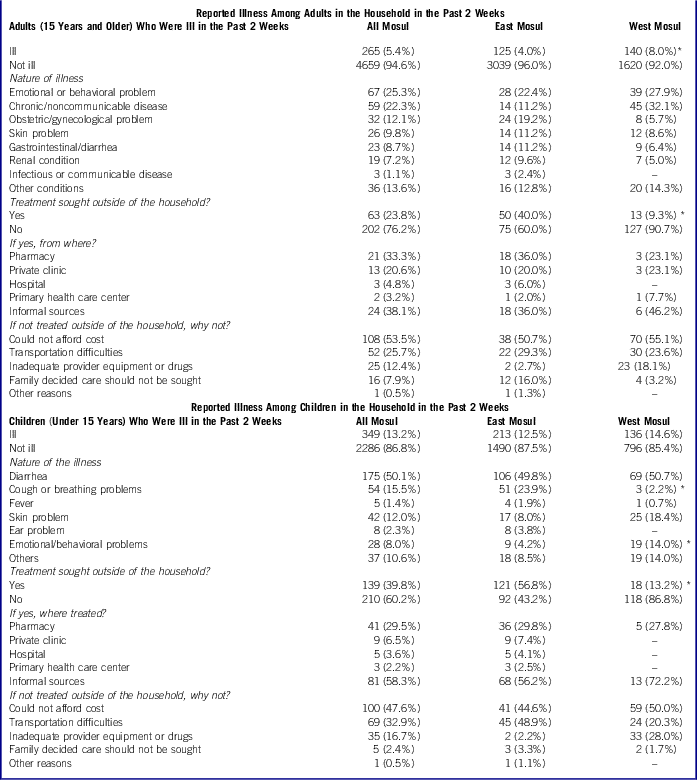
During the previous 2 weeks, 265 (5.4%) out of 4924 adults reported an illness, 125 (4.0%) out of 3164 in east Mosul, and 140 (8.0%) out of 1760 in west Mosul (p<0.01; Table 2). A quarter (67) of these complaints were related to emotional or behavioral issues. Conditions commonly reported to interviewers were anxiety, depression, insomnia, appetite, suicidal ideation, and symptoms of posttraumatic stress disorder (PTSD). Emotional or behavioral issues were commonly reported in both west Mosul (39 [27.9%]) and east Mosul (28 [22.4%]). These was followed by 59 (22.3%) with complaints related to noncommunicable diseases (NCDs). Illnesses due to NCDs were more frequently reported in west Mosul (45 [32.1%]) than in east Mosul (14 [11.2%]; p<0.01).
Reported Illness in the Household During the Past 2 Weeks

* Difference between East and West Mosul, P<0.01.
Of the adults who reported being ill in the past 2 weeks, 50 (40.0%) from east Mosul but only 13 (9.3%) from west Mosul reported seeking care (p<0.01). By the time of the survey, few health facilities were still functioning in west Mosul. The formal health structure was not an important source of services at this point, pharmacies (21 [33.3%]) and informal sources (24 [38.1%]) being the common sources of care. Informal sources were typically health workers living in the immediate neighborhood and providing medical advice. Costs were cited as the main reason for not seeking care (108 [53.5%]). In the few households that did report amounts paid in cash for care (data are not shown), the fees paid were very modest compared with costs elsewhere in Iraq. The second most common reason for not seeking care was given as transportation difficulties (52 [25.7%]). While vehicle fuel was in short supply, and very expensive, especially toward the end of the ISIS period, this response could also include a fear of going outside or moving far from the house. During the liberation period, households reported a steady bombardment by missiles and artillery shells. The households were asked about distances to seek care. Most who sought care did not indicate the amounts of time required because their informal sources of care were generally very close – health workers living on their street or in their immediate neighborhood.
There were 349 (13.2%) children under age 15 who had been ill in the past 2 weeks (Table 2). Of these children, a similar proportion from east Mosul (213 [12.5%]) and west Mosul (136 [14.6%]) were reported to have been ill. About half of childhood complaints on either side of the Tigris river were for diarrhea. Respiratory problems were more commonly reported from east Mosul (51 [23.9%]) compared with west Mosul (3 [2.2%]; p<0.01). The sample in east Mosul was taken during the wet cool season, and in west Mosul during dry, warmer weather. The third most common illness reported in the previous 2 weeks was behavioral or emotional problems, noted in 28 (8.0%) children. This was more commonly reported in west Mosul (19 [14.0%]) than in east Mosul (9 [4.2%]; p<0.01). Childhood conditions reported by mothers or other family members included sleep disturbances, agitation and crying, enuresis, nail-biting, and stuttering. Some mothers reported giving children sedatives to keep children calm, especially during the fighting during the liberation.
Overall, 139 (39.8%) of the 349 ill children had been taken for treatment. Treatment was much less commonly sought in west Mosul (18 [13.2%]) than in east Mosul (121 [56.8%]; p<0.01), again recognizing the extensive destruction in west Mosul prior to the survey. Almost all care was received from pharmacies (41 [29.5%]) or informal sources (81 [58.3%]). Barriers of cost, transportation difficulties, and inadequate services accounted for 204 (97.2%) of reasons for not seeking treatment.
Households were asked if any children under age 5 years in their household had received immunizations during the time since June 2014. Out of the 480 households with children under 5 years, 223 (46.5%) indicated that a child had received an immunization, including 174 (49.2%) households in east Mosul and 49 (38.9%) households in west Mosul.
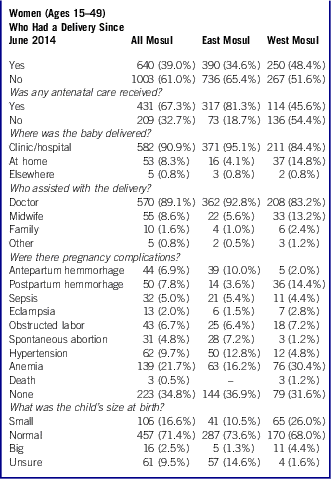
During the 29 months of exclusive ISIS control, there were 640 (39.0%) women of childbearing age who delivered (Table 3). Antenatal care was received by 431 (67.3%). The majority (582 [90.9%]) delivered in a hospital or clinic, almost all attended by a doctor. Among the deliveries, there were 3 maternal deaths, all reported from west Mosul. Complications, including anemia (139 [21.7%]), were reported among 417 (65.2%) of the 640 women who delivered. Hemorrhage was reported by 94 (14.7%) of women delivering. Newborns were reported to have been small in size for 106 (16.6%) of the 640 deliveries.
Delivery and Complications

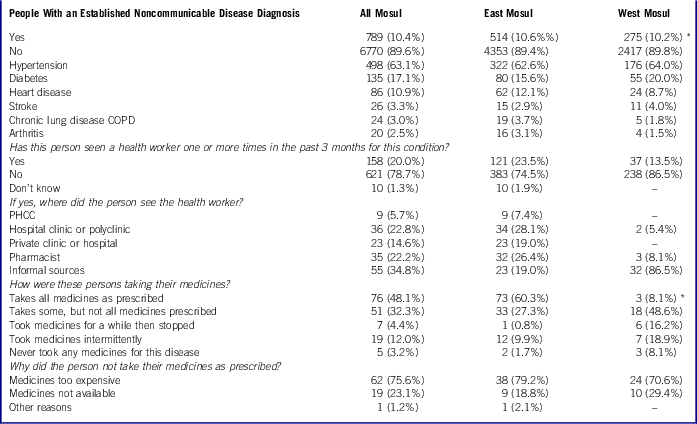
The presence of NCDs was very commonly reported (789 [10.4%]) in Mosul households (Table 4), with hypertension being the most common. Overall, there were 498 persons who reported a health worker diagnosis of hypertension, accounting for 63.1% of reported NCDs. Diabetes and heart disease were less common. Only 158 (20.0%) of those with 1 of these conditions had seen a health provider in the past 3 months. Those who had seen a provider in the past 3 months chose a variety of locations: hospital, private clinic, and pharmacy, though the largest number listed their provider as an informal source. As with other conditions, the primary health care (PHC) clinics were not frequently used. Only 3 (8.1%) persons with NCDs in west Mosul had reported always taking their medicines as prescribed, compared with 73 (60.3%) in east Mosul (p<0.01). The most common reasons for not taking medicines was the cost, reported by 62 (75.6%) people.
Persons With an Established Noncommunicable Disease Diagnosis

COPD=chronic obstructive pulmonary disease; PHCC = primary health care clinic.
* Difference between East and West Mosul, P<0.01.
DISCUSSION
This survey of 1202 households with 7559 residents, completed just after Mosul had been reclaimed from ISIS, found that 5.4% of adults and 13.2% of children had been sick in the previous 2 weeks. The number was significantly higher in east Mosul where populations were more mobile and health facilities were more likely to be functional. There were 789 persons or 10.4% of the residents with an established NCD. Only 23.8% of adults sought care outside of the house, and for children it was 39.8%. A fifth of persons with NCDs had seen a health worker in the past 3 weeks for their condition. Households reported that 640 women had delivered during ISIS control of Mosul. Although two-thirds had received some antenatal care, 90.9% had delivered in a health facility. Two-thirds of women delivering reported some complication during their pregnancy. The repression by ISIS and the flight during the liberation by Iraqi and coalition forces resulted in a major shift in population both out of Mosul and between west and east Mosul.
These data were collected as soon as security forces allowed entry into Mosul, although the situation was still unsettled. Interviewers were Mosul health workers who had escaped the ISIS control who returned for this survey. Through their distinctive Mosul accent, they could quickly establish rapport with survey households. Their findings reflect many of the difficulties endured through 3 years of occupation by ISIS and brutal repression. The constant scrutiny by Hesba morality police searching for minor infractions created fear among Mosul residents. With limitation to movement, especially of women, frequent flogging for minor infractions of ISIS rules, and numerous public executions, it comes as little surprise that emotional or behavioral concerns is the leading health problem identified by adults and common among children. Many have had family members shot. The grim experiences of being survivors of the final defense of west Mosul by ISIS and the ceaseless artillery and aerial bombardments make it no surprise that emotional or behavioral problems were reported more commonly in west Mosul, among both children and adults. Anxiety and depression, suicidal ideation, and symptoms of PTSD were commonly reported to interviewers by adults. Among children, caregivers reported anxiety, agitation, enuresis, nail-biting, and stuttering developing among children. An increase in these common mental disorders as a response to the psychological trauma, as well as exacerbation of underlying serious psychiatric condition, has been extensively documented during and following conflict.Reference Siriwardhana, Adikari and Pannala 16
Diarrhea being a common complaint in the past 2 weeks among both children and adults is also not a surprise. The water system started deteriorating early in ISIS years and stopped completely in many neighborhoods during the last year of ISIS control. Sometimes, interruption of water supplies seems to have been done deliberately.Reference Tawfeeq and Abdelaziz 17 Early in ISIS years, persons blamed illnesses on the poor quality of water available. 18 During the ISIS times and at the time of the survey, households were largely relying on wells for water, many being dug by residents.Reference Aboulenein 19 It was dangerous to draw water from the Tigris, as people were often shot by the ISIS snipers while doing so. The limited availability of water may have restricted hygiene to a point where skin diseases became more common, particularly in children. In the period leading up to the defeat of ISIS, many households reported their toilets stopped working, particularly in west Mosul. Among the Iraqis displaced by ISIS fighting in central Iraq in 2015–2016, a similar high prevalence of skin disease and diarrhea was noted.Reference Lafta, Aflouk and Dhiaa 6 The low utilization figures for the formal health sector probably represent as much of the destruction of health facilities and particularly the loss of health workers, as well as other potential reasons.Reference Roome, Raven and Martineau 20 Among the Rohingya displaced into Bangladesh from August 2017, a Doctors Without Borders (MSF) survey found that a third of refugees had been ill in the past 2 weeks, but only 46% of the new arrivals sought care for illness. 5
The prevalence of NCDs in Iraq has been well documented.Reference Doocy, Sirois and Tileva 3 , Reference Cetorelli, Burnham and Shabila 21 , Reference Mateen, Carone and Al-Saedy 22 With the flight from Mosul of some 500,000 persons at the time of the ISIS take-over, it was likely that the younger and able-bodied persons managed to flee, leaving behind the older and less mobile who also had a higher prevalence of NCDs. It is interesting that NCDs were reported much less commonly in our data from Mosul than reported by Iraqi refugees on Jordan and Syria in 2013.Reference Doocy, Sirois and Tileva 3 A similar higher prevalence of NCDs was noted among self-settled Syrian refugees in Jordan and Lebanon.Reference Doocy, Lyles and Roberton 23
Among children, the major health problems reported were diarrhea, respiratory infections, skin problems, and behavioral problems. Skin problems and behavioral problems were significantly more common in west Mosul, and consistent with the other patterns observed. A reason why diarrhea and respiratory tract infections were more commonly reported in east Mosul may have been that the survey was done there in the cooler rainy season, while in west Mosul it was done in the hot dry season. Utilization of health services was significantly less for children in west Mosul. Some households reported children receiving immunization during the time of ISIS control, though details of how the vaccines were provided is lacking. Before ISIS control, Mosul had good childhood immunization coverage and parents had a satisfactory knowledge of childhood vaccine needs.Reference Al-lela, Bahari and Salih 24
Emotional or behavioral issues among children exposed to violence have been studied extensively. Conditions commonly seen include anxiety related, mood related, somatization, and behavior-related conditions.Reference Lokuge, Shah and Pintaldi 25 , Reference Bolton 26 In the Mosul survey, emotional or behavioral conditions were recorded as reported by households, without efforts to specifically diagnose conditions. The violence widely practiced by ISIS and the forced witnessing by children to executions of civilians transgressing ISIS moral authority will undoubtedly have a long-lasting impact on the mental health of those in Mosul, as has been noted elsewhere in Iraq.Reference Al-Nuaimi, Hamad and Lafta 27
The pattern for maternal health factors is somewhat mixed. Antenatal care visits were nearly twice as common in east Mosul, and women in east Mosul were more likely to deliver in a hospital or clinic. Hemorrhage had the same frequency on both sides of the Tigris. Hypertension and spontaneous abortion was more common on the east side, but maternal anemia was more common in west Mosul. All three reported maternal deaths occurred in west Mosul. There were significantly more children reported to have been a smaller size at birth in west Mosul. A recent meta-analysis of maternal and neonatal service in fragile and conflict-affected populations found substantial underutilization compared with more stable situations and so increasing the burden of maternal and neonatal ill health.Reference Gopalan, Das and Howard 28
The provision of health services during the ISIS years presents a complex picture. As time went along, the Hesba morality police reportedly were increasingly vigilant in hospitals, clinics, schools, and public places. Few activities occurred outside of their scrutiny. Patients tended to avoid this scrutiny, by minimizing movement in public, which included travel to health facilities. The ISIS authorities gave preference to hospitals over PHC clinics for their importance in treating wounded ISIS fighters. PHC clinic staff hid instruments and equipment to prevent them from being commandeered for hospitals. Everywhere there were shortages of medicines. In the final months of ISIS control, it was forbidden for health workers to treat any persons who did not openly espouse support for ISIS leadership. Salaries of health workers collapsed after the Iraq central government stopped paying salaries in 2015, though pensions were continued. Health workers in hospitals would generally receive around US$50–$100 per month, but their colleagues in PHC clinics received only about US$10–$30 a month. After oil revenues for ISIS were interdicted in 2015 and 2016, the amount of money in circulation in Mosul shrank substantially. Although most city neighborhoods had a pharmacy, people had little money as many were unemployed. People needing care would informally consult health workers in their immediate neighborhood.Reference Van der Zee 29 This would minimize travel in public and avoid use of facilities. Some private clinics continued, but their utilization was not great. The conflict affected the population of west Mosul the most. During the military campaign, there was very little access to food or water. Some people were reportedly reduced to eating tree leaves.
Before the liberation of east Mosul from ISIS control, many in west Mosul who could move went to stay with friends and family in east Mosul, sensing the violence that would accompany the defeat of ISIS. The destruction of health facilities in the intense fighting for west Mosul could also explain why there was less treatment sought by those in west Mosul, and providers and medical equipment were deemed inadequate in west Mosul by persons interviewed. West Mosul, particularly around the old city, was traditionally a poorer part of the city and could explain why more persons in the west found it too expensive to seek treatment. This would be particularly true if travel was required to east Mosul where most functioning health facilities were located. While Iraqi and Syrian refugees in the studies cited also complained about the costs of treatment, this did not seem to hamper their utilization of health services.
Limitations
This study has many limitations. The 2 parts of Mosul were surveyed 3 months apart because of the military situation. In both cases, the intent was to obtain information at the very beginning of the recovery period. There was no accurate Mosul census available, making the application of the numbers found to the city’s overall population not possible. Our use of a geospatial random sampling approach rather than one which is population-based is a limitation that can introduce bias. In planning the study, the investigators assumed that the distribution of the remaining population across neighborhoods would be similar to the pre-ISIS situation. For the west Mosul, this turned out not to be true. The intense nature of the final attack on west Mosul killed an unknown number of residents and forced many to flee. Entire neighborhoods were destroyed. As soon as security forces allowed, the survey teams assessed the neighborhoods of west Mosul, which still had populations remaining. New clusters had to be selected, as some of those previously randomly selected were almost totally destroyed, deserted, or entry was forbidden by security forces. Obviously, survivor bias was substantial, especially on the west side, where abandoned and destroyed houses were very numerous in the selected clusters, as noted in the supplemental table. Because of recall issues, we did not attempt to assess disease patterns from earlier in the ISIS control period. A survey of this nature can only begin to touch on the physical and psychological trauma of this time. Some findings are difficult to interpret.
CONCLUSIONS
This survey, even with its limitations, presents a glimpse of a beleaguered population that tried to meet its health needs as best as possible under a rigid authoritarian regime. The resourcefulness of the survivors was impressive, yet the consequences to their physical and emotional health will be substantial and for many, permanent. Some did not survive. Childhood illnesses insufficiently treated, immunizations inadequately provided, and end organ disease not prevented by NCD treatment are but a part of the picture. The commitment and dedication of the health workers who tried their best to serve the people of Mosul with such limited resources and working in such a difficult environment deserve respect. Many continued to work despite daily physical threats and while carrying the emotional burden of family members killed or missing, livelihoods destroyed, and the fabric of their once-proud city torn apart. Rebuilding health facilities and services and gaining the public’s confidence are major tasks.
Acknowledgments
Our deepest appreciation and admiration go to the 4 interviewers who visited the 1202 households in the devastated remains of their city and those who undertook data management. Support was through existing university resources with no specific funding received. The views expressed in this paper are those of the authors and do not necessarily reflect the views of the United Nations.
Conflict of Interest Statement
The authors declare no conflict of interest.
Funding Source
No specific funding for this work was received.
Supplementary material
To view supplementary material for this article, please visit https://doi.org/10.1017/dmp.2019.11