INTRODUCTION
Salt production for meat and fish preservation was a significant industry in Roman Britain and in parts of the province may have been operated as a state monopoly.Footnote 1 The Somerset Levels was one of several coastal areas of salt production in the Romano-British period with other major salt-preparation areas in the Thames EstuaryFootnote 2 and the Fenland,Footnote 3 on the coasts of Kent and Sussex, and at Poole Harbour in Dorset.Footnote 4 Jeremy Taylor has pointed out that, in terms of geographical distribution, the main areas of salt production are found where ‘other industries, complex rural settlement hierarchies and urban settlements [are] concentrated’.Footnote 5
Sites of production (salterns or briquetage mounds) are routinely recognised, yet despite several attempts, mostly regionally focused,Footnote 6 to understand their archaeological signature, many questions still remain as to how they functioned. In particular, the ceramics associated with salt production, known as briquetage, has several specific component types, but how it was actually used has been a matter for conjecture.Footnote 7 This article reports on the excavation of a saltern in the Somerset Levels that produced a significant assemblage of briquetage and rare evidence for water management, which provides an opportunity to further the debates regarding the activity taking place at these sites.
Grove and Brunning in reviewing the evidence for salt production in the Somerset Levels identified four regions:Footnote 8 (1) close to the present coastline, in the area around Highbridge and Huntspill Island; (2) exposures in the Huntspill Cut, below marine clay; (3) Gold Corner to Burtle, on an area of peat moor; (4) Badgworth.Footnote 9 The current site, although not exposed by the digging (in 1939) of the Huntspill Cut, falls into Region 2. The nearest similar site lies within 300 m. As with the Huntspill Cut sites, the Pyde Drove site had been buried by post-Roman marine transgression clay deposits; these sites all post-date the second century.
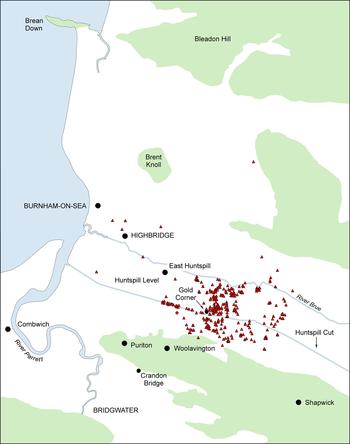
The presence of marine transgression deposits (302) and (303) must be associated with the known post-Roman inundation of parts of the levels in the fourth to ninth centuries.Footnote 10 These deposits buried the saltern, masking it from view. However, salterns in association with Romano-British ceramics in the Somerset Levels are not uncommon; until recently 167 saltern sites had been recorded, with the majority in the area around Gold Corner and the river Cripps in the east of Huntspill parish.Footnote 11 These sites are located to the north-east of Woolavington and the current site is on the southern edge of the densest distribution (fig. 1); many more must remain buried and are currently unknown.
The site (red dot) in relation to other known Roman period salterns (triangles) in central Somerset. (Data courtesy of Somerset HER)

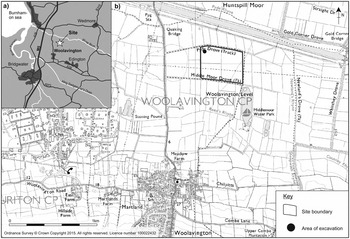
An archaeological excavation on land at Pyde Drove, near Woolavington, Somerset (centred on ST 3531 4299), was undertaken by AC archaeology during January 2014. The site was situated on pasture at c. 5 m OD and c. 1.1 km north of Woolavington on the Somerset Levels (fig. 2). A saltern was identified by geophysical surveyFootnote 12 and confirmed by trench evaluation and augering.Footnote 13 This site type consists of a large mound of debris from broken ceramic structures and containers (also known as briquetage) associated with salt production.Footnote 14 This article provides a summary of the significant findings from the excavation,Footnote 15 particularly the interpretation of the briquetage assemblage.Footnote 16
Location of site.

SITE SUMMARY
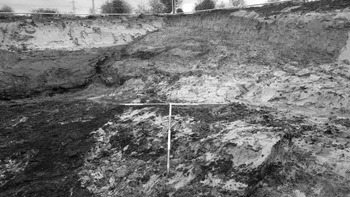
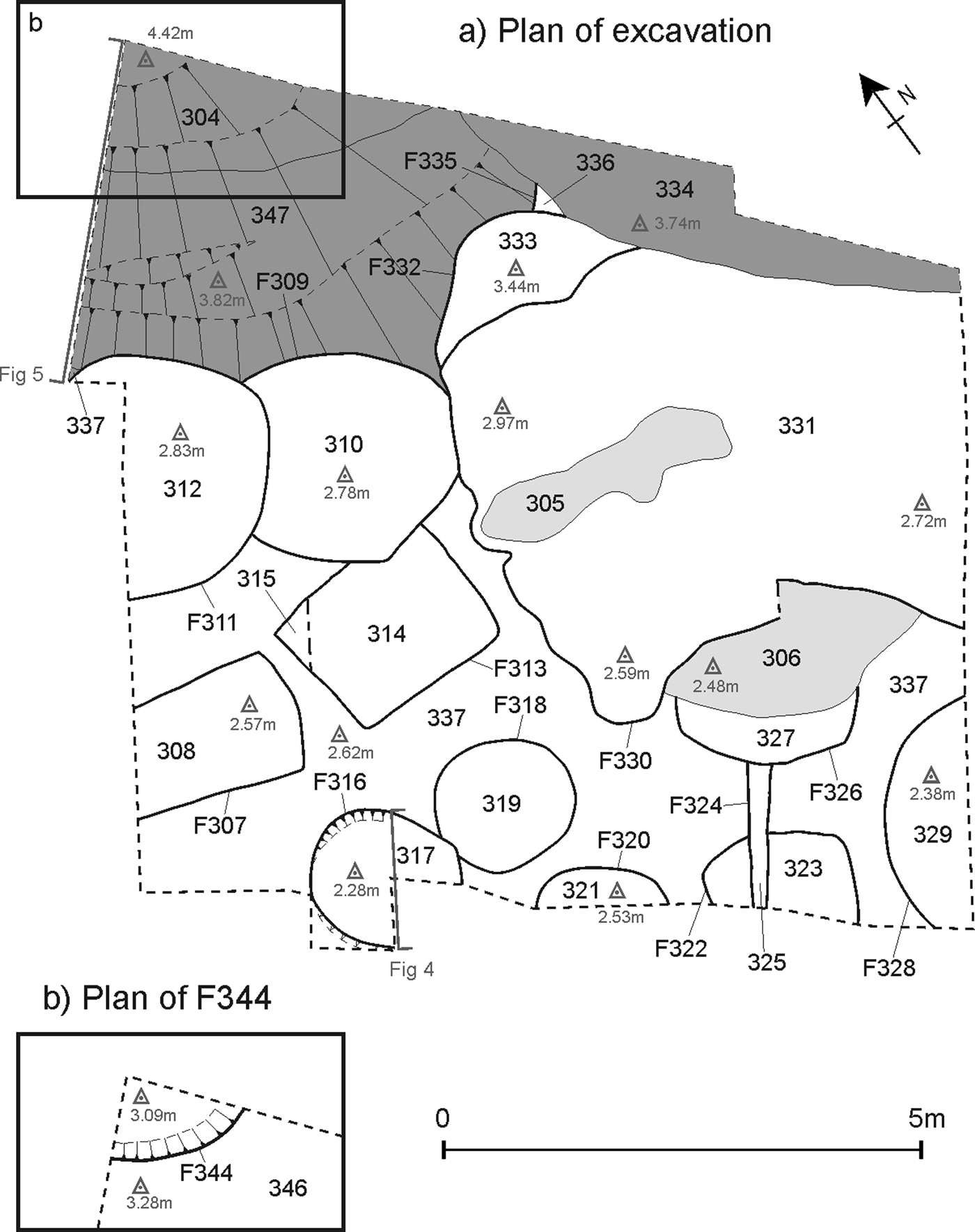
The area was stripped using a tracked excavator to a variable depth, with the majority of the site cleared to the top of peat (context 337), which was exposed at a depth of c. 1.8 m below the existing ground level. The exposed archaeological deposits were cleaned and investigated by hand as effectively as possible, though the winter conditions were particularly adverse (fig. 3). In the north-west corner of the site, the targeted portion of the buried saltern was present from a depth of 0.48 m below ground level. The overlying deposits consisted of two layers of homogeneous bluish-grey to light greyish-brown marine clay layers (303) and (302) that measured a total of 1.54 m thick. These were overlain by a dark greyish-brown silty clay agricultural subsoil (301) and topsoil (300). Adjacent to the mound there was a total of 12 discrete and intercutting settling tank features (F307, F309, F311, F313, F316, F318, F320, F322, F326, F328, F332 and F335), two channel features (F324 and F330) and two ‘working layers’ (305) and (306) (fig. 4).
Saltern, viewed from the south (scales 2 m and 2 m).

Plan of excavation.

PIT F344 AND THE SALTERN
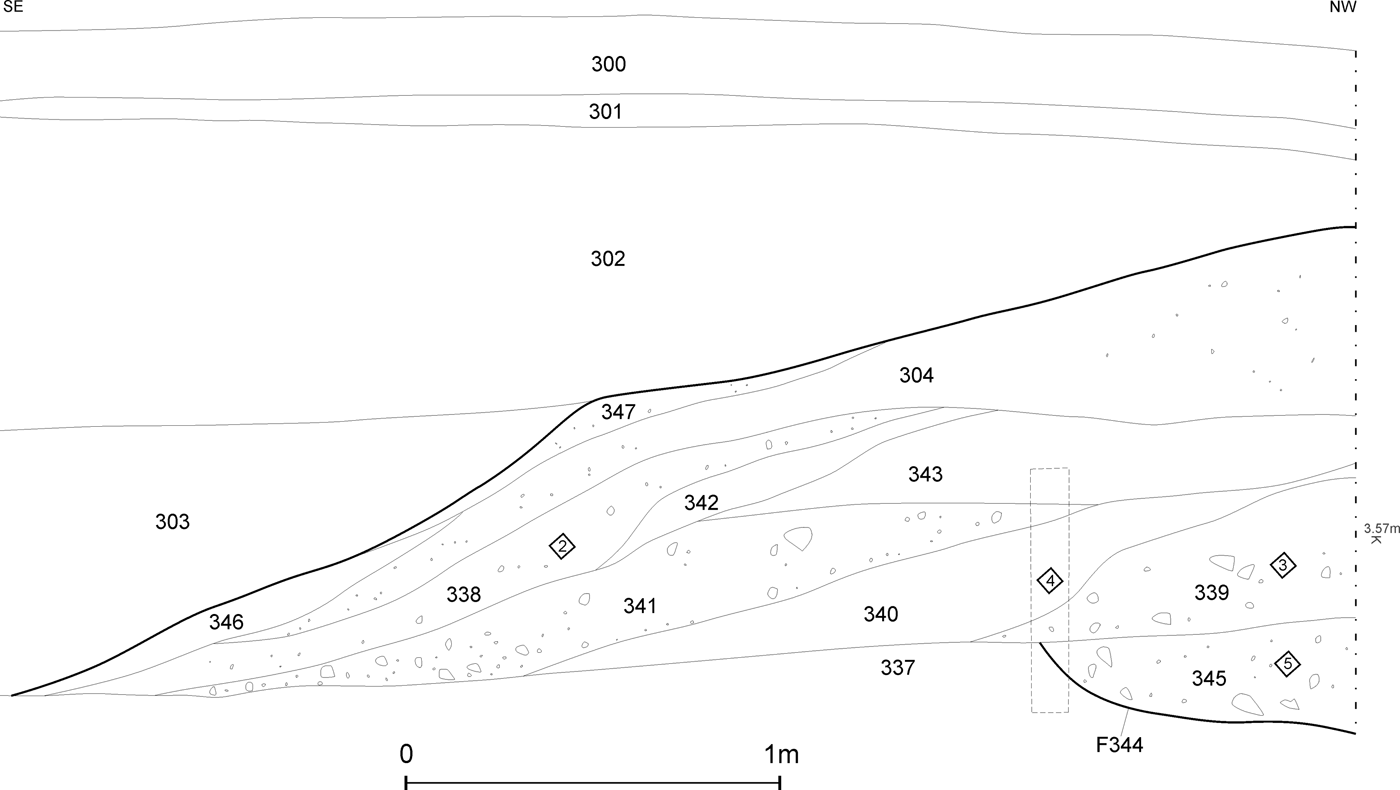
Beneath the saltern was a partially exposed pit, F344 (fig. 5). This rounded feature was located close to the centre of the later mound and was cut into the underlying peat (337). It measured 0.3 m deep with moderately steep-sloping sides and a flat base. The pit was infilled with a dumped deposit of mixed, dark grey redeposited peat (345) containing abundant briquetage fragments, sandy lenses and grit.
Section of saltern mound and pit F344.

The saltern measured 1.45 m high with moderately steep-sloping sides and comprised ten distinguishable layers: (339), (340), (341), (343), (342), (338), (304), (346), (347) and (334). The basal deposit (339) consisted of redeposited peat similar to the underlying pit fill (345). This was overlain by a fairly homogeneous, dark brown dump of redeposited peat (340) with occasional pieces of briquetage and grit. The overlying deposit (341) comprised a more mixed brown to greenish-grey dump of silty clay with abundant briquetage fragments, grit and coarse sand, which was sealed by reddish-brown to reddish-grey silty clays (342) and (343), with abundant small grit and sand inclusions. Layer (338), which overlay layer (342), consisted of a dark greyish-brown mixed redeposited peat with common briquetage fragments and grit. This was partially sealed by (304), which comprised a thick dump of reddish-brown to brown silty clay similar to layer (343). The upper deposits comprised a layer of redeposited dark brown peat (346) with final dumps of light reddish-grey to light grey, gritty silty clays (347) and (334).
Soil micromorphology analysis undertaken by Michael Allen indicates that the fuel used at the saltern was principally peat; there was a lack of charcoal fragments in all samples and uppermost layer (304) included burnt peat and vegetative ground mass. He concludes that the upper mound was upcast during channelling of water and water-boiling activities relating to salt production. The analysis clearly shows more peat-based material at the base and more briquetage-working debris in the upper part of the mound, which may derive from the cutting of the peat for channels, followed by the cleaning out of briquetage and working debris from those channels.
SETTLING TANK PITS, CHANNELS AND LAYERS
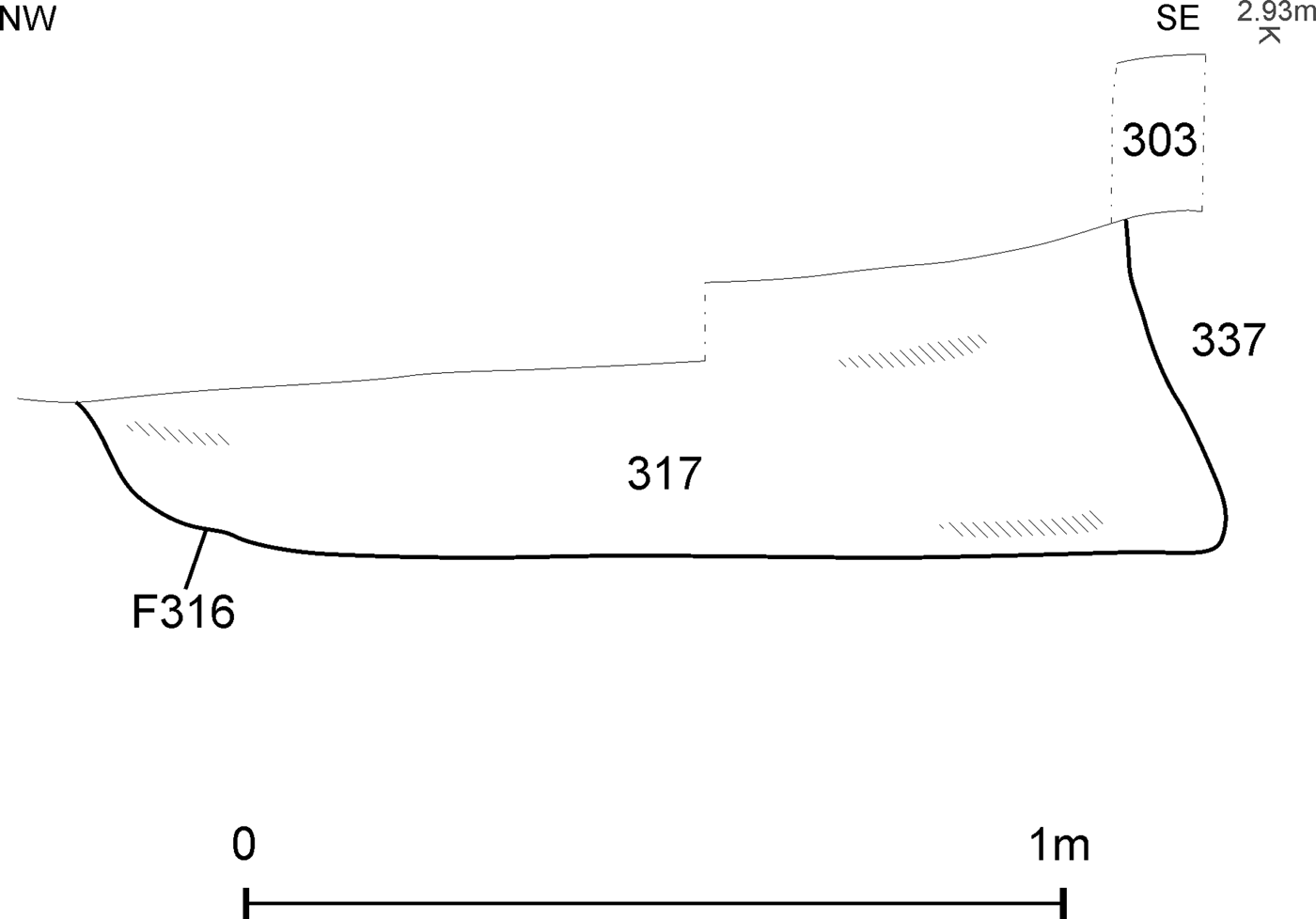
With the exception of discrete pits F307, F320 and F328, which had no direct stratigraphic relationships, all the other features and layers either intercut or overlay each other or the mound. The features were principally infilled with similar light grey marine clays that had lenses of redeposited peat and grit. The settling tanks were either sub-rectangular, in the cases of pits F307, F313 and F322, or more commonly, circular to sub-circular in plan, and ranged from 1.3 m to 2.5 m in diameter. As development was not predicted to disturb these deeply buried features, only one example of a tank was investigated (F316); it measured 1.38 m across and 0.37 m deep with steep to undercutting sides and a flat base (fig. 6). As with other tanks, it contained a light grey marine clay (317) with lenses of redeposited peat.
Section of pit F316.

Channel F324 measured 0.23 m wide and cut across earlier tank F322. It was exposed over a length of 1.5 m and was cut by later tank F326. Channel F330 measured 4 m wide and had a squared terminal at its south-west end. It cut the earlier tanks F309 and F332 as well as layer (306) and was overlain by the upper mound layer (334) and working debris layer (305). Layers (306) and (305), which were separated stratigraphically by channel F330, represented similar deposits. These consisted of dark greyish-brown mixed peat and silty clay material containing abundant fragments of crushed briquetage. In addition to these layers similar deposits were found as upper fills (308) and (314) of tanks F307 and F313. In the case of F313, its upper fill overlay the more homogeneous, light grey clay (315) found in the other tanks. These deposits are considered to represent the residues of the processing that was taking place on the site and therefore relate to the working levels.
ROMAN POTTERY By Mark Corney and Naomi Payne
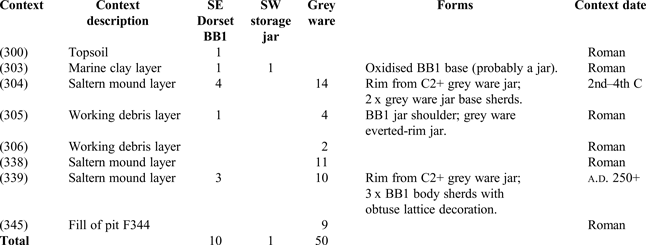
In total, 61 sherds (1,162 g) of Roman pottery were recovered from eight contexts. The pottery includes ten body sherds of South-East Dorset black burnished ware 1, a few of which have obtuse lattice decoration, indicating a date after c. a.d. 250, and a body sherd of a probable South-Western storage jar from layer (303). The remaining sherds are all grey wares, which cannot be closely dated. The Roman pottery is summarised in Table 1.
ROMAN POTTERY

BRIQUETAGE By Naomi Payne
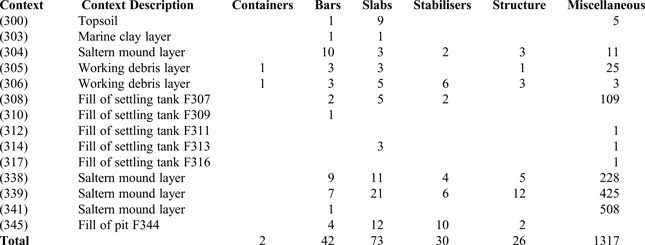
The briquetage assemblage consists of 1,490 pieces, weighing a total of 22.311 kg, from 14 contexts. The assemblage is quite fragmentary, making classification of many pieces problematic. The larger pieces are the most diagnostic and most can be identified to type using material from other local sites for reference. The briquetage was sorted into four categories: containers, supports, structure and miscellaneous, following the classification used by Lane and Morris.Footnote 17 Pieces that were not identifiable with high probability were classed as miscellaneous. The majority of the identifiable pieces fall into the category of supports, including bars, slabs and stabilisers. There are also two possible container fragments and some structural material. Just one piece of briquetage had vitrified. This was a stabiliser fragment from layer (338). The briquetage is summarised by context in Table 2.
CATEGORIES OF BRIQUETAGE BY CONTEXT

FABRIC
Almost all of the assemblage had been made from the same vegetable-tempered fabric, implying that a sizeable quantity of briquetage was prepared ready for use at the site. The only exceptions were two stabiliser fragments, which were made in a fine silty fabric, made opportunistically using clay that had not been specially prepared. Vegetable-tempered briquetage dominates the other Somerset Levels assemblages which have been studied in detail. The organic temper was probably chosen because this fabric stood up well in the intense heat of the hearth due to the voids created during initial firing.Footnote 18
The surface and internal colouration of the briquetage varies considerably, from cream, buff and light grey to shades of orange, red, pink and lavender, to mid/dark grey. The pinks, whites, greys and lavenders (as opposed to normal firing colours of buff to orange to red) have been described as ‘salt colours’.Footnote 19 They are thought to be caused by the natural reaction of salt water and heat, so they are more commonly seen on the supports, which were more likely to have come into contact with brine. Certain pieces show clear evidence of differential surface colouration relating to usage, apparently where pieces of briquetage covered over parts while in use, or where part of a bar had been embedded in the wall or floor of a hearth. This was not examined in detail but there is potential for further study of surface colouration and comparison with other assemblages. The forms are described in detail below.
CONTAINERS
Two possible briquetage container fragments (60 g) come from different contexts (305 and 306). The sherd from (306) has been described by Sarah-Jane Hathaway as a classic base of a rectangular flat-based briquetage container used for brine evaporation.Footnote 20 Context (305) produced a thin-walled fragment with an undulating surface, which may be a body sherd from a curving-walled container. This has a buff internal surface and an orange-red external surface suggesting it has not come into contact with brine, so the identification of this sherd as a container is tentative.
The dearth of evidence for containers on Somerset salt-production sites could be due to the habitual use of lead troughs for brine evaporation in this area.Footnote 21 The lack of ceramic container fragments from excavations may be, at least partially, explained by the fragmented state of briquetage assemblages and difficulties in identification.Footnote 22 However, this does not adequately explain this feature of the Somerset assemblages, as container fragments are so much more common within assemblages from other parts of the country. Medieval saltern sites which have associated documentary evidence for the use of lead containers have produced lead droplets and globules; however, no Somerset salt-production site has yet produced any lead, even where metal-detectors have been used.Footnote 23 Metal-detecting and soil micromorphology failed to find any evidence of lead droplets at the current site. However, the production of lead troughs in quantity would have been a significant investment so they would have been carefully looked after and recycled if they were damaged or wore out.
BARS
Bars are a standard feature of Somerset briquetage assemblages.Footnote 24 The late Iron Age/early Roman salt-production sites at St Georges, Worle, Banwell Moor and Puxton Dolemoor (North Somerset) all produced pedestals, wide-based supports that were clearly designed to stand in a vertical position.Footnote 25 The bars from the Central Somerset Levels sites, which appear to be later in date than the cluster in North Somerset, are generally slender and usually have parallel or sometimes tapering sides. It has been suggested that bars had technologically superseded pedestals by the third to fourth century in this area.Footnote 26
There are 42 bar fragments, weighing a total of 6,886 g. There are doubtless other bar fragments within the material classed as undiagnostic, partly because bars with incomplete cross-sections cannot always be separated with certainty from slab edges. There are no complete bars within the assemblage and the length of fragments varies between 39 mm and 170 mm. The majority have a consistent thickness throughout their length but nine examples taper.
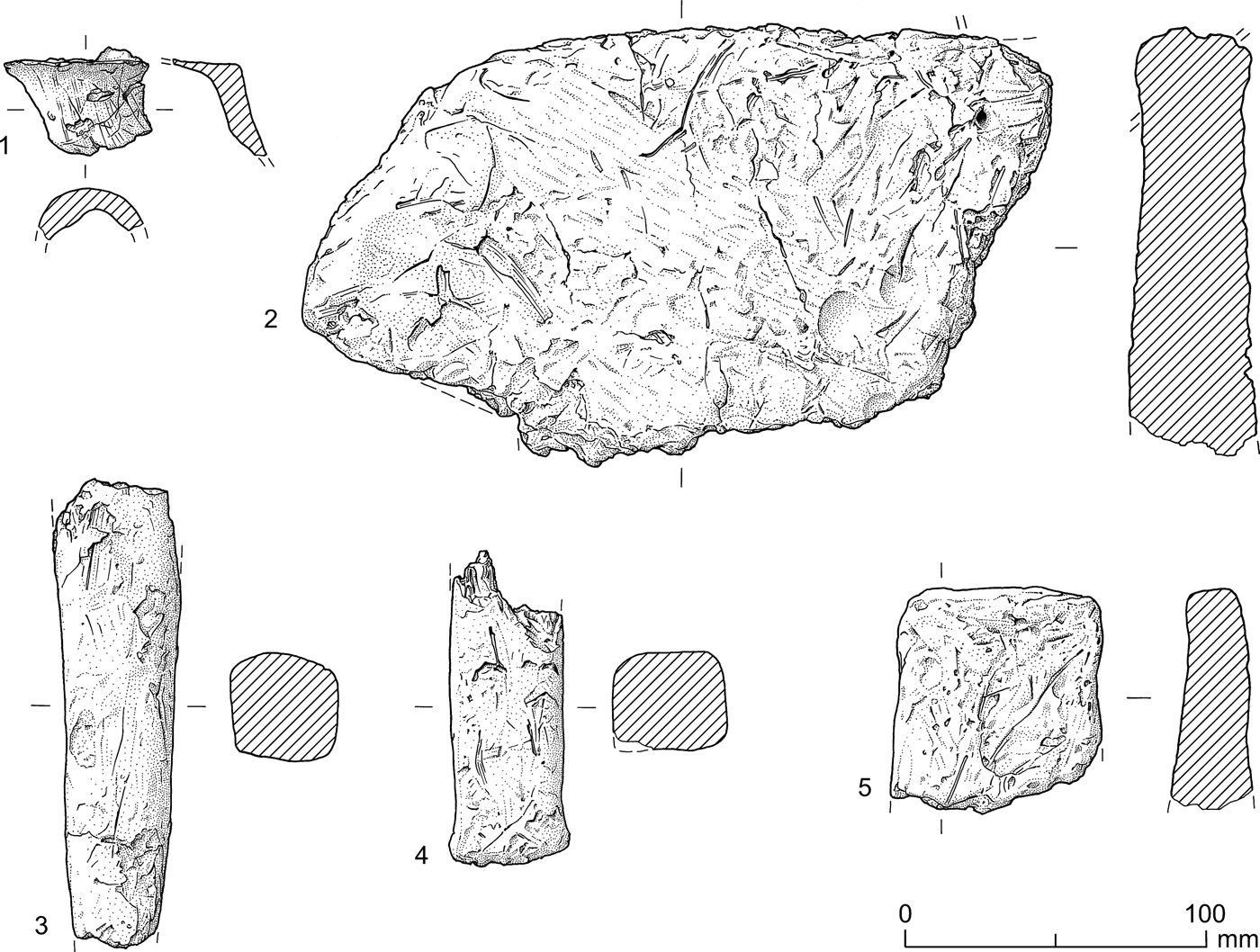
Most bars have square/sub-square cross-sections (31 examples; see fig. 7.3). The majority of the quadrangular sections have rounded corners, although there are a few which are notably more angular. There are also five bars which have more distinctly rectangular cross-sections. One has a rectangular section with rounded ends, like a flattened oval. There are four bars with circular cross-sections and two which are square/rectangular in section with the exception of a c. 20 mm length beside the end, which has a circular section. Both the latter bars have differential colouration which changes at the point where the shape of the section changes. The circular-sectioned bars tend to have slightly uneven surfaces, with finger prints or slight squashing apparent, indicating they were formed by hand and rather less carefully than the square- and rectangular-sectioned bars. Their diameters range from 38 mm to 50 mm. The maximum width for the square bars varies between 28 mm and 48 mm. The measurement is often c. 40 mm (21 of the square-sectioned examples have width measurements between 38 mm and 42 mm).
Selected illustrated briquetage. 1. ‘Stabiliser’ (context 339); 2. Large slab (339); 3. Bar (304); 4. Bar (338); 5. Slab, possible corner piece (304). (Drawn by Jane Read)

Of the bar fragments, 11 have one intact end. Most of the surviving bar ends are flat and perpendicular (or nearly so) to the sides, but three are convex (one is circular-sectioned and the other two square/rectangular). Three bars taper towards the intact end and the others have a consistent width. Three end pieces from context (338) have slightly expanded terminals (fig. 7.4). Two are flat and one is slightly convex. They may have been intended to be used in a vertical position.
SLABS
Slabs are another common feature of Somerset briquetage assemblages. They are believed to have been used as flat supports for containers, probably on top of another support, creating a raised or suspended floor to provide extra protection for the container.Footnote 27 In Somerset they appear to have been used with directly heated hearths as opposed to the indirectly heated hearth flues which were in use in some other parts of the country. At Puxton Dolemoor, Rippon noted that there were two distinct types of slab, the first 15–25 mm thick and the second 40–50 mm thick.Footnote 28 It has also been observed that many slabs have one smooth side and one rough side, the latter often impressed with plant material; the slabs from Woolavington BridgeFootnote 29 and East HuntspillFootnote 30 are consistent with this. None of the slabs from Pyde Drove were observed to have hobnail impressions on one side, as seen nearby at Hathaway's Site 295 and at Woolavington Bridge.Footnote 31
There are 73 ‘thin’ slab fragments, weighing a total of 3,468 g. For the purposes of the analysis only pieces which were corner pieces, edge fragments and pieces with two opposing parallel surfaces were recorded as slabs, as these are all fairly certain identifications (due to the dearth of other evidence for containers in any quantity at Pyde Drove). This allowed at least one original measurement (the thickness) to be taken from all the examples. As with the bars there are doubtless other slab fragments which have been classed as undiagnostic.
Three of the slab fragments were corner pieces, demonstrating that these fragments are certainly from slabs, as opposed to straight-sided containers or hearth superstructure. The corner piece from context (304) is interesting because its original width as well as its thickness has been preserved (fig. 7.5). It measures 25 mm in maximum thickness, 65 mm in width and it survives to a length of 72 mm. The fabric is somewhat softer and more powdery than much of the briquetage within the assemblage and the surface is slightly uneven (likely hand-made rather than knife-cut), so this may not be a typical piece. The degree of abrasion suggests that it had a long use-life. The other corner pieces are typical ‘thin’ slabs with one smooth side and one plant-impressed side, measuring 19 mm and 23 mm in thickness. Almost all the remaining ‘thin’ slab fragments (67 examples) have one smooth and one plant-impressed surface. There are 14 slab edge pieces, all with straight, usually knife- or wire-cut edges. The edge of nine examples are set at a slight angle of c. 110 degrees, and are higher beside the plant-impressed surface. The remainder are cut squarely. The thicknesses of the ‘thin’ slab fragments range from 13 mm to 31 mm, with an average of 19 mm.
STRUCTURAL FRAGMENTS
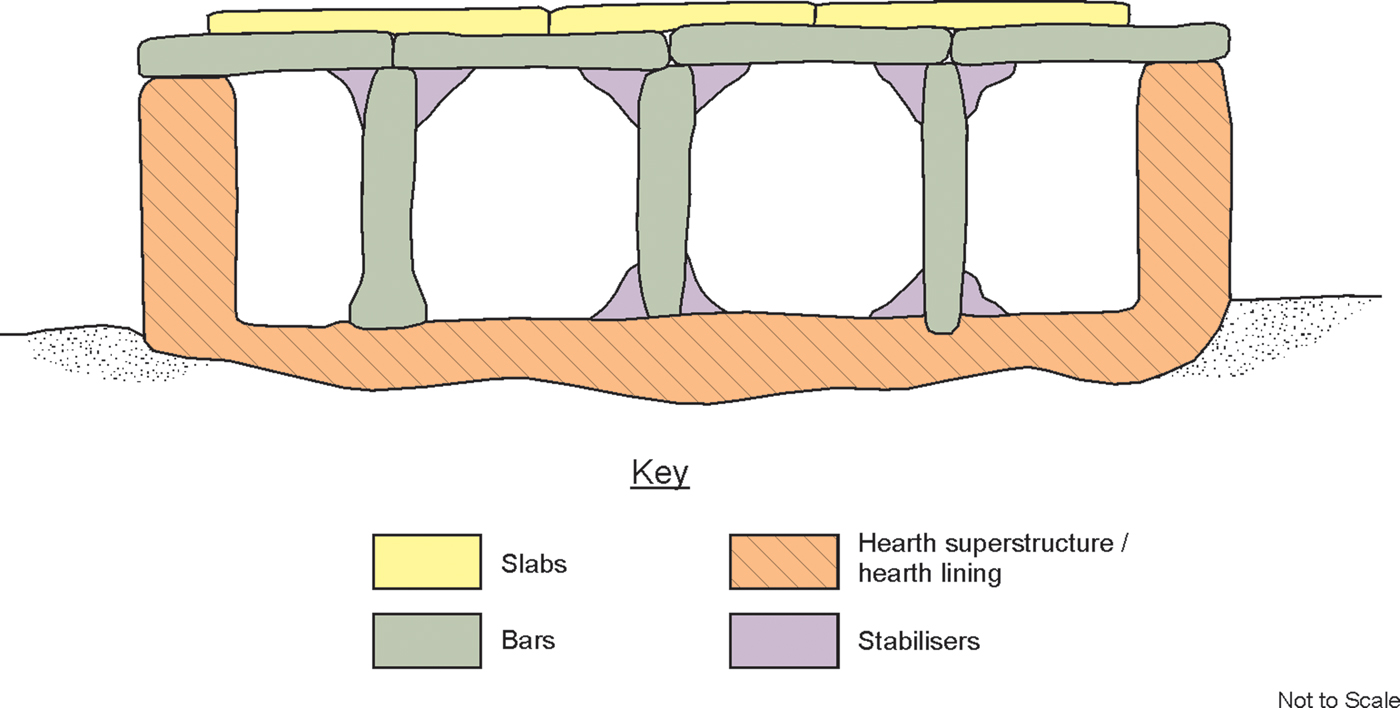
Twenty-six pieces (6,992 g) were classified as structural fragments. This includes pieces which have been classed as ‘thick’ slab fragments. The form of one ‘thick’ slab fragment in particular suggests it could be a piece of hearth superstructure rather than a support. It is a large edge piece from context (304). The piece does not appear to be a simple slab because it expands on one side (at right angles to the surviving edge). However, it is broken close to this point so its original form is not clear. At its widest point it is 55 mm thick. This piece seems to be more highly fired than the supports in the assemblage and all its surviving surfaces are smooth, although the fabric is no different, suggesting that it came from close to the corner of a raised hearth wall of the type constructed as an experiment by Richard Brunning following his saltern excavation at Woolavington Bridge.Footnote 32 This raises the possibility that the remaining thick slabs are also in fact hearth superstructure. There are 18 of these of which 12 are edge pieces. All have broadly smooth surfaces (as opposed to one smooth surface and one plant-impressed surface as is usual for the ‘thin’ slabs) and the edge pieces generally appear to have been hand-shaped, making them either convex (11 examples) or slightly concave (two examples), as opposed to the majority of the ‘thin’ slabs, which have knife-cut edges. Three of the ‘thick’ slabs have curving edges, including the very large slab fragment from context (339) (fig. 7.2). These may be from the stoke-hole to the hearth superstructure, which would have allowed the hearth to be raked out (fig. 8).
Conjectural reconstruction of briquetage hearth at Pyde Drove.

Eight fragments were assigned to the category of hearth lining. These are chunky fragments with one flat (sometimes plant-impressed) surface, which is generally oxidised, and an irregular opposing surface, which is usually reduced and somewhat convex. Their general form and firing suggest a position at the base of the hearth.
STABILISERS
Stabilisers were small pieces of raw clay that were used in an ad hoc way to keep brine evaporation containers stable.Footnote 33 The heat from the hearth caused them to be soft-fired. Stabilisers can indicate that more than one container was used simultaneously within a single hearth.Footnote 34 Three main types have been identified in other assemblages: pinch-props (sometimes called clips) were pushed into the rims of two or more containers; spacers were attached to the sides; and platforms were placed between the tops of pedestals (or other supports) and the containers.
Pyde Drove produced 30 stabilisers and fragments thereof (525 g). These elements are not easy to recognise, particularly when incomplete, and there are probably other stabiliser fragments which have been assigned to the miscellaneous category. The forms of many suggest that they were used to ‘glue’ together the other supports rather than placed in-between brine-evaporation containers. The whole structure presumably had to be fired hard before brine evaporation was undertaken. It seems unlikely that pinch-props in particular would have hardened very much if they were used to stabilise containers at the rim. The melting point of lead is only 327.5 degrees Celsius, at which temperature clay used as pinch-props would not have fired solid, particularly above an open fire as opposed to a closed kiln or oven. There are no clear container rim impressions in the Pyde Drove stabilisers.
Many of the more complete stabilisers acted as supports in the hearth structure. For example, the illustrated stabiliser from context (339) (fig. 7.1) appears to have been used as a ‘bracket’ to fix a bar end in an upright position to a slab. There are at least eight stabilisers which appear to be of this type. A larger, although incomplete, stabiliser from context (306) may have functioned to anchor the base of a square-sectioned bar set vertically. An apparently classic pinch-prop from context (339) is perhaps better explained as a piece used to ‘glue’ together two slabs. The pinched element is angled and very smooth, similar to many of the surviving slab edges. There are a further four fragments which appear to be of similar form. The remaining stabilisers are mainly fragmentary and less easy to classify but they could all have been used in an ad hoc way within the hearth to cement together the bars and slabs.
RADIOCARBON DATING By Michael J. Allen and Paul Rainbird
The humified peat (337) contained a few very fine (<2 years growth) horizontal woody twigs which were removed from the monolith sample near the top of the peat. A twig was selected as suitable short-lived material and submitted for AMS dating to the Scottish Universities Environmental Research Centre to provide a terminus post quem for the saltern. The sample was obtained from the first, clearly intact black humified peat immediately below pit F344. This meant that the sample was taken from c. 4 cm below the surface of the peat and the interface with the saltern.
The result from the twig of 896–796 cal b.c. at 95% probability (2665 ± 33 BP, SUERC-58184) indicates a Late Bronze Age date for the peat sample. The calibration curve indicates that the younger end of this range (840–800 cal b.c. at 68%) is more likely.Footnote 35 It must be borne in mind that the radiocarbon result represents a terminus post quem and the surface of the peat is at least 4 cm further up the profile. The artefacts in the saltern point to occupation of the site in the Romano-British period only and if this activity took place on the original surface of the peat at that time then we are looking at peat growth of only 4 cm in c. 1,000 years; a rather small amount assuming the environment had not changed significantly over that period of time. An explanation could be that the extant surface of the natural peat, may have been eroded or truncated in antiquity and that the dated peat had been buried lower in the peat sequence prior to this activity, involving cutting peat for fuel and digging the peat to form basins and channels, on the site.
DISCUSSION
The saltern was established on a ground surface of peat with some features filled with clay. Nearby, at Woolavington Bridge, the peat returned a Late Iron Age date.Footnote 36 The Late Bronze Age date obtained from close to the top of the peat beneath the saltern indicates that peat growth was active at that time and, unless it slowed significantly during the Iron Age, probably indicates that the upper levels have been truncated, presumably to provide fuel for the activity taking place on the site. Possible Romano-British peat-cutting channels have been identified on the opposite side of the Huntspill Cut.Footnote 37
The saltern mound was sub-circular in plan with maximum dimensions of 13 by 16 m rising to 1.45 m high. The mound comprised debris from the salt-production process; here an open-pan method was used where sea water is trapped at high tide and allowed to settle before being transferred to pans and heated causing evaporation of the water and leaving a residue of salt crystals.Footnote 38 The briquetage material represents the remains of the paraphernalia used in the heating stage and is discussed further below. There is no evidence to indicate that the site had any other purpose than salt-making. The pottery assemblage, with its composition of coarseware jars, may indicate that they had a role in transporting the salt, as there is certainly no evidence for domestic activity. James Gerrard has argued that Dorset black burnished ware jars were purposefully produced to transport Poole Harbour salt.Footnote 39
Other salterns (within Region 2) may be compared with Pyde Drove. Huntspill Cut site 121 revealed ‘half of a circular clay filled structure’ interpreted as ‘a brine settling tank for the removal of sediment’.Footnote 40 At East Huntspill a saltern revealed hearths and floor layers.Footnote 41 No hearths were identified at the Pyde Drove saltern, although the dump material of the mound illustrates that burning was taking place. Hathaway identified two distinct types of saltern mound:Footnote 42 one type contains hearths and layers or lenses of mixed hearth clear-out and burnt material with trampled floor areas, which she regards as working platforms, while the other does not contain hearths or the obvious lensing of clear-out material or trampling. Pyde Drove matches the latter type, indicating that it is the focus for dumping rather than being used as a working area. This perhaps explains why settling tanks were encroaching upon it, which would perhaps be less likely if the mound was functioning as a working platform.
At Pyde Drove we have many of the various features that were required for salt production including channels for bringing the tidal salt water closer to the site, settling tanks and the saltern mound itself, formed in part of the peat excavated to dig the channels and settling tanks. The geoarchaeological analysis showed that the development of this activity is reflected in the deposits making up the saltern, with more evidence of sediments altered by heat in the upper layers. The results of the previous auger survey may indicate that settling tanks are present on all sides of the mound. No hearth locations were identified but the presence of layers (306) and (305), as well as the upper deposits of tanks F307 and F309, suggests that the processing was likely to have taken place in the area of the settling tanks. The geoarchaeological analysis has shown that, as at East Huntspill,Footnote 43 peat was being used to fuel hearths for salt-making.
The excavation has revealed the relationship between the mound and the adjacent area of settling tanks. This shows that some settling pits (F309, F311 and F332) were cut into the perimeter of the standing mound which perhaps indicates a restriction in available space. The large channel (F330), which appears to be one of the latest water-management features on the site, is in part covered by the uppermost mound deposit (334) and also has a fragment of a working debris layer (305) on the surface of its fill, indicating that salt-making activity continued once this channel had become defunct.
Sub-square tank F314 pre-dates several of the other features and may suggest that there is a change from sub-square to circular tanks. However, although not fully revealed in plan, tank F344, buried beneath the saltern mound and thus early in the sequence, appears to be of the circular variety. A seasonal use of the site is perhaps indicated by the natural infilling of the settling tanks by marine clay when abandoned and new tanks dug at the beginning of each season of activity. Pyde Drove must now be regarded as the best evidence for water management at a saltern in Somerset and joins East HuntspillFootnote 44 as a site with multiple brine-settling tanks.
The actual organisation of activity at Pyde Drove is difficult to establish. While complete plans of the late Roman salterns were revealed at Stamford Wharf in Essex and Middleton in the Norfolk Fens, with outer ditches for collecting the sea water and settling tanks and hearths within, accounting for the full process of water to salt-crystal production,Footnote 45 no such neat plan is illustrated at Pyde Drove. The reason for this could simply be that the excavation was not on a large-enough scale to reveal the complete plan of the activities taking place. However, this seems unlikely, and the differences perhaps relate more to the character of the activities taking place in the East of England compared with the South-West.
The sites in the East give an impression of being well organised with the same working areas returned to on a seasonal basis. Although Pyde Drove illustrates reuse, it is clear given the stratigraphic relationships that the same tanks and ditches were not being used each season and that there appears to have been a desire to dig new ones; working areas where hearths would have been located appear to shift also, although the evidence for the actual locations for these was not forthcoming. This apparently rather more ad hoc use of the site perhaps relates to management of the salt industry which may indicate a more artisan approach to the organisation of production in the South-West compared with a more managerial, perhaps state-controlled, organisation in the East; however, in both areas there is no actual evidence regarding the level of organisation.
A more prosaic interpretation of the differences between the character of the sites in the east and west of the province is that it relates to the fuel being used for the hearths. In the East the evidence for the fuel indicates that saltmarsh plants were being harvested to burn, with some wood charcoal in the latest phases, which compares with the evidence in the South-West for peat as fuel. In this regard the excavating of new tanks each season at Pyde Drove would provide some of the fuel to be dried for the hearth and provide the necessary facilities for capturing and processing the salt water. That the peat surface appears to have been truncated would support such an interpretation.
The analysis of the briquetage from the site has drawn some innovative conclusions:
(1) Brine evaporation was undertaken over hearths which may have been dug into the ground, but which also had a simple superstructure. This probably consisted of a low hand-formed clay wall, c. 40–50 mm thick. A stoke-hole allowed the hearth to be raked out as necessary. The hearths themselves appear to have been located elsewhere, but presumably at no great distance.
(2) Previously fired bars and slabs were used to construct a platform which was strong enough to hold one or more large shallow lead containers at a suitable distance to allow evaporation to take place without melting the lead. Some bars were perhaps used vertically to support further bars placed in a horizontal position, onto which the slabs were placed. This arrangement would have provided some insulation for the containers against the strong heat from the fire.
(3) The elements of the framework may have been ‘glued’ together with pieces of raw clay, which we call stabilisers when excavated. The hearth could then have been fired to set everything in place prior to actual use.
(4) The two possible briquetage container sherds may indicate occasional use of ceramic containers for brine evaporation, but the general lack of container sherds seems to indicate that lead containers were the primary choice. A well-known Roman lead industry was located on the Mendip Hills, only 20 km from Pyde Drove.
The sequence of features suggests the constant evolution of the site probably over several seasons of salt production. It is interesting that the saltern mound itself is cut by the sequence of tanks, but these in turn are then covered in part by the upper mound deposit. The overlapping of the features may indicate the need for close proximity to the mound or changing environmental conditions.
ACKNOWLEDGEMENTS
The excavation was undertaken in support of a planning application for a new solar park and was commissioned by Will Bedford of CgMs Consulting for Wessex Solar Energy and with the advice of archaeologists from the Somerset County Council Historic Environment Service (SCCHES). The site works were carried out by Simon Hughes, Kerry Kerr-Peterson, Ben Pears, Paul Jones, Jon Hall, Vince Simmons, Will Smith and Stella De-Villiers. The illustrations were prepared by Sarnia Blackmore and Elisabeth Patkai. The collaborative roles and helpful advice of Steve Membery, Richard Brunning and Tanya James from the SCCHES are duly acknowledged. N.P. would like to thank Sarah-Jane Hathaway for useful discussion regarding the briquetage. fig. 1 was created using data from the Somerset HER which was kindly provided by Chris Webster of the SW Heritage Trust. Comments on a draft of this paper by both Rick Turner and two anonymous referees are greatly appreciated. The archive will be deposited at the Somerset Heritage Centre, Taunton under reference no. TTNCM 116/2013.