Introduction
In recent years, organic microcontaminants in surface waters have been detected frequently. These emerging contaminants (ECs) comprise a great variety of chemicals such as pharmaceuticals (PhAcs), personal care products, surfactants, steroid hormones, plasticizers, fire retardants, pesticides, etc. (Hedgespeth et al. Reference Hedgespeth, Sapozhnikova, Pennington, Clum, Fairey and Wirth2012; Luo et al. Reference Luo, Guo, Ngo, Nghiem, Hai, Zhang, Liang and Wang2014). Several recent reviews have confirmed the presence of ECs in finished drinking waters across the world, as treatment processes largely fail to reduce the amounts of these substances to below current detection limits (Kleywegt et al. Reference Kleywegt, Pileggi, Yang, Hao, Zhao, Rocks, Thach, Cheung and Whitehead2011; Rodil et al. Reference Rodil, Quintana, Concha-Graña, López-Mahía, Muniategui-Lorenzo and Prada-Rodríguez2012; Meffe and Bustamante Reference Meffe and Bustamante2014).
Granular activated carbon (GAC) is used in the majority of water treatment plants. A good correlation between the percentage removal by activated carbon and the octanol/water partition coefficient (Kow) has been found but only for compounds with log Kow > 3 (Zwiener Reference Zwiener2007). Studies, therefore, now focus on the search for alternative or complementary sorbents to improve EC removal. In this context, clay minerals, as sorbents with unique properties such as large surface area, low cost, and high abundance, have been assessed for the removal of ECs after functionalizing their surfaces for improved performance. This is achieved usually by two methods: cationic exchange reactions and grafting of organic groups. The most widely used cations for intercalation on the clay surface are quaternary ammonium surfactants and polymers (Gardi et al. Reference Gardi, Nir and Mishael2015; Shabtai and Mishael Reference Shabtai and Mishael2016). Lelario et al. (Reference Lelario, Gardi, Mishael, Dolev, Undabeytia, Nir, Scrano and Bufo2017) studied the removal of three ECs by laboratory-scale filtration using three clay-based composites prepared from two cationic surfactants and one polycation. The removal was strongly dependent on the modifier used, which affected the interaction mechanism. However, potential leaching of the modifier during water treatment represents a considerable concern and needs to be addressed. One potential approach may involve silane grafting (silylation) of the clay mineral surfaces, which provides a durable immobilization of the modifier by covalent bonding (polycondensation) between the organosilane agents and the OH of the clay surfaces (He et al. Reference He, Tao, Zhu, Yuan, Shen and Yang2013). The adsorption selectivity of the silylated surface can be improved by introducing specific functional reactant groups. Based on previous studies, amino- or mercapto-grafted clays are effective sorbents for the removal of heavy metals by chelation (Tonle et al. Reference Tonle, Ngameni, Njopwouo, Carteret and Walcarius2003; Liang et al. Reference Liang, Xu, Sun, Wang, Sun, Sun and Qjn2011). Silylated clays have also demonstrated a high level of efficacy for the removal of organic pollutants (Paul et al. Reference Paul, Martens and Frost2011a). Studies regarding the use of grafted sepiolites in the removal of organic pollutants, however, are scarce (Paul et al. Reference Paul, Martens and Frost2011b).
In the current study, the removal of three PhAcs via a commercially available sepiolite and following the silylation of its surface was studied. The specific objectives were: (i) to modify the sepiolite surface by grafting onto its external surface organic moieties that render it with different physicochemical properties; (ii) to study the removal of PhAcs as a function of their nature and of the grafted groups; and (iii) to test the new materials for their potential use in filtration processes.
Materials and Methods
Materials
Sepiolite (Pangel S9) was obtained from Tolsa S.A. (Madrid, Spain). Pangel S9 is a high purity sepiolite produced from the raw mined sepiolite by a wet micronization process that removes the large amount of higher density impurities such as feldspars, quartz, carbonates, and other detrital materials. Its X-ray diffraction pattern corresponds to sepiolite (Fig. 1). Its physical appearance is a fluid, creamy-colored powder; its specific surface is 320 m2/g; and it has a cation exchange capacity of 0.15 mmolc/g.
XRD pattern of the sepiolite Pangel S9

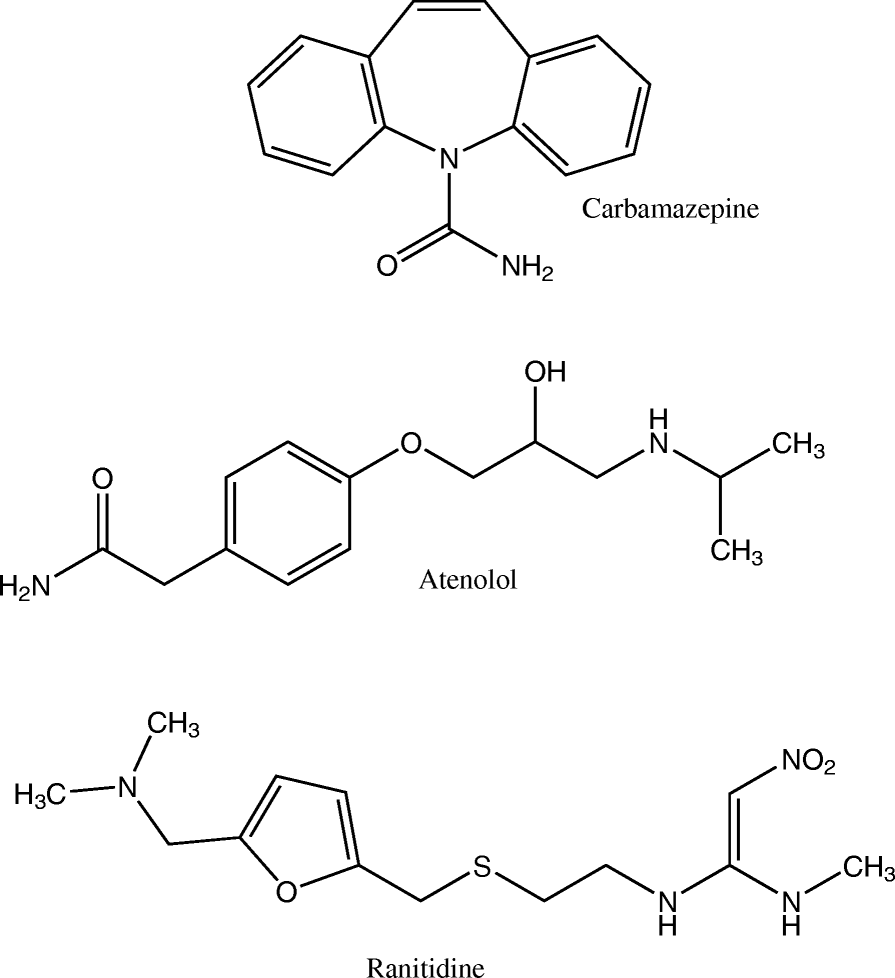
Analytical-grade organosilane agents and pharmaceuticals were obtained from Sigma-Aldrich (Sigma Chemical Co., St Louis, Missouri, USA). The organosilane grafting agents were γ-aminopropyltriethoxysilane (APTES), 3-chloropropyltriethoxysilane (CPTES), triethoxy(octyl)silane (OTES), and phenyltrichlorosilane (TFS). The pharmaceuticals studied were atenolol, carbamazepine, and ranitidine (Fig. 2). Granular activated carbon (NUSORB GC60, 12 × 30 mesh) was purchased from NUCON International, Inc. (Columbus, Ohio, USA); High Performance Liquid Chromatography (HPLC)-grade acetonitrile and methanol were obtained from Teknokroma S.A. (Barcelona, Spain).
Structural formula of PhAcs

Preparation of Grafted Sepiolites
One gram of pristine sepiolite was refluxed for 24 h in 50 mL of dry toluene with an amount of organosilane equivalent to the amount of silanol groups on the clay surface (0.6 mmol) (Rytwo et al. Reference Rytwo, Nir, Margulies, Casal, Merino, Ruiz-Hitzky and Serratosa1998). The reaction was carried out in an oxygen-free environment. Having completed the reaction, the mixture was filtered and washed with 50mL of anhydrous ethanol and the product was dried at 60°C for another 24 h. The amount of grafted organosilane was determined by elemental C analysis (LECO Elemental Analyzer, model CHNS 932). Parallel experiments were performed using twice the amount of organosilane. The grafted sepiolites are abbreviated as Y-sep, where Y refers to the organosilane agent.
Preparation of Sorption-Based Sepiolites
Sorption of the organosilane agents on the clay was performed in toluene at a clay concentration of 1.6 g/L. The organosilane was added at five times the concentration of silanol groups. After shaking for 24 h, the suspension was centrifuged for 15 min at 39200×g, and the pellets were lyophilized.
Characterization of Functionalized Sepiolites
Thermogravimetric analysis (TG) and differential thermogravimetry (DTG) analysis of the samples were performed using a modulated SDT Q600 system and the software package Universal Analysis-NT 2000 (TA-Instruments, New Castle, Delaware, USA). The samples (2–6 mg) were heated at a rate of 10°C/min from 30 to 1100°C in aluminum pans with a pin-hole under a nitrogen atmosphere (60 mL/min).
Fourier-transform infrared (FTIR) spectra were recorded from KBr pellets (2 wt.% sample), using a 6100 Jasco spectrometer (Easton, Maryland, USA) with a DTGS detector, in the range 4000–400 cm−1 and with a resolution of 2 cm−1. In order to improve the signal-to-noise ratio in the spectra, 300 scans were undertaken.
Zeta potential measurements of suspensions of the organo-sepiolites following redispersion at a concentration of 1.6 g/L were performed using a Zetasizer Nanosystem (Malvern Instruments, Southborough, Massachusetts, USA). The samples were allowed to equilibrate for 1 h before a several mL aliquot of the dispersion was analyzed. The temperature of the samples was 25 ± 1°C. The zeta potential was deduced from the mobility of the particles using the Smoluchowski equation.
Sorption Experiments
Sorption isotherms of ranitidine, atenolol, and carbamazepine onto sepiolite and grafted sepiolites were conducted in triplicate by mixing 15 mL of the solutions of each adsorbate (0–50 mg/L) with 24 mg of clay; clay concentration was 1.6 g/L. Having been shaken for 24 h at 20°C, the suspensions were centrifuged at 12,000×g for 10 min, and the analyte in the supernatants was measured via HPLC.
Sorption was modeled by using the Langmuir-Scatchard equation:

where Lo and L denote the molar concentration of total and free surfactant, respectively, Ro is the molar concentration of sorption sites, and K L is the binding coefficient.
Removal of PhAcs by Filtration
Column filter experiments were performed using a 50/1 (w/w) mixture of quartz sand with grafted clay. Glass columns with a length of 21 cm and a diameter of 2 cm, containing a porous plate at the bottom, were filled with 73.5 g of thin quartz sand mixed with 1.5 g of clay-polymer complexes (Experiment 1). The active sorbent layer was 13 cm thick. Glass wool (0.35 g) was placed on both ends of the column to prevent sand loss. The pore volume of the column was 12.9 mL and it was connected to a peristaltic pump and saturated at a constant flow rate of 10 mL/min with distilled water. Single solutions of PhAcs at a concentration of 5 mg/L were passed through the columns.
Different constructive and operational parameters were used in another filtration experiment (Experiment 2), with columns 24 cm long and 3 cm in diameter and filled with 154 g of sand and 3.1 g of composite. The pore volume was 38 mL and the sorbent layer was 10 cm thick. A 1 mg/L solution of PhAcs was filtered at a flow rate of 12 mL/min.
Analysis of the Kinetics of Filtration
In this analysis, the adsorption and convection phenomena occurring in the filter were described by Eq. 2 as in Nir et al. (Reference Nir, Zadaka-Amir, Kartaginer and Gonen2012). A column of length L was filled with material whose initial molar concentration of adsorbing sites was Ro, and whose concentration later changed to R(X,t). The beginning and end of the filter were at the coordinates X = 0 and X = L, respectively. The pollutant concentration at the inlet, Co, was constant, i.e. C(X,t) = Co, X = 0, where t denotes time.
The kinetics parameters were C1 (M−1 min−1, rate constant of forward adsorption), D1 (min−1, rate constant of desorption), and ν (flow velocity). The equation used was:

The statistical criteria employed for simulation and prediction of certain experimental results of filtration by the calculations according to Eq. 2 were the values of R2.
Analysis of Pollutants
The solutions were analyzed isocratically using a Shimadzu HPLC (Kyoto, Japan) equipped with a photo diode array detector. The reverse-phase column used was a 15-cm Kromasil 100 C18, with a flow rate of 1.0 mL/min. The mobile phases were binary mixtures of: (1) methanol with water acidified to pH 3.0 by glacial acetic acid at a ratio of 45:55 for atenolol; (2) methanol with 0.5 M ammonium acetate at a ratio of 20:80 for ranitidine; and (3) acetonitrile with 10 mM of KH2PO4 acidified to pH 2.5 with phosphoric acid at a ratio of 30:70 for carbamazepine. The PhAcs concentrations were measured at the following wavelengths: atenolol at 230 nm, ranitidine at 254 nm, and carbamazepine at 210 nm. The retention times were 2.55 min for atenolol, 4.20 min for ranitidine, and 4.94 min for carbamazepine.
Results and Discussion
Characterization of Functionalized Sepiolites
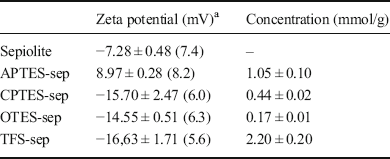
Organosilane covalently bonded to sepiolite can be obtained through one, two, or three silanols on the sepiolite surface. Moreover, additional polymerization between the grafted organosilanes may occur. Elemental C analysis of the grafted sepiolites enabled determination of the reaction products (Table 1). On APTES-sep, CPTES-sep, and OTES-sep, the amount of organosilane grafted did not change with increasing amounts of added organosilane. The amount of grafted APTES on sepiolite indicated that each molecule reacted with one silanol. The excess organosilane, over the amount of silanol groups on the sepiolite surface, may interact with other mineral phases present (the mineral used accounted for 85% of sepiolite) or within the channels by cationic exchange through protonation of the amine moieties. Unlike APTES, the amount of grafted CPTES-sep was relatively close to that of the silanol groups; hence, one CPTES molecule reacted with one silanol on the sepiolite surface. In contrast, the small amount of grafted organosilane on OTES-sep showed that each OTES molecule reacted with three silanols on the sepiolite surface, yielding a value of grafted silanols of 0.54 mmol/g, which is relatively close to the total amount of silanols on the sepiolite surface (0.6 mmol/g). The high loading of TFS after grafting is proof of polymerization between TFS molecules. The adsorbed surface water of sepiolite provoked hydrolysis of Si–Cl bonds to form Si–OH groups, forming a tridimensional network by polycondensation reactions. Limiting factors are the amount of organosilane and water in the system (Fadeev and McCarthy Reference Fadeev and McCarthy2000; Fadeev and Kazakevich Reference Fadeev and Kazakevich2002).
Zeta potential of sepiolite and organo-sepiolites and the amounts of organosilane grafted on sepiolite

aThe pH values of the organo-sepiolite suspensions are provided in parentheses
The surface charge of the sepiolite after silanization with the organosilane agents was determined by zeta potential measurements. The isoelectric point (IEP) of this sepiolite is 2.7 (Jalali et al. Reference Jalali, Taromi, Atai and Solhi2016), and so its surface was negative at the pH of the suspension. After grafting with the organosilanes with the exception of APTES, the surface potentials were more negative and similar which was not related to the pH of the suspensions given their more acidic character. The absence of variable charges due to silanols located on the external surface of the sepiolite and providing certain positive charges enhanced the permanent negative charges associated with isomorphic substitutions. This sepiolite has 0.17–0.23 Al atoms every 12 tetrahedral positions (García-Romero and Suárez Reference García-Romero and Suárez2010) inducing a polarized charge on the basal oxygens of the external tetrahedral planes, enabling them to behave as weak electron donors. When the surface of the clay was grafted with APTES, the surface potential was reversed due to the excess of positive charge of the amine moieties protonated at the pH of the suspension.
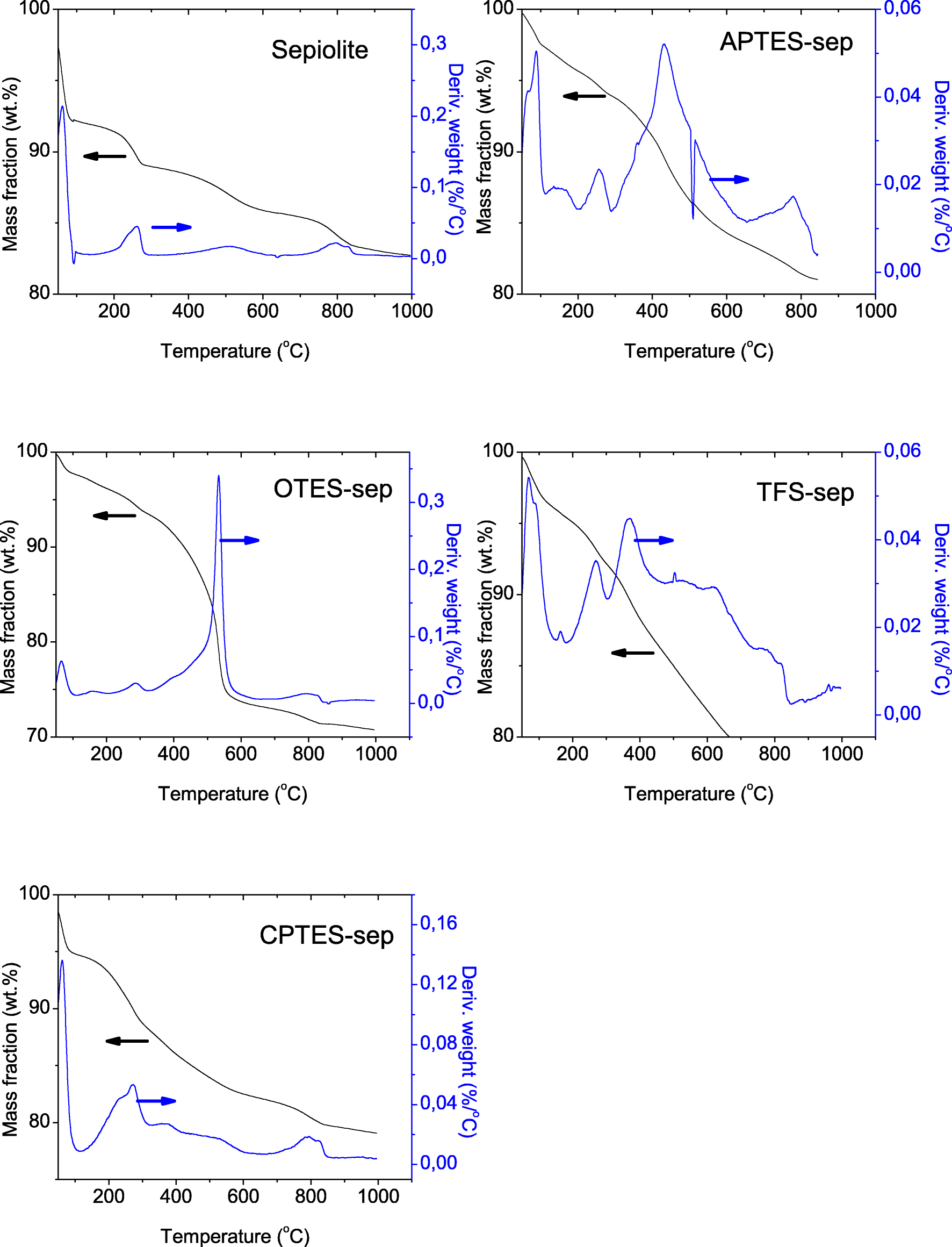
After grafting with the organosilane agents, the TG-DTG curves of pristine sepiolite (Fig. 3) showed four mass losses due to: (i) removal of adsorbed water up to 100°C (weight loss of 8.0%); (ii) removal of zeolitic water up to 270°C (3.2% weight loss); (iii) removal of water coordinated to Mg ions up to 600°C (2.5% weight loss); and (iv) dehydroxylation followed by folding of the structure up to 1000°C (2.1% weight loss) (Frost and Ding Reference Frost and Ding2003; Post et al. Reference Post, Bish and Heaney2007). The TG-DTG curves of the complexes prepared by sorption of the organosilanes were fairly similar to those of pristine sepiolite (data not shown), in contrast to those obtained from the grafted sepiolites.
TG-DTG curves of sepiolite before and after the grafting of its surface with organosilane agents

After APTES grafting, a weight loss of 3.0% was observed between the losses of adsorbed and zeolitic water. This loss is closely related to the decomposition of liquid APTES (157°C), revealing the presence and degradation of loosely bound molecules of the organosilane agent. The loss of zeolitic water also occurred over a broader temperature range, most likely due to the increased polarization of certain water molecules after interacting with amine moieties of APTES. The largest loss (13.2%) occurred between 300 and 600°C and was associated mainly with the decomposition of grafted APTES molecules. The TG-DTG pattern of OTES-sep was completely different from those of the other modified sepiolites. A significant loss of weight in the 270–600°C range (~14%) was observed, which was considerably larger than that associated with water chemically bound to Mg2+ ions (2.5%). In the DTG, a sharp peak at 532°C was noticed for the OTES-sep only, confirming a uniform reaction on the sepiolite surface, as previously mentioned. In contrast, the TFS-sep yielded on the DTG curve overlapped several peaks between 300 and 800°C, which indicates several TFS interaction mechanisms, covalently bound to the sepiolite surface and in-between the grafted TFS molecules as well as to the formation of the char. The DTG of CPTES-sep showed a peak at ~370°C, which was not detected in sepiolite, associated with the decomposition of the grafted CPTES.
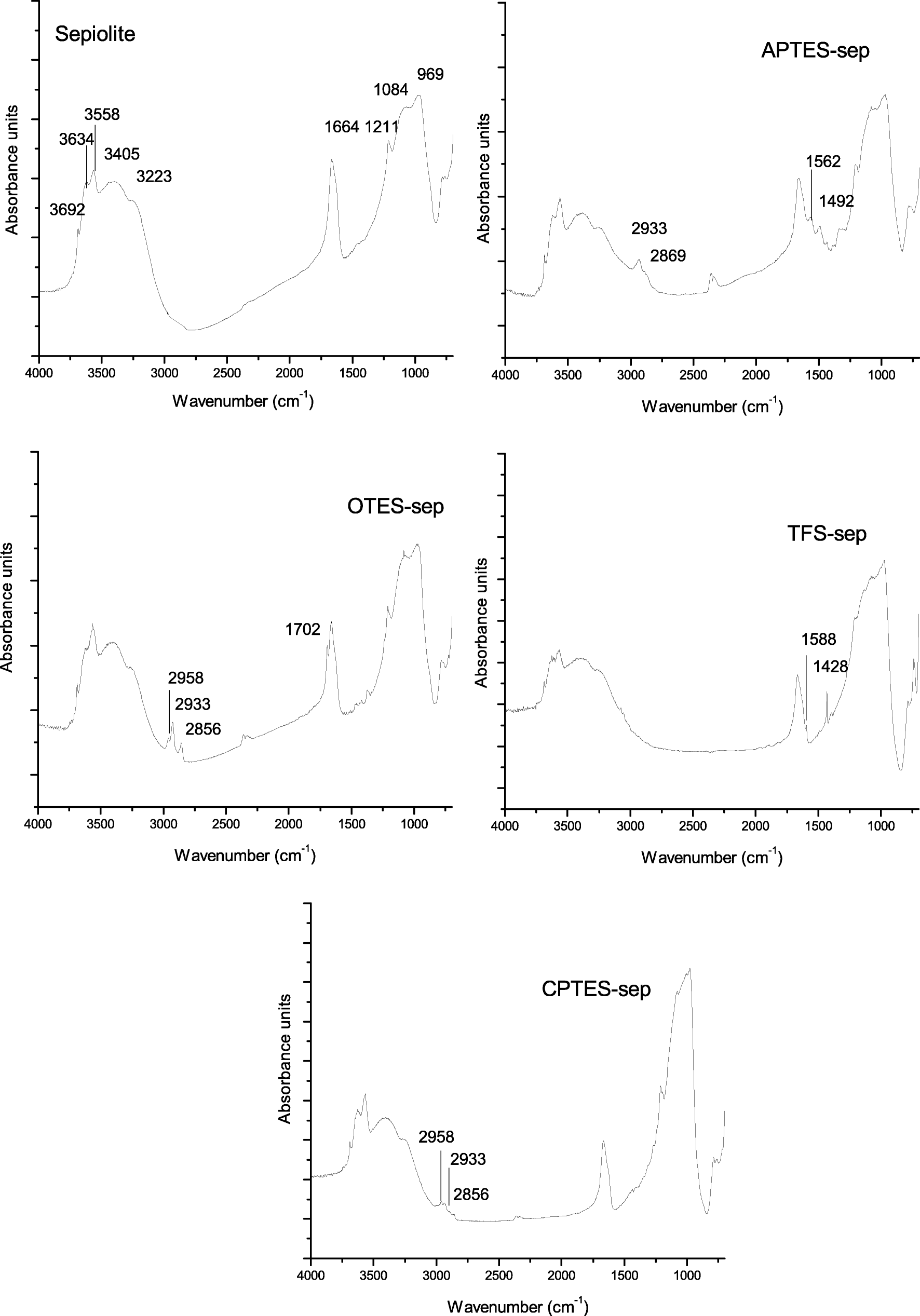
The FTIR spectrum of sepiolite shows bands at 3692 and 3634 cm−1 (Fig. 4), ascribed to vibrations of OH groups in the octahedral sheet (Mg3OH) and in the external surface (Si–OH stretch). The zeolitic water and the water bound to Mg in the octahedral sheet were responsible for the vibrations at 3558, 3405, 3233, and 1664–cm−1 (Alkan et al. Reference Alkan, Tekin and Namli2005). The tetrahedral sheet yielded absorption bands at 1211, 1084, and 969 cm−1, associated with the Si–O stretch (Frost et al. Reference Frost, Locos, Ruan and Kloprogge2001).
FTIR spectra of sepiolite and organo-sepiolites

The APTES-sep showed absorption bands at 1562 and 1492 cm−1 due to the bending vibrations of the –NH2 and –CH2 groups. Other absorptions were at 2933 cm−1 and a shoulder at 2869 cm−1, associated with the asymmetric and symmetric stretching of CH2 groups. When OTES and CPTES were grafted, the most relevant features were the presence of absorption bands at 2958 cm−1 due to CH3 and at 2933 and 2856 cm−1 due to the asymmetric and symmetric stretch of CH2 groups. In the case of OTES in particular, the increased hydrophobicity following silanization modified water vibrations, as reflected in the doublet observed at 1702 and 1664 cm−1, associated with O–H water bending vibrations. In the TFS-sep, the skeletal ring-breathing modes of phenyl moieties were observed at 1588 and 1428 cm−1. The FTIR data confirmed the interaction of the organosilane agents with the sepiolite surface. No additional absorption bands to those of pristine sepiolite were recorded for modified sepiolites based on the sorption of the organosilane agents, probably owing to their low affinity (data not shown).
Sorption Studies
The sorption of PhAcs was strongly dependent on the organosilane grafted on the surface of sepiolite, and their speciation was related to the equilibrium pH (Fig. 5). The pH ranged between 6.7 and 8.5 for carbamazepine, 5.6 to 8.3 for ranitidine, and 6.7 to 7.3 for atenolol, with the exception of the sorption of the three PhAcs on APTES-sep (pH 9.1–9.7). Atenolol sorption was greater on CPTES- and OTES-sepiolites, presenting isotherms of extremely high affinity (H-type). Its sorption was moderate on sepiolite and TFS-sep with isotherms of L-type, whereas the least sorption occurred on APTES-sep. Atenolol remained in the solution as a cation (pKa = 9.6), which explains its high sorption on sepiolite via a cationic exchange mechanism. TFS grafting did not significantly affect this mechanism. The covering of the surface with TFS molecules increases its hydrophobicity, restricting sorption by cationic exchange to a certain degree; however, a certain fraction of atenolol may be sorbed by π–π* interactions between the phenyl rings of TFS molecules and of the drug. Modification of the sepiolite surface with OTES and CPTES increased the affinity, but different modes of interaction operated. With the OTES-sep, the increased hydrophobicity of the surface by grafting alkyl chains facilitated the interactions with the lyophobic moieties of atenolol. Greater sorption was expected on CPTES-sep than on OTES-sep, based on the formation of donor-acceptor complexes between Cl and the protonated amine of atenolol as well as owing to the aromatic ring of this molecule, as described for the polar molecule imazaquin (Paul et al. Reference Paul, Martens and Frost2011b). The similar sorption of atenolol on these two sorbents reflects the formation of a near-partition phase through interaction of the grafted alkyl chains with a high affinity to atenolol, albeit the alkyl chains were slightly smaller than those described for its formation (C10).
Sorption isotherms on sepiolite and organo-sepiolites of atenolol, ranitidine, and carbamazepine

In the case of APTES-sep, the sorption isotherm followed the C-type, which is typical of a partition mechanism. The organic modifier remained mostly as a cation (~93%) at the equilibrium pH (9.7), whereas a significant fraction of atenolol was neutral (~50%). Some of these neutral molecules interacted with the –NH3 + of the APTES. This pattern was also reflected in the sorption of the other PhAcs on APTES-sep. This surface always recorded the smallest amounts sorbed.
Ranitidine sorption also followed the H-type on CPTES- and OTES-sepiolites as well as on pristine sepiolite, indicating a preferential cationic exchange mechanism for its sorption. Additional hydrophobic interactions were responsible for enhanced sorption on OTES-sep, whereas the greatest sorption was observed for CPTES-sep. Unlike atenolol, the sorption of ranitidine on TFS-sep was poor. In contrast, carbamazepine showed the highest sorption on TFS-sep. Hydrophobic interactions were clearly responsible for its sorption on the grafted sepiolites. The order of affinity followed the increase in hydrophobicity: TFS-sep > OTES-sep > CPTES-sep > sep > APTES-sep. The largest sorption of carbamazepine was on TFS-sep due to the greater number of π–π* interactions between the aromatic rings of the drug and those of phenyl grafted on the sepiolite surface, similar to those reported for the sorption of non-polar aromatic molecules on clay minerals supporting benzyl- and phenyl-moieties (Nir et al. Reference Nir, Undabeytia, Yaron-Marcovich, El-Nahhal, Polubesova, Serban, Rytwo, Lagaly and Rubin2000).
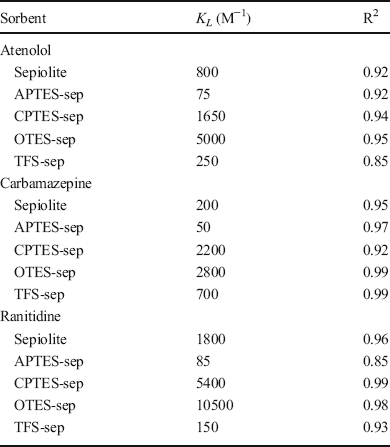
The sorption isotherms were fitted to the Langmuir-Scatchard equation (Eq. 1). As in Galán-Jiménez et al. (Reference Galán-Jiménez, Mishael, Nir, Morillo and Undabeytia2013), only one fitting parameter was used in the modeling, the binding coefficient K L . In the determination of the binding coefficients, the concentration of sorption sites (R 0) was fixed for each composite (Table 1). A high level of agreement was observed between the experimental and the calculated sorbed amounts of PhAcs (Table 2). The regression coefficients were > 0.90, with the exception of atenolol and ranitidine sorbed on TFS-sep and APTES-sep, respectively.
K L values and R2 from the fit of the experimental sorption values to the Langmuir equation

The largest K L values determined were of the order of magnitude found for the removal of PhAcs by other sorbents. Polubesova et al. (Reference Polubesova, Zadaka, Groisman and Nir2006) reported values between 7000 and 20,000 M−1 for the sorption of tetracyclines and sulfonamides on a micelle-clay complex. Using a different clay-micelle complex, Karaman et al. (Reference Karaman, Khamis, Quried, Halabieh, Makharzeh, Manassra, Abbadi, Qtait, Bufo, Nasser and Nir2012) obtained a K L value of 21,000 M−1 for the removal of diclofenac. The great affinity of the PhAcs for these micelle-clay complexes was explained by their excess of positive charge binding the negatively charged molecules of the PhAcs. With grafted sepiolites, the electrostatic interactions were not primarily responsible for the retention of PhAcs as noted in the two- to six-fold increase in the K L values of ranitidine and atenolol for certain modified clays relative to sepiolite. Recently, Lozano-Morales et al. (Reference Lozano-Morales, Gardi, Nir and Undabeytia2018) reported larger affinity of atenolol by polymer-clay composites based on cationic starches (K L : 20,000–80,000 M−1).
Filtration Experiments
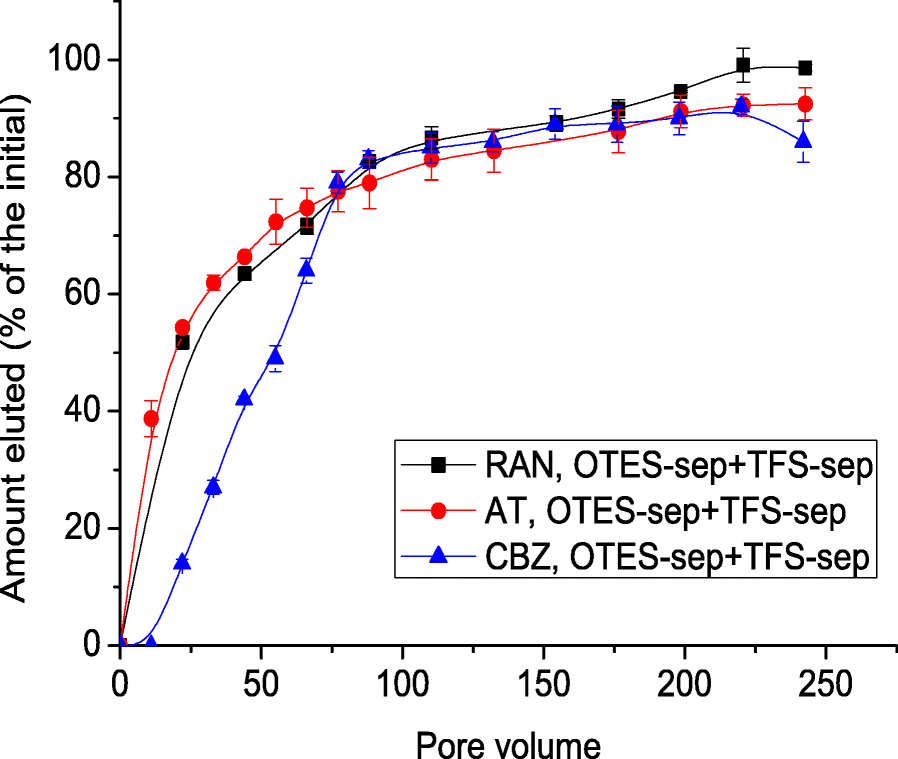
Modification of the sepiolite’s surface was necessary for its use in filtration experiments in order to preclude the formation of a gel that would clog the filter. In the first stage, the filtration experiments of single solutions of the three PhAcs were conducted using a combination of OTES-sep and TFS-sep as part of the filtering medium. According to the K L values, the highest sorption affinity of the three PhAcs was found for OTES-sep, but the sequence of the sorption (Fig. 5) showed a greater affinity of ranitidine on CPTES-sep and of carbamazepine on TFS-sep. This apparent contradiction can be explained by the presence of a larger number of sorption sites (Ro), albeit with lower affinity for the PhAcs than for OTES-sep. This lower affinity for the modified sepiolite surfaces was overcome by the greater number of sorption sites, resulting in a greater sorption of the drugs than on OTES-sep. Therefore, the selection of the combination of OTES-sep and TFS-sep represented a compromise between an adsorbent with a considerable affinity for PhAcs and an adsorbent with lower affinity but a larger number of sorption sites. The breakthrough curves revealed very poor levels of performance in the retention of the PhAcs by the filters (Fig. 6). This was slightly improved by the removal of carbamazepine, whereas similar curves were obtained for ranitidine and atenolol. Therefore, any improvement in the retention in the filters was tested for ranitidine and carbamazepine using OTES-sep and TFS-sep, respectively, i.e. the use of the medium with particularly large affinity for each PhAcs. Atenolol was excluded due to its similar pattern to ranitidine.
Eluted percentages of atenolol, ranitidine, and carbamazepine in filtration experiments including GAC or grafted sepiolites (OTES- and TFS-sepiolites) mixed with sand (1:50 w/w). The concentration of the PhAcs in the solution was 5 mg/L

The pattern in the elution curves of ranitidine and carbamazepine changed drastically by using only one of the complexes (Fig. 7a). Ranitidine did not elute in the first 60 pore volumes, whereas no elution was seen for carbamazepine during the first 25 pore volumes. The efficiency was clearly better for ranitidine, which did not reach 50% of the amount applied until the seepage of 80 pore volumes, in contrast with a value of 50 pore volumes for carbamazepine, in agreement with the magnitude of K L values.
Experimental and theoretical elution curves of ranitidine and carbamazepine in filters employing OTES- and TFS-sepiolites, respectively, with different operational and constructive parameters: (a) Experiment 1: columns 13 cm long ×2 cm diameter; flow velocity 1 m/h; pollutant concentration 5 mg/L; and (b) Experiment 2: 10 cm long × 3 cm diameter; flow velocity 0.6 m/h; pollutant concentration 1 mg/L

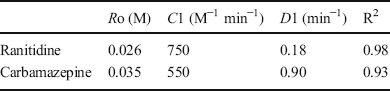
The filtration of the PhAcs was modeled using the filtration kinetics model (Eq. 2); the fitting was adequate (Table 3, Fig. 7a). An estimation of the binding rates (K = C1/D1) yielded a value of 611 M−1 for carbamazepine and 4166 M−1 for ranitidine, that is, the least eluted fraction expected for ranitidine as observed experimentally, which also followed the trend in K L values.
Calculated coefficients and R2 of the fit of the experimental data to the adsorption and convection model (Eq. 2)

The goodness of the model was examined for its predictive character under other conditions than those used in the determination of the fitting parameters. In a parallel experiment, the removal of ranitidine and carbamazepine was studied under different operational conditions (2.25 times the filter diameter; twice the sorbent concentration; 1.6-fold the flow velocity) (Fig. 7b). The removal was very efficient for ranitidine which did not show any elution during the first 114 pore volumes whereas a minute amount was detected for carbamazepine after 28 pore volumes. The model again performed rather well for ranitidine (R2 = 0.95) and carbamazepine (R2 = 0.87), and fitted particularly well in the regime of low pore volume numbers, which is of prime interest in order to determine the amount of water capable of being produced by the system, fulfilling the legal requirements for water purification. Consequently, the model can be employed to predict the eluted amounts for other scenarios, especially for the determination of the elution at low pollutant concentrations.
Conclusions
The removal of three PhAcs was studied via sepiolite, the surface of which was modified by grafting organosilanes to avoid leaching of the modifier during sorption and filtration. The study of the anchored amounts of the organosilanes and the thermal and infrared analysis of the grafted sepiolites confirmed different mechanisms of interaction with the sepiolite surface. Sorption studies revealed specific interactions between grafted moieties and the PhAcs: π–π* interactions between phenyl rings, donor-acceptor complexes between electronegative atoms and protonated groups, as well as hydrophobic interactions between alkyl chains. Therefore, certain PhAcs can be immobilized by the use of tailored adsorbents, focusing on their structure and compatibility with the grafted moieties.
Most studies of sorbents in filtration have focused on the immobilization of anionic and neutral PhAcs, which is true of most of the pharmaceuticals found in surface waters. However, their performance was usually poor when removing pollutants with a certain cationic character. The use of grafted sepiolites represents an effective alternative, which in combination with other sorbents may broaden the removal of PhAcs and increase the amount of water purified.
Acknowledgments
This research was supported by the MEC projects CTM2013-42306-R and CTM2016-77168-R. Both projects received funding from the European Social Fund. The authors acknowledge the CITIUS service from the University of Seville for thermal analysis facilities. The authors also thank Prof. Shlomo Nir for his assistance in modeling the filtration data.