Introduction
Urinary incontinence (UI) is a common condition that can affect men and women of all ages. Incontinence is defined as the involuntary loss of urine in sufficient amount or frequency to constitute a social and/or health problem.Reference Kane, Ouslander and Abrass1 Although the severity of the condition can vary significantly there is little doubt that incontinence can have a serious detrimental effect on the social, physical and psychological wellbeing of an affected individual.2
The prevalence of UI can be difficult to measure as many patients are too embarrassed to seek advice and often believe that incontinence is a normal part of ageing. This has led to significant under-reporting by patient groups and under-recognition by medical professionals.Reference Rutchik and Resnick3 Although prevalence studies have shown that incontinence becomes more common with age, a popular myth that little can be done to cure the condition continues to influence the treatments offered to older patients.Reference Gallo, Fallon and Staskin4 UI is often treated with more symptomatic measures, such as incontinence pads, rather than thorough investigative treatment. Dingwall and McLaffertyReference Dingwall and McLafferty5 studied nursing staff and their attitudes to continence care in hospital settings. The results showed that nurses had very low expectations of curing UI in hospitalized patients and cited the use of incontinence pads as an ‘effective treatment’. The emphasis of continence care was placed on containment rather than on curing the symptoms. However, a study by the Royal College of Physicians6 found that 70% of older people with UI could be cured or their symptoms alleviated with appropriate active treatment.
NICE guidelines2 on female UI suggests that first-line treatments should be conservative in nature. They are associated with minimal adverse outcomes and for a significant number of patients the results are highly satisfactory and obviate the need for medical or surgical interventions.Reference Robert and Ross7 These conservative methods will be reviewed in greater detail.
Methodology
In order to generate a systematic review of the literature, a comprehensive search of work pertaining to female UI was conducted through electronic searches of a number of recognized national medical databases including: AMED (Allied and Complementary Medicine), British Nursing Index, Embase, HMIC (Health Management Information Consortium), PsycArticles, Medline and PsycInfo.
The following inclusion/exclusion criteria were applied:
Inclusion – studies published in the English language, dated from 1980 to present.
Exclusion – traumatic or postnatal incontinence, neurological disorders, faecal incontinence, male incontinence.
Internet searches were also completed using similar search terms to identify any relevant conference papers, presentations or unlisted research articles. Additionally, a hand search of other relevant journals was completed.
These literature searches resulted in numerous articles that had some level of relevancy to the topic of the article. A brief review of all the abstracts was completed and any not related to female UI in older adults and its conservative management were discarded. In order to maintain the rigour of the study an evaluation tool was used to systematically review all remaining articles to assess the research quality and applicability to the topic. For this purpose the National Service Framework Typology evaluation toolReference Turner-Stokes, Harding, Sergeant, Lupton and McPherson8 was utilized. The evaluated articles were scored and the most comprehensive articles were short-listed. All short-listed articles were then critically appraised using the Critical Appraisal Skills Programme.9 This guidance helps to gain an understanding of the relative strengths and weaknesses of each study and therefore the strength of its contribution to the final conclusions. The articles were divided into different conservative treatment approaches.
Pelvic floor muscle training
The pelvic floor muscles (PFM) form the base of the abdominal cavity and contraction of these muscles assists in the maintenance of continence and augments inter-abdominal pressure.
PFM training (PFMT) is considered to be the first-line treatment for UI in women.2 Whilst this recommendation exists, it is debatable whether this happens in practice. There have been numerous research studies evaluating the effectiveness of PFMT, but comparing the outcomes of the studies is difficult due to the different regimes utilized. The effectiveness of PFMT depends on establishing whether the patient is appropriate for the therapy, and as with any form of training, success will depend on a person's compliance and motivation.Reference Miller10
PFMT versus no treatment
Sari and KhorshidReference Sari and Khorshid11 completed a randomized controlled trial (RCT) evaluating the effectiveness of PFMT over 8 weeks on UI and quality of life. To quantify the change in UI the study cohort were asked to record the number of leakage episodes in a bladder diary. Alongside this a pad test was completed and the incontinence quality of life questionnaireReference Patrick, Martin, Bushnell, Yalcin, Wagner and Buesching12 was used. They found that those who underwent PFMT had better quality of life scores particularly with regard to the avoidance and limiting of behaviours (23.19 vs –5.74, P value <0.1). Women randomized to PFMT also achieved significantly greater continence than the control group (leakage episodes –3.23 vs 0.82, P < 0.1).
However, the study included a relatively small cohort size (n = 34), considered only short-term outcomes and the participants were young (mean age 41.82 ± 8.65 years in exercise group and 44.64 ± 6.90 years in control group). Similar findings were reported in other studies.Reference Castro, Arruda, Zanetti, Santos, Sartori and Girao13–Reference Bö, Talseth and Vinsnes15
Bö et al.Reference Bö, Talseth and Holme16 compared the effectiveness of PFMT versus no treatment in stress incontinence. They considered a number of outcome measures to determine the effectiveness of the treatment including the pad test as an objective measurement. They found that an ‘objective cure’ was found in 44% of the PFMT group compared with just 7% of the control group. They also completed a subjective assessment, where women were asked to record their experience of UI before and after treatment. Following treatment 56% stated their condition was unproblematic. The mean age studied was 49.5 years (range 24–70 years) and therefore the results may not be applicable to the older generation.
Low versus high intensity PFMT
Borello-France et al. Reference Borello-France, Downey, Zyczynski and Rause17 assigned 36 women with stress UI to an exercise programme either one or four times a week. Urine leaks per week, volume of urine loss, quality of life and PFM strength were measured at 6 month follow-up. Women assigned to either group demonstrated similar post-intervention results. The benefits included reduced urine leaks with less volume but no difference in quality of life. However, adherence rates were difficult to measure as only half (54%) kept an exercise diary. An earlier study by Bö et al.Reference Bö, Hagen, Kvarstein, Jorgensen and Larsen18 completed a similar RCT which compared two groups of women and varying degrees of PFM exercises. Both groups performed PFM contractions three times daily for 6 months. In addition, one group exercised with an instructor intensively for 45 minutes once a week. After the treatment 60% of the intensive exercise group and 17% of the standard exercise group reported to be either continent or almost continent. The intensive exercise group noted a significant reduction in urine loss from 27 to 7.1 g (mean). PFM strength also improved in both groups but significantly more so in the intensive cohort. This study demonstrates that more intensive exercise with frequent supervision by a therapist produces significantly greater improvements. It is not clear from the study if the benefit was due to more intensive exercise or input from a therapist. Therapists would ensure that any contractions were performed correctly and adherence to all exercises was completed. Potentially it is this supervision and quality of exercise rather than the quantity that produced the beneficial effect.
Group versus individual therapy
Only one randomized intervention trial comparing individual versus group treatment in UI was identified.Reference Janssen, Lagro-Janssen and Felling19 The results of the trial showed that group or individual interventions were equally successful. There were no significant differences between urine loss or compliance between the two groups. The advantage of one therapy or another is therefore more closely related to individual choice and financial costs. A large cohort number was included (n = 414, mean age 47.8 ± 11 years). It is unclear if the results could be generalized as most patients became involved in the study following a recruitment campaign. This would suggest that they were extremely motivated to follow the training, whereas the wider population of older women with UI may present with lower compliance and motivation.
Behavioural therapy
Behavioural treatments cover a wide group of therapies that involve changing a patient's behaviour or teaching new skills in order to manage or improve their continence. Behavioural therapy is recommended in the treatment of UI.2, 20
Bladder training
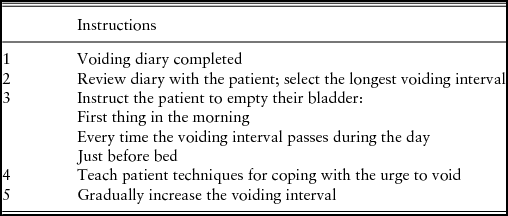
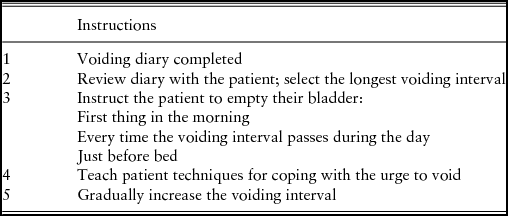
Women with UI tend to void more frequently due to an increased sense of urgency and also in a conscious attempt by the person to pre-empt incontinent episodes. Bladder training technique attempts to alter this pattern by empowering the individual to increase the interval between desire and voiding.Reference Wallace, Roe, Williams and Palmer21 Guidelines for bladder trainingReference Burgio, Goode, Haslam and Laycock22 are given in Table 1.
Bladder training stepsReference Burgio, Goode, Haslam and Laycock22
An RCTReference Fantl, Wyman and McClish23 on women over 55 with UI compared a group receiving bladder training with a control group. The cohort receiving intervention showed a mean 57% reduction in frequency. Urine loss and quality of life also showed improvement after 6 weeks of treatment. Subsequent research by Subak et al.Reference Subak, Quesenberry, Posner, Cattolica and Soghikian24 also studied bladder training on women over the age of 55. Women were assigned to a bladder training group or a control group. Those in the intervention group had instruction sessions on bladder training and were provided with voiding schedules. The control group received no instruction but kept urinary diaries. Women in the intervention group experienced 50% reduction in mean number of incontinent episodes compared with 15% within the control group. Six months on, 33% of the participants subjectively reported that bladder training had ‘helped them a great deal’. The study had a strong cohort number and a robust randomization process.
A study with a similar design but considering longer term outcomes was reviewed.Reference Dougherty, Dwyer and Pendergast25 At 2 years follow-up the bladder training group's UI severity had decreased by 61% and the control group severity had increased by 184%. This study demonstrated that bladder training can have good longer term results in incontinence management and associated improvements in quality of life.
Prompted and timed voiding
Bladder training focuses on the restoration of continence whilst prompted and timed voiding focuses on the avoidance of incontinence. ‘Timed and prompted voiding aims to pre-empt episodes and avoid incontinence using operant conditioning rather than modifying behaviour’.Reference Fantl, Wyman and McClish23, Reference Roe, Ostaszkiewicz, Milne and Wallace26, Reference Ostaszkiewicz, Johnstone and Roe27
Prompted voiding is used to teach people to initiate their own toileting through requests for help and questioning from carers followed by positive reinforcement.Reference Button, Roe, Webb, Frith, Colin-Thorne and Gardner28 One studyReference Schnelle, Traughber, Morgan, Embry, Binion and Coleman29 considered nursing home patients over 80 years old. Subjects were randomized to treatment or control groups. The treatment group received a prompted voiding schedule with carers checking the patients hourly during the day for 3 weeks. They found a significant reduction in leakage and an increase in patient requests for toileting assistance suggesting that the patients became empowered by the intervention. This study had a small cohort (n = 21) which reduces the generalizability of the findings. Another similar study also found an increase in patient toileting into a receptacle which clearly is advantageous in the avoidance of infections.Reference Schnelle, Traughber, Sowell, Newman, Petrilli and Ory30 Contrary to this, one study of residential homes in the UKReference Tobin and Brocklehurst31 found a reduction in both the control and intervention group with no statistically significant difference.
Prompted and timed voiding has been shown to be particularly successful with the ambulatory patient with dementia.Reference Schnelle, Traughber, Sowell, Newman, Petrilli and Ory30, Reference Thompson and Smith32 A study completed involving home-bound adults aged 60 years or older with cognitive impairmentReference Engberg, Sereika, McDowell, Weber and Brodak33 found a 22% reduction in daytime incontinence episodes compared with baseline.
This demonstrates that prompted voiding is an effective tool for the management of UI in cognitively impaired older adults. It is important to note that prompted voiding is a more labour-intensive practice and involves the education of both the patient and the carers. ‘Commitment and motivation need to be coupled with increased staff time to enable implementation’.Reference Eustice, Roe and Paterson34
Urge suppression therapy
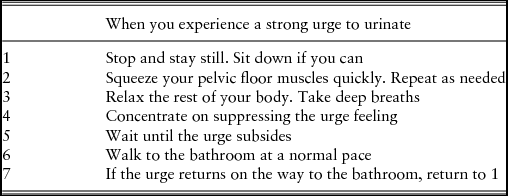
The urge suppression strategy is a mechanism used to break the conditioned response of rushing to void immediately the urge sensation is noted. Rushing ‘enhances the sensation of fullness, exacerbates the urgency and triggers detrusor contraction’.Reference Burgio, Goode, Haslam and Laycock22Table 2 illustrates the patient instructions for the urge suppression strategy.Reference Burgio, Pearce and Lucco35
Urge suppression instructionsReference Burgio, Pearce and Lucco35
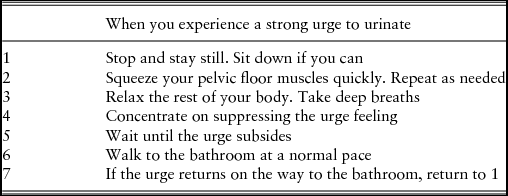
There have been no individual studies completed on the efficacy of this technique although some research has considered its use under a broader programme of behavioural therapy.Reference Burgio, Whitehead and Engel36 Borello-France et al.Reference Borello-France, Burgio and Goode37 utilized urge suppression strategy in their study. After being taught the strategy (Table 2), 92% stated that they had successfully prevented a UI episode.
Biofeedback
The International Continence Society defines biofeedback as a technique where a normally unconscious process is presented in a visual, auditory or tactile method.Reference Abrams, Cardozo and Fall38 One studyReference Bump, Hurt, Fantl and Wyman39 found that 30% of women were unable to perform an isolated pelvic floor contraction even after instruction. Therefore the use of biofeedback aims to improve the awareness of these muscles. Although there are various biofeedback tools, NICE2 endorses the use of vaginal cones and states that other feedback methods should not be routinely used due to the scarcity of evidence.
Vaginal cones are worn intermittently during the day. When the cone is positioned correctly patient must contract the PFM to keep the cone from slipping out. This increases awareness of the pelvic floor and the sensation of its contraction. As the pelvic floor is strengthened the weights can be increased. Vaginal weight training is ‘self-taught, may be motivational, involves less teaching time and less supervision than other methods’.Reference Wyman40
Cammu and NylenReference Cammu and Nylen41 compared pelvic floor exercises versus vaginal weight cones in the treatment of stress incontinence. Sixty women (mean age 56 years) were allocated to either a weekly session of out-patient PFMT or home use of cones. Fifty-seven per cent of the women in the cone group considered themselves as cured or improved to a significant degree after 12 weeks compared with 53% of the PFMT group. The cone group also demonstrated a 34% increase in the weight of cone that could be tolerated, showing an increase in their PFM strength. The authors concluded that PFMT and cones are of comparable efficacy in the treatment of stress UI. However, the study highlighted the difficulty with adherence to the cone treatment method. There was a high drop-out rate (47%) and non-compliance with treatment.
A subsequent trialReference Bö, Talseth and Holme16 compared a number of conservative treatment methods including vaginal cones with no treatment at all (n = 27, mean age 49.5 years). Patients allocated to the cone group used the cones daily for 6 months and progressed through increasing weights. Adherence was noted in a training diary. Compared with the control group there was a significant improvement in the strength of PFM, social activity and episodes of leakage. As with the previous study a number of patients reported motivation problems and difficulty in using the cones.
Due to this low compliance a new cone was developed that only needed to be worn for 5 minutes each day. A randomized prospective study to evaluate its efficacy was completed.Reference Seo, Yoon and Ho Kim42 88.3% of subjects showed an improvement in the degree of incontinence and pelvic floor strength.
Biofeedback as an adjunct to PFMT
One studyReference Berghmans, Frederiks and de Bie43 completed a randomized clinical trial to evaluate if PFMT were more effective when completed with biofeedback. Forty patients were randomized to an exercise and biofeedback group or exercises alone. The authors reported 100% compliance. The mean percentage improvement after six treatment sessions was 15.1% for exercise alone and 34.7% for the combined group. However, after twelve treatment sessions the mean percentage for exercise alone increased to 51.8% and just 46.2% in the combined treatment group. This may suggest that biofeedback is useful in the early stages of treatment to identify the pelvic floor, but once this has been achieved biofeedback is less valuable. Once again, the mean age was low (46.4 and 50.3 years) and therefore is not generalizable to older women.
Therapeutic electrical stimulation
Therapeutic electrical stimulation (TES) aims at increasing pelvic floor awareness, PFM bulk, strengthening the closure reflex and inhibiting detrusor overactivity.Reference Bower, Baessler, Schüssler, Burgio, Moore, Norton and Stanton44
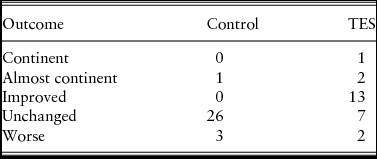
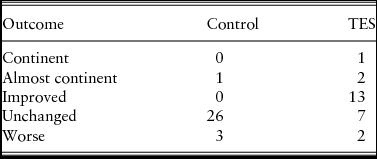
Bö et al. Reference Bö, Talseth and Holme16 evaluated TES as part of a wider study with UI. They found that PFM strength was increased, and leakage episodes and leakage accidents decreased. The cohort was also asked to complete a subjective assessment of their continence (Table 3). It is worth noting that 70% of the women that dropped out of the study were from the TES group. Patients also reported discomfort, motivation problems and difficulties in using the stimulator. Unfortunately this study had a mean cohort age of 49 and therefore different results may be observed in a higher aged group.
Subjective assessment of continence in patients receiving therapeutic electrical stimulation (TES) for urinary incontinence (n = 25) and controls (n = 30)Reference Bö, Talseth and Holme16
Siegel et al. Reference Siegel, Richardson and Miller45 considered the effect of electrical stimulation in the treatment of urge and mixed incontinence. Electrical stimulation via an insertible vaginal electrode was used daily or every other day. In both the urge and the mixed incontinence groups there was a significant decrease in urge leakage episodes. Following the 20-week study period, 72% of subjects reported satisfaction with the therapy and 69% chose to keep the device. Participants were offered money for taking part in the trial, which may have influenced the cohort selection. A similar study was completed,Reference Richardson, Miller, Siegel, Karram, Blackwood and Staskin46 this time researching the effect on stress incontinence. They found similarly reduced episodes of leakage and 62% of subjects reported that their UI was cured or had improved by 50%. A 1 year follow-up was completed, which found that 70% of participants who had continued with the device had maintained their cure or improvement status. Subjects were paid for their participation in the study again and were encouraged to perform pelvic muscle exercises, which may have skewed the data.
Only one study was identified that considered patients aged over 60 years.Reference Yamanishi, Yasuda, Sakakibara, Hattori, Ito and Murakami47 This trial compared an active vaginal electrode and a dummy device. Efficacy was judged through subjective patient experience and records in frequency and volume after 4 weeks. Cure rate was significantly higher in the active device group.
Contrary to these studies Luber and Wolde-TsadikReference Luber and Wolde-Tsadik48 also compared an electrical stimulation probe and a control ‘dummy’ probe in patients with stress incontinence with no significant difference between the two probes in relation to curing or improving the stress incontinence symptoms. Brubaker et al. Reference Brubaker, Benson, Bent, Clark and Shott49 concurred with these findings in patients with stress incontinence. However, in urge incontinence patient populations, a 50% success rate was reported in those receiving electrical stimulations versus 13% in the placebo-treated group.
Transcutaneous electrical nerve stimulation (TENS)
TENS is a form of stimulation that is used for long periods of time each day. Electrodes are placed over dermatomes and can be worn all day. Two case studiesReference Walsh, Johnstone and Keane50, Reference Hasan, Robson and Pridie51 have noted short-term improvements in frequency and urgency over a 3-week study period including both men and women. One RCT has been completedReference Soomro, Khadra and Robson52 that compared TENS therapy and treatment with oxybutynin. No significant differences were noted between the two modalities in terms of treatment effect; however, the side-effects were substantially less in the TENS group. This may encourage compliance and is also beneficial to those with an extensive prescription list. It was noted by all these authors that the patients’ symptoms of UI deteriorated again once treatment was withdrawn.
Lifestyle changes
Caffeine
Arya et al.Reference Arya, Myers and Jackson53 reported a significant association between a caffeine intake of more than 400 mg a day and detrusor instability. TomlinsonReference Tomlinson, Dougherty and Pendergast54 studied women (n = 34) with symptoms of UI and found that by reducing their caffeine intake their daily urine loss was also decreased. This study had a small cohort and therefore the findings may not be generalizable to a wider population.
Smoking
Two studiesReference Tampakoudis, Tantanassis and Grimbizis55, Reference Hannestad, Rortveit and Daltveit56 found a positive association between UI and smokers (including both current smokers and those with a history of smoking). There are no direct studies that address the effect of cessation of smoking on UI in women. Further research in this area may demonstrate a beneficial effect.
Obesity
Several studiesReference Hannestad, Rortveit and Daltveit56–Reference Subak, Whitcomb and Shen59 have shown a relationship between obesity and UI. Wing et al.Reference Wing, Creasman and Smith West60 considered the effect of weight loss on UI at 12 and 18 months post-treatment period to examine if the beneficial effects of weight loss were maintained over this period. At 12 months the weight-loss group reported a greater percentage reduction in UI episodes (65 vs 47%), demonstrating that weight loss maintenance can provide long-term benefits for UI. This study had a strong randomized design and excellent cohort retention. A further study by the same authorsReference Wing, Smith West and Grady61 examined the relationship between magnitude of weight loss and UI: a weight loss of between 5 and 10% was sufficient for significant UI benefit.
Bowel habit
It has been suggested that bowel habits are a pre-disposing factor in the cause of UI (mainly stress UI). Conditions such as chronic constipation result in elevated intra-abdominal pressure, which directly influences the bladder filling and voiding phases. In an observational study by Spence-Jones et al.,Reference Spence-Jones, Kamm and Henry62 straining at stool as a young adult was reported by significantly more women with stress UI than the control group. Alongside this, bowel frequency of less than twice a week was also associated with higher rates of UI in women.
Fluid intake
There is some evidence to suggest that modifying fluid intake can influence nocturia. However the evidence for a relationship between daytime intake and voiding is weaker.Reference Griffiths, McCracken, Harrison and Gormley63 A study by Swithinbank et al.Reference Swithinbank, Hashim and Abrams64 found that increasing fluid intake led to an increase in urgency episodes, whilst reducing the fluid intake led to reductions in leakage, urgency and frequency. They concluded that although fluid intake has no significant effect in the majority of the population, those consuming abnormally high volumes of fluid could benefit from a reduced intake.
It is worth noting that increasing fluid intake could help with quality of life in patients with UI as some people have reported sensitivity around urinary odour and cite this as a reason for withdrawal from social activities. Concentrated urine has a stronger smell so an increased fluid intake will make the urine more dilute and therefore less odorous.Reference Burgio, Goode, Haslam and Laycock22
Complementary therapy
Acupuncture
O’Dell and McGeeReference O’Dell and McGee65 initially identified the basis for the potential effectiveness of acupuncture in treating pelvic problems. A pilot studyReference Bergström, Carlsson, Lindholm and Widengren66 investigating the use of acupuncture amongst women over 65 (n = 15) who were not satisfactorily relieved by standard treatments was completed. Fifty-three per cent of the women considered their symptoms as ‘much improved’ on subjective scorings. No side-effects of the acupuncture treatment were noted. During the acupuncture treatments patients remained on pharmacological interventions, which may have affected the results.
A subsequent pilot study was double-blinded and randomized and looked specifically at the efficacy of acupuncture in urge and mixed incontinence.Reference Engberg, Cohen and Sereika67 Subjects (n = 9) were randomized to an ‘active’ or ‘sham’ acupuncture group. Subjects randomized to the active group had a mean 63.3% reduction in daytime accidents at 1 week and 67.5% at 4 weeks. The ‘sham’ acupuncture group showed a reduction of just 18.9% mean at 1 week and 16.7% mean at 4 weeks. Sample size was very small although preliminary findings from this study would encourage the completion of a larger size trial.
A similar RCT compared acupuncture with ‘sham’ acupuncture on patients (n = 74) with overactive bladder.Reference Emmons and Otto68 The study concluded that the women with active acupuncture had significant improvement in bladder capacity, urgency, frequency and quality of life. This study considered younger women with a median age of 51 years.
Hypnotherapy
‘Hypnosis has been shown to influence the central and autonomic nervous systems’.Reference Freeman and Baxby69 One case reportReference Barenberg, Abbasy, Michelfelder and FitzGerald70 followed a woman with lifelong incontinence. She reported nocturia and voiding with associated urgency and incontinence. She was treated with hypnotherapy. The patient reported improvement in continence from 15 voids a day to 2–3, with no bladder leakage and only a single episode of nocturia over 6 weeks. Although interesting, further studies are required to ensure the findings in this report are generalizable.
As with other conservative treatments it may be beneficial to combine two methods. Komesu et al.Reference Komesu, Sapien, Rogers and Ketai71 compared behavioural therapy with hypnotherapy to behavioural therapy alone in patients with an overactive bladder (n = 20). Both groups improved with treatment although scores for ‘quality of life’ and ‘global impression of improvement’ were higher in the hypnotherapy group. Once again this was a small pilot study and therefore may not be replicable to wider populations.
Conclusions
Despite being described as one of the ‘geriatric giants’, incontinence in older women is highly prevalent but under-recognized and reported.Reference Edwards and Jones72 Older people are an extremely heterogeneous group often with significant co-morbidities and therefore treatment must be carefully selected and appropriate to the individual patient.
NICE2 recommend PFMT as first-line treatment in UI and the literature reviewed confirmed the success of this modality, particularly in patients with stress incontinence. There is some evidence for PFMT with older women although the majority of studies have been completed within younger age groups. However, it has been shown that women over 75 years are able to follow the therapy and comply with treatment.Reference Perrin, Wood Dauphinēe, Corcos, Hanley and Kuchel73, Reference Tak, van Hespen, van Dommelen and Hopman-Rock74 PFMT should be considered early on in the treatment of UI: it is cost effective, non-invasive and can be used in conjunction with other therapies to increase its effectiveness. There is some evidence that suggests that the long-term efficacy and adherence to PFMT is low,Reference Bö, Kvarstein and Nygaard75 thus the need to balance PFMT with alternative treatments is crucial.
Biofeedback has also been shown to be a useful adjunct to PFMTReference Shamliyan, Kane, Wyman and Wilt76 as it raises awareness of the pelvic floor as well as being motivational to the patient. While biofeedback is not recommended on its own due to scarcity of evidence, therapists should consider it alongside other treatments. It has also been shown to be effective when used in conjunction with behavioural therapy.Reference Burgio, Goode and Locher77
Behavioural therapies are also considered a first-line treatment. The type of behavioural therapy that should be used depends on a patient's cognition and compliance. There is more evidence in this modality than others in the treatment in older women. Behavioural therapies in general do not cure UI but improve symptoms and reduce severity of the condition.Reference Milne78 Behavioural interventions can be self-taught and are highly cost effective. They can be combined with other treatment approaches and initiated at any stage. Following this review, it can be concluded that alongside PFMT these are the most successful treatment methods and would be recommended in the treatment of older women with UI.
The use of TES is difficult to evaluate due to the different combinations of treatment available and the paucity of evidence for this modality with the older age group. It is important to take into account a person's dignity and beliefs with this treatment method.Reference Bourcier, McGuire and Abrams79 Low compliance rates are reported as well as a number of contra-indications that highlight the need to use this therapy with caution. However, improvements in UI have been notedReference Bö, Talseth and Holme16, Reference Richardson, Miller, Siegel, Karram, Blackwood and Staskin46, Reference Yamanishi, Yasuda, Sakakibara, Hattori, Ito and Murakami47 and therefore should still be considered as an option with appropriate patients.
Lifestyle intervention and complementary therapies both demonstrated some beneficial effects in the management of UI. Again, the more robust evidence is in relation to the treatment of younger females. Both of these conservative methods require active participation, intact cognition and patience. In the majority of cases they are not curative. However, reduction in symptoms and improvements in quality of life suggest that such treatments should be considered. The evidence reviewed suggests that these therapies would not be recommended as a stand-alone treatment but work better as an adjunctive therapy to other methods discussed.
Limitations
In general the exclusion of older adults from relevant studies was notable. Due to this scarcity of evidence it was necessary to include studies that considered treatments on younger women. Although still valuable, this may have reduced the generalizability and validity of the review.
Similarly, there was limited contemporary evidence found on this subject. A large number of the papers reviewed were published some years ago. In order to consider as much robust research as possible it was necessary to include the more relevant of these older papers. Despite the limitations it is felt there is sufficient evidence to support the treatment of UI with conservative methods.
Recommendations
From the evidence presented it is clear that there are many conservative treatments that are effective in the treatment of UI in older adults. It is especially important in this group to complete a thorough initial evaluation, as the type of treatment that could be most beneficial depends upon the type and cause of incontinence, the cognition and motivation of the patient and the severity of the condition.Reference Tannenbaum, Perrin, DuBeau and Kuchel80 The more robust evidence supports the use of PFMT and behavioural therapy in most UI cases, but a combination of therapies would probably be most effective.
One of the first developments that needs to be made in the field of continence care is the increase in public awareness and the encouragement for patients to seek help.Reference Muller81 Patients need to be made aware that non-invasive treatments are available, easily accessible and effective. Alongside this, there is a need to raise awareness within hospitals and care homes that containment and use of pads are not curative and are rarely the best option.
Conflicts of interest
The author has no conflicts of interest to declare.