Introduction
Epistaxis is the most common ENT emergency requiring hospital admission. It affects two thirds of men in their lifetime, with 10 per cent of patients requiring hospital treatment.Reference Petruson and Rudin1 In Scotland, epistaxis represents 33 per cent of the emergency workload within ENT departments, with patients who are comparably older than patients admitted for other emergencies.Reference Walker, Macfarlane and McGarry2 Primary epistaxis is often caused by trauma whereas secondary epistaxis can be related to the use of anticoagulant medications or hypertension.
Douglas et al. demonstrated that Scottish patients admitted to hospital with epistaxis have a one-year mortality rate of 9.8 per cent.Reference Douglas, Tikka, Broadbent, Calder and Montgomery3 A similar population is found in those patients attending orthopaedic departments with hip fractures. It has been shown that instigating a set programme of rehabilitation and appropriate multidisciplinary input following injury reduces both short-term and one-year mortality.Reference Schnell, Friedman, Mendelson, Bingham and Kates4 In the UK, improvements have been made in mortality rates after hip fracture as a result of the introduction of a national clinician-led audit initiativeReference Neuburger, Currie and Wakeman5 and National Institute for Health and Care Excellence guidelines recommending early multidisciplinary referrals and input.6 If we could predict the patients who were most at risk during admission for epistaxis, we may be able to intervene in a similar manner to reduce the mortality rate.
The aim of this study was to determine any causative factors for the increased mortality rate in our patient population.
Materials and methods
Ethical considerations
Research ethics advice was sought using the online tool from the National Health Service (NHS) Health Research Authority and Medical Research Council website, and ethics committee approval was not required.7
Study design
This study was a retrospective case note review that included all hospital attendances for epistaxis over a one-year period from 1st May 2015 to 31st April 2016 at the Queen Elizabeth University Hospital in Glasgow. This is the ENT in-patient centre for NHS Greater Glasgow and Clyde, covering a population of 1.1 million people.8
Participants
Patients under 16 years of age at admission and patients treated in the emergency department or ward treatment room and discharged on the same day were excluded. Patients aged 16 years or older and those admitted to the ENT ward for management of epistaxis were included.
Patient demographics, including management of epistaxis, admission blood tests, blood transfusion requirements and comorbidities, were collected.
The Cumulative Illness Rating Scale scoring system was used to assess each patient's premorbid state. The Cumulative Illness Rating Scale was developed to summarise the overall severity of illness in patients. It was modified by Miller et al.Reference Miller, Paradis, Houck, Mazumdar, Stack and Rifai9 specifically for the geriatric population and designated Cumulative Illness Rating Scale-Geriatric. It is calculated by assigning a score for severity of illness across 14 different organ systems: cardiac, vascular, respiratory, haematological, eyes and ENT, upper gastrointestinal, lower gastrointestinal, hepatic, renal, genitourinary, musculoskeletal and dermatological, neurological, endocrine, and psychiatric. A global score is generated from this to help quantify each patient's disease burden.Reference Miller, Paradis, Houck, Mazumdar, Stack and Rifai9 An online calculator10 was used to calculate the scores for each patient.
A separate score was also used to subjectively assess each patient's performance status using the same information. For the patients who died, the cause of death was sought. This was obtained using discharge letters from their final admissions or death certificates where available.
Analysis was performed using SPSS® (version 24) statistical software. Continuous data were assessed for normality and the student's t-test or Mann–Whitney U non-parametric test was then performed accordingly. Categorical data were assessed using the chi-square test with Bonferroni post-hoc analysis in the presence of more than two groups. Population adjusted statistics were generated using the chi-square goodness-of-fit statistic.
Results
A total of 497 admissions with epistaxis were recorded during the study period. Paediatric patients (n = 60) and patients who did not require admission (n = 31) were excluded. There were 44 patients who attended on multiple occasions (n = 112), but only their first admission was used for the purpose of the study. This left 338 unique patient admissions for analysis.
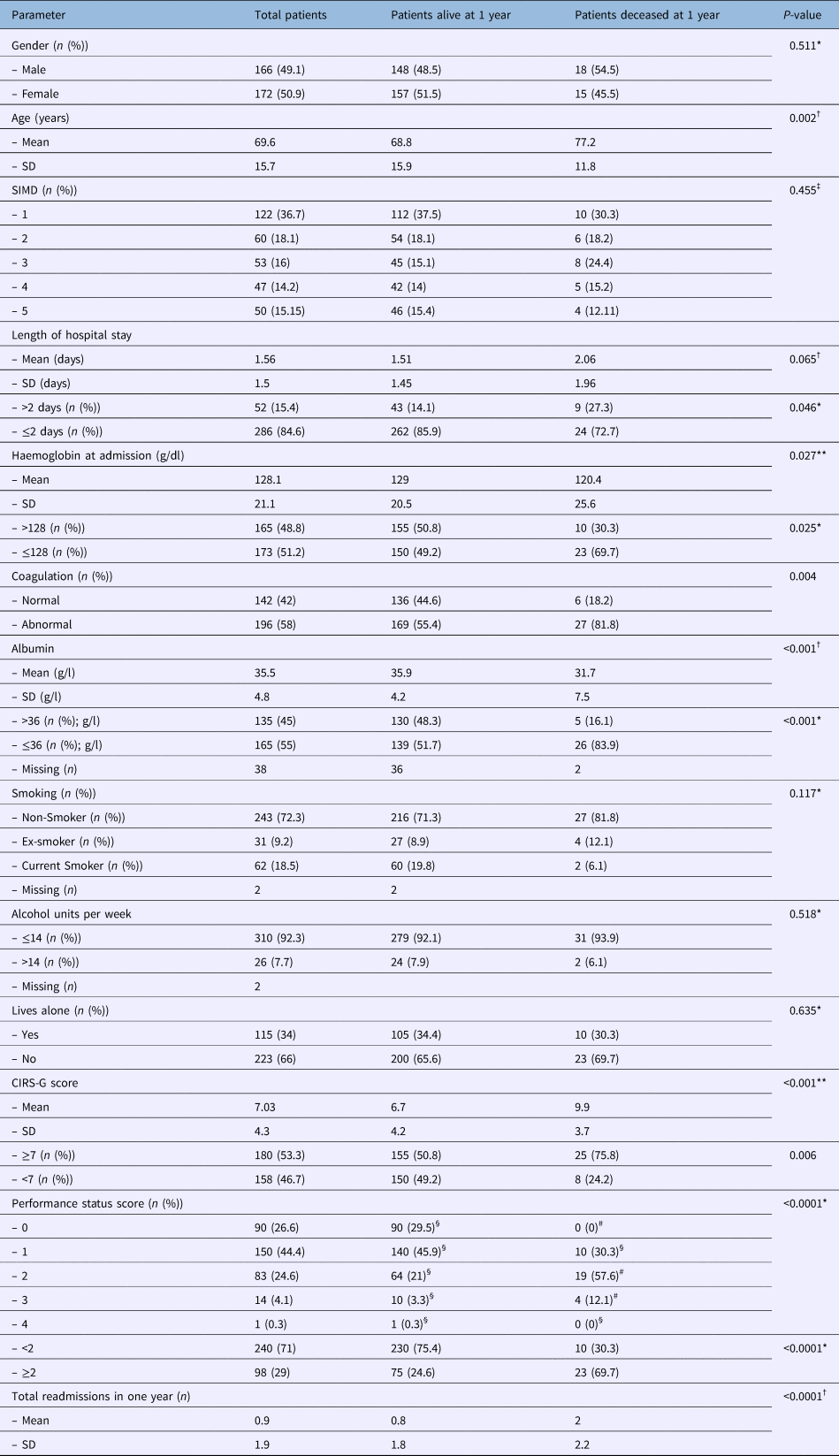
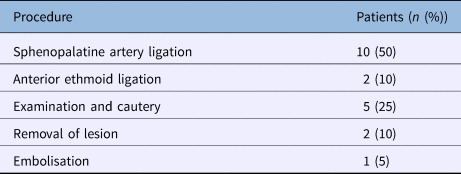
The majority of patients were female (n = 172; 50.9 per cent), and the mean age was 69.7 years (range, 18–97 years). The median length of hospital stay was 1 day (range, 1–14 days; standard deviation (SD) = 1.5). Patient demographics and admission details are shown in Table 1. Nasal packing was performed in 285 patients (84.3 per cent) and 170 patients had nasal cautery afterwards. Twenty-eight patients were treated with cautery alone. Transfusion was required in 25 patients (7.4 per cent), and tranexamic acid was given to 4 patients (1.2 per cent). A total of 20 patients (5.9 per cent) had persistent epistaxis, requiring arrest of bleeding in the operating theatre (Table 2).
Patients’ demographics and presentation characteristics

There were 338 patients in total; 305 were alive and 33 were deceased at one year. The Scottish Index of Multiple Deprivation (SIMD) is an indicator of socioeconomic status, where 1 = most deprived and 5 = least deprived. *chi-square test; †Mann–Whitney U test; ‡population adjusted goodness-of-fit chi-square test; **student's t-test; § or #subgroups with the same symbol means that the column proportion does not differ significantly from each other at the 0.05 level. SD = standard deviation; CIRS-G = Cumulative Illness Rating Scale-Geriatric
Procedures undertaken to manage epistaxis

Mortality after admission with epistaxis
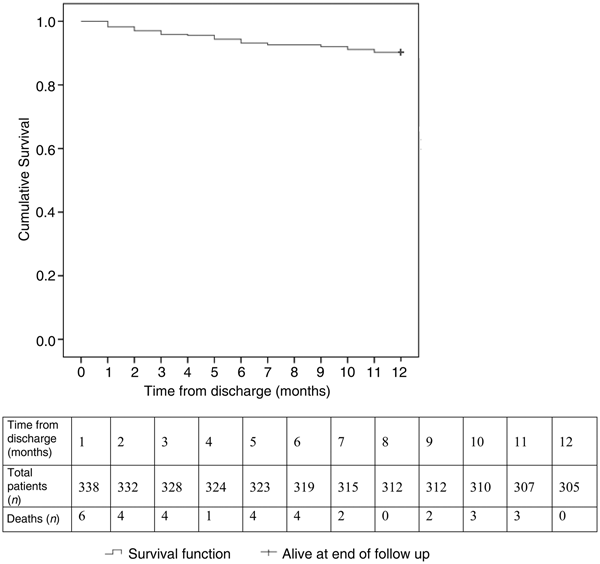
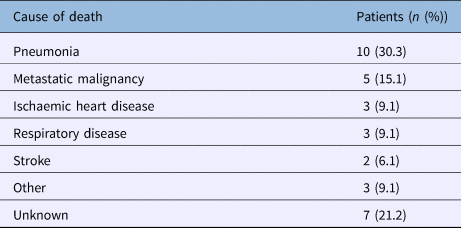
Readmission to hospital on at least one occasion within one year (for a reason other than epistaxis) was noted for 151 patients (44.7 per cent). The one-year all-cause mortality rate was 9.8 per cent (n = 33). Six of these patients (18.2 per cent) died within a month of discharge, with three deaths (9.1 per cent) recorded within 7 days of discharge (Figure 1). Therefore, in our population the 30-day mortality for a patient admitted with epistaxis was 1.8 per cent. The causes of mortality are summarised in Table 3. The time from first admission to date of death ranged from 1 to 318 days with a mean of 138 days. Twenty-two patients were followed-up in the clinic after hospital discharge (6.5 per cent) with no recorded mortality in this subgroup.
One-year all-cause mortality after hospital admission with epistaxis.

Causes of death

Age
The mean age of patients who died within one year of admission with epistaxis was 77.2 years (SD = 11.7), 7.5 years above the cohort's overall mean age of 69.7 years. Age had a significant association with mortality when treated as a continuous variable (p = 0.002; Mann–Whitney U test) and as a categorical variable (p = 0.007; chi-square test). With the cut-off value set as 70 years, after rounding up the mean to the nearest integer, 26 patients (13.5 per cent) aged 70 years or more were deceased at 1 year compared with 7 patients (4.8 per cent) aged less than 70 years who were deceased at 1 year.
Gender
Eighteen males (10.8 per cent of total males) and 15 females (8.7 per cent of total females) were deceased at 1 year with no significant association between gender and epistaxis mortality (p = 0.511).
Cumulative Illness Rating Scale-Geriatric score
The mean Cumulative Illness Rating Scale-Geriatric score was 9.9 (SD = 3.7) for patients who were deceased at one year and was 6.7 (SD = 4.3) for patients who were alive at one year. The overall mean score was 7.03 (SD = 4.3), and the score was significantly associated with mortality, both when treated as a continuous variable (p < 0.0001; t-test) and as a categorical variable (p = 0.006; chi-square) with a cut-off of 7, above and below the overall mean. Twenty-five (13.8 per cent) of the patients with a Cumulative Illness Rating Scale-Geriatric score of 7 or more were deceased at 1 year, compared to 8 (5.1 per cent) of the patients with a Cumulative Illness Rating Scale-Geriatric of less than 7.
Anticoagulants and antiplatelet medication
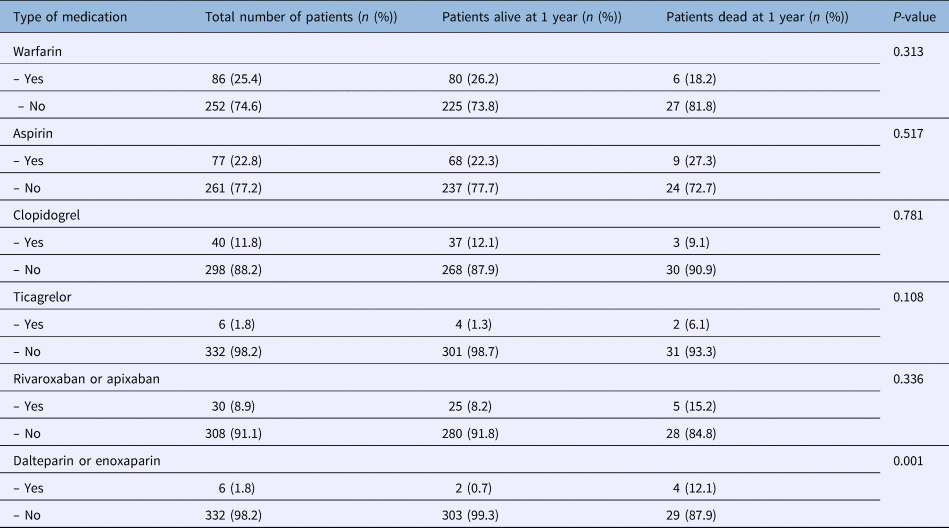
A total of 114 patients were taking anticoagulants or antiplatelet medication. The use of this medication was not significantly associated with one-year mortality (p = 0.109). When each medication type was assessed separately, there was no significant association with mortality: warfarin, p = 0.313; clopidogrel, p = 0.781; aspirin, p = 0.517; ticagrelor, p = 0.108; and ribaroxaban or apixaban, p = 0.194. Six patients (1.8 per cent) were on Clexane® or dalteparin anticoagulant injections. Of these, four (66.6 per cent) were deceased at one-year (p = 0.001). The type and indication for these medications are summarised in Tables 4 and 5.
Types of blood-thinning medications

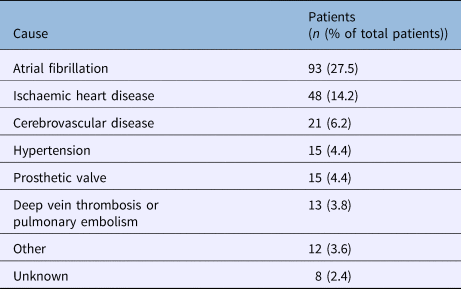
Indication for anticoagulant or antiplatelet treatment

Haemoglobin and coagulation status at admission
The mean admission haemoglobin level was 128.1 g/dl (range, 60–184 g/dl). The mean admission haemoglobin level for patients who were deceased at one year was 120.4 g/dl (range, 60–176 g/dl). The mean admission haemoglobin level of patients who were alive at one year was 129 g/dl (range, 64–184 g/dl). Twenty-three (13.3 per cent) of the patients with a haemoglobin level of 128 g/dl or below were deceased at one year, compared with 10 (6.6 per cent) of the patients with haemoglobin more than 128 g/dl. A significant association was found between one-year mortality and haemoglobin measurement at admission (p = 0.027; t-test), and the 128 g/dl mean cut-off was found to be significant (p = 0.025). Abnormal coagulation was also significantly linked with one-year mortality (p = 0.004). Twenty-seven (13.7 per cent) of the patients with abnormal coagulation were deceased at one year, compared to six (4.2 per cent) of the patients with normal coagulation.
Albumin
Albumin levels were checked at admission for 300 patients (88.5 per cent). The mean admission albumin level was 35.5 g/l (range, 19–46 g/l). Twenty-six patients (15.8 per cent) with an albumin level less than 36 g/l were deceased at one year compared with five patients (3.7 per cent) with albumin levels greater than 36 g/l. This was significant (p < 0.001).
Length of admission
The mean length of hospital stay was 1.6 days (range, 0–14 days). The mean length of stay for patients who were deceased at one year was 2.06 days (range, 0–10 days). The mean length of stay for patients who were alive at one year was 1.5 days (range, 0–14 days). This difference was not significant when assessing length of stay as a continuous variable (p = 0.065; Mann–Whitney U test). For categorical assessment, the day 2 cut-off was used, rounding the mean length of stay to the nearest integer. This showed that patients who stayed in hospital for more than 2 days were at significantly higher risk of one-year mortality (p = 0.046; 17.3 per cent vs 8.4 per cent).
Performance status and social history
A performance status of 0 was noted for 90 patients (26.6 per cent). One hundred and fifty patients (44.4 per cent) had a performance status of 1, with the remainder having a performance status of 2 or above (n = 98; 29 per cent). All patients with a performance status of 0 were alive at one year. Ten patients (6.6 per cent) with a performance status of 1 were deceased at one year compared to 23 patients (23.5 per cent) with performance status of 2 or above. Using the performance status of 2 cut-off, a significant association with mortality was identified (p < 0.0001).
Patients living alone were not at higher risk of death (p = 0.635). Smoking and alcohol use did not have any significant association with mortality (p = 0.117 and p = 0.518, respectively).
Discussion
Epistaxis is the most common cause for emergency presentation in the ENT department. Patients admitted with epistaxis were elderly (mean 69.7 years), with males and females being affected equally. Two-thirds of patients were taking anticoagulant or antiplatelet medications, most commonly for cardiovascular disease. These patients may be self-selecting. Younger, fitter patients with less disease burden may have resolution of their epistaxis more quickly, and may be able to be discharged after treatment, rather than admitted.
Management of epistaxis
The National Epistaxis Audit 201611 found that 3.2 per cent of all cases of epistaxis in the UK required surgical intervention. In our study population, 5.9 per cent of cases required surgical intervention. In both studies, the most common operation was sphenopalatine artery ligation. When compared to the national audit, our study population also had higher rates of nasal packing (84.3 per cent vs 46.1 per cent) and nasal cautery (58.6 per cent vs 32.5 per cent). One of our patients (0.29 per cent) was embolised, which was a similar rate to the 0.26 per cent shown in the national study.
One explanation for the difference could be that the national statistics included all patients attending with epistaxis even if they did not require hospital admission. Our department takes a proactive approach in epistaxis management. We favour quick pack removal and direct treatment, as highlighted by the higher rates of nasal cautery. If this direct treatment fails, then we favour surgical intervention, as highlighted by the moderately higher rates of intervention compared to the national average. This direct approach to management means that our average length of patient stay for all admissions is 1.6 days. Although the national audit's mean length of stay was 29.5 hours, their study included all patients seen with epistaxis, not just those admitted. A large study in Wales showed a mean length of stay of 3.2 days, so our patients stay half as long.Reference Fishpool and Tomkinson12 Because of the number of comorbidities, along with social circumstances, patients in our population were often not immediately discharged when bleeding stopped; furthermore, our department policy is to observe patients for 4 hours if there is active intervention to manage the epistaxis.
Premorbid state
In our study population, two thirds of the patients admitted were using some form of anticoagulant or antiplatelet medication (blood thinners), which was higher than the 51 per cent reported nationally.11 Antiplatelets such as aspirin and clopidogrel are known to be associated with increased presentations with epistaxis,Reference Rainsbury and Molony13 and there is no recognised benefit to withholding them during admission.Reference Yaneza and Amiraraghi14
Another indicator of the premorbid state of our study population was the admission albumin level. Within our laboratory, the normal reference range is 35–50 g/l. Our study population had a mean level of 35.5 g/l. Albumin has been found to be an indicator of increased mortality,Reference Goldwasser and Feldman15 and this was seen in our study population as patients with albumin levels less than 36 g/l were more likely to die at one year.
Patients who were aged 70 years or older at admission were more at risk (13.5 per cent one-year mortality vs 4.8 per cent for those aged under 70 years). Other pre-hospital factors which indicated higher risk were a performance status of 2 or more (23.5 per cent one-year mortality vs 4.2 per cent for a performance status of 0 or 1) and a Cumulative Illness Rating Scale-Geriatric score greater than 7 (14.3 per cent one-year mortality vs 5.9 per cent for a Cumulative Illness Rating Scale score of 7 or less).
Admission blood tests were obtained for all patients in our study. Patients with a haemoglobin level of less than 128 g/l had a greater risk of death than those with a level greater than 128 g/l (12.4 per vs 7.3 per cent one-year mortality, respectively). Coagulation screens were tested for 95 per cent of our patients, and an abnormal test was a significant indicator of one-year mortality.
A hospital admission length of more than 2 days was significant for increased mortality. This may be an appropriate time point at which intervention could be requested by an elderly medicine specialist or by other appropriate allied health professionals. The mortality rate following hip fracture was significantly improved by close collaboration between orthopaedic and geriatric teams. They initiated prompt and early surgery and paid particular care to post-operative mobilisation and rehabilitation.Reference Neuburger, Currie and Wakeman5
Our population had a one-year mortality rate of 9.8 per cent, which is comparable to the findings of Douglas et al. in their 20-year review of epistaxis in Scotland.Reference Douglas, Tikka, Broadbent, Calder and Montgomery3
Causes of death
Another aspect of our study was to determine the causes of mortality for our study population. Information was available from most patients’ case notes. However, some patients, particularly those who died at home, had no cause of death available through medical records. From those we were able to access, the causes of death are shown in Table 3.
The most common causes of death were pneumonia (30.3 per cent) and metastatic malignancy (15.1 per cent). The numbers for malignancy may be higher as patients who were managed palliatively at home tended to have a malignancy, but we were unable to quantify this.
• Patients admitted to ENT departments with epistaxis have a 9.8 per cent one-year mortality rate
• Factors indicating higher mortality were increased age and comorbidity score, low admission albumin, low admission haemoglobin, an abnormal clotting screen and an admission time of more than two days
• Most patients admitted with epistaxis were using anticoagulant medications, but these did not affect the mortality rate
• Pneumonia and malignancy were the two most common causes of death in this population
Scoring systems to predict outcome
The majority of our patients had a Cumulative Illness Rating Scale score between 4 and 12, although the range was 0–22. The average score was 7, which increased to 9.97 for those who died at one year. The significance of this suggests it may have a role in the management of these patients going forward. It is important to perform risk stratification for patients at admission so that adequate support can be arranged while they are an in-patient. As the Cumulative Illness Rating Scale relies on assessing information about multiple body systems and allocating them a score before calculating an overall score it may not be practical to do this for every patient seen with epistaxis. However, a performance status is a very straightforward subjective score which relies on information readily available from the initial history or nursing admission documents. The performance status was also found to be significant and so should be calculated and recorded for every patient admitted.
Conclusion
We found that the one-year mortality rate in our population was 9.8 per cent. We identified several risk factors for increased one-year mortality. Many of these could be assessed with basic blood tests and simple performance status assessment when taking the patient history.
Alongside management of their acute epistaxis, it may be of benefit for high-risk patients to see appropriate medical specialists (e.g. elderly medicine and occupational therapy professionals) while they are an in-patient in order to rationalise medications and ensure they have adequate support at home. This may provide an early intervention point for this vulnerable patient population. Further prospective studies which involve these interventions would be beneficial.
Competing interests
None declared