Introduction
Pleistocene fossil occurrences are perhaps the most relevant fraction of the fossil record given their ability to provide a deep time context toward the distribution and diversity of modern species. Living gray whales, Eschrichtius robustus, are a monotypic species in the extant family Eschrichtiidae (Rice, Reference Rice1998). Interestingly, the fossil record suggests higher diversity of this lineage in the past, including Archaeschrichtius ruggieroi (late Miocene, Italy; Bisconti and Varola, Reference Bisconti and Varola2006), Eschrichtioides gastaldii (Early Pliocene, Italy; Bisconti, Reference Bisconti2008), Gricetoides aurorae (Early Pliocene, North Carolina, USA; Whitmore and Kaltenbach, Reference Whitmore and Kaltenbach2008), and an unnamed genus (Pliocene, California, USA; Deméré and Berta, Reference Deméré and Berta2003; Deméré et al., Reference Deméré, Berta and McGowen2005). As a single species in a formerly more diverse Eschrichtiidae, the evolutionary history of living gray whales remains elusive. The phylogenetic position of Eschrichtius may be subject to taxon and character selection, resulting in varying positions of Eschrichtius robustus among Mysticeti; morphological studies have identified several disparate phylogenetic positions for Eschrichtius, including a close relationship with Cetotheriidae (true cetotheres; Steeman, Reference Steeman2007; Bosselaers and Post, Reference Bosselaers and Post2010), Balaenidae (right whales; Bouetel and Muizon, Reference Bouetel and De Muizon2006; McLeod et al., Reference McLeod, Whitmore and Barnes1993), and Balaenopteridae (rorquals; Deméré et al., Reference Deméré, Berta and McGowen2005; Bisconti et al., Reference Bisconti, Lambert and Bosselaers2013; Fordyce and Marx, Reference Fordyce and Marx2013). Molecular phylogenetic approaches typically recover Eschrichtius within Balaenopteridae, rendering the family and even the genus Balaenoptera as paraphyletic (e.g. Nikaido et al., Reference Nikaido, Hamilton, Makino, Sasaki, Takahashi, Goto, Kanda, Pastene and Okada2006). Although recent molecular studies (Dornburg et al., 2012; Nikaido et al., Reference Nikaido, Hamilton, Makino, Sasaki, Takahashi, Goto, Kanda, Pastene and Okada2006), larger morphological datasets (Bisconti et al., Reference Bisconti, Lambert and Bosselaers2013; Marx, Reference Marx2011), and total evidence analyses (Geisler et al., Reference Geisler, McGowen, Yang and Gatesy2011) broadly agree that Eschrichtius robustus is a member of the Balaenopteroidea, detailed evolutionary history of gray whales is lacking owing to a limited fossil record.
The fragmentary fossil record of Eschrichtius establishes an incomplete picture of its evolutionary history. The oldest fossil record of Eschrichtius is late Pliocene in age (Ichishima et al., Reference Ichishima, Sato, Sagayama and Kimura2006) from the western North Pacific. Pleistocene records of Eschrichtius from Taiwan outline the possible migration route of now endangered western North Pacific population (Tsai et al., Reference Tsai, Fordyce, Chang and Lin2014) and demonstrate similar skull morphology between late Pleistocene and living gray whales along the west coast of North America (Barnes and McLeod, Reference Barnes and McLeod1984). Mandibles collected from the seafloor off Georgia (U.S.A.) date to 41–48 ka, establishing a late Pleistocene age for the oldest records of Eschrichtius in the North Atlantic (Garrison et al., Reference Garrison, McFall, Cherkinsky and Noakes2012; Noakes et al., Reference Noakes, Pyenson and McFall2013).
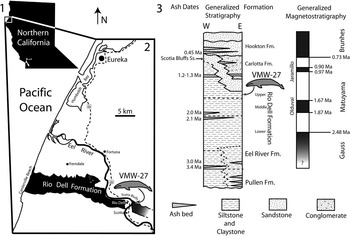
To date the fossil record of Eschrichtius is still patchy worldwide. Here we report a newly discovered eschrichtiid specimen, a tympanic bulla from the Lower Pleistocene Rio Dell Formation of Northern California (a locality map and stratigraphic column are presented in Fig. 1). This specimen represents the earliest fossil record of Eschrichtius from the eastern North Pacific Ocean.
Generalized geologic map and stratigraphy of the Wildcat Group and Rio Dell Formation in Humboldt County, California: (1), silhouette map of Northern California; (2), generalized geologic map of the Rio Dell Formation and locality of VMW 27 at Scotia Bluffs (marked by whale symbol); (3), generalized lithostratigraphy and magnetostratigraphy of the Wildcat Group in Humboldt County (modified from Sarna-Wojcicki et al. Reference Sarna-Wojcicki, Wagner, Perkins, Lajoie and Morrison1982), with stratigraphic position of VMW 27.

Systematic paleontology
Institutional Abbreviations
HMT, Historical Museum of Teshio River, Hokkaido, Japan; LACM, Natural History Museum of Los Angeles County, USA; NSMT, National Museum of Nature and Science, Tokyo, Japan; USNM, National Museum of Natural History, Smithsonian Institution, Washington DC, USA; VMW, Sierra College Natural History Museum, Rocklin, California, USA.
Order Cetacea Brisson, 1762
Suborder Mysticeti Gray, 1864a
Family Eschrichtiidae Ellerman and Morrison-Scott, 1951
Genus Eschrichtius Gray, 1864b
Eschrichtius sp. cf. E. robustus
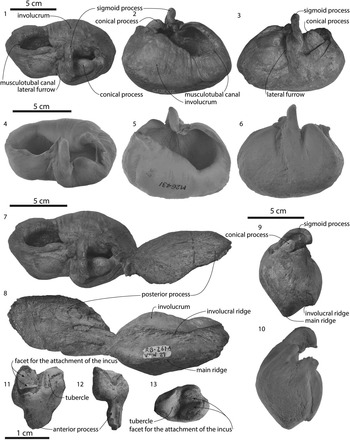
Left tympanic bulla of the Early Pleistocene Eschrichtius sp., cf. E. robustus (Lilljeborg, 1861) from the Rio Dell Formation, Scotia Bluffs, Humboldt County, California: (1, 2, 3) dorsal, medial, and lateral views of left tympanic bulla, VMW-27; (4, 5, 6) dorsal, medial, and lateral views of left tympanic bulla of extant Eschrichtius robustus, NSMT M26431; (7, 8) dorsal and ventral views of left tympanic bulla, VMW-27, and the posterior process, VMW-33; (9) posterior view of left tympanic bulla, VMW-27; (10) posterior view of left tympanic bulla, NSMT M26431; (11, 12, 13) posterior, dorsal, and lateral views of isolated malleus of left tympanic bulla, VMW-27.

2013a cf. Eschrichtius, Boessenecker, p. 915, p. 939
Referred specimen
Isolated left tympanic bulla and malleus, VMW-27 and the posterior process of the left tympanic bulla, VMW-33, collected by Ron Bushell (Field number RB 261). VMW-27 and VMW-33 were collected in association and represent a single individual but curated as separate specimens; they may be rearticulated along a fracture. Because of this, the two specimens are collectively identified as VMW-27 in the remainder of the text.
Diagnosis
Several morphological features of VMW-27 are similar to the living gray whale Eschrichtius robustus and include: 1) tympanic bulla relatively mediolaterally compressed; 2) dorsoventrally thick conical process; 3) posterior margin of the sigmoid process perpendicular to the main axis of the tympanic bulla in dorsal view; 4) anteroventrally sloping dorsal margin of the involucrum and forming a somewhat flattened area posterior to the musculotubal canal; and 5) deep and prominent lateral furrow. The dimensions of VMW-27 (Table 1) also fall into the size range of Eschrichtius robustus. The bulla morphology of VMW-27 differs from other contemporaneous mysticetes. For example, the dorsoventral orientation of the lateral furrow and roughly ovoid (rather than quadrate) shape of VMW-27 differs from Balaena and Eubalaena. The bilobate morphology of the bulla and dorsoventrally thick conical process in VMW-27 clearly differ from Caperea; these features similarly preclude identification as Megaptera. The combination of the bilobate morphology of the bulla and dorsal margin of the involucrum running anteroventrally at one third anteroposterior length and forming a flattened area posterior to the musculotubal canal differs from all Balaenoptera spp. The size of the bulla, deep lateral furrow, and lack of a broad median furrow differ from the cetotheriid Herpetocetus, which has been reported from the coeval Falor Formation further north in Humboldt County, California (Boessenecker, Reference Boessenecker2013b). The posterior process in VMW-27 and Eschrichtius robustus potentially exhibits a hitherto unrecognized autapomorphy for the genus. In the Scotia Bluffs specimen and extant Eschrichtius robustus, the posterior process is overall similar to the anteroposterior flattened strap-like posterior process of Balaenopteridae, but differs in being anteroposteriorly swollen. Swollen, plug-like posterior processes also characterize some Cetotheriidae (e.g. Nannocetus, Piscobalaena, Herpetocetus) and Neobalaenidae (Caperea); VMW-27 and extant E. robustus notably differ from Cetotheriidae in exhibiting a posterior process that is swollen but tapering medially and laterally, giving it a fusiform shape (in ventral aspect) unique among Mysticeti.
Measurements (in mm) of the left tympanic bulla of Eschrichtius cf. E. robustus, VMW-27.

* The length of the tympanic bulla of extant Eschrichtius robustus ranges from 78.16 mm (USNM593416) to 111.64 mm (LACM85980).
Occurrence
VMW-27 was recovered from near the top of the Upper Member of the Rio Dell Formation at Scotia Bluffs in Humboldt County, California (Fig. 1), spanning from 2.0–1.2 Ma (latest Pliocene to Early Pleistocene). This locality is the same as the mandible of Callorhinus sp. reported by Boessenecker (Reference Boessenecker2011). Fossil mollusks and echinoids from the Upper member of the Rio Dell Formation are correlative with the “Arcatan” provincial megainvertebrate stage, and foraminifera with the “Hallian” stage, both indicating Early Pleistocene age (Roth, Reference Roth1979; Haller, Reference Haller1980). This stratum is bracketed above by the 1.2–1.3 Ma Rio Dell Ash (exposed within the Carlotta Formation at Scotia Bluffs) and below by the base of the 1.87 Ma Olduvai Normal Polarity Subchronozone and a 2.0 Ma ash bed exposed further to the west within the Middle member of the Rio Dell Formation (Figure 1; Sarna-Wojcicki et al., Reference Sarna-Wojcicki, Wagner, Perkins, Lajoie and Morrison1982; Roth, Reference Roth1979; Haller, Reference Haller1980; Boessenecker, Reference Boessenecker2011). Detailed locality information is available on request from the Sierra College Natural History Museum or the authors.
This study follows the recommendation of Hilgen et al. (Reference Hilgen, Lourens, Van Dam, Beu, Boyes, Cooper, Krijgsman, Ogg, Piller and Wilson2012) to use a twofold division of the Pliocene (Zanclean and Piacenzian constituting the early Pliocene and Gelasian as the late Pliocene) with the traditional Plio-Pleistocene boundary at 1.81 Ma, rather than the recently proposed inclusion of the Gelasian stage within the Pleistocene and recognition of the boundary at 2.588 Ma (see also Boessenecker, Reference Boessenecker2011, Reference Boessenecker2013a).
Remarks
As a matter of clarification and avoiding further confusion, we identify the dorsal view as facing the dorsal apex of the sigmoid process; anatomical terminology follows that of Mead and Fordyce (Reference Mead and Fordyce2009). The left tympanic bulla is well preserved aside from some minor fractures in the outer lip. As discovered, the posterior process was found in articulation with the bulla, and the malleus was preserved within the tympanic cavity. In dorsal view (Fig. 2.1), the general profile is bilobate, with a concavity along the lateral furrow and a slight medial concavity along the anteromedial margin of the involucrum. Both anterior and posterior margins are rounded in dorsal view, with a transversely wider posterior lobe (sensu Ekdale et al., Reference Ekdale, Berta and Deméré2011). The dorsal part of the lateral furrow is located slightly posterior to the longitudinal midpoint of the bulla. The lateral furrow is ventrolaterally oriented, and it dissipates anteroventrally into a triangular flat region. The bulbous, hemispherical mallear ridge is positioned dorsomedial to the lateral furrow and anterior to the sigmoid process. The base of the sigmoid process is transversely wide, about half the size of the maximum width of the bulla. The sigmoid process is oriented perpendicular to the longitudinal axis of the bulla. The base of the posterior process runs along the posterodorsal margin of the bulla, pointing anteromedially. The involucrum is transversely wide posteriorly and tapers anteriorly. The dorsal surface of the involucrum is relatively smooth, with several minor transverse creases. At the level of the anterior one-third of the involucrum, the involucrum is transversely compressed. In medial view (Fig. 2.2), the tympanic bulla is somewhat egg-shaped. From the base of the posterior pedicle, the dorsal margin of the involucrum descends anteroventrally and then extends horizontally at about the anterior one third of the tympanic bulla. The anterodorsal crest descends anteroventrally from the dorsal margin to the musculotubal canal. The anterior margin of the musculotubal canal is broadly rounded. The involucral ridge curves slightly from the posterior end of the inner posterior prominence and terminates posterior to the anterior-most point of the tympanic bulla. The sigmoid fissure (sensu Ekdale et al., Reference Ekdale, Berta and Deméré2011) turns markedly anteroventrally, forming a short horizontal cleft, but it likely results from damage of the base of the conical process (Fig. 2.3). In posterior view (Fig. 2.9), the dorsal margin of the sigmoid process is broadly rounded. The conical process points dorsomedially from the base to the dorsal margin. The main ridge of the tympanic bulla forms the ventral keel. The prominent involucral ridge is dorsomedially retracted from the main ridge. The anterior process of the malleus (Fig. 2.11, 2.12) is broken off from the tympanic bulla, medial to the sigmoid process. The two facets for the attachment of the incus (Fig. 2.13) are similar size. The tubercle of the malleus is opposite to the two facets for the incus and when in situ, ventral to the two facets for the incus. The posterior process (Fig. 2.7, 2.8) is broken off from the posterior pedicle on the tympanic bulla. The posterior process is somewhat inflated, and deeper dorsoventrally than thick mediolaterally. The proximal and distal ends of the posterior process are rounded and both proximal and distal ends taper from the wider middle part of the posterior process. Minute ridges are present on the dorsal surface of the posterior process and the facial sulcus is proximally positioned on the medial margin of the dorsal surface of the posterior process.
Discussion and conclusions
The general morphology of VMW-27 closely corresponds to the tympanic bulla of living gray whales (Eschrichtius robustus), including 1) relatively transversely compressed tympanic bulla, 2) dorsoventrally thick conical process, 3) posterior margin of the sigmoid process perpendicular to the main axis of the tympanic bulla in dorsal view, 4) dorsal margin of the involucrum sloping anteroventrally and forming a somewhat flattened area posterior to the musculotubal canal, and 5) deep and prominent lateral furrow. Those morphological similarities allow the allocation of VMW-27 to Eschrichtius, and close similarity suggests referral to Eschrichtius robustus. However, given the Early Pleistocene age of this fossil, it is more conservatively identified as Eschrichtius sp., cf. E. robustus. Thus, this specimen (VMW-27) from Scotia Bluffs represents the earliest fossil record of Eschrichtius in the eastern Pacific Ocean. This study also reinforces the diagnostic utility of isolated mysticete ear bones, which has been recognized by numerous earlier studies (Oishi and Hasegawa, 1995; Fitzgerald, Reference Fitzgerald2012; Boessenecker, Reference Boessenecker2013a)
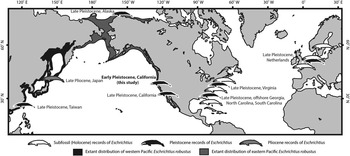
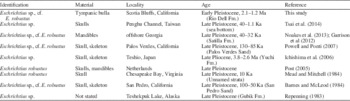
The evolution and interaction between the western and eastern Pacific populations of gray whales are poorly understood. Andrews (Reference Andrews1914) discussed the morphological difference between the extant western and eastern populations of gray whales and essentially found no morphological feature to discriminate one from the other. The earliest fossil record of Eschrichtius (Late Pliocene) was reported by Ichishima et al. (Reference Ichishima, Sato, Sagayama and Kimura2006, HMT-F-1; Eschrichtius sp.) from Hokkaido, Japan, along the western Pacific Ocean. The tympanic bulla of HMT-F-1 is not complete as VMW-27, but is sufficient to make morphological comparisons between the earliest western (HMT-F-1, the Hokkaido specimen) and earliest eastern (VMW-27, the Scotia Bluffs specimen) Pacific gray whales. The conical process is dorsoventrally and transversely thick in both the Hokkaido and the Scotia Bluffs specimens. By contrast, in HMT-F-1 the tympanic bulla is less transversely compressed than the VMW-27 and extant Eschrichtius robustus (Fig. 2.1, 2.4). In HMT-F-1, the dorsoventral depth of the involucrum decreases gently anteriorly, whereas the anterior involucrum is strongly constricted in VMW-27 and living gray whales (Fig. 2.2, 2.5). In addition, though the preservation of the lateral furrow in HMT-F-1 is poor, its lateral furrow seems less distinct than in VMW-27 and living gray whales (Fig. 2.3, 2.6). Thus, in terms of bulla morphology, the Scotia Bluffs specimen (VMW-27) shares more morphological features with the living gray whales than the earlier Hokkaido specimen (HMT-F-1) does. The fossil record of the living gray whale, Eschrichtius robustus, is still patchy worldwide (Fig. 3; Table 2). This fossil of Eschrichtius sp., cf. E. robustus (VMW-27) from the Lower Pleistocene of California not only represents the earliest record of the genus along the eastern Pacific Ocean to date, but also demonstrates closer morphological affinity with extant Eschrichtius robustus than Pliocene Eschrichtius sp. from Hokkaido. Comparison of the Scotia Bluffs and Hokkaido specimens suggests that the extant bulla morphology of the gray whale had been acquired by the Early Pleistocene.
Distribution of extant and fossil Eschrichtius, based on Repenning (Reference Repenning1983), Barnes and McLeod (Reference Barnes and McLeod1984), Mead and Mitchell (Reference Mead and Mitchell1984), Post (Reference Post2005), Ichishima et al. (Reference Ichishima, Sato, Sagayama and Kimura2006), Garrison et al. (Reference Garrison, McFall, Cherkinsky and Noakes2012), Noakes et al. (Reference Noakes, Pyenson and McFall2013), Tsai et al. (Reference Tsai, Fordyce, Chang and Lin2014), and this study. Subfossil records from Jones and Swartz (Reference Jones and Swartz2009, fig. 4).

Fossil records of Eschrichtius Footnote *

* All other fossil records of Eschrichtius described in the 19th century have been reviewed and disputed by Barnes and McLeod (Reference Barnes and McLeod1984).
Although VMW-27 represents the earliest occurrence of Eschrichtius in the eastern North Pacific, eschrichtiids have been reported from the Pliocene as well. A new genus and species of unnamed eschrichtiid with characteristics intermediate between Eschrichtius robustus and balaenopterids has been preliminarily reported from the San Diego Formation of Southern California (Deméré and Berta, Reference Deméré and Berta2003; Deméré et al., Reference Deméré, Berta and McGowen2005). Pliocene marine mammal assemblages of California are well sampled if incompletely recorded by publications (Boessenecker, Reference Boessenecker2013a) and the absence of Eschrichtius in Pliocene strata in this region appears to be genuine. The Pliocene marine mammal assemblage of the eastern North Pacific is distinct from the extant fauna (Boessenecker, Reference Boessenecker2013a, Reference Boessenecker2013b) and differs in retaining a number of archaic genera (Albireo, Balaenula, Herpetocetus, “Megaptera” miocaena), records of genera separated geographically or climatologically from extant relatives (Parapontoporia, Valenictus, and unnamed monodontids), and early records of recent genera (Balaenoptera, Callorhinus, Eubalaena, Hydrodamalis). Late Pleistocene marine mammal assemblages appear to be composed nearly entirely of extant genera and species, indicating a period of faunal turnover during the latest Pliocene or Early Pleistocene (Boessenecker, Reference Boessenecker2011, Reference Boessenecker2013a, Reference Boessenecker2013b). Eschrichtius appears in the western North Pacific during the Pliocene (Ichishima et al., Reference Ichishima, Sato, Sagayama and Kimura2006), when Eschrichtius fossils appear to be genuinely absent from the strange Pliocene fauna of the eastern North Pacific. The occurrence of geochronologically younger Eschrichtius in the Lower Pleistocene Rio Dell Formation suggests that the extant gray whale lineage (e.g. the genus Eschrichtius) appeared earlier in the western North Pacific during the Pliocene. Subsequently, Eschrichtius invaded the eastern North Pacific during or after a period of intense faunal restructuring in the latest Pliocene or Early Pleistocene; both of these processes may have contributed to the extinction of the as-yet unnamed Pliocene San Diego eschrichtiid, establishing part of the modern fauna early in the Pleistocene. Notably, this pattern is mirrored by the earlier fossil records of sea lions (Eumetopias) and walrus (Odobenus) in the Pliocene of Japan (Miyazaki et al., 1995). Further discoveries of fossil Eschrichtiidae will help test this hypothesis and interpret the evolutionary history of extant gray whales.
Acknowledgments
We thank Ron Bushell for collecting, preparing, and donating the specimen; Richard Hilton and George Bromm for access to specimens under their care; Tadasu Yamada, Naoki Kohno, Hiroto Ichishima, James Mead, Charles Potter, John Ososky, Jim Dines, Dave Janiger, and Historical Museum of Teshio River, for collections access and use of photographic equipment; Eric Ekdale, Mark Uhen, and the editor for their constructive reviews and comments. Both authors were supported by a University of Otago Doctoral Scholarship, and a University of Otago Division of Sciences Postgraduate Travel Grant awarded to RWB contributed to this study.