When the H1N1 influenza pandemic broke out in 2009, health organizations (World Health Organization [WHO] and Centers for Disease Control and Prevention [CDC]) did not operate in a vacuum. Health regulations and insights from previous influenza epidemics guided the risk management of the H1N1 influenza outbreak and the strategies used to communicate with the public. Most countries, following the 2002 and 2005 WHO guidelines, prepared national pandemic plans, which in many cases were updated with the second WHO guidelines. Those plans also were analyzed in the scientific literature.Reference Jennings, Monto, Chan, Szucs and Nicholson 1 Thereafter, all of the procedures followed by the CDC and WHO were documented in final reports, which summarizes their activity during the 2009 outbreak.
In recent years, governments and health organizations worldwide have agreed that the conceptual strategy of risk communication plays a critical role in national programs to prevent and confront influenza.Reference Allen Catellier and Yang 2 , Reference Lee and Kotler 3 Risk communication is widely used to plan communication strategies and draft guidelines. In addition, the literature has demonstrated a shift to the study of 2-way communication strategies, which also consider feedback, worries, and concerns from the ground level up (ie, from the public to the addresser), rather than 1-way communication, in which information flows only from the addresser to the public—without accounting for public response.Reference Sandman 4
The main objective of this study was to discern how risk communication guidelines for an outbreak of an emerging infectious disease (EID) were implemented by local governments throughout the world. To this end, our study involved 2 parts. The first was an analysis of documents, which examined WHO and CDC guidelines from 2005 to 2008 and reports of implementation of those guidelines from 2009 to 2011. The guidelines targeted health care professionals (policy makers, communication experts) and not the general public. We examined what the reports said about how the guidelines were understood and carried out locally and how the recommendations were conveyed to the public.
The second part of our research comprised an empirical case study, which investigated how the CDC and WHO guidelines were implemented in Israel, a member state, according to stakeholders (policymakers, public health workers, journalists, and bloggers) who were interviewed for this purpose. Our empirical case study provided a perspective on how the 2005 to 2008 guidelines were internalized from the perspective of local stakeholders in Israel, which was then compared with the reports. Our rationale for comparing reports with an empirical case study was to obtain a panoramic picture of the role of risk communication regarding vaccination both in planning for an EID and its actual implementation on international and local levels. To characterize its eventual local implementation, it was crucial to understand to what degree and how risk communication was articulated in the EID guidelines; to what extent such guidelines were considered from an international perspective as reflected by the reports; and to compare this finding with the local empirical perspective. Although other public health control measures such as hand washing are important, they were not the risk communication focus of this study.
Risk Communication
Risk communication is of paramount importance, as reflected in the following statements: “In the next influenza pandemic, be it now or in the future, be the virus mild or virulent, the single most important weapon against the disease will be a vaccine. The second most important will be communication.”Reference Barry 5 The literature Reference Covello 6 , Reference Freimuth, Linnan and Potter 7 calls one of the specific forms of risk communication during an epidemic crisis EID communication. This approach draws on health promotion communication, crisis communication, and environmental and technological risk communication.
The risk communication approach indicates that public engagement and involvement are imperative,Reference Holmes, Henrich, Hancock and Lestou 8 and stresses the importance of building trust Reference Cvetkovich and Lofstedt 9 - Reference Lofstedt 11 under the unique conditions that prevail during the outbreak of an EID.Reference Covello 6 , Reference Frewer, Hunt, Brennan, Kuznesof, Ness and Ritson 12 , Reference Sandman 13 Unpredictability and lack of control communicate uncertainty to the public.Reference Frewer, Hunt, Brennan, Kuznesof, Ness and Ritson 12 , Reference Frewer 14 - Reference Rudd, Comings and Hyde 16 The behavior of the public in a crisis is sometimes driven by self-contradictory motives: rationality with emotionalityReference Slovic, Finucane, Peters and MacGregor 17 and seeking official sources of security while tending to think independently. This behavior challenges campaign architects to create an effective dialogue with the public.
However, empirical studies about the role of risk communication during an EID outbreak are few.Reference Holmes, Henrich, Hancock and Lestou 8 , Reference Rudd, Comings and Hyde 16 , Reference Holmes 18 Furthermore, much of the literature on EID communication discusses 1-way transmission of information to the public by experts and mass communication media.Reference Holmes 18 Such 1-way communication of risk by governments in the course of an epidemic contradicts the understanding of the nature of risk perception that concerns not only its scientific but also its psychological aspects. More significantly, this 1-way communication paradigm is outmoded because it does not take advantage of recent technological innovations epitomized by social media, which facilitate 2-way communication and exemplify powerful tools for interaction with the public.
HolmesReference Holmes 18 has drawn attention to the lack of empirical studies in the field of EID communication, and stresses the need for qualitative studies involving a range of stakeholders. The goal of such studies would be to improve emergency responsiveness and, more crucially, to create an environment of optimal preventive preparedness that preempts the actual outbreak of an EID. The present study builds on his assessment by incorporating documentary analysis with empirical research, specifically with regard to the H1N1 flu pandemic. Using H1N1 as a case study, we have examined risk communication recommendations and implementation during the pandemic from a range of perspectives, from international organizations and local stakeholders implicated in the process of communication to the public. We believe that this range of perspectives provides an important contribution to this study.
THE H1N1 Pandemic
The H1N1 virus was first identified in the United States in April 2009. During the following year, approximately 61 million cases of the virus and 12 470 deaths were reported. 19 Experts differed about the degree of success or failure of health communication campaigns during the outbreak.Reference Poland 20 , Reference Rubin, Amlot, Page and Wessely 21 The timelines of vaccination recommendations for the first few months of the pandemic revealed the complexity of the relationship between international health organizations and member states. Shortly after the outbreak, as a result of vaccine shortages, the WHO instructed countries to vaccinate universally but to give priority to at-risk groups. The WHO further advised each country to independently decide which groups should be given priority. As Dr Marie-Paule Kieny, director of the WHO initiative for vaccine research, advised during WHO's virtual press briefing, “SAGE [Strategic Advisory Group of Experts] has not recommended universal vaccination, but has recommended that countries consider which groups should be prioritized according to their own needs and conditions.” 22
By the time vaccine was available, concerns and demand for it had declined significantly. The vaccine shortage and ensuing instruction to target high-risk groups may well have resulted in lower vaccination rates than would otherwise have been achieved due to confusion at the local level regarding official guidance. This situation emphasized the complexity in implementing international guidelines at a local level. This study evaluates such gaps between the international guidelines and their actual implementation according to reports worldwide and to interviews with Israeli stakeholders in a case study.
Methods
The first part of this study comprises documentary research, and the second part describes an empirical qualitative study based on interviews with stakeholders. In both cases, we highlight and analyze risk communication strategies.
Data Collection for Documentary Research
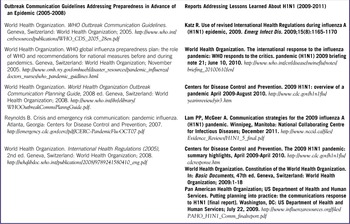
The WHO and CDC guidelines from 2005 to 2008 and reports from 2009 to 2011 were collected and read to evaluate the implementation of the guidelines for influenza outbreaks following the H1N1 2009 pandemic outbreak. The guidelines contained contingency plans and a communication framework for responding to an influenza epidemic. The reports from 2009 onward comprised ex post facto summaries and discussions of communication strategies during the H1N1 outbreak. We collected the documents in October 2012 using the search engines of the WHO and CDC websites. We also used Google Scholar and key words “communication strategies WHO and CDC” and “risk communication H1N1.” We searched for guidelines, reports, and other publications dealing with pandemic preparedness and planning. Of the 34 documents found, we excluded those that did not relate to communication planning, and chose 12 documents in which this issue was central (Table 1).
Guidelines and Reports

An inductive detection of the primary themes that emerged in the texts was conducted, using textual analysis of the documents and interviews, to determine the themes and major issues explicitly stated to examine deeper themes in risk communication. We divided the documents as follows: outbreak communication guidelines that address preparedness in advance of an epidemic (2005-2008); and reports that address lessons learned after the H1N1 pandemic (2009-2011). Of the 5 documents containing guidelines, 1 addresses dominant risk communication themes including trust, transparency, the public, and planning 23 ; a second updates pandemic phases of preparedness 24 ; a third includes a comprehensive outbreak communication planning guide from planning through implementation 25 ; a fourth provides a general overview of crisis and emergency risk communication, with special reference to pandemic influenza, and addresses segmentation and information technology 26 ; and a fifth discusses the establishment of the international health regulations (IHR) in 2005. 27
The 7 reports from 2009 onward included the following: (1) a report describing a timeline of events that led to designating the epidemic a public health emergency of international concern, following 2005 IHR proceduresReference Katz 28 ; (2) a briefing that characterizes the emerging pandemic and concerns surrounding consequent policies 29 ; (3) a slide presentation that situates H1N1 within an epidemiological overview of influenza and delves into the background, detection, impact, accomplishments, and recommendations for treatment and prevention of H1N1 30 ; (4) a retrospective report evaluating implications of communication strategies during the H1N1 outbreak and recommendations for health communication practices during future pandemics 31 ; (5) a document that summarizes key events of the H1N1 pandemic and CDC's response activities that focused on CDC communication activities in 2009 32 ; (6) a document treating the implementation of health regulations 33 ; and (7) a report on the Global Communications Conference “Putting Planning into Practice: The Communications Response to H1N1.” 34
Subjects and Procedures in the Empirical Qualitative Study
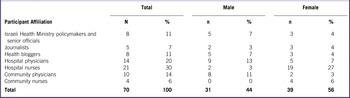
The aim of the interviews was to determine how the communication strategies and theoretical dimensions from the reports were implemented in Israel as a case study. We conducted 70 semi-structured interviews in Israel. The participants were selected to reflect the experiences of a range of health and communications professionals. The participants included 8 policymakers and senior officials from the Health Ministry with expertise in communication and epidemiology; 5 journalists from Israel's biggest news media corporations who write about health issues for daily newspapers or websites; 8 well-known bloggers on health issues; and 49 health care workers (25 nurses and 24 physicians) in community care and in hospitals (see Table 2). All interviews were conducted by 2 facilitators, either by phone or face-to-face, and they were recorded and transcribed.
Interview Participants

The interview questions consisted of semistructured protocols; we formulated separate protocols for each group (policymakers; communications experts; and health workers). The generic topics, which were included in all 3 protocols regarded knowledge of H1N1; attitudes toward vaccination; reasons for public noncompliance; conceptions of public trust in the health care system; and risk communication. The specific questions for policymakers concerned pressure they confronted from the pharmaceutical industry and from the government; the treatment of high-risk groups; coordination and synergy between communication departments and epidemiology departments; state responsibility; and engagement of health care workers in the risk communication process. The specific questions for communications experts concerned dilemmas they faced when conveying information to the public; engagement of the Health Ministry; the process through which they formulated and validated the information they shared with the public; the task of communications experts in crisis situations—whether a more active role in helping the public make decisions or a more passive role conveying government guidelines; and the role of social media in crisis situations. The specific questions for health care workers asked about the concerns and worries raised by their patients during the outbreak.
Data Analysis
Data analysis was carried out in 3 stages. The first stage was an analysis of the documents to evaluate the guidelines (2005-2008) and how they were implemented according to the 2009 to 2011 reports, coding the risk communication themes.
The second stage was a content analysis of the interviews we conducted; these were organized around the risk communication themes that were identified in the documents and interviews. In the third stage, we compared the results of the documentary analysis with the results of the interview analysis, focusing particularly on risk communication themes, and how they were treated.
The documents have been coded according to the communication themes that were identified: trust, empowerment, uncertainty, framing the vaccine, stakeholder inclusion, segmentation, and strategies used to persuade people to be vaccinated. For each theme, we present the findings from the documentary analysis, followed by the results of the empirical study. The rationale for integrating these 2 analyses is to discern the process and progression from theoretical guidelines to reports of international implementation to local implementation of the same guidelines.
Results
Communication and Coordination Among Organizations and Governments
Document Analysis
The documents included a strong emphasis on risk management of the epidemic and coordination among the WHO and CDC and the member states. While risk management and coordination issues filled a large part of the reports, very little reference to communication strategies was noted. For example, the brief that presented an overview of the pandemic focused on the trajectory, development, and management of the pandemic. 29
In both the guidelines and the reports, the WHO and CDC instructed member states to report any change in morbidity that could signal the emergence of an epidemic. The member states were required to establish a national IHR focal point for communication with WHO 27 ; meet core capacity requirements for disease surveillance; inform WHO of any incidence; and respond to additional requests for information by WHO.Reference Katz 28 The guidelines emphasized the issue of timing, specifically of make announcements early. 23
In spite of international regulations and guidelines, we found that member states received few specific guidelines on how to fulfill regulations. 29 It appeared that communication and coordination between the WHO and CDC and the member states emphasized top-down communication, from the organizations to the member states. In addition, no segmentation was observed between the member states—all received the same guidelines and regulations. 31 It was interesting to note that the communication was satisfactory sometimes, resulting from personal relationships created during the planning stages, especially after the SARS outbreak. The guidelines themselves, however, were lacking because of “the limited usefulness of the plans.” 34
Empirical Study
The interviews with policymakers in Israel also revealed a gap emanating from the guidelines. Participants highlighted a lack of segmented guidelines for member states. One senior health official reported that the Israeli Ministry of Health decided who would communicate the characteristics of the epidemic and the need for vaccination to the public, without any intervention from WHO: “There were no [guidelines from WHO]… .[the Health Ministry] controlled the guidelines… one of the senior officials at the Health Ministry instructed them.” Another senior health official added, “General recommendations from international organizations were sent to all [the member states]….They weren't specific to Israel… and concerned mainly epidemiological issues… not how to communicate.”
Risk Communication: Maintaining Trust Among Governments and Stakeholders
Document Analysis
According to our findings, WHO and CDC guidelines for an epidemic crisis emphasize that health organizations aim to establish trust with the public and other stakeholders: “The overriding goal for outbreak communication is to communicate with the public in ways that build, maintain or restore trust. This is true across cultures, political systems and level of country development.” 23 One CDC document indicates that the public judges the information provided in a crisis from the perspective of trust. The public immediately judges the content of an official emergency message as follows: “Was it timely? Can I trust this source?” and “Are they being honest?” 26
The 2009 CDC reports indicated that communication strategies to establish trust were implemented. During the outbreak, the release of information was fast, on a 24-hour cycle, with frequent updates by a core group of spokespersons. The stated goal was not only transparency, but also maintaining credibility as a trusted source of information for the public and the member states. 30 However, because no evaluation studies or opinion studies from other public/health care workers were conducted, we could not determine whether this goal was achieved.
Empirical Study
Our empirical research also revealed that the WHO and CDC were considered trustworthy sources of information by Israeli policymakers, health care workers, and the media. The Israeli policymakers reported that each WHO guideline was followed unequivocally. Questions may have emerged, but they were not expressions of distrust. As one senior health official described, “We had direct contact with the WHO…. We followed the guidelines of the WHO and the CDC.”
Health care workers and journalists also expressed trust in the WHO and CDC. Medics and senior nurses referred to WHO and CDC publications as information sources when treating patients, alongside local publications from the Israeli Health Ministry. Two medics reported that “We could rely on the WHO for information,” and “Quoting external sources like CDC and WHO… is correct and valid… adding a dimension of validity… .The CDC updated its information daily.” According to a nurse, “I referred to the CDC website frequently.” Many journalists and bloggers stated that the CDC and WHO websites were valuable information sources.
The interviewees expressed more trust in the WHO and CDC than they did for the Israeli Health Ministry. A senior nurse explained that the Health Ministry was perceived as a political organization motivated by political interests and not the public well-being. Interviewees expressed distrust toward the WHO and CDC only in doubting how decisions were made to buy vaccines, in that they may have been influenced by pharmaceutical companies with commercial interests in the choice. One health journalist reported that “There was a sense of conspiracy… some people thought that the vaccines were not needed and had been bought for no reason.” This thought was also expressed with regard to the Health Ministry.
Empowerment of the Public
Document Analysis
WHO guidelines from 2005 underscore the importance of addressing public fears and concerns during an EID outbreak. The responses and communication of information must convey empathy: “The public's concerns must be appreciated even if they seem unfounded. When a publicly held view has validity, policy-making should be consistent with that view. When a publicly held view is mistaken, it should still be acknowledged publicly and corrected, not ignored, patronized or ridiculed.” 23 CDC guidelines from 2007 highlight the importance of listening to the public, which is a crucial step toward public empowerment. 26 Both documents address goals of empowerment by focusing on listening, overlooking the importance of giving tools for the individual decision-making process.
In the reports (2009-2011), we found no explicit references to empowerment as a stated goal. Most concerned “providing information” and “delivering it to households.” 31 As in the guidelines written before 2009, the focus was to convey the information to the public quickly, emphasizing communicating information, which can be seen as a first step toward empowering the public, and providing for feedback and 2-way communication to increase the degree of empowerment.
Health care workers played a key role in empowering the public during an epidemic outbreak, especially primary care providers, 31 by carrying out the guidelines with and for the public. Therefore, it was important to define the guidelines given to health care workers. In both the guidelines and the reports, instructions for health care workers were mainly procedural. Although they received instructions regarding whom to vaccinate, when, and how, 31 they did not receive instructions on how to contend with fears, questions, and skepticism.
Empirical Study
In our empirical research, this same drawback was expressed by Israeli health care workers. While most were familiar with the guidelines regarding whom and how to vaccinate, they stated that they received no guidance on how to discuss the vaccination. Nurses said that the general impression was that the public should be forced to vaccinate and that this process lacked active explanation. As 2 senior nurses noted, “We had written protocols… what we needed to know, who would get it…,” and “There were just general guidelines.” Another nurse reported, “We were instructed to vaccinate and that's it.” The medics expressed a similar sentiment: “We dealt mainly with… who needs to get a vaccine and at what age… not communication.”
Uncertainty
Document Analysis
In 2005, the international organizations developed a plan to confront and communicate future influenza pandemics. 27 The assumptions were that susceptibility to the pandemic influenza subtype would be universal and that the clinical disease attack rate would be high, causing hospitalizations and deaths. Other assumptions concerned the duration of the pandemic, secondary infections and at-risk groups, and secondary fatal infections.
The CDC and WHO guidelines cite the importance of transparency in EID communication with the public: “Maintaining the public's trust throughout an outbreak requires transparency (ie, communication that is candid, easily understood, complete, and factually accurate). Transparency characterizes the relationship between the outbreak managers and the public. It allows the public access to the information-gathering, risk-assessing and decision-making processes associated with outbreak control.” 23
The documents underscore that transparent communication includes conveying uncertainty: “When health risks are uncertain, as likely will be the case during an influenza pandemic, people need information about what is known and unknown, as well as interim guidance to formulate decisions to help protect their health and the health of others.” 26
Based on these guidelines, the CDC and WHO reports after 2009 treated the challenges of how to communicate information about the H1N1 virus to the governments and the public when its severity was uncertain. The criticism of this finding was that instead of providing transparent communication regarding the uncertainty surrounding the new virus, they rushed to declare a pandemic. 29
Another aspect of uncertainty that emerged from the reports (2009-2011) referred to the vaccine itself. Many questions were raised regarding its safety and its capacity to prevent infection, issues that inhibited vaccination compliance. Other uncertainties related to the vaccine included availability, safety, efficacy, and priority group distribution. 34 The WHO and CDC reported “The emergence of a novel pandemic H1N1 (pH1N1) influenza strain presented many communication challenges for public health officials. There were ‘unknowns’ about the disease, such as severity and spread during the initial stages.” 31 These reports stated that despite the uncertainty that characterized the early stages of the pandemic, the system responded quickly, because communication routes were pre-established for conveying information quickly to the member states and the governments. The solution for confronting issues of uncertainty was successfully applied. 31
Empirical Study
From our empirical study, the issue of uncertainty for policymakers was raised, especially with regard to the vaccine rather than the pandemic. One policymaker reported that in the first stages of the pandemic, when decisions such as buying the vaccine needed to be made, the WHO and CDC provided few answers: “One of the central dilemmas was… how much to invest in this uncertainty….” Another health official added that while the WHO recommended the vaccine, information was still missing: “We knew what other countries were doing and what the WHO recommended… there were moments when we felt that… there would be a shortage of vaccines.”
Among the health care workers, we identified 2 tendencies. The health care workers either followed the pandemic and vaccine guidelines without being troubled by uncertainty, or they followed the WHO and CDC guidelines with feelings of ambivalence, believing that many questions had been left unanswered. One nurse commented, “On the one hand, we received guidelines to vaccinate, but we still had questions about this process… there were many unknowns… how could I vaccinate someone and convince him when I myself had doubts?”
Communicating the Vaccine as the Only Option Versus Providing Information
Document Analysis
We examined the communication process for the prevention of H1N1 regarding whether (1) the vaccine was presented as the only option recommended by the WHO and CDC; (2) the risks of the vaccine were explained; and (3) other alternatives were offered. We did not address the epidemiological question of whether any of the alternatives could provide viable solutions, but only the issue of transparent communication regarding the vaccine (especially given its newness) alongside additional preventative measures.
We found that this question could not be adequately answered based on the documents examined. However, we could assume that the vaccine was presented as the only option 34 because we found few references to alternative options, aside from medication for people already suffering from symptoms of influenza. 30
Empirical Study
The Israeli health care workers and policymakers we interviewed expressed similar insights. They stressed that their guidelines focused on the importance of the vaccine. According to 2 nurses, “The teaching session was devoted primarily to the vaccine,” and “We received some guidelines about how not to infect others, not to sneeze on your hand, but it was not presented as a solution.” One medic reported that “No alternative was presented,” while a policymaker noted that “The vaccine was the only relevant solution at that time.”
Stakeholder Inclusion
Documents Analysis
We examined the engagement of stakeholders in communicating information about the disease and the vaccine. Although health care workers were not a homogeneous group within or between different countries, it was important to understand their potential role in the communication process. In both 2005 and 2009, health care workers were the main stakeholders. The process of developing a course of action necessitated collaboration and communication with them. 31 However, the WHO and CDC documents indicated that while most of the communication routes were pre-established and allowed for the rapid exchange of information between key partners during the pandemic, little stakeholder inclusion took place either during the development of those communication routes or after the communication routes were established.
After initially conveying information to the health care workers, their attitudes were evaluated to adjust programs: “Frontline care providers were another group that found the pandemic plan insufficient in the first wave of the pandemic. They requested that information applicable to primary care settings be disseminated in a timely manner. After the first wave… they collaborated with family physicians to develop ‘Pandemic H1N1: Fast Facts for Front-line Clinicians,’ which frontline health care workers found helpful.” 31 However, even these programs were apparently insufficient, as the CDC reported conflicting results regarding the inclusion of health care workers. 31
Empirical Study
In the interviews we conducted in Israel, health care workers presented a similar picture. They reported that inclusion processes existed, but they did not always find them constructive. When asked whether they were included and consulted about communicating the pandemic and the vaccine to the public, many of them answered in the affirmative. However, they claimed that they could not determine any impact. According to one of the nurses, “We had occasional meetings….They presented what they knew and what the procedures were…. They asked if we thought that things should be changed….There was discussion and some argued and provided suggestions… .Most of the time, we felt that we still didn't have the full picture….Afterwards… I had no clue what they did with it.”
The interviews indicated inclusion of communications experts, such as journalists and bloggers regarding the design of the communication strategies. In the interviews we conducted, the Israeli journalists, and especially the bloggers, expressed their need for participation in the process. Most of them agreed that because they play a key role in conveying information, they could make an important contribution to the process, as one health journalist explained, “If you allow the media people to participate… and explain and hear… no one will say that the media doesn't care about public health….We need to work together, to think together, how to inform the public….We can represent our side in the process, which is important.” While the journalists reported that some local Israeli organizations consulted with them, bloggers noted that they were completely excluded: “We had only the press releases from the website [of the Health Ministry]…. We didn't work… with Israeli sources. Just from abroad….We sometimes needed to, but had no one to turn to.” A minority of the journalists thought that they should not be involved in designing communication strategies, so as not to compromise their position as “democracy's watchdogs.”
Identification of Subpopulations and At-Risk Groups
Document Analysis
All of the documents indicated that subpopulations and at-risk groups were targeted. Among the subpopulations mentioned were toddlers, school-age children, homeless people in shelters, and even ethnic communities (eg, aborigines). One of the strategies mentioned was information sessions held with local community partners and cultural organizations to identify these groups. 31 However, on the international level, it was almost impossible to identify additional strategies. At-risk groups that were advised to undergo vaccination were identified easily in the reports. 34
The empirical study had no data on this topic.
Segmentation: Choosing the Channels and Tailoring the Messages
Document Analysis
The WHO guidelines treat the subject of segmentation by providing instructions for culling information about various sociodemographic populations, taking cultural differences into account. 27 In addition, the reports (2009-2011) refer to channels of communication with the public, but reference to segmentation is slight.
Extensive reporting is available on the use of different communication channels, from television to the Internet, to communicate with different populations. Specific communities requiring cultural sensitivity were addressed by their special communication channels. 31 , Reference Brownstein, Freifeld and Madoff 35 The reports include many examples of various channels being used as part of the segmentation process, including public leaders among aboriginal communities in Australia, local newspapers of culturally sensitive communities in Canada, and web-based tools and social media among youth around the world. 31
In a Global Communications Conference, which took place in the midst of the pandemic, each country was called on to adapt the communication strategies to their specific cultural needs. The fact that such a call was made might indicate a general lack of such cultural adaptation. “Presenters and participants also noted the importance of communicators being attuned to social, cultural and other factors among and within countries that can and will create profound differences in how pandemic risks are perceived, and in the appropriate communications messages and tools needed to effectively reach audiences and promote appropriate behavior.” 34
With regard to segmentation, both the guidelines and the reports provided only a very general reference to the idea of segmentation. The reports (that describe how the messages in the guidelines were conveyed to the public) indicated that special populations were targeted with specific prevention and control messages 31 ; key messages were provided to specific groups 31 ; and articles were targeted to specific audiences. 33 No discussion was given about the content of these messages and how they were designed. However, it appeared that the segmentation focused on subpopulations in general and not on specific at-risk groups. Few examples were found of targeting messages to vulnerable groups in settings such as schools, day care centers, and universities.
Empirical Study
In the interviews we conducted in Israel, it emerged that most of the channels employed by the Israeli Health Ministry were traditional mass media channels. One senior health official explained the process of working with traditional mass media channels: “I took all the health journalists and vaccinated them…. One of them even recorded himself and broadcast it….”
Communication Flow: Intimidation Employed in Media Coverage but not as a Professed Strategy
Document Analysis
When facing uncertainty surrounding a health situation, the media sometimes resorts to a strategy of intimidating the public.Reference Holmes, Henrich, Hancock and Lestou 8 However, WHO and CDC documents reflect a strategy of non-intimidation, in which communication is transparent in reporting the risk. 23 , 31 , 33
Empirical Study
To evaluate whether the media's reporting was factual and nonalarmist in the Israeli case study, we found that the Israeli journalists believed that their coverage of the pandemic was always factual. They reported that they did not use intimidation, but preferred to refer to “true human interest stories.” This definition encompassed stories of people who died of the virus. One journalist explained, “We sometimes reported about people wearing masks because it's interesting….It's journalism…. Sometimes there were uncertainties and ‘hysterics’ that we reported, but it was pure facts about what had happened.” On the other hand, the bloggers reported that the journalists employed a strategy of intimidation, while insisting that their own reports represented factual information from different sources.
The policymakers found that the journalists’ reports were not always factual and were sometimes intimidating. One policymaker, in referring to the press releases that were sent to the media organizations every day, noted, “I once took a journalist and told him to take a random press release and see what it said. He found a simple, two-line, informative press release, about a suspected case of H1N1… I told him, ‘Now, look at the report on this press release’… He took the headlines: ‘Pandemic! Fear!’… I asked him, ‘Are we the ones making people hysterical or is it the media?’”
Focusing on the 1-Way Flow of Communication
Document Analysis
We examined whether the use of communication channels for risk communication focused more on providing the information or sharing it. We also examined whether the new and social media responded to public feedback through these channels, or whether they were used only as another route for conveying information.
The following excerpt from a CDC report emphasized a 1-way flow of communication:
“Information provided by the CDC reached a myriad of audiences through a variety of channels including but not limited to: a 24-hour information hotline, press briefings for the media, dissemination through health alert networks, daily postings (including video and audio podcasts) to the CDC 2009 H1N1 web site, regular updates on Facebook and Twitter, and further outreach by partners and partner organizations to their own audiences, just to name a few channels.” 32 One CDC report found that 16.2% of the YouTube videos on the web were classified as misleading. Themes in the misleading videos included antivaccination messages, conspiracy theories about manmade H1N1 virus, government propaganda, and exaggerated H1N1 risks. 31 The response to these was to promote CDC videos, but, as far as we could find, not to respond on a case-by-case basis to specific examples of misinformation.
Empirical Study
A 1-way flow of communication also emerged from the interviews we conducted, as journalists, bloggers, and health care workers reported many questions, intimidating stories, and unchecked facts appearing on the Internet.
Variety of Channels: Old Paradigms
Document Analysis
In past epidemics, health organizations employed only a few traditional mass media communication channels. From the CDC reports, it appeared that the diversity of media channels has increased. In addition, the use of new and social media was extensive. The CDC and WHO regularly updated websites, and their Facebook and Twitter accounts with the latest information on the pandemic. 32 However, not all of the member states employed these media channels on a national level.
Empirical Study
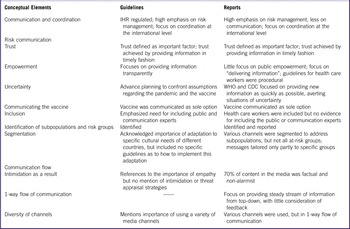
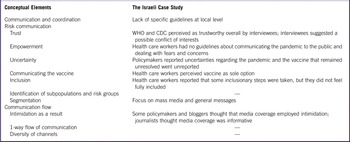
According to the interviews we conducted, although the use of traditional mass communication channels was pervasive, other options were little used. Journalists and bloggers reported that the official Israeli Health Ministry website was not updated regularly. If information was not being provided by the policymakers, it could only be accessed through international sources. In addition, Twitter and Facebook accounts were not used to communicate with the public. (The Israeli Ministry of Health's Facebook account was opened in January 2012.) Table 3 presents the theoretical dimensions and their implications in the 2005 and 2009 reports, and Table 4 references the conceptual elements in the guidelines (2005-2008) and reports (2009-2011).
Theoretical Dimensions and Their Implications in the 2005 and 2009 Documents
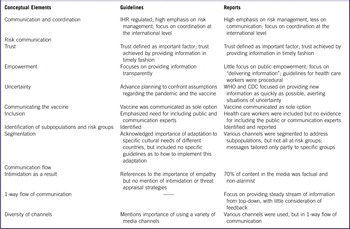
Abbreviations: CDC, Centers for Disease Control and Prevention; IHR, international health regulations; WHO, World Health Organization.
References to Conceptual Elements in the Israeli Case Study: A Summary of Findings

Abbreviations: CDC, Centers for Disease Control and Prevention; WHO, World Health Organization.
Discussion
As a result of the IHR enacted in 2005, the CDC and WHO devoted much attention to the coordination and communication between themselves and their member states. This subject received special attention in the guidelines, which described how to use specific channels for updates and monitoring. However, it appeared that while these channels were effective on the international level, more specific guidelines and guidance were needed on the national level. The guidelines mostly described top-down communication, with little attention given to their implementation in individual member states. The states received no feedback from the organizations regarding the lack of information or misunderstandings and adaptations required at the local level.
This finding was relevant to the intention of the CDC and WHO regarding informal antivaccination campaigns. Little consideration was given to these bottom-up campaigns, while the official information remained unchanged. We have attributed the greater number of communication channels employed to the emergence of new media rather than to an attempt to employ those channels for potential feedback. The key challenge of an efficient bottom-up flow of communication has been to locate individuals who can respond at the grassroots level. Those grassroots stakeholders can then evaluate and disseminate the information.
In their guidelines, the CDC and WHO declared that maintaining trust was a primary objective. Regular updates were disseminated and credible sources were employed to this end. However, in practice, the interviews we conducted indicated gaps between the stated policies and the procedures that were actually followed. Special attention was devoted to potential conflicts of interest regarding the promotion of the vaccination campaign. In addition, the interviews revealed greater trust in organizations such as CDC and WHO than in the national government.
Although the guidelines treated conceptual elements such as communicating uncertainty, segmentation, and empowerment (of diverse stakeholders), a gap was evident in the implementation, according to our analysis of the reports. In the reports, we also found a diversity of communication channels, possibly a result of the emergence of new media after 2005. Even so, the 1-way communication flow still dominated.
Both the reports and our empirical study demonstrated a gap between guidelines at the international level and their implementation by member states. While the guidelines were often perceived as unequivocal on the international level, the Israeli case study revealed that this was not always the case at the local level.
Conclusions
The first recommendation that emerges from our study relates to the first essential step in formulating effective communication strategies, which is to define the goal of a vaccination program. It should take into account the segmentation of the population, including at-risk groups and regional affiliation. In addition, 2-way communication could help in understanding special needs and in developing guidelines in light of the concerns of the public.
Our second recommendation concerns implementing conceptual elements drawn from the most current theoretical literature when planning communication strategies. Two related examples are transparency and uncertainty, which should be applied in practice when dealing with the public during an EID crisis. While many guidelines and theoretical strategies have been successful on the international level, our Israeli case study suggests that sometimes dissemination to the member states has been inadequate. Even if the CDC and WHO guidelines are in complete agreement, adaptation of messages at the local level will be necessary for each country. Also, it is important to ensure that different communication outlets such as the media and public health are consistent.
In future health crises, it is recommended that organizations be more involved in the implementation of guidelines. Although a variety of communication channels had been employed in 2009, the 2-way communication had been deficient, as was involving the public in formulating decisions. It was very difficult to reconcile the use of standardized and uniform messages while satisfying the need to target a large number of subgroups (segmentation) across widely divergent socioeconomic and geopolitical lines.
Funding and Support
This work was completed as part of the Transparent Communication in Epidemics: Learning Lessons From Experience, Delivering Effective Messages, Providing Evidence (TELL ME) project, co-funded by the European Commission within the 7th Framework Programme—HEALTH theme.