Introduction
Although the notion of path dependence is associated with historical institutionalism (e.g. Thelen and Steinmo, Reference Thelen and Steinmo1992; Pierson, Reference Pierson1996; Blyth, Reference Blyth2002; Greener, Reference Greener2005), it has become a highly popular concept in the social sciences, and is utilized by various institutional perspectives (e.g. rational choice and sociological institutionalisms) and in policy analyses. It is, however, defined and applied rather differently throughout the literature (see also Mahoney and Schensul, Reference Mahoney and Schensul2006). For instance, in one definition, path dependence implies that ‘what happened at an earlier point in time will affect the possible outcomes of a sequence of events occurring at a later point in time’ (Sewell, Reference Sewell1996: 262–263). For Levi, path dependence suggests that ‘once a country or region has started down a track, the costs of reversal are very high. There will be other choice points, but the entrenchments of certain institutional arrangements obstruct an easy reversal of the initial choice’ (1997: 28). Berman (Reference Berman1998: 380) argues that in a path-dependent process, choices made at time T shape or influence choices made at time T+1. Another highly cited definition states that ‘path dependence characterizes specifically those historical sequences in which contingent events set into motion institutional patterns or event chains that have deterministic properties’ (Mahoney, Reference Mahoney2000: 507). More recently, David (Reference David2007: 92) proposes that path dependence refers to ‘a dynamic pattern or continuity that evolves as a result of its own past’.Footnote 1
In addition to different conceptualizations, we see distinct types of path dependence in the literature. An overview of the applications of the path-dependence approach by the existing institutional and policy analyses suggests that we can identify two major types or models of path dependence: utilitarian and normative, and that each of these models is associated with a distinct logic of action: the logic of consequentiality and the logic of appropriateness, respectively. Thus, for the existing models or types of path dependence, paths are constituted by either cost-benefit calculus or by normative, ideational considerations.
This study, however, argues that existing models ignore or neglect the logic of habit and habitual routines, and as a result, the path-dependence approach remains underspecified. Thus, this work introduces the ‘habitual path’ as a unique model of path dependence and shows that this notion is discrete enough to be regarded as a separate explanatory tool. Far from rejecting the existing models, this study intends to broaden and empower the path-dependence approach. By enriching the analytical content of the path-dependence approach, the notion of the habitual path would enhance our understanding of history-dependent processes and patterns. Therefore, it would be rewarding to include the habitual model of path dependence in our theoretical and conceptual toolkits.
The article proceeds as follows: the next section presents the main assumptions and premises of the existing variants of path dependence. Then, the article presents the main features of the habitual path to explain the third model of path dependence. The concluding section summarizes the study’s main arguments and discusses some implications for institutional and policy analyses, as well as some possible counter-arguments.
The existing models of path dependence
In the existing path-dependence literature, one can find several typological analyses of path dependence. Many of them suggest that path dependence entails both self-reinforcing and reactive sequences (e.g. see Mahoney, Reference Mahoney2000; Bennett and Elman, Reference Bennett and Elman2006; Mahoney and Schensul, Reference Mahoney and Schensul2006; Beyer, Reference Beyer2010). For Mahoney (Reference Mahoney2000: 508–509), self-reinforcing sequences refers to the ‘formation and long-term reproduction of a given institutional pattern’, while reactive sequences stand for ‘chains of temporarily ordered and causally connected events’.” As Mahoney states (Reference Mahoney2000: 509), in reactive sequences ‘each event within the sequence is in part a reaction to temporally antecedent events’.
However, other studies exclude reactive sequences from the definition of path dependence (e.g. see Pierson, Reference Pierson2000, Reference Pierson2004; Sydow et al., Reference Sydow, Schreyögg and Koch2009; Vergne and Durand, Reference Vergne and Durand2010; Dobusch and Schüßler, Reference Dobusch and Schüßler2013). It is argued that each event or step in any temporal sequence can be linked to each other in a chain of causation. Thus, because any antecedent event can be linked to subsequent events, almost any non-reinforcing event sequence can be treated as a reactive sequence.Footnote 2 This raises the problem of falsifiability. Given such limitations or difficulties, this work also limits path dependence to ‘self-reproducing’ sequences and processes.
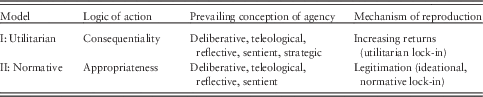
Table 1 presents a comparison of the two highly discussed and frequently employed models of path dependence in the extant literature: utilitarian and normative.Footnote 3 As seen, while these models differ in terms of the logic of action and the mechanisms of path reproduction, they have similar conceptions of human agency and of social action.
The models of path dependence

Utilitarian model
The utilitarian model of path dependence is associated with the logic of consequentiality. As March and Olsen observe, consequential or calculative logic asserts that ‘action is choice, [and] choice is made in terms of expectations about its consequences’ (1984: 741). This model assumes that human agents have fixed and prior preferences or interests, and they are primarily concerned with maximizing their utilities. Agents are also imagined as instrumentally rational, in the sense that they choose among available options by engaging in utilitarian cost-benefit calculations or assessments. Therefore, it is assumed that agents consciously create institutions to increase means-ends efficiency and to maximize collective welfare (Bates, Reference Bates1988; North, Reference North1990; Weingast, Reference Weingast2002). Bates, for instance, observes that in the contractarian, rational-choice variant of institutionalism, ‘[i]nstitutions are treated as a means for resolving collective dilemmas. Collective dilemmas arise when choices made by rational individuals lead to outcomes that no one prefers’ (1988: 387), for example, prisoner’s dilemma situations. Likewise, Weingast notes that ‘[individuals] often need institutions to help capture gains from cooperation. In the absence of institutions, individuals often face a social dilemma that is a situation where their behavior makes all worse off’ (2002: 670). Thus, in teleological and instrumentalist conceptions of social action, agency is presumed to be highly intentional, reflective, and strategic.
The main mechanism of continuity or path reproductionFootnote 4 in the utilitarian, consequentialist model of path dependence is increasing returns, which are defined as self-reinforcing, positive feedback processes (see David, Reference David1985; Romer, Reference Romer1986; Arthur, Reference Arthur1990, Reference Arthur1994; Krugman, Reference Krugman1991; Pierson, Reference Pierson1996, Reference Pierson2000; Dobusch and Schüßler, Reference Dobusch and Schüßler2013). Pierson, who provides the most systematic studies of this notion in political science, states:
In an increasing returns process, the probability of further steps along the same path increases with each move down that path. This is because the relative benefits of the current activity compared with other possible options increase over time. To put it in a different way, the costs of exit – of switching to some previously plausible alternative – rise (Reference Risse2000: 263; see also Levi, Reference Levi1997: 28).
The logic of consequentiality is evident in the above statements: the growing benefits that a certain path generates with its continued adoption create further incentives for instrumentally rational agents to maintain the existing path. In other words, self-reproduction is an outcome of the utilitarian considerations of rational actors.
Specific conditions or sources of increasing returns are identified as large set-up or fixed costs, learning effects, coordination effects (network externality) and adaptive expectations (see North, Reference North1990; Arthur, Reference Arthur1994: 112; Pierson, Reference Pierson2000: 254; Sydow et al., Reference Sydow, Schreyögg and Koch2009; Dobusch and Schüßler, Reference Dobusch and Schüßler2013: 621). Because setting up a new institution is costly, it would be preferable to maintain existing institutional arrangements. Thus, large set-up costs provide inducements for actors to invest in existing institutional patterns. Fixed costs refer to a decline in production cost per unit as output increases, also generating a lure for path maintenance. Learning effects refers to a situation where the use of a technology generates greater efficiency in the reuse of that technology. In other words, learning cultivates the knowledge and skills that enhance efficiency. As Pierson states, ‘with repetition, individuals learn how to use products more effectively, and their experiences are likely to spur further innovations in the product or in related activities’ (2000: 254). Coordination effects occur when the benefits an actor receives from a policy or technology increase as others also use the same option. In other words, a given option is more attractive to maintain if adopted by others (also known as network externality). Adaptive expectations reference how expectations adapt to experience in the sense that the success of an option would change expectations and result in actions that continue to follow that direction (i.e. self-fulfilling anticipation), reinforcing the existing pattern.
A classic and most prominent example of increasing returns is the story of the QWERTY keyboard layout (see David, Reference David1985). Although it is regarded as less efficient than the one designed by August Dvorak, QWERTY was able to lock itself in. QWERTY was introduced in the late 19th century, while Dvorak’s relatively simpler and more efficient keyboard was initiated in the 1930s. It is asserted that owing to technical interrelatedness, economies of scale and the quasi-irreversibility of investment, it became difficult to switch from the previously introduced QWERTY keyboard to the Dvorak format, regardless of its relative efficiency (David, Reference David1985).Footnote 5
The notion of increasing returns has two major implications. First, path continuity is regarded as a matter of a utilitarian cost-benefit assessment (see also Greener, Reference Greener2007: 101; Beyer, Reference Beyer2010: 3). Second, regarding the prevailing conception of human agency, agents are assumed to be intentional, reflective and strategic as they follow or maintain the existing path. Although agents are not expected to return to initial conditions or shift to another path easily, path maintenance is considered a conscious, rational, and strategic choice. As Mahoney also observes, in a utilitarian framework, ‘actors rationally choose to reproduce institutions – including perhaps sub-optimal institutions because any potential benefits of transformation are outweighed by the costs’ (2000: 517).
Normative model
Normative paths are linked to the norm-based logic of appropriateness, which assumes that actions are primarily guided by rules, norms, and identities rather than by material interests or expectations (March and Olsen, Reference March and Olsen1989; see also Boudon, Reference Boudon2003; Schmidt, Reference Schmidt2010). March and Olsen define an institution as a ‘relatively stable collection of practices and rules defining appropriate behavior for specific groups of actors in specific situations’ (1998: 948). They further note that these practices and rules are ‘embedded in structures of meaning and schemes of interpretation that explain and legitimize particular identities and the practices and rules associated with them’ (1998: 948). Thus, as a set of norms, rituals, values, meanings, and procedures, institutions provide a logic of appropriateness, which constitutes identities and interests, and consequently shapes agents’ behavior (Olsen, Reference Olsen2009: 9). In an institutional environment, then, agents are assumed to be motivated by ideational concerns such as legitimacy, reputation, and prestige (March and Olsen, Reference March and Olsen1984, Reference March and Olsen1989; Hall, Reference Hall1993: 46–49). In other words, actors are not only homo economicus but also homo sociologicus, which suggests that agents also observe collective understandings such as socially shared ideas, norms, and values. Behavior is treated as rule or norm driven rather than choice driven.
Although the normative model is based on the logic of appropriateness, which is set against the logic of consequences of the utilitarian model, interestingly, these models of path dependence share a similar conception of agency. For the normative model, in institutionalized settings actors ‘consciously’ follow the associated rules, rituals, and norms and act according to the logic of appropriateness rather than just trying to maximize their exogenously defined utilitarian interests. However, the normative model also accepts that agents are concerned with the consequences or outcomes of their actions. It is assumed that agents conform to the rules of appropriateness to avoid certain undesirable outcomes such as opprobrium. This sounds similar to the outcome-oriented, instrumentalist logic dominant in the utilitarian model. To put it differently, rule or norm-following behavior is also based on consequential thinking. In treating agents as norm or rule followers and role players, this model, too, assumes agents to be deliberative, teleological, reflective, and sentient (see also Olsen, Reference Olsen2009: 9). As Pouliot also contends, ‘the logic of appropriateness is a reflexive process whereby agents need to figure out what behavior is appropriate to a situation’ (2008: 262; see also Risse, Reference Risse2000: 6; Hopf, Reference Hopf2010).
Concerning path reproduction, legitimation constitutes the primary mechanism of path continuity rather than materialist ‘increasing returns’ logic (see Krasner, Reference Krasner1988: 76–77; March and Olsen, Reference March and Olsen1989; Orren, Reference Orren1991; Mahoney, Reference Mahoney2000: 523; Blyth, Reference Blyth2001; Campbell, Reference Campbell2002; Cox, Reference Cox2004; Olsen, Reference Olsen2009: 13). March and Olsen, for instance, argue that ‘[i]nstitutions preserve themselves, partly by being resistant to many forms of change, partly by developing their own criteria of appropriateness and success, resource distribution, and constitutional rules’ (1989: 55). Regarding the role of legitimation in path reproduction, Mahoney states:
In a legitimation framework, institutional reproduction is grounded in actors’ subjective orientations and beliefs about what is appropriate or morally correct. Institutional reproduction occurs because actors view an institution as legitimate and thus voluntarily opt for its reproduction. Beliefs in the legitimacy of an institution may range from active moral approval to passive acquiescence in the face of the status quo. Whatever the degree of support, however, legitimation explanations assume the decision of actors to reproduce an institution derives from their self-understandings about what is the right thing to do, rather than from utilitarian rationality, system functionality, or elite power (2000: 523).
Similarly, Olsen states that ‘rules are followed because they are seen as legitimate’ (2009: 13). Thus, for the normative model, agents stick to a certain path not because of an expected utility down the path but primarily because of belief in the ‘appropriateness’ of the rules, ideas, values, and norms that constitute the path. For instance, in his analysis of the persistence of the Scandinavian model of the welfare state, Cox (Reference Cox2004) shows that despite several reforms since the 1990s, its distinctiveness has remained intact owing to people’s attachment, or moral commitment, to the idea of the ‘Scandinavian model’, which is based on a unique combination of the values and norms of universality, solidarity, and market independence (de-commodification).
In brief, despite differences in terms of the logic of action and the mechanisms of path reproduction, the existing models or types of path dependence share a common key feature: a ‘reflective’ conception of social action. They all assume human agents to be deliberative, reflective, and teleological. For the reflective conception of social action, human agents, who are motivated by certain utilitarian, moral or affectual factors, conduct cost-benefit analyses and consciously choose the option that is expected to achieve the highest degree of ideational or material benefits or efficiency (Camic, Reference Camic1986: 1040; see also Pouliot, Reference Pouliot2008).
With such a one-sided conception of social action, these models either ignore or neglect the logic of habit and its implications for path dependence.Footnote 6 As Pouliot also observes, these theories of social action ‘suffer from a representational bias in that they focus on what agents think about [i.e. reflexive and conscious knowledge] instead of what they think from’ (2008: 257). Owing to such a bias, these logics of action emphasize ‘conscious representations’ at the expense of ‘background know-how’, which ‘informs practice in an inarticulate fashion’ (Pouliot, Reference Pouliot2008: 258). This tendency is unfortunate because the logic of habit is quite relevant to institutionalized settings. As Hopf puts forward, institutionalized settings, in general, ‘are likely sites for the operation of the logic of habit because of their associated routines, standard operating procedures, and relative isolation from competing ideological structures’ (2010: 547). The following section illustrates the notion of the habitual path and suggests that it constitutes a distinct model of path dependence.
Habitual path dependence
Weber (Reference Weber1978: 24–26) identifies four different ideal types of social action: Purposively or instrumentally rational (zweckrational) action is motivated by desired or calculated ends; value rational (wertrational) action is based on normative or ethical commitments; affectual (emotional) action is driven by emotional factors; and traditional action is propelled by accustomed or habituated patterns of practice.
Instrumentally, rational and value rational actions correspond to the logic of consequences and the logic of appropriateness, respectively, and, as discussed above, are highly utilized in institutional and policy analyses. However, traditional action, which is connected to the logic of habit (or practical reason), has been neglected by institutional analyses and perspectives. Rather than the purposive, calculative, and strategic aspects of human agency, the logic of habit is concerned with its dispositional, iterative, and practical aspects. It constitutes the stimulus behind recurrent (usually unconscious) patterns of action or practice. As Weber also observes, the bulk of everyday actions involves habitual actions. Unreflective, non-deliberative actions are prevalent types of social action because human agents do not always engage in calculation or deliberation before acting. As Fleetwood asserts,
[o]ne of the well-established functions of habits is that they obviate the need for a kind of ‘hyper-deliberation’ where agents might be assumed to engage in a continual process of conscious deliberation over everything that came within their orbit every moment of the day. ‘Hyper-deliberation’ would simply result in a kind of social and mental paralysis where no one would be able to deliberate or act. Such a process is rendered unnecessary because habits enable agents to operate unconsciously, on a kind of ‘auto-pilot’ as it were (2008b: 187).
Thus, habitually accustomed routines and actions occupy an important place in the social and political worlds. Although many rule-following actions are actually based on habits (Hodgson, Reference Hodgson2007: 107),Footnote 7 the logic of habit has been largely ignored by the extant path-dependence literature. This study, however, suggests that the logic of habit has major implications for the path-dependence approach. As shown below, the logic of habit constitutes self-reinforcing, reproductive sequences, and continuities in the institutional world. This study labels those patterns as ‘habitual paths’, which are distinct from the existing models presented above.
The notion of ‘habit’
Before moving further, some discussion on the notion of ‘habit’ would be useful. Although habits are associated with recurrent or iterative patterns of action or practice, they should not be reduced to sequentially correlated or linked observable behavior. Drawing upon studies by William James (1842–1910), John Dewey (1859–1952), and Thorstein B. Veblen (1857–1929), Hodgson distinguishes habit from action by defining the former as ‘a propensity to behave in a particular way in a particular class of situations’ (2004: 652; see also 2006: 6; 2007: 106; Pouliot, Reference Pouliot2008: 274).Footnote 8 Hodgson further argues that habit should be understood as a ‘causal mechanism, not merely a set of correlated events’ (2004: 653). Similarly, Fleetwood treats habit as embodied or internalized ‘disposition, capacity, or power that generates a tendency’ (2008a: 247, original emphasis; see also Camic, Reference Camic1986: 1044; Pouliot, Reference Pouliot2008).
It is widely accepted that habits serve key functions in social life. As Hopf notes, habits are ‘the unreflective reactions we have to the world around us: our perceptions, attitudes, emotions, and practices. They simplify the world, short-circuiting rational reflection’ (2010: 544). Likewise, Becker states that ‘[h]abit helps economize on the cost of searching for information, and of applying the information to a new situation. And most people get mental and physical comfort and reassurance in continuing to do what they did in the past’ (Reference Becker1992: 331). Similar to long-term contracts, habits also reduce uncertainty by increasing the predictability of future actions.
Habits are assumed to be usually unintentional, unconscious, automatic, and unreflective processes (e.g. see Wegner and Bargh, Reference Wegner and Bargh1998: 459–462; Hopf, Reference Hopf2010), but several scholars warn against overly mechanical understandings of habits, devoid of any meaning and understanding. They assert that, although unreflective, dispositional, and iterative, habits also involve meaning, understanding, and knowledge (practical). Merleau-Ponty, for instance, states, ‘We say that the body has understood and habit been cultivated when it has absorbed a new meaning and assimilated a fresh core of significance’ (quoted in Crossley, Reference Crossley2013: 148). Dewey also criticizes a purely mechanical approach to the notion of habit by stating that ‘[c]oncrete habits do all the perceiving, recognizing, imagining, recalling, judging, conceiving and reasoning that is done…. We may indeed be said to know how by means of our habits’ (quoted in Crossley, Reference Crossley2013: 150).
With respect to the nexus between habit and agency, Emirbayer and Mische (Reference Emirbayer and Mische1998) observe that theoreticians of action as practices (e.g. Bourdieu and Giddens) view habits and routinized practices as inseparable from agency. Such theories even treat human agency as primarily ‘habitual, repetitive and taken for granted’ (Emirbayer and Mische, Reference Emirbayer and Mische1998: 963). Even if Emirbayer and Mische find this approach one-sided and thus limited, they also acknowledge that habit is one of the three constitutive elements of human agency. Situating agency within the flow of time, they conceptualize agency as
a temporally embedded process of social engagement, informed by the past (in its ‘iterational’ or habitual aspect) but also oriented toward the future (as a ‘projective’ capacity to imagine alternative possibilities) and toward the present (as a ‘practical-evaluative’ capacity to contextualize past habits and future projects within the contingencies of the moment) (Emirbayer and Mische, Reference Emirbayer and Mische1998: 962).
As several other analysts also indicate, in addition to reflexive and intentional aspects, human agency also involves an unreflective, habitual dimension (see also Becker, Reference Becker1962; Arrow, Reference Arrow1986; Hodgson, Reference Hodgson2004, Reference Hodgson2006, Reference Hodgson2007; Fleetwood, Reference Fleetwood2008a; Akram, Reference Akram2012). In the social and political worlds, agents quite often act by habit, without calculating whether their behavior would be efficient in terms of utility maximization or be morally appropriate or legitimate in a given social setting. Building on Bourdieu’s works, Pouliot similarly posits that
most of what people do, in world politics as in any other social field, does not derive from conscious deliberation or thoughtful reflection – instrumental, rule-based, communicative, or otherwise. Instead practices are the result of inarticulate, practical knowledge that makes what is to be done appear ‘self-evident’ or commonsensical (2008: 258).
Habits and institutions
There is a direct linkage between habits and institutions.Footnote 9 As Fleetwood suggests, institutions ‘become internalized or embodied within agents as habits via a process of habituation, whereupon the habits dispose agents to think and act in certain ways, without having to deliberate’ (2008a: 247). Similarly, March and Olsen define institutionalization as ‘…structuration and routinization, which refer to the development of codes of meaning, ways of reasoning, and accounts in the context of acting on them’ (1998: 948). The concept of routinization is closely related to habituation. For Hodgson, habituation or the acquisition of habits refers to ‘the psychological mechanism by which individuals acquire dispositions to engage in previously adopted or acquired (rule-like) behavior’ (2006: 18). Another definition states that habituation is ‘the process through which institutions (rules, conventions, norms, values and customs) become internalized and embodied within agents, generating the dispositions we call habits’ (Fleetwood, Reference Fleetwood2008a: 249). Thus, as a largely unconscious process, habituation is characterized by repetition, regularity, routinization, reinforcement, and continuity. With these features, habituation helps a choice or action become routinized or taken for granted. Therefore, it is asserted that institutions are linked to agency through the mechanisms provided by habituation and habits (see Hodgson, Reference Hodgson2006; Fleetwood, Reference Fleetwood2008a, Reference Fleetwood2008b). In Hodgson’s words, ‘[h]abits are the constitutive material of institutions, providing them with enhanced durability, power and normative authority’ (2006: 7; see also 2007). Thus, habits help institutions sustain themselves.
As a disposition, propensity or tendency to act in a particular way, habits promote a certain course of action and consequently make certain choices or actions more likely than others. Having such characteristics, habits lock certain options in, while locking some others out. As Hopf notes,
[h]abits both evoke and suppress actions. They imply actions by giving us ready-made responses to the world that we execute without thinking. They prevent other behavior by short-circuiting any need to think about what we are doing. So infinitudes of behaviors are effectively deleted from the available repertoire of possible actions (2010: 541).
Similarly, Barnes et al. note that ‘[b]ehavioral lock-in occurs when the behavior of the agent (consumer or producer) is “stuck” in some sort of inefficiency or sub-optimality due to habit, organizational learning, or culture’ (2004: 372).
Once agents habituate a certain option or policy, then, they would be simply uninterested in some other options. This thinking would further reinforce the habituated option. Swartz (Reference Swartz2002: 66) identifies predictability and regularity as two key characteristics of habitual action. Habitual elements (e.g. internalized dispositions, routines, schemas, traditions, customs, and conventions) sustain and reproduce social and political structures. Treating habituation as an important part of human nature, Crossley states that habituation ‘is a power to conserve structures of perception, communication and action… Moreover, it lends our lives continuity’ (2013: 146). Along the same lines, Hodgson indicates that ‘[h]abits themselves are formed through repetition of action and thought. They are influenced by prior activity and have durable self-sustaining qualities. Through their habits, individuals carry the marks of their own unique history’ (2003: 164). Through habituation, individuals acquire or develop pro-status quo cognitive frames, which shape their awareness and interpretation of reality. Such cognitive frames constitute barriers to change (see also Gersick, Reference Gersick1991). Thus, as iterative factors, habits link the past to the present and so provide stability and continuity in social life.
Given the above analyses, the neglect of the logic of habit by the existing models of path dependence becomes quite surprising: compared with other logics of action (i.e. consequences and appropriateness), the logic of habit, with its iterative, self-reinforcing, reproductive nature, is even more conducive to behavioral lock-in and so to path dependence.
Features of habitual path dependence
Habitual path dependence entails some of the defining features of the classical conception of path dependence. In that understanding, a path-dependent process should have the following properties: unpredictability, inflexibility, non-ergodicity, and potential inefficiency (e.g. see Arthur, Reference Arthur1994: 112–113; Mahoney, Reference Mahoney2000: 510–511; Pierson, Reference Pierson2000: 253).Footnote 10 Unpredictability is related to the presence of multiple choices or equilibria at the initial conditions. Because early events are treated as stochastic, contingent occurrences, it is difficult to predict which option will be chosen and lock itself in. In Goldstone’s words, ‘[p]ath dependence is a property of a system such that the outcome over a period of time is not determined by any particular set of initial conditions. Rather, a system that exhibits path dependence is one in which outcomes are related stochastically to initial conditions’ (1998: 834). Similarly, Mahoney and Schensul observe that several path analyses
argue that the events that characterize a critical juncture period are contingent. In particular, they suggest that the selection of a particular option during a critical juncture represents a random happening, an accident, a small occurrence, or an event that cannot be explained or predicted on the basis of a particular theoretical framework (2006: 461).
Contingency, which is considered a necessary condition for path dependence, is also relevant to habitual paths. At critical junctures or moments, a variety of actions or choices are available for human agents, and any one might be chosen. In other words, it is difficult to predict which behavior will be habituated and lock itself in. Thus, habitual paths might also emerge out of contingent or stochastic events and conditions.
Inflexibility means that once a path is chosen, it becomes difficult for agents to return to initial conditions or to shift to another path. Mahoney asserts that ‘once contingent historical events take place, path-dependent sequences are marked by relatively deterministic causal patterns or what can be thought of as “inertia” that is, once processes are set into motion and begin tracking a particular outcome, these processes tend to stay in motion and continue to track this outcome’ (2000: 511). Habitual routines are also difficult to break (see below).
Non-ergodicity means that small, random occurrences early in a sequence of events do not cancel out; rather, such events have a long-lasting impact on future choices or events (Arthur, Reference Arthur1994; Mahoney, Reference Mahoney2000; Pierson, Reference Pierson2000). This feature is also relevant for habitual paths. Early events or developments in the process of habituation have greater determinative impact on which choice is routinized. Potential inefficiency suggests that the path chosen by agents may not be the most efficient choice. In other words, despite conventional economic models, which assume that rational actors make the most efficient decisions to maximize utilities, sub-optimal, inefficient outcomes or paths (e.g. the QWERTY keyboard layout) might also lock themselves in (see David, Reference David1985; Arthur, Reference Arthur1990). Potential path inefficiency is relevant to habitual path dependence simply because, as indicated above, efficiency is not really the issue in the case of habitual human conduct; such conduct is primarily unreflective, non-deliberative, dispositional, and automatic. Thus, optimal and/or sub-optimal options or actions can be habituated by human agents (see also Barnes et al., Reference Barnes, Gartland and Stack2004; Hopf, Reference Hopf2010).
Another important feature of path dependence is related to the distinction between productive and reproductive processes. In a path-dependent process, institutional patterns or paths are expected to reproduce themselves even in the absence of the recurrence of the circumstances, conditions, or factors that generated that path in the first place (see Stinchcombe, Reference Stinchcombe1968: 102–103; Mahoney, Reference Mahoney2000: 515; Pierson, Reference Pierson2000). Pierson, for instance, notes that ‘some original ordering moment triggers particular patterns, and the activity is continuously reproduced even though the original event no longer occurs’ (2000: 263). Thus, for the path-dependence approach, brief, sudden, exogenous, contingent events are responsible for path initiation or production. However, once created, paths tend to reproduce themselves in the absence of those original events or conditions. This feature is valid to habitual path dependence as well. Once an option is habituated and routinized, it becomes part of social and political structures. Even if the agents do not remember the original conditions or factors that facilitated the habituation of that path, the logic of habit or practical reason reinforces that option, leading to stasis or dormancy.
Breaking habitual paths
What about change? How does change take place in the case of habitual paths? Similar to the existing types of paths, habitual paths are also sticky and thus difficult to change simply because habits tend to reinforce the status quo. Weber also stressed the tendency toward inertia in habitual human conduct, stating that ‘the inner disposition (Eingestelltheit) [to continue along as one has regularly done] contains in itself [such] tangible inhibitions against “innovations”’ (quoted in Camic, Reference Camic1986: 1059). Therefore, as Hopf notes ‘[a]ny efforts to change have to first overcome the power of habitual perceptions, emotions, and practices’ (2010: 561).
Although it is difficult to break habits, change still occurs in the habitual world. Habits are formed and reformed. How, then, do agents break away from habitual paths? Hopf suggests that habits themselves do not produce change, but that when agents start to reflect on habits, then change becomes more likely.Footnote 11 Reflecting on habits is not easy, however: ‘breaking habits requires reflection, but getting people to reflect, when they are comfortably situated in institutions that protect them from any dissonant voices, is difficult and rare’ (Hopf, Reference Hopf2010: 555).
If reflection is important for change, then, when and how do agents become more reflective about habitual routines? The account of change provided by the conventional understanding of path dependence seems to be relevant to this question. The traditional approach expects change to be incremental, evolutionary, or path following (i.e. within-path or on-path change; see Krasner, Reference Krasner1988; North, Reference North1990: 99; Levi, Reference Levi1990: 415; Dimitrakopoulos, Reference Dimitrakopoulos2001; Mahoney, Reference Mahoney2001; Torfing, Reference Torfing2001; Cox, Reference Cox2004; Pierson, Reference Pierson2004: 153). Path-breaking change is treated as a rare event, occurring after long periods of stability and continuity. Such major changes are expected to take place at critical junctures or periods, when some stochastic, unexpected events, or disturbances (e.g. war, economic crises, dramatic technological developments, natural disasters, and epidemics) disrupt the existing path or equilibrium and create a new one (i.e. a new period of stasis; Arthur, Reference Arthur1994: 34, 44–45; Hall and Taylor, Reference Hall and Taylor1996; Mahoney, Reference Mahoney2000: 513; Pierson, Reference Pierson2000: 253; Alexander, Reference Alexander2001: 254; Greener, Reference Greener2005; Soifer, Reference Soifer2012). This process is also called ‘punctuated equilibrium’: a long period of continuity or stability (i.e. equilibrium) is punctuated by abrupt, sudden, contingent, metamorphic developments, or events at critical junctures, which generate a new path (see Krasner, Reference Krasner1984, Reference Krasner1988; Ikenberry, Reference Ikenberry1988; Collier and Collier, Reference Collier and Collier1991; Gersick, Reference Gersick1991; Baumgartner and Jones, Reference Baumgartner and Jones1993).
Criticizing the conventional punctuated model of path-breaking change, several recent studies draw attention to the significance of minor, incremental changes, which may have major (i.e. path-breaking) consequences in the long run (e.g. Thelen, Reference Thelen2003; Streeck and Thelen, Reference Streeck and Thelen2005; Pierre et al., Reference Pierre, Peters and Stoker2008; Mahoney and Thelen, Reference Mahoney and Thelen2010). For instance, Streeck and Thelen suggest that ‘far-reaching change can be accomplished through the accumulation of small, often seemingly insignificant adjustments’ (2005: 8). Thus, it is expected that slow-moving, transformative processes (i.e. a series of piecemeal and gradual changes or adjustments) in times of stability are likely to accumulate into a new institutional equilibrium or a new, self-reinforcing, stationary path over an extended period of time. In other words, the amassment of continuous, incremental changes might result in substantial structural changes (see also Rose and Davies, Reference Rose and Davies1994; Pierson, Reference Pierson2003, Reference Pierson2004; Berkman and Reenock, Reference Berkman and Reenock2004: 799; Kay, Reference Kay2005: 566; Boas, Reference Boas2007).
Both the abrupt (i.e. punctuation of institutional paths or equilibria at critical junctures) and incremental models of change presented above are applicable to habitual paths. Endogenous or exogenous shocks or events at critical junctures or moments, which are defined as ‘relatively short periods of time during which there is a substantially heightened probability that agents’ choices will affect the outcome of interest’ (Capoccia and Kelemen, Reference Capoccia and Kelemen2007: 348), are likely to make agents more conscious, deliberative, and reflective. Agents’ reflections, in return, would challenge habitual perceptions, attitudes, and practices, and so enhance the likelihood of breaking away from existing habitual routines. Bourdieu (Reference Bourdieu1977: 168–169) also acknowledges that although rare, crisis moments or situations, that involve major political and economic unrests, are likely to halt doxa (i.e. habit) from functioning as a basis for action. Thus, critical junctures also facilitate path-breaking change in the case of habitual paths by facilitating agents’ conscious deliberation and contestation. Once a critical juncture paves the way for a new choice or action, agents would habituate it through time and a new habitual path would lock itself in.
Habits may also adapt themselves to new situations slowly and unconsciously (see Swartz, Reference Swartz2002: 66). Marginal groups and their counter-hegemonic voices are particularly likely to play a key role in the gradual change of habitual routines. As Clemens and Cook state ‘[g]roups marginal to the political system are more likely to thinker [sic] with institutions… Denied the social benefits of current institutional configurations, marginal groups have fewer costs associated with deviating from those configurations’ (1999: 452; see also Pierson, Reference Pierson2004; Hopf, Reference Hopf2010). Regarding the source of change, either spontaneous and unreflective processes or deliberate choices might drive habitual change (Crossley, Reference Crossley2013: 150).
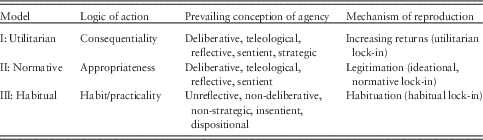
In sum, although habitual path dependence shares several features with the utilitarian and normative models of path dependence, it has quite different assumptions with respect to the prevailing conception of human agency and the mechanisms of path reproduction (see Table 2). Although utilitarian and normative models assume agency to be deliberative, teleological, and reflective, in the habitual model, human agency is assumed to be unreflective, non-deliberative, dispositional, and insentient. Another major difference is related to the mechanisms of reproduction. In the habitual model, path continuity or path maintenance is based on habituation or habitual lock-in rather than utilitarian or normative lock-in. Otherwise stated, path dependence in the habitual model is not because of utilitarian or normative concerns but to largely insentient, dispositional habituation.
A comparison of habitual path dependence with utilitarian and normative models

Final discussion
In the last decades, the concept of path dependence has become a highly popular notion in the social sciences, used extensively in institutional and policy analyses. Despite its popularity, however, the notion of path dependence suffers from its own limitations. As shown above, path dependence remains limited owing to the oversight of the role of habitual routines by the existing path-dependence literature. Moreover, the existing models consider agency as reflective and deliberative, disregarding its non-reflective, non-strategic, and dispositional aspects. By illuminating, elaborating on, and clarifying the existing models or variants of path dependence and by adding a novel one (i.e. habitual path dependence), this study is expected to contribute to a more-conscious and so more-fruitful usage of the path-dependence approach in scholarly research.
The notion of the ‘habitual path’ introduced by this study as a complementary but analytically distinct model of path dependence would certainly enrich the analytical content of the path-dependence approach. One might still, however, raise the following question: How and when would the notion of habitual path dependence be useful for institutional and policy analyses? Several studies have already shown that the logic of habit improves our understanding of many patterns and continuities in world politics, such as diplomacy, cooperation, security communities, security dilemmas, and enduring rivalries and enmities (see Pouliot, Reference Pouliot2008; Hopf, Reference Hopf2010). Regarding domestic politics, this notion would be useful particularly for analyzing formal and informal institutional patterns of path dependence. As suggested above, most formal institutions involve habitual elements such as internalized dispositions, routines, schemas, traditions, customs, and conventions. Thus, habitual path dependence is quite pertinent to the study of political processes and outcomes in formalized institutional settings (e.g. legislatures, political parties, courts, and bureaucracies).
Habitual path dependence remains even more relevant for the analysis of informal institutions, which are defined as ‘socially shared rules, usually unwritten, that are created, communicated, and enforced outside of officially sanctioned channels’ (Helmke and Levitsky, Reference Helmke and Levitsky2004: 727). It is undeniable that informal institutional elements such as political legacies, heritages, traditions, customs, and conventions substantially mold political life in various ways in several domains (e.g. see North, Reference North1990; Lauth, Reference Lauth2000; Stacey and Rittberger, Reference Stacey and Rittberger2003; Helmke and Levitsky, Reference Helmke and Levitsky2004, Reference Helmke and Levitsky2006; Pop-Eleches, Reference Pop-Eleches2007; Ingraham et al., Reference Ingraham, Moynihan and Andrews2008; Painter and Peters, Reference Painter and Peters2010). Furthermore, as indicated above, many highly formalized institutional or organizational structures also entail informal rules and practices, molding formal processes (e.g. see Lauth, Reference Lauth2000; Helmke and Levitsky, Reference Helmke and Levitsky2004, Reference Helmke and Levitsky2006). Although informal institutions (e.g. diplomacy, consociationalism, custom law, clientalism, patronage, bribery, patrimonialism, nepotism, tribalism, and militarism) are quite prevalent in the political world, they are largely ignored by institutional approaches. As Helmke and Levitsky note,
informal rules have remained at the margins of the institutionalist turn in comparative politics. Indeed, much current literature assumes that actors’ incentives and expectations are shaped primarily, if not exclusively, by formal rules. Such a narrow focus can be problematic, for it risks missing much of what drives political behavior and can hinder efforts to explain important political phenomena (2004: 725–726).
If comparative research on political institutions needs to pay greater attention to the role of informal institutions, then, the notion of habitual path dependence, as a possible theoretical framework, has great potential to contribute to such efforts because compared with formal institutions, informal institutions, which are treated as ‘unwritten codes embedded in everyday social practice’ (Bratton, Reference Bratton2007: 96), involve relatively stronger habitual dimensions.
Habitual path dependence seems to have another potential benefit in terms of studying informal institutions. Helmke and Levitsky (Reference Helmke and Levitsky2004: 734) rightly indicate that more theorizing is necessary about the emergence of informal institutions (particularly the mechanisms through which informal rules are created) and about the sources of informal institutional stability and change. The use of the logic of habit and habituation would be quite rewarding, particularly for analyzing the persistence of informal institutions. The notion of the habitual path would also be helpful in terms of understanding the gap between formal and informal institutional change. Institutional perspectives are content to merely acknowledge that formal institutions change relatively easily compared with informal institutions (e.g. North, Reference North1990; Lauth, Reference Lauth2000); the ideas of habituation and habitual lock-in associated with the notion of the habitual path could shed some light as to why.
A counter-argument might suggest that the normative model does recognize the role of habits and routines. Indeed, March and Olsen (Reference March and Olsen1984, Reference March and Olsen1989, 1998) acknowledge the role of rituals, ceremonies, and traditions in the institutional world. I have three responses to such a counter-argument. First, I believe that the normative model does not do justice to habitual routines; they deserve more than a mere acknowledgement. As Weber’s (Reference Weber1978) typology of social action also suggests, the logic of habit and habitually accustomed actions are distinct enough not to be subsumed under a logic of appropriateness (the former is dispositional; the latter is more conscious, deliberative, and reflective; see also Hopf, Reference Hopf2002: 12; Pouliot, Reference Pouliot2008). Thus, it is neither accurate nor useful to include two analytically distinct elements (i.e. highly routinized, dispositional ‘habitual/practical action’, and conscious, reflective ‘normative action’) into a single framework.
Second, of the two logics of action (i.e. habit and appropriateness), the logic of habit is more distinct from the logic of consequentiality (see also Hopf, Reference Hopf2010). Although the logic of appropriateness was proposed as an alternative to the logic of consequences, several analysts treat them as similar logics of social action. For instance, it is suggested that complying with the rules and norms in a given institutional environment and acting ‘appropriately’ to avoid certain costs (e.g. opprobrium) should be a very rational action (see Goldfarb and Griffith, Reference Goldfarb and Griffith1991; Goertz and Diehl, Reference Goertz and Diehl1992: 637; Noll and Weingast, Reference Noll and Weingast1991: 237). Thus, for several scholars, actors’ ideational concerns might be easily incorporated into a rational cost-benefit calculation. Ostrom, for instance, states that
recognizing the importance of rules and social norms is not inconsistent with a rational-choice interpretation of individual action within the constraints of a rule-ordered set of relationships…
To be rule-governed, the rational individual must know the rules of the games in which choices are made and how to participate in the crafting of rules to constitute better games (1991: 240, 241).
Schimmelfennig also suggests that ‘in an institutional environment, it can be the rational choice to behave appropriately’ (Reference Schimmelfennig2000: 116). Similarly, Goldmann (Reference Goldmann2005) maintains that far from being mutually exclusive, these two logics overlap considerably. Pouliot concurs, stating that ‘norm-based actions stem from a process of reflexive cognition based either on instrumental calculations, reasoned persuasion, or the psychology of compliance’ (2008: 262).
Third, the habitual model has an advantage over the normative model. The latter remains one-sided owing to its bias toward socially accepted or legitimate rules and behavior. For instance, March and Olsen (Reference March and Olsen1998: 951) suggest that appropriateness involves an ethical dimension, which is that an appropriate action should be ‘virtuous’. Focusing on actions conforming to moral or ethical norms and principles in a social order, this model tends to ignore the patterns or continuities constituted by ‘inappropriate’ or ‘illegitimate’ actions such as nepotism, bribery, militarism, patrimonialism, and patronage. As indicated above, although such informal rules also play a major role in the political world, the normative model is almost silent on them. This situation exists partly because, similar to the utilitarian model, the normative model is also based on representational knowledge. Treated as conscious, verbalizable, and intentional, ‘representational knowledge’ is associated with reflexive cognition: ‘In situation X, you should do Y’ (owing to either utilitarian or normative motivations). The habitual model, on the other hand, is based on ‘practical knowledge’, which is tacit, inarticulate, and automatic. Practical knowledge is based on unreflexive cognition: ‘In situation X, action Y follows’ (see Hopf, Reference Hopf2002: 12; Pouliot, Reference Pouliot2008: 270–271). Such a distinction implies that the habitual model, based on practical knowledge, does not have a normative bias. It acknowledges the possibility that in a social setting, agents might also habituate so-called ‘inappropriate’ actions. In other words, the logic of habit/practicality does not have any utilitarian or normative bias. Therefore, the habitual model is relatively more advantageous for dealing with such continuities or patterns in the institutional world.
In brief, at this early stage of theorizing, it appears that the notion of habitual path dependence would increase the explanatory potential of path dependence and consequently better contribute to our understanding of institutional and policy patterns or continuities involving path-dependent processes and mechanisms. At the very least, it would enrich our conceptual and theoretical toolboxes and so further empower us in dealing with various forms of historical causality. Therefore, further conceptual and theoretical reflection on the habitual model of path dependence and its employment in empirical research would be worthwhile for institutional perspectives. Some of the challenging questions or issues to be addressed in future research are as follows: When and under what conditions does habituation or the acquisition of habits take place and generate self-reinforcing habitual paths in the social and political worlds? Why do agents habituate a particular option or policy but not another one? How does the logic of habit interact with other logics?
Acknowledgments
The author would like to acknowledge his debt to Ted Hopf, whose work encouraged and helped his thinking on this study. An earlier version of this study was presented at the 2013 Annual Meeting of the American Political Science Association (APSA) in Chicago, IL, USA, 31 August–1 September 2013. The author thanks Didem Buhari Gulmez, Christina Hamer, Burcu Ozdemir, Hillel D. Soifer, and three anonymous reviewers for their useful comments and suggestions on earlier versions of this work.