Introduction
Cochlear implantation is a safe and beneficial procedure, even in patients with inner-ear malformation.Reference Daneshi, Farhadi, Ajalloueyan, Rajati, Hashemi and Ghasemi1 It has improved the hearing ability significantly in patients with moderate to profound hearing loss. The overall rate of complications is reported as 10.43 per cent.Reference Awad, Rashad, Gamal and Youssif2 Improvement of the surgical procedure has resulted in a decreased rate of complications.Reference Hashemi, Bozorgi, Kazemi and Babaei3
Since the introduction of cochlear implants, and Food and Drug Administration approval for their clinical use in 1985, efforts have continued to improve their efficacy.Reference Clark4 Intracochlear lesions and new bone and fibrous tissue formation induced by electrode insertion can be minimised by surgical technique and electrode design.Reference Foggia, Quevedo and Hansen5,Reference Li, Somdas, Eddington and Nadol6 This has led to a growing interest in performing atraumatic surgery to maintain residual hearing. Two major surgical techniques have been promoted in recent years: the round window approach and the cochleostomy technique.
Round window insertion ensures that the electrode array is placed into the scala tympani, which is advantageous compared with cochleostomy approaches. Several studies have suggested round window insertion may be less traumatic regarding scala tympani access and electrode insertion compared with cochleostomy approaches. Histological studies have confirmed the atraumatic nature of this approach.Reference Khater and El-Anwar7,Reference O'Connell, Hunter and Wanna8 Clinically, it reduces the risks of damage to residual hearing caused by drilling and basilar membrane perforation, which may arise if the electrode is dislocated from the scala tympani to the scala vestibuli.Reference O'Connell, Hunter and Wanna8
Anatomical variations in the round window location, such as in cases where the round window membrane faces inferiorly, can hinder access to it. In addition, if it has a more horizontal orientation, the bony cochlear hook interferes with a straight trajectory.Reference Jain, Gaurkar, Deshmukh, Khatri, Kalambe and Lakhotia9 Comparison of the round window niche exposure between paediatric and adult patients revealed that full round window visibility was attained in 52 per cent versus 87 per cent of patients, respectively. Full round window exposure was achieved after facial nerve exposure at the level of posterior tympanotomy in 70 per cent of paediatric cases versus 33 per cent of adult cases.Reference Stuermer, Winter, Nachtsheim, Klussmann and Luers10 In all such cases, a cochleostomy approach can become necessary, even if residual hearing preservation is targeted. The influence of the technique on post-operative complications, residual hearing and auditory nerve stimulation has been considered in previous studies.Reference Rajput and Nilakantan11–Reference Elafandi, Khalifa and Elguindy13
Post-operatively, different measurements can be used to assess the integrity and performance of a cochlear implant. Electrode impedance and neural response telemetry are common parameters. Electrode impedance determines the status of the interface between tissue and electrode and the adjacent tissue of the cochlea. Impedance is highly related to the integrity and function of a cochlear implant. In addition, impedance is used for debugging cochlear implants clinically.Reference Cheng, Wang, Liu, Yuan, Shu and Chen14
The Cochlear™ company designed a neural response telemetry system to measure the electrically evoked nerve potentials of the distal part of the auditory nerve without accessing the cochlea directly. The implant generates stimuli and records the responses.Reference Mittmann, Rademacher, Mutze, Hassepass, Ernst and Todt15
This study aimed to compare objective measurements for auditory nerves stimulated by cochlear implants associated with round window and cochleostomy approaches, and any relevant complications for either technique.
Materials and methods
Study design and setting
This prospective case–control study was performed on patients who underwent cochlear implantation in Fars Cochlear Implant Center, affiliated with Shiraz University of Medical Sciences, Iran.
The study protocol was approved by the institutional review board of Shiraz University of Medical Sciences, and the approval of the ethics committee was attained before the study commenced (ethics code: IR.SUMS.MED.REC.1395.10).
Participants
We included patients aged less than 3.5 years with severe to profound hearing loss (more than 70 dB hearing loss on pre-operative auditory brainstem response (ABR) testing) who underwent cochlear implantation using the round window or cochleostomy approach.
Paediatric patients were excluded from the study if they had: structural cochlear malformations; aetiologies that might cause obliteration or ossification (e.g. deafness caused by bacterial meningitis, otosclerosis and autoimmune diseases); auditory neuropathy spectrum disorder; intra-operative abnormal impedance and neural response telemetry measurements; partial insertion of the electrode array; inner-ear anomalies; syndromic causes of deafness or other co-morbidities; or incomplete follow up. Those undergoing revision surgery were also excluded.
Surgical procedures
Under general anaesthesia, a posterior auricular incision was performed. The periosteal pouch was designed for the insertion of the implant receiver. Partial mastoidectomy was then performed. Anatomical landmarks such as the posterior wall of the auditory canal, the antrum with the incus, mastoid part of the facial nerve, chorda tympani canal, semicircular canals, sigmoid sinus and sinodural angle were exposed and preserved. After that, posterior tympanotomy was created by widely opening the facial recess. Then, a bone bed was created for the insertion of the implant at 1 cm posterosuperior to the sinodural angle. After that, a connecting canal was constructed to the mastoid in projection on the sinodural angle, for the safe insertion and fixation of the electrode.
After visualisation of the round window, the round window niche was drilled with a 0.7 mm diamond burr, and then opened via incision of the round window membrane, which is called the round window approach.
When the round window could not be positively identified or accessed safely, such as in anatomical variants of the facial nerve or the jugular bulb location, or when the round window membrane angle was greater than 45° inferiorly, a completely separate cochleostomy was performed anterior and inferior to the round window niche.
Then, after partial insertion, the electrode was advanced into the cochlea, and, after full insertion, the stylet was removed. Muscle or soft tissue pieces were used around the electrode opening for secure closure of the cochlea, to avoid perilymph fistula. Intra-operative electrode impedance and neural response telemetry measurements were recorded. The incision was closed in several layers, covering the implant.
In both groups (cochleostomy and round window approach), a Cochlear Nucleus® implant (Freedom® Contour Advance® (CI24RE) implant) was used. In our centre, cochlear implantation surgery is routinely performed unilaterally. The right ear was selected in cases of symmetric sensory neural hearing loss because of the dominancy of the left brain hemisphere in speech perception and production in most patients.Reference Kraaijenga, Derksen, Stegeman and Smit16 Thus, all subjects underwent right-sided cochlear implantation. Post-operatively, a transorbital X-ray was performed to determine the proper location and full insertion of the electrode.
Outcomes
The primary outcome was the comparison of mean impedance threshold levels and neural response telemetry thresholds between the two groups (cochleostomy and round window approach), three and six months after implantation. The secondary outcome was the comparison of complications between the two groups.
Variables
Data were prospectively obtained from medical and follow-up records. Patients’ records were reviewed regarding age, sex, side of surgery, manufacturer of implanted device, type of cochlear implantation approaches, post-operative complications and post-operative audiometric performance. Finally, the information from patients was collated using a data collection form.
Post-operative audiometry was performed three and six months after implantation to evaluate neural response telemetryReference Mittmann, Ernst and Todt17 and impedanceReference Hey, Böhnke, Dillier, Hoppe, Eskilsson and Löwgren18 measurements obtained according to previously described methods. We used electrodes 1 (proximal electrode (basilar)), 11 and 22 (distal electrode (apical)) for the analysis of low, mid and high frequencies, respectively.
Complications were classified into major and minor. Major complications included: facial nerve paralysis or paresis, cerebrospinal fluid leak (‘gusher’), and significant infection (e.g. meningitis). Minor complications consisted of: vertigo or imbalance for more than 1 day, vomiting, cellulitis, ipsilateral anterior ageusia, seroma, and local infection.
Statistical analysis
Values were expressed as mean ± standard deviation for the quantitative variables, and as percentages for the categorical variables. A chi-square test was performed to compare the gender and rates of post-operative complications between the groups. An independent t-test was performed to compare the difference in post-operative audiometric performance. Data were analysed using SPSS statistical software, version 25 (SPSS, Chicago, Illinois, USA). A p-value of less than 0.05 was considered statistically significant. The effect size was calculated using JASP 0.14.1 computer software (JASP Team, Amsterdam, The Netherlands).
Results
A total of 64 patients were studied (34 patients in the cochleostomy group and 30 patients in the round window group). The mean age of patients was 21.94 ± 8.14 months (range, 13–42 months) in the cochleostomy approach group, and 23.63 ± 6.13 months (range, 8–34 months) in the round window group (p = 0.357). Of the patients, 47.1 per cent (16 of 34) and 53.3 per cent (16 of 30) were male in the cochleostomy and round window groups respectively (p = 0.616). All patients had pre-lingual hearing loss. Post-operative transorbital X-ray showed the appropriate location and full insertion of the electrodes in all patients.
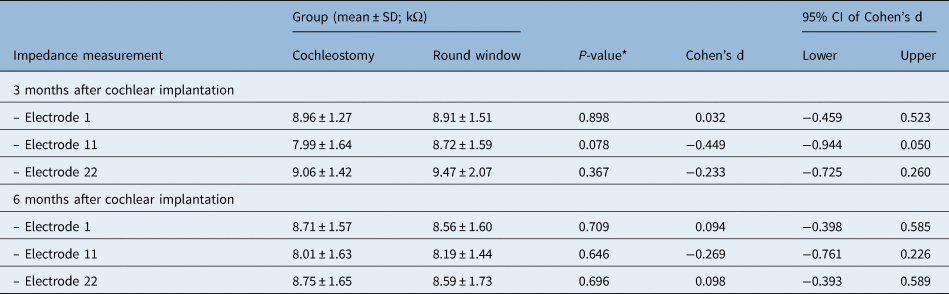
The mean impedance values for electrodes 1, 11 and 22 revealed no significant differences between the two study groups at three and six months after implantation. Table 1 shows the mean impedance measurements at three and six months after cochlear implantation.
Mean impedance measurements

*Independent sample t-test. SD = standard deviation; CI = confidence interval
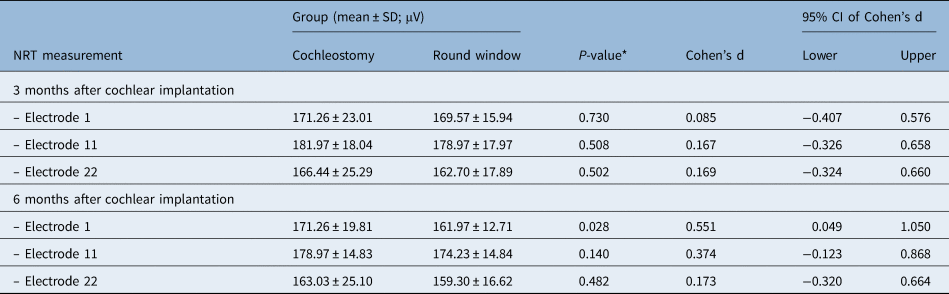
Table 2 represents the mean neural response telemetry values for the groups at three and six months after implantation. After six months, the neural response telemetry value for electrode 1 in the cochleostomy group (171.26 ± 19.81 μV) was significantly higher than that for electrode 1 in the round window group (161.97 ± 12.71 μV) (p = 0.028), with a medium effect size (0.551). Comparison of other neural response telemetry values showed no statistically significant differences between the two groups.
Mean NRT measurements

*Independent sample t-test. NRT = neural response telemetry; SD = standard deviation; CI = confidence interval
There were no major post-operative complications in either group. There were three patients with minor post-operative complications in the round window group. Two of them presented with cellulitis, and one presented with a local infection, which was treated by local dressing and antibiotics. No patients had any minor complications in the cochleostomy group (p = 0.059).
Discussion
Our results indicate no significant differences in the action potentials at the distal portion of the auditory nerve – in terms of neural response telemetry – in multichannel cochlear implant patients using the implant to elicit stimulation and record responses, regardless of whether implantation was carried out through cochleostomy or the round window approach.
Previous studies have compared the two approaches in terms of histological, radiological and audiometric findings and complications. Cochlear implant electrode impedance is defined as the resistance to current flow at the electrode. Histological studies showed that electrode impedance differs for each electrode array depending on the size, shape, constituent materials and changes in the endocochlear fluids, tissues and fibrosis. Rises in impedance are associated with increased intracochlear fibrosis and scar tissue.Reference Wilk, Hessler, Mugridge, Jolly, Fehr and Lenarz19 In the present study, there were no significant differences between the two implantation approaches regarding the impedance measurements at three and six months after implantation. A study by Richard et al. demonstrated that implantation performed through the round window minimised the initial intracochlear trauma and subsequent new tissue formation, in comparison with cochleostomy.Reference Richard, Fayad, Doherty and Linthicum20
Some previous studies compared radiological findings between the round window approach and the cochleostomy approach. Minimal interscalar excursion is a key factor for a successful audiological outcome. In a study by Jiam et al., it was reported that cochleostomy approaches were linked to a higher rate of interscalar excursion.Reference Jiam and Limb21 Another study by Jiam et al. showed that the round window approach was associated with a higher risk of perimodiolar placement with the Med-El® 12-electrode implant. The authors concluded that, in the round window approach, the electrodes may be placed closer to the cochlear neural substrates, minimising the current spread, in comparison with cochleostomy approaches.Reference Jiam, Jiradejvong, Pearl and Limb22
There are different ways to objectively measure the electrical stimulation of the auditory nerve in cochlear implant users, such as by examining ABRs, middle latency responses, late potentials and stapedial reflexes.Reference Bayrak, Mutlu, Kırkım and Şerbetçioğlu23 Neural response telemetry is used to measure electrically evoked compound action potentials during surgery or post-operatively in implanted patients. This is an important test for accurately monitoring the external and internal hardware function and assessing cochlear stimulation through neural responses.Reference Hamerschmidt, Schuch, Rezende, Wiemes, Oliveira and Mocellin24
• Cochlear implant technique may influence post-operative auditory nerve stimulation
• No differences were observed in neural response telemetry between cochleostomy and round window approaches
• No differences were noted concerning impedance in both approaches
A systematic review of 16 studies, with a total of 170 patients, did not show any benefit of one surgical approach over the other regarding the preservation of residual hearing.Reference Havenith, Lammers, Tange, Trabalzini, della Volpe and van der Heijden25 Residual hearing preservation after cochlear implantation performed via the round window or cochleostomy approach was also investigated by Sun et al., who found no statistically significant difference in residual hearing preservation between the two groups.Reference Sun, Hsu, Chen and Wu26 In another study, Kang and Kim found that patients who underwent the round window approach showed similar language perception compared with the cochleostomy group.Reference Kang and Kim27 A study by Adunka et al. investigated the effect of the surgical approach on hearing electric-acoustic stimulation of the auditory system. That study reported similar outcomes in hearing preservation rates and speech perception measures.Reference Adunka, Dillon, Adunka, King, Pillsbury and Buchman28 Another study compared electrode impedance values immediately after implantation.Reference Liu, Xie, Wang and Yang29 The authors concluded that the mean electrode impedance values were lower in the round window group. There were statistically significant differences in the impedance values for electrodes 1 to 14. However, the difference in electrodes 15 to 22 was not significant.Reference Liu, Xie, Wang and Yang29 In our study, none of the differences in measurements were significant, and there were no significant differences between the two approaches in terms of the risk of complications. This is consistent with the results of other studies.Reference Hamerschmidt, Schuch, Rezende, Wiemes, Oliveira and Mocellin24,Reference Gudis, Montes, Bigelow and Ruckenstein30
The limitation of this study is the assessment of neural response telemetry results just three and six months after the follow up, and we did not measure neural response telemetry immediately after the operation. Furthermore, we did not evaluate radiological findings and speech performance in the patients. Moreover, further studies could be performed with a larger sample size for a conclusively powered study, to verify these preliminary findings.
Conclusion
No differences were noted between the two approaches concerning cochlear nerve stimulation, impedance and complication rate. Surgeons need to select the procedure of their choice with a view to safety.
Acknowledgements
The authors would like to thank Shiraz University of Medical Sciences, Iran, and the Center for Development of Clinical Research of Nemazee Hospital, Shiraz, as well as Dr Nasrin Shokrpour for editorial assistance. This article was extracted from a thesis by Dr Masoud Janipour that was financially supported by the Vice Chancellor of Research at Shiraz University of Medical Sciences (grant number: 94-01-01-9323).
Competing interests
None declared