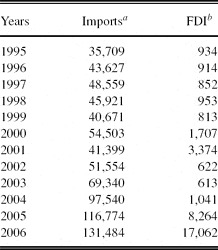
Turkish Imports and Foreign Direct Investment (FDI) Inflows (U.S. $millions)

a Source: Turkish Statistical Institute, foreign trade statistics database.Footnote 1
b Source: Central Bank of the Republic of Turkey, balance of payments analytic presentation.Footnote 2
“Jack of all trades” Ahmed Midhat Efendi, one of the most famous and popular Ottoman writers of the 19th century, ranged widely in his subject matter, which included economics.Footnote 3 Although he was criticized for not having a proper education in the field, his independent thinking made him the most important critic of the laissez-faire system that prevailed in the Ottoman Empire. He disapproved of the liberalism transferred from the West in a normative framework. In his Ekonomi Politik (Political Economy), which was published in 1879, he writes,
In our opinion, there is a need for bringing the new European industry to our country. But it is not absolutely necessary to liberalize foreign trade to realize this. . . . If we do not make imports difficult for them [foreigners], they will no more have the need to produce here. Therefore, we first have to impose heavy duties on foreign imports in order to protect our domestic industry.Footnote 4
He also cites Peter the Great of Russia and Mehmet Ali Pasha of Egypt as successful protectionists.
Ahmed Midhat was ahead of his time. Current introductory economics textbooks list trade restrictions as one reason for carrying out foreign direct investment (FDI). If market potential is high in country X, foreign companies may decide to produce in X in order to overcome trade restrictions.Footnote 5 For example, after facing voluntary export restraints during the 1980s, Japanese car manufacturers realized that it was necessary to build cars in the United States in order to increase their sales there. Ahmed Midhat was thinking along the same lines when he recommended increased import duties in order to attract FDI, which he believed would spur economic growth. Economic historians dismissed him as unrealistic. In their view, because the Ottoman Empire was not economically independent, it was absurd to think about increasing taxes and providing generous incentives to foreigners in order to lure them to the region.Footnote 6
Like some 19th-century critics of Ahmed Midhat, supporters of liberalism and the 1995 customs union agreement between Turkey and the European Union (EU) were convinced that only free trade could attract FDI to Turkey. Foreign as well as Turkish commentators were expecting that the agreement, which eliminated all customs restrictions between the two entities, would reduce the perception that investing in Turkey is risky. Improved access to EU markets would also encourage investment.Footnote 7 A “substantial rise” in FDI would bring Turkey such benefits as increased competition and better technology as well as much needed capital.Footnote 8
I examined the relationship between imports and FDI after the 1995 customs union agreement by analyzing quarterly imports and FDI statistics. The FDI figures are direct inflows of capital into the manufacturing and services sectors, excluding real estate purchases by foreigners. The numbers include all types of FDI from Greenfield investments to mergers, acquisitions, and joint ventures. Table 1 shows these data condensed as annual series, although calculations have been performed with quarterly series.
Both imports and FDI inflows to Turkey are increasing, and for the last three years growth rates are positive. However, correlation coefficients calculated for two periods, from the first quarter of 1996 to the last quarter of 2003 and from the first quarter of 1996 to the last quarter of 2004, equal −0.18 and −0.11, respectively. The most recent growth of FDI inflows to Turkey should be regarded as exceptional and the years after 2003 as outliers: FDI inflows to Turkey after 2004 are almost totally for acquisitions of already existing firms and privatized public enterprises. The negative but small correlation coefficients for the periods ending in 2003 and 2004 reveal that there is no relationship between imports and FDI inflows to Turkey.
A free-trade environment may discourage foreign investors from making equity investments in country X. Why would they take on the political and economic risks attached to production abroad when they are able to make a healthy profit simply by exporting? Of course, the free-trade environment is just one factor investors consider; others include host-country economic conditions (inflation and growth rates), demographic and geographic circumstances (size and accessibility of the market, availability of labor), and the state of infrastructure. However, Ahmed Midhat may have been right. Had Turkey followed protectionist policies, foreigners might have tried to avoid trade barriers and built factories in the republic in order to sell to this large market.