Implications
Castration of piglets is performed to eliminate boar taint, an unpleasant off-odour present in pork from some male pigs. Efforts are now being made to ban surgical castration. One alternative is immunocastration, a method based on vaccination which uses the pig’s natural immune system to prevent production of male hormones. This study evaluates the effect of the timing of the second vaccination on behaviour, performance, carcass and meat quality within the suggested standard timing of 4 to 6 weeks before slaughter. This study indicates that increasing the time post second injection by 2 weeks reduces unwanted male pig behaviour (aggressiveness) with limited effect on production efficiency and meat quality.
Introduction
Production of entire male pigs is more efficient compared with the production of surgically castrated male pigs as they show lower feed intake, feed conversion ratio (FCR) and carcass back fat level, with similar daily gain (DG, Dunshea et al., Reference Dunshea, Allison, Bertram, Boler, Brossard, Campbell, Crane, Hennessy, Huber, de Lange, Ferguson, Matzat, McKeith, Moraes, Mullan, Noblet, Quiniou and Tokach2013). Production of entire male pigs is hindered by the possible presence of boar taint. Vaccination against gonadotrophin-releasing hormone (GnRH) or ‘immunocastration’ can be used as an alternative to surgical castration. Immunocastration induces the formation of antibodies against endogenous GnRH, thereby reducing the secretion of luteinising hormone, follicle stimulating hormone and testicular steroids, as well as boar taint. The vaccine is administrated twice, once around 10 weeks of age and a second time about 4 to 6 weeks before slaughter, which is the standard protocol recommended by vaccine producer. Before this second vaccination, pigs perform and behave like entire male pigs (Rydhmer et al., Reference Rydhmer, Lundstrom and Andersson2010). About 1 week after V2, feed intake (Weiler et al., Reference Weiler, Gotz, Schmidt, Otto and Muller2013) and DG (Millet et al., Reference Millet, Gielkens, De Brabander and Janssens2011) increases. Therefore, immunocastration creates opportunities to achieve similar performance results as entire males, while eliminating boar taint. In a previous field study, feed conversion increased by +0.2 for barrows and +0.1 for immunocastrates compared with entire male pigs for the overall finishing phase (Aluwé et al., Reference Aluwé, Tuyttens and Millet2015). Literature also indicates that meat, but also fat thickness of immunocastrates is higher compared with boars, resulting in a similar or lower estimated lean meat percentage and higher intramuscular fat (IMF) content compared with boars (Pauly et al., Reference Pauly, Luginbuhl, Ampuero and Bee2012; Aluwé et al., Reference Aluwé, Tuyttens and Millet2015). Considering these differences in performance results between entire male pigs, immunocastrates, and surgically castrated male pigs, it can be expected that an optimal timing of V2 can improve production results as has been suggested in other studies (Bonneau and Enright, Reference Bonneau and Enright1995; Dunshea et al., Reference Dunshea, Allison, Bertram, Boler, Brossard, Campbell, Crane, Hennessy, Huber, de Lange, Ferguson, Matzat, McKeith, Moraes, Mullan, Noblet, Quiniou and Tokach2013). Recently, some studies have been performed to evaluate the effect of time post second injection by varying slaughter age and thereby also weight, while age at V2 was similar (Dunshea et al., 2008; Skrlep et al., Reference Skrlep, Segula, Prevolnik, Kirbis, Fazarinc and Candek-Potokar2012). However, results comparing performance, carcass and meat quality at comparable slaughter weight is scarce. As literature indicates that fat deposition increases from 4 weeks after the second vaccination (Dunshea et al., Reference Dunshea, Allison, Bertram, Boler, Brossard, Campbell, Crane, Hennessy, Huber, de Lange, Ferguson, Matzat, McKeith, Moraes, Mullan, Noblet, Quiniou and Tokach2013), we focused on a difference post injection time of 2 weeks and hypothesised that elongation of the time post second injection with 2 weeks (6 weeks in total) would lead to improved results for DG, muscle thickness, meat quality and lower testes weight, while 4 weeks time post second injection would coincide with a better FCR, lower fat thickness and weight of the gastro-intestinal tract. The aim of the present study is therefore to evaluate the effect 6 v. 4 weeks post second injection on behaviour, performance, and carcass and meat quality for immunocastrates at comparable slaughter weights.
Material and methods
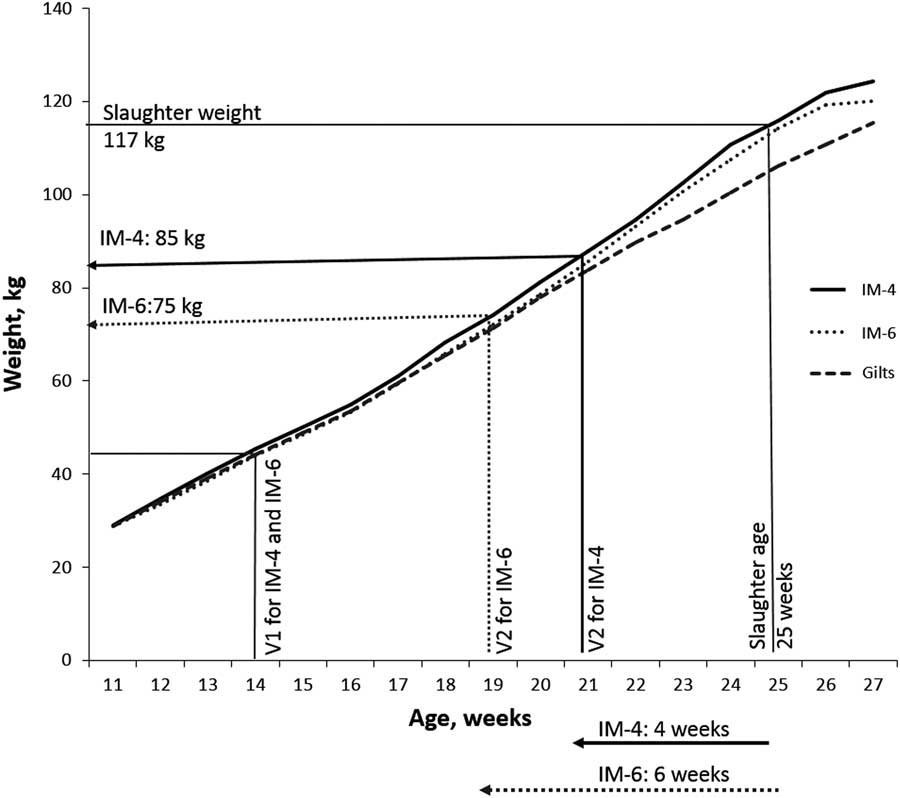
Spread over two consecutive weaning rounds, in total 180 animals (Piétrain×hybrid sow) were used in this experiment: 60 gilts and 120 entire male pigs. At 4 weeks of age, the entire male pigs were randomly divided into two treatment groups, that is with V2 at 6 weeks before slaughter (IM-6) and at 4 weeks before slaughter (IM-4), thus leading to three treatment groups in total. Animals of the same treatment group were housed with six animals per pen, resulting in 10 pen replicates per treatment. From 4 to 10 weeks of age, the animals were housed in the nursery pens. At 10 weeks of age, they were moved to the finishing barns. All entire male pigs received the first vaccination (V1) at 14 weeks of age (Figure 1). The timing of V2 depended on the treatment group and was based on the average pen weight and growth estimations to achieve comparable slaughter weights, resulting in V2 given at an average pen weight of 75 kg for IM-6 and at 85 kg for IM-4.
Experimental design indicating the timing of the first vaccination (V1) at 14 weeks and the timing and corresponding weight for the second vaccination (V2) for both groups of immunocastrates, with IM-6 receiving receiving V2 at ~6 weeks before slaughter or 75 kg of live weight and IM-4 receiving V2 at ~4 weeks before slaughter or 85 kg of live weight.

The pigs had free access to water and were fed ad libitum with a three phase feeding strategy (20 to 40 kg: net energy (NE) 9.6 MJ/kg, CP 16.2%, ileal digestible lysine (IDlys) 10.6 g/kg; 40 to 70 kg: NE 9.4 MJ/kg, CP 15.4%, IDlys 9.7 g/kg; 70 to 110 kg: NE 9.1 MJ/kg, CP 14.6%, IDlys 9.1 g/kg). To reach comparable slaughter weights per treatment group, pigs (at pen level) were sent to the slaughter house at weekly basis if average live weight of the pen reached 117 kg.
Behaviour, skin lesions and lameness
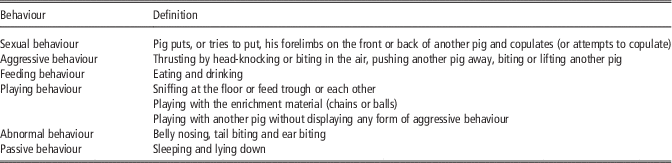
Behavioural observations took place every 2 weeks from 10 to 18 weeks of age. From 20 weeks onwards, observations were performed weekly. The observations were always performed between 14 and 16 h, as pigs are usually most active during that time of the day (Ingram and Dauncey, 1985). The performed behaviour was recorded based on live scan sampling (10 recordings per pen) as number of animals performing a certain behaviour per pen according to the ethogram in Table 1. At the same time points, skin lesions and lameness were monitored as an indication of the cumulative consequence of aggressive and sexual behaviour (Turner et al., 2006). Skin lesions were scored on a four-point scale (0=0 scars, 1=1 to 8 scars, 2=9 to 24 scars, 3⩾25 scars). Lameness was also scored on a four-point scale, from non lame (the pig moves fluidly) to lame (the pig does not place his affected limb on the floor and is very unwilling to move).
Ethogram of recorded behaviours

Performance
All pigs were weighed individually and feed consumption per pen was recorded weekly to calculate average DG, average daily feed intake (DFI) and FCR overall and per feeding phase. The pigs were fasted one day before slaughter then slaughtered in a commercial slaughterhouse using carbon dioxide anaesthesia followed by exsanguination. Muscle and fat thickness were measured using autoFOM III and values were converted into lean meat percentage by the equation approved by the regulation 2012/416/EU. Dressing percentage was calculated as cold carcass weight divided by live weight (recorded before transport to slaughterhouse). At slaughter, gastrointestinal tracts and testes (of the immunocastrates) were weighed. Percentage of fasting weight loss was calculated as difference in live weights one day before slaughter v. live weight after fasting (before transport to slaughter), divided by the weight 1 day before slaughter and multiplied by 100.
Carcass and meat quality
At 45 min postmortem, electric conductivity was measured by PQM (Pork Quality Meter, TECPRO NV, Antwerp, Belgium). Musculus longissimus thoracis et lumborum was sampled 24 h postmortem to determine ultimate pH (pHu), drip loss and colour (L, a, b, using HunterLab Miniscan, Reston, USA). Ultimate pH was measured on one meat sample per animal at least 24 h after slaughter (Knick Portamess, Type 911 pH with a Xerolyt puncture-type electrode (Mettler Toledo)). Colour determinants (L, a, b) were measured using a HunterLab Miniscan (45/0 geometry) on two meat samples per animal after 15 min of blooming. Average values were used for further statistical analysis.
Drip loss was measured based on the method described by Honikel (Reference Honikel1987). Samples (131±25 g) were hung by a nylon cord and placed in a plastic bag for 48 h. The percentage drip loss was calculated by dividing the difference in weight of the meat sample before and after 48 h by the sample weight at the beginning and multiplied by 100.
Measurements of cooking loss and Warner–Bratzler shear force (Boccard et al., Reference Boccard, Buchter, Casteels, Cosentino, Dransfield, Hood, Joseph, Macdougall, Rhodes, Schon, Tinbergen and Touraille1981) were executed on two meat cuts per animal. Meat cuts (25 mm) were placed in a closed plastic bag in a hot water bath of 75°C for 50 min, then cooled by placing the samples in the fridge for 24 h. Cooking loss (%) is defined as the difference in weight of the meat sample (after wiping dry) before and after cooking, divided by the sample weight at the beginning and multiplied by 100. Average raw weight of the meat samples was 121±23 g at the beginning of this measurement. Shear force was determined for 10 round cores (∅ 12.5 mm) per meat sample and the average value was used for further analysis after excluding the lowest and highest value of each sample. The amount of IMF was calculated based on the total amount of lipids present in another slice (with all visible fat removed) as determined using the modified Bligh and Dyer method (Bligh and Dyer, Reference Bligh and Dyer1959). IMF content was determined on 30 randomly chosen samples per treatment group.
The same 30 samples selected for IMF were also evaluated by a trained expert panel at the sensory laboratory of the Food Pilot (Melle, Belgium). Pork chops were grilled (Tefal, model GC3060, Rumilly, France) for ~5 min until a core temperature of 75°C was reached. Each grilled pork slice was cut into six pieces and tasted by six panellists. The panellist evaluated 10 attributes (fried odour, ‘piggy’ odour, boar taint odour, acid flavour, fried flavour, piggy flavour, boar taint flavour, tenderness, juiciness, overall tastiness) on an unstructured 10 mm line scale with low and high intensity marked on the ends of the scale. As results for odour and flavour attributes were similar, we only presented the results for the flavour attributes. Fifteen pork samples (five samples per treatment group) were tasted per session and a Williams (Reference Williams1949) design was used to determine the order of the samples so that the study was balanced for first-order carry-over effects. Between each sample, the panellists cleansed their mouths with water and a cracker.
Statistics
Statistical analysis was performed with R core software (R Core Team, 2013), using general linear mixed models. For individually assessed parameters, pen was included as random factor to correct for factors influencing the individuals within the same pen. Differences were considered significant if P<0.05. Tukey’s post hoc test was used to compare treatment means. Behaviour, lameness and skin lesions of the animals were analysed as repeated measurements (age) with treatment and age as fixed factors and pen and round as random factors. Performance results (DFI, DG and FCR) were analysed using a longitudinal model that included treatment and feeding phase as fixed factors, and pen and round as random factors. Feed intake per pen during the last week before slaughter of IM-4 and IM-6 was evaluated with a t-test with treatment as fixed factor. Carcass weight was analysed with pen and round as random factors. Carcass quality measurements were analysed with treatment as fixed factor and carcass weight as co-variable and pen and round as random effects. All meat quality measurements were analysed with treatment as fixed factor, and pen and slaughter date as random effects. Sensory meat quality was evaluated with treatment as fixed factor and animal and expert as random factor.
Results
Behaviour
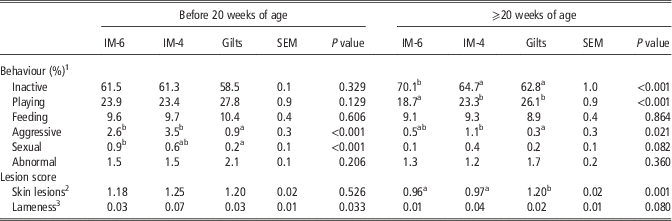
With the last behavioural observation before the age of 20 weeks performed at 18 weeks of age, none of the immunocastrates had yet received V2, as IM-6 received V2 at 19.9±1.0 weeks and IM-4 at 21.0±0.9 weeks of age. This is reflected in the higher boar-like behaviour of both groups compared with gilts (Table 2). IM-6 and IM-4 showed significantly more aggressive behaviour compared with gilts (P<0.001). IM-6 showed also more sexual behaviour than gilts (P<0.001), but neither were significantly different from IM-4. Playing, feeding, inactive and abnormal behaviour did not differ up to 20 weeks of age. After the age of 20 weeks, IM-6 and IM-4 seemed to differentiate, with IM-6 showing more inactive behaviour (P<0.001) at the expense of playing behaviour (P<0.001) and aggressive behaviour (P=0.076). Aggressive behaviour clearly decreased after V2 for both groups and no longer differed between IM-6 and gilts. Still, more aggressive behaviour was observed for IM-4 compared with gilts (P=0.019) and IM-4 tended to show more sexual behaviour the last weeks before slaughter compared with gilts and IM-6.
Behaviour of immunocastrates receiving V2 at 6 weeks before slaughter (IM-6), immunocastrates receiving V2 at 4 weeks before slaughter (IM-4) and gilts in the period before 20 weeks of age and the period after 20 weeks of age expressed as percentage of pigs per behaviour

a,bWithin a row, means without a common superscript differ (P<0.05).
1 Expressed as percentage of animals per behaviour.
2 Scored on a scale from 0 (no lesions) to 4 (>25 scars).
3 Scored on a scale from 0 (non lame) to 4 (lame).
Performance
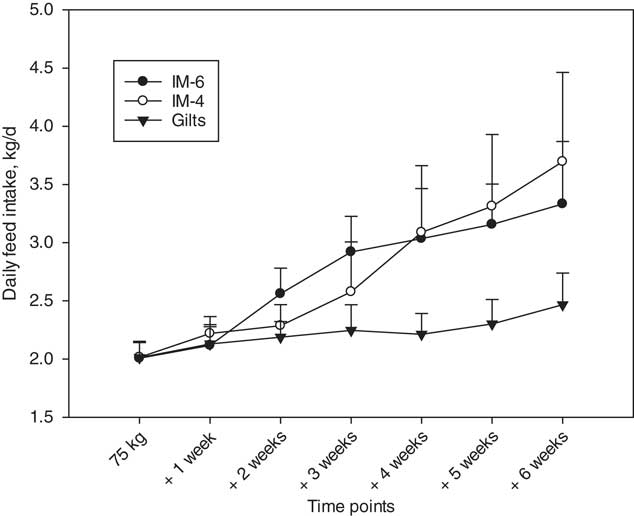
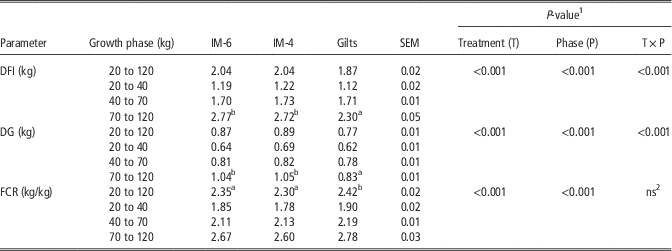
The second vaccination was performed at 78.6±6.3 kg live weight and 42.0±4.5 days before slaughter for IM-6, and at 86.9±9.6 kg live weight and 30.6±3.4 days prior slaughter for IM-4. As intended, slaughter weight did not differ between treatment groups (see the penultimate table). Overall, DFI and DG showed an interaction between feeding phase (P) and treatment (T) (P<0.001) (Table 3). In the first and second feeding phase, DFI and DG did not differ between treatment groups. In the last feeding phase, DFI and DG were significantly lower for gilts compared with IM-6 and IM-4 (P<0.001). The weekly representation of DFI from 75 kg onwards shows the earlier increase in feed intake of IM-6 compared with IM-4, although IM-4 reached a higher final level of feed intake at slaughter age (Figure 2). During the last week before slaughter, feed intake tended to be higher for IM-4 (3.7±0.3 kg/day) compared with IM-6 (3.4±0.5 kg/day) (P=0.052). FCR showed no P×T interaction and was significantly higher for gilts compared with IM-6 and IM-4 between 20 and 120 kg (P=0.001).
Weekly evolution of daily feed intake (mean±SD) from an average pen weight of at least 75 kg up to slaughter age for immunocastrates receiving V2 at 6 weeks before slaughter or 75 kg of live weight (IM-6), immunocastrates receiving V2 at 4 weeks before slaughter or 85 kg of live weight (IM-4) and gilts.

Means of daily feed intake (DFI), daily gain (DG) and feed conversion ratio (FCR) of immunocastrates receiving V2 at 6 weeks before slaughter (IM-6), immunocastrates receiving V2 at 4 weeks before slaughter (IM-4) and gilts from 20 kg to slaughter and per feeding phase

a,bWithin a row, means without a common superscript differ (P<0.05).
1 Performance parameters (ADFI, ADG and G : F) from 20 to 115 kg were analysed using a longitudinal model that included feeding phase as fixed factor; therefore, no P values of the different feeding phases are given.
2 ns=not significant (P>0.05). Interaction was not included in statistical model due to nonsignificant interaction.
Carcass quality and dressing
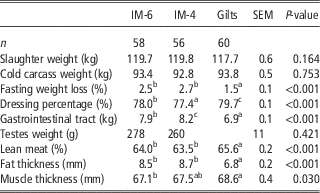
In the present study, back fat measurements of IM-6, IM-4 and gilts at 70 kg (10.5±1.4, 10.7±1.9 and 11.0±1.7 mm) or at slaughter weight (12.8±1.3, 13.1±1.5 and 12.4±1.3 mm) (mean±SD) did not differ significantly between three treatment groups. Also carcass leanness of IM-6 and IM-4 did not differ significantly (Table 4). Dressing percentage was lowest for gilts, intermediate for IM-6 and lowest for IM-4 (P<0.001). Similarly, weight of gastrointestinal tracts was highest for IM-4, intermediate for IM-6 and lowest for gilts. Fasting weight losses were also lower for gilts compared with both groups of immunocastrates and did not differ between IM-6 and IM-4 (P<0.001). Testes weights did not differ between IM-6 and IM-4 (P>0.05)
Carcass traits (means) of immunocastrates receiving V2 at 6 weeks before slaughter (IM-6), immunocastrates receiving V2 at 4 weeks before slaughter (IM-4) and gilts

a,b,cWithin a row, means without a common superscript differ (P<0.05).
Meat quality and palatability
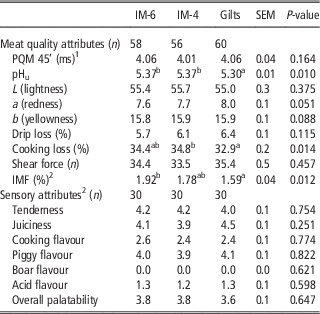
For pHu, IM-4 and IM-6 showed higher values compared with gilts (Table 5). Cooking loss was higher for IM-4 compared with gilts, both not differing from IM-6. IMF content was higher for IM-6 compared with gilts, both not differing from IM-4. Redness and yellowness of the meat tended to differ, with the highest redness value for gilts compared with IM-4 followed by IM-6, and the highest yellowness value for gilts and IM-4 compared with IM-6. The meat quality measurements of PQM, lightness (L value), shear force as well as all sensory attributes were not significantly different between gilts, IM-6 and IM-4.
Meat quality and sensory attributes of immunocastrates receiving V2 at 6 weeks before slaughter (IM-6), immunocastrates receiving V2 at 4 weeks before slaughter (IM-4) and gilts

a,bWithin a row, means without a common superscript differ (P<0.05).
1 Higher values are associated with paler, wetter meat.
2 Intramuscular fat content (IMF) and sensory meat quality were evaluated on the same 30 animals per treatment.
Discussion
Behaviour
Before the age of 20 weeks, differences in sexual and agressive behaviour between IM-6 and IM-4 cannot be explained by the effect of vaccination or vaccination time. Still, IM-6 showed the highest prevalence of sexual behaviour. Therefore, this result seems to reflect accidental differences in sexual behaviour present between groups of entire male pigs. After the age of 20 weeks, playing behaviour reduced and also aggressive behaviour tended to reduce for IM-6 compared with IM-4. These results are in line with the study of Andersson et al. (Reference Andersson, Brunius, Zamaratskaia and Lundstrom2012) who studied the effect of early (11 weeks before slaughter) compared with late vaccination (4 weeks before slaughter) and other literature indicating the clear shift from boar-like to barrow-like behaviour of immunocastrates after V2 (Cronin et al., Reference Cronin, Dunshea, Butler, McCauley, Barnett and Hemsworth2003; Rydhmer et al., Reference Rydhmer, Lundstrom and Andersson2010). Nevertheless, skin lesions and lameness scores were not highly affected by the time post second injection. Still, the behavioural results indicate that even a shift in vaccination time from 4 to 6 weeks is relevant to calmer animal behaviour and thereby a reduction of restlessness in the barn.
Performance
In the present study, the different time interval post second injection did not significantly affect performance, while differences between immunocastrates and gilts were confirmed. Lealiifano et al. (Reference Lealiifano, Pluske, Nicholls, Dunshea, Campbell, Hennessy, Miller, Hansen and Mullan2011) found no significant difference in FCR or DG between immunocastrates slaughtered at 0, 2, 3, 4 or 6 weeks after V2, while DFI increased linearly with increasing time post second injection. The results for DG and FCR are in line with this study, while the short 2-week difference in time post second injection did not imply significant differences in DFI.
The increase in DFI of IM after V2 is well reported (Millet et al., Reference Millet, Gielkens, De Brabander and Janssens2011; Batorek et al., Reference Batorek, Candek-Potokar, Bonneau and Van Milgen2012; Aluwé et al., Reference Aluwé, Tuyttens and Millet2015). Weiler et al. (Reference Weiler, Gotz, Schmidt, Otto and Muller2013) observed that the strong increase in feed intake of IM after V2 mainly resulted from an increased feeding rate. In accordance with that study, we did not observe differences between treatment groups in the percentage of pigs spending time at feeding. DFI of entire male pigs is suppressed by the presence of oestrogens and androgens (Weiler et al., Reference Weiler, Gotz, Schmidt, Otto and Muller2013). Immunocastration reduces steroidogenic capacity and lowers the levels of these compounds, which can partly explain the increased feed intake. Another factor often suggested to increase feed intake after V2 is the drop in aggressive and sexual behaviour of IM compared with entire male pigs. Also, several studies indicate that DFI and DG are higher when entire male pigs are housed individually instead of in a group (Dunshea et al., Reference Dunshea, Allison, Bertram, Boler, Brossard, Campbell, Crane, Hennessy, Huber, de Lange, Ferguson, Matzat, McKeith, Moraes, Mullan, Noblet, Quiniou and Tokach2013). Aggressive and sexual behaviour are often mentioned as the main reason for this. Sexual and aggressive behaviours are substantially lower in gilts and barrows compared with entire male pigs, but still a reduction in DG and DFI of 4% to 5% without effect on FCR is also observed for barrows and gilts in group housing compared with individual housing (Gonyou et al., Reference Gonyou, Chapple and Frank1992). According to Gonyou et al. (Reference Gonyou, Chapple and Frank1992), group housed animals avoid eating in paired feeders, which coincides with spending more time standing. This may indicate that also other social aspects that are not directly related to aggressive or sexual behaviour and are different from aggressive and sexual behaviour may influence eating behaviour. The hormonal shift is probably the most relevant factor to explain this effect of immunocastration.
Carcass quality and dressing
The meta-analysis of Dunshea et al. (Reference Dunshea, Allison, Bertram, Boler, Brossard, Campbell, Crane, Hennessy, Huber, de Lange, Ferguson, Matzat, McKeith, Moraes, Mullan, Noblet, Quiniou and Tokach2013) suggested that fat deposition increases from 4 weeks after V2. Indeed, some studies found a lower meat percentage or increased fat depth with increasing time post second injection (Lealiifano et al., Reference Lealiifano, Pluske, Nicholls, Dunshea, Campbell, Hennessy, Miller, Hansen and Mullan2011; Andersson et al., Reference Andersson, Brunius, Zamaratskaia and Lundstrom2012). In the present study, back fat measurements and carcass leanness did not differ significantly between IM-6 and IM-4. These results are similar to the results of Boler et al. (Reference Boler, Killefer, Meeuwse, King, McKeith and Dilger2012) and in line with the lack of difference in performance results between treatment groups. We may conclude that fat deposition at 6 weeks after V2 does not yet differ from fat deposition at 4 weeks after V2.
The lower dressing for the immunocastrates compared with the gilts can be explained by the difference in weight of the gastro-intestinal tract, which was higher for the immunocastrates compared with the gilts. This difference is also in line with the higher feed intake of the immunocastrates compared with the other sexes, and has already been described in previous studies (Batorek et al., Reference Batorek, Candek-Potokar, Bonneau and Van Milgen2012; Font i Furnols et al., Reference Font i Furnols, Gispert, Soler, Diaz, Garcia-Regueiro, Diaz and Pearce2012). Consequently, gilts showed lower fasting weight losses compared with immunocastrates. Boler et al. (Reference Boler, Killefer, Meeuwse, King, McKeith and Dilger2012) studied the differences in dressing percentage in more detail and found 0.24% units more gut fill and 0.20% units more intestinal mass for immunocastrates compared with barrows. In the present study, dressing percentage was also lower for IM-4 compared with IM-6. This difference was not seen in previous studies (Andersson et al., Reference Andersson, Brunius, Zamaratskaia and Lundstrom2012; Boler et al., Reference Boler, Killefer, Meeuwse, King, McKeith and Dilger2012). Testes weight is often suggested as a factor influencing dressing percentage. In contrast with literature (Brunius et al., Reference Brunius, Zamaratskaia, Andersson, Chen, Norrby, Madej and Lundstrom2011; Lealiifano et al., Reference Lealiifano, Pluske, Nicholls, Dunshea, Campbell, Hennessy, Miller, Hansen and Mullan2011), testes weight did not further increase in case of a 2-week-later vaccination, and thereby did not explain the difference in dressing. The higher weight of the gastrointestinal tract of IM-4 compared with IM-6 does partly comply with the lower dressing percentage of IM-4. As IM-6 have experienced a longer period post second injection with increased feed intake, this reduction in weight was unexpected. However, the weekly measurements of DFI may clarify this difference (Figure 1). Indeed, although the response to V2 was earlier for IM-6 compared with IM-4 as expected, DFI of IM-6 tended to reach a lower final level during the last week before slaughter compared with IM-4.
Meat quality and palatability
Literature results for the meat colour determinants are inconsistent. In a previous study (Aluwé et al., Reference Aluwé, Langendries, Bekaert, Tuyttens, De Brabander, De Smet and Millet2013), barrows and boars tended to have lighter meat (L) than immunocastrates, while Gispert et al. (2010) found that boars had darker meat than barrows, with intermediate results for immunocastrates. Most studies indicate higher cooking losses for boars compared with immunocastrates (Pauly et al., Reference Pauly, Spring, O’Doherty, Kragten and Bee2009; Skrlep et al., Reference Skrlep, Candek-Potokar, Batorek, Segula, Prevolnik, Pugliese and Bonneau2010). While cooking loss of IM-4 differed significantly from the gilts, both treatment groups did not differ from IM-6. For IMF content, results were more logical, with a significant difference between gilts and IM-6, both not significantly different from IM-4. The higher IMF content of IM-6 compared with gilts is in line with the differences seen between boars and immunocastrates, with the latter having higher IMF content (Pauly et al., Reference Pauly, Luginbuhl, Ampuero and Bee2012). We can conclude that meat quality attributes and sensory characteristics did not differ significantly between both groups of immunocastrates. Extending the time post second injection by only 2 weeks is probably too small to sufficiently improve IMF content and tenderness.
Conclusion
Within the studied time frame of second injection from 4 to 6 weeks before slaughtering, performance, carcass leanness, meat quality and palatability were not significantly affected. An elongation of the time post second injection by 2 weeks improved animal behaviour in late finishing and resulted in a better dressing percentage.
Acknowledgements
This study was financially supported by ADLO (Demonstration project). Thanks for all the practical support given by our colleagues at ILVO, particularly Jurgen Devos, Myriam Audenaert, Roland Limpens and Liesbeth De Wilde. We also thank Miriam Levenson for English language editing and Bart Ampe for his statistical advice.