Introduction
The study of the treatment of psychiatric disorders of late life usually involves persons aged 65 years and over with few studies specifically examining the treatment of psychiatric disorders in persons aged over 85 years, often described as the “old” old. This is a rapidly increasing age group. The 2000 U.S. Census found that there were 4,239,587 persons aged 85 years and over, comprising 12.1% of those aged 65 and over. This is projected to rise by 69% by 2019 in comparison to the 18% projected increase for the total U.S. population (U.S. Census Bureau Population Division, 2008). Similarly, there were 322,857 persons over 85 years in Australia in 2006, or 12.2% of those aged 65 and older (Australian Bureau of Statistics, 2007). Owing to their frailty and medical comorbidities, the style of psychiatric intervention to the “old” old differs from the “young” old by requiring increased attention to geriatric syndromes, functional status, comprehensive geriatric assessment and multi-modal intervention (Blazer, Reference Blazer2000).
Epidemiological studies of psychiatric disorders in the “old” old are limited. Rates of dementia appear to increase exponentially until at least the age of 90 years while the prevalence of depression in a number of European studies has ranged from 9% to 25% (Forsell et al., Reference Forsell, Jorm, von Strauss and Winblad1995; Meller et al., Reference Meller, Fichter and Schroppel1997; Jorm and Jolley, Reference Jorm and Jolley1998; Paivarinta et al., Reference Paivarinta, Verkkoniemi, Niinisto, Kivela and Sulkava1999). Suicidal ideation and suicide rates also increase over the age of 75 years (Skoog et al., Reference Skoog1996; De Leo et al., Reference De Leo, Draper, Krysinska, Wasserman and Wasserman2009).
There are also limited data on the specialist treatment of psychiatric disorders in the “old” old. One report of referrals to an old age psychiatry service from 1983 to 2000 in the U.K. noted that those aged 85 years and over had a marked rise in referrals over time and that these were mainly for organic disorders (Macdonald et al., Reference Macdonald2007). A census of psychiatric inpatient treatment in five European countries – Austria, Hungary, Romania, Slovakia and Slovenia – reported that persons aged over 80 years had the highest rate of involuntary treatment and treatment in locked wards (Rittmannsberger et al., Reference Rittmannsberger2004).
In Australia, analysis of data from the universal healthcare system, Medicare, of private psychiatric service provision for 1998 showed that per capita service provision declined over the age of 75 (Draper and Koschera, Reference Draper and Koschera2001). Analysis of national psychiatric hospitalisation data found that over the age of 80, admission rates increased in men but decreased in women (Low and Draper, Reference Low and Draper2009). Neither of these studies specifically focused on persons older than 85 years.
An investigation of current psychiatric service provision to those aged 85 years and over, the “old” old, will inform planning for service delivery. Our aim is to describe the pattern of mental health service delivery in Australia to the “old” old in comparison to younger age groups, in particular the “young” old aged 65–84 years by examining the rates and types of consultant psychiatrist services provided through Medicare and the rates and lengths of stay of hospital separations for psychiatric diagnoses in specialist and non-specialist psychiatric hospital settings.
We hypothesized that the “old” old would differ from the “young” old by diagnostic category (the “old” old will have higher rates of organic disorders), lower rates of admission to specialist psychiatric in comparison to non-specialist hospital beds for psychiatric disorders, and lower rates of Medicare-funded psychiatric service delivery in the community apart from home visits including those in residential aged care facilities where rates for the “old” old will be higher.
Methods
Institutional ethics committee approval was obtained from the Human Research Ethics Advisory Panel of the University of New South Wales, Sydney.
Data were obtained for 2001–02 to 2005–06 from two Australian datasets publicly available online: the Medicare Benefits Schedule database (available at https://www.medicareaustralia.gov.au/statistics/mbs_item.shtml) and the National Hospital Morbidity database (available at http://www.aihw.gov.au/mentalhealth/datacubes/index.cfm).
Medicare Benefits Schedule Item Statistics from July 2001 to June 2005 were obtained for the consultant psychiatrist item numbers from the Health Insurance Commission. All Australian citizens and permanent residents and New Zealand citizens resident in Australia qualify for Medicare Benefits. These were grouped in the following categories: office-based consultations (items 300–308); office-based consultations over 50 sessions per year (items 310–319); hospital consultations (items 320–328) and home visits (items 330–338). In addition, group therapy (items 342–346); interviews with a person other than the patient (items 348–352); and electroconvulsive therapy (ECT) (item 14224) were recorded. Items for telepsychiatry were not included as they were infrequently used in the study period (377 occasions of service of which only one recipient was aged 85 years and over). The data do not include services that qualify for a benefit under the Department of Veterans’ Affairs. At June 2006, there were 305,229 persons who qualified for Veterans’ Affairs benefits: 21.6% were aged under 65, 8.2% aged 64–75, 45.4% aged 75–84 and 24.7% aged 85 and over.
The National Hospital Morbidity Database (NHMD) comprises information supplied by all public hospitals and over 97% of private hospitals in Australia aggregated by the Australian Institute of Health and Welfare. Specialized psychiatric separations were defined as hospitalization episodes where the patient spent one day or more in a specialized psychiatric unit or hospital. Non-specialized mental health care was defined as a mental health-related inpatient separation that did not involve any care in a specialized psychiatric unit or ward. In the NHMD, “separations” is the technical term used to describe admitted episodes of patient care and includes discharges, deaths and transfers to other facilities.
Using national population data for each year linearly extrapolated from the 2001 and 2006 Australian censuses, separation rates were calculated per 1000 persons. The data for the five years were averaged because the pattern of separations were visually inspected and appeared similar for each year; this allows greater confidence in the results than focusing on a single year.
The principal diagnosis is the diagnosis chiefly responsible for occasioning the hospitalization episode. Mental health-related separations were defined as a principal diagnosis that falls within the “Mental health and behavioral disorders” chapter in the International Statistical Classification of Diseases and Related Health Problems, 10th revision, Australian Modification (ICD-10-AM).
ICD-10 mental and behavioral disorder codes were grouped as follows: F01 to F03 – dementia and amnestic syndromes; F05 – delirium; F06 – other organic brain syndromes; F32.2 – severe depressive episode without psychotic symptoms; F32.3 – severe depressive episode with psychotic symptoms; F32–34 and F39 (without F32.2 and F32.3) – other depression; F30 and F31 – manic disorders; F20–29 – schizophrenia, schizotypal and delusional disorders; F40–49 – neurotic, stress-related and somatoform disorders; F60–69 – disorders of adult personality and behavior; F10–19, F50–59 and F70–99 – other mental and behavioral disorders.
Since these were national level data, tests of statistical significance were not undertaken as it was not meaningful to attempt to generalize from this population to a larger population
Results
Community psychiatric services
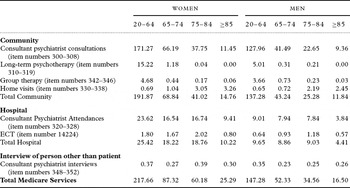
Between 2001–02 and 2005–06, the annual per 1000 person rate of consultant psychiatrist services funded by Medicare was lowest for both men and women in persons aged 85 and over, slightly higher in those aged 75–84 and 65–74 and highest in those under the age of 65 years (see Table 1). Women over 84 years used Medicare-subsidized office-based psychiatric consultation services at 6.7% of the rate of women under 65 years, and men over 84 used services at 6.0% the rate of their younger counterparts. However, women over 84 years received psychiatric home visits at 472% of the rate received by women under 65, and men over 84 received home visits at 377% the rate of men under 65.
Medicare data 2001–02 to 2005–06, psychiatric services per annum per 1000 persons

ECT = electroconvulsive therapy
There is limited information available about treatment. Consultant psychiatrist reimbursements for >50 sessions in a calendar year can be regarded as a proxy for long-term psychotherapy. In comparison with younger adults, persons aged 65–74 years receive 8.6% the rate of long-term psychotherapy and those aged 85 years and over receive less than 1% the rate received by younger adults. There is a similar pattern for group therapy but the decrease with age is less. In contrast, interviews with a person other than the patient were similar for men in “young” old and “old” old though lower than for those aged 20–64, and for women were highest in those aged 75–84 (Table 1).
Persons aged 85 years and above received the lowest rate of ECT in private hospitals compared to 65–84 years olds and 20–64 year olds (Table 1).
Hospital-based services for psychiatric disorders
Consultant psychiatrists had a lower per capita rate of private hospital attendances for over 84 year olds than the “young” old or younger adults (Table 1).
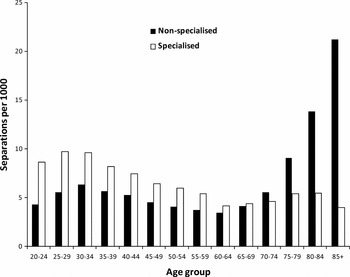
Between 2001–02 and 2005–06 the annual hospital separation rate in Australia involving inpatient specialist psychiatric care in persons over 64 years increased slightly with age from 4.41 per 1000 persons among 65–69 year olds to 5.50 among 80–84 years olds, then dropping slightly to 3.98 among those aged ≥85 years (see Figure 1). In contrast, the inpatient non-specialized hospitalization rate for psychiatric disorders increased dramatically in old age, with the trajectory increasing from 3.45 per 1000 in those aged 60–64 to 21.2 per 1000 in those aged ≥85 years. The cross-over point where the rate of non-specialized separations starts exceeding the rate of specialized separations is 70–74 years.
Annual specialized and non-specialized psychiatric hospital separations by age (2001–02 to 2005–06)

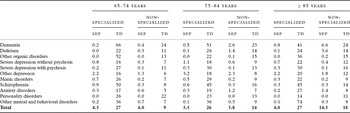
In all older age groups, the most common primary diagnosis resulting in specialized psychiatric hospitalization was depression (3.2, 4.6 and 3.2 separations per 1000 persons per annum for 65–74 year olds, 75–84 year olds and 85 years and over respectively), making up more than 70% of all psychiatric hospitalizations that received specialist care. In 65–74 year olds, schizophrenia (0.9 per 1000) and manic disorders (0.7 per 1000) were the second and third most common diagnoses in specialized psychiatric separations; in 75–84 year olds schizophrenia (0.6 per 1000), and dementia (0.5 per 1000) were the second and third most common diagnoses; and in persons aged 85 years and older dementia (0.8 separations per 1000 persons) and anxiety disorders (0.2 separations per 1000) were the second and third most common diagnoses.
In all three age groups the rate of separations per 1000 was higher for non-specialized care than specialized psychiatric care for dementia, delirium and other organic disorders, anxiety disorders and other mental and behavioral disorders. This increase in separations for non-specialized care was higher with age.
The proportion of specialist hospital separations with involuntary treatment was highest in 65–74 year olds (21.1%), intermediate in 85 years and over (19.6%), and lowest in 75–84 year-olds (16.2%). In persons aged 85 years and over the disorders with the highest rate of involuntary separations in specialist psychiatric care were manic disorders (37.0%), schizophrenia (34.1%) and other mental and behavioral disorders (29.0%). Over 99% of hospitalizations for psychiatric disorders not involving specialist care were voluntary in persons aged 85 years and over.
The average length of stay (ALOS) for specialized psychiatric separations was similar for 65–74 year olds, 75–84 year olds and those aged 85 years and over. However, for non-specialized separations of psychiatric disorders ALOS increased from 9 days in 65–74 year-olds, to 14 days in 75–84 year olds, and to 18 days in those aged 85 years and over (Table 2). ALOS was lower in non-specialized care than specialized psychiatric separations for all psychiatric diagnostic groups examined in all older age groups.
Hospital separations per 1000 per annum, mean treatment days per separation by specialist psychiatric care, age and diagnosis for Australians aged 65 years and above (2001–02 to 2005–06)

Sep = separations; TD = treatment days
Discussion
This is the first detailed description of psychiatric services utilized by the “old” old and, as hypothesized, it confirms that in Australia the “old” old have a distinctly different pattern of psychiatric service utilization from the “young” old, although the main changes occurred from the age of 75 rather than 85 years. Mental health service delivery plans for older people tend to consider all persons aged 65 years and over as a single group (for example see NSW Department of Health, 2006).
This study demonstrates that the “old” old require specific attention especially given the rapid growth of this age group over the next 20 years. In particular, as hypothesized, service delivery in the community is more frequently required in the older person's residence (including residential care), while in hospital settings a higher proportion of episodes of psychiatric care occurs in non-specialist beds. Both of these service delivery settings require a consultation liaison style of specialist old age psychiatry service delivery and close functional relationships with geriatric medical services.
Although these datasets do not provide information about medical comorbidity, it is well established that disability and frailty increases with age (Xie et al., Reference Xie, Matthews, Jagger, Bond and Brayne2008). We believe that it is the frailty and comorbid physical health problems found in the “old” old that result in this pattern of service delivery. Many of the “old” old will require broad geriatric medical input as well as specialist old age psychiatric care and will often have presentations with acute changes in behavior, cognition and mood suggestive of underlying acute medical problems requiring primary medical care. Combined medical and old age psychiatry units might be a model of service delivery that is particularly suitable for this age group though at present there is limited data on effectiveness (Draper and Low, Reference Draper and Low2005). There is, however, evidence that a consultation liaison style of service delivery is effective in these settings (Draper and Low, Reference Draper and Low2004). Acute psychogeriatric units might not be suitable for many of the “old” old as they often have exclusion criteria based upon functional capacity, such as ability to self care and being ambulant and the types of medical treatment required, for example, intravenous therapy. Although organic disorders are the main diagnoses found in the “old” old, it is also important to note that severe depression is also common.
In the community, perhaps partially due to frailty, decreased mobility and medical comorbidity, there is a marked decrease in psychiatrist office consultations and a higher rate of home visits, but overall the “old” old receive fewer psychiatric consultations. The reasons for this are unclear but might include low referral rates from general practitioners (Issakidis and Andrews, Reference Issakidis and Andrews2006), disinclination of psychiatrists to treat the “old” old and reluctance of the “old” old to see psychiatrists. There are no Australian data on community service provision to this age group in the public sector apart from the ambulatory-equivalent clinics that would include both public and private hospitals so we are unable to determine whether community specialist old age psychiatry services follow the same pattern. There is, however, good evidence that community specialist old age psychiatry services can provide effective service delivery in people's homes and residential aged care facilities (Draper and Low, Reference Draper and Low2004). Thus, in planning for the “old” old this type of service delivery will be particularly important.
There are a number of limitations to this study. The National Hospital Morbidity Database is derived from data obtained from numerous clinicians making diagnoses and hence their validity is variable. Additionally, the accuracy of coding of diagnoses and data entry by medical record staff is unknown. Only primary diagnoses are reported so the effects of comorbidity cannot be examined. The data do not allow comparisons between public and private facilities. Further, these data are for treatment episodes, not treated individuals. For individuals treated in non-specialist hospital episodes it is not possible to determine whether a psychiatric consultation was obtained during the episode of care. The Medicare data do not include services provided by the Department of Veterans’ Affairs and only includes services by consultant private psychiatrists, but not psychologists. It is also not known whether these findings can be generalized to other countries but we believe that the same issues need to be addressed by service delivery systems in other high income countries with a comparable population demographic.
There are also important strengths to the datasets. The databases cover almost the whole population and also cover the entire adult age range. Five years of hospitalizations from 2001–02 to 2005–06 are included and it is noteworthy that patterns of hospitalizations by age, sex and diagnosis were similar across the five years allowing us to combine them.
In conclusion, the “old” old are a rapidly growing age cohort that has a distinctly different use of psychiatric services than the “young” old and will require specifically tailored service plans.
Conflict of interest
None.
Description of authors’ roles
BD conceptualized the study, assisted with analyses and wrote the paper. LFL performed the data analyses and assisted in writing the paper.
Acknowledgments
Dr Low was supported by grant 455377 from the National Health and Medical Research Council and the Australian Government's initiative, Dementia: A Health Priority. The authors thank Medicare Australia and the Australian Institute of Health and Welfare for compiling the data.