
Introduction
The A 4Nb2O9 compounds, where A = Ni, Co, Mg, Mn, and Fe, and their mixtures possess a wide range of dielectric, magnetoelectric, and physicochemical properties due to the peculiarities of crystalline structure of the corundum-type compounds which can be described as a network of edge- and corner-sharing [AO6] and [NbO6] octahedral units.[Reference Wichmann and Mueller-Buschbaum1–Reference Kan, Ogawa, Yokoi and Nakamura3] The nickel diniobate-based ceramics already has a variety of applications as the catalysts for oxidative dehydrogenation of hydrocarbons,[Reference Santander, López, Diez, Dennehy, Pedernera and Tonetto4–Reference Qiao, Kalevaru, Kumar, Lingaiah, Prasad and Martin7] as the electrical gas sensors[Reference Mirzaei, Sun, Lee, Lee, Choi and Kim8] and electrochemical ion-selective sensors for the analysis of technological solutions,[Reference Podkorytov, Shtin, Kashapova, Luppov and Shubina9] as the capacitors and varistors.[Reference Loiu10] New mixed nickel niobates (Ni–Nb–M–O, where M = Co, Mo, V, W, Cr, Mn, and REM) are considered as promising materials for wireless communication technologies.[Reference Kan, Ogawa, Yokoi and Nakamura3, Reference Ehrenberg, Wltschek, Weitzel, Trouw, Buettner, Kroener and Fuess11, Reference Tarakina, Nikulina, Hadermann, Kellerman, Tyutyunnik, Berger, Zubkov and Van Tendeloo12]
The mixed nickel niobate-based functional products mentioned in the above papers were synthesized by the conventional solid-state reaction method from the proper metal oxides at the temperatures above 1000 °C. Molten salts are the promising reaction media to synthesize the nanosized complex metal oxides and to modify a chemical composition of both powder products and sintered ceramics at the temperature range of 400–700 °C.[Reference Khokhlov, Modenov, Dokutovich, Kochedykov, Zakir'yanova, Vovkotrub and Beketov13–Reference Li, Deng, Chen and Xing15]
The aim of this study is to investigate and demonstrate a new way of changing the chemical composition of nickel niobate powders in the thermal stable chloride melt containing Co2+-modifying ions as a typical example of the molten salt reaction medium.
Experimental
In this section, we discuss in detail the synthesis ways of the main test subject and salt reaction medium as well as the peculiarities of the experimental procedure of the Ni4Nb2O9 powders chemical composition modification. The high-temperature nickel diniobate orthorhombic modification[Reference Burdese, Borlera and Rolando16] was selected as a starting oxide compound, while the molten potassium and cobalt chlorides eutectic mixture was used as a reaction medium for modifying the chemical composition of nickel niobate powder.
Methods used to study the initial and final products
The differential scanning calorimetry (DSC), thermogravimetry (TG), x-ray diffractometry (XRD), Raman and IR spectroscopies, scanning electron microscopy (SEM), energy-dispersive spectroscopy (EDS), spectral emission analysis, and conductometry were used to study the starting materials and reaction products.
The structural phase analysis was conducted on a Rigaku D/MAX-2200VL/PC automated x-ray diffractometer (Japan) using the Cu Kα1 radiation and graphite monochromator. The XRD peaks were identified with the MDI/JADE6 database. The elemental chemical analysis of reaction salt mixtures was carried out using an Optima 4300 DV emission spectrometer with inductively coupled plasma. The information on the microscopic structure of the powders surface layers, disordering of the microcrystal structural units, was obtained on an Avantes Ava-Raman fiber-optic spectrometric complex (the Netherlands), including a laser source of monochromatic light (power 50 mW, wavelength λ = 532 nm) and a Bruker TENSOR 27 IR Fourier spectrometer (Germany). The morphology and semi-quantitative elemental composition of the powder particles were studied using a scanning electron microscope with a nitrogen-free energy-dispersive detector x-act ADD+JSM-5900LV (Jeol, Tokyo, Japan) supplied with a wave dispersive microanalyzer, a sluice chamber, and a device for suppression of electromagnetic interference INCA Energy 250 and INCA Wave 500 (Oxford Instruments, High Wycombe, UK). The thermal stability and possible phase transitions were examined using a synchronous thermal analyzer STA 449C Jupiter® (Germany). The electrical conductivity was measured with an AC bridge P 5083 (Russia). The apparent density of sintered ceramic pellets in the cylindrical form prepared for the conductometry was calculated using the measured samples geometrical dimensions and weight.
Ni4Nb2O9 synthesis
The solid-phase synthesis of stoichiometric Ni4Nb2O9 was performed taking into consideration the experience of obtaining this compound by many researchers.[Reference Khamman, Yimnirun and Ananta17–Reference Timofeev, Podkorytov, Shtin, Mal'tseva, Bamburov and Marshenya20] The powders of high-purity niobium and nickel oxides (Nb2O5 and NiO) manufactured at the “Vekton Ltd.” (St. Petersburg, Russian Federation) were used as starting materials. They were pre-annealed at 700 °C (NiO) and 1200 °C (Nb2O5) within 1.5 h. After cooling, both oxides weighed in necessary quantities were mixed thoroughly to obtain a uniform composition which was annealed at 1350 °C during 1 h. Then, the powder was treated at room temperature (grinding) and at 1350 °C (annealing) for 1 h under air atmosphere. This operation was repeated for two more times to obtain a single-phase nickel niobate powder of stoichiometric composition (Ni4Nb2O9). At each stage of the synthesis, the powders were subjected to the XRD examination. It showed that the pure Ni4Nb2O9 phase was obtained after four annealings by the above procedure (Supplementary Fig. S1). The XRD spectrum of the final product is in agreement with the results of Liou et al.,[Reference Liou, Tsai, Fung and Liu19] Timofeev et al.,[Reference Timofeev, Podkorytov, Shtin, Mal'tseva, Bamburov and Marshenya20] and Khamman et al.[Reference Khamman, Jainumpone, Watcharapasorn and Ananta21] for the stoichiometric Ni4Nb2O9 samples synthesized in other ways. A smaller number of successive operations and less time expended on the formation of the nickel niobate powder of stoichiometric composition as compared with those mentioned in Ref. [Reference Shtin, Podkorytov, Khlupin, Kudakaeva, Sokolova and Khuramshina22] were due to the selection of a special heating and cooling mode of annealed samples.
Preparing salt reaction medium
The KCl–CoCl2 eutectic (mole ratio KCl/CoCl2 = 0.565/0.435; T m = 351 °C)[Reference Seifert23, Reference Robelin, Chartrand and Pelton24] selected as the salt reaction medium was prepared by melting together anhydrous components at 800 °C under a high-purity inert gas (argon) atmosphere. The starting components (reagent-grade KCl and CoCl2; “Vekton Ltd.,” St. Petersburg, Russian Federation) were preliminarily dried to get rid of possible impurities of adsorbed water. KCl was additionally subjected to a double zone recrystallization.[Reference Shishkin and Mityaev25] The chemical analysis of the cooled salt mixture aqueous solution showed that the KCl content in the reaction mixture increased to 0.585 mole fraction due to the high CoCl2 volatility at the temperatures above 700 °C. A slight increase in the liquidus temperature (about 20°),[Reference Seifert23] caused by a change in the composition of the salt mixture, did not affect the choice of operating temperature (500 °C), at which the reaction mixture would not change its composition and mass for a long time due to a significant decrease in the salt melt volatility.[Reference Burylev, Mironov, Tsemekhman and Sryvalin26] Indeed, we did not observe any marked molten salt loss at the working temperature (Supplementary Fig. S2). All operations associated with weighing and loading of the salts into the reactor were performed in a glove box under a dry nitrogen atmosphere.
Experimental procedure
The isothermal holding method was used for modifying the chemical composition of the Ni4Nb2O9 powders. Two series of the experiments were performed under the same test conditions. The first was conducted under inert gaseous atmosphere (argon), while the second was carried out under air atmosphere. In experimental series, the same amount of the synthesized Ni4Nb2O9 powder (about 0.6 g) and the reaction KCl–CoCl2 eutectic mixture (about 3.0 g) were loaded into a platinum crucible located in a quartz tube. The “argon” and “air” assembles (Supplementary Fig. S3) were placed into an electrical oven, and then, they were heated to the constant operating temperature (500 °C). The molten salt–solid Ni4Nb2O9 samples were held at this temperature for 6 h. After completing the test, the modified Ni4Nb2O9 powders cleaned of salt were examined with all above-mentioned methods. The elemental composition of the salt aqueous solutions ([KCl–CoCl2] ≈ 30.0 g/dm3) obtained after the careful washing of the powders were determined by the method of emission spectrometry.
Results and discussion
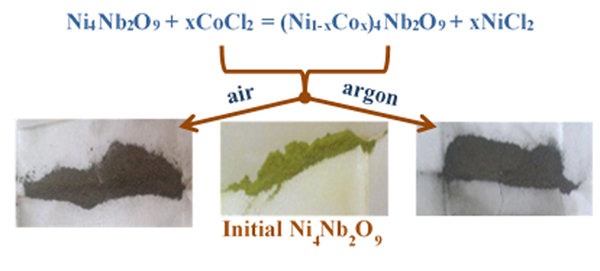
The marked quantity of elemental Ni was found in the KCl–CoCl2 reaction mixtures after the experiments. This points out that there is an exchange process between nickel niobate and the cobalt dichloride containing melt, which results in the mixed Ni–Co niobate occurrence:
 $${\rm N}{\rm i}_4{\rm N}{\rm b}_2{\rm O}_9 + x{\rm CoC}{\rm l}_2 = {\rm} \lpar {{\rm N}{\rm i}_{1-x}{\rm C}{\rm o}_x} \rpar _4{\rm N}{\rm b}_2{\rm O}_9 + x{\rm NiC}{\rm l}_2.$$
This is evident from the data presented in Table I. Moreover, both experimental series show a coincidence of concentration ratios. The Nb atoms were not found in the post-experimental salt melt within the error of elemental analysis on an emission spectrometer.
Elemental composition of aqueous solutions of reaction KCl–CoCl2 mixtures after the end of the experiment.

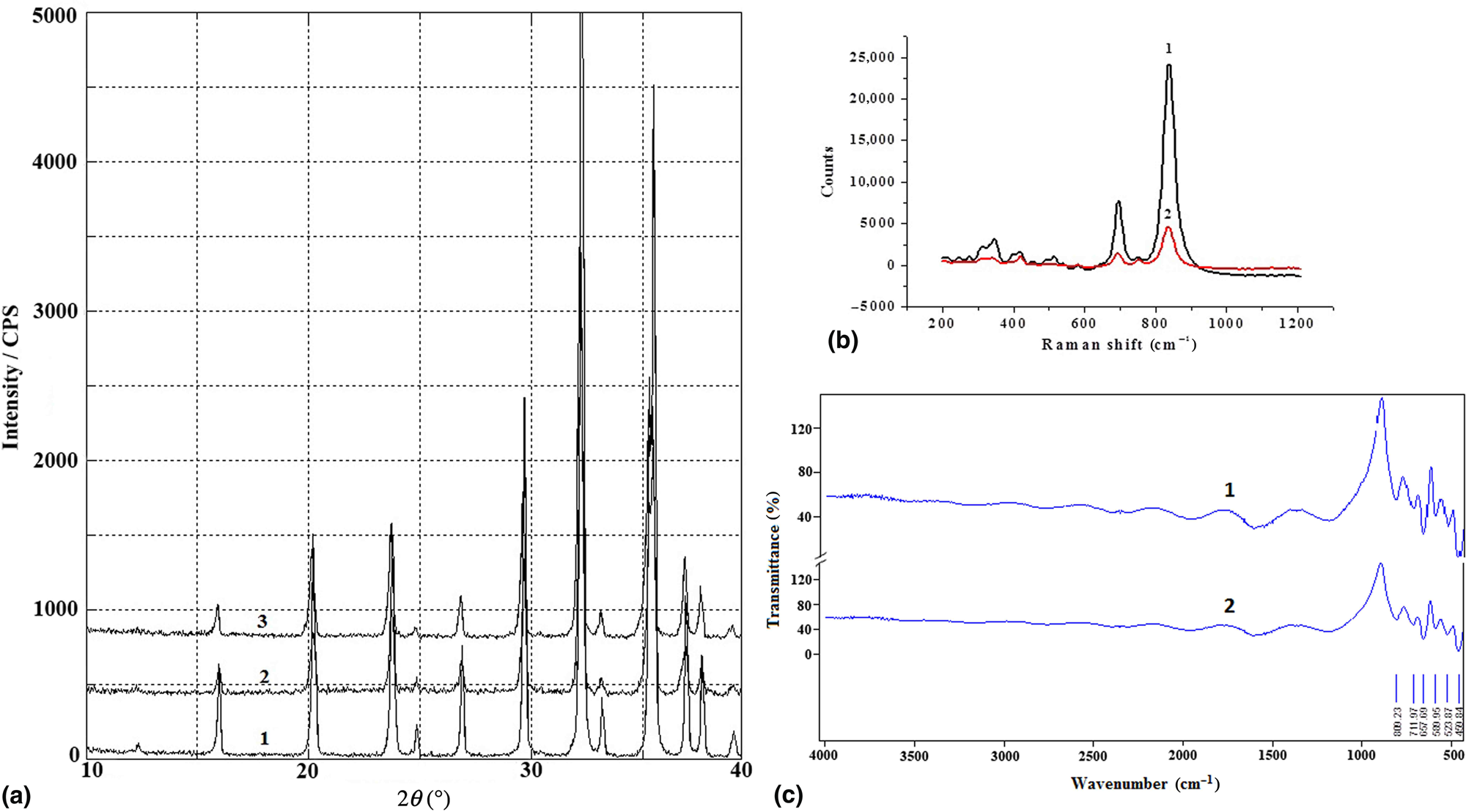
The XRD analysis of the powders showed a similarity of the initial and modified Ni4Nb2O9 powder diffraction patterns [Fig. 1(a)]. Only a relative decrease in the intensity of the base lines, which is intrinsic in defect crystals,[Reference Alexander and Klug27] and their negligible shift to the low-angle region are observed. We calculated the ratios of XRD line intensities observed at the 2θ angles equal to ~29.6° and ~35.4° to the intensity of the base line measured at 32.2° for all samples under study. The ratios were 0.663 and 0.431 for pure Ni4Nb2O9, while they were equal to 0.646 and 0.384 for the (Ni–Co)4Nb2O9 sample modified under Ar atmosphere and 0.579 and 0.358 for the sample modified under air atmosphere, respectively. A more significant decrease in relative intensities of the powder modified under air atmosphere can be associated with possible partial oxidation of Co2+ to Co3+. The Co4Nb2O9 phase[Reference Bertaut, Corliss and Forrat28, Reference Chaiyo, Muanghlua, Ruangphanit, Vittayakorn and Vittayakorn29] was not revealed.
X-ray diffraction patterns (a), Raman (b), and IR (c) spectra of the Ni4Nb2O9 powders: initial sample (1) and samples modified under air (2) and argon (3) atmosphere.

The data on the Ni4Nb2O9 powders vibrational spectra are of special interest since they describe the state of the Nb–O vibrational modes depending on the ion composition of the surrounding NbO6 octahedra as the basic structural element of the (Ni1−xCox)4Nb2O9 solid solution. The Raman and IR spectra of the initial and modified Ni4Nb2O9 powders are presented in Figs. 1(b) and 1(c).
The initial and modified Ni4Nb2O9 powders correlate between themselves in the Raman spectra and in the IR spectra as well as in the x-ray diffractogrammes. The basic Raman band shift to the short-wave area is negligible and does not exceed 5 cm−1. The analysis of the Raman spectra high-frequency bands, which describe the vibrational modes of [NbO6] octahedra, was carried out for the initial and modified under air atmosphere samples (Supplementary Table S1). The vibrational bands broadening, as is clear from the calculated FWHM (full width at half maximum) values, and marked change in the relation of spectral band (A, B, and C) intensities in the modified sample as compared with those in the initial powder are the evidences of the structural disordering and of the deviation of chemical composition from stoichiometry described by the [Ni]/[Nb] concentration ratio. Similar regularities were found and analyzed in detail in the Raman scattering studies of mixed alkali metal niobates (ANbO3, where A = Li, Na, and K) doped SrTiO3[Reference Polomska, Hilczer, Kosec and Malič30] and Eu2O3.[Reference Wang and Luo31]
The morphology and approximate elemental composition of the modified Ni4Nb2O9 powder surface layers were studied by the SEM and EDS methods. As it is seen from Supplementary Figs. S4 and S5, the treatment of the Ni4Nb2O9 powders in the molten KCl–CoCl2 mixture under air atmosphere results in the marked powder agglomeration that can exert some influence on the modified Ni4Nb2O9 properties. The Co distribution in the surface layer of powder particles is generally uniform in both cases, as it is illustrated in Supplementary Table S2 where the elemental composition of the modified Ni4Nb2O9 powders is presented.
To evaluate the possibility of practical implementation of the results of this work, we studied the thermal stability and electrical conductivity of the initial and modified Ni4Nb2O9.
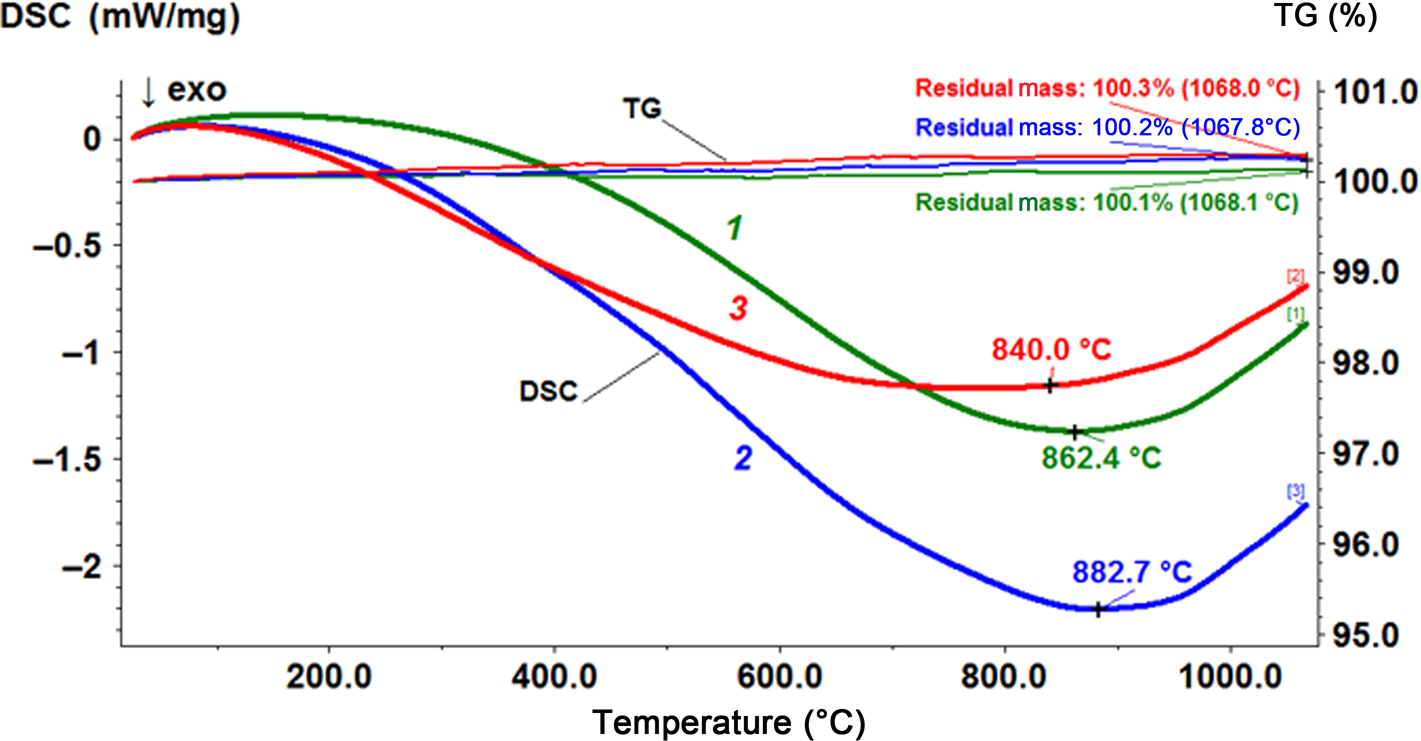
The thermal stability was investigated in the temperature range of 20–1100 °C. As it is evident from Fig. 2, the initial and modified samples are thermally stable. The small exothermal effects observed for all samples which coincide within an instrumental error are possible due to the agglomeration processes which are sensible to the operating conditions such as synthesis temperature and gas atmosphere.
DSC and TG curves for Ni4Nb2O9 powders: initial sample (1) and samples modified under argon (2) and air (3) atmosphere.

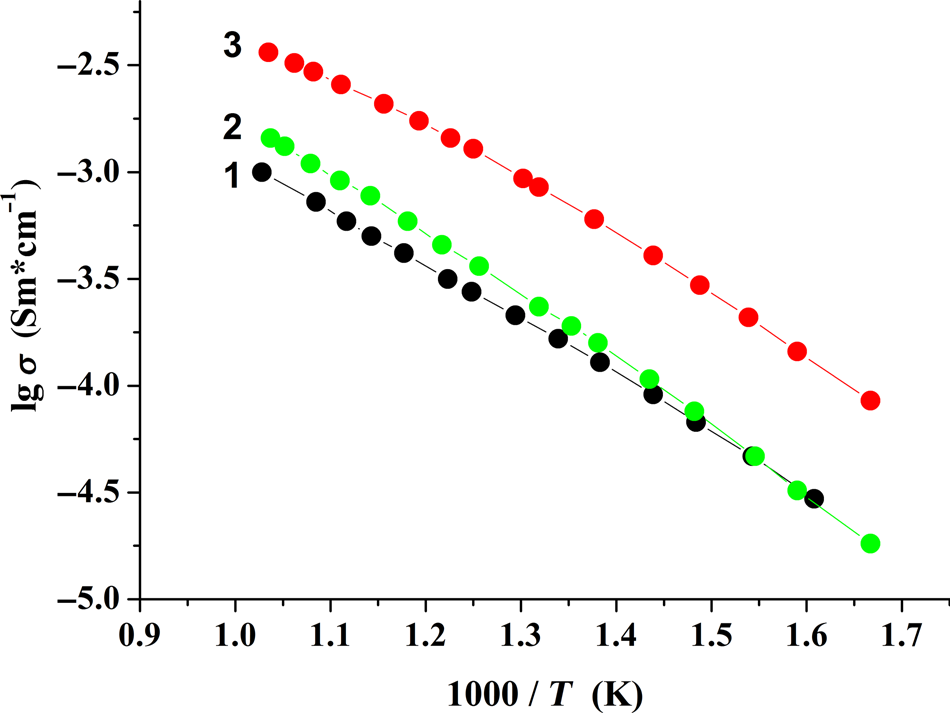
The cylindrical pellets from the initial and modified Ni4Nb2O9 powders were fabricated to measure the electrical conductivity. After compression, they were sintered at 1000 °C. The pellets apparent density was calculated of the samples weight and geometrical dimensions. The found densities equal to 4.32, 4.29, and 4.27 g/cm3 for initial, “argon,” and “air” Ni4Nb2O9 samples, respectively, indicate a high porosity of the prepared samples. The silver paste was used to make the electrodes. The frequency dependence of the measured electrical resistance in the investigated temperature range (300–700 °C) and frequencies (102–105 Hz) was negligibly small. The electrical conductivity measuring was performed at the frequency of 10 kHz. The experimental results presented in Fig. 3 show that the electrical conductivity of the samples fabricated from the modified Ni4Nb2O9 powders is higher than that of the pellets made from the initial material.
Electrical conductivity of the pellets fabricated from Ni4Nb2O9 powders: initial sample (1) and samples modified under argon (2) and air (3) atmosphere.

The literature data on the electrical conductivity of pure Ni4Nb2O9[Reference Timofeev, Podkorytov, Shtin, Mal'tseva, Bamburov and Marshenya20, Reference Shtin, Podkorytov, Khlupin, Kudakaeva, Sokolova and Khuramshina22, Reference Tsygankov and Safonov32, Reference Podkorytov, Shtin, Zhukovskii and Pantyukhina33] cannot be correlated with our results since in these papers the information about the sample density is lacking. The electrical conductivity of Co-modified nickel niobate has been measured for the first time. The higher electrical conductivity of the modified samples as compared to pure nickel diniobate is associated with the violation of the stoichiometry of the composition. It is important to note that the more friable sample (3) has a higher electrical conductivity. This unexpected phenomenon is a possible consequence of the decrease in the area of intergranular borders due to the enlargement of the powder particles size that causes the decrease in the contact electrical resistance. It is also impossible to exclude the possibility of the appearance of electronic conductivity 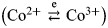 $\big( {{\rm C}{\rm o}^{{\rm 2+ }}\buildrel {\rm e} \over \leftrightarrows {\rm C}{\rm o}^{{\rm 3+ }}} \big)$ in the result of the electron exchange between Co2+ and Co3+.
Conclusion
The ingenious results of the direct effect of molten KCl–CoCl2 mixtures on the fine single-phase Ni4Nb2O9 powder under argon- and oxygen-containing gaseous atmospheres at 500 °C showed that the thermal stable chloride melts are the attractive reaction medium for modifying the chemical composition of complex oxide materials. The initial stoichiometric Ni4Nb2O9 powder synthesized specially by the solid-phase method as well as the reaction products were studied in detail by the methods of DSC, TG, XRD, Raman and IR spectroscopies, SEM, energy-dispersive x-ray spectroscopy, chemical analysis, and conductometry which demonstrated clearly the formation of the thermal stable (Ni1−xCox)4Nb2O9 solid solutions with the elevated electrical conductivity. A marked decrease in the relative intensity of the base x-ray lines, the ratios of the Raman bands intensities, and the increase in the FWHM of the modified samples as compared with those of the initial powder are the evidence of the structural disordering and of the deviation of chemical composition from stoichiometry described by the [Ni]/[Nb] concentration ratio. The proposed way for modifying complex oxides in thermoresistant halide melts allows realizing a controlled change in their chemical composition at temperatures much lower than those in the traditional solid-phase synthesis.
Supplementary material
The supplementary material for this article can be found at https://doi.org/10.1557/mrc.2019.123.
Acknowledgment
This study was partly supported by the Russian Foundation for Basic Research (Projects No. 15-03-00368a and No. 18-03-00475a).