Introduction
Sample surveys aim to describe finite populations (large or small) by collecting and analysing information relating to only a part of the population (Barnett, Reference Barnett2002). The broad aim of the sampling theory is to devise sampling schemes that are inexpensive and easy to operate, yield unbiased estimators, and minimize the effects of sampling variations. Surveys play a major role in epidemiological studies of wildlife populations. Although direct examination of animals for disease processes is ideal, the logistical constraints, effort and expense needed to do so for wild fauna make it highly ineffective (Müller-Graf et al., Reference Müller-Graf, Woolhouse and Packer1999; Vicente et al., Reference Vicente, Fierro and Gortázar2005). Faecal surveys are an alternative non-invasive method of examination for certain diseases, including microparasites and macroparasites (Villanúa et al., Reference Villanúa, Perez-Rodriguez, Gortázar, Hofle and Vinuela2006). Faecal surveys are very valuable in comparing indices of infection between populations (Vicente et al., Reference Vicente, Fernandez de Mera and Gortázar2006). The method provides valuable tools to address both management and ecological/epidemiological research issues and is a cost-effective and labour non-intensive means to monitor prevalence and intensity of infection in wildlife populations. It has been used to study nematode seasonality (e.g. Vicente et al., Reference Vicente, Fierro and Gortázar2005), host–parasite relationships (e.g. Acevedo et al., Reference Acevedo, Vicente, Alzaga and Gortázar2005) and comparison of parasites between sympatric species (e.g. Patton & Rabinowitz, Reference Patton and Rabinowitz1994).
Game species, particularly deer, are increasing in density and distribution in many countries across the world (e.g. Côté et al., Reference Côté, Rooney, Tremblay, Dussault and Waller2004). This, along with artificial feeding and other management actions, has led to densities where the health and well-being of populations are under threat due to increased probability of disease transmission. The study of parasite infection rates may be useful to evaluate the impact of human management on the spread and persistence of pathogens, which may vary greatly according to the nature of the selected host–pathogen system (Vicente et al., Reference Vicente, Höfle, Fernández-de-Mera and Gortazar2007a). In some cases, factors such as host susceptibility may be more important than host density and exposure to parasites (parasite resistance of individuals may vary as body condition varies, for example). In this sense, well-spread parasites across populations are of choice because the majority of the individuals are exposed to the parasite, and the infective stage outputs may well reflect the intimate host–parasite immunological interaction (Gaudernack et al., Reference Gaudernack, Halvorsen, Skorping and Stokkan1984). In this context, faecal examination is an appropriate diagnostic tool to study aspects of the epidemiology of common parasites in situations where direct examination of animals is not possible, e.g. outside hunting seasons or in non-hunted areas.
In the present study Elaphostrongylus cervi Cameron (Nematoda: Metastrongyloidea), a parasite of the central nervous system and intramuscular connective tissue of skeletal muscles in red deer, Cervus elaphus (Mason, Reference Mason1995; Handeland et al., Reference Handeland, Gibbons and Skorping2000), was used as a model for evaluating excretion abundance and prevalence through faecal surveys. The parasite has a wide natural distribution in Eurasia but is also present in New Zealand. The L1 stage larvae are excreted through faeces (Handeland et al., Reference Handeland, Gibbons and Skorping2000). Previous research on protostrongylids and extrapulmonary lungworm infections in wild ungulates strongly suggests that the host immune response modulated not only the establishment, but also the fecundity of parasites (Gaudernack et al., Reference Gaudernack, Halvorsen, Skorping and Stokkan1984; Pelletier et al., Reference Pelletier, Page, Ostiguy and Festa-Bianchet2005).
Elaphostrongylu cervi rarely causes clinical signs in deer, but extensive surveys in Mediterranean Spain have shown an association between excretion prevalence and increased animal density associated with watering stations (Vicente et al., Reference Vicente, Fernandez de Mera and Gortázar2006), and between excretion abundance and deer fitness-related parameters (Vicente et al., Reference Vicente, Perez-Rodriguez and Gortázar2007b). Thus, excretion of this parasite by deer populations may eventually be used in the diagnosis of overabundance (Gortázar et al., Reference Gortázar, Acevedo, Ruiz-Fons and Vicente2006) and/or the evaluation of the effects of human management schemes on parasitism, which is not always density dependent (Vicente et al., Reference Vicente, Höfle, Fernández-de-Mera and Gortazar2007a). The aim of the present study was to establish protocols that minimize the number of faecal samples or pools of samples needed to attain the mean excretion prevalence and mean excretion abundance of E. cervi L1 in wild red deer populations from Mediterranean habitats in Spain.
Materials and methods
Study areas
Based on information available from previous surveys, one estate (MO) was selected with low E. cervi faecal L1 prevalence and excretion abundance and a second estate (QM) with high E. cervi faecal L1 prevalence and excretion abundance (Vicente et al., Reference Vicente, Fernandez de Mera and Gortázar2006). The study areas were located in Castilla-La Mancha, Spain, in the central–southern portion of the Iberian Peninsula, a region where deer hunting is common. Populations of both study sites are fenced but essentially wild, and treatment with anthelminthics or other veterinary health measures have not been undertaken. The climate of both estates is typically Mediterranean and the mean annual precipitation (period from 1990 to 2005) is 442 ± 38 mm for estate MO (low excretion rates) and 588 ± 45 mm for the estate QM (high excretion rates). Both estates were selected because previous studies indicated that E. cervi excretion rates are very different (Vicente & Gortazar, Reference Vicente and Gortázar2001; Vicente et al., Reference Vicente, Fernandez de Mera and Gortázar2006), and therefore are representative of the range of parasite excretion rates found across deer populations in the study area. Previous research suggested that, although density is similar in both estates (see below), E. cervi excretion rates may be reduced in estate MO as a result of artificial feeding, and subsequent improved host body condition and immune response against E. cervi (Vicente et al., Reference Vicente, Höfle, Fernández-de-Mera and Gortazar2007a, Reference Vicente, Perez-Rodriguez and Gortázarb; Corbin et al., Reference Corbin, Vicente, Martin-Hernando, Acevedo, Pérez-Rodríguez and Gortazar2008).
Study area MO comprises a privately owned and managed hunting estate of 900 ha in the province of Ciudad Real (38°55′N; 0°36′E; 600–850 m above sea level). Red deer are the most abundant ruminant species present (density = 0.35 deer/ha). Supplemental feeding is available all year round, and the range is fenced in order to restrict movement of wildlife. The habitat is characterized by evergreen oak (Quercus ilex) scrubland with scattered pastures and small crops. Seasonal streams cross the estate, but water availability is provided in the main by several water holes and is available to the wildlife year round.
Study area QM comprised a government owned and managed park of 6864 ha located in the border between the provinces of Ciudad Real and Toledo (39°82′59″N; 48°0′49″W; 700–900 m above sea level). Population density of red deer is slightly lower (density = 0.30 deer/ha), and supplementary food is not available. Vegetation includes Pinus pinea, P. pinaster, Q. ilex, and Q. faginea as the predominant trees and pastures. A small river crossing the park is the main water source.
Coprological analyses
In June 2006, 80 different fresh faecal pellet groups were collected per hunting estate (those with fresh mucus covering the pellets). Small-sized faecal group pellets from calves were not collected. Samples were not collected on rainy days since E. cervi L1 may migrate early from faeces. Protostrongylid larvae were extracted in less than 24 h from 8–10 g of faeces collected using the Baermann beaker extraction method (Anonymous, 1986) as described by Forrester & Lankester (Reference Forrester and Lankester1997). Larvae were quantified in a Favatti counting chamber and expressed as the number of L1 per gram of faeces (lpg) (Vicente et al., Reference Vicente, Fierro and Gortázar2005). Microscope measurements were made with a calibrated ocular micrometer and the larvae were identified to the genus level by their morphology and linear dimensions using the descriptions in Kutzer & Prosl (Reference Kutzer and Prosl1975), Demiaszkiewicz (Reference Demiaszkiewicz1986), Rezac (Reference Rezac1990), Mason (Reference Mason1995), Lankester (Reference Lankester, Samuel, Pybus and Kocan2001), and Vicente & Gortázar (Reference Vicente and Gortázar2001).
Statistical analyses
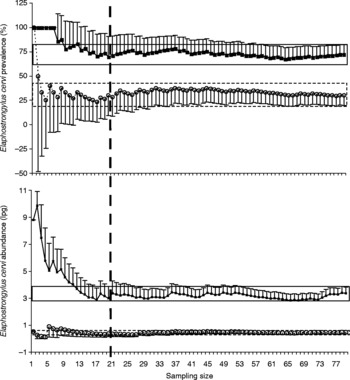
The aims were, first, to determine how many individual faecal samples need to be analysed to get a reliable estimate of the ‘true’ prevalence that would have been obtained by analysing all 80 samples. Secondly, to establish how many pools are needed for a reliable estimation of ‘true’ excretion abundance. Pools of 5 and 10 samples each were randomly created from the 80 samples to measure E. cervi excretion abundance. The means of these pools were compared, in an additive way, with the excretion abundance for all 80 samples and also with the mean of 20 randomly selected samples (see fig. 1).
Mean prevalence (%) and excretion abundance of E. cervi L1 (lpg) in both study localities (squares QM and circles MO) in relation to increased sample size (up to n = 80). Standard errors are represented within a 95% confidence interval. The rectangles delineate the standard error obtained with n = 80 samples. Discontinuous vertical line indicates n = 20 samples.

The statistical association was tested between the E. cervi excretion abundance for all samples (n = 80 per each hunting estate) and the random pools (8 different pools of 10 faecal groups, and 16 different pools of 5 faecal groups, respectively). A statistical analysis for a random subsample of smaller size was similarly performed (n = 20 in this case, since the above analysis indicated that between 20 and 30 individual samples would produce a reliable estimate of the ‘true’ abundance; see below) against the same pools (8 different pools of 10 faecal groups, and 16 different pools of 5 faecal groups). For statistical purposes, E. cervi L1 counts were log10-transformed and means compared by t-tests using the SPSS 14.0 statistical software package (SPSS Inc., Chicago, Illinois, USA). The level of significance was established at 5%. All P values refer to two-tailed tests. Excretion prevalence and abundance were used as in Margolis et al. (Reference Margolis, Esch, Holmes, Kuris and Schad1982). Standard errors for prevalence within a 95% confidence interval were estimated with the expression  (Martin et al., Reference Martin, Meek and Willeberg1987).
Results
Prevalence and excretion abundance of E. cervi L1 in red deer faeces were significantly lower (χ2 = 28.92, df = 1, P < 0.001; F 1,158 = 35.624, P < 0.01, respectively) in the MO study site (prevalence 30 ± 10.19%, abundance 0.48 ± 0.23 lpg; n = 80), than in the QM study site (prevalence 73 ± 10.17%, abundance 3.36 ± 0.92 lpg; n = 80).
As shown in fig. 1, the analysis of between 20 and 30 individual samples produced a reliable estimate of the ‘true’ prevalence for both study sites (MO: 30 ± 20.58%; QM: 70 ± 20.58%; n = 20; MO: 33 ± 17.25%; QM: 73 ± 16.07%; n = 30). As a reference, the differences between the prevalences obtained with 20 and 80 samples were 0% for MO and 3% for QM, and the errors of the smaller sample sizes would only double those of the 80 reference samples in both localities.
Similarly, the analysis of 20 individual samples would produce a reliable estimate of the ‘true’ excretion abundance (MO: 0.37 ± 0.41 lpg; QM: 3.00 ± 1.72 lpg; n = 20). The differences between the abundances obtained with 20 and 80 samples were 23% for MO and 11% for QM, and the errors of taking 20 samples would be 43% and 46% higher than those of the 80 reference samples for each locality, respectively (fig. 1).
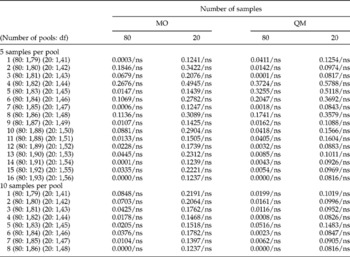
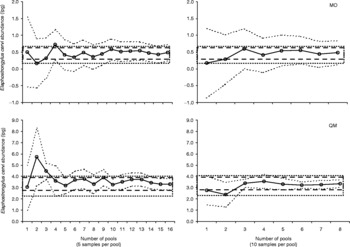
When pools of both 5 and 10 random samples were created, there was no significant difference in excretion abundance (P > 0.05) compared to the overall mean (table 1). In both study sites, the analysis of 5 pools of 5 pellet groups each, or of 4 pools of 10 pellet groups each, already provided a reliable estimation of the ‘true’ excretion abundance estimated by the analyses of all the 80 samples, since the mean abundance of each of the pool sizes fell within the 95% confidence interval for both 20 and 80 individual samples (fig. 2). Differences in estimated mean excretion abundance (for 5 pools of 5 pellet groups and 4 pools of 10 pellet groups, respectively) were 12 and 15% for MO, and 6 and 6% for QM. In the same way, the differences in the errors were 50 and 55% for MO, and 24 and 32% for QM. When compared to the analysis of 20 randomly selected pellet groups, differences in estimated mean excretion abundance (for 5 pools of 5 pellet groups and 4 pools of 10 pellet groups, respectively) were 14 and 10% for MO, and 6% and 19 for QM. Similarly for the errors, the differences were 10 and 24% for MO, and 60 and 64% for QM (fig. 2).
Statistical tests (F value/P) when comparing the differences between E. cervi L1 mean abundance for n=80 and n=20, respectively, against randomly pooled samples of both 5 and 10 samples, respectively.

ns, Not significant at P ≤ 0.05.
Mean abundance of E. cervi L1 (lpg) in relation to increasing number of analysed pools. Results are displayed for pools of 5 and 10 faecal samples in both localities (MO and QM). Standard errors are represented within a 95% confidence interval with dotted lines. The rectangles represent the standard error obtained with n = 80 samples (discontinuous frame) and n = 20 samples (dotted frame), respectively.

Discussion
Our results confirm that sample sizes around 20–30 are enough to calculate E. cervi excretion prevalence in red deer in Mediterranean habitats. Similar sample sizes have already been used in studies of seasonal variation in parasite excretion rates (Vicente et al., Reference Vicente, Fernandez de Mera and Gortázar2006). Faecal surveys are a reliable and cost-effective method to determine prevalences and excretion abundances of certain parasites, which can be used in non-invasive studies of wildlife. However, for large-scale assessments, standardization of the surveys may be necessary to reduce the time spent in the field and laboratory. Although assessment of the presence of faecal stages is not a perfect tool for estimating prevalence and intensity of adult parasites, such information is very valuable for exploring the magnitude and general distribution of parasite infection and for studying comparable indexes of parasite infection with large numbers of samples across extensive areas and a high number of populations (Vicente et al., Reference Vicente, Fernandez de Mera and Gortázar2006).
Pooling of the samples enables a reliable estimation of excretion abundance with only 4–5 analyses. The reliability of the pool method for this parasite–host system in different situations should be interpreted in the context of the study area. In favour of the reliability of estimates of excretion figures to be expected with the pool method in other populations, we note that for the estate (QM) which presented with a higher abundance and prevalence of faecal E. cervi L1, the confidence intervals for abundance were closer and converged sooner to the confidence intervals for 20 and 80 samplings compared to the estate with lower (MO) excretion figures. Based on Vicente et al. (Reference Vicente, Fernandez de Mera and Gortázar2006), E. cervi L1 excretion was widely spread across the red deer population of the study area. About 78% (14 out 18) of the studied populations presented prevalences of E. cervi L1 excretion above the prevalence found in this paper for QM, whereas only 9% (2 out of 18) of the estates presented prevalences below the prevalence described in this paper for MO.
In summary, the advantages of using a pool sampling survey for faecal E. cervi L1 in Spanish red deer are the ease of access and low costs in terms of effort. One disadvantage of pool methods is the difficulty and effort needed to accurately calculate the prevalence, and therefore the intensity (maximum likelihood methods; Williams, Reference Williams2001). This point should be evaluated for each specific parasite–host system. For example, abundance estimations result in good indexes of parasitism when parasites are relatively widespread among hosts. When the target of the study is the degree of spread of the parasite among individuals of the populations, individual analyses prove more adequate. Excretion abundance fits better to ecological studies since this index combines excretion prevalence and excretion intensity.
By randomly creating pools of data, this study was able to achieve results regarding excretion abundance that were not statistically different from the combined sample data (5 analyses versus 80). A pool-based method for monitoring ungulates in south-central Spain is proposed which will facilitate future research and management efforts. There is a need to generate large-scale information for red deer, a keystone species (Power et al., Reference Power, Tillman, Estes, Menge, Bond, Mills, Daily, Castilla, Lubchenco and Paine1996), which is becoming even more relevant due to an apparent increase in its populations across their distribution areas in the Palaearctic, and subsequent ecological impact and risks to animal and human health. This information will be beneficial for future research of the relationship between population density and fitness in deer, as well as for potential management issues.
Measures of performance in wild ungulates must consider parasitic rates along with estimates of population density (Sams et al., Reference Sams, Lochmiller, Quails and Leslie1998). Standardized parasite counts would be an useful index of population density–carrying capacity relationships or response to intensive management. In many cases, information about changes or trends is easier to obtain than absolute estimates and may be a sufficient basis for management decisions. Similarly to studies of E. cervi and red deer, other key indicator parasite species may be useful for monitoring the health of other wildlife populations on a large scale (Böhm et al., Reference Böhm, White, Daniels, Allcroft, Munro and Hutchings2006). Such long-term monitoring needs to be easily and reliably carried out, according to standard protocols.
Acknowledgements
We are deeply indebted to all the gamekeepers of both study areas. This is a contribution to project PREG-05-19, Junta de Comunidades de Castilla-La Mancha and to the agreements between Yolanda Fierro and the UCLM, and between Ministerio de Agricultura, Pesca y Alimentación, the Organismo Autónomo de Parques Nacionales and the CSIC. This is a contribution to the memorandum of agreement (MOA) between Texas A&M University and Universidad de Castilla-La Mancha. Jordan Tayce received a grant from Texas A&M University Summer Veterinary Student Research Fellowship Program and additional funding from the McMillan Endowment. Pelayo Acevedo enjoyed a postdoc grant from the Junta de Comunidades de Castilla-La Mancha.