

The true meaning of the word ‘inclusive’ when it comes to educational settings is more than just students with disabilities physically sitting in class with their peers. It means that through the development of strategies that provide equal opportunity for all students in inclusive community schools, all students have equal access to the curriculum and learning activities (UNESCO, 1994). This may be accomplished in several ways, such as differentiating instruction, physically modifying the environment, and by providing supports for these students (Australian Government Department of Education and Training, 2015). Schools in Australia are bound by the Disability Standards for Education (DSE) to ensure that all students with disability can access and participate in education on the same basis as other students (Commonwealth of Australia, 2006). However, the DSE is not prescriptive as to how this should be accomplished (Australian Government Department of Education, Employment and Workplace Relations, 2012).
Unlike other countries, such as the United States, there is no federal mandate that students with disabilities in Australia have an individualised transition plan for postschool transitions. Many schools, particularly special schools, recognise the provision of these planning documents as best practice, and the Nationally Consistent Collection of Data on School Students with Disability (NCCD; Department of Education, 2019) and its accompanying resources, such as the Planning for Personalised Learning and Support: A National Resource (Australian Government Department of Education and Training, 2015) have recently provided schools and teachers with guidance in those areas. Despite this, there are claims in the literature that students with autism and intellectual disabilities placed in inclusive educational environments do not receive the full range of supports, including instruction in life skills, that are accorded to them in segregated special settings (Pellicano, Bölte, & Stahmer, Reference Pellicano, Bölte and Stahmer2018). This includes the preparation for the various transitions that students experience throughout their schooling (Brede, Remington, Kenny, Warren, & Pellicano, Reference Brede, Remington, Kenny, Warren and Pellicano2017).
All children and young people experience a number of transitions throughout their schooling years (e.g., moving from home to school, primary to high school, and from high school to adult life), but those with autism and intellectual disabilities often find these transitions more challenging than their typically developing peers do (Strnadová, Cumming, & Danker, Reference Strnadová, Cumming and Danker2016). They also typically experience more transitions than their peers, such as the transitions into and out of special schools or segregated classrooms in mainstream schools. The importance of supporting students with autism and intellectual disabilities through diverse schooling transitions cannot be understated, given the alarming postschool outcomes of this population, including being less likely to be employed and living in poverty, compared to any other group of people with disabilities (Siperstein, Parker, & Drascher, Reference Siperstein, Parker and Drascher2013). Research throughout the past few decades has provided a solid evidence base that promotes effective transition practices for students with these disabilities (Strnadová & Cumming, Reference Strnadová and Cumming2016). The cornerstone of these practices is planning for transitions early. Although transition planning is not federally mandated in Australia as it is in other countries (Authors, 2016), timely and careful planning of schooling transitions for students with disabilities is still considered to be best practice (Forlin, Chambers, Loreman, Deppler, & Sharma, Reference Forlin, Chambers, Loreman, Deppler and Sharma2013).
Although transition planning for students with autism and intellectual disabilities attending special schools has been researched in Australia and beyond, there is a limited body of knowledge about transition planning and procedures in place for students with these disabilities in mainstream schools in Australia. The current study aimed to close this gap by examining transition practices in New South Wales (NSW) inclusive classroom settings, and by mapping these against the Taxonomy for Transition Programming 2.0 (the Taxonomy; Kohler, Gothberg, Fowler, & Coyle, Reference Kohler, Gothberg, Fowler and Coyle2016), which is the conceptual framework for this study.
Model of Practice
The Taxonomy (Kohler et al., Reference Kohler, Gothberg, Fowler and Coyle2016) provides a research-based model of practice to support multidisciplinary teams (student, family, teachers, and other practitioners if relevant) in planning, organising, and evaluating the transitions of students with disabilities. The Taxonomy provides best practice suggestions that can be adjusted for various transitions and contexts. The Taxonomy consists of five primary practice categories: (a) student-focused planning, (b) youth development, (c) family engagement, (d) program structures, and (e) interagency collaboration. Figure 1 provides an illustration of the five categories, along with practices that belong under each.
Taxonomy for Transition Programming 2.0 (Kohler, Gothberg, Fowler, & Coyle, Reference Kohler, Gothberg, Fowler and Coyle2016). IEP = individualised education program.

The area of student-focused planning provides lists of evidence-based practices in the areas of individualised education program (IEP) development, planning strategies, and student participation. Integral to all three areas is the idea of student-centredness (e.g., involving students in all facets of transition planning and practice). This includes considering their preferences, hopes, and dreams when planning, and facilitating their self-determination throughout the process. Services and supports should be appropriate and integrated. To effectively integrate services, the responsibilities of stakeholders should be specified, along with how their fulfilment will be evaluated. Communication and collaboration are the keys to effective planning and implementation (Carter, Brock, & Trainor, Reference Carter, Brock and Trainor2014).
Other practices in the Taxonomy area of youth-focused planning that are well aligned with a multisystemic approach include setting adequate time aside for IEP and transition planning meetings and engaging relevant stakeholders. The importance of the young person being referred to an adult service provider(s) prior to leaving school is also suggested.
In the Taxonomy area of youth development, a multisystemic approach is recommended to support youths through partnerships with community-based service providers such as social services, mental health, and law enforcement. Practices in the area of family engagement that support this approach include (a) families participating in service delivery, (b) families as natural support networks, (c) providing support for families to engage youth in community experiences, and (d) linking families with adult service providers during transition planning (Kohler et al., Reference Kohler, Gothberg, Fowler and Coyle2016). The family must be viewed as an integral part of the transition planning team. Strnadová et al. (Reference Strnadová, Cumming and Danker2016) propose that parents seldom receive guidance on how to participate in the transition process or on how to advocate for their child. Many parents may distrust system professionals due to their own unpleasant history with one or more of the following: education, juvenile justice, mental health, social workers, or family court. Family involvement can be fostered by (a) arranging meetings around parents’ work schedules, (b) involving parents in transition planning, (c) providing training for court personnel on working with families, (d) integrating parent advocates into the system, (e) encouraging parent training, and (f) efficient exchange of information, such as school records (Strnadová & Cumming, Reference Strnadová and Cumming2016).
Best practices included under Kohler et al.’s (Reference Kohler, Gothberg, Fowler and Coyle2016) Taxonomy areas of program structure and interagency collaboration support the use of wraparound services. Many young people are involved in more than one system, such as education, health, child welfare, and juvenile justice, and require more planning in the area of transition to ensure that all issues from all systems are addressed and a plan for permanency is developed (Bertram, Suter, Bruns, & O’Rourke, Reference Bertram, Suter, Bruns and O’Rourke2011). Kohler et al. (Reference Kohler, Gothberg, Fowler and Coyle2016) suggest strategic planning includes multiple stakeholders from relevant education, agency, and community partners, as well as an alignment of policies and procedures among providers to address gaps and reduce the duplication or omission of a young person’s transition services across sectors. Another important practice in this area is resource development and allocation. Allocating resources, such as staffing and funding, in a flexible manner facilitates a wraparound model, providing professionals with the time necessary for collaboration and planning (Schurer Coldiron, Bruns, & Quick, Reference Schurer Coldiron, Bruns and Quick2017). Allocating time for collaboration has been identified in the literature as a priority for successful wraparound services for students with disabilities (Bruns, Reference Bruns, Bruns and Walker2015; Eber, Malloy, Rose, & Flamini, Reference Eber, Malloy, Rose, Flamini, Walker and Gresham2013; Schurer Coldiron et al., Reference Schurer Coldiron, Bruns and Quick2017).
A review of the literature revealed a lack of research investigating the transition experiences of students with autism and intellectual disabilities in mainstream schools in Australia. The present study aimed to contribute to the current transition literature by discovering what transition planning and programming was being implemented for students with autism and intellectual disabilities enrolled in mainstream classes in government schools in NSW, Australia. It also looked at how these practices were aligned with best practice, by mapping these practices to the five categories of the Taxonomy. The Taxonomy was chosen as the transition model for this study, as it is based on the latest research on postschool outcome predictors, transition planning strategies and practices, and vocational rehabilitation services focused on fostering the successful transition of youth with disabilities in postsecondary education and employment (Kohler et al., Reference Kohler, Gothberg, Fowler and Coyle2016).
Research Aims
Although the Taxonomy encompasses the best practices in transition planning and programming, schools may use some but not all of the practices suggested within each category. Thus the overarching aim of the research study was to investigate the current transition planning and procedures for students with autism and intellectual disabilities who were placed in mainstream settings. Specifically, the researchers sought to answer the following question:
How are the current transition planning and procedures for students with autism and intellectual disabilities placed in mainstream settings aligned with the Taxonomy for Transition Programming 2.0, according to the perceptions of parents and teachers?
The answer to this question was determined by interviewing parents and teachers and using a combination of inductive and deductive content analysis methods.
Method
Participants and Setting
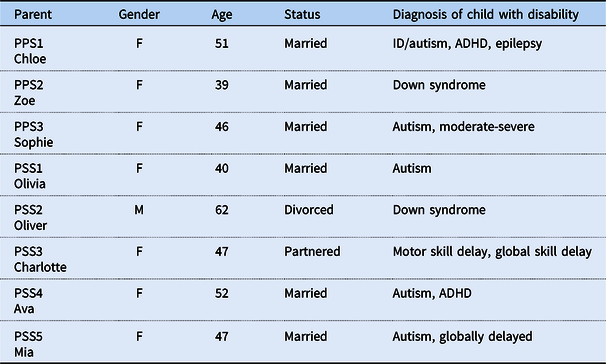
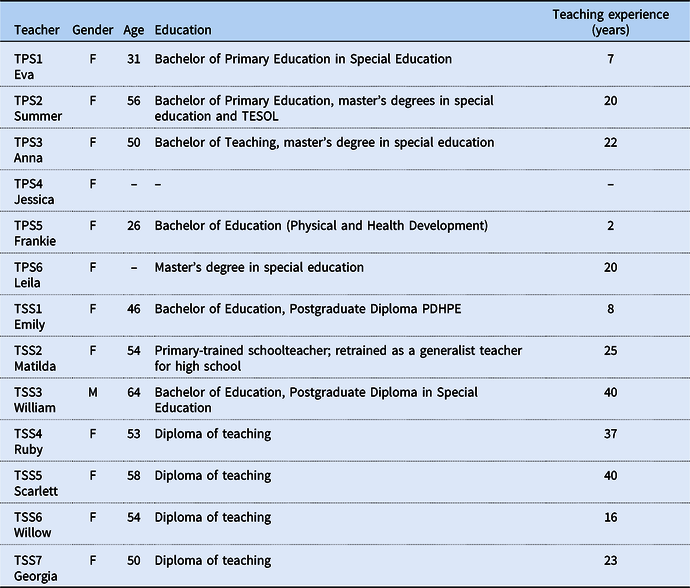
The participants in this study were eight parents (seven mothers and one father), and 13 teachers (one male and 12 females) from four primary and four high schools in NSW. The age of participating parents ranged from 39 to 62 years, with an average age of 48 years. Their children ranged in age from 11 to 19 years, with an average age of 15.13 years (see Table 1 for parent participant demographics). Two of the participating teachers did not feel comfortable with sharing their age; the age of the remaining teachers ranged from 26 to 64 years, with an average age of 49.27 years. The participating teachers had an average of 22.1 years of teaching experience (see Table 2 for teacher participant demographics).
Parent Participant Demographics

Note. ID = intellectual disability; ADHD = attention-deficit/hyperactivity disorder; PPS = parent with child in primary school; PSS = parent with child in secondary school.
Teacher Participant Demographics

Note. TPS = teacher in primary school; TSS = teacher in secondary school; – = participant declined to provide information.
Procedure: Semistructured Interviews
Ethics approval for the study was provided by the authors’ affiliated university and the NSW Department of Education. The authors randomly selected four mainstream schools in Sydney and emailed school principals, inviting them to take part in the study. All four schools agreed to participate. The authors met with school principals and explained the study. The principals approached parents and teachers with a letter explaining the study, then signed consent was obtained from all who agreed to participate.
The authors developed two semistructured interview protocols (parents and teachers), based on Kohler et al.’s (Reference Kohler, Gothberg, Fowler and Coyle2016) Taxonomy and a review of literature on transition planning. The interview protocol comprised 17 questions for parents and 16 questions for teachers, with several demographic questions (interview protocols are available upon request from the corresponding author). Each interview lasted an average of 29 minutes.
The interviews were conducted by the first two authors in person, via Skype, or via phone, according to the participants’ preferences. The interviews were audio-recorded with the permission of participants and transcribed verbatim. In line with qualitative research, all transcripts were deidentified, and participants were allocated pseudonyms.
Data Analysis
The second author listened to all audio-recorded interviews to confirm the accuracy of the transcripts and corrected a few inconsistencies. The interviews with parentsFootnote 1 and teachers were analysed using inductive content analysis (Elo & Kyngäs, Reference Elo and Kyngäs2008). For the purpose of data analysis, a coding unit was words, sentences, or paragraphs ‘containing aspects related to each other through their content and context’ (Graneheim & Lundman, Reference Graneheim and Lundman2004, p. 106). The second and third authors independently coded one parent interview and one teacher interview. They then compared the results of their coding and resolved any differences. Once an agreement was reached, the third author conducted open coding of all remaining parents’ interviews, and the second author conducted open coding of all remaining teachers’ interviews, reading all interviews line by line and identifying initial codes. There were in vivo codes (actual words of participants that describe the code itself) noted in this process (Corbin & Strauss, Reference Corbin and Strauss2015). The second author then checked the results of the open coding phase for accuracy of coding, carefully reading the open coding results, as well as reading through all of the transcribed interviews. All three authors met several times to verify the results of this coding phase and any disagreement was resolved through discussion.
The authors then refined and clustered the emerging codes and categories into themes, following the ‘emergent nature of qualitative research methods’ (Hodgetts, Nicholas, & Zwaigenbaum, Reference Hodgetts, Nicholas and Zwaigenbaum2013, p. 168). The evidence for an established theme was confirmed by triangulation of ‘memos, codes, frequency of occurrences, and interview quotes’ (Hodgetts et al., Reference Hodgetts, Nicholas and Zwaigenbaum2013, p. 168).
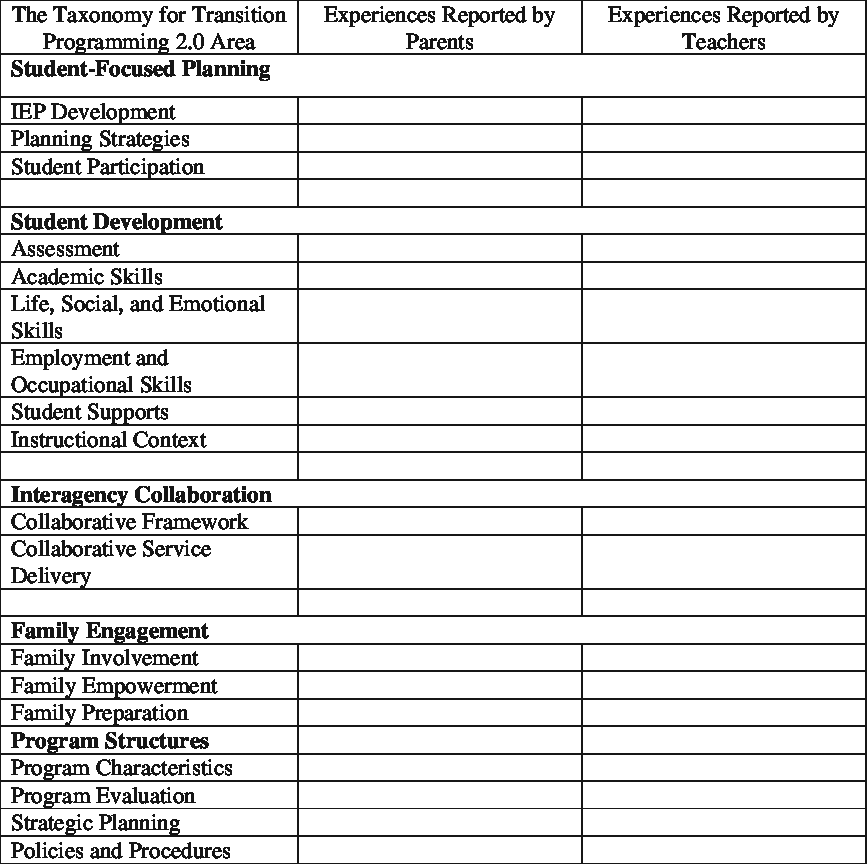
Lastly, the first author used deductive content analysis to determine the answer to the research question. This method is appropriate for examining the phenomenon of interest in regard to an existing conceptual framework (Mayring, Reference Mayring2014). A table was constructed with the five areas and practices of the Taxonomy (see Figure 2). The first author then used the themes as a guide to pick out practices mentioned by both teachers and parents as being present or needed and matching each with a Taxonomy area. The second author then reviewed the table and any disagreement was resolved through discussion. This provided a full picture of how the perceived transition practices aligned with the Taxonomy. The involvement of all authors in every step of the data analysis enabled triangulation and peer checking (Brantlinger, Jimenez, Klinger, Pugach, & Richardson, Reference Brantlinger, Jimenez, Klinger, Pugach and Richardson2005; Rodger, O’Keefe, Cook, & Jones, Reference Rodger, O’Keefe, Cook and Jones2012).
Coding Table. IEP = individualised education program.

Results
The researchers sought to discover whether the transition practices reported by parents and teachers were aligned with the Taxonomy. Although the Taxonomy was originally intended to be used for the transition from high school to postschool life, its areas and examples are also relevant to the transition from primary to high school, and thus it has been applied to both transitions in the current study. A summary of current transition practices in relation to the Taxonomy is presented as follows.
Student-Focused Planning
The first practice within the student-focused planning area is IEP development. Parents did not mention IEPs often, with three parents stating that their children had only had one IEP meeting, and one acknowledging a need for more: ‘You really need one at least twice a year. Maybe one every term’ (Oliver). One parent also recognised the importance of transition planning being part of that meeting. Teachers, on the other hand, mentioned both IEPs and transition plans more frequently, with Anna stating that IEPs are important as, ‘the individual education plan guides the targets’. Teachers agreed that transition planning typically starts in their schools in Year 9 or Year 10. Four teachers experienced a team approach to transition, and three mentioned that parents were involved in the transition meeting.
Transitioning from primary to high school
Planning strategies for the transition from primary to high school that were discussed by parents were visits to the receiving school, camp, and orientation day. Two parents were satisfied with the preparation for this transition, and two felt the need for more preparation. This could be due to the different needs of specific students and their families, or variations in support from one school to another. Many teachers (seven) acknowledged the need to plan early for the transition to high school, and three felt that transitions from primary to high school were not addressed at their schools. Speaking to students about the transition to high school was considered an important part of the transition planning process by five teachers. Frankie summed it up: ‘Talk to them, read them Social Stories … where they can become familiar with the new setting that they’re going to be in’.
Three teachers felt that there were good transition practices between primary and high schools, but another acknowledged that it is logistically difficult for both primary and high schools to cater for the transition to high school. Three teachers put the onus of this transition on the high school staff, stating that they initiate the transition process and visit the student in his or her primary class to observe them. Six teachers spoke of planning for the students to visit the high school the year before. Two teachers stated that they had supported students in transitioning from support units in primary school to mainstream classes in high school, and a greater number (five) had prepared students to move from a mainstream primary classroom to a special unit in a high school.
Transitioning from high school to postschool life
There were many more practices mentioned to prepare students with autism and intellectual disabilities in inclusive school settings for the transition to postschool life. Parents spoke about the need for this transition to be planned well in advance and be gradual. Paid employment was mentioned as both a goal and a transition practice. Parents also spoke of visits to sheltered workshops and community organisations that acted as transitional agencies. One parent expressed concern over the lack of supported housing:
… and we’ve looked into housing. There’s been a couple of programs where some companies buy into a housing project and get some commonwealth funding as well, and they develop them up to become a sort of share rental accommodation for kids with disabilities or adults with disabilities, and it’s all taken care of in their pension payments. But it’s hard to get those. (Oliver)
Teachers mentioned more planning strategies than the parents, and the majority (seven) felt that transition planning was important. One alluded to the importance of parental involvement in planning, particularly around sharing information. Three teachers described an individualised approach to transitions.
All of the teachers spoke about transition planning processes in regard to the transition to postschool life. One teacher said that these processes start early, and two others agreed, stating that transition planning begins in Year 9, and a transition planning meeting was held each year. Teachers spoke about teacher and parent involvement in planning for and student participation in work experience. Teachers felt that they needed more time for transition planning and more knowledge about postschool options. Only one teacher spoke of the role of the transition support teacher: ‘… my role is to talk about what is available, so my main aim is work experience’ (Willow).
According to parents, student participation in the transition planning process was limited; only two parents experienced their child’s participation in planning meetings, and two others expressed concern over the lack of student participation. These parents felt that students needed more support in transition planning preparation, self-determination, and how to participate in meetings and decision-making.
Only three teachers talked about students being part of the transition team. Five teachers indicated that student participation in planning did not involve being present in formal transition meetings but consisted of conversations about transition with the teachers. Two teachers discussed how they elicited students’ input and preferences for work placements. Five teachers described using Social Stories as a means to support student understanding of the transition process. Areas of need during transition planning included integration activities to foster the students’ need for a sense of belonging, support for friendship development, and assessing students’ independence.
Student Development
Assessment is an important part of the transition planning process for any school transition, and sits under the area of student development. Alarmingly, it was the least discussed topic for both parents and teachers. Only one teacher mentioned assessment, and it was in regard to assessing students’ independence. Only two parents spoke about assessment, and they talked about strengths and needs assessment for the IEP meeting, vocational skills assessment, and the Higher School Certificate assessment. Academic skill development was referenced by parents and teachers in regard to the transition from primary to high school, whereas life, social, emotional, and employment/occupational skills were spoken of in regard to the transition from high school to postschool life.
Academic skills
Although the students referenced in the present study were all attending inclusive school settings, parents felt that academically their children’s needs for basic skills instruction, including notetaking and handwriting, were ignored, resulting in them being unable to keep up in class and contributing to a widening gap academically when compared to same-age peers transitioning from primary to high school. Olivia offered her opinion: ‘They need to concentrate on getting the basics. Getting them to learn reading, writing, maths …’. Two parents felt the need to provide their children with tutoring outside of school to remedy this situation. One parent was happy that her son was being taught a life skills curriculum; another felt this was not appropriate and wanted his son to participate in the Australian Curriculum (https://www.australiancurriculum.edu.au).
Two of the teachers interviewed spoke about the more gradual academic progress made by students with disabilities in mainstream settings, and remarked that mainstream high school subjects could be difficult for these students at first. A majority of the teachers echoed parents’ feelings about the importance of functional academic skills, as a lack of these affect students’ ability to fit into mainstream classes. One teacher explained that it was not unusual for students with autism and intellectual disabilities to attend mainstream classes for some academic subjects and the special unit for others. Another stated that academic skills were an important part of individual transition plans (ITPs), particularly for the transition to high school: ‘it’s hard to get away from just the academic focus, which is that you want them to go to high school literate and numerate, if nothing else’ (Summer).
Life, social, and emotional skills
As the majority of students in mainstream classes are following the Australian Curriculum, it is important to plan instruction in life, social, and emotional skills for those students with disabilities who require support in these areas (https://www.australiancurriculum.edu.au). Parents felt that there was a need for instruction in the areas of (a) independent living, (b) verbal skills, (c) cooking, (d) shopping, (e) travel, (f) social skills, and (g) self-regulation skills. Five parents revealed that their children received instruction in those areas from the support unit, as they were only attending mainstream classes part time. One parent was happy with this experience and related how it had transferred to his son’s everyday life:
I really like the cooking and the food technology stuff, where they go shopping because he’s doing my shopping … He knows what I want to get, it’s just that he usually takes off and I can’t find him, and then he comes back with it all. So that’s worked well, and the cooking stuff that he’s done is important. (Oliver)
Two parents accessed external organisations to support their children in learning life skills, and another recalled that those skills were taught during respite care.
Although teacher participants shared the same views as parents as to the types of skills that students should be supported in acquiring, they did so from life skills and transition perspectives. Four teachers discussed the need to emotionally prepare students for transition. The majority of teachers felt that teaching independence was critical but that parents are (and should be) the largest contributors to children’s independence. Two teachers felt that parents of students with autism and intellectual disabilities often ‘mollycoddled’ their children. Interestingly, parents did not mention technology to support the acquisition of these skills, but eight teachers mentioned using technology in different ways to support transition; for example, iPads for communication (Matilda, Frankie), Social Stories, and other transition activities (William); using a mobile phone for emergencies (Ruby), social networking, and travel (Georgia); and using a calculator (Scarlett). This may point to a disconnect between supports used at school and home.
Employment and occupational skills
In terms of employment and occupational skills, both parents and teachers spoke about how support was provided to assist students in gaining these skills. Work experience programs were mentioned by only one parent but by the majority of teachers. Two parents spoke of transitional agencies that provided vocational assessment and skills training. Parents also voiced their worries and concerns, with two worrying that technology skills would likely be required for paid employment, one concerned that his child’s special education background would limit employment possibilities, and one forecasting that her child would need employment with a set routine in order to be successful.
Teachers recognised the importance of advance preparation for transition to work. Two claimed that their school focuses on preparing students for postschool life, and three stated that this preparation begins in Year 9 or 10. In addition to work experience, teachers spoke of TAFE (vocational) courses, Disability Australia workshop training, group work placement, and interim employment positions as vehicles for students with disabilities to learn employment and occupational skills. Three of the teachers recounted that students are prepared for work experience prior to it occurring: ‘a lot of the subjects they do are very much around getting a job, and social skills, workplace relations, role-playing, all that kind of thing they do’ (Ruby). Teachers also highlighted specific work skills that were taught as part of transition preparation: technology skills, employment social skills, and developing a CV. Three teachers spoke of teaching these skills, and one revealed that some students attend mainstream vocational education courses.
Student supports
Although the Taxonomy (Kohler et al., Reference Kohler, Gothberg, Fowler and Coyle2016) lists examples of student supports that relate directly to transition, the parents interviewed for this study tended to speak of student supports in more general terms, mostly about how they related to the students being placed in both primary and secondary mainstream classrooms. Parents spoke of various settings that their children had participated in, including a special school (one), support units in mainstream schools (four), small classes (two), and a small school (one). Two parents were unhappy with what they perceived to be a lack of support for their children in mainstream classes and during unstructured times such as lunch and recess. Four parents believed that they were the greatest form of support that their children received. One parent described the necessity and expense of accessing private support. Three parents bemoaned the fact that punishment was more prevalent than behaviour support at their children’s schools.
The majority of the parents mentioned various types of support provided to their children, including (a) teacher aides, (b) teacher support, (c) mobile technology, (d) incorporation of routines, (e) employment support, (f) visual supports, (g) medication, (h) peer support, (i) travel support, (j) feeding support, (k) medical support, and (l) monetary support. It should be noted that the parents who mentioned support for transition were split, with two reporting good support and two others reporting a lack of support. One parent felt that support for the transition to postschool life would be improved if a case manager coordinated services: ‘I think we need a really good case manager, who knows what services are there’ (Zoe).
Teachers described a variety of supports available in their settings for students with disabilities when preparing for and during the transition to postschool life. Support for behaviour was a priority for three teachers. Individualising work placements to meet the needs of students involved several supports, including collaborating with employers, teachers, or aides supporting students on the job, modifying the physical environment, and providing students with a sense of structure and belonging to ease anxiety. Teachers expressed concern about not having enough time to support students with work experience and that students typically did not know how to access support at TAFE or university.
Instructional context
Parents described a diversity of experiences in the area of instructional context. In terms of school placements, transitions were mentioned from preschool, one support unit to another, small class to a large class, to primary school, and from one to many teachers. One parent expressed concern that mainstream school was unsuited for students with disability, particularly in high school where students have to change classes and there was a confusing lack of routine. Another parent spoke of the difficulty that teachers experience catering to a wide variety of student abilities:
Because the range of abilities in the class are so big that there’s no way one teacher and one aide can address it all, so how do you teach so many children with such a range of issues? (Olivia)
When parents discussed the contexts in which their children received their education, they ranged from early learning programs to postschool settings such as sheltered workshops and TAFE. One parent surmised that practicalities determine school choice due to the lack of schooling options in the area and the supports offered in some schools.
Another parent suggested that the transition from primary school to high school would be greatly facilitated by ensuring there were familiar peers in the class. Two parents spoke of the value of community-based instruction and camps. One parent found that in her daughter’s experience, TAFE courses were well suited to students with a disability, thus making this a viable postschool option for vocational training.
Teachers spoke very little of specific instructional contexts. About half of them mentioned visits to the receiving school when transitioning from primary to high school, and two expressed the belief that small schools provide a better transition. Anna commented:
They were isolated in their own high school for whatever reason: their disability, or because they were different, or refusing to go to school … they’d come to our school, because we were a smaller school, and we were there, basically, to meet their needs. (Anna)
Interagency Collaboration
Parents generally felt that they were part of a collaborative process in planning for their children’s transitions, but two of them expressed dissatisfaction that their children were not part of the collaboration framework or involved in the transition process at all. For example, Zoe described her family’s experience: ‘No-one was even looking at the student, or having these small chances where the teachers can meet her — it just doesn’t work. They’ve got to meet the student’. The majority of parents (seven) appreciated the importance of mutual support between home and school and discussed team planning and problem-solving.
Although some parents (four) indicated that there was a lack of collaborative framework and information-sharing protocol, others indicated that there were good collaboration processes between primary and high schools. Postschool transitions were cited as more collaborative; three parents mentioned good collaboration and planning between schools, families, and outside support organisations, with two experiencing a wraparound model for their children’s transition from high school to postschool settings. Parents experienced support through meeting with outside support organisations and obtaining referrals from one organisation to another.
A team approach to transitions was experienced by four of the teachers, with multidisciplinary teams, collaboration among staff, collaboration with TAFE, and collaboration among school, home, and the workplace given as examples. One teacher was fortunate enough to have dedicated time allocated for information sharing. Teachers also spoke about their collaboration with outside stakeholders, such as employers and service providers. One teacher felt that there needed to be better communication between employers and teachers.
Teachers appeared to have a similar experience to parents, citing less collaboration during the transition from primary to high school. Four high school teachers attributed this to a lack of time to visit the primary school and collaborate, although three explained that they visited the primary school to observe students in that setting before their transition to high school. Primary teachers voiced concern that once their students transitioned to high school they did not receive feedback on how they were doing. The one area of collaboration that appeared to be strong for this transition was collaboration to arrange students’ visits to high school, with six teachers mentioning it during their interviews.
Family Engagement
The importance of family involvement in their children’s education, and more specifically transition planning, is well documented throughout the literature (Ankeny, Wilkins, & Spain, Reference Ankeny, Wilkins and Spain2009; Beamish, Meadows, & Davies, Reference Beamish, Meadows and Davies2012). In the present study, this engagement was viewed through the three lenses of the Taxonomy (Kohler et al., Reference Kohler, Gothberg, Fowler and Coyle2016): family involvement, family empowerment, and family preparation.
Family involvement
All eight of the parent participants interviewed expressed the belief that parents and teachers should be a team. Six of the parents were satisfied with their communication with schools as well as the level of their involvement. The most common form of communication with schools mentioned by 75% of the parents was communication books or diaries. Other communication modes included text messages, phone calls, notes, videos, face-to-face meetings, and photos.
The family members interviewed for this study listed many ways that they perceived they were involved in the transition process. Two of the interviewees who had children attending high school stated that the school did not involve parents in the transition process, that there was less involvement in high school than primary, and any communication was initiated by the parent. Others spoke about being involved in IEP meetings (five) and orientation (two). Charlotte spoke about the advantages of enrolling her daughter in a smaller school: ‘I look at how I am with a smaller school. I know my daughter’s got friends at [a bigger school], and the parent–teacher relationship isn’t as good as what we have here’.
All of the teacher participants stressed the importance of school–home collaboration and parent involvement. The teachers had a different perspective than the parents on the topic of parent involvement, with five of them stating that teachers needed to work with parents to adjust their expectation of their child’s ability, which was often either unrealistic or too low. They also voiced the opinion that the level of parent involvement depended on the parents’ wishes. The majority of teachers (11) felt that facilitating communication with parents was one of their professional responsibilities, and that this was especially true during transitions, when family involvement was most important. For example, Anna spoke about parent involvement during the transition to high school: ‘… but I think it’s really important that the parents are involved in going to the high school with the child, and being seen to be there’. Matilda spoke about parent involvement in the postschool transition planning process:
We have ITP meetings at the beginning of every year, where we sit down and the classroom teacher with the student, and the parents or caregiver, and we talk about goals that we want them to achieve for the year, and that’s an individual plan which we do.
Family empowerment
Georgia cited the fact that although some parents had difficulty planning for postschool life, if they started planning early, they often enjoyed the process. Two teachers had negative experiences in regard to parent involvement, saying some parents were unsupportive and did not turn up for transition planning meetings or support their child’s independence. Parents recognised this trait in themselves at times, discussing the need for friendship and empowerment from teachers, as school can be intimidating for parents, and sometimes it was difficult to allow their children to be independent, as they were afraid for their welfare. Every parent participant spoke of the need to be empowered enough to advocate for their children. For example, Olivia expounded, ‘We’re the voice for the kids, and if we don’t speak for them, they’re not going to be able to do it’. Three parents were grateful that schools had referred them to support services outside of the school and assisted them with choosing schools and/or programs for their children.
Teachers felt that they could empower parents by making them comfortable and fostering open communication. They also perceived that parents seemed more empowered when they were involved in their children’s education, transition process, IEP meetings, and work placement decisions. The teacher participants talked about fostering parental empowerment through involvement, open nights, access to the school, the provision of information, and early planning.
Family preparation
The parent participants felt that schools prepared them for transitions in many different ways, starting with individualising advice and planning by getting to know the family and their individual situation. Several parents were unaware of what types of transition supports were available, and desired more information in this area. Three of them suggested that schools collaborate with outside service providers to ensure services were coordinated across sectors. Some parents cited difficulty in this area, saying they had to establish support on their own.
According to the teacher participants, parents were prepared for their children’s transition from primary to high school through IEP meetings, support in choosing a high school, visits to the schools with the opportunity to meet the high school teachers and specialists, and information about the receiving school’s philosophy on support and inclusion. Teachers felt that families were prepared for postschool transitions via involvement in the IEP, ITP, work placements, open nights, and expos. Overall, both types of participants were mixed in their experiences of and satisfaction with family involvement in the various school transition processes.
Program Structures
The last area of the Taxonomy, program structures, consists of (a) program characteristics, (b) program evaluation, (c) strategic planning, (d) policies and procedures, (e) resource development and allocation, and (f) school climate. Parent participants tended to describe the characteristics of the mainstream education programs their children were involved in with negativity. The issues discussed included excess assessment, student not learning, lack of individualised and differentiated instruction, large class sizes, and lack of teaching excellence. The characteristics of high school that make it more confusing and difficult than primary school were mentioned by Oliver and Chloe, who felt that high schools had too many exclusionary discipline practices, were too big for students with disabilities, and were unable to accommodate students with high medical support needs.
Teachers, on the other hand, had inverse opinions of how their mainstream schools accommodated students with disabilities, citing a team approach, particularly around transitions, which involved teachers, teacher aides, transition support teachers, and counsellors. They shared the belief that smaller schools served students better, particularly during transitions. One teacher also felt that transition is easier when students are in a support unit rather than mainstream classes; another spoke of the transition supports available to all students in the inclusive classroom setting: ‘in the mainstream they do quite a few vocational subjects [like] industrial arts and hospitality courses’ (Ruby).
Neither parent nor teacher participants mentioned anything remotely related to program evaluation for any school transitions. This may be due to a lack of consistent policy and procedures in the area of transition planning in NSW government schools or simply that the participants who were interviewed were not involved in evaluating any of the programs. In fact, when discussing the area of policy, both parents and teachers mentioned things that were needed or needed to change. Parents demonstrated disappointment with the lack of policies to support students with autism and intellectual disabilities, particularly in the area of discipline, where students are subject to exclusionary practices such as removal from the classroom and suspension. Both groups of participants recognised the need for better information sharing procedures between schools and between school and family.
Another area where participants were in agreement was resource development and allocation. Half of the parents and nearly all of the teachers mentioned a lack of money and resources to support students with autism and intellectual disability. Parents were also concerned about a perceived lack of trained professionals and teachers who were unaware of available resources during critical transition times. Similarly, 10 teachers highlighted the need for quality personnel, five mentioned that many teachers lack experience in postschool transition planning, and three revealed that teachers need support in the area.
The last area, school climate, was spoken about by both groups of participants in a hopeful way. Parents stressed the need for routines, especially as students transition from primary to high school, due to the differences in size and schedules. They also spoke of the importance of supportive schools and teachers. Four teacher participants recognised the importance of students having friends and familiar people at school. All of the teachers stressed the importance of positive teacher–student relationships to a positive school climate. Supportive principals were perceived to improve inclusive school philosophies and effective student integration. Lastly, half of the teachers stated that an accessible environment was crucial to successful inclusion and a positive school climate.
Discussion and Conclusions
The authors of this study aimed to investigate the transition planning and procedures for students with autism and intellectual disabilities in mainstream settings. The transition planning practices and procedures were mapped against the Taxonomy (Kohler et al., Reference Kohler, Gothberg, Fowler and Coyle2016). The findings indicate that although most of the areas of the Taxonomy are represented in the planning processes, there are still many areas that are not being addressed. Specifically, student-focused planning as one of the five key pillars of the Taxonomy needs to be considered and applied by mainstream schools when supporting transitions of students with autism and intellectual disabilities. Alarmingly, in most cases, students with these disabilities were not even present at the IEP meetings, and only one parent mentioned that their child was actively involved in these meetings. This is consistent with current literature (Chandroo, Strnadová, & Cumming, Reference Chandroo, Strnadová and Cumming2018; Shogren & Plotner, Reference Shogren and Plotner2012), according to which active involvement of students with this condition in transition planning is minimal. If students with autism and intellectual disabilities are present at the IEP meeting, they usually have minimal understanding of the whole process (Wagner, Newman, Cameto, Javitz, & Valdes, Reference Wagner, Newman, Cameto, Javitz and Valdes2012). Yet there are research-based programs aimed at developing students’ self-determination skills and knowledge in order to effectively take part in the transition planning process, including IEP/ITP meetings. These, for example, include TAKE CHARGE for the Future (Powers et al., Reference Powers, Sowers, Turner, Nesbitt, Knowles, Ellison, Powers, Singer and Sowers1996), the Self-Directed IEP curriculum (Martin, Marshall, Maxson, & Jerman, Reference Martin, Marshall, Maxson and Jerman1997), and Whose Future Is It Anyway? (Wehmeyer et al., Reference Wehmeyer, Lawrence, Kelchner, Palmer, Garner and Soukup2004).
This lack of students’ active involvement in the transition planning process is also relevant from the perspective of interagency collaboration, another pillar of the Taxonomy. Most parents agreed about the importance of collaboration among all relevant stakeholders; however, some expressed their disappointment that their children were not a part of the transition planning team. Otherwise, interagency collaboration worked well for planning the transition to postschool life. Transitions from primary to high schools, however, lacked information sharing among the relevant stakeholders (primary and high schools). According to van Rens, Haelermans, Groot, and van den Brink (Reference van Rens, Haelermans, Groot and van den Brink2018), in order to facilitate successful transitions for students from primary to high school, it is essential that primary and high school teachers establish close relationships to better prepare and support students who may be susceptible to a difficult transition. Also, while most participants in this study recognised the importance of positive teacher–student relationships, only a handful acknowledged the significance of peer relationships to a successful transition and a positive school climate. Teachers could ease students’ transitions to a new environment by considering existing friendships or grouping students from the same primary school together when assigning them to classes (Wang & Eccles, Reference Wang and Eccles2012).
When it comes to student development, transition assessment — while critical for successful transition planning — was not mentioned by most of the participants. Furthermore, some parents felt that their children are being let down by schools as their basic academic skills, which are critical for academic success, such as notetaking, are not being developed (Chang & Ku, Reference Chang and Ku2015). Most teachers and parents agreed on the importance of developing students’ life, social, and emotional skills. They especially highlighted the need for instruction in the areas of independent living, travel, social skills, and self-regulation skills. Employment and occupational skills were an important part of the curricula, with most teachers mentioning work experience programs for students with autism and intellectual disabilities. From the parents’ perspective, a problematic area of student development was student support. Some parents felt that their children were not supported in mainstream schools, especially when it comes to time spent outside classrooms (e.g., lunch, recess).
Another pillar of the Taxonomy, family engagement, seemed to be perceived as critical by both parents and teachers. This is encouraging, as family involvement has been connected with enhanced postschool outcomes for students (Lindstrom, Doren, Metheny, Johnson, & Zane, Reference Lindstrom, Doren, Metheny, Johnson and Zane2007). Indeed, most parents were satisfied with their involvement in home–school collaboration, and most teachers felt professional responsibility for developing a positive communication environment with teachers. All parents highlighted the need to be empowered to be efficient advocates for their children. In order to do that, they also need better preparation, such as opportunities to gain knowledge about transition planning process.
In terms of the last pillar of the Taxonomy, program structures, parents and teachers spoke of the need for a system to identify students with disability so that they could receive funding for necessary supports. The NCCD (Australian Government Department of Education and Training, 2019) was created for this purpose. Being a relatively new initiative, parents and some teachers may not have a clear understanding of the NCCD and how it works yet.
Strengths and Limitations of the Study
In the current study, researchers explored the under-researched topic of transition planning for students with autism and intellectual disabilities in mainstream schools via qualitative research tools, specifically in-depth interviews with parents and teachers. These interviews allowed insights that would not have been achieved by methods such as surveys. The examination of how the transition planning practices used to support students with autism and intellectual disabilities in inclusive school settings in schools in NSW, Australia, align with the Taxonomy highlights a possible need for improvement in the areas of formal individual education program and transition planning, student involvement, information sharing, and program assessment.
However, the study also had several limitations. First, the sample size was small, consisting of only eight parents and 13 teachers from four schools in metropolitan NSW; therefore, the results cannot be generalised to other settings. Although they reported similar experiences across settings, future studies should include participants from a variety of schools in different geographic locations. Only parents and teachers of students with autism and intellectual disabilities were interviewed. Future research needs to consider including the voices of students with autism and intellectual disabilities themselves by using accessible research methods, such as photovoice (Danker, Strnadová, & Cumming, Reference Danker, Strnadová and Cumming2017). Furthermore, exploring transition planning and procedures across all states in Australia would allow for more in-depth understanding, especially in light of a rather recent call for making transition planning practices mandatory (New South Wales Parliament, Legislative Council, Standing Committee on Social Issues, 2012).
Recommendations for Research, Legislation and Practice
As previously stated, future research should expand the geographical scope beyond NSW and strive to also include the voices of students with autism and intellectual disabilities. Indeed, involving students with autism and intellectual disabilities as participants in research is critical, as well as using inclusive research approaches to explore schooling transitions together with the students, as it is their future that is at stake. There is a spectrum of approaches to inclusive research, from students with autism and intellectual disabilities being in advisory roles, through participatory and student-led approaches (Bigby, Frawley, & Ramcharan, Reference Bigby, Frawley and Ramcharan2014).
This study also has implications for legislation, as transition planning is recommended via education policy but is not mandatory. The authors suggest that future legislation and policy not only mandate transition planning for students with autism and intellectual disabilities, but also include the main pillars of Kohler et al.’s (Reference Kohler, Gothberg, Fowler and Coyle2016) Taxonomy in the requirements. Case studies of good practice could be collected and made accessible to schools. Teacher training programs can ensure that knowledge about transition planning process and relevant evidence-based transition practices are an integral part of teacher education, both on pre- and in-service levels. With such preparation, schools can then design and implement solid transition planning practices. These should be monitored and evaluated on a regular basis to ensure that they are effective in supporting positive outcomes for students with autism and intellectual disabilities.
Acknowledgements
The authors would like to express their sincere gratitude to the participating parents and teachers of students with intellectual disability and/or autism. Our gratitude also belongs to the school principals, who were essential in recruiting the families.