INTRODUCTION
Many Romano-British sites contain small copper-alloy or iron bells, which on the whole are briefly mentioned in the site reports, illustrated and then forgotten. The aim of this paper is to consider the function, distribution and symbolic meaning of bells. It provides a typology and chronology of the bells, and a greater understanding of their spatial and social distribution. The funerary and ritual evidence in particular is considered in detail. The analysis is based on a corpus of just over 300 bells from Britain and consideration of some continental examples. Much of this work is based on the second author's MA dissertation.Footnote 1
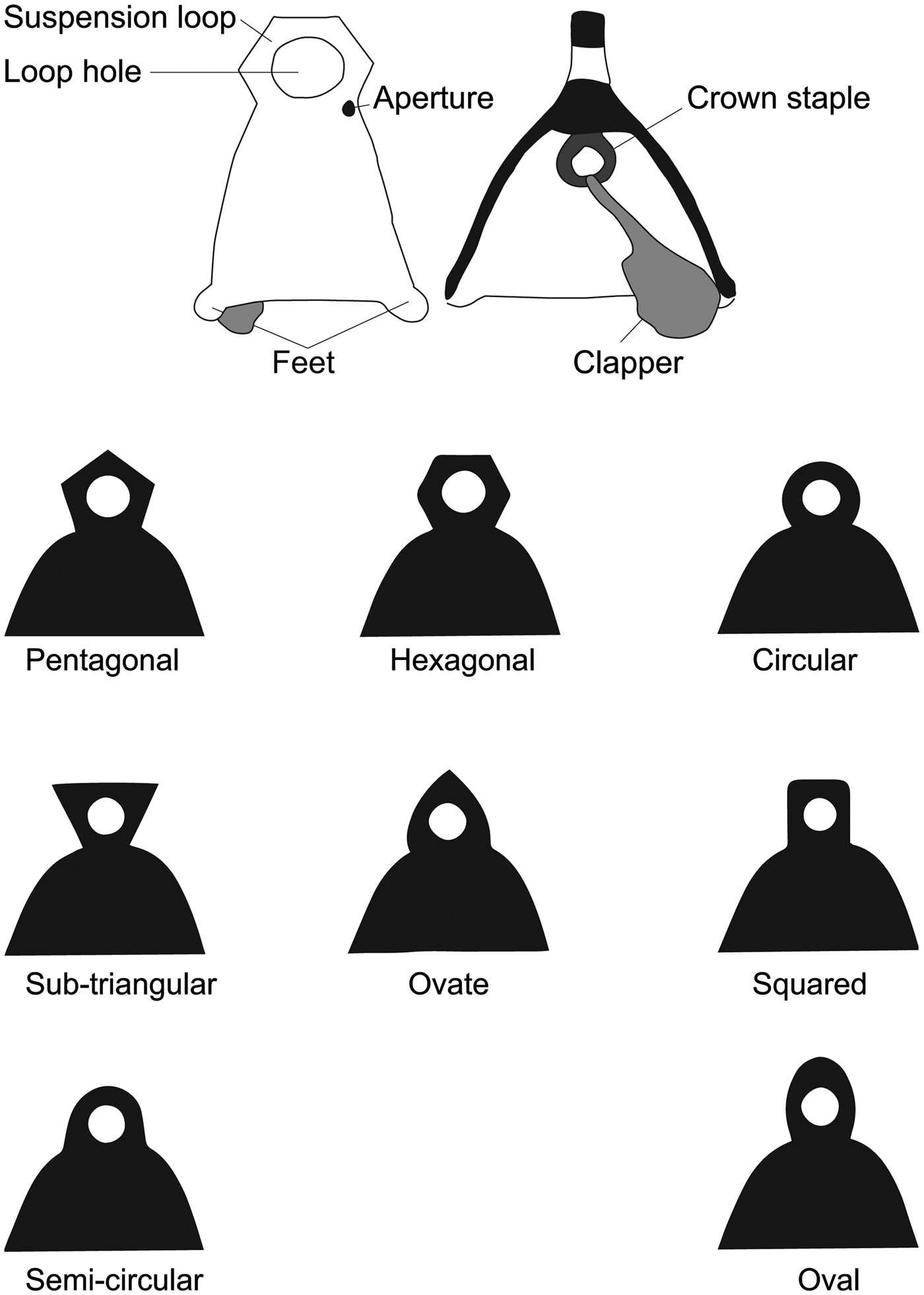
Bells are usually small and the vast majority are cast in copper alloy, with only eight examples made from iron. These figures are likely skewed by the under-recording of iron objects on many sites prior to systematic x-ray analysis and the bias towards copper-alloy objects recorded on the Portable Antiquities Scheme (PAS). All bells would have originally had a suspension loop at the top and contained a clapper suspended from the apex of the bell (fig. 1). There are some examples which appear to have been modified or repaired, including bells which have had a hole drilled into them, possibly in order to replace a clapper or crown staple that had broken. The main form of decoration on Romano-British bells consists of incised grooves around the circumference of the bell; some have small feet on each corner.
There have been numerous theories about the function of the bells, ranging from simple animal bells to apotropaic objects. There is information on Roman bells from written, iconographical and archaeological sources. Bells have been mentioned in Greek and Roman literature from as early as the fifth century b.c., when Aeschylus describes in detail Tydeus’ shield, which contained many bells used to cause terror among his enemies by their sound: ‘and at his shield's rim, terror in their tone, clang and reverberate the brazen bells’.Footnote 2 This trick of using bells to frighten an enemy is seen almost 700 years later, as Cassius Dio informs us that a northern British tribe, the Maeatae, had bells attached to the end of their short spears ‘so that when it is shaken it may clash and terrify the enemy’.Footnote 3 Bells could also be used to sound a warning; for example, sentries carried bells while on duty in order to let their comrades know that all was well and to give warning if anything was amiss.Footnote 4
As well as their use as doorbells, classical sources also mention use as animal bells, which is the use highlighted by many modern commentators.Footnote 5 Some early Roman coins bear images of elephants wearing bells around their necks.Footnote 6 More commonly, bells are known to have been used for mule and horse harnesses, as noted by ApuleiusFootnote 7 and as depicted on a relief now in Naples.Footnote 8 In Beuningen (Netherlands) a horse was carefully buried with its headstall; among the studs were a lunula and a domed bell with hexagonal loop.Footnote 9 In such contexts bells may have been amuletic, as has been suggested for early medieval high-status male graves containing horses with bells on their harness.Footnote 10 At Kalkriese, the site of the Battle of the Teutoburg Forest (a.d. 9), the remains of a mule buried under a bank were found and in situ around the animal's neck was a large bronze bell.Footnote 11 The bell had been filled with vegetal matter (the stalks of beans or peas) to silence it; this had been picked fresh from the ground as it still contained roots.Footnote 12 Experiments using a replica suggest that this bell would have been audible for up to 400 m if rung deliberately and for up to 200 m if worn around an animal's neck and sounding as it walked.Footnote 13 That carts may have had bells attached is suggested by the discovery of quadrangular bells next to a cart found in the courtyard of the House of Menander in Pompeii.Footnote 14
Bells were also used to announce the opening — and most likely the closing — of the baths and markets. MartialFootnote 15 tells us that those who do not get to the baths when the bell of the warm bath rings, will end up with a cold bath and Plutarch mentions the market bell.Footnote 16 An official and possibly liturgical function is likely for larger inscribed bells, such as the example from Tarragona, Spain, thought to have been used as part of the imperial cult,Footnote 17 and bells dedicated to Mercury.Footnote 18
Finally, there are the apotropaic or ritual uses for bells. Juvenal refers to bells used to ward off the eclipse of the moon.Footnote 19 Bells were rung in religious ceremonies and could be attached to the costumes of dancers, for example in Bacchic rituals but also mimes.Footnote 20 As protective charms against the ‘evil eye’ bells were included in graves. Wind chimes (tintinnabula) and bells were suspended in doorways, houses and gardens to offer protection; splendid examples are known from Vesuvian sites.Footnote 21 Mimicking the use of bells in doorways, Augustus hung bells from the temple to Jupiter Tonans.Footnote 22 Bells of different sizes and types clearly had different functions. This paper will explore their use in Roman Britain in detail.
Terminology and common loop shapes. (Original images by Sandie Williams and Amy Atkins)

METHODOLOGY
A dataset of 303 bells was collected from published reports, the Portable Antiquities Scheme and some museum collections in 2009. From this, a catalogue was created, which contains detailed descriptions, dimensions, context and site information, references and scanned images.Footnote 23 The data were entered into an Access database in 2014 by Amy Atkins; some editing and checking of context dates and similar information also took place. Each bell was given a catalogue number, which is provided in the text below and can be used to cross-reference information in the database (available on the Archaeological Data Service website: https://doi.org/10.5284/1043774).
Once all the data were collected, the bells were sorted into different typological groups, but establishing a chronology for the bells proved difficult due to the nature of the collection, with the PAS and many published finds derived from contexts with limited dating information. Where possible, bell types were cross-referenced to their continental counterparts. Next, the geographical spread was mapped and any sub-types with regional distributions identified. Finally, the bells’ social distribution and contexts were examined. One of the main problems faced during this study was to define context and site types. Many sites had multiple uses over time (such as Colchester) and we also have to face the issue of excavation bias, where there are significantly more military and villa sites excavated than small settlements or vici.Footnote 24 Context information is often limited but where detailed data were available, especially in funerary contexts, temples and hoards, it is possible to analyse the ritual and symbolic meaning of bells.
TYPOLOGY AND CHRONOLOGY
Bells occur throughout the Roman period in a wide variety of shapes and sizes, so for a clearer understanding of their function it is important to divide them into types. Hitherto, there has been some terminological confusion, with, for instance, examples of ‘Type 1 Quadrangular bells’ described as ‘pyramidal’, ‘rectangular’ and ‘sub-rectangular’.Footnote 25 Similarly, for suspension loops the terms pentagonal and hexagonal are frequently mixed up (fig. 1). This section aims to provide a typological study of both bell and suspension loop types, in order to form an identification system from which finds specialists can work and which can be compared to continental typologies.
Obviously all bells were manufactured with basic features which are dictated by functional requirements. In order to suspend a bell a suspension loop is required and to be heard it needs a clapper. These are rarely found due to loss during use, leading to the bell being discarded, and corrosion processes of iron, from which the majority of clappers were made. However, there are several examples where the clappers were made of lengths of copper alloy.Footnote 26 The clapper could be suspended from a loop fastened to the top of the bell or two holes could be drilled and a wire from which the clapper could be suspended was threaded through them. It has been suggested that beads found within bells at Colchester and Scole were replacement clappers, but these are interpreted here as votive deposits (see below); in any case, such beads would at best have produced a dull sound. We are aware of one bell with a maker's name (Facundus).Footnote 27
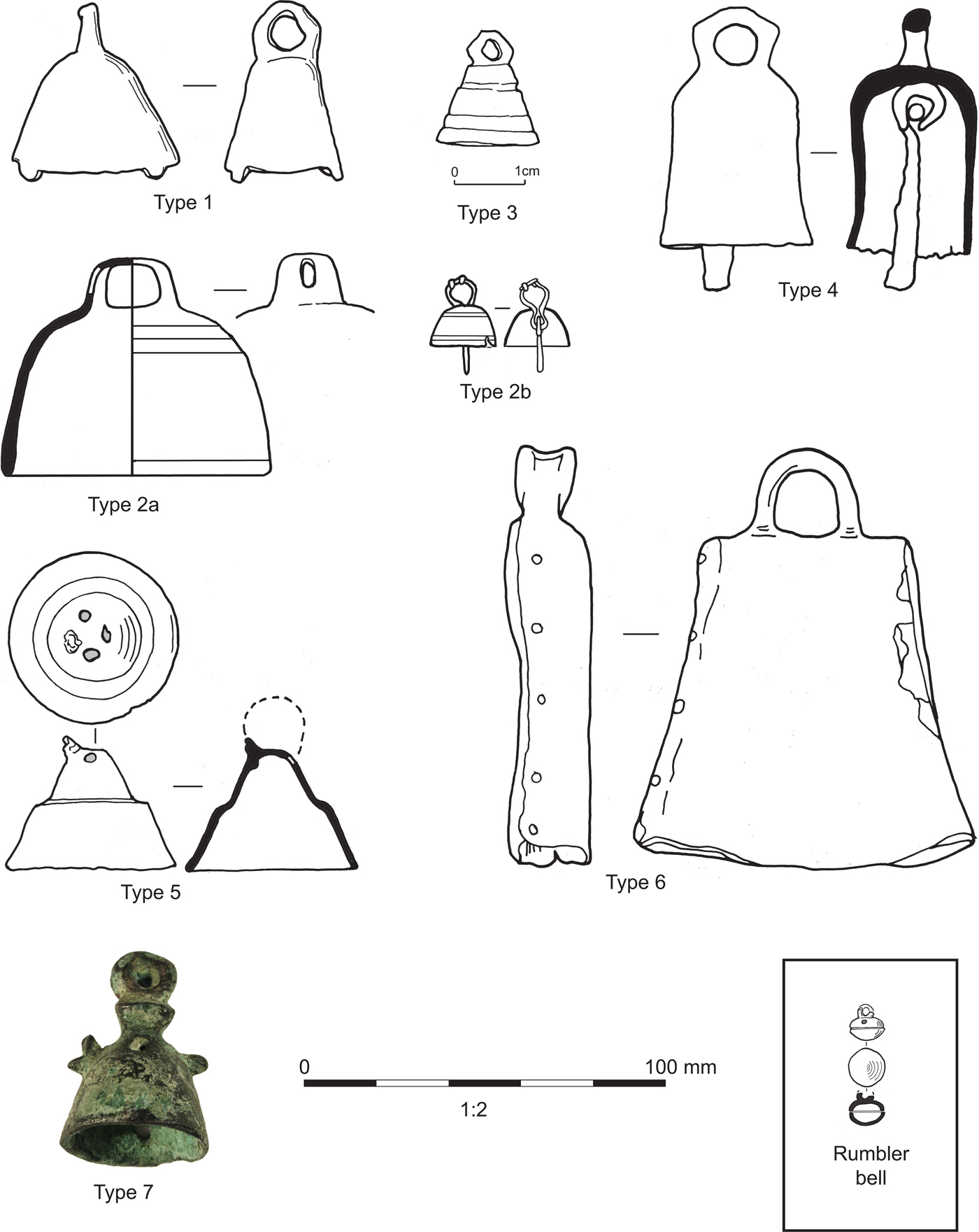
The Romano-British bells were divided into seven typological groups; an eighth group (Openwork bells) is not certainly Roman (fig. 2).
Bell typology: Type 1: Quadrangular bells (after No. 32, Colchester: Crummy Reference Crummy1992, fig. 5.51.1663); Type 2: Domed bells (after No. 92, Coventina's Well: Allason-Jones and McKay Reference Allason-Jones and McKay1985, fig. 67; and No. 57, Colchester: Crummy Reference Crummy1983, fig. 54.1811); Type 3: Conical bells (after No. 102, Trentholme Drive, York: Wenham Reference Wenham1968, fig. 36.7); Type 4: Tulip bells (after No. 3, Loughor: Marvell and Owen-John Reference Marvell and Owen-John1997, fig. 101.158); Type 5: Shouldered bells (after No. 9, Catterick: Wilson Reference Wilson2002, fig. 301.16); Type 6: Iron bells (after No. 109, Beadlam: Neal Reference Neal1996, fig. 40.96); Type 7: Miscellaneous and fragmentary bells (after No. 282, Cold Kitchen Hill: unpublished, Devizes Museum DZSWS:2004.240.2).
Rumbler bells, not Roman (after No. 23, Verulamium: Frere Reference Frere1984, fig. 21.195).

TYPE 1: QUADRANGULAR BELLS
This form of bell has four sides, with walls that expand out slightly from the top of the bell. Frequently the bell is not square, but rectangular, with the shorter side normally aligned with the loop hole. Many examples have small ‘feet’ at each corner; these are cast and globular or flat in profile. The suspension loop is usually hexagonal or pentagonal but can be circular (fig. 2). All the examples of this form originally had an iron clapper hanging from the apex of the bell, but this has either broken off or been lost due to the natural corrosion process, although the corroded residue is frequently visible on the internal apex of the bell or on the walls.
This type of bell is common in Britain (total 54) and is found on a variety of military, urban and rural sites. One example is a possible votive offering at one of the springs at SpringheadFootnote 28 and another is from the Seven Sisters hoard.Footnote 29 Type 1 bells in Britain occur in contexts dated from the second half of the first to the later third century, with the earliest examples found at Fishbourne,Footnote 30 Seven SistersFootnote 31 and in the foundations of the eastern gateway at the Lunt;Footnote 32 there is also a pre-Flavian example from Usk.Footnote 33
TYPE 2: DOMED BELLS
Domed bells do not normally have feet, while the suspension loop is usually rounded or hexagonal but can be pentagonal. If the loop is not cast integrally with the bell, wire can be used to suspend the bell (fig. 2). Some examples have incised grooves around the body as decoration; these can be below the loop, in the middle of the body or towards the base. These bells are again commonly found with the remains of iron residue in the apex of the bell, but occasionally, especially in the smallest examples found in burial contexts, they have long, straight copper-alloy clappers, which hang below the base of the bell. This is the most common type (total 70). The domed group of bells also has a sub-group where the base of the bell has a lip (total 10; overall total 80).
Type 2 bells are again attested in a number of pre-Flavian contexts, notably Fishbourne,Footnote 34 the Seven Sisters hoard,Footnote 35 UskFootnote 36 and Leadenhall Court, London.Footnote 37 There is also one in a Flavian burial from Winchester.Footnote 38 The many examples from later contexts extend into the third and even fourth century and may indicate that this is a very long-lived type, although some may be residual. Domed bells are known from Anglo-Saxon gravesFootnote 39 but these were not counted here. The lipped domed bells are of similar date, with two early examples attested at Hod HillFootnote 40 and Wanborough.Footnote 41
TYPE 3: CONICAL BELLS
Whereas the body of Type 2 bells is rounded in form, Type 3 bells are conical in shape (total 46). The suspension loop is usually circular or oval but can be hexagonal, pentagonal or square. As with the domed bells there can be incised circular decoration on the body (fig. 2). It is noticeable that the majority of Romano-British examples were recorded by the PAS, which may hint at a mainly rural distribution and also means that there is very little contextual dating evidence. Some may be medieval, but one recently excavated from London, Paternoster Square,Footnote 42 is from a context dated to the later second or third century and another is from a mid-second-century burial at Pepper Hill, Southfleet;Footnote 43 both context dates chime with continental dates for this type (see below, Table 2).
TYPE 4: TULIP BELLS
Tulip bells are in general quite large in size (ranging from c. 35 mm by 74 mm to 71 mm by 129 mm). The apex of the bell is rounded in shape, before narrowing and then flaring out again — very similar in form to an inverted tulip (total 9; fig. 2). A Type 4 bell at Binnington Carr was found with 12 silver coins of Caesar, Nero, Vitellius and Vespasian, with the latest coin dated to a.d. 75–6.Footnote 44 Others are found in contexts dated from the second to fourth century, probably residually.
This type of bell may have been used for ritual purposes more often than the smaller types, as one was used to contain a hoard and another comes from the temple at Wanborough.Footnote 45 On the other hand, the tulip bell from CanterburyFootnote 46 was found in the bath palaestra where it may have been used to announce the times for warm baths (see above).
TYPE 5: SHOULDERED BELLS
Shouldered bells are on the whole quite small in size and are characterised by a ‘step’ approximately one-third down from the apex (total 19; fig. 2). Bells of this type can have a suspension loop (circular, hexagonal or squared) or the apex can be pierced with two or four holes for suspension. Type 5 is a later form on the Continent (see below) and the same appears to be true for Roman Britain, with three examples from contexts dated to the third to fourth century.Footnote 47 A shouldered bell is also known at Finsbury Circus, London from a burial dated to c. a.d. 200–400.Footnote 48 The earliest bell of this type is from Corbridge from a context dated to a.d. 86–163.Footnote 49 A bell from Wroxeter is published as coming from fortress layers and would thus date to a.d. 60–90, but it is quite possible that it is in fact from later deposits.Footnote 50
TYPE 6: IRON BELLS
Although the majority of the bells in this study are of copper alloy, there are eight iron bells from British excavation reports. Iron bells are likely under-represented within this dataset, as fragmented iron bells may not have been recognised, especially in older excavations prior to the systematic use of x-ray analysis. Metal-detectorists are also much more likely to collect and report copper-alloy rather than iron objects. In most cases these are simple sheets of iron which have been cut, folded and then welded or riveted into shape; iron bells are generally much larger than copper-alloy bells, with the exception of tulip bells. Most are roughly rectangular and similar to the Type 1 bells in overall shape, though without that type's characteristic feet (fig. 2). Two examples appear to have a copper-alloy coating, a feature also noticed on continental examples and thought to be for protection against corrosion rather than to change the sound.Footnote 51
It is often suggested that iron bells are animal bells, with different sizes possibly used for goats and cattle.Footnote 52 It has been suggested that a large iron bell from the Bennecourt (France) sanctuary may have been worn by a sacrificial beast.Footnote 53
Examples from dated contexts are known at Caerleon,Footnote 54 Vindolanda,Footnote 55 Maiden CastleFootnote 56 and Frocester.Footnote 57 This may point to a late Roman date overall.
TYPE 7: MISCELLANEOUS BELLS
This section includes bells which do not fit into any of the other categories, often because they are fragmentary or poorly illustrated (total 53). The unusual bells include very large examples from Wanborough (diameter 80 mm) and Castle Collen (diameter 98 mm).Footnote 58 A bell from an early third-century child's burial at Brougham proved difficult to classify as it is domed and lipped but also has a slight step at the apex.Footnote 59
Two highly unusual bells come from the Romano-British temple on Cold Kitchen Hill in Wiltshire (fig. 2). One has a lion's head in relief, a motif common on furniture studs,Footnote 60 while the other is described as depicting human figures.Footnote 61 Relief-decorated bells are very rare; there are a few examples decorated with images of the god Bes and animal heads from Roman EgyptFootnote 62 and the British Museum also houses a pair of miniature gold bells decorated with the labours of Hercules said to be from Tarsus, Turkey.Footnote 63
OPENWORK BELLS
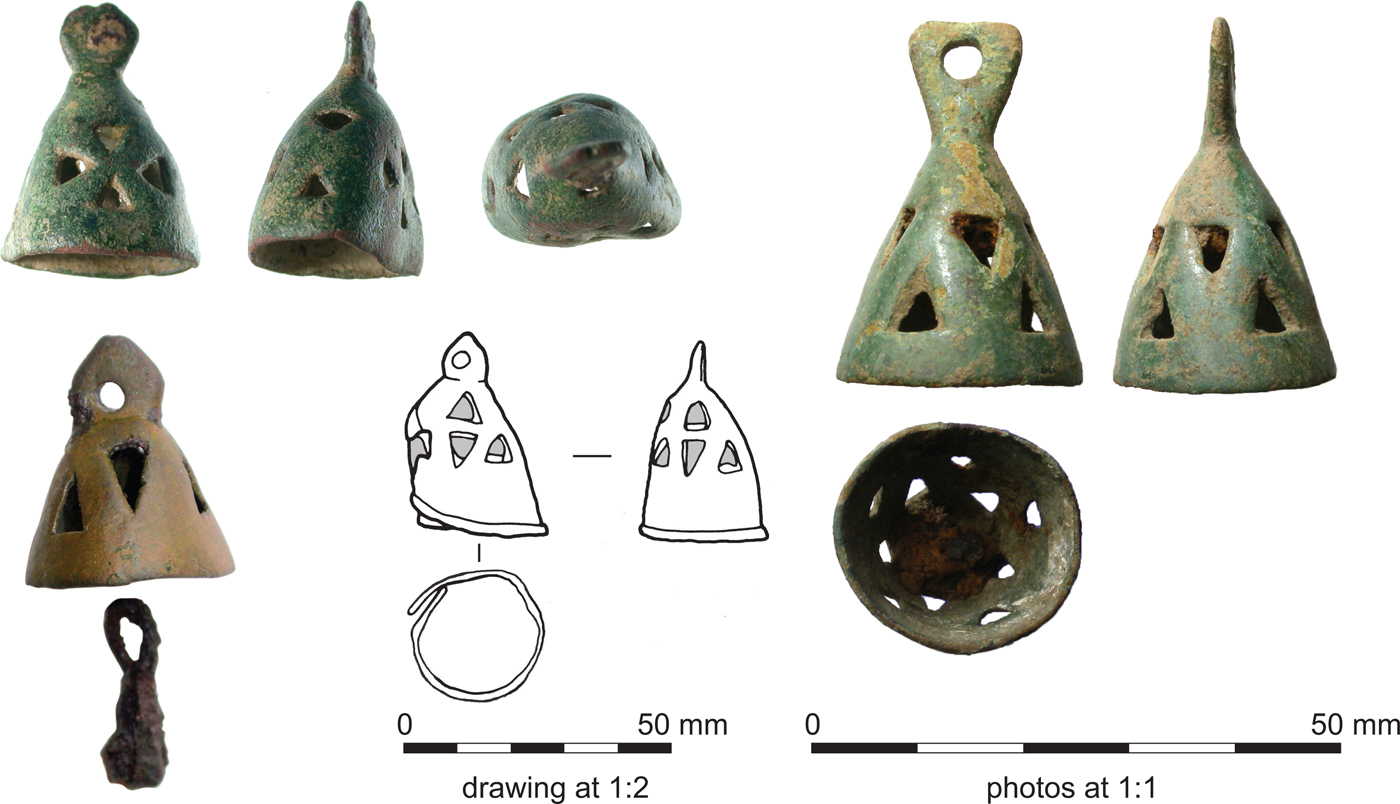
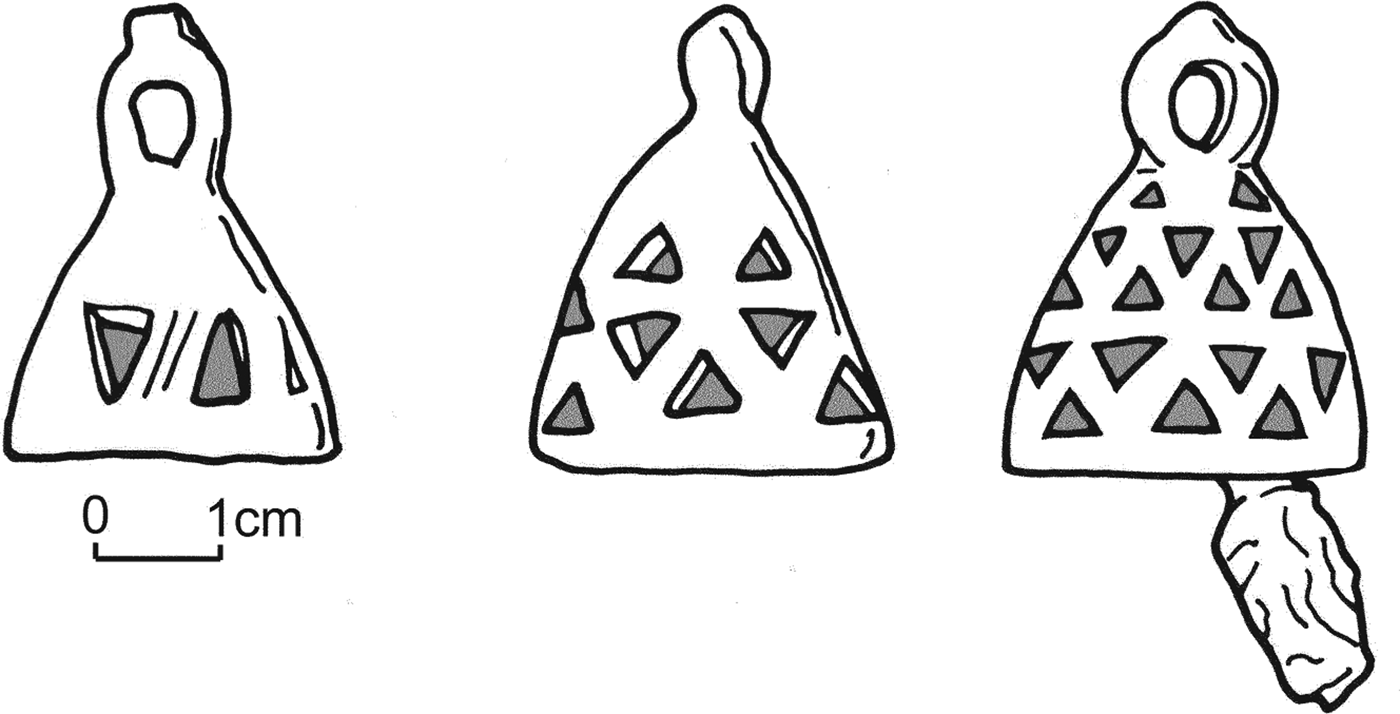
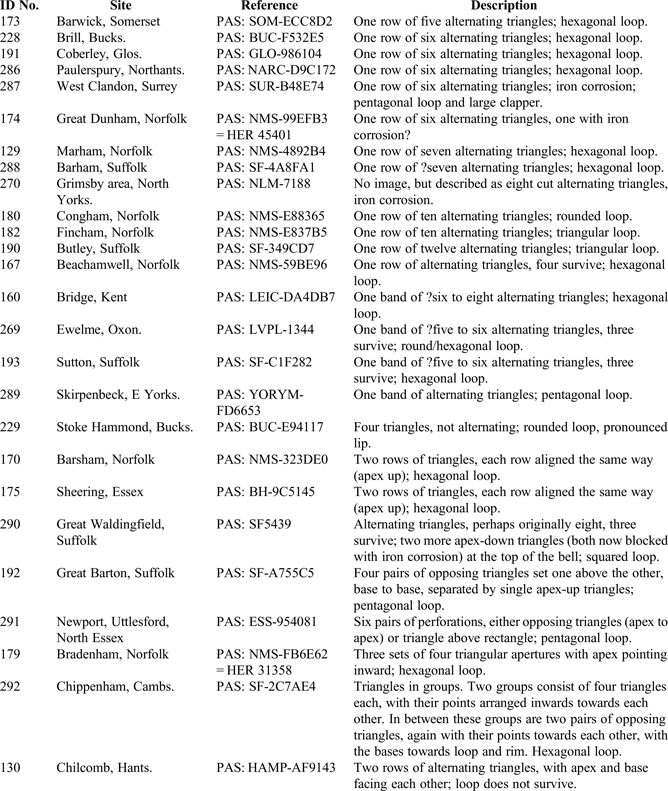
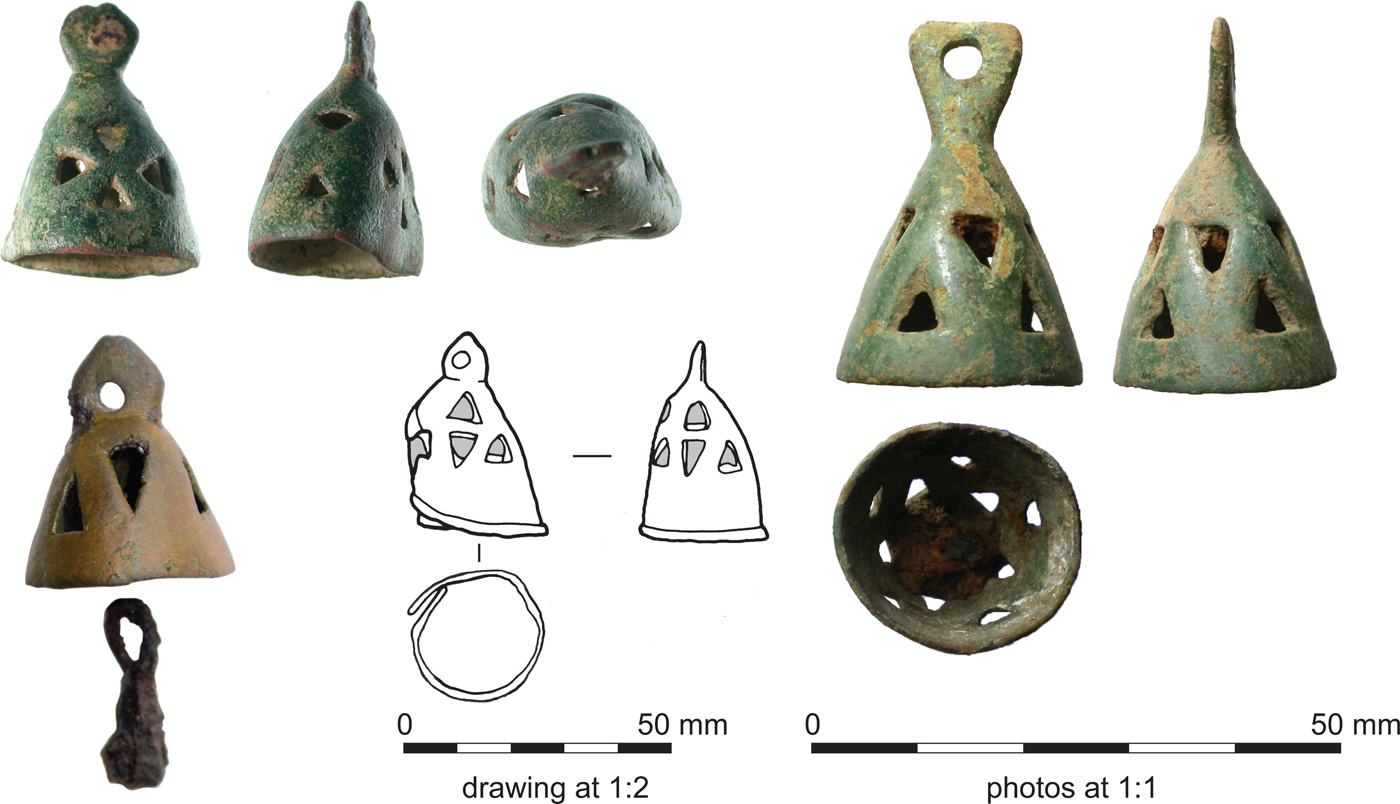
Not included in the original dissertation, this is a new form of bell that has recently been recognised on the PAS, with 26 examples recorded by 2016 (see Table 1). The bells are all made from copper alloy, domed or conical in form and have distinctive triangular cut-outs, which can be arranged in a variety of patterns (fig. 3). The most common design consists of a band of triangles set in an alternating pattern (apex to base). The number of triangles varies (and can often not be determined as many bells are only partially preserved), with the most common number being six and the maximum twelve.Footnote 64 In one case there are only four very crude triangles that all appear to be aligned the same way (base down).Footnote 65 Some bells are decorated with more complex patterns; thus two similar but very fragmentary examples from Norfolk and Essex appear to have two rows of triangles aligned the same way (base down).Footnote 66 Two additional triangles (apex down) are set above an alternating band in a bell from Suffolk,Footnote 67 while other bells have pairs of opposing triangles separated by single triangles or other shapes. Thus SF-A755C5 from Great Barton (fig. 3) has four pairs of opposing triangles set one above the other base to base, separated by single apex-up triangles, while ESS-954081 has six pairs, either opposing triangles (apex to apex) or a triangle above a rectangle. Two very similar examples from Norfolk and Cambridgeshire have a flower design created by four inward-pointing triangles; set between them is a pair of triangles, again with the apices pointing towards each other.Footnote 68 Perhaps the most elaborate example has a design of two rows of alternating triangles.Footnote 69 While there is variation in the number and alignment of the triangles, this is clearly a distinctive form of bell, usually with pentagonal or hexagonal loops. Even where the loop shape is unusual and where production at the same workshop may be assumed, the number of triangles can vary.Footnote 70 Three bells cross-referenced on the PAS from Monks Eleigh, Covehithe and Beeston with Bittering either have no perforationsFootnote 71 or circular perforations.Footnote 72 The clapper only survives very rarelyFootnote 73 but several examples have significant interior iron corrosion, in some cases completely filling the triangles.
Openwork bells from West Clandon (SUR-B48E74), Fincham (NMS-E837B5), Chippenham (SF-2C7AE4), Chilcomb (HAMP-AF9143) and Great Barton (SF-A755C5).
The purpose of the triangles is unclear — openwork decoration works best visually when set against leather or fabric for contrast or when filled with enamel; the latter does not appear to be the case here and the former would render the object non-functional. Perhaps the aim was simply a decorative effect or the intention may have been to alter the sound produced by the bells. Unfortunately no openwork bells are as yet known from excavated contexts in Britain and there is consequently no contextual dating evidence. It is possible that they are a much later type, or even a modern import, although the wide spread is unlike the pattern created by metal-detector rallies where a site may have been ‘seeded’ with material bought on eBay. The distorting effect of modern imports is well demonstrated by coins with eastern Mediterranean mint marks from Scotland, which are in fact modern losses.Footnote 74
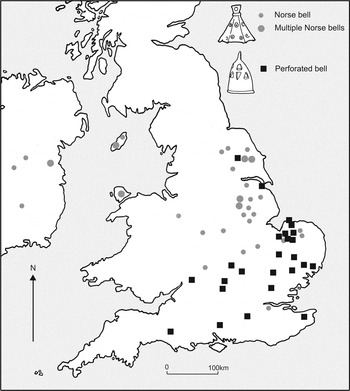
Bells of this type were originally thought to be of medieval date but research on ‘Norse’ bells has shown all certain examples to be of hexagonal shape, often with circle-and-dot decoration; the openwork bells are circular in plan and domed or conical, while the loop shapes are very similar to Roman bells. The openwork bells are broadly similar to domed bells in terms of their dimensions, ranging in height from 12 mm to 35 mm. Openwork bells also have a very different spatial distribution to the tenth-century bells with Scandinavian affiliations,Footnote 75 with the majority occurring in the south of Britain (see fig. 6).
Until examples from excavated contexts are found in Britain, the date and origin of this enigmatic bell type will remain unclear. The only continental parallels we were able to identify come from the Black Sea region (see below).Footnote 76
NON-ROMAN RUMBLER BELLS
Eight bells that appear to have a closed form, often made in two halves and originally containing a pellet, were found during the literature search (fig. 2). Unstratified examples come from Roman sites such as Verulamium and South Shields, and from two villa sites where the bells are said to be associated with first- and second-century material.Footnote 77 Such rumbler bells are usually thought to date from the thirteenth century onwards, although some earlier medieval examples are known from the Continent.Footnote 78 This is not a Roman type and it is most likely that these bells are in fact of much later date and intrusive in Roman layers.
BELLS IN OTHER PARTS OF THE ROMAN EMPIRE
Bells are frequent finds across the Roman Empire, but it is not the purpose of this paper to offer a full review of the continental material. However, we may note some large assemblages such as Augst, Vitudurum, Kempten and Lyon.Footnote 79 A very interesting phenomenon is the export of Roman bells into the Barbaricum, where they have mainly survived in burials.Footnote 80
Most continental typologies are based on that of NowakowskiFootnote 81 and have been summarised by Flügel.Footnote 82 This can be compared to a recent analysis by NicolayFootnote 83 and an attempt by Furger and SchneiderFootnote 84 to modify these typologies to more carefully reflect production techniques.
The continental data compare well with the British material both in terms of typology and chronology, though the continental material obviously has an earlier start date (Table 2).
SOCIAL AND SPATIAL DISTRIBUTION
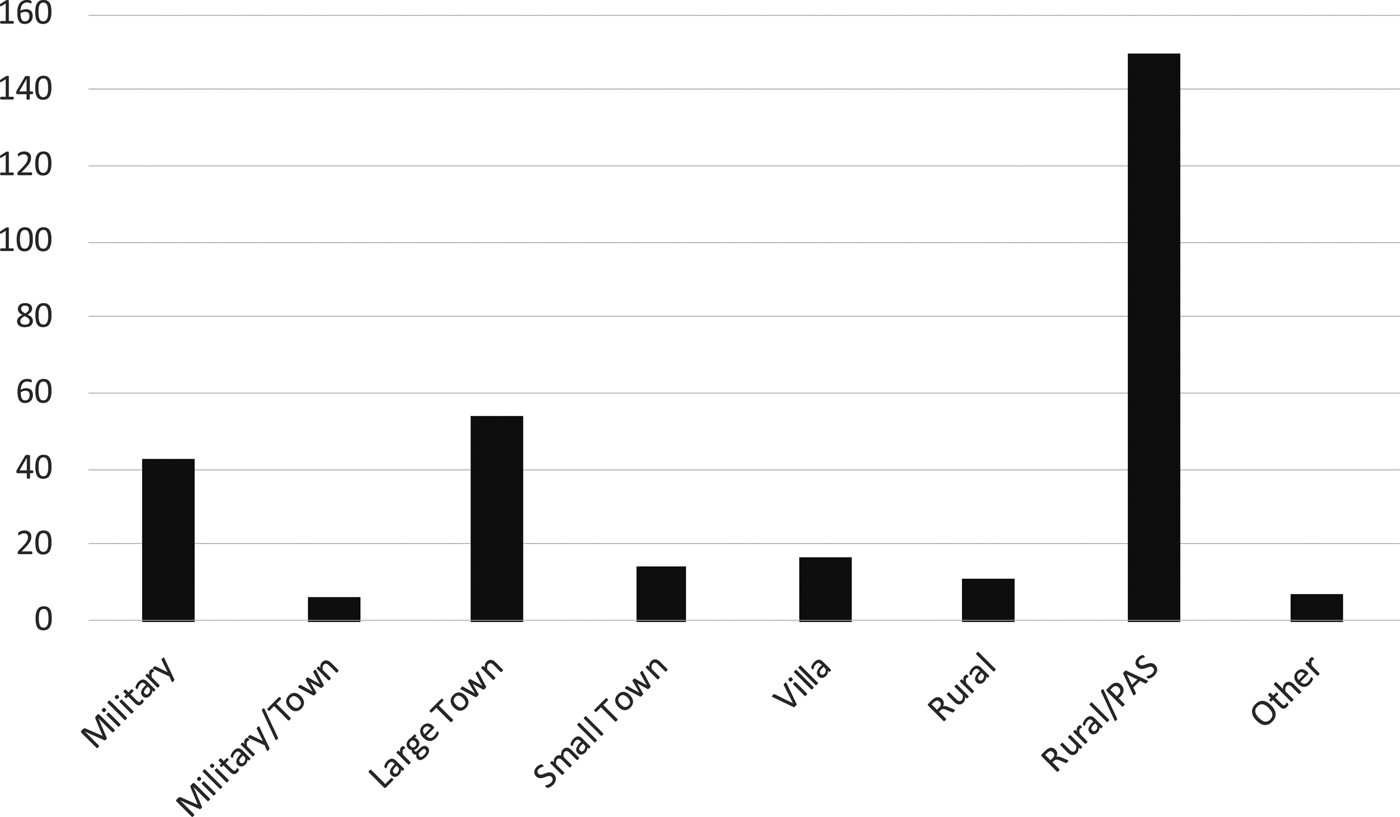
To assess the bells' social distribution, the sites from which they were recorded were classified according to the methodology set out by Eckardt (fig. 4).Footnote 85 Major towns include London, Verulamium and the civitas capitals; small towns are those defined by Burnham and Wacher;Footnote 86 and military sites encompass legionary fortresses, auxiliary forts and marching camps and their associated vici. In cases where there is both a military and an urban site (e.g. York or Colchester) and finds are without exact findspots or stratigraphic information, the value is split. The finds from the Romano-British countryside are divided into those from villas, those from other small settlements or shrines and the many bells recorded by the PAS, which do not have archaeological contexts but are likely to be from rural settlements.
The social distribution of all recorded Romano-British bells (total = 303).

The social distribution is heavily skewed towards the PAS data, which hugely increase the number of bells that probably came from rural sites; among the excavated sites military and urban settlements dominate. The context categories can then be broken down further to identify bells that were found in burials, hoards or temple areas (see below).
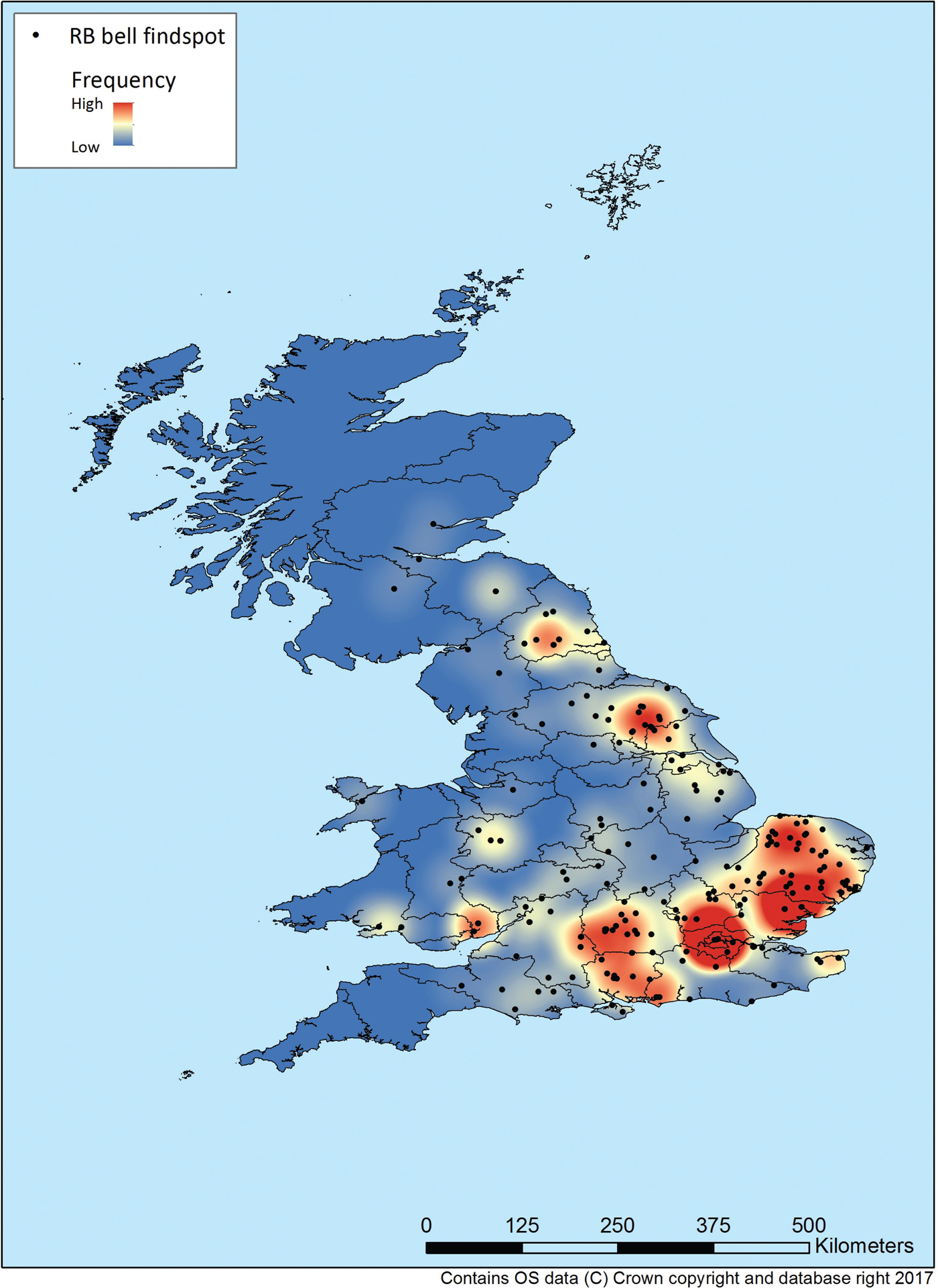
In terms of the spatial distribution, it is clear from the just over 300 bells recorded that these objects were in common use throughout Britannia (fig. 5). They are found as far north as ScotlandFootnote 87 and as far south as the Isle of Wight, with multiple finds mainly from major sites such as Colchester and London. A group of 14 quadrangular bells was found at Coggeshall, half way between Colchester and Braintree, Essex. DenisonFootnote 88 has claimed that the fact that they were discovered ‘in a ring’ meant that they were buried deliberately, ‘perhaps as part of some forgotten ceremony’. Others suggest that they were accidently lost on their way to market; all 14 are of the same type but slightly different dimensions and they may have been tied together for safe transport.Footnote 89 Areas with few or no bells, such as the Weald, the South-West and North-West, may reflect ancient practice but also, of course, patterns in settlement, metal-detecting and excavation; the concentration in East Anglia is typical of PAS data, for example, and reflects the fact that 153 of the 303 bells recorded here come from metal-detected finds.Footnote 90
Density map of all recorded bells. (Produced by Rob Fry)

Distribution of Type 8 openwork bells compared to Norse bells.

For the purpose of this paper we have only mapped openwork bells in detail as this is an unusual and new form of possibly Roman date. It is evident that this type has an essentially southern (and south-eastern) distribution (fig. 6). The most northerly examples recorded by the PAS are in Yorkshire (Grimsby and Skirpenbeck). The overall distribution varies from that of Norse bellsFootnote 91 and would appear to be more typical of either Anglo-Saxon or Roman objects, with the multiple finds in the east characteristic of many PAS maps and essentially reflecting metal-detecting patterns.Footnote 92 A number come from near Roman roads (e.g. Skirpenbeck, Stoke Hammond, a group in Norfolk around the terminal of Peddars Way) and this may hint at the means by which these particular objects were moved across the province.
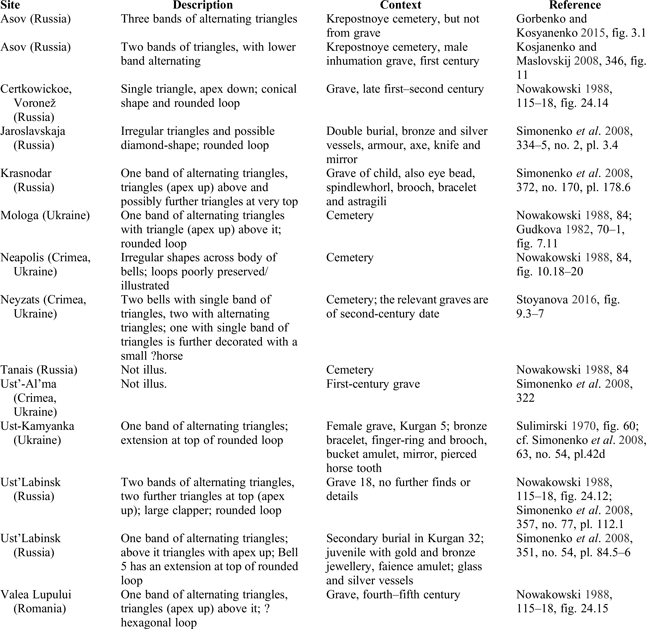
We have been unable to find published parallels for this bell type in Britain and across the Roman Empire. However, there are strikingly close examples from a very distant region, namely the area around the Black Sea (see Table 3; fig. 7).
Bells with triangular cut-outs from the Black Sea region: Ust-Kamyanka (after Simonenko et al. Reference Simonenko, Marčenko and Limberis2008, pl. 42d), Krasnodar (after Simonenko et al. Reference Simonenko, Marčenko and Limberis2008, pl. 178.6) and Ust'Labinsk (after Nowakowski Reference Nowakowski1988, fig. 24.12).

These bells all have various arrangements of alternating and opposing triangles in the same style as the British examples and similar loop shapes. Where this information is available they are perhaps slightly larger than the British examples (e.g. heights of 3.9 and 4.8 cm) but overall they are clearly very similar to the British PAS bells. Only one (Valea Lupului, Romania) is of a late Roman date while the remainder are thought to date to the (?later) first century.Footnote 93
Recently, Daniel Kostromichev has kindly drawn our attention to further examples from the region (fig. 8). They are also generally dated to the first and second century and broadly associated with Sarmatian groups; many come from burials, including those of children.Footnote 94 There are conflicting views as to the place of manufacture of these perforated bells. NowakowskiFootnote 95 sees them as ‘East-Sarmatian’ products, or perhaps more broadly as local to the Black Sea region; however, Simonenko et al.Footnote 96 note that the form is rare compared to plain bells in the same region and suggest that they may be imported, although they do not specify where their source may lie. Standard Roman bells are quite commonly found in cemeteries within this region, where they can occur on items of female costume such as belts.Footnote 97 Thus by no means all bells in this region are of the openwork type.
The distribution of perforated bells in the Black Sea region.

If we assume that the British finds are genuine and of Roman date, it is difficult to explain their relationship, if any, with the Russian and Ukrainian parallels. The Black Sea region was wealthy in antiquity and from the first century b.c. onward Roman control increased through the establishment of provinces (Pontus and Bithynia, Moesia), the transformation of the Bosporan kingdom into a client kingdom and the presence of Roman garrisons in the Crimea; in general, the whole region was closely connected to the Mediterranean and the wider Roman Empire.Footnote 98 However, trade and general contact ought to result in finds across the Mediterranean or along the Danube. This is the case for cast buckles that were part of Roman military costume and widely copied in the Black Sea region; they are usually dated to the second quarter of the second century to the early fourth century and occur not just in the Crimea but along the Danube and Rhine as well as in Britain.Footnote 99
The occurrence of bells of this form apparently only in two regions without finds from the intermediate areas might appear to be more typical of the movement of people, most likely connected to the military. Movement of objects or people from the Black Sea to Britain may be thought to relate to the presence of Sarmatians in Britannia, a phenomenon that has been much debated. While there is epigraphic and sculptural evidence, the suggestion that objects such as gold-in-glass beads indicate a Sarmatian presence is much more contentious; in any case any Sarmatian presence is usually thought to date to the reign of Marcus Aurelius and later.Footnote 100 The Roman military presence on the Black Sea coast and the Crimea is now quite well documentedFootnote 101 and the date of the bells may relate to a peak of Roman military activity during the Neronian period,Footnote 102 but to our knowledge only one of the units attested in the region has possible links with Britain. However, while Legion VIII is attested in Moesia, most commentators are now not certain that this unit was involved in the conquest of Britain as had previously been thought.Footnote 103
No firm conclusion can be drawn at this point, but it is hoped that bells with triangular openwork are found in stratified contexts in the future so that their origin and date may be resolved.
THE RITUAL AND APOTROPAIC FUNTION OF BELLS
One of the most intriguing aspects of the bells was their use as part of apotropaic or ‘good-luck’ charms and the part they played in both burial and religious rituals. This section will not only examine the bells from Britannia, but also examples for which ritual use can be suggested both in the Empire and the Barbaricum. Bells are thought of as magical in other cultures and times, for example in pre-Columbian Mesoamerica where bells ‘offered protection in war and structured rituals that celebrated fertility and regeneration’ and the sounds and colour of the metal ‘constituted a system of visual and aural symbols that created and recreated the experience of the sacred’.Footnote 104 A handbell or set of small handbells is rung at significant moments during the Catholic mass.
Tintinnabula were wind-chimes to be hung out in the garden or courtyard, which made a pleasant tinkling noise as they blew in the breeze. However, they also functioned as apotropaic charms against the ‘evil-eye’. Approximately 30 examples are known and most form part of a group of ithyphallic objects in order to give the owner a perceived sense of extra good luck.Footnote 105 Other examples of bells used in domestic ritual are also known. Seven bells were suspended from a bust of Mercury from Orange, France (fig. 9).Footnote 106 Some hoard finds containing copper-alloy figurines that are presumably derived from shrines include bells, such as those from Brèves and La Comelle-sous-Beuvray (France).Footnote 107
Bust of Mercury from Orange, France. (By kind permission of the Bibliothèque Nationale, Paris)

That bells were associated with luck is also demonstrated by the dice tower from Froitzheim (Germany), where originally three bells hung just above the stairs down which the dice would have tumbled.Footnote 108 Another curious example comes from a grave in Rebenstorf (Free Germany), where a bronze container has three small bells fitted to its outside, possibly to protect its contents.Footnote 109
Bells with beads inside them may have functioned as votive offerings. In Colchester, Culver Street, a Type 1 bell was found in the floor make-up/dump of Building 120.Footnote 110 Inside the bell was a blue frit melon bead. More recently, at the Roman small town of Scole in Suffolk, a Type 4 tulip bell was discovered underneath a packed flint threshold to a small building.Footnote 111 Once it was conserved, three blue frit melon beads were discovered inside the bell. Beads, and especially melon beads, were thought to have magical properties and may have been associated with bells as amulets, as in a small hoard from Augst (Switzerland), which contained melon beads, bronze rings and bells.Footnote 112 Two melon beads were found strung along with a bell, pierced coins and boar tusk amulets in a child's grave at Rouen, France.Footnote 113 In the Winchester Grange Road grave discussed below both a bell and eight melon beads were among the finds.Footnote 114 At the Bloomberg site, London, a melon bead was found in association with a bone hand and phallus amulet.Footnote 115 Overall, the deposition of beads and bells in doorways might therefore point to them acting as protective or votive offerings.Footnote 116
BELLS IN THE FUNERARY RECORD
One context in which bells may have served an apotropaic function as amulets is the funerary record.Footnote 117 For example, in several of the catacombs of Rome, bells were found to have been placed in the soft mortar surrounding the loculi (niches) of children.Footnote 118 In Pompeii's Porta Nocera cemetery a child aged between three and ten months was buried with a phallic amulet and a bracelet with an attached bell; this is thought by the excavators to be a girl.Footnote 119 Martin-Kilcher, in her discussion of mors immatura, discusses the number and variety of amulets that have been found in the burials of young women and classifies them as crepundia, or objects that rattle or make a noise.Footnote 120 These were either worn on a string or chain or on rings and it is thought that their noise was important for their ‘effect and function’, in this case protection from the dead.Footnote 121 There are many examples of bells in continental graves, including those of children.Footnote 122 Bells occur in children's graves in Gaul, often associated with other amulets or protective charms.Footnote 123 From Arras there is an example of a child's grave where a bell is combined with a phallic amulet, much as in the Colchester grave discussed below.Footnote 124 Bells were used in the Byzantine period to ward off evil spirits, especially from children; John Chrysostom condemns women for tying bells to the hands of children in the late fourth century, but there are Byzantine graves with bells demonstrating that this practice existed.Footnote 125 Bells also occur in Anglo-Saxon graves, where they are usually interpreted as belonging to animals,Footnote 126 but this should perhaps be rethought.
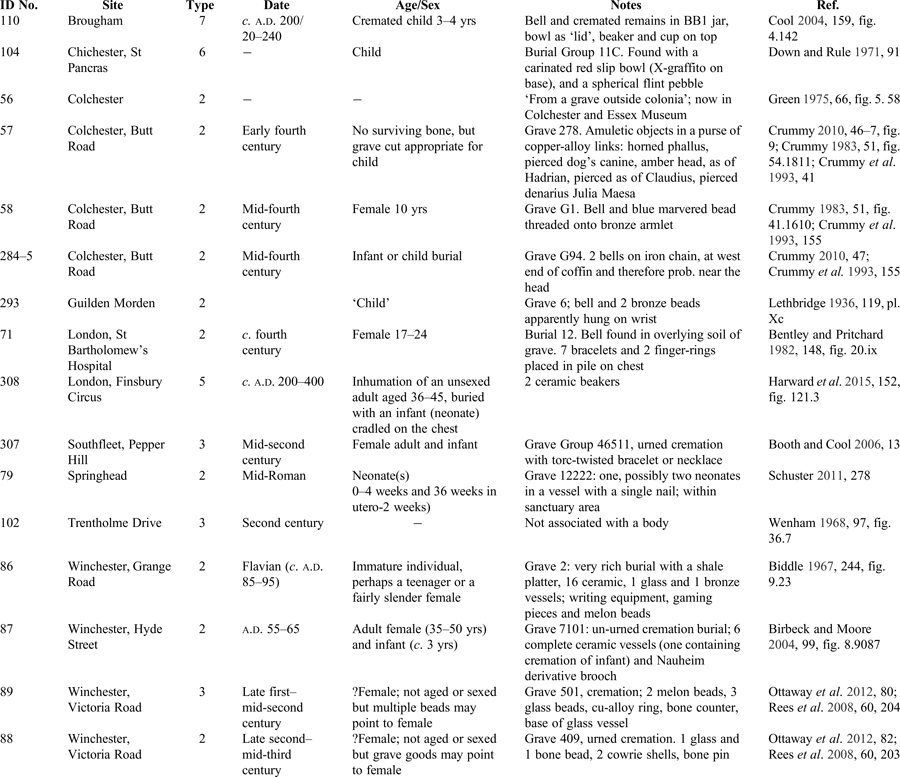
In the Romano-British dataset 17 bells were found in 16 graves; there is also one (No. 102) that could not be attributed to a specific grave in the densely packed Trentholme Drive cemetery at York.Footnote 127 Where sexing and/or ageing was possible, these are the graves of either women or young children (Table 4).
Female graves were identified on the basis of both osteological information and grave goods. At the St Bartholomew's Hospital site in London a bell was found in the fill above the coffin of a young female, aged 17–24, who had been buried with seven bracelets and two finger-rings placed onto her chest.Footnote 128 The late Flavian Grave 2 at Grange Road, Winchester contained feasting (a shale tray, multiple ceramic vessels, copper-alloy and glass jugs) and writing (a seal-box,Footnote 129 two styli, a pen-knife and an iron double-ended spatula) equipment as well as 18 glass counters, a spoon, melon beads and a piece of banded flint. The grave was mistakenly thought by Biddle to be male on the basis of the grave goods but the osteological analysis suggested that ‘the cremated remains are those of an immature individual, perhaps a teenager or a fairly slender female’.Footnote 130 Multiple beads and in one case a hairpin from two graves at Victoria Road, Winchester suggest that they are of females; one is an adult but the bone for the other is lost.Footnote 131 In a first-century cremation at Hyde Street, Winchester a mature woman was buried with a child of c. three years, though it is not possible to determine with which individual the bell was associated.Footnote 132 In the Pepper Hill cemetery at Southfleet a woman was buried with an infant; the only grave goods accompanying the second-century urned cremation were a bell and a torc-twisted bracelet or necklace.Footnote 133 At the Finsbury Circus site in London the inhumation grave (dated to c. a.d. 200–400) of an unsexed adult aged 36–45 years buried with an infant, possibly a neonate, cradled on the chest, is probably that of a woman. Two ceramic beakers were placed by the right shoulder and by the skull of the adult; the bell was found on the right side of the adult's pelvis, by the feet of the infant.Footnote 134
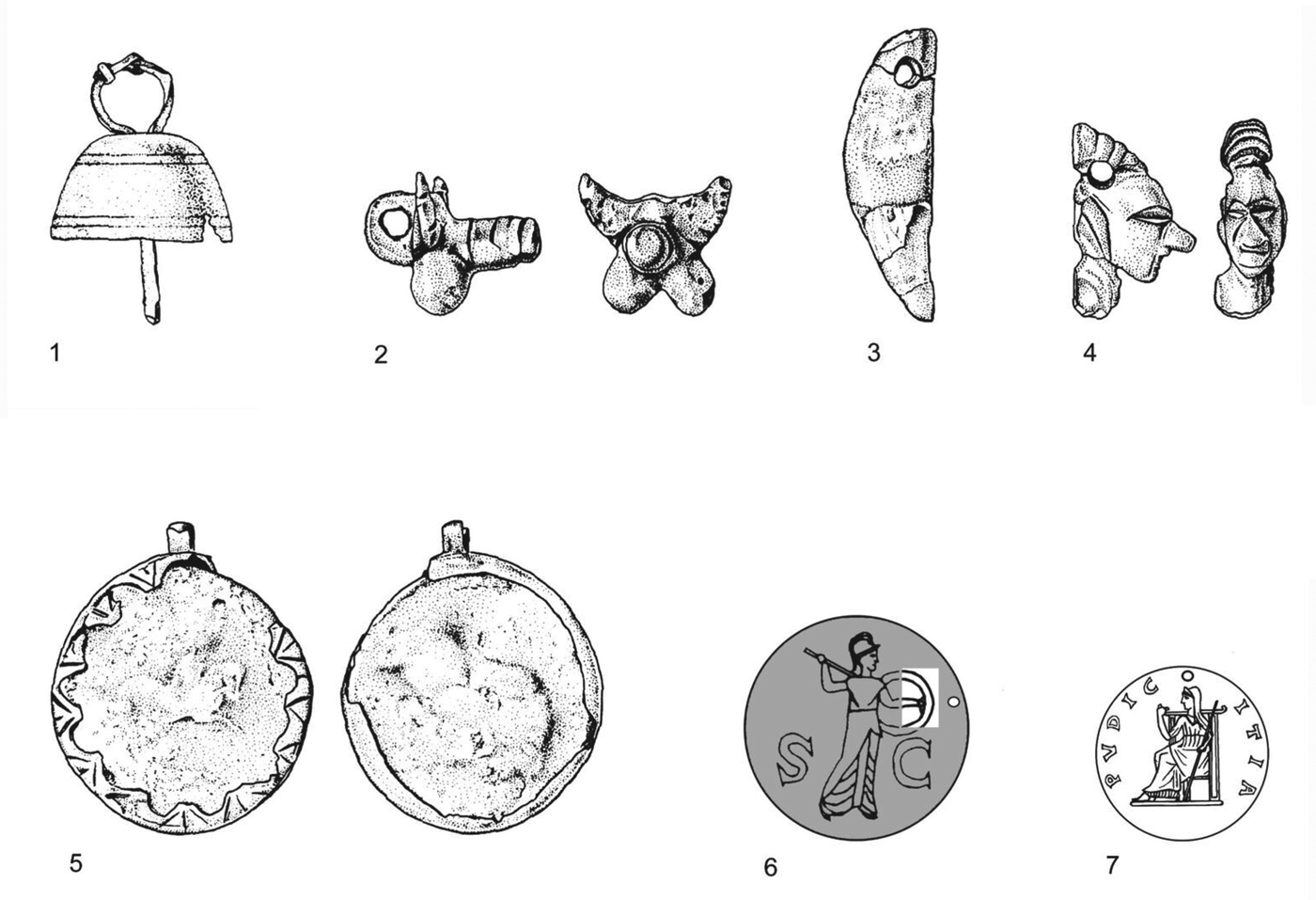
All remaining graves are those of children, with three known from the later Roman Butt Road cemetery at Colchester. The bell from G1 was found in the grave of a girl around ten years of age, and was attached to a copper-alloy armlet on which there was also a bead.Footnote 135 The second grave, G94, is the inhumation of a child and contained two bells on a short length of chain.Footnote 136 Both date to Period 2, the mid- to later fourth century. The final grave, G278, contained what appears to be a chain purse containing several amuletic objects. Among the objects were the bell, an amber pendant in the form of a human head with a possibly phallic nose, a small copper-alloy horned phallus and two pierced coins (fig. 10). This grave is dated to Period 1 (pre-a.d. 320/40); there was no evidence of any remains in the grave, but the size of the grave cut indicated that it, too, belonged to a child.Footnote 137 At a grave in Guilden Morden the bell was hung on the wrist of a child of unspecified age, together with two beads.Footnote 138
Grave 278 at Colchester. (After Crummy Reference Crummy2010, fig. 9)

One burial from Chichester (Burial Group 11) contained a child burial with grave goods consisting of an iron bell, a red-slipped carinated bowl with a graffito of a cross on the base, and a small pebble.Footnote 139 The authors claim that both the bell and the pebble represent toys, but they could also be classed as crepundia. At the military cemetery at Brougham, which is argued to be the final resting place of people with Danubian origins, a bell was placed (apparently unburnt) into the BB1 jar that also contained the cremated remains of a three-to-four-year-old child; there were three further ceramic vessels, one of which covered the jar.Footnote 140 A bell and a single nail were found in a neonate's (0–4 weeks) burial at Springhead, Kent, and both may have had an apotropaic meaning for the parents.Footnote 141 It is possible that the vessel into which the newborn had been placed contained the remains of another neonate; it was placed in one of the sanctuary areas of the site (Property 2, which includes a temple).
While a small dataset, the evidence from Britain certainly seems to suggest that bells were used as amulets, sometimes associated with other apotropaic objects such as a pierced dog's canine or melon beads; they were especially associated with children and women.
THE RITUAL USE OF BELLS IN TEMPLES
Tintinnabula may have been linked to Priapus and at Aventicum (Avenches, France) a large Type 2 bell with a dedication to Mercury was discovered just to the west of the sanctuary area of the town.Footnote 142 Although only a small fragment of the bell survives, this includes the key fragment with the inscription to Deo Mer. Inscribed bells are rare, but several have been found on the Continent with inscriptions to Mercury, perhaps invoking his role as mediator between men and gods.Footnote 143 Generally, an association of bells with sanctuaries has been suggested, as with the bell from the temple at Sichelen and the votive deposit of eight small bells from the sanctuary at Les Bolards, Nuits-Saint-Georges (France).Footnote 144
Bells have also been found at several Romano-British temple sites. Two bells from the poorly understood religious complex at Cold Kitchen Hill in Wiltshire have figurative decoration that may be of ritual significance. One is decorated with a lion's head, the other has two human figures.Footnote 145 At the Green Lane site in Wanborough, Wiltshire, a Type 4 tulip bell was discovered in the area around the religious site and the author believes that it may have either hung around the neck of an animal or been used during rituals.Footnote 146 Bells have also been found on temple sites at Maiden Castle,Footnote 147 Corbridge,Footnote 148 HaddenhamFootnote 149 and Woodeaton.Footnote 150 In all these instances there is no certain association with the temple and the activities that took place within it, but for the Mithras cult a case for the ritual use of bells can be made. This secretive cult, mainly associated with the military and only open to men, held their meetings in cavern-like locations, so recreating the myth of Mithras, who slayed a bull in a cave.Footnote 151 At Segontium (Caernarvon) several iron fragments were found at the base of an altar within the third-century mithraeum, which are thought to be from a tall candleholder or standard; a small copper-alloy bell may have been hung from its two arms.Footnote 152 Another bell of Type 2a form was found in the mithraeum at Tienen in BelgiumFootnote 153 and two iron bells are known from the mithraeum at Strasbourg.Footnote 154 It has been suggested that bells were rung to increase the audience's attentiveness at certain points in the narration of the myth.Footnote 155
In some cases bells were among votive offerings, most notably in the case of Coventina's Well on Hadrian's Wall.Footnote 156 In a less formal context, it is also possible that the bell found with Roman pottery, an iron knife, oyster shells, burnt sticks as well as human and animal bones in a deep shaft at Plumstead were ritual offerings.Footnote 157
BELLS IN HOARDS
Several bells have been discovered in hoards in Britain. At Binnington Carr in North Yorkshire, a Type 4 tulip bell was discovered in a ploughed field in 1876.Footnote 158 Placed inside the bell were 12 silver coins, including one of Julius Caesar (49–44 b.c.), one of Nero (a.d. 54–68), three of Vitellius (a.d. 69) and seven of Vespasian (a.d. 69–79). At the Saxon Shore fort of Burgh Castle, Norfolk, a Type 1 quadrangular bell was discovered in a pit with a hoard of glass vessels and a small bronze vessel. The hoard was placed in a bronze bowl and all the items were contained within an iron-bound bucket.Footnote 159 Two bells were part of the Seven Sisters (near Neath, Wales) hoard discovered in 1875 and dated to a.d. 50–75 on the basis of Roman military equipment; the 37 objects recovered consist of horse gear and tankard handles as well as ingots, scrap metal and two casting jets, with the latter leading to the suggestion that this could be a metal-worker's hoard.Footnote 160 The hoard comprises objects of both ‘Roman’ and ‘native’ style and manufacture; more recent metal analysis showed differential use of alloys and the uptake of Roman techniques such as brass and enamels in the post-conquest period.Footnote 161
Bells also occur in hoards on the Continent, both within the Empire and in the Barbaricum; examples include the hoard associated with a shrine to Dolichenus at Mauer-an-der-Url in AustriaFootnote 162 and the so-called Alemannic booty from the Rhine at Neupotz, Germany.Footnote 163 At Havor, in Gotland, a hoard was buried within a ring-fort, which on the evidence of the finds was of first-century date.Footnote 164 The hoard comprised a bronze situla, a large gold torc, a wine ladle and strainer, and two large Type 4 tulip bells, which had been tied to a ring using a leather strap. Beside the bells were a stack of small copper-alloy saucepans, placed one inside the other.Footnote 165
River finds may be seen as votive but unfortunately the only information for the example from the Thames (No. 4) is that it came from the northern foreshore.Footnote 166
CONCLUSION
This study analysed a corpus of just over 300 published and unpublished bells from Roman Britain, with a database of this material now available on the ADS website (https://doi.org/10.5284/1043774). It has identified clear types and explored their possible functions. While iron bells may well have been used for animals and large forms such as tulip bells may have functioned as door, market or warning bells, many of the smaller forms appear to have had broadly amuletic or apotropaic functions. The use of a bell clearly depended on its size and material. Some objects appear to show long use, possibly in a variety of functions. We have summarised the available dating evidence from the province and the Continent, demonstrating that bells were used throughout the Roman period but with a peak in the first century.
Many of the types can be paralleled on the Continent but this paper has also identified a new bell type, characterised by triangular cut-outs in a variety of arrangements. Unfortunately all examples from Britain were recorded by the PAS, with none known from excavations. This is an unusual pattern, given that quite significant numbers have now been recorded, but there is no particular reason for seeing the PAS finds as modern imports. The finds come from widely dispersed sites (i.e. not from a small number of rallies by the same metal-detecting club) and while some are well preserved there are also many fragmentary examples. Doubts remain whether this openwork type really is Roman but it differs in details of design and distribution from early medieval bells. The only parallels we were able to identify are of first-century date and come from graves in the Black Sea region, a pattern that is difficult to explain. It is hoped that future finds will come from excavated contexts, so that the type can be more securely dated and its origin established.
An analysis of social distribution suggests that bells were used across the settlement hierarchy; among the excavated material there is an emphasis on military and urban sites but this is balanced by the new data available from the PAS, which show the widespread use of all types on rural sites. Bells occur on temple sites and in hoards, but contextual information for temples is quite poor, and they may occur in hoards for their metal value, as containers or for the sound they produced. We have much better information on the use of bells as amulets, in particular from the graves of children and young women. In these cases, it must have been the sound of the bells that exerted magical and protective powers. As suggested by Schoenfelder and Richards bells represent an ‘audible form of ostentation’Footnote 167 and, we would argue, magic.
APPENDIX
OPENWORK BELLS FROM BRITAIN RECORDED BY THE PAS

COMPARATIVE TYPOLOGIES

OPENWORK BELLS FROM THE BLACK SEA REGION
(this is a sample, given the difficulties of accessing the relevant literature)

BURIALS WITH BELLS FROM ROMAN BRITAIN

ACKNOWLEDGEMENTS
The authors thank Amy Atkins, who transcribed the original catalogue onto an Access database. The paper was written during study leave supported by the Department of Archaeology, University of Reading. We would like to thank John Creighton, Nina Crummy, Michel Feugère, Stefanie Hoss, Daniel Kostromichyov, Michael Marshall and Julian Richards for additional information. Matt Fittock, Owen Humphreys and Philippa Walton kindly commented on an earlier draft of this paper. Illustrations were produced by Jennifer Foster and Sarah Lambert-Gates, and we thank Devizes Museum for the photo of a bell from Cold Kitchen Hill, Sally Worrell for the images from the Portable Antiquities Scheme and the Bibliothèque Nationale de France for permission to reproduce the Mercury bust from Orange. Rob Fry kindly produced the GIS density map.