Introduction
Globally it is estimated that 24.3 million people have dementia, with 4.6 million new cases of dementia being diagnosed every year. The number of people affected will double every 20 years to 81.1 million by 2040. Most people with dementia live in developing countries (60% in 2001, rising to 71% by 2040) where the design and building of residential services is, at best, embryonic. In these countries, the rate of increase is higher than the average; numbers in developed countries are forecast to increase by 100% between 2001 and 2040, but by more than 300% in India, China, and their South Asian and Western Pacific neighbors (Ferri et al., Reference Ferri2005).
It is estimated that there are 230,000 older people with dementia in Australia (Access Economics, 2009). Of these, 44% were in cared accommodation, mainly residential care but some in health facilities (AIHW, 2007). The proportion of people with dementia who live in households decreases with age – 79% of people with dementia aged 65–74 years still live in the community, but for those aged 85 and over the proportion decreases to 36%. Most people with mild dementia live in households in the community (96%) while most people with moderate or severe dementia are in cared accommodation (91%).
If the Australian figures are applied to the global figures, the result suggests that by 2040 about 36 million people with dementia will require residential care. It may well be that a focus on community services or developments in pharmacology will reduce this number but it seems clear that a great many people stand to benefit from well-designed facilities for people with dementia.
In her influential statement on designing environments for people with dementia, Professor Mary Marshall of the Dementia Services Development Centre at the University of Stirling, Scotland, recommended that dementia-specific residential facilities should be designed in a way that compensates for disability, maximizes independence, reinforces personal identity, enhances self esteem/confidence, demonstrates care for staff and welcomes relatives and the local community (Marshall, Reference Marshall2001).
To achieve these results she recommended that residential facilities for people with dementia should:
• be small in size
• control stimuli, especially noise
• enhance visual access, i.e. ensure that the resident can see what they need to see from wherever they spend most of their time
• include unobtrusive safety features
• have rooms for different functions with furniture and fittings familiar to the age and generation of the residents
• have single rooms big enough for a reasonable amount of personal belongings
• be domestic and home-like
• have scope for ordinary activities (unit kitchens, washing lines, garden sheds)
• provide a safe outside space
• provide good signage and multiple cues where possible, e.g. sight, smell, sound
• use objects rather than colour for orientation.
The aims of this paper are to assess the strength of the evidence for these recommendations and to identify those recommendations that could be used as the basis for guidelines to assist in the design of long-term care facilities for people with dementia.
Methods
A report on the empirical evidence available to guide the design of facilities for people with dementia has been conducted for the Primary Dementia Collaborative Research Centre in Australia (Fleming et al., Reference Fleming, Crookes and Sum2008). This paper extends the findings of this report with the inclusion of additional and more recent papers.
The major databases (Medline, Cinahl, PsycInfo, Embase, Central, ProQuest, Pubmed, Google Scholar and Cochrane) were searched electronically and reference lists in earlier reviews, related published articles and books were checked manually.
The search terms were based on those used by Day et al. (Reference Day, Carreon and Stump2000) in their comprehensive review of the literature. These terms were “dementia”, “physical environment”, “home”, “nursing home”, “assisted living”, “day care”, “hospital”, “residential care”, “public places”, “resident room”, “SCU”, “privacy”, “security”, “safety”, “behavioral changes” and “behavioral modifications”.
The titles, key words, abstracts and, where necessary, the methodology, discussions and/or conclusions of the papers identified by the electronic and manual searches were screened for potential relevance by one of the researchers. This was an over inclusive process designed to eliminate only papers that were obviously irrelevant, with 332 papers being identified as potentially relevant. The over inclusiveness was tested by both researchers assessing the first 39 papers available to both of them. They agreed that 32 of them were relevant. All seven of those for which there was disagreement were rated as relevant by the junior researcher, who was carrying out the screening, and judged as being not relevant by the senior researcher. There was no occasion when the screening researcher excluded an article that would have been included by the senior researcher. On completion of the screening by the junior researcher, 242 articles remained.
These articles were assessed for relevance by two researchers, resulting in the identification of 148 articles as relevant. Eight additional papers were identified during internal peer review process (see acknowledgment). Papers that were identified as relevant were then subjected to an assessment of their validity using the model provided by Forbes (Reference Forbes1998).
The Forbes approach to the validation of the papers was chosen in the absence of any well-accepted alternative contender. The Forbes approach involves an assessment of external validity (design, inclusion, attrition), internal validity and statistical validity resulting in the allocation of a rating of strong, moderate, weak or poor. The most recent comprehensive review of the environmental design literature (Day et al., Reference Day, Carreon and Stump2000) did not attempt any systematic validation, while in the area of psychosocial research the Forbes approach has been used in recent reviews (Opie et al., Reference Opie, Rosewarne and O'Connor1999; O'Connor, Reference O'Connor2007). While the Forbes approach is not finely tuned to the methodologies used in the environmental design literature, an adaptation of it was used in the Cochrane Review on bright light therapy (Forbes et al., Reference Forbes, Morgan, Bangma, Peacock and Adamson2004) and its use provides an opportunity for a future comparison between the strength of the environmental design literature and the psychosocial intervention literature.
In practice, the Forbes approach required a great deal of discussion between the two raters to come to a consensus on the ratings and resulted in the description of some important work, particularly that of Namazi and Johnson (Reference Namazi and Johnson1991a; Reference Namazi and Johnson1991b; Reference Namazi and Johnson1992a; Reference Namazi and Johnson1992b; Reference Namazi and Johnson1992c; Reference Namazi and Johnson1992d; Reference Namazi and Johnson1992e) as weak or poor because of the descriptive nature of the statistical analysis and/or because of high attrition rates, which are sometimes impossible to avoid in research on very elderly people.
The methods used in 93 papers were judged to be “poor” as per the Forbes criteria (Forbes, Reference Forbes1998) and were excluded from the review. Additionally, two papers were excluded as we were unable to obtain sufficient details to apply Forbes criteria. This left 63 papers which were of sufficient quality (Forbes rating: 9 strong, 14 moderate, 40 weak but sufficient) and are included in the current review. The findings of these papers are reported below under headings based on Marshall's schema.
Results
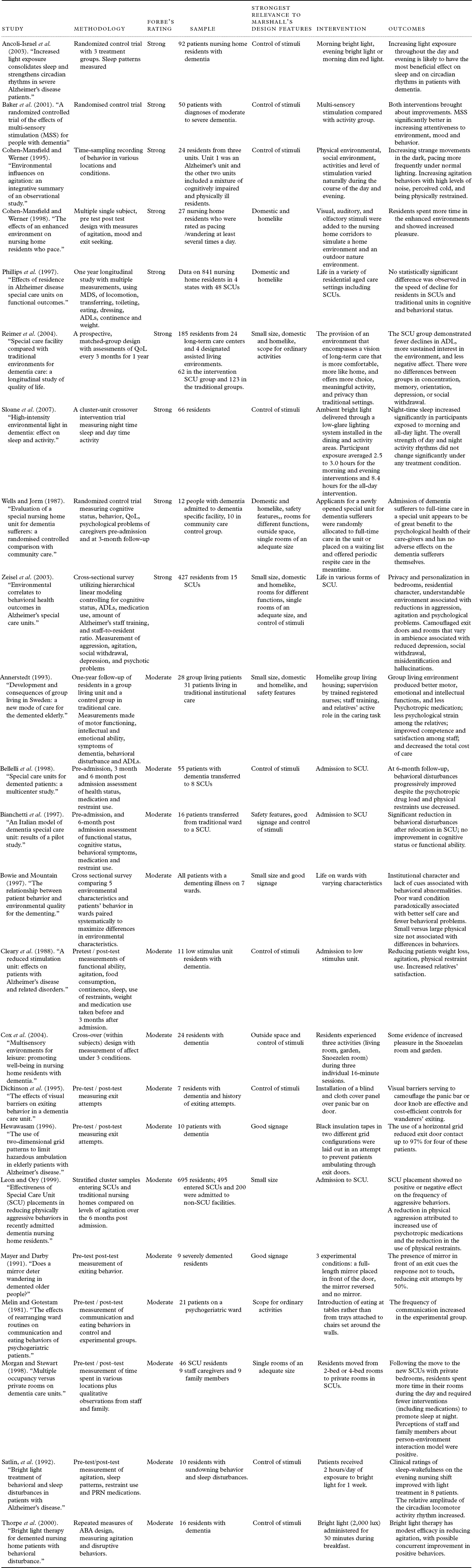
A summary of the strong and moderately strong articles and their relationship to Marshall's schema is contained in Table 1.
Summary of strong and moderately strong papers

ADL = activities of daily living; MDS = minimum data set; MSS = multi-sensory stimulation; QoL = quality of life; SCU = special care unit.
Size of the care home
Perhaps the most influential combination of principles in recent decades has been that of “small and homelike”. Their frequent combination makes it virtually impossible to tease out the individual contributions of the principles. While there is evidence supporting the proposition that small size – i.e. a small number of residents – is associated with a variety of positive outcomes for people with dementia (Annerstedt, Reference Annerstedt1993; Sloane et al., Reference Sloane, Mitchell, Preisser, Phillips, Commander and Burker1998; Reimer et al., Reference Reimer, Slaughter, Donaldson, Currie and Eliaszew2004), it is impossible to quantify the contribution that the size of the unit makes in comparison with the other environmental factors that are commonly associated with a purposely designed, small unit, e.g. home likeness, safety and familiarity (Reimer et al., Reference Reimer, Slaughter, Donaldson, Currie and Eliaszew2004). The relationship between size and positive outcome is not always evident. No significant correlation was found between facility size – large or small – and physically aggressive behaviors in a sample of 695 residents of special care units (SCUs) and traditional nursing homes (Leon and Ory, Reference Leon and Ory1999) However, this study defined large facilities as those with more than 150 beds, a definition that may have swamped the effects of genuinely small facilities. A recent study carried out in Holland found no relationship between neuropsychiatric symptoms and the number of residents per SCU or per living room in 25 nursing homes of regular size SCUs (Zuidema et al., Reference Zuidema, de Jonghe, Verhey and Koopmans2009). In smaller sized group living homes there was no difference in behavioral problems compared to traditional, larger sized nursing homes (te Boekhorst et al., Reference te Boekhorst, Depla, de Lange, Pot and Eefsting2009).
The relationship between behavioral disturbance and the size of the space in which the group lives has been investigated in two studies (Bowie and Mountain, Reference Bowie and Mountain1997; Elmstahl et al., Reference Elmstahl, Annerstedt and Ahlund1997) and the findings suggest a lack of association between the amount of space available in a ward and the level of behavioral disturbance.
Optimum level of stimulation
People with dementia have difficulties in dealing with high levels of stimulation. Their ability to screen out unwanted stimuli appears to be reduced. They can become more confused, anxious and agitated when overstimulated (Cleary et al., Reference Cleary, Clamon, Price and Shullaw1988). Common causes of overstimulation are busy entry doors that are visible to patients, clutter, public address systems (Cohen and Weisman, Reference Cohen and Weisman1991; Brawley, Reference Brawley1997), alarms, loud televisions (Hall et al., Reference Hall, Kirschling and Todd1986; Evans, Reference Evans1989), corridors and crowding (Nelson, Reference Nelson1995). The careful optimization of levels of stimulation is well supported (Cleary et al., Reference Cleary, Clamon, Price and Shullaw1988; Cohen-Mansfield and Werner, Reference Cohen-Mansfield and Werner1995; Zeisel et al., Reference Zeisel2003). Methods of dealing with specific elements of the environment that cause overstimulation, e.g. hiding or disguising busy entry doors that provide a view to the outside, providing two wardrobes so that the resident accesses one that has only a manageable range of clothing in it, have been thoroughly investigated and found to be effective (Namazi et al., Reference Namazi1989; Namazi and Johnson, Reference Namazi and Johnson1992b; Dickinson et al., Reference Dickinson, McLain-Kark and Marshall-Baker1995).
While it is necessary to reduce unhelpful stimulation, care must be taken to optimize helpful stimuli. There is good evidence that increasing levels of illumination beyond that which is usually considered to be normal can improve sleep patterns and reduce behavioral disturbance (Satlin et al., Reference Satlin, Volicer, Ross, Herz and Campbell1992; Thorpe et al., Reference Thorpe, Middleton, Russell and Stewart2000; Ancoli-Israel et al., Reference Ancoli-Israel2003; Sloane et al., Reference Sloane, Christianna, Williams and al.2007). The introduction of multi-sensory stimulation has been shown to improve mood and behavior as much as the introduction of an activity group (Baker et al., Reference Baker2001).
Studies involving the combination of reduced stimulation with other environmental and care practice manipulations have been shown to reduce behavioral disturbance (Bianchetti et al., Reference Bianchetti, Benvenuti, Ghisla, Frisoni and Trabucchi1997; Bellelli et al., Reference Bellelli1998).
Residents in care homes are exposed to a variety of different noise sources including man-made noise and noise from household/electrical equipment. Repeated measurements in nursing homes in the U.S.A. revealed that noise levels reached 55–70dB, comparable to busy road traffic noise (Bharathan, Reference Bharathan2007). One group videotaped nursing home residents to identify antecedents of agitated behavior and it appeared that unwanted music or interruption to pleasurable music can lead to agitated behavior (Ragneskog, Reference Ragneskog1998).Noise has been recognized as a possible contributing factor to poor sleep. However, interventions in nursing homes to reduce night-time noise have not improved sleep time (Ouslander, Reference Ouslander2006), although another study using non-pharmacological interventions, including decreasing noise levels to increase night time sleep, found a modest benefit (Alessi, Reference Alessi2005). Furthermore, Alessi et al. (Reference Alessi1999) established that a combination of increased physical activity during the day and reduced noise levels at night can lessen agitation in nursing home residents.
Total visual access
The observation that people with dementia stand a better chance of finding something if they can see it from where they are led to the idea of “total visual access,” which was incorporated into the design of the NSW Health units for the confused and disturbed elderly (CADE) (Fleming and Bowles, Reference Fleming and Bowles1987). It resulted in a very simple, corridor-free environment. The evidence for the incorporation of good visual access on the unit-level scale is not strong (Elmstahl et al., Reference Elmstahl, Annerstedt and Ahlund1997; Passini et al., Reference Passini, Pigot, Rainville and Tetreault2000) but the dramatic effect of making an important amenity – the toilet – easily seen provides good supporting evidence for the concept (Namazi and Johnson, Reference Namazi and Johnson1991a).
Unobtrusive safety features
The level of safety and security in facilities designated as providing care to people with dementia is higher than in other facilities (Morgan et al., Reference Morgan, Stewart, D'Arcy and Werezak2004). One of the most common problems associated with caring for people with dementia in an environment that has not been designed for their use is that of keeping them safe from the danger of wandering away and perhaps getting lost or run over (Rosewarne et al., Reference Rosewarne, Opie, Bruce, Ward and Doyle1997). The most obvious response to this problem is to provide a secure perimeter, preferably one that allows for safe wandering and access to an outside area.
Positive effects have been found when unobtrusive means are used to provide a secure perimeter (Zeisel et al., Reference Zeisel2003). Depression was negatively correlated with exits that were well camouflaged and had silent electronic locks rather than alarms. Zeisel hypothesized that residents would try to leave less frequently in such settings and that caregivers, believing that such environments are safer, would give residents greater independence of movement. Residents who experience this greater freedom have less conflict about trying to leave and feel a greater sense of control and empowerment, leading in turn to less depression (Zeisel et al., Reference Zeisel2003).
Placing a horizontal grid of black tape in front of an exit reduced contact with the door by up to 97% in four people with Alzheimer's disease (Hewawasam, Reference Hewawasam1996). The presence of a mirror in front of an exit was found to cue the response not to touch, reducing exit attempts by 50% (Mayer and Darby, Reference Mayer and Darby1991), and hiding the latch behind a cloth panel reduced the number of attempts to exit (Dickinson et al., Reference Dickinson, McLain-Kark and Marshall-Baker1995; Dickinson and McLain-Kark, Reference Dickinson and McLain-Kark1998).
The beneficial effects of unobtrusive safety features, particularly in relieving depression, were noted in an early randomized controlled trial (Wells and Jorm, Reference Wells and Jorm1987; Zeisel et al., Reference Zeisel2003). The need for security to be unobtrusive and to avoid restraining people with dementia who, while confused, are not likely to abscond is supported by the finding that harmful behaviors, particularly risk taking and passive self harm, were associated with more security features (Low et al., Reference Low, Draper and Brodaty2004). The possibility that an emphasis on safety reduces enjoyment of activities and the feeling of being able to control the environment has been suggested in a U.K. study (Torrington, Reference Torrington2006).
Availability of rooms to suit varying functions or specific purpose
The provision of rooms for different functions has been shown to differentiate SCUs from non-SCUs in a statewide survey involving 436 nursing homes in Minnesota (Grant et al., Reference Grant, Kane and Stark1995). The strongest evidence for its importance comes from the well controlled study by Zeisel et al. (Reference Zeisel2003) that provides some certainty about the contribution of the individual factors to the well-being of the residents. It concluded that the degree of privacy-personalization in the SCUs studied was negatively correlated with patient scores on the Cohen-Mansfield total aggression scale. Residents in facilities with more individual rooms and more opportunities for personalization tend to experience less anxiety and aggression. The provision of common areas that vary in ambiance is associated with reduced depression, social withdrawal, misidentification and hallucinations.
A well conducted cross-sectional study involving 38 homes and 452 residents (Barnes, Reference Barnes2006) showed that gradation of space is associated with resident quality of life, highlighting the necessity for design guidance to emphasize a variety of spaces.
The availability of private rooms has been shown to reduce irritability and improve sleeping patterns in people with advanced Alzheimer's disease and other related disorders (Morgan and Stewart, Reference Morgan and Stewart1998).
Social environment (homeliness, activities and outside space)
The problem of an intricate relationship between the social/professional environment (the philosophy of care, staff skills, good management practices) and the physical environment appears again when assessing the impact of providing a homelike environment, especially in the case of people with advanced dementia. However, there is good evidence that such an environment reduces aggression (Zeisel et al., Reference Zeisel2003) A very well controlled investigation of the effects of introducing a few of the most basic elements of a homelike environment into a very institutional nursing home (Cohen-Mansfield and Werner, Reference Cohen-Mansfield and Werner1998) showed that residents chose to spend time in a corridor containing comfortable chairs, pictures, coffee table, books and the aroma of citrus in comparison with a normal corridor. There was a weak trend to reduced agitation, pacing and exit seeking in comparison to behavior in a normal corridor but this positive trend was stronger when, instead of a domestic setting being provided, a setting reminiscent of a natural outdoor setting was provided. The differences between the two enhanced settings were small.
If it can be assumed that homelikeness is a feature of SCUs in the U.S.A. – and there is some doubt about this (Chappel and Reid, Reference Chappel and Reid2000) – then the findings of the four State study of 800 facilities (Phillips, Reference Phillips, Sloan, Howes and Koch1997) are relevant. This study showed that SCU residents declined at the same rate as non-SCU residents matched for baseline cognitive status, behavioral problems, age, sex and length of stay.
The provision of opportunities to engage with ordinary activities of daily living is often associated with the principle of homelikeness (Verbeek et al., Reference Verbeek, van Rossum, Zwakhalen, Kempen and Hamers2009). There is moderately strong evidence for the beneficial effects of providing people with dementia with an environment that gives them this opportunity (Melin and Gotestam, Reference Melin and Gotestam1981.; Reimer et al., Reference Reimer, Slaughter, Donaldson, Currie and Eliaszew2004). However, it is very difficult to differentiate the contribution of the physical environment from that of staff encouragement and support.
Similarly, there is little evidence for the benefits of outside spaces by themselves but good evidence of benefit when combined with staff interaction (Cox et al., Reference Cox, Burns and Savage2004).
Signage and orientation cues
Perhaps surprisingly, the evidence for the beneficial effects of signage is not strong (Hanley, Reference Hanley1981; Namazi and Johnson, Reference Namazi and Johnson1991b) and weak empirical support was found for the use of the display of personal memorabilia as aids to orientation (Namazi et al., Reference Namazi, Rosner and Rechlin1991).
Discussion and conclusions
Marshall's schema provides a useful framework for organizing the existing literature. The items in it are broad but sufficiently detailed to inform a literature search and to help identify areas of strength and weakness in our knowledge base. The available research suggests that designers and architects may be confident about using unobtrusive safety measures; varying the ambience, size and shape of spaces; providing single rooms; maximizing visual access to important features and providing for stimulus control with the periodic availability of high levels of illumination.
There is less agreement on the usefulness of signage of various sorts and the quality of the research is sufficiently high to suggest that we should not be placing much emphasis on this area. The response to the identification of other areas where there is limited empirical support – e.g. homelikeness, provision for engagement in ordinary activities of daily living, small size, provision of outside space – should perhaps be different. These are areas where there is a great deal of anecdotal and experiential evidence to suggest that they are highly desirable. They are worthy of more research before concluding that they are unimportant and the research must be designed to control for the confounding effects of changes in staff attitudes and skills.
Most of the research has been carried out in special care units, a generic term that covers a wide range of facilities, but tends to focus on the relatively physically robust person with dementia. There is little research on the impact of dementia on people in the final stages of the disease where physical frailty is very common. It is therefore clear that we are not in a position to provide a formula for the design of an environment that will suit the needs of everyone. The evidence does not exist to support the description of a well-designed environment for the person with dementia who is in the final stages of palliative care and, perhaps more importantly, there is a consensus that while common elements may be identified there cannot be one optimal environment. The environment should, as far as possible, meet the individual needs of the resident, and as these will vary even within a single facility, every environment will be a compromise.
Designing for dementia in isolation from other common problems encountered by the elderly, e.g. sensory deficits and falls, is far from ideal but the evidence base for designing for combinations of problems is very small indeed. There is also the issue of designing for the person caring for the person with dementia, both the professional carer and the relatives who visit. How can the needs of these people be met by the physical environment?
It may yet be too early to argue for the provision of definitive guidelines for the design of long-term care units for people with dementia. While progress has been made since 1980 the evidence base is still not strong. Yet there are some aspects of design that promote confidence and the need to offer guidance in this large and expanding area of service provision is great. The following suggestions are offered as a contribution to the process of determining guidelines. Perhaps the next step in this process should be a consensus statement. The suggestions are offered as an update on those that have already been offered (Day et al., Reference Day, Carreon and Stump2000; Marshall, Reference Marshall2001).
The empirical evidence supports the advice that long-term facilities for people with dementia should be designed and constructed with these features in mind:
1. Where it is necessary to provide for the safety and security of the residents by confining them within a secure perimeter, this should be achieved by means of unobtrusive security measures that maximize the feeling of control over the environment.
2. Those parts of the facility which are accessible to the residents should contain a variety of spaces that provide the residents with differing ambience, size and function.
3. Each resident should have the opportunity to have a single room and be allowed to personalize that room.
4. Residents should be able to see the features that are most important to them from the location(s) where they spend most of their time.
5. The levels of stimulation should be adjusted to minimize unhelpful stimulation and optimize helpful stimuli with the periodic availability of high levels of illumination.
Furthermore, it is desirable that the facility should:
6. be small
7. have a homelike appearance
8. provide opportunities for engagement with the ordinary activities of daily living, and
9. have an outside space that is accessible to the resident when accompanied by a member of staff.
Conflict of interest
None.
Description of authors' roles
R. Fleming designed the literature review, supervised and contributed to the review of the articles and wrote the paper. N. Purandare supplemented the review with additional articles on noise levels in long term care and contributed to the style and content of the article.
Acknowledgments
Professor Henry Brodaty, Director of the Primary Dementia Collaborative Research Centre based in the University of New South Wales, Sydney, Australia provided valuable comments during the peer review process. Dr. Sytse Zuidema, Department of Primary and Community Care, Centre for Family Medicine, Geriatric Care and Public Health, Radboud University Nijmegen, Medical Centre, Nijmegen, Holland provided valuable comments and additional papers for review during the peer review process. Dr. Shima Sum, Paramedicine Faculty, Babol University of Medical Sciences, Babol, Mazandaran, Iran provided invaluable assistance with sourcing and reviewing the articles in the literature review used as the basis for this paper.
The writing of the literature review used as the basis for this paper was supported by a grant from the Primary Dementia Collaborative Research Centre, University of NSW, as part of the Australian Government's national initiative “Dementia: A Health Priority”.