Paris’ Choice
Aphrodite's gift to Paris of ‘grievous lust’ (Il. 24.30) seems, in my opinion (after Richardson Reference Richardson1993, 279), to stand as a metaphor for his wedding with Helen and the ill consequences it would bring to him and the whole of Troy. One can imagine that Paris’ lust would be satisfied once he had married Helen. This union, bringing about the Trojan War and the ultimate destruction of Ilion, would be rightly considered a calamity. There is, however, the possibility that this is not a metaphor: that the ‘lust’ or μαχλοσύνη resembles effectively what Aphrodite offered to Paris. To clarify this reading, I shall compare literary and artistic renderings that depict the gift of Aphrodite in representations of the Judgement or the meeting of Paris and Helen, which I have taken from Lilly Kahil's (Reference Kahil and Boardman1988) entry ‘Helene’ in the Lexicon Iconographicum Mythologiae Classicae. I will first discuss Herbert Rose's interpretation, which alerted me to this alternative reading for the gift of Aphrodite in Homer, and will then examine the relevant evidence, beginning with the most explicit cases and moving on to the less explicit ones. In examining the different representations of the Judgement, I separate the less explicit cases, i.e., the ones that do not evidently show an element (in this case the gift of Aphrodite) within the depiction or narrative, into those that imply and those that suggest such an element. The method to distinguish these two groups consists of spotting the idea of beauty or love (or a visual representation of them as Erotes) concerning Paris within a representation of the Judgement or his encounter with Helen, and asking why the process or gesture in which this idea is involved takes place. If Aphrodite's bribe of making Paris beautiful and lovable is suitable as a direct cause explaining that process or gesture, then I shall assert that the representation implies the gift of Aphrodite. If her bribe is not suitable as a direct cause, even though the idea of beauty or love is visible, then I shall assert that the representation suggests the gift. It could be argued that the Erotes on visual renderings are the gift of Aphrodite and, therefore, they are explicit rather than ‘less explicit’ elements. Images, however, cannot ‘tell’ us in no uncertain terms what written texts can; they are subject to multiple interpretations in many regards and this is certainly the case for such abstract notions as beauty and love or desire.
The explanation offered by Rose (Reference Rose1951) on the Homeric reference to the Judgement of Paris (Il. 24.29–30) was eccentric, since he rejected that the passage points to the story of the Judgement, while still allowing that Paris received the gift mentioned in these lines. Rose's interpretation contains, nevertheless, a compelling detail – that Paris was offered (and given) the characteristic of being irresistible to women. Rose resorts to the argument that Homer does not refer to the Judgement at Iliad 24.30 but to another story according to which Hera and Athena did not go to Paris to compete on account of their beauty, but to find out whether he was affable or disdainful;Footnote 1 after they were rejected with insults, another woman – either Aphrodite or a witch – went to him and offered him the power to get anything he wanted from women. On this reading, the μαχλοσύνη (Il. 24.30) offered by this female character does not mean madness for women or randiness, but it rather represents his attractiveness to women.
While Rose might have just forced the meaning to fit his narrative – as he does concerning ᾔνησɛ, probauit potius quam laudauit (283) –, this interpretation conforms well with the two post-Homeric accounts of the Judgement delivered by Cratinus (5th cent. BC) and Lucian of Samosata (mid-2nd cent. AD), and with the episode told in Il. 3.390–427. A few pictorial renderings of Paris with Helen, discussed below, seem to display this fascination of women with Paris by surrounding him with Erotes, who make Paris attractive in the eyes of Helen. On the ground of Od. 17.485–7, Rose asserts that Il. 24.28–30 relates to a fable of the gods putting men on trial to see whether they are fair or not. In his analysis of this passage Malcolm Davies (Reference Davies2003) offers an ingenious reading. He acutely reveals the patterns of the three brothers and the magic helper from traditional tales, although ‘the three brothers have been contracted into one [that is Paris], whereas the tester or helper figure has been expanded into three’ (35), the goddesses. This explanation is sufficient for understanding Rose's confusion, and the literature on this Homeric episode from the last century has provided conclusive arguments for the claim that Il. 24.22–30 refers to the Judgement of Paris.Footnote 2 If correct, Rose's reading of μαχλοσύνη must be understood as part of Aphrodite's bribe to Paris, alongside or on top of Helen.
How can we be sure Aphrodite would offer such a gift? One reason would be that it is explicitly mentioned in two literary works from antiquity. In 430–429 BC, Cratinus’ comedy Dionysalexandros (preserved in a summary)Footnote 3 offered a parody of the Judgement of Paris in which Dionysus disguised as Paris judged the goddesses and stole Helen, but decided to hide Helen in a basket and to disguise himself as a ram when he learned that the Achaeans were after him to recover Helen. In this story, we find the oldest preserved testimony of the gifts offered by the three goddesses: Hera offered power (τυραννίδο[ς] ἀκινήτου), Athena offered success in battle (ɛὐψυχί[ας] κ[α]τ[ὰ] πόλɛμο[ν]), and Aphrodite offered ‘Dionysalexandros’ to become κάλλιστόν τɛ καὶ ἐπέραστον. About six centuries later, Lucian (Dial. D. 20.15) would write that Aphrodite offered both Helen and attractiveness through the escort of Eros and Himeros: ὁ μὲν Ἔρως ὅλος παρɛλθὼν ɛἰς αὐτὴν ἀναγκάσɛι τὴν γυναῖκα ἐρᾶν, ὁ δ’ Ἵμɛρος αὐτῷ σοι πɛριχυθɛὶς τοῦθ’ ὅπɛρ ἐστίν, ἱμɛρτόν τɛ θήσɛι καὶ ἐράσμιον (‘Eros will force the woman, by wholly running into her, to love you, and Himeros will make you desired and beloved by pouring this that he is upon yourself’). In this account, Aphrodite explained that Eros (Love) would make Helen fall in love, while Himeros (Desire) would make Paris look irresistible to her. Their action reflects the beauty (κάλλιστος) and love (ἐπέραστος) offered by Aphrodite in Cratinus’ Dionysalexandros.
Although commonplace in literature, Aphrodite offering Helen is not a scene ordinarily found in artistic renderings. That Aphrodite offered Helen as a gift to Paris is suggested on the Lycian silver double-head kantharos London 1962,1212.1, 350–300 BC, the heads of which represent those of Paris and Helen. Aphrodite's bribe seems clearer (implied) on the Athenian red-figure lekythos Athens 1282 (BAPDFootnote 4 32481), 400– 380 BC, on which Paris is the focal point of the scene. Eros stands beside him, leaning on Paris’ chair and talking to him while pointing to a woman to the left. To the right is Athena, standing and fully armed; a big snake rises beside her. Additionally, a Palladion is placed on the floor to the left of Eros. To the left of the Palladion is the female figure towards which Eros points: as for the remaining inscription, this indicates either Hera or Helen. Irmgard Raab (Reference Raab1972, 197) suggests that this cannot be a goddess because the attitude of the woman makes no sense for either Hera or Aphrodite, as she is running. According to Christoph Clairmont (Reference Clairmont1951, 56), the woman is Helen and is running to Paris. According to Jane Harrison (Reference Harrison1903, 307), the woman is Helen and she implores the Palladion to be gracious. While these are plausible readings, I want to suggest that the Palladion and Eros symbolize Athena's and Aphrodite's offerings to Paris: victory in battle as well as handsomeness. As the woman running from the left cannot be Aphrodite or Hera, she must be Helen. Her presence here does not account for an encounter between her and Paris, but for the gifts offered by Aphrodite to him. These two, the Lycian kantharos in London and the Athenian lekythos in Athens, are the only examples I am aware of.
Spelling Out Some Implications
Homer tells us that Helen was stolen by Paris (Il. 3.442–6; cf. Od. 4.141–6) and implies that Aphrodite made this possible (Il. 3.392–4). This episode does imply the gift of Aphrodite not only because it emphasises Paris’ attractiveness but also (and maybe especially) because it is the goddess who delivers this description and it is Helen who listens. In the much later Colluthus’ Raptus Helenae (5th cent. AD), Helen will feel instantly attracted to Paris when they meet in Sparta (259–64). The poet does not attribute this reaction to Aphrodite's influence, but it seems too exceptional to not be credited to her – especially when we are aware of the special grace she granted Paris.
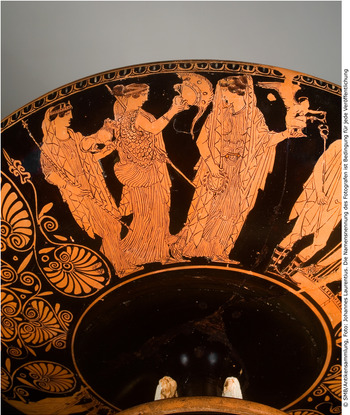
The gifts of the goddesses described by Cratinus agree with those depicted on the Athenian red-figure cup, name vase of the Painter of Berlin 2536 (BAPD 217284), c. 440 BC (fig. 1), as Hera carries a miniature lion – a symbol of power, Athena carries a helmet, and Aphrodite carries a small Eros. On the Athenian red-figure hydria (lost) once Berlin F2633 by the Kadmos Painter (BAPD 215722), 430–420 BC, an Eros engages in conversation with Paris, while the three goddesses wait for his decision – this rendering also implies the bribe of Aphrodite, which convinced Paris in choosing her over Hera or Athena. This situation of an Eros interacting with Paris while he reflects on his decision enjoyed some popularity, as is apparent from the many artefacts that represent it between 440 BC and AD 300:
1. the Athenian red-figure fragmented bell krater Sarajevo 33 (BAPD 9288), 440–420 BC;
2. the Athenian red-figure hydria Syracuse 38031 by the Modica Painter (BAPD 217533), 425–400 BC;
3. the Athenian red-figure hydria Karlsruhe 259/B36, name vase of the Painter of the Carlsruhe Paris (BAPD 220515), c. 400 BC;
4. the Athenian red-figure lekanis lid fragment Athens (Agora) P7645 (BAPD 21745), c. 400 BC;
5. the Athenian red-figure bell-krater Vienna 1771 near the Meidias Painter (BAPD 220529), 400–380 BC;
6. the Athenian red-figure pelike Saint Petersburg St2020, 400–350 BC;
7. the South Italian red-figure hydria London market (Sotheby 1928, no. 130), 360–340 BC;
8. the Athenian red-figure pelike Athens 1181 by the Marsyas Painter (BAPD 230423), 350–340 BC;
9. the Apulian red-figure volute krater New York 69.11.7 by the Baltimore Painter, 330–310 BC;
10. the Roman mural Naples 8988, 20 BC–AD 79;
11. the Roman mural Pompeii VIII.4.4 (Casa di Marco Holcono Rufo, Room 22), 20 BC–AD 79;
12. the Roman bronze mirror Columbia (MO) 77.124, 2nd cent. AD;
13. the Roman sarcophagus fragment Rome 8563, AD 117–138;
14. the Roman sarcophagus Paris MA1335, AD 175–200;
15. the Roman sarcophagus Rome (Villa Medici) 54, AD 180–200;
16. the Roman sarcophagus lid Paris MA267, AD 200–235;
17. the Roman onyx cameo Florence 14470, 2nd–3rd cent. AD.
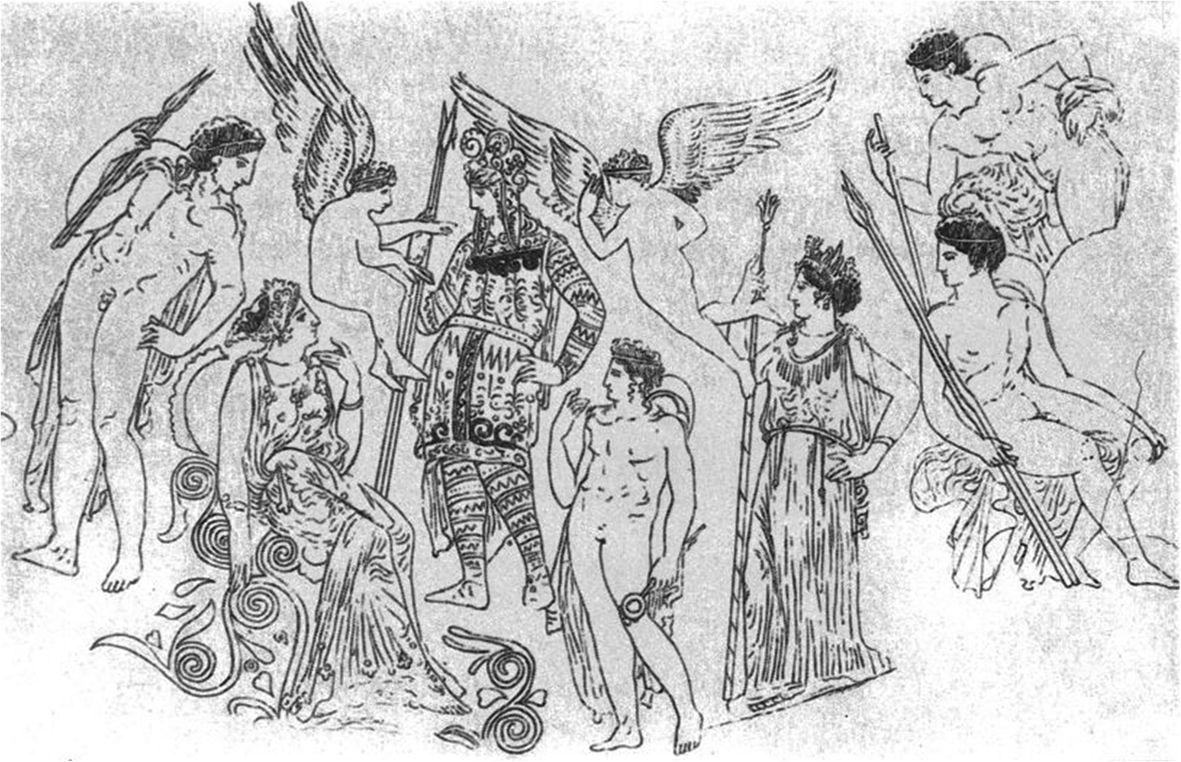
Some visual renderings of Paris and Helen also imply the gift of Aphrodite. The Athenian red-figure neck amphora Berlin 30036 by the Heimarmene Painter (BAPD 215552), 430–420 BC, illustrates Eros talking to Paris while Aphrodite intimately speaks with Helen: the parallel interactions reflect what the goddess offered Paris on Mount Ida. The Athenian red-figure plate Athens 14792 by the Washing Painter (BAPD 215007), c. 420 BC, includes Aphrodite sitting in front of Helen and Eros hovering above the goddess, besides Paris: the interaction of Aphrodite with Helen in the presence of Paris and Eros signals how she directly intervenes in making Helen fall in love with Paris. The Athenian red-figure squat lekythos Athens 1284 (BAPD 42135), end of the fifth century BC, shows Eros between Paris standing and Helen sitting: the mediation of Eros points toward the gift of Aphrodite, and the presence of her (with Aeneas) watching the meeting of Paris and Helen connects this scene to Aphrodite's bribe. The Athenian red-figure hydria (lost) once Istanbul (private coll.) (BAPD 44431), 380–370 BC (fig. 2), shows Helen paying attention to Paris surrounded by two Erotes while Aphrodite and other characters watch the scene from either side: this arrangement seems to highlight how Aphrodite grants beauty and desire to Paris at the moment he meets Helen. The fragmented Athenian red-figure hydria London E236 (BAPD 13301), 370–360 BC, pictures Helen sitting in conversation with Eros while Paris watches: it is as if Paris expects Eros to effect on Helen the gift of Aphrodite (cf. Kahil Reference Kahil and Boardman1988, 525f). The Apulian nestoris Naples (private coll.) 352 by the Group of the Copenhagen Dancer, 345–310 BC, depicts Aphrodite taking Helen's right hand to introduce her to Paris, who is crowned by an Eros: the interaction of Aphrodite and Eros with Helen and Paris strongly connotes that Paris was offered exceptional graces by Aphrodite. The Neo-Attic relief Naples 6682, second quarter of the first century BC – which is very similar to the neck amphora Berlin 30036 – portrays Aphrodite addressing Helen and pointing to Paris while an Eros talks to him. The Neo-Attic relief Vatican (Cortile del Belvedere) 867, first century BC, and the marble krater Rome (Palazzo dei Conservatori) 39G, first century AD, are the same as the relief Naples 6682. The Roman relief known as ‘Vase Jenkins’ once Marbury Hall, imperial period, shows the same composition as the relief Naples 6682, although Cupid tries drawing Paris towards Helen here. The Roman wall-painting Pompeii VI.16.7 (Casa degli Amorini Dorati), AD 35–45, depicts a meeting of Paris with Helen in the presence of a Cupid who, standing in the middle of the scene, points to the door of the thalamos and includes Venus behind Paris.
Athenian red-figure cup, name vase of the Painter of Berlin 2536 (BAPD 217284), c. 440 BC. The Berlin State Museums, Berlin. Photograph © Antikensammlung, Staatliche Museen zu Berlin – Preussischer Kulturbesitz, photo by Johannes Laurentius.

Athenian red-figure hydria once Istanbul, private collection, now lost, BAPD 44431, c. 380–370 BC (after Kahil Reference Kahil1955, pl. 23.2).

This section has listed two literary accounts and thirty visual renderings of either the Judgement of Paris or a meeting of Paris and Helen that imply the gift of Aphrodite as described by Cratinus or Lucian, that is, to become most beautiful and most lovable or to count on the assistance of Eros and Himeros. The next section will present additional testimonies – six literary accounts plus 32 visual renderings – that are suggestive of this gift, and it will discuss whether the accumulated evidence of representations implying or suggesting the ‘second gift’ points to an origin within the oral tradition.
Evidence Suggestive of a Gift
Although the detail that Aphrodite offered Paris a quality that women would be unable to resist is unambiguous in only two (literary) sources, Cratinus’ Dionysalexandros and Lucian Dial. D. 20, it is also found in many other sources, but in a less explicit form; these are, or so I argue, either implying or suggestive of a ‘second’ gift. In my analysis I will follow Werner Jaeger's advice and interpret these hints as a set of ‘symptoms’.Footnote 5 They all seem to follow an episode that existed within the oral tradition, even if it is only explicitly mentioned by two of the surviving records of the story. Other evidence can be adduced to support this interpretation, though ‘not by summing up single impressions of more or less significance but by one unified impression based on many details’. I shall examine works that suggest (rather than imply, like those already described) that Aphrodite offered (or granted) Paris the power to become irresistible to women.
In Colluthus’ Abduction of Helen 160–6 (5th cent. AD), Aphrodite does not mention attractiveness as one of her gifts but she asks the Erotes (85–6) to assist her in the competition against Hera and Athena.Footnote 6 Similarly, in Apuleius’ second century AD novel Golden Ass, in a play representing the Judgement that Lucius watches (Apul. Met. 10.32), Venus is joined not only by Cupids but also by the Graces and the Hours when she approaches Paris to offer him a bribe. The anonymous Anthologia Latina 863a (probably post-Apuleian) makes Venus highlight lasciua uoluptas as one of her affairs when she addresses Paris during the Judgement. Both this poem and Met. 10.32, while pointing to Helen as the gift of Venus to Paris, suggest that Paris will also be favoured by Venus’ influence on love and lust. This suggestion had been made without reference to Helen in Sophocles’ Krisis (Nauck 334), where Aphrodite is characterized as a pleasure goddess also in connection with the Judgement of Paris. Likewise, she relied on her being ἃ μὲν ἐπὶ πόθῳ τρυφῶσα (Eur. IA 1304), ‘she who takes pride in desire’, for facing the Judgement, which is also highly suggestive of the nature of her bribe.
Hyginus Fab. 92 (1st cent. BC) asserts that Juno and Minerva each offered two gifts instead of one during the Judgement. While the description is not very clear, this feature could reflect the effort of the poet to equalize the number of bribes of these goddesses to those of Venus. A similar intention may be present in Apul. Met. 10.31, when on the way to Paris Juno is escorted by the Dioscuri, and Minerva by Terror and Fear. Although each goddess offers only one gift in this account, there is a special emphasis on what they represent. This emphasis (present since at least Sophocles’ Krisis) illustrates how each goddess offers Paris something related to what she represents. This is why Hyginus makes Juno offer Paris ‘to stand out as the richest of all men’, while Minerva offers him ‘having knowledge for every skill’: these gifts correspond to the sphere of influence each of them governs, even though these bribes are to be found nowhere else in the literature.
Some visual renderings that display Paris in the presence of Helen with the participation of Erotes suggest the definition proposed by Rose, that is, Aphrodite's bribe of being irresistible to women.Footnote 7 These examples are less explicit than those mentioned above because these do not include Aphrodite in their arrangements. This is also the case for the fragmented hydria London E236, included among the illustrations that imply the gift of Aphrodite, but there is also a difference in the attitude of Eros. On the hydria, Eros reciprocally interacts with Helen. In the following examples, the Erotes are present but do not engage in such intimate interaction with either Paris or Helen. The most meaningful examples in this regard seem to be those that depict Helen in the presence of Paris, while the latter is either crowned by an Eros or surrounded by two of them. The positioning of the figures highlights the erotic interest that Paris evokes in Helen, who is often shown staring at him.
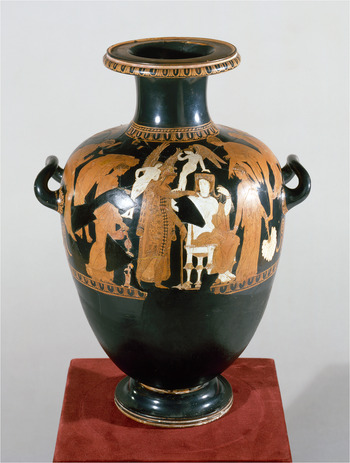
Paris being crowned by an Eros is found on at least six vase images: (a) the Athenian red-figure calyx krater Bologna 305 in the manner of the Meleager Painter (BAPD 218028), 400–390 BC, (b) the fragmented Apulian lebes gamikos Basel (Cahn coll.) HC227, 375–350 BC, and (c) the Apulian pelike Kassel T723, 350–340 BC. Paris is surrounded by two Erotes on the Athenian red-figure hydria Saint Petersburg St1924 by the Helen Painter (BAPD 6546), 370–360 BC (fig. 3). Simpler versions of the same arrangement put a single Eros close to Paris, such as (d) the Athenian red-figure hydria Hildesheim 1252 (BAPD 32483), beginning of the fourth century BC, on which an Eros hovers towards Paris; (e) the Athenian red-figure pelike Paris CA2261 (BAPD 11291), beginning of the fourth century BC, on which an Eros hovers in front of Paris while touching his head as if he were crowning Paris, and (f) the possibly Corinthian terracotta pyxis lid Copenhagen 3410, fourth century BC, on which a child Eros stands on the legs of a sitting Paris. Sutton (Reference Sutton1998, 35) has observed how, in nuptial scenes, the presence of Eros at eye level between bride and groom makes ‘explicit the erotic nature of their gaze.’ This arrangement occurs in some representations of Paris and HelenFootnote 8 and establishes, through their erotic gaze indicated by Eros, an obvious connection to the gift of Aphrodite to Paris. Similar renderings put Eros on the scene, although not precisely at eye level.Footnote 9 The interaction of Eros with either Paris or Helen in these latter vases still suggests the gift of Aphrodite.
Athenian red-figure hydria Saint Petersburg St.1924 by the Helen Painter (BAPD 6546), 370–360 BC. The State Hermitage Museum, St. Petersburg. Photograph © The State Hermitage Museum, photo by Vladimir Terebenin.

Two scenes depicting the Judgement of Paris contain suggestive arrangements. The Boeotian black-figure Kabeiric bowl Boston 566 01.8069, c. 420 BC, depicts Aphrodite sitting while holding out a small Eros on her right hand, as she does on the cup Berlin F2536, although the display on the Kabeiric bowl does not make it clear whether she is offering Eros as a gift to Paris, who sits on the left edge of the setting, or not. The Roman floor mosaic (from Antioch) Paris MA3443, AD 130-150, illustrates the moment when Paris is contemplating the three goddesses who pose in front of him. There are two statues on a high position surrounding the scene: on the left, behind Paris and Mercury, Psyche; on the right, behind the three goddesses, Cupid. These statues refer to their love story and suggest the gift which Venus will offer to Paris.
The two explicit sources plus the seven literary and 62 visual representations connoting the gift of Aphrodite strongly support the impression that she offered Paris both Helen and his (fatal) attraction to women. The claim that this second gift was part of the oral tradition is based on two things: 1) the variety of the evidence, which consistently delivers signals that point to that gift, and 2) the fact that Homer suggests this gift in Il. 3.392–4. Homer does not explicitly mention this element for the reason Reinhardt explained over seventy years ago (1948): the hate of Hera and Athena against Troy seems deeply sinister in the absence of a clear cause. Even though Paris is often characterized as handsome in the Iliad, there is a special emphasis on his attractiveness in the episode of his meeting with Helen after Aphrodite rescued him from Menelaus; in other words, the beauty the goddess granted Paris appears to have been part of the Homeric account as much as it was of Cratinus’ or Lucian's. Hence, they and the other poets and painters are following the oral tradition. Hence as well, the μαχλοσύνη of Il. 24.30 probably refers to the second gift of Aphrodite.
Conclusion
Rose did not come up with the interpretation of μαχλοσύνη as ‘the fascination of women’ ex nihilo but must have derived it from Aristarchus, who defined it as ‘lust felt by women’ (cf. Richardson Reference Richardson1993, 276f). Aristarchus’ definition does not explain, however, why he ignored the fact that Aphrodite offered to make Paris most beautiful and most desirable (as in Cratinus’ version) and stated, in turn, that she offered Paris only Helen (described as καλλίστην γυναίκα: Erbse Reference Erbse1977, 521). It is true that Aristarchus (c. 216–144 BC) is separated by at least two centuries from Cratinus (5th cent. BC), but such a temporal distance did not prevent Lucian (mid-2nd cent. AD) from mentioning the two gifts of Aphrodite. Indeed, how would the Head of the Alexandrian Library not know of the gifts offered by Aphrodite to Paris? It is hard to believe that Aristarchus had encountered no earlier reference to the story of μαχλοσύνη offered by Aphrodite. The answer is to be found in the method that Aristarchus used to claim interpolations within the Homeric poems. If we consider Aristarchus’ method for analysing the Homeric poems, that is, Ὅμηρον ἐξ Ὁμήρου σαφηνίζɛιν: ‘to clarify Homer through Homer’,Footnote 10 we are almost forced to accept his rejection of Il. 24.30. Homer says that Paris stole Helen (Il. 3.442–6; cf. Od. 4.141–6) and implies that Aphrodite made this possible (Il. 3.418–20). He does not assert, however, that Aphrodite gave Paris μαχλοσύνη (except at Il. 24.30) or made him look especially attractive when stealing Helen. Consequently, if we choose to ignore all the evidence outside the Homeric poems, it is reasonable to be suspicious of Il. 24.30. Nevertheless, Homer does suggest elsewhere that Aphrodite attributed μαχλοσύνη to Paris when she says that ‘no one would think he is coming back from fighting, but rather that he is going to a dance or to sit down after having danced’ (Il. 3.392–4). This episode at the end of Iliad Book 3, a metaphorical re-enactment of the Theft of Helen, provides grounds for asserting that Aphrodite offered both Helen and μαχλοσύνη to Paris as narrated in Il. 24.30. Besides, μαχλοσύνη is not exactly what Aphrodite offered Paris, but rather the quality of being ἐπέραστος – maybe Aristarchus thought of this nuance when addressing the wording of line 30?
Rose's proposal alerted me to the connection between Cratinus’ and Lucian's texts with Il. 24.22–30 and other testimonies. These other sources are not linked in a straightforward, explicit manner, yet if examined carefully, the details indicate that Aphrodite's bribe is to be expected or, at least, fits the context smoothly and without conflict. Homer's account of the Judgement, which recounts how Paris preferred the goddess who offered him μαχλοσύνη, gives the impression that he is referring to this as a result of Paris’ union with Helen. Nevertheless, the protest of Aristarchus and the existence of another gift – not Helen but women's fascination with Paris – present us with an alternative reading. The evidence provided by the accounts of Cratinus and Lucian plus the sources that either imply or suggest the same version of this episode allow us to safely assume that this episode was part of the oral tradition and that Homer was most likely invoking this tradition when he referred to the Judgement. This interpretation, however, is not incompatible with the other one, that Homer points to the effect of Paris marrying Helen: the poet might well have summarised both gifts within this single image of μαχλοσύνην ἀλɛγɛινήν. Of the few episodes about the Judgement that are scarcely (if ever) present in literature,Footnote 11 this one seems especially relevant, because it sheds light on a Homeric passage widely discussed since antiquity. Although the literature of the past century seemed to have left little room for adding anything after demonstrating how it actually refers to the Judgement of Paris, Rose's innovative proposal has allowed the highlighting of another detail within these famous lines.
Acknowledgements
I would like to thank Prof. Em. Elizabeth Minchin for her comments on an early version of this article. I am grateful for the useful suggestions of an anonymous reviewer and the editor of Antichthon, Prof. Han Baltussen, and for the kind lexical comments of Mr. Hugo Keith.
Appendix
Section A: Eros Between Paris and Helen at Eye Level
1. Athenian red-figure squat lekythos Athens 1162 in the manner of the Meidias Painter (BAPD 220602), end of the 5th cent. BC;
2. fragment of Athenian red-figure cup (?) Barcelona 487 in the manner of the Meidias Painter (BAPD 220675), end of the 5th cent. BC;
3. Athenian red-figure hydria Saint Petersburg KAB104B by the Hippolytos Painter (BAPD 32482), 375–370 BC, and
4. Lucanian bell-krater Berlin F3182 by the Creusa Painter, beginning of the 4th cent. BC.
Section B: Eros in the Presence of Paris and Helen, Not at Eye Level
1. Athenian red-figure hydria New York 19.192.86 by the Washing Painter (BAPD 214962), 430–420 BC;
2. Athenian red-figure Chous Athens 1263A in the manner of the Meidias Painter (BAPD 220591), end of the 5th cent. BC;
3. Athenian red-figure squat lekythos Berlin 4906 by the Pronomos Painter (BAPD 217503), end of the 5th cent. BC;
4. Athenian red-figure squat lekythos Boston 95.1403 (BAPD 12951), end of the 5th cent. BC;
5. Apulian skyphos Warsaw 142473 by the Skiron Group, 400–370 BC;
6. Athenian red-figure hydria Berlin 3768 by the Jena Painter (BAPD 231037), 380–370 BC;
7. Athenian red-figure calyx krater, name vase of the Group of Munich 2388 (BAPD 218147), c. 370 BC;
8. Apulian volute amphora Milan (H.A. coll.) 377 by the Ilioupersis Painter, 370–360 BC;
9. Campanian pyxis lid Basel 1921.375, c. 360 BC;
10. Apulian lebes gamikos Ruvo di Puglia 1619, 360–350 BC;
11. Athenian red-figure squat lekythos Athens 17315 near the Erbach Painter (BAPD 260015), 4th cent. BC;
12. Apulian loutrophoros Naples 82265 by the Ruvo Group, c. 350 BC;
13. Apulian volute krater Geneva (Sciclounoff coll.) by the Baltimore Painter, 330–310 BC;
14. Apulian hydria Mattinata (Sansone coll.) 685 by the Baltimore Painter, c. 320 BC;
15. Roman wall-painting Naples 114 320, beginning of the 1st cent. AD;
16. Roman wall-painting Pompeii I.7.7 (Casa del Sacerdos Amandus), AD 35–45;
17. Roman wall-painting from Herculaneum (lost) once Napoleon, 1st cent. AD;
18. Roman wall-painting from Pompeii (lost: see Kahil Reference Kahil1955, pl. 37.2), 1st cent. AD;
19. Neo-Attic terracotta panels Florence 4936 & 4937, 1st cent. AD;
20. Roman wall-painting Naples 9002 (Casa dei Cinque Scheletri VI.10.2), c. AD 50.