‘nose’ and the
 ‘village’. I argue that surface onglides are in the nucleus and not in the onset. The proposed representation contrasts with the ones for onglides in related languages, that is, English and Frisian. I show that Westphalian German also possesses a labial approximant [υ]—also known as a consonantal glide—which is distinct from both the onglide
1. Introduction
In contrast to New High German (NHG), postconsonantal glides in etymologically native words are common in the Low German dialects spoken in Westphalia. Three representative examples are presented in the first column in 1 below, which have been modified slightly from the transcriptions in one of the original sources for these dialects (Grimme Reference Hubert1922). Here and below,  and
 represent a palatal and labial glide, respectively.
(1) Glide plus vowel sequences in Westphalian


Sequences like  and
 in 1 arose historically through Westphalian Breaking, which converted a short stressed vowel in an etymologically open syllable to a sequence of glide plus vowel (Sarauw Reference Sarauw1921, chapter 1). The original context for that shift has long become opaque; hence, the motivation for that sound change is not always obvious in the Westphalian German examples to be presented below.
Little is known of the synchronic patterning of prevocalic glides (henceforth onglides) like the ones in 1 in the phonology of Westphalian German, not to mention their significance for the literature on theoretical phonology in general and German phonology in particular. Clearly, any analysis of Westphalian needs to provide an explicit statement concerning the distribution of onglides. Are there co-occurrence restrictions concerning the type of vowel that can follow and and/or constraints governing the type of consonant that can precede them, and if so, how are these generalizations to be captured in a formal model? For example, the item in 1c illustrates that the onglide can be preceded by the rhotic [r]. Although that sequence shows a sonority rise (from left to right), other varieties of German (for example, NHG) do not permit any sequence at all of nonsyllabic sonorants at the left word edge (Wiese Reference Richard1996, Hall Reference Hall2002, and many other authors). Clearly, words like  ‘crust’ pose a potential challenge for any analysis in which sonority plays a role.
I argue that the answer to the type of question posed in the preceding paragraph can be expressed formally in the way in which onglides are analyzed in terms of syllable structure (Booij Reference Geert1989, Davis & Hammond Reference Stuart and Hammond1995 provide similar treatments in Frisian and English, respectively). In particular, I maintain that surface Westphalian onglides like and are parsed under the same nucleus (that is, mora) together with the following vowel. This nuclear glide representation captures phonotactic regularities: First, there is a relatively loose bond between the onglide and the preceding consonant (that is, a wide variety of consonants are possible, as in 1c), and second, there are tight restrictions on what can follow the onglide (that is, only one vowel can follow and one ). I show below that the proposed representation for Westphalian onglides differs from the representations proposed in the literature for onglides in other West Germanic languages, that is, English and Frisian.
In addition to the three onglides ( and the high front rounded
 ), Westphalian possesses a labial sound I symbolize as [υ], which is phonetically distinct from both the onglide and the fricative [v]. I refer to [υ] below as the labial approximant or, alternatively, the consonantal glide. [υ] and [v] are shown to be in complementary distribution in the onset: the former only surfaces as the second member of an onset cluster, but the latter only occurs at its left edge.
I argue that the three onglides derive from underlying short vowels, which are parsed as nuclear segments by syllabification. I also claim that the approximant [υ] derives from /v/. The analysis of [υ] as an allophone of /v/ is shown to be superior to one in which [υ] is seen as a realization of /u/, as proposed by Wiese (Reference Richard1996) for NHG. It becomes clear below that only the present analysis obeys crosslinguistic generalizations on underlying and derived glides (for example, Levi Reference Levi2004, Reference Levi, van Oostendorp, Ewen, Hume and Rice2011; Nevins & Chitoran Reference Andrew and Chitoran2008).
The present article is structured as follows: In section 2, I discuss how glide plus vowel sequences are represented nonlinearly in the crosslinguistic literature. I pay particular attention to the West Germanic languages English and Frisian, which are closely related to Westphalian. Section 3 provides some background information on the Westphalian dialect under investigation and the attested vowels and onglides in that dialect. I also discuss the phonetics of [υ] and [v] and give the reader the basics of Westphalian syllable structure. In section 4, I examine a larger set of Westphalian examples containing onglides like the ones in 1 and argue that they are always represented structurally as nuclear glides on the surface. In that same section, I discuss the distribution of [υ] and [v]. My analysis of onglides, the approximant [υ], and the fricative [v] is presented in section 5. The article concludes in section 6.
2. The Nonlinear Analysis of Onglides
A number of proposals have been made in the crosslinguistic literature concerning the way in which onglides should be parsed in terms of syllable-internal constituents (see Yip Reference Moira2003 for a recent overview). Since the nature of these constituents is a matter of controversy, there are a number of models that can, in principle, be compared. I adopt the moraic model (for example, Hayes Reference Bruce1989 and many subsequent authors). In that approach, an onglide (G) could, in principle, be parsed together with a vowel (V) entirely as a nuclear segment (that is, it is moraic, as in 2a) or as a part of the onset (that is, it is linked directly to the syllable node, as in 2b). I refer henceforth to these two types of glides as nuclear glides and onset glides, respectively.Footnote 1 Although the moraic approach is adopted below, the insights of my analysis could potentially be captured in an alternative model with traditional constituents such as onset, nucleus, and coda, and with X slots capturing length. Thus, the analysis I propose for Westphalian does not crucially depend on moraic theory.
(2) Nonlinear representation of onglides
A question I do not discuss is whether or not the GV sequence in the nuclear glide representation has a single mora, as in 2a, or if it is bimoraic. Since this question is peripheral to my analysis of onglides, I leave it open for further study.
Several arguments for constituency have been discussed in the literature which bear on the question of how to determine which of the structures in 2 is correct (for example, Booij Reference Geert1989, Davis & Hammond Reference Stuart and Hammond1995, Cser Reference András1999, Yip Reference Moira2003). The argument I discuss below is based on phonotactics. First, if there are few or no restrictions governing the type or number of consonants that can occur before an onglide, then the nuclear glide representation is correct. By contrast, the onset glide analysis is appropriate if there are restrictions on the preceding consonant(s). Second, a nuclear glide representation shows that there is a tighter bond between the onglide and the following vowel. This means that if an onglide can only precede a restricted set of vowels, then structure in 2a is correct, but if there are few or no restrictions concerning the types of vowels that can follow an onglide, then this supports 2b.
A number of authors have examined the behavior of onglides in various languages and have argued in favor of either 2a or 2b, or both. For example, Davis & Hammond (Reference Stuart and Hammond1995) argue that the postconsonantal onglide in English words like cute in 3a is a nuclear glide, while the postconsonantal onglide in words like twin in 3b is an onset glide. (In the original source, and are transcribed [y] and [w], respectively).
(3) Postconsonantal onglides in English
The reason 2a is correct for the in 3a is that can only be followed by the vowel [u] and that there are few restrictions concerning the consonants that can precede it. By contrast, in 3b can be followed by all sorts of vowels, but there are tighter restrictions concerning the type of consonant that can precede it. In particular, cannot be preceded by a sonorant. Note that English has a strict ban on onset clusters consisting of two sonorants (see 4). Treating as an onset glide(while treating as a nuclear glide) means that the otherwise needed ban on two-sonorant onset clusters in 4 correctly rules out sonorants before and correctly allows sonorants before (for example, in music in 3a).
(4) Constraint on two sonorant onsets
Davis & Hammond (Reference Stuart and Hammond1995) adopt the view endorsed by Steriade (Reference Donca1988) that a sonority-based constraint referring totwo adjacent sounds (like the one in 4) counts as an argument in favor of treating those sounds as belonging to the same constituent (for example, onset). By contrast, a (nonsonority based) constraint against homorganic tautosyllabic sequences can hold between subsyllabic constituents and therefore does not provide an argument for constituency. For example, there are languages that disallow sequences like [mu] and  because they consist of adjacent labial sounds, but the *[labial][labial] constraint refers to homorganicity and therefore does not imply that [m] and [u] or and [u] are both nuclear. Note that the co-occurrence restrictions on onglide plus vowel sequences referred to above are not attributable to a constraint against sonority. (These co-occurrence restrictions are not discussed in Steriade Reference Donca1988). I therefore follow Davis & Hammond (Reference Stuart and Hammond1995), who see them as an argument for analyzing the onglide plus vowel sequence together under the nucleus.
A case study very much relevant to the Westphalian data is presented by Booij (Reference Geert1989), who considers onglides in Frisian and Dutch. At issue are Frisian words like the ones in 5 with onglides that have been proposed in the literature on Frisian to be the first part of a rising diphthong (for example, Cohen et al. Reference Antonie, Ebeling, Eringa, Fokkema and van Holk1959:114“stijgende diftongen”). Significantly, Booij (Reference Geert1989) argues, on the basis of phonological patterning, that both prevocalic and prevocalic in Frisian words like the ones in 5 are onset glides. The reason is that and occur before a wide variety of vowels, regardless of quality or quantity. For example, and surface before both, short vowels in 5a and long vowels in 5b.
(5) Frisian onglides
The analysis of Frisian and in 5 as onset glides is significant precisely because these sounds are traditionally referred to as the first part of a rising diphthong in the literature cited above, where “rising diphthong” is synonymous with my nuclear glides in 2a (recall note 1). This point is significant in the present context: As I point out below, one cannot conclude that the structure in 2a is correct for Westphalian onglides like the ones in 1 because they might be called rising diphthongs in the traditional literature. Whether or not an onglide is represented as in 2a or 2b is an empirical question that can only be answered by considering a large data set that sheds light on their phonological patterning. It is also worth noting that the onglides in the Frisian examples in 5 arose historically through Frisian Breaking (see Booij Reference Geert1989 and Visser Reference Willem1997, as well as references cited in those two sources). Although not identical to the process of Westphalian Breaking referred to above, both historical processes affected short vowels in originally stressed open syllables, thereby creating onglide plus vowel sequences. In the case of Frisian, these newly created onglides are now onset glides, but I argue that in Westphalian, they are nuclear glides. In the remainder of this paper, I present phonotactic evidence for that type of representation.
3. Westphalian German
In section 3.1, I discuss the Westphalian German dialect, and in sections 3.2–3.4,I present some background information concerning itsphonology.
3.1. Introduction
Westphalian German (henceforth Westphalian) is classified as a West Low German dialect (Durrell Reference Martin and Russ1989). Westphalian itself is usually divided into several subgroups, namely Ostwestphälisch, Südwestphälisch, Westmünsterländisch, and Münsterländisch (Niebaum Reference Hermann1977). General descriptions of Westphalian phonology include Keller Reference Keller1961, chapter 8 and Durrell Reference Martin and Russ1989. A number of Ortsgrammatiken published throughout the past 150 years describe Westphalian dialects—especially those belonging to the Münsterländerisch or Südwestphälisch subgroups—which have onglides like the ones in 1. Some of the important sources include Kaumann Reference Julius1884 for Münster, Jellinghaus Reference Hermann1877 for the area around Ravensburg, Beisenherz Reference Heinrich1907 for the region northeast of Dortmund, Ahrens Reference Josef1908 for Elspe, Grimme Reference Hubert1922 for Assinghausen and Ostbevern, Frebel Reference Peter1957 on the western Sauerland, and Niebaum Reference Hermann1974 for Laer.
The data in the present study have been drawn primarily from Grimme Reference Hubert1922, although it is noted below that the relevant examples are very similar in other varieties of Westphalian, especially the ones described by Beisenherz (Reference Heinrich1907) and Frebel (Reference Peter1957). Grimme (Reference Hubert1922) provides a description of four Low German dialects, namely the ones spoken in Assinghausen, Ostbevern, Dithmarschen, and Stavenhagen, the former two belonging to Westphalian. An inspection of that source reveals that the varieties of Westphalian spoken in Assinghausen and Ostbevern possess onglides that form the subject of the present investigation.
Ostbevern and Assinghausen are both situated in the state of North Rhine-Westphalia. The former town lies about 18 km northeast of Münster and 18 km to the northwest of Warendorf on the Bever river. Assinghausen lies about 63 km southwest of Paderborn. The variety of Westphalian spoken in Ostbevern can be classified as Münsterländisch and in Assinghausen as Südwestphälisch.
3.2. Vowels and Onglides
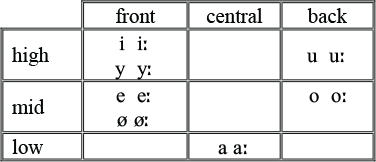
The monophthongs of Westphalian (from Durrell Reference Martin and Russ1989) are presented in table 1.Footnote 2 Contrasts between these sounds require all to be analyzed as phonemic. Durrell (Reference Martin and Russ1989:72) also lists two additional long low vowels, which I have omitted from table 1 because they are not present in the examples I list in section 4.
Westphalian monophthongs.
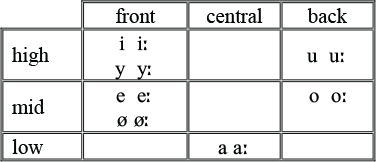
In table 1 and below, I do not encode a qualitative difference between the long and short vowels; for example, I have transcribed [e] versus  and not [ε] versus
 These broad transcriptions are intended to abstract away from phonetic detail that is peripheral to the representations of onglides under investigation. In any case, the material in the original sources for Westphalian suggests that the dialect is similar to NHG in the sense that the contrast between vowels like [u] and
 is a quantitative one and not a qualitative one (see Wiese Reference Richard1996, Hall Reference Hall2002).
A complete list of Westphalian onglide plus vowel sequences is difficult to compile because the number of such sequences as well as the quality (and quantity) of the vowel following the onglide can differ in significant ways depending on the variety of that dialect. For this reason, I consider in 6 only the onglide plus vowel sequences attested in the Westphalian dialects referred to above (described by Grimme Reference Hubert1922, Beisenherz Reference Heinrich1907 and Frebel Reference Peter1957). Grimme (Reference Hubert1922) calls the sequences in the left-hand column steigende Diphthonge ‘rising diphthongs’, although the reader should recall from the discussion of Frisian in section 2 that that designation does not necessarily imply the correctness of the nuclear glide representation in 2a. In the first column below, I list the transcriptions provided by Grimme, Beisenherz, and Frebel for the relevant onglides, in the second column my interpretation of those sequences in IPA, and in the third column a complete IPA transcription of one representative example. Note that the vowel following the onglide  for the dialects described by Grimme and Frebel is [ø], but for thedialect described by Beisenherz it is [e]. According to Frebel, the vowels [o] and [æ] follow and , respectively, but for the other two dialects those two vowels are [a] and [e].Footnote 3 In each example, the onglide is preceded by a single consonant (a stop). In section 4, I consider in detail a greater selection of data and discuss at length the types of segments attested before onglides.
(6) Westphalian onglidesFootnote 4
I have indicated in the IPA column with the subscript arch the onglide, that is, the nonsyllabic member of the adjacent vocalic ([—consonantal]) sequences. The discussion in Grimme Reference Hubert1922:16,18,20 leaves little doubt that the adjacent vocalic sequences in 6 are onglide (that is, nonsyllabic) plus vowel (that is, syllabic) sequences. The transcriptions in Beisenherz Reference Heinrich1907 are just as clear in the sense that the onglide is indicated with a subscript or superscript arch. Frebel is clear on the syllabicity of the sounds in question since he refers to the nonsyllabic sound (my onglide) as unbetont ‘unstressed’ and the syllabic sound as betont ‘stressed’.
I have represented the vowel following the onglide in 6 with one of the corresponding symbols for short vowel listed in table 1. Recall that these symbols are broad phonetic transcriptions; hence, a sequence like , for example, is not meant to imply that the [e] is tense and not lax. Instead, [e] is intended to represent a short, front, mid, unrounded vowel. That the vowel following an onglide—such as [e] in —is short and not long is clear from the original sources. For example, Beisenherz (Reference Heinrich1907:10) refers specifically to the three onglide plus vowel sequences in 6 as Kurzdiphthonge ‘short diphthongs’, which contrast with seven Lang-diphthonge‘long diphthongs’. The latter seven examples are all similar in that a long vowel is followed by a glide (that is, an offglide), but there are no onglides followed by a long vowel in that source. The same points hold for the dialects described by Grimme and Frebel: All of the onglides in 6 are followed by short vowels; there are no long vowels following onglides. Additional sources for Westphalian listed in section 3.1 possess the latter sequences. For example, in the variety of Westphalian described by Ahrens (Reference Josef1908:15–16), there are not only three onglide plus short vowel sequences (as in 6), but also two onglides followed by a long vowel, for example,  According to Frebel (Reference Peter1957:8), there are two communities in the dialect he investigates with the “overlong” diphthong

In section 4, I provide extensive examples for each of the onglides in 6 in order to determine which of the two structures in 2 is correct. I argue in favor of the nuclear glide representation in 2a. Therefore, the onglides in 6 have the representations in 7 as opposed to the one in 2b.
(7) Nonlinear representation of Westphalian onglides
Westphalian onglides like the ones in 6 have a very different representation from the same sequences in Frisian, which are represented phonologically as onset glides. A similar point holds for English, in which requires an onset glide representation (recall 3b), in contrast to Westphalian .Footnote 5
3.3. The Approximant [υ] and the Fricatives

In addition to the three onglides  Westphalian also has two sounds rendered by traditional grammarians as j (< West Germanic
 ) and w (< West Germanic
 ), for example, NHG ja ‘yes’ and wo ‘where’, which Grimme (Reference Hubert1922) transcribes phonetically as ja and wō, respectively for Westphalian. Since those sounds play an important role in my analysis, I discuss their phonetics.
On the basis of the description of the sounds in question in the original sources, I interpret Westphalian j and w in the following manner: j is phonologically a fricative (that is, IPA  ) and not a glide; w is a fricative (that is, IPA [v]) if it occurs at the left edge of a syllable (as in NHG), but it is neither a fricative nor a glide if it occurs after a word-initial consonant. I refer henceforth to the latter type of w as a labial approximant (symbolized as [υ]), although it would be equally correct to think of that sound as a consonantal glide. In any case, the [υ] referred to here is argued in section 4 to be the second member of an (word-initial) onset cluster.
The present analysis treats the labial fricative [v], the labial approximant [υ], and the labial glide as three distinct categories in surface representations. Among palatals, there is a fricative,  and a glide, , but no corresponding approximant. In section 5, the three labial sounds
 and the two palatal sounds
 are argued to differ from one another with respect tothe major class features [consonantal] and [sonorant] alone.
Consider now some independent evidence that Westphalian j and w are the sounds I claim. Grimme (Reference Hubert1922) does not discuss the phonetics of the sound I analyze as  while Frebel (Reference Peter1957:8 and elsewhere) classifies that sound as a voiced palatal fricative (which he describes as the voiced equivalent of the voiceless palatal fricative). Although examples in Beisenherz Reference Heinrich1907 for j inherited from West Germanic
 appear to be lacking, he has copious words containing a sound he refers to as a voiced palatal fricative (in his words,“die stimmh. Entsprechung zu” [ç]). The phonetic symbol Beisenherz uses for the fricative in question is
 which represents the spirantized and fronted reflex of West Germanic +[g]. The description and patterning of the same modern sound—either etymological
 or +[g]—in related Low German dialects support my claim that it is a (voiced) fricative:see, for example, Frebel (Reference Peter1957:40), whose term is stimmhafte Spirans ‘voiced spirant’. Holthausen (Reference Ferdinand1886:8) is clear in his description of j in the Soest variety of Westphalian that it is a fricative (engelaut) and not a glide (consonantisch fungirendesi). Phonological support for this treatment comes from the fact that the voiced fricative
 devoices to [ç] word-initially before a front vowel, for example, junk
 ‘young’ versus
 jenseits ‘afterlife’ (Holthausen Reference Ferdinand1886:43). Similar voiced versus voiceless alternations are attested involving [ç] and
 —where both are reflexes of West Germanic +[g]—in the Low German dialect described by Tita (Reference Fritz1965), although in these examples, the change is not word-initial, as in
 kriege ‘get-1sg’ versus
 ‘got’.
Evidence for my interpretation of w comes from the descriptions of these sounds in the works cited here, although it becomes clear below that those authors see the (minor) place of articulation as being primary. Consider first Grimme's (Reference Hubert1922) description of w. He writes (p. 40) that the sound in question is bilabial after a (word-initial) consonant, otherwise it is labiodental (“…hinter k, t, d, s bilabiales, sonst labiodentales w”). Clearly, Grimme (Reference Hubert1922) sees the bilabial sound—my [υ]—as distinct from the labial glide—my —because he transcribes the two sounds differently (that is,w and u). Beisenherz (Reference Heinrich1907) has a nearly identical treatment of w in his grammar. He writes (p. 12) that the voiceless bilabial fricative (“der bilab. stimml. Reibelaut”) he transcribes as w—my [υ]—only occurs after a word-initial consonant, that is, in his kw, tw, and  as in [sυat] schwarz ‘black’. By contrast, his labial glide—my —is transcribed as
 which is distinct from his v, which he describes as a labiodental fricative (p. 11). The latter sound occurs only at the left edge of a syllable, as in
 Wasser ‘water’, [gar.və] Garbe ‘sheaf’ (Beisenherz Reference Heinrich1907:16).Footnote 6
In their description of the phonetics of labials, both Grimme and Beisenherz refer to place of articulation (that is, labiodental versus bilabial), while I see the manner distinction (fricative versus approximant versus glide) as being primary. It needs to be stressed that a distinction between the two categories approximant (or consonantal glide) and glide simply did not exist for linguists writing a hundred years ago; hence, they were unable to describe the three labials given these manner categories. The important point is that the sound Grimme and Beisenherz describe as bilabial was something distinct from the (fricative) labiodental: I claim that the first sound was not a fricative (or a glide), but instead an intermediate manner category.Footnote 7 See also Wiese (Reference Richard1996: 238–242), who has the three-way distinction between  as in Westphalian—sounds he refers to as a glide, an approximant, and a fricative, respectively. In contrast to the variety of NHG described by Wiese, Westphalian has the three surface sounds
 in prevocalic position.
In 8, I list in the first column the manner categories and in the second column my phonetic symbols for the five sounds in question. In the final three columns, I list the symbols employed by Grimme (Reference Hubert1922), Beisenherz (Reference Heinrich1907), and Frebel (Reference Peter1957). Recall that Grimme's phonetic symbol [w]representsa bilabial after a word-initial consonant but alabiodental in word-initial position.
(8) j or w before a vowel
Frebel's use of symbols suggests that the labial glide is different from the labial deriving from West Germanic  in the final two rows of 8. However, in Frebel's dialect, there is no evidence for a distinction between [υ] and [v], since he sees both sounds as stimmhafte labiodentale Spirans‘voiced labiodental fricatives’. In the following treatment, I concentrate on those varieties of Westphalian that have a three-way labial distinction.
3.4. Syllable Structure
It becomes clear in section 5 that a proper understanding of Westphalian onglides makes crucial reference to the structure of the syllable onset. As a prelude to this discussion, I provide in 9 Westphalian data illustrating onsets consisting of a one-member [+consonantal] sound or two-member [+consonantal] sounds. The onset in the former case can be either an obstruent, as in9a, or a sonorant consonant, as in9b. Two-member onsets can consist of either an obstruent followed by a sonorant consonant, as in 9c, or a sequence of two obstruents, as in 9d. In the latter case, the first of the two obstruents is always a coronal fricative, that is, [s]. In 9 and below, I list the phonetic transcription of the example taken directly from Grimme Reference Hubert1922 in the first column, my interpretation of Grimme's transcriptions in IPA transcriptions in the second column, the corresponding NHG word in the third column, and the English gloss in the fourth column. The page numbers in the final column are the ones in Grimme Reference Hubert1922.
(9) Westphalian syllable structure
Although the examples in 9 have been taken from the specific Westphalian dialects described in Grimme Reference Hubert1922, the same generalizations concerning onset structure hold for Westphalian in general (as well as NHG). The generalization that becomes relevant in the following sections is this: Two-member onset clusters (setting aside the special case of [s] plus obstruent) can consist of an obstruent and a sonorant but not of a sonorant and an obstruent or a sonorant and a sonorant. This general-ization and its relevance to the structure of Westphalian onglides are discussed in sections 4.3 and 5.Footnote 8
A final point needs to be made concerning the examples in 9: There are no restrictions governing the type of vowel that can follow either a one-member onset (in 9a,b) or a two-member onset (in 9c,d). For example, [a] can follow a word-initial [d], but there are also many examples in which a word-initial [d] can be followed by other vowels. In this respect, the examples in 9 are very different from onglides, which can only be followed by a restricted set of vowels (recall 6).
4. The Distribution: Onglides, Fricatives the Approximant [υ]
 the Approximant [υ]
In the present section, I discuss first the distribution of onglides (section 4.1) and then compare their distribution with that of  and [υ] (section 4.2). I then propose syllable structure (section 4.3) in which onglides arein the nucleus and 4. and [υ] in the onset. My conclusion concerning that syllable structure—in particular, the analysis of onglides as nuclear and [υ] as an onset—is shown to derive support from the following generalizations:
(10) Onglides versus
versus [υ
 versus [υ
4.1. Onglides
I have provided below a representative list of words that contain onglide plus vowel sequences. In all of these examples, this sequence is situated in a word-initial syllable. This restriction is a consequence of the historical source of onglides: As noted above, onglide plus vowel sequences arose through Westphalian Breaking, which affected short stressed vowels in a historically open syllable. Since the first syllable is stressed in the native lexicon that forms the basis for the data in the studies cited here, it is that syllable in which the onglides occur.Footnote 9
The data in 11–14 are arranged in terms of the number of word-initial consonants that can precede the three onglides. Data set 11 illustrates the occurrence of onglides in word-initial position: in 11a, in 11b, and  in 11c. The page numbers in the final column in 11 and all subsequent data sets have been drawn from Grimme Reference Hubert1922 (G), Beisenherz Reference Heinrich1907 (B), or Frebel Reference Peter1957 (F).Footnote 10
(11) Word-initial onglides
The examples in 12a–c consist of words beginning with a single consonant followed by one of the three onglides. Within each of these three data sets, the words have been arranged according to manner of articulation, that is, obstruents first (including [h]) and then sonorants. Within those two categories, the words are arranged according to the major place of articulation, that is, labial, coronal, dorsal, and glottal ([h]). No example has been found in which [h] occurs before  but I interpret this gap as being accidental.Footnote 11
(12) Onglides after a word-initial consonant
Words in which two or three word-initial consonants precede an onglide are presented in 13 and 14, respectively. No examples have been found in which  is preceded by three consonants—a gap Iassume is accidental. Recall from section 3.4 that Westphalian two-member onset clusters can consist of either an obstruent plus a sonorant or two obstruents. Three member clusters always begin with [s] followed by an obstruent plus sonorant. All of these onset clusters occur in 13.
(13) Onglides after two word-initial consonants
(14) Onglides after three word-initial consonants
The data in 12–14 illustrate generalizations 10c–f: First, the consonant preceding the onglide can be either a sonorant or an obstruent (that is, 10c). Second, the vowel following the three onglides is restricted to the ones listed earlier in 6 (that is, 10d). Third, there are no restrictions on the place of articulation of the consonant preceding the onglide (that is,10e). Finally, there are few restrictions on the type of sound following the onglide plus vowel sequence (that is, 10f). For example, a sequence like can be either in an open syllable or in a closed syllable. If the onglide plus vowel sequence is in a closed syllable, then the consonant that follows can be an obstruent or a sonorant, and there are no restrictions concerning its place of articulation. (The one type of sound disallowed from occurring after an onglide plus vowel sequence is an offglide; recall note 5).
4.2. Fricatives and the Approximant [υ]
 and the Approximant [υ]
I consider below the distribution of  and [υ] in word-initial syllables in order to facilitate a comparison with onglides, which are restricted in their occurrence to word-initial syllables, as noted in the previous section.Footnote 12 Both
 and [v] have a restricted distribution in the sense that they can only surface at the left edge of a word and before a vowel. In 15a and 15b, I have provided examples of word-initial
 and word-initial [v], respectively. The examples in 15 are significant because they demonstrate that the two fricatives
 contrast with onglides, since both surface word-initially before a vowel (comparethe examples in 11). This contrast illustrates generalization 10a.
(15) Word-initial
or [v] before a vowel
 or [v] before a vowel
In contrast to onglides, neither  nor [v] impose significant restrictions on the type of vowel that can follow. This point is especially clear from the examples in 15b, in which virtually any phonemic vowel is attested after word-initial [v]. I argue that any gaps in 15 involving vowels are accidental.Footnote 13
Both [v] and  can occur word-initially before an onglide, as in 16 and 17.
(16) [v] followed by an onglide
(17)
followed by an onglide
 followed by an onglide
The fricative [v] has a wider distribution than  since the latter only occurs before one of the onglides and the former before or after all three. The nonoccurrence of
 followed by the other two onglides is interpreted as accidental.
In 18, I have provided representative examples of Westphalian words containing [υ]. What all of these words have in common is that [υ] surfaces after a word-initial consonant and before a vowel. [υ] is always preceded by an obstruent, [t s k]; no sonorant consonant is attested before it. The data in 18 are important because they demonstrate that [υ] contrasts with onglides: Both occur in the context C __ V, where the C is an obstruent (see generalization 10b).
(18) Distribition of [υ]
It is not clear whether or not there are systematic restrictions on vowels following [υ]. No examples have been found in the sources listed above in which [u] or  follow that sequence, however the final example in 18 shows that Westphalian does not ban all rounded vowels in that context. See also Woeste (Reference Friedrich1882), who lists swungen (NHG geschwungen‘swing.past part.’) and twungen (NHG gezwungen ‘force.past part.’) in his dictionary of Westphalian.Footnote 14
Grimme (Reference Hubert1922) does not have examples of [υ] followed by an onglide, but Beisenherz (Reference Heinrich1907:12) lists the items in 19. Recall that the sound he transcribes as w in the first column is a labial (which I analyze phonologically as [υ]).
(19) [Cυ] before onglides
There do not appear to be examples in which [Cυ] is followed by an onglide beginning with a rounded vowel, for example,  or
 This question is related to the issue discussed above concerning the extent to which [Cυ] can or cannot be followed by rounded vowels. I assume that this is an accidental gap until evidence can be presented to the contrary.
4.3. Syllable Structure
The distributional generalizations summarized in 10 strongly support an analysis in which the three onglides are nuclear, but the fricatives  and the approximant [υ] are onset sounds. Representative words with the proposed syllable structure are presented in 20.
(20) Onset and nucleus structure
Onglides are nuclear (and [υ] is in the onset) for the following reasons. First, when onglides are preceded by a consonant, that sound can be either an obstruent or a sonorant. By contrast, [υ] can only be preceded by an obstruent. The latter generalization derives from the facts of Westphalian syllable structure described in section 3.4: In a two-member onset cluster (not including [s]-initial clusters in 9d),the second segment cannot be an obstruent. This means that [υ] is phonologically a sonorant (see section 5), and that it occupies the second slot in an onset. Since the onglide (which is also a sonorant) is in the nucleus and not in the onset, it can be preceded by a sonorant, which itself could be the second (or third) member of an onset cluster. In general, onglides can be preceded by any legitimate onset cluster of the language, including onsets of two or three members. This fact follows directly from the representations in 20. An additional argument for the nuclear representation for onglides derives support from the co-occurrence restrictions involving the vowels that can follow (that is, 10d).
The existence of contrasts supports the representations in 20 as well (that is, 10a,b). For example, the fricatives  and the onglides can both occur in word-initial position, as in 20, but each occurs in a different constituent of the syllable. Given this analysis, it is therefore not surprising that an onglide can be preceded by the corresponding fricative (as in the second structure in 20b) or that an onglide can contrast with the corresponding approximant (as in 20c,d).
In 21, I summarize the sounds in question and their distribution. I also include the corresponding vowels, that is, [i] in 21a and [u] in 21b.
(21) Surface sounds and their distribution
I show below that onglides and short vowels are allophones that both derive from the latter. For example, /u/ surfaces as or as [u] depending on the context. Within the onset, [υ] and [v] are similarly analyzed as surface realizations of /v/. The palatal fricaitve  is phonemic (that is,
 ); as shown above, it contrasts with the onglide in word-initial position.
5. Analysis
In table 2, I illustrate that the two major class features [consonantal] and [sonorant] can distinguish the categories glide and approximant. I also include the corresponding fricatives and high vowels for comparison. See Wiese Reference Richard1996:235,where it is argued that the same four classes of sounds are attested in NHG. In his system, they are distinguished with major class features [±consonantal] and [±obstruent]. I include the palatal approximant [j] in table 2 as well, although as noted in section 3.3, that sound is not attested in Westphalian.Footnote 15 The proposal referred to in note 1, namely, that glides and the corresponding high vowels are identical featurally, has been adopted (pace Padgett Reference Jaye2008). The features in table 2 are the ones present in surface representations. I discuss the underlying segments and features below.
Surface features.

I analyze approximants as [+consonantal] because all other sounds allowed in the Westphalian onset are [+consonantal] (recall section 3.4).Footnote 16 The analysis of fricatives as [−sonorant] and glides/high vowels as [+sonorant] is not controversial. That approximants are [+sonorant] can be deduced from the generalizations discussed earlier concerning syllable structure: Two-member onset clusters consist either of two obstruents or an obstruent and a sonorant. Since [υ] is [+sonorant], clusters like [kυ] are analogous to ones like [kl] or [kr]. What is more, since [υ] is [+sonorant], it can only be preceded by an obstruent because complex onsets cannot consist of more than one sonorant.
I adopt the Sonority Hierarchy in 22, which is similar to the ones posited by Wiese (Reference Richard1996) and Hall (Reference Hall2002) for NHG, who base their hierarchies on the universal one proposed by Clements (Reference GeorgeN, Kingston and Beckman1990). Each of the six categories in 22 is defined featurally; hence, high vowels and glides occupy the same slot.
(22) Sonority Hierarchy (‘>’ = more sonorous than)
It becomes clear below that the proposed treatment for Westphalian makes a crucial distinction between high vowels and nonhigh vowels in the Sonority Hierarchy.Footnote 17
In 23, I present the underlying representations and phonetic representations for fricative [v], approximant [υ], labial onglide and short vowel [u]. It can be observed in 23a,b that [v] and [υ] are analyzed as surface realizations of the underlying sound /v/. This treatment derives support from the complementary distribution of those two sounds summarized in 21b: [υ] surfaces as the second member of a word-initial onset and [v] at the left edge of an onset (either word-initial or word-internal). Short vowels and the corresponding glides are similarly analyzed as allophones of underlying vowels, for example, [u] and from /u/ in 23c,d. This treatment derives support from the complementary distribution of those classes of sounds summarized in 21: Vowels are the syllabic members of the nucleus and glides are the nonsyllabic members. In addition, onglides and vowels stand in complementary distribution before consonants and vowels: The generalization is that [i yu]—together with the other short vowels—surface only before a consonant, but never before a vowel. Grimme (Reference Hubert1922) lists the examples [ful] ‘full’ (NHG voll) and [us] ‘us’ (NHG uns), which are taken to be representative. By contrast, the onglides  occur before a vowel but never before a consonant.Footnote 18
(23) Underlying and phonetic representations
All surface short vowels and surface onglides (for example, in 23c,d) lack a nucleus (that is, mora) in the underlying representation. The assignment of a nucleus in examples like these is accomplished by Syllabification (see below). By contrast, long vowels (for example,  ) are underlyingly bimoraic.
Surface [υ] derives from /v/ by the rule in 24.
(24) Sonorization
According to Sonorization, an obstruent becomes a sonorant if it follows an obstruent in an onset cluster. It is not necessary to specify that the leftmost obstruent in the context is word-initial because there are no examples of word-internal obstruent plus [v] clusters (recall section 4.2). The analysis needs to ensure that only a labial obstruent undergoes the change to a sonorant. Thus, it is only the /v/ after a postword-initial consonant that shifts to a sonorant and not the postsibilant obstruent in words like [stof] from 9d. This can be accomplished by specifying that the sound to the left of the arrow in 25 is [labial]. Alternatively, the feature [labial] could be omitted if the [s] plus obstruent clusters in 9d are analyzed structurally in a different way (for example, as complex segments or with an extrasyllabic [s]; see Hall Reference Hall2002 for discussion on NHG). I leave these questions open for further study.
The Syllabification algorithm for Westphalian is presented in 25. Step 25a assigns a nucleus to all underlying short vowels. Only short vowels undergo 25a because long vowels are underlyingly bimoraic. The condition specified in 25a is necessary to guarantee that no nucleus is assigned to an onglide.(See Harris & Kaisse Reference W. and Kaisse1999:131 for a nearly identical condition for Spanish syllabification). The syllabification of prevocalic high vowels as a nucleus linked with the nucleus of the following vowel follows from 25b. The syllable node (σ) is assigned to all moras by an operation I have ignored.Footnote 19
(25) Syllabification
There are four types of examples that are distinguished in the derivations in 26: (i) an underlying /v/ in syllable-initial position on the surface, for example, [vulf] ‘wolf’ (from /vulf/); (ii) an underlying /v/ after a word-initial consonant and before a surface vowel, for example, [sυat] ‘black’ (from /svat/); (iii) an underlying /v/ after a word-initial consonant and before a surface onglide, for example,  ‘across’ (from /kvies/); and (iv) an underlying short vowel (for example, /u/) not adjacent to a vowel, for example, [ful] ‘full’ (from /ful/).
(26) Analysis of [v], [υ] and onglides
In the third example, no nucleus can be assigned to /i/ by 25a because that sound (as a high vowel) is less sonorous than the following vowel, which is nonhigh.
Although no competing analysis of Westphalian is known to me, it is worth considering a possible alternative based on Wiese's (Reference Richard1996) treatment of NHG. As noted earlier, Wiese observes that NHG has the approximant [υ] in words like  ‘two’, but he argues that [υ] derives from the short vowel /u/
 and not from /v/, as in 26 (Wiese Reference Richard1996:238–242). Recall that Wiese adopts features akin to the ones in table 2; he also endorses a treatment in which short vowels are assigned a nucleus in the derivation. If this treatment were adopted for Westphalian, then it would require a different underlying representation for onglide plus vowel sequences than the one proposed above to prevent that onglide from being parsed as the second member of the onset and then undergoing the change to [υ]. This could be accomplished by prespecifying the onglide with syllable structure in the underlying representation. For example, if a word like [sυat] were underlyingly /suat/, then the surface sequence in a word like
 from 20c, would be prelinked to the nucleus in the underlying representation.
According to the alternative approach described above, Westphalian onglides like are underlying (phonemic) and not derived. By contrast, the approximant [υ] (the consonantal glide) is derived from a vowel (namely /u/). The crosslinguistic literature dealing with underlying and derived glides provides excellent arguments against the alternative analysis.
Although many phonologists have argued that surface glides—regardless of the language—are always derived from the corresponding high vowels (see Durand Reference Jacques, Anderson and Durand1987, Kaye & Lowenstamm Reference Kaye, Lowenstamm, Dell, Hirst and Vergnaud1984, and many other authors), a number of languages have been shown to have underlying (phonemic) glides. See, in particular, Levi (Reference Levi2004), who has argued that the following languages have those sounds: Imdlawn Tashlhiyt Berber (Afro-Asiatic), Cree (Algonquian), Karuk (Hokan), Sundanese (Austronesian), Yawelmani (Yokuts), Tahltan (Athabaskan), Pulaar (Niger-Congo), Turkish (Altaic), and Pashto (Indo-Iranian).
Underlying glides and derived glides (from vowels) have been shown to exhibit contrastive phonological behavior (see Hume Reference Elizabeth1994; Levi Reference Levi2004, Reference Levi, van Oostendorp, Ewen, Hume and Rice2011; Nevins &Chitoran Reference Andrew and Chitoran2008). The generalization is that glides derived from vowels behave phonologically like vowels, while underlying glides pattern with consonants to the exclusion of the vowels (and derived glides). For example, an underlying glide—like a consonant—could be transparent to rules affecting vowel features (for example, vowel harmony), but a derived glide—like a vowel—should not be. By contrast, an underlying glide should not be transparent to rules affecting consonant features (for example, consonant harmony), but aderived glide could be.
The generalizations described in the preceding paragraph have been captured in the theoretical literature by adopting the following two claims: (A) glides derived from high vowels are identical featurally with those high vowels; and (B) underlying glides are featurally distinct from the corresponding phonemic high vowels. The predictions are two-fold: First, if vowels and the corresponding derived glides are identical featurally, then the derived glides should behave phonologically like vowels. Second, if underlying glides are featurally distinct from the corresponding high vowels (and derived glides), then they should not pattern together with those segments.Footnote 20
The problem with the alternative treatment for Westphalian is that both (A) and (B) are implicitly rejected: (A) cannot be upheld because /u/ and [υ] differ in terms of their values for the feature [consonantal] and (B) because onglides and the corresponding vowels are the same featurally. By contrast, there are no such drawbacks with the treatment in 26 because onglides are derived from vowels, as per (A). Although the consonantal glide [υ] is a derived sound in 26, it is not derived from a vowel, and hence Sonorization does not present a problem for (A). In contrast to the alternative treatment, my proposal in 26 has no phonemic glides and hence (B) is obeyed vacuously.
6. Conclusion
In the preceding paragraphs, I have investigated the phonology of Westphalian German glides. First, I demonstrated that onglides require a nuclear glide representation and not an onset glide representation. The treatment for Westphalian therefore stands in contrast to onglides in related languages (for example, English and Frisian), for which very different representations have been proposed. Second, I argued that surface onglides derive from short vowels and that [υ] is a surface realization of /v/. This treatment was argued to be superior to one in which [υ] is an allophone of /u/, since that alternative analysis does not conform to crosslinguistic generalizations concerning underlying and derived glides.
The analysis proposed for Westphalian has potential implications for much of the crosslinguistic work on the phonological behavior of glides. In particular, Westphalian can be added to the list of languages that have a phonological (surface) contrast between a consonant-type glide and a vowel-type glide (see Levi Reference Levi2004, Nevins & Chitoran Reference Andrew and Chitoran2008). Future work needs to compare the phonology of those two types of Westphalian glides with their counterparts in unrelated languages.
 can be schwa (that is, [ə]) before a voiced palatal fricative plus syllabic lateral (his
 ). It should be noted that these consonants trigger a number of shortenings and lengthenings in the Westphalian dialect described by that author. I interpret
 and
 henceforth as allophones. Frebel (
 occur in two separate regions.
 in the word
 ‘dew’. In the present article, I do not discuss the distribution of Westphalian offglides.
 cannot be preceded by any of the three onglides (for example,
 Clearly, Westphalian does not allow triph-thongs, although it is not clear how this gap is captured in a formal treatment. One possibility is that Westphalian (as many other languages) does not allow three segments in the nucleus (mora). It can be observed from the example
 in 1 that the offglide
 can occur after an onglide plus vowel sequence. As in NHG,
 derives from /r/ and is hence referred to as the “vocalized-r.” I assume that surface sequences like
 are allowed because /r/ is parsed in the coda and not in the nucleus.
 ‘order’ (compare NHG befehlen), where [bə] is a prefix and
 the stem. Note that the first syllable in words like
 is unstressed because the prefix is realized with schwa.
 as the syllabic vocalized-r
 and his coda r as the nonsyllabic vocalized-r
 By contrast, Frebel (
 alternates with
 kurz in 12b versus
 kürzer in 12c. While
 might be phonologically derived from /ua/ in that type of example, not all instances of
 are amenable to that type of analysis because they occur in morphemes that do not alternate, for example,
 ihr in 11a.
 ‘doubt’ (compare NHG Zweifel; Grimme
 was eliminated in Westphalian at an earlier historical stage.
 followed by [o] or
 This is certainly accidental, since an independent source for that dialect (Woeste
 —a sequence that is usually seen as a systematic gap in NHG (Wiese
 ), for example, Westphalian [sυat] (see NHG schwarz < PGmc
 ‘black’; Seebold
 shifted to the corresponding fricative
 in word-initial position (for example, in words like the ones in 15). In contrast to PGmc
 PGmc
 was not attested after a word-initial consonant. There do not appear to be any sound changes that introduced
 ‘across’ in 19), one could make a case that [υ] is less sonorous than glides if the Sonority Sequencing Generalization holds across syllabic constituents. (In this example, [υ] is in the onset and
 ‘boards’ (compare NHG Bretter),
 ‘asked’ (compare NHG gebeten) (also taken from Grimme
 which were alluded to in note 5.