Despite widespread recognition of the adverse effects of prenatal tobacco exposure (PTE) on fetal development, smoking during pregnancy remains common. In 2014, 8.4% of US women smoked during pregnancy based on birth certificate data (CDC, 2016). In addition to an increased risk of perinatal complications (Difranza, Aligne, & Weitzman, Reference Difranza, Aligne and Weitzman2004; Himes, Stroud, Scheidweiler, Niaura, & Huestis, Reference Himes, Stroud, Scheidweiler, Niaura and Huestis2013; Windham, Hopkins, Fenster, & Swan, Reference Windham, Hopkins, Fenster and Swan2000), the offspring of women who smoke during pregnancy are two to four times more likely than their non-exposed peers to be diagnosed with a disruptive behavior disorder by middle childhood and are more likely to show severe antisocial behavior and substance use disorders in adolescence and adulthood (Cornelius, Goldschmidt, De Genna, & Larkby, Reference Cornelius, Goldschmidt, De Genna and Larkby2012; Fergusson, Woodward, & Horwood, Reference Fergusson, Woodward and Horwood1998; Gaysina et al., Reference Gaysina, Fergusson, Leve, Horwood, Reiss, Shaw and Harold2013; Murray, Irving, Farrington, Colman, & Bloxsom, Reference Murray, Irving, Farrington, Colman and Bloxsom2010; Paradis, Fitzmaurice, Koenen, & Buka, Reference Paradis, Fitzmaurice, Koenen and Buka2011; Wakschlag & Hans, Reference Wakschlag and Hans2002; Wakschlag, Leventhal, Cook, & Pickett, Reference Wakschlag, Leventhal, Cook and Pickett2000; Wakschlag, Pickett, Cook, Benowitz, & Leventhal, Reference Wakschlag, Pickett, Cook, Benowitz and Leventhal2002). A series of large-scale genetically informed studies have cast doubt about a causal nature of these associations (D'Onofrio et al., Reference D'Onofrio, Singh, Iliadou, Lambe, Hultman, Grann and Lichtenstein2010; Maughan, Taylor, Caspi, & Moffitt, Reference Maughan, Taylor, Caspi and Moffitt2004; Roza et al., Reference Roza, Verhulst, Jaddoe, Steegers, Mackenbach, Hofman and Tiemeier2009) but have been limited with respect to the measurement of both PTE and child outcomes. More recently, studies using well-controlled, prospective designs and sensitive, multi-informant measures have shown exposure effects that are small but independent of confounding influences (Estabrook et al., Reference Estabrook, Massey, Clark, Burns, Mustanski, Cook and Wakschlag2016; Gaysina et al., Reference Gaysina, Fergusson, Leve, Horwood, Reiss, Shaw and Harold2013; Knopik et al., Reference Knopik, Marceau, Bidwell, Palmer, Smith, Todorov and Heath2016). These conflicting findings highlight a need for nuanced, developmentally informed studies to clarify the mechanisms that foster differences in outcome amongst children with PTE.
We have suggested that atypical patterns of behavior and cognition found among children with PTE can best be characterized as behavioral disinhibition, a profile of deficient self-regulation that often precedes severe antisocial behavior and substance dependence in adulthood (Clark, Espy, & Wakschlag, Reference Clark, Espy and Wakschlag2016; Tarter et al., Reference Tarter, Kirisci, Mezzich, Cornelius, Pajer, Vanyukov and Clark2003; Zucker, Heitzeg, & Nigg, Reference Zucker, Heitzeg and Nigg2011). Behavioral disinhibition is a broad behavioral profile, encompassing impulsiveness, aggression, resistance, poor executive control, and sensation seeking (Lester et al., Reference Lester, Lin, DeGarmo, Fisher, Lagasse, Levine and Higgins2012; Nigg, Reference Nigg2017; Tarter, Reference Tarter2002). This integrative phenotype meaningfully and efficiently bridges early patterns of dysregulation with later antisocial trajectories in the PTE population. In particular, the use of this higher order construct enables developmental coherence in identification of these patterns. That is, rather than studying precursors in very young children and then frank clinical disorder at older ages, the behavioral disinhibition framework enables identification of component features at very young ages, which can continue to be measured as component features along with clinical symptoms across development (Carter, Gray, Baillargeon, & Wakschlag, Reference Carter, Gray, Baillargeon, Wakschlag, Tolan and Leventhal2013). Beginning in infancy, children with PTE show higher levels of temperamental irritability, poorer attention, and altered patterns of arousal (Clark et al., Reference Clark, Chevalier, Nelson, James, Garza, Choi and Espy2016; Espy, Fang, Johnson, Stopp, & Wiebe, Reference Espy, Fang, Johnson, Stopp and Wiebe2011; Law et al., Reference Law, Stroud, LaGasse, Niaura, Liu and Lester2003; Shisler et al., Reference Shisler, Eiden, Molnar, Schuetze, Coles, Huestis and Colder2016; Wiebe, Fang, Johnson, James, & Espy, Reference Wiebe, Fang, Johnson, James and Espy2014; Willoughby, Greenberg, Blair, & Stifter, Reference Willoughby, Greenberg, Blair and Stifter2007). By preschool age, PTE is associated with increased activity levels and disruptive behavior, and deficits in executive control, including lower levels of selective attention and inhibitory control (Huijbregts, Séguin, Zoccolillo, Boivin, & Tremblay, Reference Huijbregts, Séguin, Zoccolillo, Boivin and Tremblay2007; Hutchinson et al., Reference Hutchinson, Pickett, Green, Wakschlag, Hutchinson, Pickett and Wakschlag2010; Martin, Dombrowski, Mullis, Wisenbaker, & Huttenen, Reference Martin, Dombrowski, Mullis, Wisenbaker and Huttenen2006; Mezzacappa, Buckner, & Earls, Reference Mezzacappa, Buckner and Earls2011; Noland et al., Reference Noland, Singer, Short, Minnes, Arendt, Kirchner and Bearer2005; Wakschlag, Leventhal, Pickett, Pine, & Carter, Reference Wakschlag, Leventhal, Pickett, Pine and Carter2006; Wiebe et al., Reference Wiebe, Clark, de Jong, Chevalier, Espy and Wakschlag2016). These difficulties are particularly prominent in emotionally evocative or motivational contexts (Huijbregts, Warren, De Sonneville, & Swaab-Barneveld, Reference Huijbregts, Warren, De Sonneville and Swaab-Barneveld2008; Wiebe et al., Reference Wiebe, Clark, de Jong, Chevalier, Espy and Wakschlag2016). In middle childhood and adolescence, children with PTE show poorer performance on measures of vigilance, cognitive flexibility and emotion processing (Cornelius, Ryan, Day, Goldschmidt, & Willford, Reference Cornelius, Ryan, Day, Goldschmidt and Willford2001; Kristjansson, Fried, & Watkinson, Reference Kristjansson, Fried and Watkinson1989; Wakschlag et al., Reference Wakschlag, Kistner, Pine, Biesecker, Pickett, Skol and Cook2009), and parents and teachers report increased levels of distractibility, rule-breaking, and aggression (Cornelius et al., Reference Cornelius, Goldschmidt, De Genna and Larkby2012; Wakschlag et al., Reference Wakschlag, Henry, Blair, Dukic, Burns and Pickett2011; Yang, Decker, & Kramer, Reference Yang, Decker and Kramer2013). Thus, across multiple points in childhood, children with PTE show the deficits in cognitive and behavioral control that characterize behavioral disinhibition (Zucker et al., Reference Zucker, Heitzeg and Nigg2011).
Early childhood is a key inflection point in the behavioral disinhibition trajectory, with deficient self-regulation during this period setting the stage for future psychopathology and adverse functional outcomes (Moffitt, Reference Moffitt1993; Moffitt et al., Reference Moffitt, Arseneault, Belsky, Dickson, Hancox, Harrington and Caspi2011). As children develop an ability to recognize and evaluate their own and others’ emotions and executive control capacities increase, they are expected to coordinate their behavior independently in increasingly complex social and academic environments (Carlson & Moses, Reference Carlson and Moses2001; Cole, Zahn-Waxler, & Smith, Reference Cole, Zahn-Waxler and Smith1994; Kopp, Reference Kopp1982; Wakschlag, Tolan, & Leventhal, Reference Wakschlag, Tolan and Leventhal2010). By the time they transition to formal schooling, most children have developed the rudimentary ability to self-regulate their attention, emotional expressions, and behavior (Clark et al., Reference Clark, Sheffield, Chevalier, Nelson, Wiebe and Espy2013). Thus, delays or deficits in self-regulation are likely to be especially prominent by the end of preschool, a critical period for shaping school readiness and adaptive function (Blair & Raver, Reference Blair and Raver2015).
One of the most robust predictors of children's self-regulatory competence is maternal sensitive responsiveness, the tendency of a mother to respond with warmth, promptness, and contingency, driven by her sensitivity to her child's emotional expressions and bids for attention (Bernier, Carlson, & Whipple, Reference Bernier, Carlson and Whipple2010; Clark & Woodward, Reference Clark and Woodward2015; Eiden & Leonard, Reference Eiden and Leonard2007; Kochanska, Murray, & Harlan, Reference Kochanska, Murray and Harlan2000; Landry, Smith, & Swank, Reference Landry, Smith and Swank2006; Wakschlag & Hans, Reference Wakschlag and Hans2002). Predictable, contingent patterns of maternal behavior theoretically provide a consistent feedback loop that facilitates children's understanding of which behaviors are most appropriate in a given context (von Suchodoletz, Trommsdorff, & Heikamp, Reference von Suchodoletz, Trommsdorff and Heikamp2011; Wakschlag & Hans, Reference Wakschlag and Hans2002). From an attachment perspective, continued signals from a mother that she is available and sensitive to her child's needs also provide a secure environment for the child, shielding the child from stress and boosting his/her confidence to explore and learn from the environment (Ainsworth, Reference Ainsworth1979; de Wolff & van Ijzendoorn, Reference de Wolff and van Ijzendoorn1997). Through these responsive caregiver cues, the child gradually internalizes strategies for coping with emotional and motivational demands in the environment and is able to assume more autonomous regulation of his/her behavior, learning how this behavior affects environmental responses and resting on the secure knowledge that the environment will respond in predictable ways (Chase-Lansdale, Wakschlag, & Brooks-Gunn, Reference Chase-Lansdale, Wakschlag and Brooks-Gunn1995). Although studies of maternal responsiveness have predominantly focused on parent-child interactions in infancy and the early preschool period, there is increasing evidence for the impact of maternal responsiveness on children's self-regulation during the late preschool period and transition to kindergarten (Chazan-Cohen et al., Reference Chazan-Cohen, Raikes, Brooks-Gunn, Ayoub, Pan, Kisker and Fuligni2009; Pianta, Nimetz, & Bennett, Reference Pianta, Nimetz and Bennett1997; von Suchodoletz et al., Reference von Suchodoletz, Trommsdorff and Heikamp2011), and studies typically report moderate stability in responsive, sensitive maternal behavior across early childhood (Perry, Mackler, Calkins, & Keane, Reference Perry, Mackler, Calkins and Keane2014; Spinrad et al., Reference Spinrad, Eisenberg, Silva, Eggum, Reiser, Edwards and Gaertner2012).
Previously, we found that maternal responsiveness, as observed during parent-child interactions in the first years of life, moderated the relation of PTE to conduct problems in a high-risk sample of 9- to 11-year-olds (Wakschlag & Hans, Reference Wakschlag and Hans2002). Notably, conduct problems were elevated only in boys whose mothers showed low levels of responsiveness during early childhood. Exposed boys with responsive mothers and exposed girls showed levels of conduct similar to their non-exposed peers. In another study, we found that paternal responsiveness during adolescence buffered the relation of PTE to disruptive behavior in adolescents (Wakschlag et al., Reference Wakschlag, Henry, Blair, Dukic, Burns and Pickett2011). To our knowledge, only two other groups have examined responsive parenting as a potential protective factor in this population; both focused on early childhood and reported null effects. In the Quebec Longitudinal Study (Huijbregts, Seguin, Zoccolillo, Boivin, & Tremblay, Reference Huijbregts, Seguin, Zoccolillo, Boivin and Tremblay2008), observed maternal responsiveness did not moderate the relation of PTE to maternal ratings of toddler's physical aggression. Likewise, in Godleski, Eiden, Scheutze, Colder, & Heutis (Reference Godleski, Eiden, Schuetze, Colder and Huestis2016), observed maternal responsiveness was not associated with maternally reported regulatory difficulties in toddlers with PTE, although there also was no direct correlation between PTE and self-regulation in this study. Notably, all of these studies concentrated primarily on clinical outcome measures and did not assess multiple features of behavioral disinhibition.
The scarcity of research examining the impact of parenting on the PTE-behavioral disinhibition link, as well as the discrepant findings reported in studies of different age groups, highlight a need to more deeply explicate the mechanisms by which parent-child interactions may foster adaptive pathways in children with PTE. This is especially true in light of evidence that mothers who smoke during pregnancy are less emotionally responsive, show higher levels of negative affect and parenting stress, and report more harsh, punitive parenting practices relative to mothers who do not smoke (Fergusson et al., Reference Fergusson, Woodward and Horwood1998; Lynch, Johnson, Kable, Carroll, & Coles, Reference Lynch, Johnson, Kable, Carroll and Coles2011; Schuetze & Eiden, Reference Schuetze and Eiden2007; Tandon et al., Reference Tandon, Si, Belden, Spitznagel, Wakschlag and Lubya2013). Studies focused on early childhood, and the transition to kindergarten are especially relevant for prevention science, given that self-regulation is central to school readiness and interventions tailored to this period are likely to be most cost-effective (Bruner, Reference Bruner2002; Early Childcare Research Network, 2005; Nelson et al., Reference Nelson, Nelson, James, Clark, Kidwell and Espy2017). Moreover, it is critical that these studies use sensitive, multidimensional measurement approaches to capture the variability in self-regulatory capacities that characterize this age range (Clark et al., Reference Clark, Chevalier, Nelson, James, Garza, Choi and Espy2016; Wakschlag et al., Reference Wakschlag, Tolan and Leventhal2010).
The traditional model for parenting research assumes that children at risk will be more vulnerable to poor parenting practices, a diathesis-stress or dual-risk perspective (Belsky, Bakermans-Kranenburg, & van Ijzendoorn, Reference Belsky, Bakermans-Kranenburg and van Ijzendoorn2007). This perspective is in line with our assumption that sensitive, responsive parenting buffers the relation of PTE to behavioral disinhibition, whereas lower responsiveness compounds the vulnerability of exposed children. In recent years, however, there has been increasing support for a “differential susceptibility” model, whereby some children show greater sensitivity to their rearing environments in a “for better or for worse” fashion (Belsky et al., Reference Belsky, Bakermans-Kranenburg and van Ijzendoorn2007; Belsky & Pluess, Reference Belsky and Pluess2009; Ellis, Boyce, Belsky, Bakermans-Kranenburg, & van Ijzendoorn, Reference Ellis, Boyce, Belsky, Bakermans-Kranenburg and van Ijzendoorn2011). From this latter, evolutionarily based perspective, exposure to prenatal adversity is theorized to induce adaptive epigenetic changes in utero that render an organism more malleable or plastic in the face of both positive and negative postnatal experiences (Pluess & Belsky, Reference Pluess and Belsky2011; Rabinowitz & Drabick, Reference Rabinowitz and Drabick2017). In support of the differential susceptibility model, children with difficult temperament (Pluess & Belsky, Reference Pluess and Belsky2010), low birth weight and preterm birth (Gueron-sela, Atzaba-poria, Meiri, & Marks, Reference Gueron-Sela, Atzaba-Poria, Meiri and Marks2015), particular genetic alleles (Van Ijzendoorn, Belsky, & Bakermans-Kranenburg, Reference Van Ijzendoorn, Belsky and Bakermans-Kranenburg2012), and high neuroendocrine reactivity (Obradović, Bush, Stamperdahl, Adler, & Boyce, Reference Obradović, Bush, Stamperdahl, Adler and Boyce2010) have been shown to benefit more from positive rearing experiences than children without these characteristics. Previous studies have not systematically tested these alternative theoretical models for responsiveness effects in children with PTE.
Consistent with the diathesis-stress model, human and animal studies indicate that PTE disrupts the development of neural systems involved in self-regulation. In addition to exerting vasoconstrictive and anorexigenic effects on the fetus, nicotine binds directly to nicotinic acetylcholine receptors in the brain (Wickstrom, Reference Wickstrom2007). Premature stimulation of these receptors spurs alterations to synaptogenesis, receptor density, presynaptic signaling, and neurotransmitter release across multiple neurotransmitter systems (Dwyer, McQuown, & Leslie, Reference Dwyer, McQuown and Leslie2009; Mychasiuk, Muhammad, Gibb, & Kolb, Reference Mychasiuk, Muhammad, Gibb and Kolb2013; Slikker, Xu, Levin, & Slotkin, Reference Slikker, Xu, Levin and Slotkin2005; Slotkin, Reference Slotkin2004; Slotkin et al., Reference Slotkin, Skavicus, Card, Stadler, Levin and Seidler2015). PTE is also associated with reduced dopamine turnover, changes to dopamine receptor binding in the forebrain, and reduced neuron density in the dorsolateral prefrontal cortex of exposed fetuses (Chatterton et al., Reference Chatterton, Hartley, Seok, Mendelev, Chen, Milekic and Haghighi2017; Heath & Picciotto, Reference Heath and Picciotto2009). Moreover, these neural alterations vary by sex, with male rodents being more vulnerable to PTE-modulated alterations in receptor density and neural signaling than their female counterparts (Slotkin et al., Reference Slotkin, MacKillop, Rudder, Ryde, Tate and Seidler2007). Neuroimaging studies of children and adolescents with PTE have revealed disruptions to white matter development and cortical thinning in several neural regions, most notably in the orbitofrontal cortex, a key area for emotional and behavioral regulation (Bublitz & Stroud, Reference Bublitz and Stroud2012; El Marroun et al., Reference El Marroun, Schmidt, Franken, Jaddoe, Hofman, van der Lugt and White2014; Jacobsen et al., Reference Jacobsen, Picciotto, Heath, Frost, Tsou, Dwan and Mencl2007; J. Liu, Cohen, Gongvatana, Sheinkopf, & Lester, Reference Liu, Cohen, Gongvatana, Sheinkopf and Lester2011; Lotfipour et al., Reference Lotfipour, Ferguson, Leonard, Perron, Pike, Richer and Se2010). Coupled with evidence from rodent studies that less responsive parenting correlates with reduced hippocampal and prefrontal volumes, while responsive parenting (i.e., licking and grooming) can mitigate the neurodevelopmental impact of prenatal adversity (Kundakovic & Champagne, Reference Kundakovic and Champagne2015; D. Liu et al., Reference Liu, Diorio, Tannenbaum, Caldji, Francis, Freedman and Meaney1997; Luby et al., Reference Luby, Belden, Botteron, Marrus, Harms, Babb and Barch2013), it is possible that exposed children who go on to experience less responsive caregiving are at dual risk for behavioral disinhibition due to vulnerabilities in key neural regions associated with stress modulation and self-regulation.
On the other hand, recent models have conceptualized prenatal substance exposure as a potent stressor, which triggers adaptive changes to stress response systems in the developing fetus (Lester & Padbury, Reference Lester and Padbury2009; McDonald et al., Reference McDonald, Walker, Perkins, Beyene, Murphy, Gibb and Ohlsson2006). Indeed, a number of studies have suggested deviant neuroendocrine and behavioral responses to stress in children with PTE (Huijbregts, van Berkel, Swaab-Barneveld, & van Goozen, Reference Huijbregts, van Berkel, Swaab-Barneveld and van Goozen2011; Park, O'Malley, King, & Picciotto, Reference Park, O'Malley, King and Picciotto2014; Ramsay, Bendersky, & Lewis, Reference Ramsay, Bendersky and Lewis1996; Schuetze, Lopez, & Granger, Reference Schuetze, Lopez and Granger2009), and animal studies suggest that PTE leads to hyperreactivity of the hypothalamic-pituitary-adrenal (HPA) axis (He et al., Reference He, Lu, Dong, Jiao, Zhang, Yu and Xu2017). These effects appear to be modulated by epigenetic changes to the expression of genes involved in the HPA axis and glucocorticoid receptor density in the hippocampus, an important regulator of cortisol release (He et al., Reference He, Lu, Dong, Jiao, Zhang, Yu and Xu2017; Stroud et al., Reference Stroud, Papandonatos, Rodriguez, Mccallum, Salisbury, Phipps and Marsit2014). Such neurophysiological changes are similar to those reported for animals exposed to other forms of prenatal stress, where male rodents often show greater susceptibility than females (Bale, Reference Bale2011; Bock, Wainstock, Braun, & Segal, Reference Bock, Wainstock, Braun and Segal2015; Li, Gonzalez, & Zhang, Reference Li, Gonzalez and Zhang2012; although, see Sandman, Glynn, & Davis, Reference Sandman, Glynn and Davis2013 for evidence that females do not escape the effects of prenatal adversity). Thus, consistent with a differential susceptibility model, increased reactivity and malleability of physiological and neural systems could magnify the impact of both adverse and favorable environmental influences in children with PTE (Pluess & Belsky, Reference Pluess and Belsky2011). Given calls for the detailed analysis of moderation effects to address both diathesis-stress and differential susceptibility perspectives in parenting research (Roisman et al., Reference Roisman, Newman, Fraley, Haltigan, Groh and Haydon2012), we examined whether hypothesized interactions between PTE and maternal responsiveness were more consistent with a diathesis-stress or a differential susceptibility model.
Against this background, we drew on data from the Midwestern Infant Development Study–Preschool Phase (MIDS-P). This sample is optimized for modeling individual differences in pathways from PTE to behavioral disinhibition due to oversampling of PTE (50%), bioassay validation of exposure status, high-quality measures of responsiveness and behavioral disinhibition, and assessment of several confounding factors. The primary aims of the present study were to
(1) Determine whether maternal responsiveness moderates the association between PTE and multifaceted measures of behavioral disinhibition in young children with PTE. Testing alternative diathesis-stress and differential susceptibility models, we hypothesized that the diathesis-stress model would be supported, consistent with the assumption that maternal responsiveness operates as a protective buffer against neurodevelopmental vulnerabilities associated with PTE.
(2) Determine whether associations between PTE, maternal responsiveness, and behavioral disinhibition are moderated by sex. Based on our previous findings (Wakschlag & Hans, Reference Wakschlag and Hans2002) and on evidence for enhanced vulnerability to prenatal adversity in males (Bale, Reference Bale2011), we expected that boys with PTE would be more vulnerable to low maternal responsiveness than their female counterparts.
Method
Participants
Details regarding the MIDS cohort are described elsewhere (Espy et al., Reference Espy, Fang, Johnson, Stopp and Wiebe2011; Fang, Johnson, Stopp, & Espy, Reference Fang, Johnson, Stopp and Espy2011). Briefly, pregnant mothers were recruited through fliers distributed to obstetrics clinics in a small city in Nebraska and a rural area in southern Illinois. Women who contacted the laboratory to express interest in the study were screened to ensure over-recruitment of smokers, no illegal drug use, and an even representation of household income to needs and ethnicity across smoking and non-smoking study groups. Mothers who reported consuming four or more drinks in a single sitting during pregnancy (n = 8) were excluded from this study, as were children born before 35 weeks (n = 8). All mothers were recruited prior to the 28th gestational week. Of the 369 children who were eligible and participated in the perinatal study phases, 29 subsequently became ineligible for MIDS-P due to a diagnosis of pervasive developmental delay or genetic disorder in the child, international relocation, or parent custody loss. Further, five sets of twins were excluded from analyses because multiple birth is associated with altered parenting behavior (Beer et al., Reference Beer, Israel, Johnson, Marlow, Whitelaw and Glazebrook2013). Our analytic sample in this study includes 276 children and their mothers, representing 84% of the eligible follow-up sample (32 lost to follow-up, 15 declined participation, 7 missing covariates). Complete data for the laboratory measures were available for 234 (85%) of the children, whereas the remainder were unable to complete the laboratory visit due to relocation and therefore had questionnaire and interview data only.
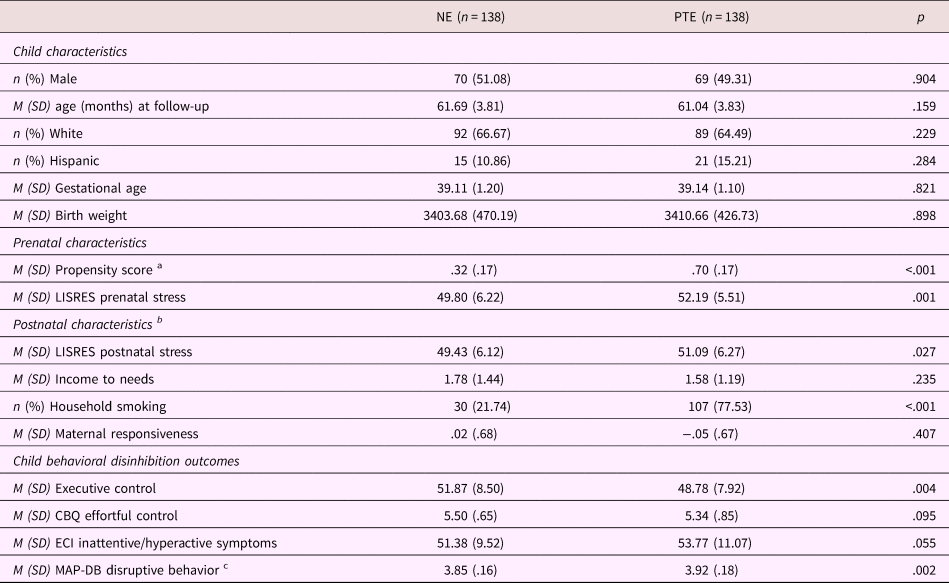
Table 1 provides descriptive information for the analytic sample. Reflecting the demographics of women who smoke during pregnancy in the US (Mumford, Hair, Yu, & Liu, Reference Mumford, Hair, Yu and Liu2014), sociodemographic disadvantage was prevalent: 8% of mothers had not completed high school, 78% were eligible for Medicaid, and the median household income was $32,664 at the 5-year follow-up. Mean reported prenatal alcohol use (drinks per day) for exposed and non-exposed groups was 0.04 and 0 drinks/day, respectively: t (274) = 5.6, p < .001. While self-reported maternal drug use was an exclusion criterion at enrollment, the prevalence of maternal marijuana use, as derived from subsequent interviews or meconium, was 20% in the exposed- and 4% in the non-exposed group, respectively: Χ2 (1) = 16.24, p < .001.
Descriptive characteristics of PTE and non-exposed (NE) groups

a Probability score based on maternal age, education, race, diet, health, alcohol and marijuana use, IQ, mental health, and personality characteristics (Fang et al., Reference Fang, Johnson, Chevalier, Stopp, Wiebe, Wakschlag and Espy2010); b All measured during the 5-year follow-up assessment; c Variable log transformed.
Procedure
All procedures were approved by human subjects protection boards at the participating institutions, and mothers provided written, informed consent to participation. Within 6 months of the child participants’ 5th birthdays, families were contacted and invited to participate in MIDS-P, a follow-up study consisting of a home visit and a laboratory-based assessment. Relevant measures administered during each visit are detailed in the following paragraphs.
Measures
Tobacco exposure
Exposure was determined using a multistep approach (Espy et al., Reference Espy, Fang, Johnson, Stopp and Wiebe2011). Mothers reported on their smoking status during eligibility screening and in month-by-month timeline follow-back interviews administered at 16 and 28 weeks of pregnancy and at delivery. Mothers who reported smoking at dates past the last menstrual period were classified as pregnancy smokers. Cotinine levels were assayed from maternal urine samples at these prenatal time points and from infant meconium at birth. Two mothers who did not report smoking were reclassified as smokers based on cotinine samples higher than 100 ng/mL at these time points. Finally, as a measure of postnatal tobacco exposure, mothers reported the number of smokers residing in the child's home during the 5-year interview. Children living with any smokers were classified as exposed at this postnatal time point. Based on this measure, 137 (50%) of the sample were living in households with smokers at age 5 years.
Maternal responsiveness
Mothers were assigned an overall responsiveness score using a multi-method approach combining home-based, lab-based, and maternal report measures of responsiveness. The Early Childhood Home Observation for the Measurement of the Environment (EC-HOME) (Caldwell & Bradley, Reference Caldwell and Bradley1984) was administered during the home visit at the follow-up assessment. This is an observational and interview-based measure of the quality of the home environment. The eight-item “warmth/responsiveness” subscale includes items such as, “During visit, parent answers child's questions verbally,” which are evaluated with a yes/no format. Thirty percent of ratings were completed by two raters, and the Spearman's correlation between these raters for the scale was .93, p < .001. Disagreements were resolved through discussion during regular study fidelity meetings.
During the laboratory visit, mothers completed a standardized set of activities with their children during the Disruptive Behavior–Diagnostic Observation Schedule, and their behavior was subsequently coded using the Parenting Clinical Observation Schedule (PCOS) (Hill, Mascowitz, Danis, & Wakschlag, Reference Hill, Mascowitz, Danis and Wakschlag2008). Parent-child activities are designed to elicit parenting behaviors across varying contexts and included a tidying task (putting crayons away), jigsaw puzzle building, and a waiting task, in which the mother instructed the child to occupy himself/herself while she completed a questionnaire. Maternal scaffolding, responsiveness to positive child behavior, warmth, engagement, labeling, and intensity and predominance of positive emotion during each task were rated on a 4-point scale from 0 = none to 3 = high, and these scores were summed to produce an overall score for responsive involvement. Weighted kappa inter-rater reliability, based on 20% of tapes that were coded by independent raters, ranged from 0.65 for labeling to 0.82 for scaffolding, with an average weighted kappa of 0.77 across all coded behaviors.
Finally, the 11-item Warmth and Involvement Scale from the Parenting Styles and Dimensions Questionnaire (Robinson, Mandleco, Olsen, & Hart, Reference Robinson, Mandleco, Olsen and Hart1999) provided a self-reported measure of parent responsiveness. Parents rate statements such as, “I give comfort and understanding when my child is upset,” on a 1- to 5-point scale. The measure is widely used in parenting research and correlated with parent-child interaction ratings in a previous study (Coolahan, McWayne, Fantuzzo, & Grim, Reference Coolahan, McWayne, Fantuzzo and Grim2002; Olivari, Tagliabue, & Confalonieri, Reference Olivari, Tagliabue and Confalonieri2013).
Pearson's correlations among the parenting measures ranged from 0.16, p = .008 to 0.21, p = .002. In cases with missing data for any parenting measure, multiple imputation was performed using the Marcov chain Monte Carlo method in SAS 9.3. Ten imputations were performed based on 100 iterations each. The mean of these imputations was used as the child's imputed value. In the interests of analytic parsimony and to provide a more robust, multi-contextual measure of maternal responsiveness, the mean of the standardized scores for the three parenting measures (i.e., scores were equally weighted) was used as the responsiveness score for each child.
Measures of child behavioral disinhibition
Behavioral disinhibition incorporates deficits in executive control, attention, and inhibitory control, as well as aggression and behavioral undercontrol (Tarter et al., Reference Tarter, Kirisci, Mezzich, Cornelius, Pajer, Vanyukov and Clark2003; Zucker et al., Reference Zucker, Heitzeg and Nigg2011). A combination of neuropsychological, clinical checklist, and dimensional assessments was used to capture this phenotypic profile.
Executive control
During the laboratory-based assessment, children completed measures of executive control, including the Nebraska Barnyard working memory task (adapted from the Noisy Book task; Hughes, Dunn, & White, Reference Hughes, Dunn and White1998) and a Go/No-go inhibitory control task (Simpson & Riggs, Reference Simpson and Riggs2006; Wiebe, Sheffield, & Espy, Reference Wiebe, Sheffield and Espy2012). Both measures were programmed and administered using E-Prime software (Psychology Software Tools, Pittsburgh, PA). The Nebraska Barnyard is a span-type task. Children are presented with a 2 × 2 grid of colored buttons depicting barnyard animals (cat on orange button, horse on black button, pig on pink button, cow on brown button). As children press the buttons on a touch screen, they emit noises associated with the animals. After a training phase to familiarize children with the buttons, the animal pictures are removed and children are asked to press the buttons that correspond to sequences of animal names in the order verbalized by the examiner. The task proceeds from sequences of two to eight animal names, with three trials possible at each level. If the child fails to replicate the sequence for all three trials at a given level, the task is discontinued. The task advances automatically if children pass the first two trials at a given span level, in which case credit is automatically granted for the third trial. The dependent variable was the total number of correct trials.
In the go/no-go task, children are instructed to press on a button in response to cartoon images of fish while avoiding making a response to shark images. After a short training phase, children complete 40 trials (75% fish, 25% sharks). Each stimulus is presented for a maximum of 1500 ms after an inter-stimulus interval of 750 ms. Children are provided with a 500-ms feedback stimulus of a bubbling fishing net when they correctly respond to a fish and a buzzing, breaking net when they incorrectly respond to a shark. A d’prime score was calculated using the standardized probability of responding to a shark subtracted from the standardized probability of responding to a fish. In the interests of parsimony, dependent variables for these executive control tasks were standardized to a mean of 50, and the mean of these scores was used as a total executive control score (see Clark, Wakschlag, & Espy, Reference Clark, Espy and Wakschlag2016 for further details).
Effortful control
Parents completed the 12-item Effortful Control Scale from the Children's Behavior Questionnaire (CBQ) – Short Form (Putnam & Rothbart, Reference Putnam and Rothbart2006). Effortful control is considered a constitutionally based ability to manage affect and physiological reactivity through the regulation of attention, and the scale is linked theoretically to the adult personality dimension of constraint/conscientiousness (Rothbart, Sheese, Rueda, & Posner, Reference Rothbart, Sheese, Rueda and Posner2011). Items such as, “When drawing or coloring in a book, shows strong concentration,” are rated from 1 – extremely untrue to 7 – extremely true. Scales from the very short form of the CBQ correlate well with the longer version of the CBQ, which has demonstrated reliability across international samples (Rothbart, Ahadi, Hershey, & Fisher, Reference Rothbart, Ahadi, Hershey and Fisher2001).
Disruptive behavior
During the laboratory visit, mothers completed the Multidimensional Assessment Profile of Disruptive Behavior (MAP-DB) (Wakschlag et al., Reference Wakschlag, Briggs-Gowan, Choi, Nichols, Kestler, Burns and Henry2014), a 118-item questionnaire designed to differentiate normative misbehavior from clinically concerning disruptive behavior within the developmental context of early childhood. The MAP-DB assesses quality (e.g., dysregulation), context (e.g., during daily routines vs. out of the blue), and frequency (on a six-item scale from never to many times each day) of child disruptive behavior as a means of developmentally sensitive differentiation. Item response theory analysis was used to identify items with maximum differentiation and factor coherence for the MAP-DB scale (Wakschlag et al., Reference Wakschlag, Briggs-Gowan, Choi, Nichols, Kestler, Burns and Henry2014, Reference Wakschlag, Perlman, Blair, Leibenluft, Briggs-Gowan and Pine2018). For this study, a disruptive behavior dimensional composite score was generated by summing scores across all of these items.
Inattentive/hyperactive symptoms
Mothers completed the DSM-based Stony Brook Early Childhood Inventory Attention-Deficit Hyperactivity Disorder (ADHD) Scale (ECI; Gadow & Sprafkin, Reference Gadow and Sprafkin2000). Items such as, “Fidgets with hands or feet or squirms in seat” are rated on a 4-point scale from never to very often. The measure discriminates effectively between children with and without clinical diagnoses of ADHD and correlates with scores from similar instruments (Sprafkin, Volpe, Gadow, Nolan, & Kelly, Reference Sprafkin, Volpe, Gadow, Nolan and Kelly2002). In this study, we used the t score from the scale to obtain a continuous measure of difficulties with inattention and hyperactivity/impulsivity.
Confounding factors
Maternal smoking propensity score
A propensity score was used to minimize the effects of selection bias associated with PTE on study outcomes (see Fang et al., Reference Fang, Johnson, Chevalier, Stopp, Wiebe, Wakschlag and Espy2010 for a complete description). This score was calculated using generalized bootstrap modeling in the R Twang package (Ridgeway, Reference Ridgeway2006) based on 42 confounding variables, including several maternal characteristics such as age, education, race, diet, health and pregnancy history, alcohol, marijuana and prescription medicine consumption, intelligence quotient (IQ), depression, anxiety, hyperactivity, attention and impulsivity symptoms, and personality characteristics such as hostility and psychoticism.
Household stress
Women who smoke during pregnancy are more likely to live in stressful environments (Clark et al., Reference Clark, Chevalier, Nelson, James, Garza, Choi and Espy2016; Pickett, Wilkinson, & Wakschlag, Reference Pickett, Wilkinson and Wakschlag2009; Weaver, Campbell, Mermelstein, & Wakschlag, Reference Weaver, Campbell, Mermelstein and Wakschlag2008), and family and household stress was measured both prenatally (at 16 or 28 weeks) and at the 5-year follow-up time point using the Life Stressors and Social Resources Inventory (LISRES) (Moos & Moos, Reference Moos and Moos1994). This scale assesses perceived stress associated with extended family, friends, negative life events, children, a spouse or partner, work, home and neighborhood, and health. The scale shows adequate internal (α = 0.83–0.84) and inter-rater reliability (r = 0.67–0.70) (Moos, Reference Moos1995). Total prenatal and 5-year LISRES stress scores were created by averaging the standard scores for all stressors at each time point. Given that stress associated with children is likely to be confounded with measures of parent responsiveness, we excluded LISRES child-related stress from our indicators of prenatal and postnatal stress.
Household income-to-needs
Household income-to-needs was used as a marker for the level of poverty in the home and was calculated by dividing maternal-reported household income by the federal poverty threshold for the year the interview was conducted (Brooks-Gunn & Klebanov, Reference Brooks-Gunn and Klebanov1996). Thus, a score of 1 would indicate an income equivalent to the federal poverty threshold, whereas a score below 1 would indicate an income below this threshold.
Statistical methods
Analyses were conducted in two major phases. First, descriptive statistics and correlations were examined for all predictors. These analyses showed that the MAP-DB scores were skewed (skewness = 1.46; kurtosis = 2.73), and this variable was therefore log transformed (skewness = 0.9; kurtosis = 0.67) for all reported analyses. Second, hierarchical linear regression models were constructed for each of the four behavioral disinhibition outcomes: executive control, effortful control, disruptive behavior, and inattentive/hyperactive symptoms. In the first step of the regression equations, control variables, including child's age in months at the 5-year follow-up, child's sex (1 = male, 0 = female), the maternal smoking propensity score, the LISRES prenatal and postnatal stress scores, household income to needs, and household tobacco use, were entered in a single block. The primary predictors of interest, which included PTE (1 = yes, 0 = no) and maternal responsiveness, were then entered. In the final step, two- and three-way interactions between sex, PTE, and parent responsiveness were entered. A backward trimming approach was used for these interactions, so that those that did not contribute significantly to the model (p > .05) were iteratively removed.
Significant interactions between PTE and responsiveness were probed based on Roisman et al.’s (Reference Roisman, Newman, Fraley, Haltigan, Groh and Haydon2012) recommendations. First, we graphed and estimated the slopes for maternal responsiveness values 2 SDs above/below the sample mean. Next, we conducted a simple slopes analysis using the process macro (Hayes, Reference Hayes2018) to quantify the relation between parenting and the behavioral disinhibition outcome in each study group. Thereafter, we used tools developed by Fraley (Reference Fraley2012) and Roisman et al. (Reference Roisman, Newman, Fraley, Haltigan, Groh and Haydon2012) to conduct a region of significance (ROS) analysis, which determined the range of values of maternal responsiveness for which the association between PTE and the self-regulatory outcome was significant. A diathesis-stress effect is supported when the interaction is significant primarily at lower levels of maternal responsiveness. Conversely, a differential susceptibility effect is supported when the interaction is significant at both low and high levels of maternal responsiveness (i.e., the effect is “for better” and “for worse”). Finally, we examined the Proportion of Interaction (POI) index, which measures the area between the two regression lines to the left of the crossover point on the interaction plot. POI values closer to 0 or 100 favor a diathesis stress effect, indicating that the area on one side of the crossover point is much larger than the other. Values close to 0.5 indicate that the areas on either side of the crossover point are relatively even. This is evidence for a differential susceptibility effect because the likelihood of benefitting from high maternal responsiveness is generally equivalent to the likelihood of being adversely affected by low maternal responsiveness.
Results
Univariate relations between predictors and covariates
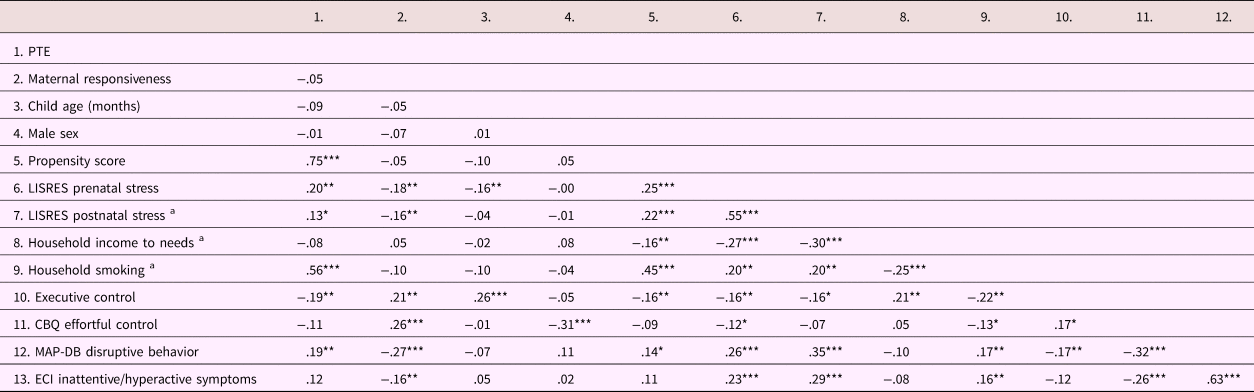
Table 2 provides the univariate correlations between the variables considered in subsequent analyses. Contrary to previous research, mean levels of maternal responsiveness did not differ between the PTE and non-exposed groups. However, maternal responsiveness correlated with all measures of behavioral disinhibition.
Correlations between study predictors and outcomes

a Measured at the 5-year follow-up assessment; *p < .05; ** p < .01; ***p < .001.
Relation of PTE and maternal responsiveness to behavioral disinhibition in early childhood
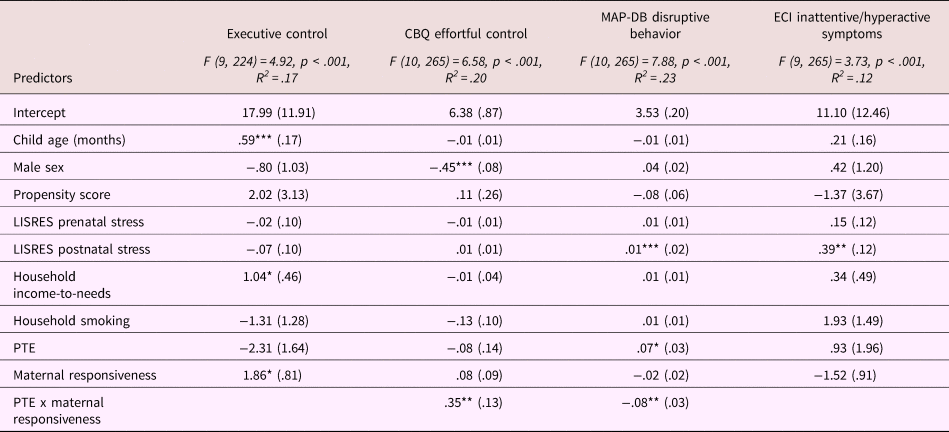
Table 3 describes a series of regression models predicting each of the child behavioral disinhibition measures. Contrary to our hypothesis, PTE and responsiveness did not interact to predict child executive control task performance. There was a main effect of maternal responsiveness, however, where each increase in the responsiveness score predicted a 1.86-point increase in executive control performance (p = .02). Notably, PTE was not significant in this model with all other predictors included. PTE and maternal responsiveness did not interact with child sex to predict executive control. Overall, the model explained approximately 17% of the variance in executive control performance.
Predictors of behavioral disinhibition

a Measured at the 5-year follow-up assessment; *p < .05; ** p < .01; ***p < .001.
In terms of CBQ Effortful Control Scale scores, there was a significant interaction between PTE and maternal responsiveness (p = .007; R 2∆ = .02; see Figure 1). A simple slopes analysis to probe the nature of this interaction indicated that higher maternal responsiveness predicted increased effortful control for children with PTE, B (SE) = .42 (.09), p < .001, whereas it did not correlate with effortful control in the non-exposed group, B (SE) = .08 (.09), p = .26. A ROS analysis revealed that the association between responsiveness and effortful control in the PTE group was significant for maternal responsiveness values below −.68 and above 1.77. Given that scores for maternal responsiveness in the sample ranged from -2.50 to 1.48 and the value of 1.77 is outside of this range, this finding suggests that PTE children in the low range of maternal responsiveness (< −.68) were affected, whereas those in the high range were not (a diathesis-stress effect). As further support for a diathesis-stress effect, the POI index indicated that only 38% of the area for the interaction plot was above the crossover point on the graph. Accordingly, most of the interaction effect was attributable to lower scores for exposed children who had less responsive mothers. There were no significant interactions among PTE, sex, and maternal responsiveness, although male children were rated almost half a point lower in effortful control than their female counterparts (p < .001). Collectively, predictors accounted for 20% of the variance in child effortful control scores.
Predicted CBQ effortful control scores for exposed (PTE) and non-exposed (NE) children with low (−2 SDs of mean), average (sample mean), and high (+2 SDs of mean) levels of maternal responsiveness. Estimates are based on a female, 5-year-old child with continuous covariates centered at the sample mean.

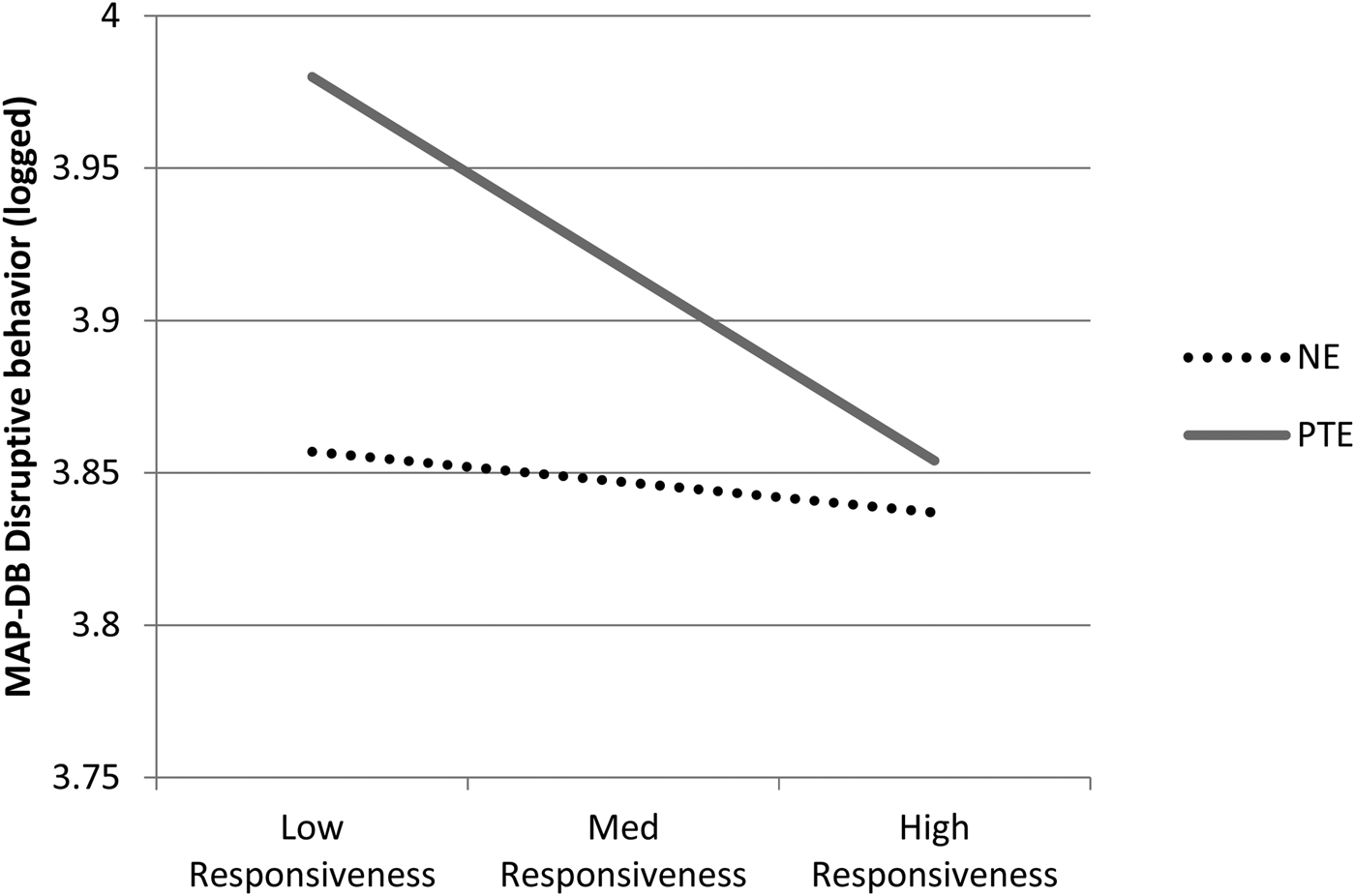
The interaction between PTE and responsiveness also emerged as significant for MAP-DB disruptive behavior scores, p = .008, R 2∆ = .02 (see Figure 2). Again, there was a significant association between maternal responsiveness and disruptive behavior in the PTE group, B (SE) = −.09 (.02), p < .001, whereas the relation was not significant in the non-exposed group, B (SE) = −.02 (.02), p = .46. The ROS analysis showed that the relation of maternal responsiveness to MAP-DB scores in the PTE group was significant for values below .07 and above 3.71, supporting a diathesis-stress effect. The POI index was .13, indicating that the majority of the interaction effect was carried by the adverse effects of low maternal responsiveness for children with PTE. The main effect of PTE was also significant in the model (p = .03). There were no other interactions. The model accounted for 23% of the variance in MAP-DB scores.
Predicted MAP-DB scores for exposed and non-exposed children with low (-2 SDs of mean), average (sample mean), and high (+2 SDs of mean). Estimates are based on a female, 5-year-old child with continuous covariates centered at the sample mean.

Finally, neither PTE nor responsiveness predicted children's inattentive/hyperactive symptoms, as measured by the ECI. There were no significant interactions in this model.
Discussion
Children with PTE are susceptible to self-regulatory impairments that increase their risk for psychopathology across their life spans (Cornelius, Goldschmidt, & Day, Reference Cornelius, Goldschmidt and Day2012; Monshouwer & Huizink, Reference Monshouwer, Huizink, Harekeh, Raaijmakers, Reijneveld, Oldehinkel, Verhulst and Vollebergh2011; Wakschlag et al., Reference Wakschlag, Leventhal, Pickett, Pine and Carter2006). Less is known regarding the postnatal factors that may compound or mitigate this risk. Over and above several environmental stressors and risk factors that co-occur with PTE, this study shows that exposed children whose mothers are sensitive, warm, and responsive are at reduced risk for impairments in areas associated with behavioral disinhibition. Collectively, our findings highlight parent-child interactions as a promising target for early intervention to support self-regulation and reduce the risk of externalizing trajectories among children with PTE.
Consistent with previous findings in this and other cohorts (Clark et al., Reference Clark, Chevalier, Nelson, James, Garza, Choi and Espy2016; Cornelius et al., Reference Cornelius, Goldschmidt, De Genna and Larkby2012; Mezzacappa et al., Reference Mezzacappa, Buckner and Earls2011; Wakschlag et al., Reference Wakschlag, Leventhal, Pickett, Pine and Carter2006; Wiebe et al., Reference Wiebe, Clark, de Jong, Chevalier, Espy and Wakschlag2016), young children with PTE were vulnerable to deficits in executive control and increased disruptive behavior relative to their non-exposed peers. Scores from the various measures were moderately correlated, suggesting that difficulties cluster into a broader profile of behavioral disinhibition. Nonetheless, distinct predictors emerged as important for the various outcome measures. Our primary hypothesis was supported with respect to child effortful control and disruptive behavior; children with PTE were at higher risk than their non-exposed peers when their mothers showed low levels of responsiveness. Conversely, exposed children whose mothers were responsive showed similar scores to their non-exposed peers. Importantly, this buffering effect of maternal responsiveness was significant even after accounting for several prenatal and postnatal stressors that correlate with PTE and with children's self-regulation (Betts, Williams, Najman, & Alati, Reference Betts, Williams, Najman and Alati2015; Evans & Rosenbaum, Reference Evans and Rosenbaum2008; Merz et al., Reference Merz, Landry, Williams, Barnes, Eisenberg, Spinrad and Clancy-Menchetti2014). Overall, our findings for these measures are consistent with a diathesis-stress, as opposed to a differential susceptibility model (Roisman et al., Reference Roisman, Newman, Fraley, Haltigan, Groh and Haydon2012).
These findings underscore the importance of considering the type of prenatal adversity in models of differential susceptibility, dual risk, and prenatal programming. The nature of intrauterine adversity associated with epigenetic and other changes that putatively confer plasticity may be quite specific. Although PTE has been linked to fetal HPA axis reactivity, decreased fetal growth, and difficult infant temperament, all factors implicated in differential susceptibility (Belsky et al., Reference Belsky, Bakermans-Kranenburg and van Ijzendoorn2007; Pluess & Belsky, Reference Pluess and Belsky2011), PTE alone, when separated from commonly associated prenatal stressors, may restrict fetal growth and neural development, but may not influence plasticity. Indeed, the sheer viability of the fetus may come at the expense of neural development. In this way, optimal rearing may attenuate or help compensate for the effects of PTE on child self-regulation, but may not yield better-than-average outcomes. Further investigations that characterize the timing and dosage of varying forms of prenatal adversity will be necessary to build a more complete picture of the circumstances under which differential susceptibility versus diathesis stress effects may hold.
Contrary to hypotheses, there was no interaction between PTE and responsiveness when considering executive control as an outcome. The lack of an interaction may reflect that these executive control tasks did not incorporate strong emotional or motivational elements, a factor that has been shown to be important in previous studies of children with PTE (Wiebe et al., Reference Wiebe, Clark, de Jong, Chevalier, Espy and Wakschlag2016). The central role of postnatal environmental factors in accounting for executive outcomes accords with the protracted development of cognitive capacities and neural systems that support and are modulated by executive control (Gogtay et al., Reference Gogtay, Giedd, Lusk, Hayashi, Greenstein, Vaituzis and Thompson2004; Wolfe & Bell, Reference Wolfe and Bell2004). Similarly, only postnatal stress exposure was associated with elevated inattentive/hyperactive symptoms. It is possible that the DSM-based checklist used to measure hyperactive/inattentive symptoms in this study, in contrast to the dimensional approach of other measures, obscured subtle, subclinical effects of PTE on attention regulation. It is also possible that PTE interacts with specific risk alleles to place children at stronger risk for ADHD-type symptoms and that these more nuanced associations were not captured in this study (Becker, El-Faddagh, Schmidt, Esser, & Laucht, Reference Becker, El-Faddagh, Schmidt, Esser and Laucht2008; O'Brien, Mustanski, Skol, Cook, & Wakschlag, Reference O'Brien, Mustanski, Skol, Cook and Wakschlag2013).
The buffering effect of maternal responsiveness on different facets of behavioral disinhibition is consistent with our previous findings in adolescent boys (Wakschlag & Hans, Reference Wakschlag and Hans2002) but inconsistent with studies that have examined interactions between PTE and maternal responsiveness in toddlers (Godleski et al., Reference Godleski, Eiden, Schuetze, Colder and Huestis2016; Huijbregts et al., Reference Huijbregts, Séguin, Zoccolillo, Boivin and Tremblay2007). Note that, for both of the latter studies, maternal responsiveness was measured in infancy. It is possible that moderation effects for maternal responsiveness in relation to disinhibited behavior are more evident in preschool and school-aged children because parent-child dyadic behavior is more complex and entrenched by this stage of development. For instance, maternal responsiveness is likely to incorporate more diverse linguistic strategies at this age point, whereas these types of responses may be less clear at younger ages. Similarly, because self-regulation is an important developmental milestone for this stage of development, inappropriate or disruptive behavior may be more noticeable to mothers. Finally, former studies have tended to rely on single measures of parenting responsiveness and relatively coarse outcome measures. For instance, Huijbregts et al. (Reference Huijbregts, Séguin, Zoccolillo, Boivin and Tremblay2007) used a relatively brief checklist measure of aggressive/hyperactive behavior administered at 17–42 months. A multi-method approach, incorporating detailed assessments of parenting and of self-regulatory outcomes, may be necessary to capture these interactions between prenatal and postnatal experiences.
Findings did not support our secondary hypotheses regarding sex-specific effects of PTE and maternal responsiveness. Previous studies have indicated that PTE boys may be at greater risk for self-regulatory deficits and elevated conduct problems than girls (Wiebe et al., Reference Wiebe, Clark, de Jong, Chevalier, Espy and Wakschlag2016; Willoughby et al., Reference Willoughby, Greenberg, Blair and Stifter2007) and that PTE boys may benefit to a greater extent than girls from high levels of maternal responsiveness (Eiden et al., Reference Eiden, Molnar, Granger, Colder, Schuetze and Huestis2015; Wakschlag & Hans, Reference Wakschlag and Hans2002). Variable findings with respect to sex are perhaps attributable to sample size limitations in a number of studies, but may also reflect variation across development. For instance, Wiebe et al. (Reference Wiebe, Clark, de Jong, Chevalier, Espy and Wakschlag2016) reported that developmental differences in self-regulation were more pronounced in exposed boys at 3 years of age, a period of particularly rapid growth and inter-individual variability in self-regulation. While intensive longitudinal studies will be necessary to test these nuanced developmental effects, our findings indicate that high levels of maternal responsiveness are equally beneficial for young boys and girls with PTE and that interventions targeting parent-child interactions are likely to benefit both genders.
This study included rare, multi-method, prospective measurement of PTE combined with a detailed assessment of maternal responsiveness and various dimensions of self-regulation, which typically are absent from large epidemiological studies. The use of a propensity score to account for multiple psychological and social factors that predispose a mother to smoke during pregnancy is an important strength, highlighting the robust nature of the links from parenting to behavioral outcomes in this high-risk cohort. However, the sample size was comparatively small, which limited our capacity to control for the multitude of hereditary influences known to confound PTE (D'onofrio et al., Reference D'Onofrio, Singh, Iliadou, Lambe, Hultman, Grann and Lichtenstein2010). Our measurement of postnatal tobacco exposure did not incorporate bioassays. Assessment of paternal responsiveness would also have provided a more complete picture of individual children's experiences and remains a critical question for future research, especially in light of our previous finding that paternal responsiveness buffered the association between PTE and disruptive behavior in adolescents (Wakschlag et al., Reference Wakschlag, Henry, Blair, Dukic, Burns and Pickett2011) and considering that children with PTE are less likely to grow up in households with a stable father presence (Gilman, Breslau, Subramanian, Hitsman, & Koenen, Reference Gilman, Breslau, Subramanian, Hitsman and Koenen2008). Finally, it is important to acknowledge the transactional nature of parent-child interactions (Sameroff, Reference Sameroff2010). Children who are less regulated are likely to be more difficult to parent, and lower ratings of responsiveness are likely to reflect, at least in part, a response to the child's characteristics.
The study demonstrates the importance of sensitive responsiveness in maternal-child interactions for fostering resilience among children with PTE and highlights the utility of a developmental approach that captures the dynamic influences of prenatal and postnatal experiences on children's behavioral regulation. Given this interplay of prenatal and postnatal influences, prevention efforts will ideally be multi-tiered, targeted both at the reduction of tobacco consumption in pregnant mothers, as well as the enhancement of parent-child interactions during this critical early childhood period.
Acknowledgments
We gratefully acknowledge Desiree M. de Jong and all of the members of the Developmental Cognitive Neuroscience Laboratory for their work on data collection, coding, and entry; and extend special thanks to the families who generously shared their time and personal experiences to make this work possible.
Financial support
This research was supported by NIDA grants RO1DA023653 (PIs: Kimberly Andrews Espy and Lauren Wakschlag); RO1DA014661 (PI: Kimberly Andrews Espy); and K23DA037913 (PI: Suena Massey).