1. Introduction
The Serbo-Macedonian and Rhodope high-grade metamorphic massifs constitute the crystalline basement of the Alpine orogenic belt in the Balkan Peninsula and display a record of a late Mesozoic convergence resulting in nappe stacking overprinted by an early Cenozoic extensional deformation (e.g. Burg et al. Reference Burg, Ricou, Ivanov, Godfriaux, Dimov and Klain1996; Bonev et al. Reference Bonev, Burg and Ivanov2006; Bonev & Beccaletto, Reference Bonev, Beccaletto, Taymaz, Yilmaz and Dilek2007). Both massifs are surrounded by a very low- to low-grade Circum-Rhodope Belt (CRB) that extends from the Chalkidiki Penisula (western part) across the Aegean Sea to the Thrace area (eastern part) in northern Greece (Fig. 1; Kauffmann et al. Reference Kauffmann, Kockel and Mollat1976). The eastern CRB contains unmetamorphosed Evros ophiolite of supra-subduction zone origin (e.g. Magganas et al. Reference Magganas, Sideris and Kokkinakis1991; Magganas, Reference Magganas2002; Bonev & Stampfli, Reference Bonev and Stampfli2008, Reference Bonev and Stampfli2009), which has Early–Middle Jurassic crystallization ages (Bonev et al. Reference Bonev, Marchev, Moritz and Collings2015 a). The south-vergent, thrust system of the Serbo-Macedonian and Rhodope massifs was constructed during a contractional phase in the hanging wall of a north-dipping Cretaceous–Tertiary subduction zone that was located within Vardar Ocean further to the SSW (in the present-day coordinate system) (Ricou et al. Reference Ricou, Burg, Godfriaux and Ivanov1998). However, the late Mesozoic shortening and nappe-stacking event was predated by intra-oceanic subduction that resulted in the formation of arc-related Evros ophiolite, which together with the associated sedimentary rocks was thrusted and accreted to the Serbo-Macedonian – Rhodope continental margin of Eurasia (Bonev & Stampfli, Reference Bonev and Stampfli2003, Reference Bonev and Stampfli2011; Bonev et al. Reference Bonev, Мagganas, Klain, Christofides, Kantiranis, Kostopoulos and Chatzipetros2010 a, Reference Bonev, Marchev, Moritz and Collings2015 a).
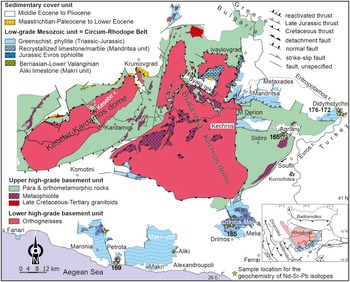
Simplified geological map of the eastern Rhodope Massif in southern Bulgaria and northern Greece (after Bonev et al. Reference Bonev, Marchev, Moritz and Collings2015 a), showing the locations of studied samples listed in Table 1. Bold numbers refer to radiometric ages of the Evros ophiolite. Inset: tectonic framework of the Alpine system in the Aegean domain of the eastern Mediterranean region.

The low-grade metamorphic CRB forms the uppermost crustal unit of the Serbo-Macedonian and Rhodope massifs, with distinct metamorphic grade and N-directed kinematics compared to the high-grade basement (Bonev et al. Reference Bonev, Мagganas, Klain, Christofides, Kantiranis, Kostopoulos and Chatzipetros2010 a; Bonev & Stampfli, Reference Bonev and Stampfli2011; Bonev & Filipov, Reference Bonev and Filipov2018), which indicate that they all experienced a deformational event, and that they were already part of the crustal architecture in the Balkan Peninsula by the earliest Cretaceous (Ivanova et al. Reference Ivanova, Bonev and Chatalov2015; Bonev et al. Reference Bonev, Marchev, Moritz and Collings2015 a, b). However, the nature of the CRB ophiolite melt source(s) is not well understood. The existing models consider them as ophiolitic allochthonous tectonic sheets, representing the remnants of a Tethyan oceanic lithosphere (Robertson et al. Reference Robertson, Dixon, Brown, Collins, Morris, Pickett, Sharp, Ustaömer, Morris and Tarling1996; Robertson, Reference Robertson2002; Papanikolaou, Reference Papanikolau2009; Stampfli & Hochard, Reference Stampfli, Hochard, Murphy, Keppie and Hynes2009; Bonev et al. Reference Bonev, Мagganas, Klain, Christofides, Kantiranis, Kostopoulos and Chatzipetros2010 a, Reference Bonev, Marchev, Moritz and Collings2015 a, b; Ferrière et al. Reference Ferrière, Baumgartner and Chanier2016), which formed in fore-arc, intra-arc/arc and back-arc environments (Bonev & Stampfli, Reference Bonev and Stampfli2008, Reference Bonev and Stampfli2009; Bonev et al. Reference Bonev, Spikings, Moritz and Marchev2010 b, Reference Bonev, Marchev, Moritz and Collings2015 a, b; Bonev, Reference Bonev2020). These different arc-related settings have major implications for the crustal evolution of the Balkan Peninsula and need to be validated with isotopic studies.
In this paper, we report on the Nd–Sr–Pb radiogenic isotope geochemistry of the Evros ophiolite mafic units in the eastern CRB exposed in northeastern Greece (Fig. 1). Our isotopic data suggest crust–mantle interaction recorded in these mafic rock units, which represent island arc magmatic assemblages formed during intra-oceanic subduction evolution outboard the Rhodope margin in the Early to Late Jurassic. We present a brief account of the regional geology, geochemistry and isotopic signature of the Jurassic Evros ophiolite mafic rocks, and then discuss their origin in different arc-related magmatic settings.
2. Regional geology of the eastern CRB and Evros ophiolite
In the Thrace area of the northern Aegean region, the Evros ophiolite is exposed from the Aegean coast in Greece up to the northern tip of the eastern Rhodope Massif in Bulgaria, and built the eastern CRB, also called the Mesozoic low-grade unit (Fig. 1, inset; e.g. Bonev & Stampfli, Reference Bonev and Stampfli2003). The Samothraki Island is an extension of the Evros ophiolite offshore Greece, named Samothraki ophiolite of back-arc origin (Tsikuras & Hatzipanagiotou, Reference Tsikouras and Hatzipanagiotou1998). The two main units of the eastern CRB include the greenschist-facies metasedimentary Makri unit and the overlying very low-grade to unmetamorphosed Drimos–Melia unit; the latter in turn includes a major part of the Evros ophiolite (Fig. 1; Papadopoulos, Reference Papadopoulos1980, Reference Papadopoulos1982). The eastern CRB overlies the upper unit of the high-grade basement with a reworked thrust contact and by extensional detachments directly onto the lower unit of the high-grade basement testifying for extensional omissions in the tectonostratigraphy (Fig. 1; Bonev & Stampfli, Reference Bonev and Stampfli2011).
The Makri unit consists of stratigraphically lower metasedimentary series conformably overlain by an upper metavolcanic–sedimentary series, which are intercalated with two marble horizons and covered by a single limestone horizon. The metasedimentary series (i.e. marble–shale–phyllite sequences) has the characteristics of shallow-marine platform type slope-rise deposits (Papadopoulos et al. Reference Papadopoulos, Arvanitidis and Zanas1989). One of the lowest marble horizons yielded Upper Triassic corals (Maratos & Andronopoulos, Reference Maratos and Andronopoulos1964), and the metasedimentary series supplied Tithonian–Beriassian ammonites (Dimadis & Nikolov, Reference Dimadis and Nikolov1997). The youngest group of detrital zircons in the sandstones cluster at c. 240 Ma, providing at least a Middle Triassic depositional age for the stratigraphically lower levels of the Makri unit (Meinhold et al. Reference Meinhold, Reischmann, Kostopoulos, Frei and Larionov2010). The metavolcanic–sedimentary series is dominated by greenschists derived from mafic to acid lavas and pyroclastics, with occurrences of scarce serpentinite bodies. The uppermost limestone horizon, known as Lower Cretaceous ‘Aliki limestones’ (Maratos & Andronopoulos, Reference Maratos and Andronopoulos1964), lies unconformably on the metavolcanic–sedimentary series (Kopp, Reference Kopp1969; Ivanova et al. Reference Ivanova, Bonev and Chatalov2015), implying a pre-Cretaceous age of deposition and greenschist-facies metamorphism of the Makri unit. Recent biostratigraphic data confirmed Beriassian – lower Valanginian depositional age of the ‘Aliki limestones’ (Ivanova et al. Reference Ivanova, Bonev and Chatalov2015).
The Drimos–Melia unit consists of massive mafic lava flows intruded by mafic dykes and pillow lavas of the Evros ophiolite intercalated in a flysch succession (Papadopoulos, Reference Papadopoulos1982; Papadopoulos et al. Reference Papadopoulos, Arvanitidis and Zanas1989; Bonev & Stampfli, Reference Bonev, Stampfli, Yanev and Nedyalkov2005; Bonev, Reference Bonev2020), which yielded Middle–Upper Triassic (Dimadis et al. Reference Dimadis, Papadopolous, Goranov and Encheva1996) and Middle–Upper Jurassic (Trikkalinos, Reference Trikkalinos1955) biostratigraphic ages. The detrital zircons in the flysch cluster at c. 315–285 Ma, and the youngest grain at c. 160 Ma provides a Late Jurassic maximum age of deposition (Meinhold et al. Reference Meinhold, Reischmann, Kostopoulos, Frei and Larionov2010).
Middle Eocene to Oligocene sedimentary rocks represents unconformable sedimentary cover unit onto the Makri and Drimos–Melia units, which includes also thick Late Eocene – Oligocene up to early Miocene volcanic and volcanic–sedimentary successions (Kopp, Reference Kopp1965; Christofides et al. Reference Christofides, Pécskay, Elefteriadis, Soldatos and Koroneos2004).
The Evros ophiolite consists of massive and rare pillow tholeiitic basalt, and evolved boninitic–tholeiitic basaltic andesite–andesite lavas (e.g. Magganas et al. Reference Magganas, Sideris and Kokkinakis1991; Magganas, Reference Magganas2002; Bonev & Stampfli, Reference Bonev, Stampfli, Yanev and Nedyalkov2005, Reference Bonev and Stampfli2008), together with tholeiitic to calc-alkaline cumulitic and isotropic gabbro (Biggazzi et al. Reference Biggazzi, Del Moro, Innocenti, Kyriakopoulos, Manetti, Papadopoulos, Norelliti and Magganas1989; Bonev & Stampfli, Reference Bonev and Stampfli2009), which together demonstrate a typical upper crustal intrusive and volcanic section of an ophiolite. Volcanic section of the Evros ophiolite is most extensively exposed in the Drimos–Melia unit, but other smaller exposures also occur at the villages of Krovili and Kornofolea and at the town of Didymotycho (Fig. 1). One of the intrusive members of the Evros ophiolite, called the Petrota gabbroic complex (Biggazzi et al. Reference Biggazzi, Del Moro, Innocenti, Kyriakopoulos, Manetti, Papadopoulos, Norelliti and Magganas1989), is exposed within the Tertiary Petrota graben. According to U–Pb zircon dating, the Petrota gabbro crystallized at 169 ± 2 Ma (Koglin et al. Reference Koglin, Reischmann, Kostopoulos, Matukov and Sergeev2007), and apatite fission-track ages ranging between 161 Ma and 140 Ma (Biggazzi et al. Reference Biggazzi, Del Moro, Innocenti, Kyriakopoulos, Manetti, Papadopoulos, Norelliti and Magganas1989) from the gabbro reveal the shallow crustal low-temperature history. Another Evros ophiolite intrusive section gabbroic body occurs at the village of Agriani (Bonev & Stampfli, Reference Bonev and Stampfli2009). At Agriani, an isotropic gabbro is cross-cut by boninitic dykes, and the gabbro yielded a 40Ar/39Ar amphibole cooling age of 163.49 ± 3.85 Ma (Bonev et al. Reference Bonev, Marchev, Moritz and Collings2015 a). Further east at the town of Didymotycho, a plagiogranite stock is cross-cut by boninitic–tholeiitic basalt and andesite dykes (Bonev & Stampfli, Reference Bonev and Stampfli2009). Rare-earth element modelling suggests that the plagiogranite is the result of extreme fractional crystallization of a basaltic magma similar in composition to the dykes intruding the plagiogranite. At Didymotycho, according to U–Pb zircon dating, the 171 Ma old plagiogranite intruded into 176 Ma old gabbro as well as into massive tholeiitic basalt lavas overlying the gabbro (Bonev et al. Reference Bonev, Marchev, Moritz and Collings2015 a). Bonev & Stampfli (Reference Bonev and Stampfli2009) have interpreted the Evros ophiolite occurrences at Agriani and Didymotycho as a proto-arc (fore-arc) segment of the large-scale eastern Rhodope – Evros Jurassic intra-oceanic arc system. Equivalent to the Evros ophiolite, the low-K and low-Ti boninitic–tholeiitic massive lavas are included in the Mandritsa unit in Bulgaria, from which Nd (143Nd/144Ndi = 0.512405–0.512950) and Pb (206Pb/204Pbi = 18.132–18.564; 207Pb/204Pbi = 15.573–15.640; 208Pb/204Pbi = 37.959–38.551) isotopes are available (Bonev & Stampfli, Reference Bonev and Stampfli2008). Collectively, based on geochemical affinities, the Evros ophiolite generated in fore-arc to arc tectonic environments, and it can be classified as subduction-related supra-subduction type to volcanic arc type ophiolite (e.g. Dilek & Furnes, Reference Dilek and Furnes2011).
3. Nd–Sr–Pb isotopes results
We analysed three samples from the mafic rocks at Didymotycho (GR59, GR46-9, Dd2) and three samples from the Drimos–Melia unit (GR11-73, GR41-9, GR35-9), together with two samples from the Agriani (AGR, GR11-65) and three samples from the Petrota (GR53-9, GR12-9, GR24-9) gabbroic bodies, and a mafic rock sample (GR44-9) at the village of Kornofolea for Nd, Sr and Pb isotopic compositions (Fig. 1; Table 1). Whole-rock compositions of these samples are published in Bonev & Stampfli (Reference Bonev and Stampfli2009), Bonev et al. (Reference Bonev, Marchev, Moritz and Collings2015 a) and Bonev (Reference Bonev2020). We compared the Nd and Pb isotopes of our rock samples to the published Nd and Pb isotopic compositions of the mafic ophiolitic rocks in the adjacent Mandritsa unit of the CRB, in Bulgaria (Bonev & Stampfli, Reference Bonev and Stampfli2008).
Summary of studied samples from the Evros ophiolite. Location of samples is shown in Figure 1

Chemical separation of the samples and whole-rock isotopic analyses were done in the Department of Earth Sciences at the University of Geneva (Switzerland) and calibrated against both international and internal standards. Nd–Sr–Pb isotopes were measured on a Thermo Neptune PLUS Multi-Collector inductively coupled plasma – mass spectrometer (ICP-MS). For monitoring the internal fractionation, we used 88Sr/86Sr = 8.375209 for the 87Sr/86Sr ratio, 146Nd/144Nd = 0.7219 for the 143Nd/144Nd ratio and 203Tl/205Tl = 0.418922 for the three Pb ratios. Long-term reproducibility of the measurements was controlled by repeated measurements of the external standards SRM987 (87Sr/86Sr = 0.710248, McArthur et al. Reference McArthur, Howarth and Bailey2001; JNdi-1 143Nd/144Nd = 0.512115, Tanaka et al. Reference Tanaka, Togashi, Kamioka, Amakawa, Kagami, Hamamoto, Yuhara, Orihashi, Yoneda, Shimizu, Kunimaru, Takahashi, Yanagi, Nakano, Fujimaki, Shinjo, Asahara, Tanimizu and Dragusanu2000) and SRM981 (Baker et al. Reference Baker, Peate, Waight and Meyzen2004) for Pb. Further analytical details can be found in Chiaradia et al. (Reference Chiaradia, Müntener and Beate2011). The whole-rock Nd, Sr and Pb isotopic compositions are given in Tables 2-4. The Nd–Sr–Pb isotopic results were age-corrected to the known crystallization ages of the Evros ophiolite or biostratigraphic age of the sediments associated to this ophiolite (see Table 1).
Sr isotopic compositions of the Evros ophiolite mafic rocks

* Values corrected for internal fractionation using 88Sr/86Sr = 8.375209 and for external fractionation using a nominal value of SRM987 87Sr/86Sr = 0.710248 (McArthur et al. Reference McArthur, Howarth and Bailey2001).
Nd isotopic compositions of the Evros ophiolite mafic rocks

* Values corrected for internal fractionation using 146Nd/144Nd = 0.7219 and for external fractionation using a nominal value of JNdi1 143Nd/144Nd = 0.512115 (Tanaka et al. Reference Tanaka, Togashi, Kamioka, Amakawa, Kagami, Hamamoto, Yuhara, Orihashi, Yoneda, Shimizu, Kunimaru, Takahashi, Yanagi, Nakano, Fujimaki, Shinjo, Asahara, Tanimizu and Dragusanu2000).
Pb isotopic compositions of the Evros ophiolite mafic rocks

* Values corrected for internal fractionation using 203Tl/205Tl = 0.418922 and for external fractionation using nominal values of SRM981 of Baker et al. (Reference Baker, Peate, Waight and Meyzen2004).
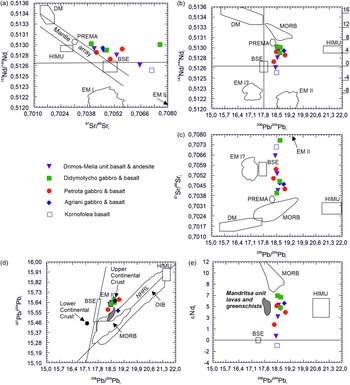
The 143Nd/144Nd ratios of the mafic rock samples fall in the range 0.512571–0.512976, with positive ϵNd values that are characteristic of mantle melts, and only a single exception of sample GR44-9 with negative ϵ Nd = −1.3. When time-corrected for the crystallization age of the mafic rocks (176 Ma to 165 Ma; see Table 1), the ϵ Nd(t) values vary from +0.2 to +6.6 (Table 3). The 87Sr/86Sr ratios display values ranging from 0.703998 to 0.707584 that are characteristic of the oceanic crust and subduction-related volcanic rocks (Table 2). However, basalt sample GR44-9 at Kornofolea and sample Dd2 from the dyke at Didymotycho have higher 87Sr/86Sr ratios of 0.707153 and 0.707584, respectively. These data indicate that the analysed mafic rocks except samples GR44-9 and Dd2 originated from magmas that were derived from a similar mantle source with a high time-integrated Sm/Nd ratio and with a moderate range of Rb/Sr ratios. In a correlative 143Nd/144Nd vs 87Sr/86Sr diagram (Fig. 2a), the majority of the samples parallel the mantle array and plot close to the Bulk Silica Earth (BSE), while samples GR41-9 and GR44-9 plot close to BSE and sample Dd2 plots with high 87Sr/86Sr ratio. In a 143Nd/144Nd vs 206Pb/204Pb diagram isotopic ratios cluster between the BSE, Prevalent Mantle (PREMA) and Mid-Ocean Ridge Basalt (MORB) (Fig. 2b) and spread along the same mantle reservoirs towards higher 87Sr/86Sr ratios in the 87Sr/86Sr vs 206Pb/204Pb diagram (Fig. 2c).
Correlation diagrams for Nd–Sr–Pb isotopes of the Evros ophiolite mafic rocks. (a) 143Nd/144Nd vs 87Sr/86Sr diagram. DMM and EMI mantle reservoirs from Hart (Reference Hart1984). (b) 143Nd/144Nd vs 206Pb/204Pb diagram. (c) 87Sr/86Sr vs 206Pb/204Pb diagram. (d) 207Pb/204Pb vs 206Pb/204Pb diagram. The NHRL and the fields of reference mantle reservoirs are after Zindler & Hart (Reference Zindler and Hart1986), and the fields of OIB and MORB from Rollinson (Reference Rollinson1993). (e) ϵ Nd(t) vs 206Pb/204Pb diagram. Mantle reservoirs are after Zindler & Hart (Reference Zindler and Hart1986).

The 206Pb/204Pb ratios of the analysed rocks show a relatively narrow range (18.314–18.930), display a narrow range of 207Pb/204Pb ratios (15.565–15.670) and a relatively narrow range of 208Pb/204Pb ratios (38.197–39.096), reaching a higher value in sample GR53-9 (Table 4). Almost all the mafic rocks exhibit a short linear trend parallel to progressive enrichment along the MORB–OIB line in the 207Pb/204Pb–206Pb/204Pb correlation diagram (Fig. 2d), plotting above the Northern Hemisphere Reference Line (NHRL) where enriched mantle reservoirs (EMI, EMII) are identified (Zindler & Hart, Reference Zindler and Hart1986). An exception of Pb isotopic compositions is a single sample plotting within the large OIB field and close to the MORB field (Rollinson, Reference Rollinson1993). In a ϵ Nd(t) vs 206Pb/204Pb diagram samples show linear trend toward higher ϵ Nd(t) values plotting between the MORB and the BSE (Fig. 2e).
The analysed Evros ophiolite mafic rock samples have Pb isotope ratios that cluster close to those of the counterpart Jurassic mafic rocks (lavas and greenschists) from the Mandritsa unit of the CRB in Bulgaria, which in turn partly plot within the OIB field (closest to the MORB field) (Bonev & Stampfli, Reference Bonev and Stampfli2008). However, our samples from the Evros ophiolite show high 206Pb/204Pb and 207Pb/204Pb ratios. When the Mandritsa unit mafic rocks are compared to our Evros ophiolite samples, both rock suites display striking similarities in terms of Nd–Pb isotopic compositions (Fig. 2d, e).
4. Discussion and conclusions
The Nd isotope compositions obtained in this study are consistent with involvement of MORB reservoir, a compositional feature also displayed by trace element and REE geochemistry of the studied samples (Bonev & Stampfli, Reference Bonev and Stampfli2009; Bonev, Reference Bonev2020). The range of Nd isotopes is consistent with the values of the oceanic crust developed in the seafloor and arc-related settings such as refractory mantle peridotite. The Pb isotope data also suggest a contribution of MORB mantle source. Thus, the boninitic–tholeiitic basalt to andesites and gabbros exhibits Nd and Pb isotopic chemistry that suggests contribution from depleted MORB-type mantle source in the magma generation (Fig. 2). The relatively narrow range of ϵ Nd(t) and Pb isotope values indicates that the mantle source of the mafic lavas and gabbros was rather homogeneous, depleted MORB-type lithospheric mantle.
The range of Sr isotopes also supports a MORB-type mantle component in the source region, but in addition shows the enrichment process via crustal contamination, explaining the variations and high 87Sr/86Sr ratio in samples Dd2 and GR44-9. The dyke Dd2 shows a deep negative Ce anomaly that has been interpreted in favour of involvement of the sediments in the subduction zone (Bonev & Stampfli, Reference Bonev and Stampfli2009). We infer a contribution from continental crust to explain the elevated 87Sr/86Sr ratios (0.7071 and 0.7075) observed in these samples. The negative ϵ Nd(t) value of sample GR44-9 suggests that more likely subducted sediments were involved in the magma genesis. The fact that sample Dd2 belongs to the fore-arc segment, and that both it and sample GR44-9 are based on 87Sr/86Sr values, might well demonstrate a contribution of sedimentary input into the fore-arc region of the subduction zone. We infer, therefore, the involvement of MORB reservoir in the mantle source region mixed with crustal component in the source mantle of subduction zone from the fore-arc to arc edifice.
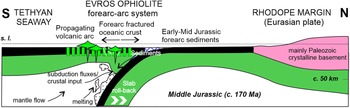
Our results highlight coherent Nd–Sr–Pb isotopic ratios of the Evros ophiolite mafic rocks, indicating generation of magmas by partial melting of a MORB-source mantle. These isotopic data indicate variable contamination of magmas by continental crust material and/or sediments entrained in the subduction zone (Fig. 3). These isotopic and compositional features are compatible with an intra-oceanic arc system represented by the Evros ophiolite in the Tethyan realm (Fig. 3), and are similar, for example, to the documented chemostratigraphy in some of the Pacific Ocean fore-arc–arc systems (Yu et al. Reference Yu, Dilek, Yumul, Yan, Dimalanta and Huang2020, Reference Yu, Yumul, Dilek, Yan and Huang2022). Comparision of the Nd–Pb isotope results with analogous data from the Mandritsa unit mafic rocks demonstrates region-wide similarity of the isotopic compositions, which in turn provides additional support for the supra-subduction zone origin for the Evros ophiolite in the eastern CRB. Overall, the Nd–Sr–Pb isotopes systematics revealed mantle–crust interaction caused by mantle wedge magmatic process in supra-subduction zone Evros ophiolite.
Simplified model of the Evros ophiolite Middle Jurassic intra-oceanic tectonic setting in the Tethyan realm accounting for the mantle–crust interaction in the mantle wedge as derived from the Nd–Sr–Pb isotopic results.

Acknowledgements
The support provided by the National Science Fund (Bulgaria) under contract KP-06-N54/5 is gratefully acknowledged. We thank Yildirim Dilek for careful reading and commenting on the manuscript, which helped us to improve the article.