Reconstruction of the early history of the Uto-Aztecan (UA) language family remains contentious. Romney (Reference Romney1957) proposed that speakers of Proto-Uto-Aztecan (PUA) were maize cultivators living in the upper drainages of the Gila River. Klar (Reference Klar1977, Reference Klar, Klar, Langdon and Silver1980), Nichols (Reference Nichols1981), and Turner (Reference Turner1983) presented loanword evidence for locating PUA in central California. Fowler (Reference Fowler1983) concurred with Romney in locating PUA in the upper Gila River drainage system (but extending west into the Little Colorado drainage to the San Francisco Peaks, and as far south as central Chihuahua), but argued that speakers of PUA were hunter-gatherers. Fowler (Reference Fowler1983) ruled out a central California homeland as outside the range of some key plant and animal genera with labels reconstructing to PUA, especially agave and turkey. Bellwood (Reference Bellwood, McConvell and Evans1997) returned to Romney's suggestion that the PUA community included cultivators, but proposed that the very large range occupied by Uto-Aztecan languages looked like a first-farmer spread out of Mesoamerica. The present paper pursues linguistic evidence for Bellwood's ‘first-farmer’ proposal, building on evidence presented in Hill (Reference Hill2001, Reference Hill, Bellwood and Renfrew2003, Reference Hill, Staller, Tykot and Benz2006, Reference Hill2008a).
In support of the hypothesis that the PUA community included maize cultivators (or, at the very least, was in close contact with maize cultivators), I present new evidence for the reconstruction of a PUA maize-cultivation vocabulary, including a few lexical items from the UA languages of California which were missing in Hill (Reference Hill2001). In support of the hypothesis that the PUA community was located in northwest Mesoamerica, I present evidence that some items in the PUA lexicon for maize and pottery were borrowed from an Otomanguean language, perhaps Kaufman's (Reference Kaufman1990) Oto-Chinantecan. The reconstruction of pottery vocabulary suggests that PUA broke up into its daughter languages no earlier than the period when pottery is first attested archaeologically in central and western Mexico and the American Southwest, between about 4400 and 4100 years ago.
PUA AS A COMMUNITY OF CULTIVATORS: PUA MAIZE VOCABULARY
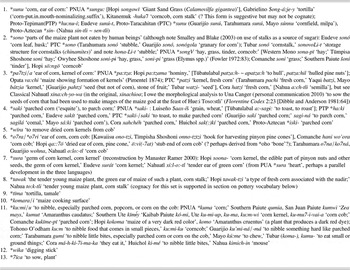
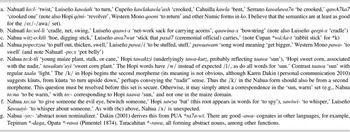
Table 1 shows the 13 items that have been reconstructed so far for the PUA maize vocabulary. I show full cognate sets only where new items have been added since the publication of 11 reconstructions in Hill (Reference Hill2001). Forms that are phonological cognates but with meanings outside the maize domain are in square brackets. See note on transcription and sources.
The PUA maize vocabulary

An important question about the items in Table 1 is the level of confidence with which we can reconstruct PUA meanings within the maize domain. Campbell (Reference Campbell, Bellwood and Renfrew2003) pointed out that lexical items that originally referred to non-maize items could have shifted to maize meanings independently in the daughter languages after the PUA breakup. Some evidence in Table 1 improves the case for reconstruction of a PUA maize lexicon. For instance, for the set in (3), Campbell (Reference Campbell, Bellwood and Renfrew2003:53) suggested that the meaning ‘seed of maize, kernel of maize’ might be a secondary development in the daughter languages, with the original meaning seen in those languages where the form is glossed as ‘seed, in general’ or ‘seed, but not of maize.’ However, the new Opata form in (3) adds another branch of the southern languages with a meaning clearly within the maize domain. In addition, it appears that the reflex could include the meaning ‘maize seed’ in Classical Nahuatl. Classical Nahuatl had a second word for ‘seed,’ xina:chtli, with the root appearing also in the word for human sperm, -xina:chyo:. I hypothesize that xina:ch- includes two elements: xin-, having to do with scattering and spraying (although Karttunen [1992] gives the verb ‘to sprinkle, to water something’ as xi:nia: with a long vowel), and a:ch-, the ‘seed’ word that is the reflex of PUA *pa7tzi/a (again, vowel length is an issue; in isolation the seed word exhibits a short vowel. However, Karttunen [1992:3] suggests that xina:chtli and achtli are probably related). A verb xina:chyowa, which Dibble and Anderson (Reference Dibble and Anderson1981:64) translate as ‘to scatter as seed,’ is attested in the Florentine Codex in a description of planting corn seeds taken from images of the maize gods. Ceremonial vocabulary is a known realm of archaism in Classical Nahuatl, and apparently in this vocabulary the morpheme a:ch- could be used within the maize domain. This finding, along with the new Opata form, strengthens the argument for reconstructing a PUA meaning that includes the sense of ‘maize kernel.’
Campbell (Reference Campbell, Bellwood and Renfrew2003) challenged the reconstruction of *sono ([2] above) in the cultivation domain, arguing that plant parts like stalks or canes, leaves, stubble, and cobs do not necessarily have to do with cultivated plants. However, in nearly all the languages it is clear that the reference is to parts of maize specifically. Maize exists only under cultivation. Stubble (rastrojo in the sources, the stubby canes that remain in the field after harvest) is a by-product of cultivation.
Campbell (Reference Campbell, Bellwood and Renfrew2003:52) correctly observed that it was ‘disturbing’ that nearly all of the cognates representing Northern Uto-Aztecan (NUA) in Hill (Reference Hill2001) came from Hopi. Following Manaster Ramer (Reference Manaster Ramer1992), I take NUA to be a valid branch of Uto-Aztecan (this argument is developed in Hill [2001, 2008a]). Technically, any single language within NUA should be able to stand for the whole. Nonetheless, data from across the sub-branches of NUA is preferable, and cognate forms have now been identified in two NUA languages of California, Gabrielino (in set [1]) and Luiseño (in set [4]), and possibly in a third language, Kitanemuk (in set [1]). The Gabrielino word $ong- in (1), modifying a word for ‘thing to eat’ to mean ‘tortilla,’ a food made of ground corn, is almost certainly in the maize domain, although the Gabrielino were not cultivators. Merrill et al. (Reference Merrill, Hard, Mabry, Fritz, Adams, Roney and MacWilliams2010) point out that Gabrielino's $ong- might be from a PUA root like *sïnV- insteand of *sunu (in Gabrielino, /u/ from PUA *u and /o/ from PUA *ï are not differentiated in unstressed syllables). However, no descendants of their hypothetical *sïnV- can be identified in any of the Takic languages in any remotely appropriate domain (the lexical slot with the expected phonological shape is filled by a verb meaning ‘to grin’ in Cahuilla and Cupeño, and the only UA word that I can identify that might reconstruct as *sïnV- means ‘snake’). $ong- almost certainly means ‘corn’ and is an excellent candidate for a reflex of PUA *sunu.
The Luiseño cognate in (4) means ‘grain, wheat’ within the domain of cultivated plants. While the meaning ‘wheat’ is obviously a late development, it may reflect an idea that grains of wheat looked like pieces of parched corn. Merrill et al. (Reference Merrill, Hard, Mabry, Fritz, Adams, Roney and MacWilliams2010) challenged this form, arguing that Luiseño /xi/ cannot come from PUA *ki and thus the word cannot be a reflex of PUA *saki. They are correct that the canonical account of the spirantization of PUA *k to Cupan /x/ requires a prior change of *k to /q/ before /a/. However, in Luiseño, massive analogical leveling has led to many sequences of /xi/ from PUA *ki. Luiseño verb roots in Elliott (Reference Elliott1999) show /x/ before both intransitive -a, in the expected spirantizing environment, but also before the transitive suffix -i. Unless we wish to argue unparsimoniously that Luiseño reinvented the well-known PUA transitivity contrast between transitive *a, and intransitive *i (Luiseño has reversed their values), this transitive suffix must be an inherited environment. A clear example showing Takic *k > /x/ before *i is Luiseño neexish ‘wild gourd’ where Kitanemuk, a language that never spirantizes /k/, has nonokich ‘wild gourd’ (Anderton Reference Anderton1988).
A new cognate in set (6), again clearly in the maize domain, comes from Comanche, a Numic language (see Hill [2003] for a discussion of Comanche maize vocabulary). In addition, cognate items in the domain of pine nut processing have been identified in Tübatulabal in set (3), parallel to the pine-nut domain cognates in (6) in Numic. An argument that the pine-nut domain meanings are due to secondary shift is presented in Hill (Reference Hill, Bellwood and Renfrew2003). Two new cognate pairs in maize-domain meanings in Hopi and Nahua are seen in (7) and (8).
In summary, Table I includes new evidence to support the reconstruction of a PUA maize vocabulary, and, consequently, the hypothesis that speakers of PUA were either cultivating maize or were in regular contact with such cultivators. The list of 13 items compares favorably with the size of the maize-complex vocabularies that can be reconstructed for protolanguages that are securely Mesoamerican in provenance (Hill Reference Hill, Staller, Tykot and Benz2006).
OTOMANGUEAN LOANS AS EVIDENCE FOR A MESOAMERICAN HOMELAND FOR PUA
Fowler (Reference Fowler1983:235) mapped the the PUA dialect chain to extend roughly as far south as the city of Chihuahua (see Figure 1), and calculated a date of 5,000 b.p. At that date the northernmost archaeological evidence for maize is in Oaxaca and southern Puebla, about a thousand miles south of the southernmost zone proposed by Fowler. While this is not a distance that would have precluded knowledge of maize cultivation, it is a degree of isolation from cultivators that would hardly have favored the development of a multi-item maize-domain vocabulary.
Fowler's Uto-Aztecan dialect chain and earliest maize sites (adapted from Fowler Reference Fowler1983:235, Figure 3). Reproduced by permission of the University of Chicago Press.

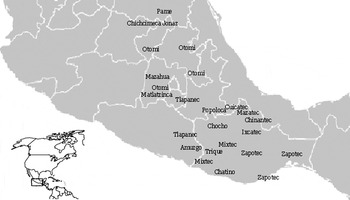
Fowler's date of 5,000 b.p. (derived from lexicostatistical estimates) may be simply too early. Archaeological maize with a radiocarbon date of ca. 2260 b.c. has been identified just outside the area on her map, at the Old Corn Site on Carrizo Wash south of Zuni Pueblo, and is fairly widespread in the region as far south and west as the Tucson Basin by ca. 2100 b.c. (Merrill et al. Reference Merrill, Hard, Mabry, Fritz, Adams, Roney and MacWilliams2010). The oldest archaeological maize within the PUA area on Fowler's map is from McEuen Cave near Safford, Arizona, with a date of ca. 2080 b.c. (Merrill et al. Reference Merrill, Hard, Mabry, Fritz, Adams, Roney and MacWilliams2010). Cerro Juanaqueña in northwestern Chihuahua, dated to 3330–2970 b.p. (Hard and Roney Reference Hard and Roney1998:1661), is also within Fowler's proposed dialect-chain region. I will argue below that a date near the end of the third millennium b.c. for the breakup of PUA is probably correct. At that date, a speech community within the area predicted by Fowler (Reference Fowler1983) could have acquired maize cultivation and a maize vocabulary. However, there is other evidence suggestive of a PUA homeland farther south, in the form of a suite of PUA vocabulary for maize and pottery that I believe to be borrowed from some Otomanguean language. The northernmost Otomanguean language historically is Chichimeco Jonaz, a member of the Pamean branch of the Oto-Pamean subgroup spoken in the Mexican states of Guanajuato and San Luis Potosi (see Figure 2 for a map of Otomanguean languages). But I will argue that the phonological properties of the PUA vocabulary for ‘maize’ and ‘pot’ suggest that it is unlikely that these loans, if loans they are, come from Oto-Pamean. Instead, they probably come from some variety or varieties of an earlier stage; Kaufman's (Reference Kaufman1990) proposed Proto-Oto-Chinantecan (POCh) is in the right place at the right time.
Otomanguean languages.
The argument for a suite of loans from POCh into PUA consists not of a claim of obvious resemblance between individual lexical items, but in the identification of a network of similarities across the two language families in the two domains of maize and pottery. These include a loose phonetic similarity across the languages, shared initial consonant alternations, and shared phonological resemblances with words in related domains—‘green, grass’ for maize and ‘excrement’ for pottery clay—that may reflect metaphors or similes common to the two communities. I will first review the evidence for an Otomanguean source for some items in the PUA maize vocabulary (initial presentation of this idea appears in Hill [2006, Reference Hill and Bengtson2008b]) and then turn to the pottery vocabulary.
The Case for Otomanguean Loan Words in the PUA Maize Vocabulary
Campbell (Reference Campbell, Campbell and Mithun1979:949) long ago suggested that the Aztecan form in (1) in Table 1 was a loan from some Otomanguean language. However, the evidence presented above supports a PUA provenance of this item. Thus if it is an Otomanguean loan it was borrowed into PUA itself. I argue here that it is indeed such a loan, and furthermore that this word was not the only Otomanguean loan in the PUA maize domain.
Three lines of evidence support the proposal that some PUA maize vocabulary is borrowed from an Otomanguean language. First, Proto-Otomanguean (POM) and PUA, uniquely among the Mesoamerican protolanguages, exhibit similarities between words for ‘maize’ and words for ‘green, grass.’ Second, these words are loosely resemblant across the two protolanguages. Finally, the words in both protolanguages exhibit initial-consonant doublets, with reconstructed words beginning in *s and *kw in POM, and *s and *k with a following labial element in PUA. In PUA, pottery (and the metaphorically related domain of ‘excrement, entrails’) is the only other vocabulary domain that exhibits such doublets. However, in POM such doublets occur in diverse domains.
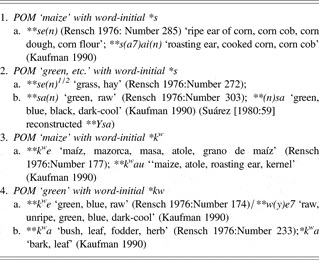
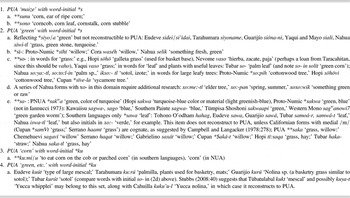
The POM words are shown in Table 2, and the PUA words appear in Table 3. Note that Rensch (Reference Rensch1976) and Kaufman (Reference Kaufman1990) do not reconstruct proto-meanings at the POM level. I list a representative sample of daughter-language glosses from Rensch, and all of those listed by Kaufman. Rensch's (1976) reconstructions include many variable nasalizing, glottalizing, and palatalizing elements that are reflected in some of the languages. I show only his invariable roots. Rensch's occasional reconstructions of tone are shown in superscript numbers. Kaufman (Reference Kaufman1990) does not include tone in his reconstructions. Finally, I do not argue that PUA borrowed maize vocabulary from POM itself, which is at least 2,000 years too early. I use the POM forms because there is no reconstruction of POCh, the stage that is the most likely source for PUA.
POM Words for ‘maize’ and ‘green’

PUA Words for ‘maize’ and ‘green’

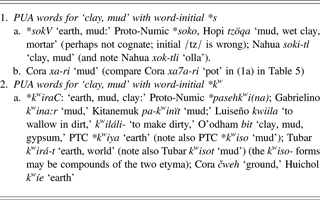
A peculiarity of the PUA words in Table 3 is the appearance of multiple initial *sV combinations. It seems likely that the two maize words *sunu (1) and *sono (2) in Table 1, and (1a) and (1b) in Table 3, are somehow related to each other. In the PUA words in the domain of ‘green,’ broadly understood, every single PUA vowel: *i, *ï, *u, *o, *a, appears in the various daughter languages following *s. I give the full bewildering system in Table 3, with an attempt to sort the items into preliminary groups. If the hypothesis that some of these are loans holds up, it may be that this diversity represents borrowing into different dialects, at different times, creating diversity in PUA.
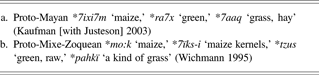
The first point of parallelism between the two proto-languages that can be seen in Tables 2 and 3 is that in both the words for ‘maize’ and words for ‘green, grass, leaf, raw’ and related domains such as leafy trees are phonetically similar (within each initial-consonant set). No other Mesoamerican proto-languages exhibit such similarities. Compare the POM and PUA words for ‘maize’ and ‘green, grass, etc.’ in Tables 2 and 3 with the items in Table 4, where we find no phonological resemblance for words with these meanings.
‘Maize,’ ‘Green,’ ‘Grass’ in Proto-Mayan and Proto-Mixe-Zoquean
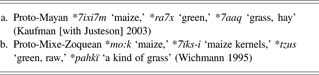
There may be an exception. Tequistlateco (Oaxacan Chontal), generally considered to be a language isolate, does have the sequence xk in two of its maize words and in the word for ‘green;’ Tequistlateco -uxak ‘corncob,’ -xkuh ‘tortilla,’ uxkua ‘green,’ -bajac ‘grass’ (Turner and Turner Reference Turner and Turner1971).
Taube (Reference Taube, Clark and Pye2000) identified an iconographic association between maize and precious green objects, such as jade and quetzal feathers, in Mesoamerican art in all regions from the Olmec period forward. The phonetic similarities between ‘maize’ and ‘green’ noted above for Otomanguean suggest that the origin of this association may trace to ideological developments in early Otomanguean communities, which were borrowed by speakers of PUA. Note that Hopkins (Reference Hopkins, Staller, Tykot and Benz2006), following Brown (Reference Brown1977) suggested that the path of semantic change was probably not ‘grass’ > ‘maize’ (yielding a coincidence of an association between ‘green’ and ‘maize’), because the life-form term ‘grass’ appears late in the evolution of vernacular taxonomies and appears to postdate maize in Mesoamerican languages.
The second point of parallelism is phonetic resemblances among individual items across the two proto-languages. Phonetic resemblances include the match of initial consonant *s and a final nasal in the words for ‘corn’ with initial *s. I suggest that initial PUA *ku is a resemblant match to POM *kw. The vowels do not match. These resemblances are weak and cannot alone support the case for loans from POM into PUA. The possibility of chance resemblance is elevated by the fact that the POM reconstructions all consist only of single syllables. Furthermore, Rensch (Reference Rensch1976) reconstructs only seven onset consonants for POM (**t, **k, **kw, **s, **n, **w, **y), raising the likelihood of accidental matches. However, for the items that concern us, the match of initial consonants also can be seen with Kaufman's (Reference Kaufman1990) reconstructions, based on his more realistic POM system of 16 consonants (except in [4a] in Table 2, where Kaufman reconstructs *w, not *kw). Also, as I noted above, the weak similarities of the PUA words with POM may be due to the fact that this is not the right stage of the development of Otomanguean. Hopkins (Reference Hopkins, Josserand, Winter and Hopins1984) and Kaufman (Reference Kaufman1990) date POM to the end of the seventh millennium b.c. While I use the POM reconstructions here for lack of an alternative, the PUA loanwords are surely from a much later daughter stage, probably POCh, for which no reconstruction has been published. Finally, the loan of words for ‘maize’ is a historically likely one. There is general agreement that Otomanguean-speaking peoples were cultivators from the earliest stages of the development of the group, and may be the descendants of the earliest Mesoamerican cultivators (e.g., Hopkins Reference Hopkins, Josserand, Winter and Hopins1984; Kaufman Reference Kaufman1990). Lastra de Suárez (Reference Lastra de Suárez2006) argues persuasively that one hunter-gatherer Otomanguean group, the Chichimeca-Jonaz, were former cultivators who had abandoned that practice. If PUA speakers acquired maize vocabulary by borrowing—and the borrowing of words for novel cultigens is extremely common around the world—some Otomanguean language is the most probable source.
The third point of parallelism is the presence of very similar initial-consonant doublets in both protolanguages. Doublets of this type, with *s and *ku (and *k, *kw in the pottery words) appear in PUA only in words in the domains of ‘maize,’ ‘green/leaf/grass,’ and, as we shall see below, ‘pottery,’ ‘mud,’ and related ‘excrement, entrails.’ In contrast, such alternations of initial consonants (*s~*kw is one of several types) appear in OM languages in several families, and are reconstructed by Rensch (Reference Rensch1976) for POM. Rensch (Reference Rensch1976) cites work by Bartholomew (Reference Bascom1965) for Otopamean, Gudschinsky (Reference Gudschinsky1959) for Popolocan and Mixtecan (‘Popotecan’), and Longacre (Reference Longacre1957) for Mixtecan, all of whom found initial consonant doublets. Suárez Reference Suárez1980 also reconstructed such doublets. Rensch (Reference Rensch1976:335, Note 14) suggests that while some of the OM initial consonant alternations are the residue of old phonological processes, the *s/*kw alternation specifically ‘probably developed from an old morphological system of replacement.’ The *s/*kw doublet is clearly attested in Chinantecan (Rensch Reference Rensch1976:336, Note 14; see also forms in Kaufman Reference Kaufman1990:103; Rensch Reference Rensch1989. Note that Kaufman does not agree with the theory of consonant alternations). However, the POM *s/*kw doublet is not preserved in Proto-Oto-Pamean or its daughter languages (Bartholomew Reference Bascom1965). Thus it is unlikely that the PUA loanwords come from Oto-Pamean, the northwestern-most Otomanguean family. Instead, Kaufman's ‘Proto-Oto-Chinantecan’ (POCh), a branch of his Western Otomanguean, is a more likely source. Kaufman (Reference Kaufman1990:95), based on ‘very approximate lexicostatistic calibration,’ dates the breakup of POCh at 4,000 years ago, and locates this group in the central highlands from the Valleys of Mexico and Toluca southeast to the Valley of Morelos, with the earliest stages of Otomian forming as far north and west as Queretaro (Kaufman Reference Kaufman1990:130). The flora and fauna of the highlands in this area match that reconstructed by Fowler (Reference Fowler1983). Furthermore, Kaufman's date for POCh fits well with the evidence of the pottery vocabulary, to which I now turn.
The Case for Otomanguean Loan Words in the PUA Pottery Vocabulary
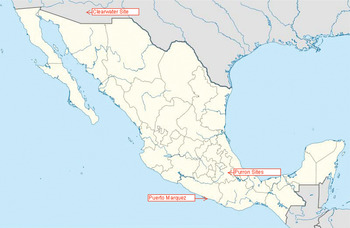
The notion of ‘resemblance’ in loan vocabulary is not as tightly defined as is the concept of ‘cognacy’ in the Comparative Method. To reduce the possibility that resemblances are due to chance, it is useful to constrain the search for these by applying a priori models of what kind of vocabulary is likely to be borrowed. Labels for cultural innovations that are unfamiliar to speakers of the target language are of course especially likely to be diffused. Maize, in the case of hunter-gatherer/cultivator contact in the Americas, is one such domain, and pottery is another. The discovery of pottery dated to 2100 b.c. at the Clearwater Site in the Tucson Basin (Heidke Reference Heidke, Thiel and Mabry2006) suggested a search for a PUA pottery vocabulary and for possible loan words in this domain (see Figure 3 for a map of early pottery sites). This site lies squarely in the corridor where the earliest maize north of Mesoamerica has been identified, and is also within the area inhabited by Uto-Aztecan cultivators in the historic period.
Earliest ceramic sites in Mexico and American Southwest.

The archaeological remains of pottery at the Clearwater Site consist of fragments of small human figurines (Stinson Reference Stinson, Thiel and Mabry2006) and sherds from small vessels of uncertain function that might have been used for single servings of a beverage or for holding incense or other offerings (Heidke Reference Heidke, Thiel and Mabry2006). Heidke suggested that the pottery was not in everyday use since very few sherds were found (they came from six different vessels). The pottery is of a very basic type, made of untempered alluvial clay and fired at a relatively low temperature. A tradition of plain wares continues in the Tucson Basin throughout the prehistoric period after this date, and all Uto-Aztecan speaking peoples made and used pottery in the historic period. While Sutton (Reference Sutton2009) points out that pottery is only attested archaeologically after 1300 b.p. in Southern California, the Cupan languages spoken in this region exhibit a pottery vocabulary that I argue reflects a PUA origin.
The earliest date anyone has claimed for pottery in Mexico is from the site of Puerto Marquez on the coast of Guerrero at 4400 b.p. (Brush Reference Brush1965).While Clark and Gosser (Reference Clark, Gosser, Barnett and Hoopes1995) dispute Brush's date as too early; the dating of the Tucson Basin sherds to 4100 b.p. supports the early date. These dates are close to Kaufman's rough lexicostatistic dates (4500–4000 b.p.) for POCh, a possible source for the PUA pottery vocabulary.
The earliest archaeological evidence of pottery in the Mexican highlands, in the Purron phase in the Tehuacan Valley, is in an area inhabited today by Mixtecan-speaking Otomanguean descendants, and probably within Otomanguean territory since the earliest stages of the language family (Hopkins Reference Hopkins, Josserand, Winter and Hopins1984; Kaufman Reference Kaufman1990). The Puerto Marquez site is also in an area where Otomanguean languages were spoken historically. Thus an Otomanguean language is a reasonable source for pottery vocabulary in PUA.
In this section, I propose PUA reconstructions in the domain of pottery. I then compare the reconstructed forms with POM vocabulary items for which words in OM daughter languages have meanings in the pottery domain (in POM itself the items reconstructed by Rensch (Reference Rensch1976) and Kaufman (Reference Kaufman1990) cannot have referred to pottery, since POM is at least two thousand years too early). These display the same type of systematic resemblances to the PUA vocabulary that we have seen for maize: a metaphoric resemblance between ‘clay’ and ‘excrement’ that is visible phonologically, a weak phonetic resemblance between the words of similar meanings across the two languages (in this case, the resemblances are actually more compelling than they are for the maize vocabulary), similarities between words for ‘pot’ and words for ‘mud, clay’ found in both languages, and the presence of initial-consonant doublets, including *s/*kw alternations in the POM vocabulary and *s/*k ~ *kw in PUA.
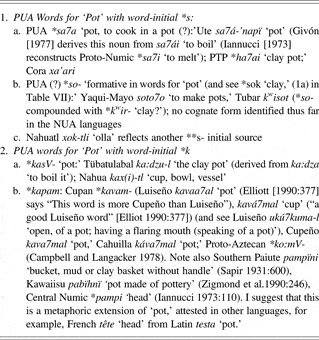
The PUA words for ‘pot’ with the supporting cognate sets are shown in Table 5. Two of the words in Table 5, (1a) and (2a), appear to be derived from words for ‘to boil.’ Thus these nominalizations might originally have referred to a container used for stone boiling, acquiring the meaning ‘pot’ independently in the daughter languages after the diffusion of pottery. The item in (1b) is also weak evidence for PUA pottery, since only the *so- syllable can be identified. These words may be derived from words for ‘clay, mud’ (seen in [1a] in Table 8). Given the possible derivational origin of these three items (although, as we shall see, they look like Otomanguean forms), the proposed etymology in (2b) in Table 5 is crucial to the argument that a word for ‘pottery,’ implying a knowledge of the craft or contact with groups with such knowledge, was present in PUA. Miller (Reference Miller1988) and Stubbs (Reference Stubbs2008) tentatively assigned the Aztecan form as a member of sets in /kom/ having to do with ‘back, turtle,’ on the theory that turtle shells might have been used as containers. However, the semantics of the etymology proposed here are more transparent, and I will demonstrate here that the correspondence suggested in (2b) in Table 5 is a regular one.
PUA Words for ‘Pot’

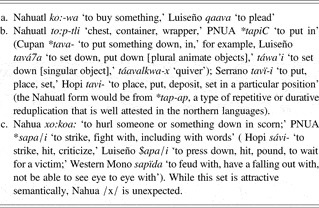
Reconstructing Proto-Cupan *kavam- requires, first, internal reconstruction of the final -m. In Cupeño and Cahuilla, the sequence /7m/ seen in the Cupan words derives regularly from /mm/. The second /m/ in these languages begins a diminutive suffix -ma-l. The medial /v/ in the Cupan words is a regular reflex of PUA *p, spirantized between vowels. The initial /k/ and final /m/ correspond in Cupan and Aztecan. The key issue is whether Aztecan /o:/ is a regular development of PUA*-apa- It turns out that other sets, shown in Table 6, exhibit precisely this correspondence. This is a new source for Aztecan *o:. Sources previously proposed for Aztecan /o:/ include the following: PUA *apo/u (e.g., PUA *naaput, Nahua no:ch-tli ‘nopal,’ PUA *taapun, Nahua to:ch-tli ‘cottontail rabbit’); PUA *oC, (e.g., *koNwa ‘snake, rattlesnake,’ Nahua ko:wa-tl, PUA *kon- ‘jewel, shell,’ Nahua ko:ska-tl ‘jewel, necklace,’ PUA *woh ‘two,’ Nahua o:-me, PUA *pohN- ‘fur, body hair,’ for which I propose Nahua po:-c-, -po:-ch- in ichpo:chtli ‘maiden,’), telpo:chtli ‘youth,’ ichpo:ca-tl ‘maiden,’ telpo:ca-tl ‘youth.’ One example of PUA *oho yields Nahua /o:/. This is PUA *ohotsi- ‘to be pregnant,’ Nahua o:ts-tia: (the northern cognate, an addition to the PUA *-ts- >NUA *-y- correspondence set established by Manaster Ramer [1992], is Hopi ööyiwta ‘to be pregnant’). For the new source for Aztecan *o:, PUA *apa, in Table 6 I show two cognate sets with reflexes in the northern languages and in Classical Nahuatl.
PUA *apa > Nahuatl /o:/

Since PUA *p becomes /w/ intervocalically in the southern languages, the contrast between PUA *VpV and *VwV is lost. Thus the sequence of sound changes yielding the Nahua forms is *apa > *awa > /o:/. Examples that may reflect Nahuatl /o:/ from PUA *awa are seen in Table 7.
PUA *awa > Nahuatl /o:/

As is evident from the doublets in Table 7 (a and b), there are derivational complexities and alternative cognacies that require attention. The Southern Numic (Kawaiisu and Southern Paiute) words for ‘pot’ in Table 5 (2b) raise the possibility that PUA *kapam is an old compound, *ka-pam. However, I would argue that we have enough evidence to propose that PUA *-apa- > *-awa- can indeed be a source for Nahuatl /o:/, supporting the etymology in (2b) in Table 5.
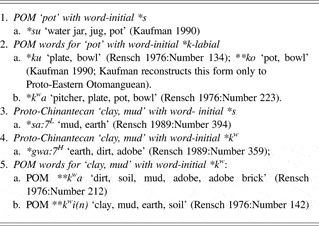
In Table 8, I show reconstructed PUA words for ‘mud, clay.’ Such words of course need not have anything to do with ceramics. However, when we turn to the Otomanguean forms below, we will see that they are candidates for loans from Otomanguean, and it is unlikely that ordinary words for ‘mud’ would have been borrowed. Hence I suggest that in PUA these forms had central meanings in the pottery domain. In these words, we see *s/*kw doublets, similar to the PUA ‘pot’ words, and suggestive of Otomanguean origin as discussed for the maize-complex words. We also can see a resemblance between the words for ‘clay’ in (1a) and the words for ‘pot’ with initial *so- in Table 5 (1b).
PUA words for ‘clay, mud’
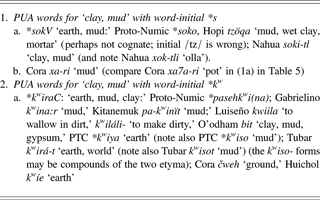
We can now compare the PUA words for ‘pot’ and ‘clay, mud’ with the POM forms shown in Table 9. These show the *s/k-plus-labial (here sometimes reflected in the vowels *u and *o) alternations, and resemble the PUA forms—again, with the cautionary note that these resemblances alone might be due to chance for the reasons discussed above for the maize vocabulary. As with the maize vocabulary, the claim of a meaningful resemblance between the two protolanguages is based on multiple parallelisms and not simply on phonetic similarity. In Table 9, I show in (3) and (4) forms from Rensch's reconstruction of Proto-Chinantecan. These show with particular clarity the *s/*kw doublet, and may attest to the Proto-Oto-Chinantecan forms that are a likely source of the PUA words. Neither Rensch nor Kaufman reconstruct a ‘mud’ word with initial *s to the POM level, but the Proto-Chinantecan forms suggest that such a word might have existed.
POM words for ‘pot’ and ‘clay, mud’

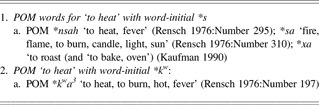
Recall that in POM these words could not have meant ‘pot,’ because there were no pots at that time. They may have referred to some other kind of container, or perhaps to the process of cooking itself. Rensch has identified distinct POM *sa/*kwa words for ‘to heat,’ shown in Table 10. Words involving sa- for ‘heat’ are widespread. Campbell and Langacker (Reference Campbell and Langacker1978:268) proposed that Proto-Mixe-Zoque *sam- ‘to heat something’ was the source of a loan into the southern languages, a set of words for ‘adobe’ (Tohono ‘Oodham $a:mt ‘adobe,’ PTC *sami ‘adobe,’ Cora ša:mi ‘adobe brick,’ Nahuatl xa:mi-tl ‘adobe’). This loan clearly post-dates the formation of Proto-Tepiman, since PUA *s becomes /h/ in that branch. In contrast, the Tepiman word for ‘pot’ in Table 5 (1a) shows the regular development.
POM ‘heat, cook’

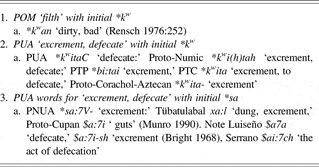
In addition to the intersecting resemblances presented above, both PUA and POM exhibit a resemblance between words for ‘clay, mud’ and words for ‘excrement’ and ‘entrails.’ No other Mesoamerican language family has such a resemblance; compare the Proto-Mayan reconstructions *laq ‘plate, dish, cooking vessel;’ *lo:q.oq ‘mud’ (these two perhaps related) with unresemblant Proto-Mayan *tzaa7, *taa7 ‘shit’ (Kaufman [with Justeson] Reference Kaufman and Justeson2003). Words for ‘pottery’ do not appear to reconstruct to Proto-Mixe-Zoquean (Wichmann Reference Wichmann1995). Rensch (Reference Rensch1976:252) points out the similarity between his reconstruction *k wan ‘dirty, bad’ and his reconstruction **k wa ‘dirt, etc.’ (Table 9, 5a). The POM and PUA words for ‘excrement,’ ‘entrails,’ etc. are shown in Table 11.
POM and PUA words for ‘excrement,’ ‘filth’

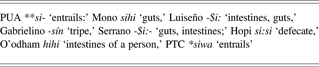
PUA words for ‘defecate, entrails’ in *si
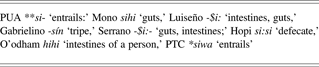
Finally, Table 12, shows a set of PUA items that does not resemble anything in POM. However, *si might be a doublet with PUA *k wi in ‘excrement, defecate.’
The reason for the similarities between the words for ‘mud, clay’ and ‘excrement,’ and, in turn, ‘guts, entrails,’ if the similarities are indeed meaningful and not due to chance, probably cannot be known. However, several possibilities suggest themselves. ‘Excrement’ and ‘mud, clay’ are both smeary dark-colored substances. The Incipient Plain Ware of the Tucson Basin and other early wares are all built on coils, which may have been thought to resemble the shape of healthy human excrement. Yet another possibility is that within the system of body-part metaphors that is very widespread in Mesoamerica (Hollenbach Reference Hollenbach, Cuarón and Levy1990; MacLaury Reference MacLaury1989), pots have ‘bellies.’ Something inside a pot is considered to be ‘in the belly,’ like intestines and their contents. Pots also have ‘bottoms,’ often with the same word as that for human ‘buttocks, butt.’ Since the construction of a coiled pot begins in the center of the base, the process of construction may have been considered to be like the excretion of feces.
In summary, we can reconstruct to PUA at least one word with the primary meaning of ‘pot,’ and three other words that may be derivations, but that have that meaning in languages in more than one major branch of UA. The PUA words for ‘pot’ exhibit *s/k doublets. The words for ‘mud’ exhibit *s/kw doublets. These words resemble the vocabulary for ‘pot’ and ‘mud’ reconstructed for POM, which also have *s/kw doublets. Finally, in both languages, the words for ‘mud, clay’ resemble words for ‘excrement, entrails,’ which in PUA show *s/kw alternations. This network of resemblances, which is similar to the network of resemblances in the PUA and POM ‘maize,’ ‘green,’ ‘grass’ vocabulary, is consistent with a hypothesis of language contact between PUA and some stage of the development of OM, which I have suggested is most likely to be Kaufman's (Reference Kaufman1990) Proto-Oto-Chinantecan.
The proposed reconstruction of PUA ‘pot’ has important implications for dating. In the areas proposed for PUA homelands, the earliest dates proposed for pottery are from 4400 to 4100 b.p. Of course the earliest date may be pushed back by new finds. But if these are indeed the correct dates for the earliest pottery in central and western Mexico, then the breakup of PUA into its daughter languages probably did not take place before this time. This is a much later date than those proposed for the language family by Fowler (Reference Fowler1983) or Miller (Reference Miller, Ortiz and Sturtvant1983), although not too much later than Hale's (Reference Hale1958, Reference Hale1959) lexicostatistic date of about 4800 b.p. If PUA lasted as late as the end of the third millennium or the beginning of the second millennium b.c., then UA speakers could not have been in California at that time, contra suggestions by a number of archaeologists (see Sutton Reference Sutton2009). However, this date is consistent with the idea that the early cultivators in southeastern and south central Arizona just before 4000 b.p., and the earliest cultivators on the Colorado Plateau by about 3500 b.p., could have been UA speakers, as suggested in Hill (Reference Hill, Bellwood and Renfrew2003, Reference Hill2008a). It is also consistent with Kaufman's rough lexicostatistical estimates for the dates of Proto-Oto-Chinantecan.
CONCLUSION
The present paper has summarized evidence accumulating in favor of the hypothesis that the PUA speech community included cultivators and was located in the northwest quadrant of Mesoamerica, perhaps as far south as Queretaro or even Toluca, in contact with speakers of at least one Otomanguean language, probably Proto-Oto-Chinantecan. The pottery vocabulary suggests that this contact was probably under way during the last few centuries of the third millennium b.c. However, an alternative possibility must be raised, that Fowler (Reference Fowler1983) and Romney (Reference Romney1957) were correct to locate PUA in the Gila River uplands, and that the contact with an Otomanguean language that I propose here took place along the southern edges of that zone. This would require that we assume a period of expansion of Otomanguean-speaking peoples, at a fairly early stage of the differentiation of the Otomanguean languages, far beyond their historically attested territories. The attested UA distribution would then represent a UA expansion to the south, and a retreat, perhaps in response to the UA expansion, of Otomangueans to their present northern limits in Guanajuato and San Luis Potosi. This possibility, which is consistent with a long history of proposals that the UA corridor in western Mexico attests to a southward expansion from the American Southwest, should be tested archaeologically. However, I have framed my hypotheses in terms of a model in which, in response to the ameliorating climate at the end of the third millennium, there was a northward expansion by both UA speakers and speakers of early stages of Oto-Pamean.
RESUMEN
Propongo la hipótesis de que el país natal de la comunidad proto-yuto-azteca se encontraba en la región noroeste de Mesoamérica, y que la comunidad de hablantes incluía por lo menos algunos agricultores de maíz. Presento tres líneas de argumentación. En primer lugar, muestro nuevas palabras cognadas en el juego de 13 palabras reconstruidas al nivel proto-yuto-azteco en el dominio semántico de maíz, incluyendo palabras en las lenguas yuto-aztecas de California. En segundo lugar, sugiero que algunas de las palabras reconstruidas son préstamos de un idioma de una etapa temprana de la familia otomangueana, posiblemente el proto-oto-chinanteco sugerido por Kaufman. En tercer lugar, presento un juego de palabras reconstruidas al nivel proto-yuto-azteco en el dominio semántico de la cerámica, y sugiero que aquellas palabras también son préstamos de un idioma otomangueano. En los dos dominios (maíz y cerámica), las palabras proto-yuto-aztecas y las palabras proto-otomangueanas reportan semejanzas incluyendo alternaciones consonánticas (probablemente de origen otomangueano). En los dos dominios, los dos proto-idiomas presentan semejanzas con palabras reconstruidas en dominios relacionados: para el maíz, el color verde y el dominio de hierbas y hojas, y para las palabras para ‘lodo, barro’ en el dominio de cerámica, el excremento. Finalmente, la reconstrucción de una palabra para ‘vasija de cerámica’ nos permite argumentar que el idioma proto-yuto-azteca se mantuvo como una unidad hasta no antes del periodo 2440 a.C. (datación por radiocarbono de la cerámica ‘Pox’ en Puerto Marquez, Guerrero) –2100 a.C. (datación por radiocarbono de la cerámica en el sitio ‘Clearwater’ en la cuenca de Tucson, Arizona), fechas propuestas de los inicios de la presencia de la cerámica en México y el suroeste de los Estados Unidos.
Note on Transcription and Sources
To avoid problems of font compatibility, I use here the transcription system developed by Terrence Kaufman for Mesoamerican indigenous languages. Original sources should be checked for transcription details. Symbols include /7/ ‘glottal stop,’ /tz/ for phonetic [c], /ch/ for phonetic [tʃ], /j/ for phonetic [x], /x/ for phonetic [ʃ]. I add /$/ for retroflex /s/ in the California languages. The central vowel (usually high in UA languages) is written /ï/. Sources for language data are as follows, unless otherwise noted: Proto-Numic: Iannucci (Reference Iannucci1973); Western Mono: Bethel et al. (Reference Bethel, Kroskrity, Loether and Rinehardt1993); Tümpisa Shoshoe/Panamint: Dayley (Reference Dayley1989); Comanche: Robinson and Armagost (Reference Robinson and Armagost1990); Kawaiisu: Zigmond et al. (Reference Zigmond, Booth and Munro1990); Chemehuevi: Press (Reference Press1979); Southern Paiute: Sapir (Reference Sapir1931); Ute: Givón (Reference Givón1979); Hopi: Hopi Dictionary Project (1998); Tübatulabal: Voegelin (Reference Voegelin1958); Serrano: Hill (Reference Hill2001); Kitanemuk: Anderton (Reference Anderton1988); Cahuilla: Seiler and Hioki (Reference Seiler and Hioki1979); Luiseño: Elliott (Reference Elliott1999); Cupeño: Hill and Nolasquez (Reference Hill and Nolasquez1973); Proto-Cupan: Munro (Reference Munro1990); Gabrielino: Harrington (Reference Harrington1907–1959); Tohono O'odham: Saxton et al. (Reference Saxton, Saxton and Enos1983); Proto-Tepiman: Bascom (Reference Bascom1965); Eudeve: Lionnet (Reference Lionnet1986); Tubar: Lionnet (Reference Lionnet1978); Yaqui: Molina et al. (Reference Molina, Valenzuela and Shaul1999); Mayo: Collard and Collard (Reference Collard and Collard1984); Guarijío: Miller (Reference Miller1996); Tarahumara: Brambila (Reference Brambila1976); Cora: McMahon and Aiton de McMahon (Reference McMahon and de McMahon1959); Huichol: Grimes et al. (Reference Grimes, de la Cruz Avila, Vicente, Díaz, Díaz, de la Rosa and Rentería1981); Nahuatl: Karttunen (Reference Karttunen1992).