


INTRODUCTION
In recent years, East Asia has seen momentous changes, including China's rise, progress in North Korea's nuclear program, increased uncertainty about US alliances, and the revival of historical disputes. Many observers argue that such changes are eroding Japan's longtime national security restraint. Indeed, conservative Prime Minister Shinzo Abe—who famously declared: “Japan is back” (Abe Reference Abe2013)—resuscitated flagging defense spending with 10 percent increases, reinterpreted the constitution to facilitate the dispatch of the Self-Defense Forces overseas, and continued to seek constitutional revision: discarding numerous postwar constraints on Japanese security policy (Rich Reference Rich2017; Moritsugu Reference Moritsugu2015). These changes have led some observers to proclaim Japan's “abandonment of pacifism” or “push toward militarization” (Ripley Reference Ripley2015; New York Times 2014). In China and South Korea, commentators characterize Japanese conservatives as seeking to “revive [Japan's] military glory” (China Daily 2015a; China Daily 2015b; Kim Reference Kim2013).
Furthermore, observers also see significant changes afoot in Japanese national identity. “Tensions in Asia,” as the Wall Street Journal (2014) argued, “Stoke Rising Nationalism in Japan.” Abe (Reference Abe2006) sought to cultivate national pride in what he called “beautiful Japan.” But many observers characterized this as “dangerous revisionism.” Critics characterized the prime minister as “a fervent nationalist who has pledged to ‘restore Japan's honour’” (Morris-Suzuki Reference Morris-Suzuki2015), and argued that Abe “stoked a patriotic fervor” (Estévez-Abe Reference Estévez-Abe2014). Japan's rising nationalism, observers note, is apparent in the Japanese public's “apology fatigue” toward South Korea (Kazianis Reference Kazianis2019; Kingston Reference Kingston2015). Abe's tenure empowered an increasingly active and influential political right, some commentators warn, that is orchestrating a “rightward shift in mood” (Rich Reference Rich2017; also Sugano Reference Sugano2016; Kingston Reference Kingston2016b; Nakano Reference Nakano and Kingston2016a, Reference Nakano, Mullins and Nakano2016b, Reference Nakano2015; Morris-Suzuki Reference Morris-Suzuki2015; Nihon Saiken Inishachibu 2015). Given that Abe's resignation was accompanied by praise for his many achievements—and that so far his party appears committed to staying the course Abe charted—a “leftward shift” seems unlikely.
Is Japan “back”: shedding its post-World War II “pacifist” identity and highly restrained national security policy, in favor of stronger nationalism and greater military assertiveness? Answering these questions is important, first because it's important to understand whether in Asia—expected to be the locus of future great-power competition (Friedberg Reference Friedberg2015; Mearsheimer Reference Mearsheimer2014)—a major power is experiencing this kind of sea-change. A more nationalistic Japan would be more likely to initiate or take a hard line in territorial or historical disputes with its neighbors, and to exacerbate regional security dilemmas (Christensen Reference Christensen1999). A more militarily assertive Japan—one willing to participate more actively in a balancing coalition against China—would affect the regional balance of power and the stability of deterrence. Understanding to what extent Japan's national security orientation is changing is particularly important for Washington, as US–China relations grow more competitive, and as US leaders encourage a political or even military coalition in response to growing Chinese power (Ratner, et. al. 2020; Gholz, Friedman, and Gjoza Reference Gholz, Friedman and Gjoza2019; Beckley Reference Beckley2017).
While the significance of Japan's “militarization” and “rising nationalism” is quite clear, it's less clear what those words actually mean—and to what extent such trends are actually occurring. After all, while some observers describe a nationalist, increasingly militarist Japan breaking out of its post-World War II malaise, others (notably in US grand strategy debates) characterize Japan as an unusually restrained ally that Washington has been prodding, without much success, to balance China more actively (Gholz, Friedman, and Gjoza Reference Gholz, Friedman and Gjoza2019; Posen Reference Posen2014; Preble Reference Preble2011). Commentators discussing Japan's “rising nationalism” or more “muscular” military posture often use language loosely, without defining these terms or providing empirical evidence for such claims. Before we can conclude that Japan is experiencing dramatic changes in its national identity or security posture, it is essential to clarify what “nationalism” and “military assertiveness” actually mean. It is also essential to clarify what “rising” means: Japan's nationalism and military assertiveness might be growing relative to Japan's own previous behavior—or relative to other countries.
This article contributes to this debate in several ways. (1) We define and operationalize “nationalism.” We draw from social identity theory to argue that debates about Japanese nationalism conflate a more benign “patriotism” with a more dangerous “nationalism”; we contribute to debates about Japan by making this important distinction. (2) We create metrics for measuring national identity that include public opinion and leader's statements. (3) We rely on longitudinal poll data, and also introduce new data from leaders’ annual speeches since 1960, to measure Japanese national identity over time. Additionally, we use similar data from seven other countries to (4) compare Japanese national identity across space: to assess (if indeed Japanese nationalism is rising), whether it is rising at levels unusual in the international system.
We take a similar approach with respect to Japanese “military assertiveness.” (5) We define “military assertiveness” as the extent to which a country mobilizes and projects military power. We then (6) create several metrics for measuring this from Japanese policy and public opinion, such as military expenditure, overseas military operations, and so forth. Using data from these metrics, we (7) measure Japanese military assertiveness over time. Furthermore, (8) we compare Japan's military assertiveness to that of seven other countries. In short, we define and measure Japanese nationalism and military assertiveness across both time and space.
Two sets of findings emerge. First, we find that Japan's military assertiveness remains consistently low according to some indicators (defense budget and size of military) but has grown in other ways (with the weakening of institutional constraints and the overseas dispatch of peacekeepers). These changes have been very gradual over time and started from a very low baseline. Importantly, however, the cross-case comparison shows that Japan remains the least assertive of the comparison countries.
Second, we find that Japanese national identity has been generally stable over time. We find that poll data show a consistently high level of what social identity theorists call patriotism (national connectedness and pride). We find some indication of what scholars call nationalism—but no evidence that it is rising over time. Furthermore, quite the opposite of what scholars see as nationalism, Japan exhibits growing self-criticism and empathy toward other countries.
These findings have important implications for both political science and for foreign policy. Social identity theorists have usefully distinguished between nationalism and patriotism (for example, Powers Reference Powers2018; De Figueiredo and Elkins Reference De Figueiredo and Elkins2003), noting that patriotism is not associated with increased risk of conflict. Our findings show that this distinction is essential for debates about Japan—and East Asia more broadly, where nationalism is frequently described as on the rise (Wang and Qin Reference Wang and Qin2020).
In fact, our findings suggest the need for even further conceptual nuance. The social identity literature currently views a “preference” for one's country as evidence of the more toxic nationalism. However, our findings suggest that people can prefer their country to others absent denigration and thus absent its pernicious effects. In other words, scholars should explore whether the field is currently lumping together a benign concept (preference for one's country) with a malign one (denigration). In order to determine whether or not the malign one is driving the empirical result of increased risk of conflict, further conceptual nuance and more empirical testing are needed by national identity scholars.
This article suggests that scholars and policy makers need to examine why these findings differ so significantly from a prominent zeitgeist about Japan. In some cases, the dispute is among scholars who have different ways of conceptualizing and measuring nationalism and thus reach different conclusions. In such situations, the way forward is continued research and debate. But another factor is that in some countries, particularly China, leaders accuse Japan of far-right extremism or militarism to cultivate domestic political support, or to undermine regional balancing efforts. Rather than being taken at face value, such accusations should be understood to be strategically motivated. Such was the case during the Cold War, when the Soviet Union spread the narrative that West Germany was dominated by fascists intent on German revanchism (Trachtenberg Reference Trachtenberg1999).
Indeed, just as the United States did not allow such talk to stand in the way of security cooperation with West Germany then, Washington should not allow such talk to prevent security cooperation with Japan today. Our findings suggest that fears about Japan's nationalist resurgence are unfounded. If Japan could be convinced to be a more active regional partner, it would be a responsible one.
DEBATING JAPAN'S RETURN TO “NORMALCY”
Since World War II, Japan has pursued a highly restrained security policy, and public attitudes, described as “pacifist,” have been highly skittish about military statecraft (Berger Reference Berger1998; Chai Reference Chai1997). Scholars have long debated about whether and when Japan would start to behave as a “normal” country (Soeya, Welch, and Tadokoro Reference Soeya, Welch and Tadokoro2011; Lind Reference Lind2004; Inoguchi Reference Inoguchi1993). In this debate, scholars have examined changes in Japanese national identity and security policy.
First, scholars study different conceptions of Japanese national identity and its evolution over time.Footnote 1 Numerous works focus on Japan's collective memory of World War II (Berger Reference Berger2012; He Reference He2009; Orr Reference Orr2001; Oguma Reference Oguma2002; Shirai Reference Shirai2014). Within this debate, some scholars claim (or dispute) that Japan's nationalism is experiencing a rightward “tilt” or “shift” (Estévez-Abe Reference Estévez-Abe2014; Kingston Reference Kingston2016b; Nakano Reference Nakano and Kingston2016a, Reference Nakano, Mullins and Nakano2016b, Reference Nakano2015; Nihon Saiken Inishachibu 2015). Nakano (Reference Nakano and Kingston2016a), for example, points to an “illiberal, authoritarian turn in contemporary nationalism.” Our article contributes to debates about Japanese nationalism by operationalizing the concept, measuring it across time and space, and introducing new data (leaders’ speeches). Drawing upon social identity theory, we also contribute to the debate by distinguishing nationalism from patriotism, a distinction that we argue is vital for advancing the debate about Japanese identity (Machida Reference Machida2017; Karasawa Reference Karasawa2002).
Second, the debate about Japan's return to “normalcy” also connects to security studies literature about Japan's national security policy. Scholars have debated the drivers of key policy changes, such as Japan's strategic environment (regional threats and the US–Japan alliance), “antimilitarist” norms, and domestic politics and institutional reform (Catalinac Reference Catalinac2016; Samuels Reference Samuels2007; Oros Reference Oros2017; Lind Reference Lind2004; Soeya Reference Soeya and Alagappa1998; Berger Reference Berger1998). Scholars in this literature discuss a variety of important trends in Japanese national security policy. Christopher Hughes (Reference Hughes2016) argues that, in response to growing threat perception of China, Japan is shifting from hedging toward greater balancing. Important recent books have analyzed “Japan Rearmed,” “Japan's Security Renaissance” (Smith Reference Smith2019; Oros Reference Oros2017), and previously, “Japan Rising” (Pyle Reference Pyle2007). Empirically rich and careful, this literature has emphasized changes in Japan's national security policy over time; our project contributes an important cross-national dimension.
RESEARCH DESIGN
To make a persuasive claim that Japanese nationalism is rising, or that Japan's military assertiveness is growing, these concepts need defining, operationalizing, and measuring. This calls, as Johnston (Reference Johnston2017) noted in his study of Chinese nationalism, for “conceptually valid, consistent, and observable or measurable indicators,” and for a baseline for comparison. This baseline may be temporal (i.e., Japanese nationalism and assertiveness are changing relative to the past) or spatial (i.e., relative to other countries).
In the sections that follow we define and operationalize nationalism and military assertiveness, and we measure and compare Japanese nationalism and assertiveness both over time and across space. For the latter we compare Japan on both dimensions to seven countries: all liberal democracies that, like Japan, are having regionally or globally consequential conversations about national security. We do not include illiberal countries; authoritarian leaders often stoke nationalism and prohibit a free marketplace of ideas; they mobilize military power in great part to contain internal security threats.Footnote 2 Thus we measure both military assertiveness and nationalism in Japan and seven other countries: France, Germany, India, Israel, the Republic of Korea, the United Kingdom, and the United States.
MEASURING MILITARY ASSERTIVENESS
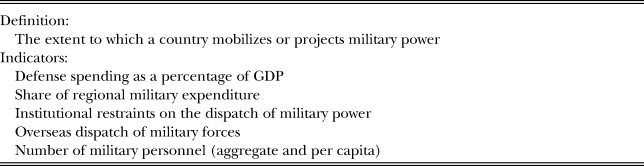
To what extent is Japan growing more militarily assertive—either relative to itself over time, or relative to other countries? One might assess a country's military assertiveness in many different ways: for example its behavior with respect to territorial claims, crisis behavior, or diplomacy (see Johnston Reference Johnston2013). Here we define military assertiveness as the extent to which a country mobilizes or projects military power. We measure this through several indicators: institutional restraints on the dispatch of military power, the overseas dispatch of military forces, number of military personnel (aggregate and per capita), and defense spending as a percentage of GDP (i.e., how much effort a country devotes to military mobilization relative to other priorities). The global average is 2.2 percent of GDP (Stockholm International Peace Research Institute 2019). To assess how consequential is a country's military spending in its region, we also measure share of regional defense expenditure. (For a summary see Table 1, below.)
Measuring Military Assertiveness

Less assertive countries mobilize smaller militaries and spend less on the military as a percentage of GDP. They mobilize a small amount of their region's military power. They place more institutional constraints on the use of military force; they rarely or never dispatch military forces overseas, or confine such dispatches to peacekeeping activities. By contrast, more assertive countries field large militaries; their military expenditure exceeds the global average; and they spend a large share of their region's military expenditure. They have fewer institutional constraints on the use of force, and they dispatch military forces overseas to intimidate, coerce or conquer.
JAPANESE ASSERTIVENESS OVER TIME
Three indicators show that Japan's military assertiveness has remained consistently low or has decreased. First, the number of personnel in Japan's Self-Defense Forces (SDF) has never exceeded its 1990 high of 250,000 soldiers, and has not risen in recent years. Quite the opposite, demographic decline is posing major challenges for recruitment (Green and Hornung Reference Green and Hornung2018).
Second, Japanese defense budgets have consistently hovered around one percent of GDP. Since the 1960s, as Patrick Boyd writes, “a consensus began to form … around this figure as an appropriate limit for peacetime defense spending” (Boyd Reference Boyd2012, 233; also see Berger Reference Berger1998). Japanese defense budgets have remained at or near this level despite ongoing burden-sharing pressure from Washington, and despite significant changes in Japan's strategic environment. Some scholars have pointed out that with military pensions (omitted in Japan's defense accounting) and the budget of the Japanese Coast Guard, military spending exceeds 1 percent of GDP (Dekle Reference Dekle, Makin and Hellmann1988; Samuels Reference Samuels2007).Footnote 3 Nevertheless, Japan's military expenditure has remained consistently low (at or near 1 percent of GDP) since the 1960s.
Third, Japan's share of regional defense budgets is decreasing rather than increasing. For many years Japanese spending was about a third of East Asian military spending.Footnote 4 With China's rise, however, Japan's share of regional military expenditure has plummeted from 33 percent in 1990 to 9 percent in 2018.
According to two other metrics—institutional constraints and the overseas dispatch of the JSDF—Japanese military policy has grown somewhat more assertive over time. This change has occurred both from a very low baseline (i.e., from total military demobilization and a prohibition on the dispatch of military forces), and it has risen gradually over a seventy-year period.
After World War II Japan had significant institutional constraints on its military statecraft (Oros Reference Oros2017; Berger Reference Berger1998). Article 9 of Japan's constitution states that “land, sea, and air forces, as well as other war potential, will never be maintained” and that “the right of belligerency of the state is not recognized.” Initial interpretations of Article 9 were so strict as to not even permit national self-defense. Institutions that inhibited Japan's mobilization and dispatch of power included the Arms Export Ban (1967), the 1969 Diet resolution prescribing the non-military use of space, and the three Non-Nuclear Principles (a 1971 Diet resolution). The government's defense organ was relegated to the status of “agency” rather than ministry.
Over time, most of these constraints have been relaxed, making it easier for the Japanese government to mobilize and dispatch military power. Article 9 was “re-interpreted”: initially to permit national self-defense (the 1954 SDF law); over the years with respect to a variety of policy decisions; and most recently in 2014 to permit “collective self-defense” (Liff Reference Liff2017). The 1991 Peacekeeping Operations (PKO) law and subsequent legislation enabled Japanese SDF personnel to participate in operations in the Indian Ocean, post-war Iraq, and the Gulf of Aden. In 2007, reforms elevated the Japan Defense Agency to the status of a ministry. Tokyo created two new institutions– a National Security Council (in 2013) and an amphibious force modeled on the US Marine Corps (in 2014). After a North Korean rocket launch, Japan acquired military intelligence satellites in 1998, and in 2008 the Diet passed the “Basic Law on Space” (reinterpreting the “peaceful” use of space to mean “non-aggressive” instead of “non-military”) (Maeda Reference Maeda2009). In 2014, Tokyo relaxed the Arms Export Ban to permit exports of armaments to security partners (Lewis Reference Lewis2015). In 2018, in yet another departure from longstanding norms, the National Defense Program Guidelines authorized an increase in defense spending, long-range strike capabilities, and aircraft carriers (Green and Hornung Reference Green and Hornung2018).
The Economist (2017, 53) has noted that Japan has “one of the world's odder armies. It has never fired a shot in battle.” While famously non-assertive, Japan has increasingly begun to dispatch the SDF overseas in peacekeeping and rear-area support missions. In 1984, when the United States requested Japanese minesweeping in the Straits of Hormuz during the Iran–Iraq War, the Diet blocked Japanese participation. “The idea of actually dispatching the SDF overseas,” writes Paul Midford (Reference Midford2011, 69), “remained unfamiliar to the Japanese public and generated considerable suspicion.” However, after the PKO law, Japan dispatched six minesweepers to the Gulf after the 1991 Persian Gulf War, and the country has sent SDF personnel to UN peacekeeping operations in Thailand, Cambodia, Mozambique, South Sudan, Haiti, and other areas (Mune Reference Muneo2014; Ministry of Foreign Affairs of Japan 2018).
Over the next decade, Japan participated in other military operations. After the September 11, 2001 attacks, Japan sent three SDF ships to the Indian Ocean to support the United States in Afghanistan. Japan did not commit troops to the 2003 Iraq war, but sent 9,600 SDF personnel (in reconstruction and humanitarian roles) to support the US occupation. The SDF also later participated in multilateral anti-piracy operations in the Gulf of Aden.
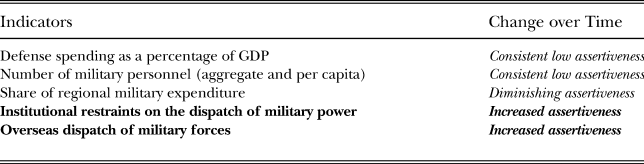
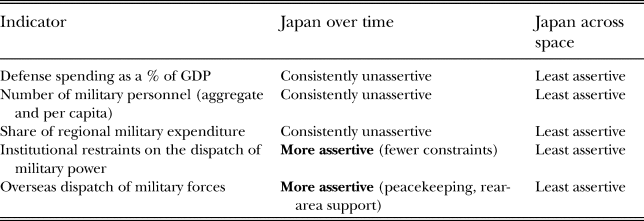
In sum, Japanese military assertiveness remains low in terms of defense spending, number of personnel, and share of regional defense spending. Japan has grown somewhat more assertive in other areas: namely the loosening of institutional constraints and increased dispatch of peacekeepers and rear-area support personnel. See Table 2, below.
Japan's military assertiveness

JAPANESE ASSERTIVENESS COMPARED TO OTHER COUNTRIES
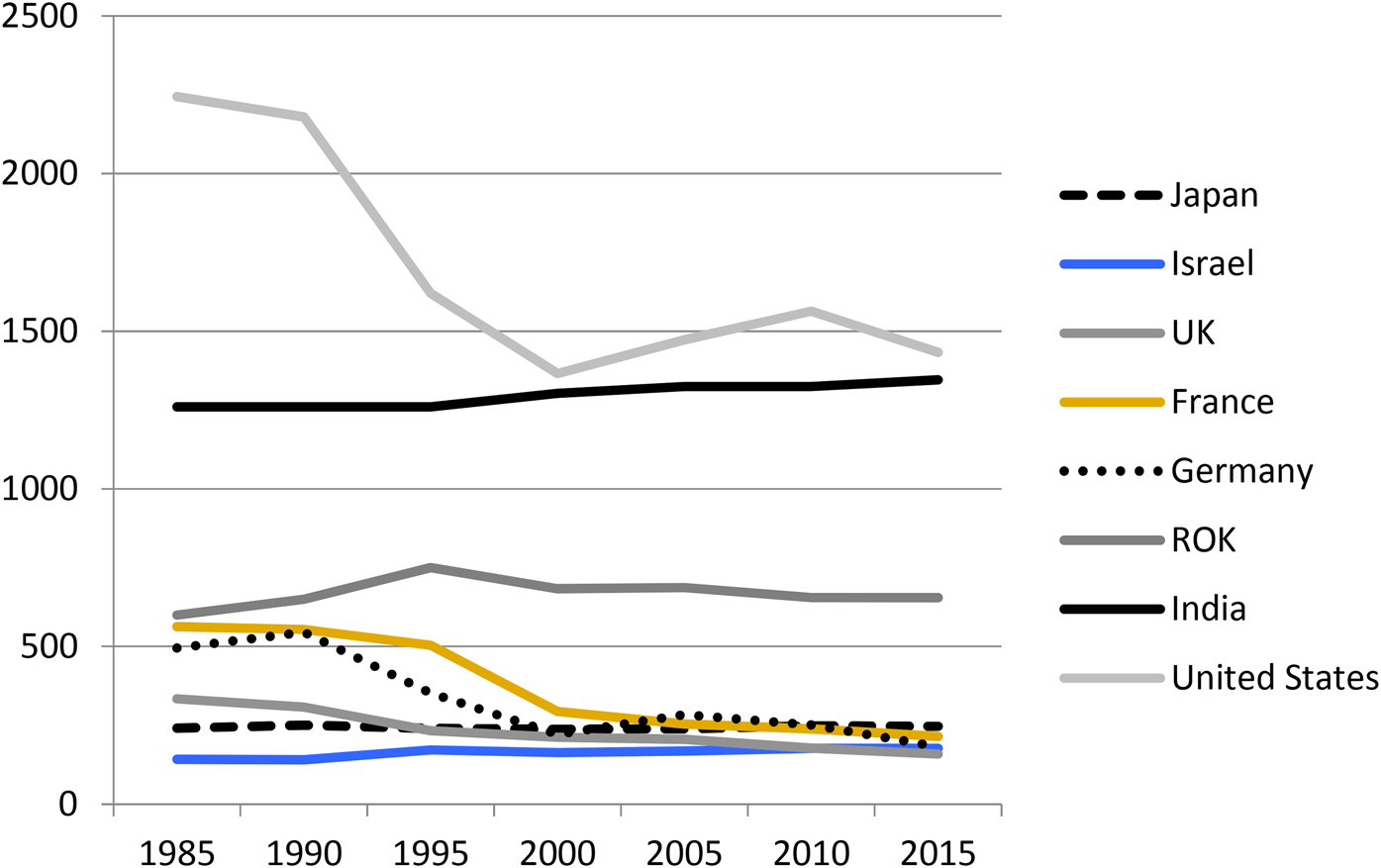
Despite some signs of growing assertiveness, Japan remains the least militarily assertive country in the comparison set. First, as seen in Figure 1, Japan's military is the smallest relative to all of the other countries. Japan raised military forces comparable in size to Israel, whose population over the time period was approximately 4 percent of Japan's population.Footnote 5 After the fall of the Soviet Union, steep disarmament in France, Germany, and the United Kingdom reduced the numbers of their military personnel at or below Japan's low level. The size of Japan's military has remained constant, and low, over the entire period.
Number of Military Personnel By Thousands, By Country

On a per capita basis, Japan's military ranks with Germany as having the smallest number of military personnel in the comparison set. Today Japan and Germany both field 2.5 military personnel per 1,000 of population. This compares to the United Kingdom and India (at 3.6 and 3.9), France (5.6), the United States (6.9), Israel (79.5), and South Korea (159.7) (Institute for International Strategic Studies 2016).
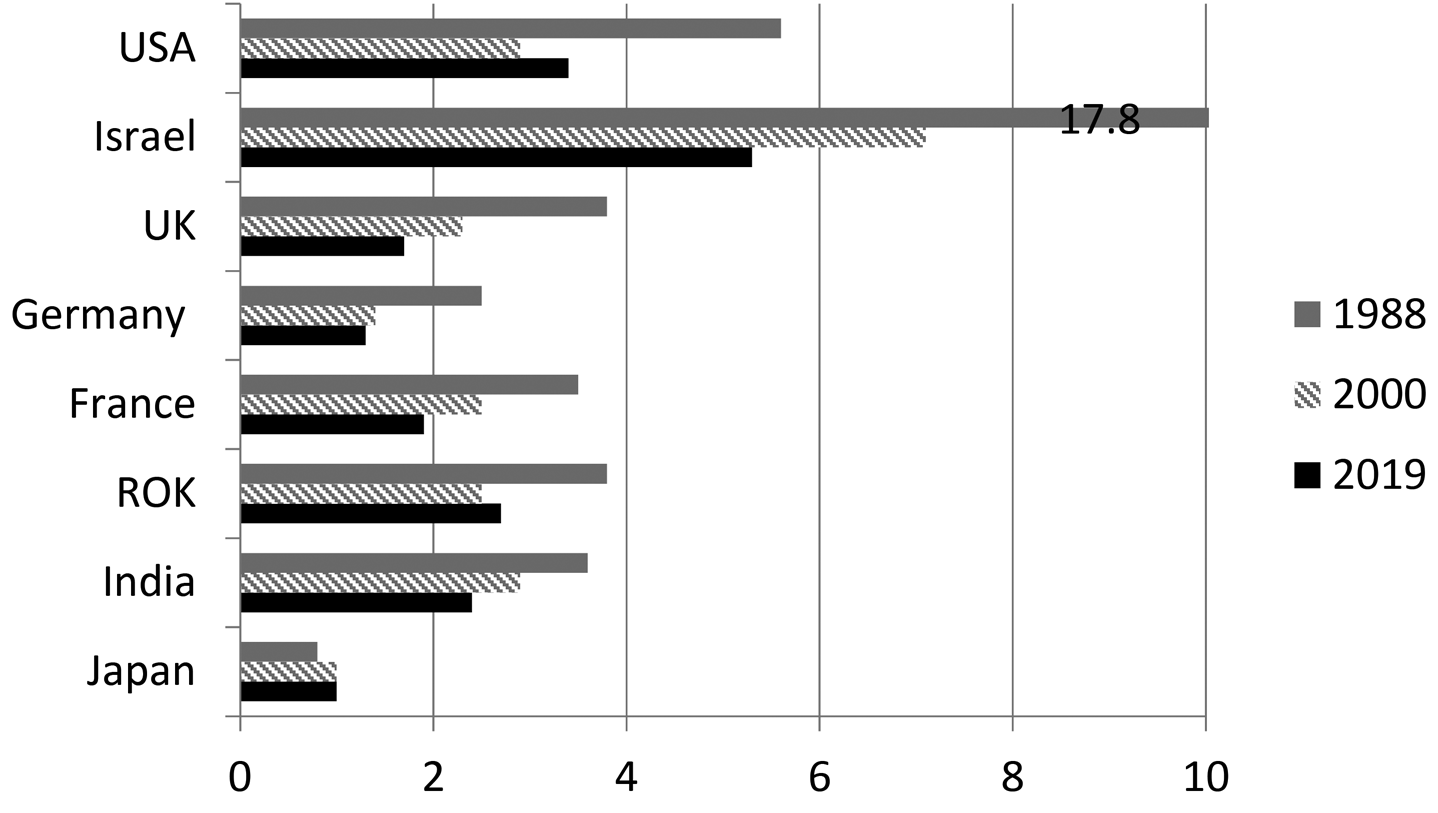
Second, Japan's low level of effort in military spending contrasts markedly with the other countries. (Again, the contrast was greatest during the Cold War; since the early 1990s, NATO countries have reduced their military spending.) Tokyo remains an outlier, however: 1 percent of GDP on defense situates Japan far below the global average of 2.4 percent, and consistently below every other country in the comparison group (see Figure 2, below) (Hughes Reference Hughes2009, 37–40).
Cold War and Post-Cold War Military Spending By Country (% of GDP)
Data from: World Bank, World Development Indicators, various years. (1988 data from the Federal Republic of Germany.)

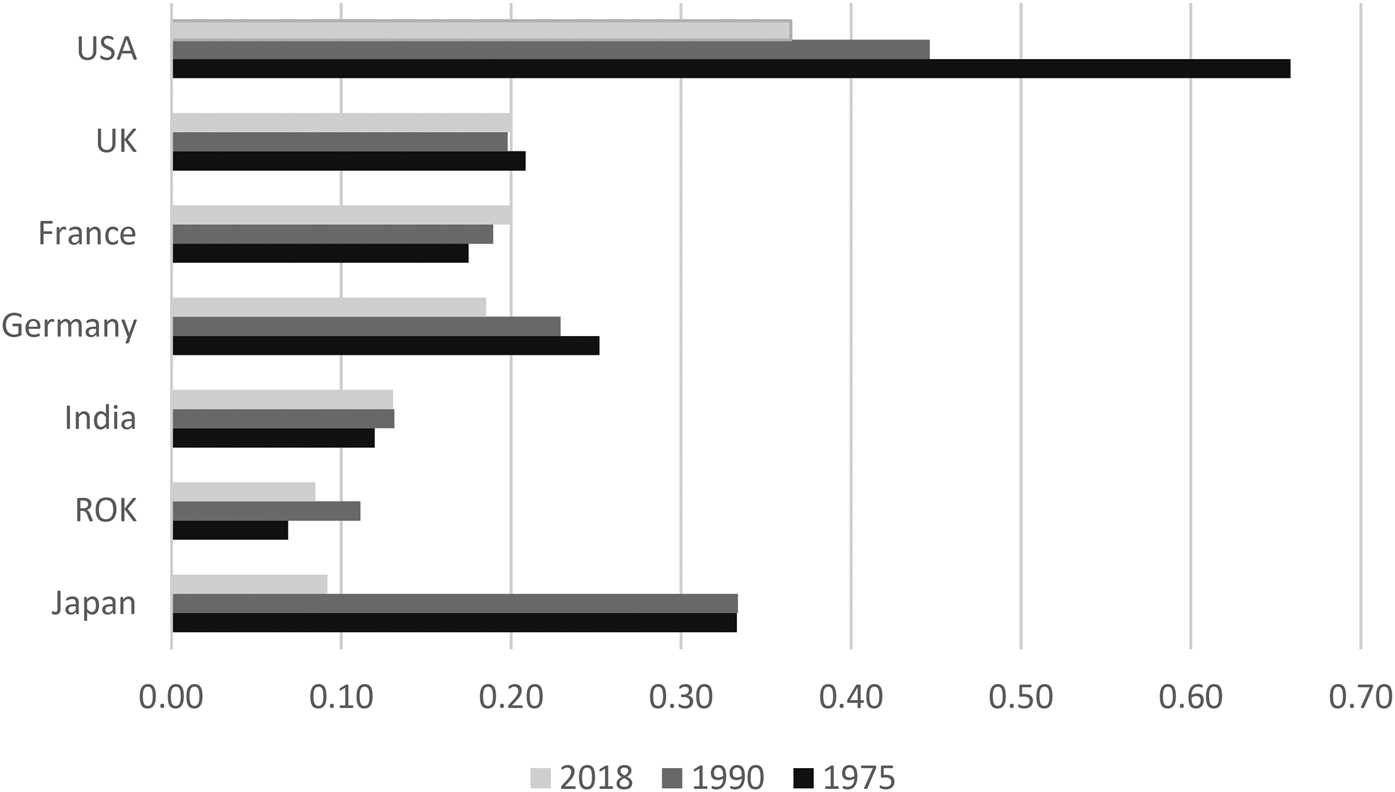
Third, Japanese spending in its region is the second lowest of any of the comparison countries. As shown in Figure 3, Japan's share of regional defense spending has been consistently lower than that of any other country except for South Korea—and in recent years Japan's share of regional military expenditure has dropped to near-parity with South Korea (with Tokyo spending 9 percent and Seoul spending 8 percent).
Share of Regional Military Expenditure

Fourth, though Japan's institutional restrictions on military statecraft have relaxed over time, they remain the most restrictive of any country in the comparison set. Only Germany constrains its national security policy making to a similar extent. Germany's constitution establishes the primacy of international law (the peaceful resolution of interstate disputes) over federal law; acts of aggression are unconstitutional. Since 1994, a parliamentary veto on military deployments “presents a very real, systemic constraint on Germany's projection of force” (Miller Reference Miller2010). In a comparison study of war powers in Europe, scholars code Germany as having “very strong” limitations on its ability to wage war (in contrast to France and the United Kingdom, at the “very weak” end of the spectrum). In the United States, declining checks and balances against the growing influence of the executive branch has permitted the more frequent dispatch of military force overseas (Goldgeier and Saunders Reference Goldgeier and Saunders2018).
Finally, while Japan has increasingly dispatched its SDF overseas, it has done so only in the context of UN-sanctioned peacekeeping operations, and in rear-area support for the US–Japan alliance. Relative to all of the comparison countries, Japan remains by far the least assertive in terms of both the type and frequency of its dispatches. The United States occupies the far end of the spectrum; over the years in question, the United States used military force to topple three governments: Panama, Afghanistan, and Iraq (plus Grenada in 1983). Recently the US military has bombarded Libya, Syria, Yemen, and Somalia; US leaders routinely debate whether to launch regime change operations in North Korea and Iran. Previously the United States bombed Afghanistan and Sudan in 1998 and Libya in 1986. American military forces stand at the ready to defend against a North Korean invasion of South Korea (or to conduct a preventive military strike) at a moment's notice.
Other countries in the comparison group also routinely use military statecraft. France, Germany, and the United Kingdom all send soldiers to peacekeeping operations, and have participated in military operations in Bosnia, Kosovo, Afghanistan, Iraq, and Libya. After World War II in West Germany, military force projection remained deeply controversial for decades; however since unification, German troops have increasingly participated in multinational operations (Schreer Reference Schreer, Matlary and Petersson2013; Berger Reference Berger1998). The United Kingdom fought a war with Argentina over the Falkland Islands in 1982. France is known for a “military culture that places the use of force at the centre of strategy” (Tardy Reference Tardy2014). The French bombed ISIS in Syria after the 2015 attack in Paris on the offices of Charlie Hebdo. Furthermore, France's historic ties to African countries led it to conduct military operations in Chad, Central African Republic, Côte d'Ivoire, Mali, and Rwanda. Over 3,000 French troops are stationed in five countries across Africa, aimed at combatting extremism (Bender Reference Bender2015; Larivé Reference Larivé2014).
South Korea, Israel, and India also prepare extensively for the projection of military force, occasionally dispatch forces in military operations, and routinely contribute forces to multinational operations. South Korea and Israel both have mandatory military service. South Korea prepares to fight, at any moment, a war against North Korea. Israel has dispatched military forces to airlift Jews to Israel, to rescue hostages, to carry out counterterrorism raids, and to bomb suspected nuclear facilities in Iraq and Syria. Israel has long fought Hezbollah in Lebanon, most recently in 2006. India, for its part, dispatched military forces in counter-terrorism operations against the LTTE (Tamil Tigers) and in 1999 fought the Kargil war against Pakistan. Most recently, Indian jets bombed Pakistan in retaliation for a terrorist attack against its military forces in Kashmir (Tharoor Reference Tharoor2019). It also previously conducted a retaliatory strike in Myanmar against insurgents who had killed 18 Indian soldiers (Parameswaran Reference Parameswaran2015). By contrast, Japan's SDF have only recently begun to participate in nonlethal humanitarian operations, have not experienced a single casualty, and express pride in never firing a single bullet in combat.
As summarized in Table 3, our analysis shows that—measured both over time or across space—while Japan's security policy has evolved over time, it remains extraordinarily unassertive. Japan's security policy has remained highly unassertive in some aspects (in terms of defense spending, number of personnel), or has grown even less assertive (in terms of share of regional defense expenditure). In some ways, though, Japan has grown more assertive: Tokyo has shed many institutional constraints and increasingly dispatched peacekeepers and rear-area support personnel. Importantly, these changes have occurred from a very low baseline and gradually over a period of 70 years. Furthermore, the cross-case comparison shows that Japanese military assertiveness is the lowest relative to the comparison countries, and the lowest of all the great powers.
Japanese military assertiveness across time and space

MEASURING JAPANESE NATIONAL IDENTITY
Commentators often assert that nationalism in Japan is “on the rise” (Kingston Reference Kingston2016a; Nakano Reference Nakano and Kingston2016a, Reference Nakano, Mullins and Nakano2016b; Nihon Saiken Inishachibu 2015). But to what extent is Japanese national identity changing—either over time, or relative to other countries? As we did above vis-à-vis military assertiveness, in this section we define nationalism, create metrics for measuring it, and measure it both in Japan over time, and Japan compared to seven other countries.
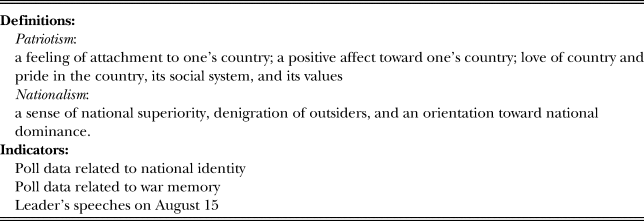
The literature on social identity distinguishes between nationalism and patriotism. Scholars describe patriotism as a feeling of attachment or connectedness to one's country; as a love of country and pride “in a number of different domains,” “beliefs in the social system and values of one's country,” and a “positive affect toward the nation” (Herrmann, Isernia, Segatti Reference Herrmann, Isernia and Segatti2009; De Figueiredo and Elkins Reference De Figueiredo and Elkins2003, 78; Powers Reference Powers2018; Rathbun and Albuyeh Reference Rathbun and Albuyeh2018). Nationalism, by contrast, connotes not only a sense of identification with one's country, but a sense of national superiority, denigration of outsiders, and “an orientation toward national dominance.”Footnote 6
Nationalism has long been seen as a cause of political violence (Cottam and Cottam Reference Cottam and Cottam2001; Van Evera Reference Van Evera1994). But scholars have examined the extent to which some kinds of national identity are or are not associated with violence (Machida Reference Machida2017; Karasawa Reference Karasawa2002; Schrock-Jacobsen 2009; Snyder 2000). Kosterman and Feschbach (Reference Kosterman and Feshbach1989) distinguish “between nationalism as a jingoistic cause of war and patriotism as a healthy national self-concept”; Druckman (Reference Druckman1994, 60, 48) says it is possible “to have pride, patriotism in one's nation while still recognizing its shortcomings and being willing to cooperate with, and perhaps even include other nations in one's ingroup.” Empirical work by Brewer (Reference Brewer1999; Reference Brewer1979) found that “variations in ingroup positivity and social identification do not systematically correlate with degree of bias or negativity toward outgroups.” In her memorable phrase, ingroup love does not lead to outgroup hate. Experiments have found that strong patriotism can co-exist with high levels of trust in out-groups (Chung Reference Chung2015) and that “attachment to the nation is not the cause of militarist and conflictive dispositions” (Herrmann, Isernia, Segatti Reference Herrmann, Isernia and Segatti2009, 747).
In debates about Japan, claims that Japanese nationalism is “on the rise” have not distinguished between the more benign “patriotism” and the more dangerous “nationalism.” Toward informing debates about Japan, we draw upon the social identity literature to make this key distinction, and to provide metrics for measurement. One might measure national identity both among political elites (who guide national policy and shape public views) and among the general public (which both produces those elites and constrains elite agendas (Goddard and Krebs Reference Goddard and Krebs2015)). In this article we measure both, using three metrics.
JAPANESE NATIONAL IDENTITY: THREE METRICS
To assess changes in Japanese national identity, we first evaluate public opinion data related to national identity. For evidence of patriotism we evaluate questions that asked people whether they feel like a citizen of their country, feel a desire to serve their country, and feel proud of their country. For evidence of nationalism we evaluate questions such as whether you think your country is superior to other countries, whether you think the world would be a better place if other countries were more like it, or whether you would side with your country even if it is in the wrong. (Relying on similar metrics are Powers Reference Powers2018; Machida Reference Machida2017; Johnston Reference Johnston2017; De Figueiredo and Elkins Reference De Figueiredo and Elkins2003; Kosterman and Feshbach Reference Kosterman and Feshbach1989.)
Second, we assess public attitudes about war memory. Stephen Van Evera (Reference Van Evera1994, 27–30) argues that nationalistic countries engage in “self-glorifying” (justifying and glorifying past violence), “self-whitewashing” (denying the country's own misdeeds and ignoring the suffering of others), and “other-maligning” (blaming wars on other countries, denigrating them as inferior, and inflating the threat they pose). Alternatively, people might support narratives and other gestures (e.g., apologies, reparations, memorials) that show respect for (rather than denigrate) past victims (Daugbjerg Reference Daugbjerg2009; Berger Reference Berger2012; He Reference He2009; Lind Reference Lind2008). Toward assessing changes in Japanese national identity, then, we evaluate public opinion polls about official apologies, reparations, war memorials, and so forth.
To assess changes in Japanese attitudes about national identity and war remembrance, we evaluated longitudinal poll data since 1960. We relied on all available longitudinal polls: both occasional polls conducted by several Japanese newspapers (on both the liberal and conservative range of the spectrum), and longitudinal polls regularly conducted by the Japanese Prime Minister's Office, the national broadcasting organization NHK, Asia Barometer, the Pew Research Center, World Values Survey, and the International Social Survey Programme. To compare Japanese patriotism and nationalism to other countries, we relied on public opinion data (since 1985) from available cross-national polls: the World Values Survey, Eurobarometer, the European Values Survey, the International Social Survey Programme, and the Pew Research Center.
Third, we evaluated leaders’ speeches. Leaders are not all-powerful in shaping national narratives and identity, particularly in liberal democracies, but they do exert important influence (Krebs Reference Krebs2015, 48–50; Olick Reference Olick1999). Thus, from Japan and the seven comparison countries, we gathered, translated, and analyzed leaders’ speeches given on national memorial or commemorative holidays—occasions when leaders typically discuss national identity.
As we analyzed these speeches, we focused on three themes. The first was security threats: we looked to see whether leaders discussed security threats, and whether did they do so in chauvinist, dehumanizing, and denigrating terms—all of which would be evidence of nationalism. Second, we evaluated heroes and accolades—who leaders depicted as national heroes and for what kinds of actions (for example, war heroes versus resistors; co-nationals versus people in other countries). Third, we analyzed war remembrance and self-criticism: how leaders talked about past violence, and whether they were self-critical and empathetic versus emphasizing the country's own victimhood and glorifying its violence against others.
Because of the highly nuanced nature of the subject matter, we analyzed these speeches ourselves rather than relying on coders, or using keyword or other automated coding methods.Footnote 7 For example, often what does not appear in a speech (e.g., an Indian leader not mentioning Pakistan in a speech less than a month after a terrorist attack) is often as significant as what does appear. Table 4 summarizes our three metrics for assessing Japanese nationalism.
Measuring Japanese Identity

JAPANESE NATIONAL IDENTITY OVER TIME
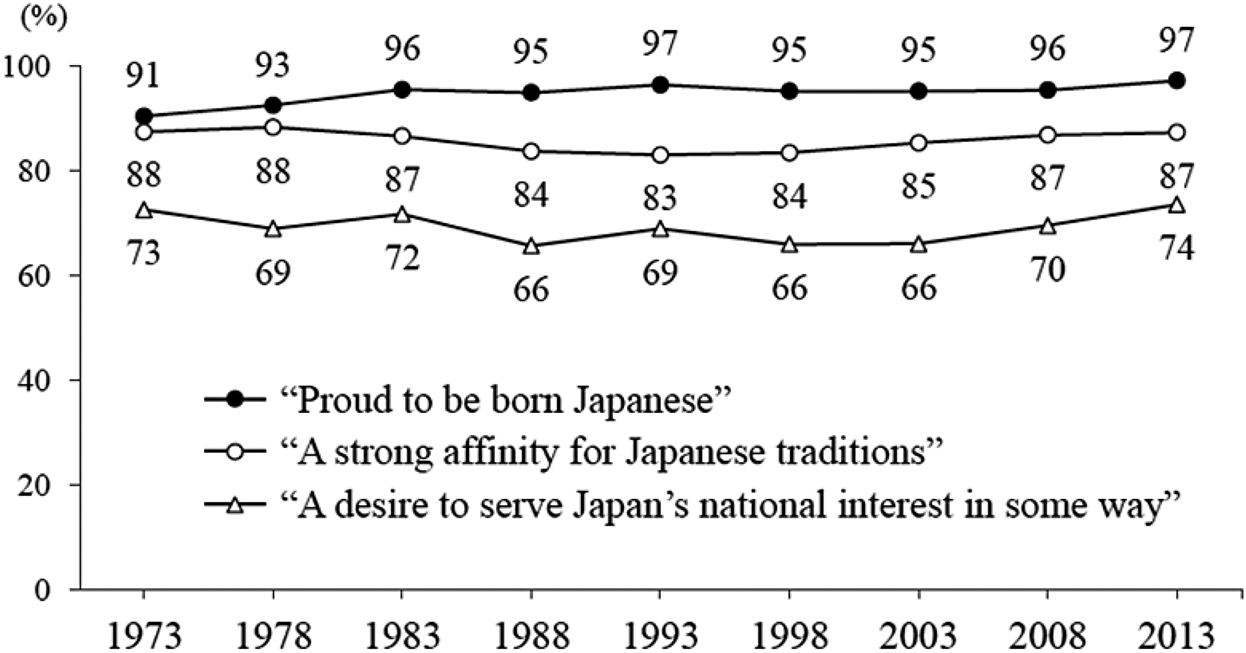
First, poll data about national identity reflect strong patriotism that is consistent over time. People were asked how they see themselves, and the number of people who “strongly agree” and “agree” with the statement, “I see myself as a Japanese citizen” was over 70 percent (essentially the same since the question was first asked in 2005). Japanese older people feel a stronger level of attachment compared to youth (28 percent of people over 50 say that they strongly feel part of the Japanese nation, compared to only 18 percent of people under the age of 29 (World Values Survey 2014). Respondents also report a “strong level of affinity for Japanese traditions.” This response was high and quite consistent over time (88 percent in 1973; dipping slightly but back to 87 percent by 2013).
Poll data about national identity also show a consistently strong sense of national pride. Longitudinal polls show that the number of people who agree/strongly agree that they were proud “to be born Japanese” has always exceeded 90 percent (Takahashi and Aramaki Reference Takahashi and Aramaki2016). (See Figure 4.) Older people are more proud of Japan than younger; for example, in 2010–2014, 74 percent of people over the age of 50 were “quite” or “very” proud, compared to 54 percent of people under the age of 29 (World Values Survey 2014).
Indicators of Japanese Patriotism
Data from: Takahashi and Aramaki Reference Takahashi and Aramaki2016

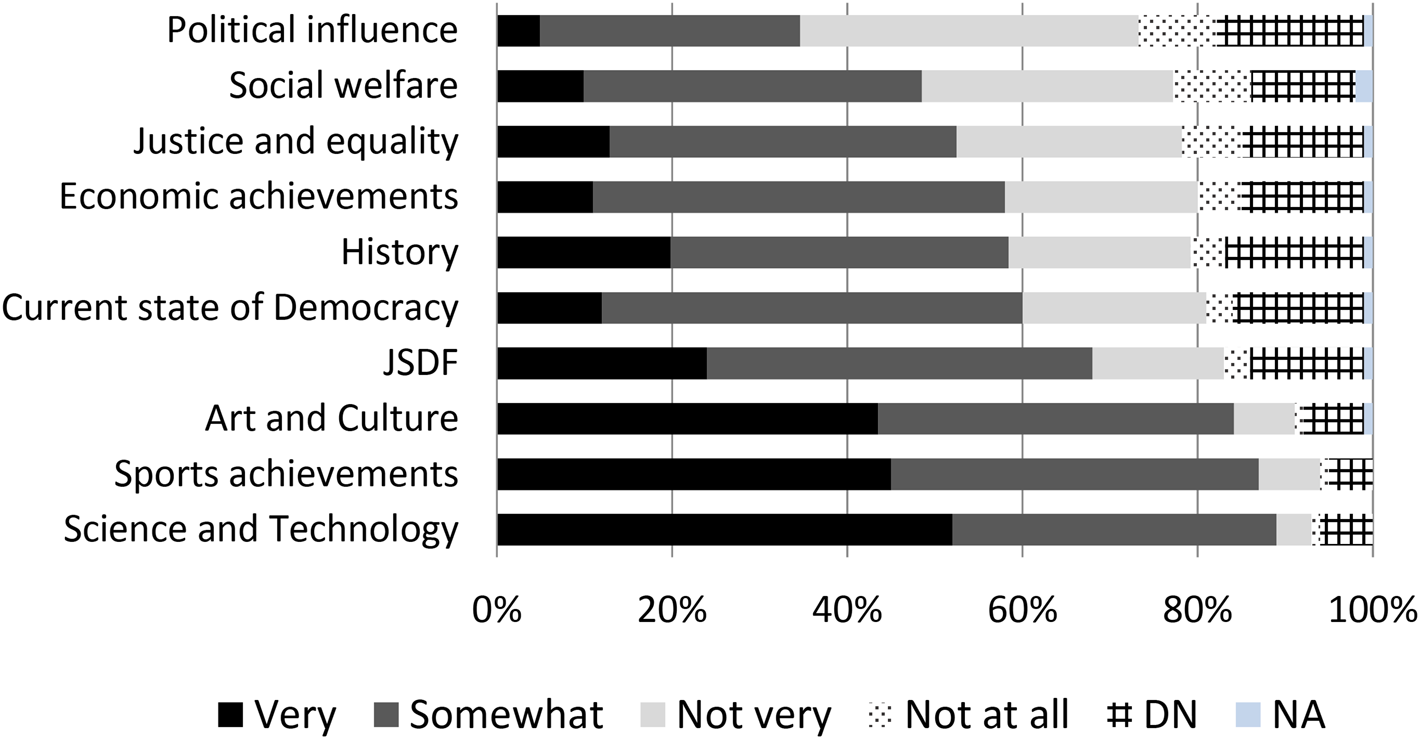
Japanese people value their country's achievements in science, sports, arts, and culture (see Figure 5). People have never felt much pride in the country's military, but pride in the SDF is rising (24 percent “very proud” and 44 percent “somewhat proud,” up from 8 percent and 26 percent respectively since 2003). Murata (Reference Murata2014) attributes the increase to the SDF's high-profile rescue efforts in natural disasters such as the earthquake and tsunami of March 2011.
Sources of Japanese National Pride
Data from: ISSP 2014, “National Identity.” The survey asked respondents how proud they were of their country based on the various categories.

Willingness to contribute to and sacrifice for one's country can also reflect a sense of attachment to the nation. Poll data show that most Japanese people report a “desire to serve Japan in some way”: 73 percent of people agreed with this sentiment: a feeling that was generally stable across time, as seen in Figure 4 (Takahashi and Aramaki Reference Takahashi and Aramaki2016).
When it comes to serving Japan in the realm of national self-defense, people are much less willing. Scholars have noted the persistence of anti-military views in Japanese society, and the low level of popularity for joining the SDF (Hornung and Mochizuki Reference Hornung and Mochizuki2016). Asked if they were “willing to fight for Japan,” in the 1980s, only 21 percent said they were willing, and this decreased still further over time to 15 percent. Similar to results in other categories, older people are more willing to fight than younger. In the 2010–2014 poll, for example, only 10 percent of respondents under the age of 29 said they were willing to fight, compared to 20 percent for those over 50.Footnote 8 Thus, while most people want to “be useful” to Japan (reflecting national attachment), they exhibit a low level of willingness to fight for their country.
As for evidence of nationalism, poll data show mixed results. First, Japanese people prefer their country relative to other countries. 86 percent of Japanese say they would “rather be a citizen of Japan” than any other country (ISSP (International Social Survey Programme), 2013), a sentiment that was generally consistent (always over 80 percent) over time. Polls also show that approximately 80 percent of Japanese say that if they were to be born again, they would want to be born as a Japanese (Nakamura et al. Reference Nakamura, Yoshino, Maeda, Inagaki and Shibai2017).
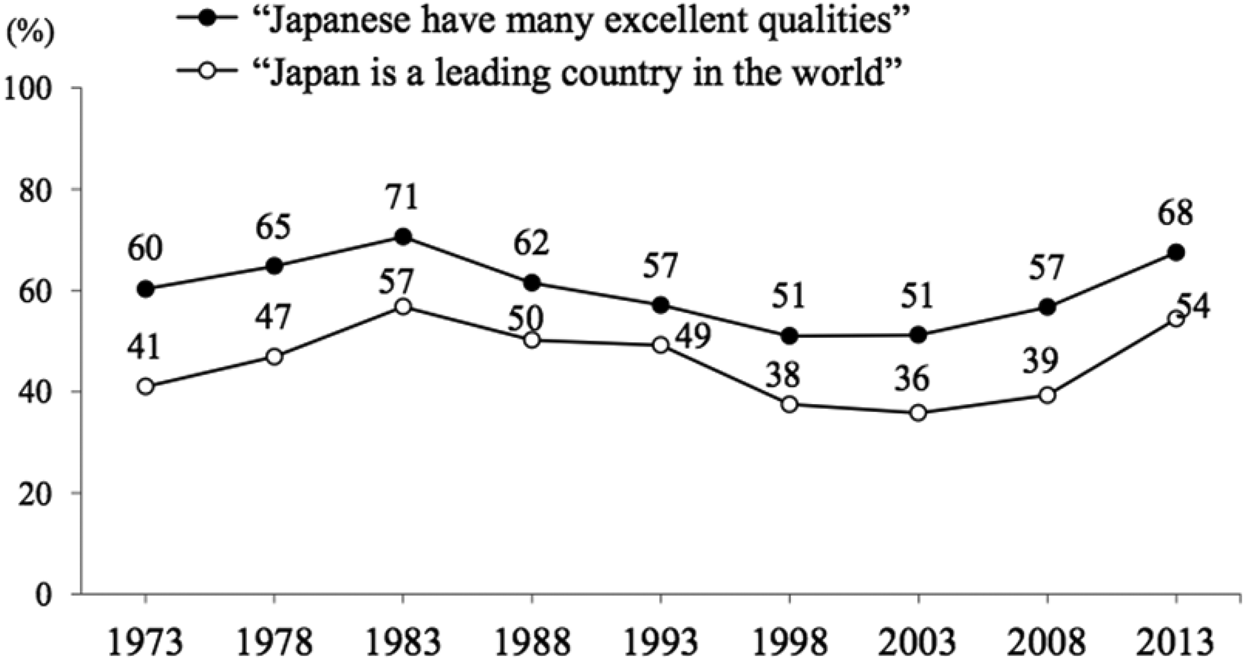
In ISSP polls, most Japanese people agreed that “Generally speaking, Japan is a better country than most countries.” 84 percent agreed with this sentiment in 1995, dipping down to 73 percent in 2003, and then recovering to 86 percent in 2013 (ISSP various years). Furthermore, about a half to two-thirds of respondents agreed that “compared to other countries in the world, Japanese people have excellent qualities” (see Figure 6). Thus not only do most Japanese people feel a positive attachment toward their own country, they prefer it to others.
Indicators of Japanese Nationalism
Data from: Takahashi and Aramaki Reference Takahashi and Aramaki2016.

While the people's preference for Japan relative to other countries is consistent with what scholars see as nationalism, three other indicators are not. First, as shown in Figure 6, people were ambivalent about calling Japan “a leading country in the world.” The number of people who agreed with this statement was initially low (41 percent in 1973, during Japan's postwar economic takeoff); it has fluctuated over time, and was at 52 percent in 2018 (ISSP various years).
Second, when asked if “the world would be a better place if more countries were like Japan,” opinions were split down the middle, with 45 percent agreeing and 46 percent disagreeing (ISSP 2013). Third, poll data also show little (and diminishing) support for a question used to gauge nationalism: the extent to which people would “support their country even if it were in the wrong.” The number of people answering in the affirmative have fallen from 23 percent in 1995, to 18 percent in 2014 (ISSP, various years).
Public opinion about war remembrance shows the opposite of nationalist denigration—people increasingly criticize Japan's past violence and increasingly recognize other countries’ suffering. Scholars have argued that Japan's earlier evasion of its wartime past began to change in the 1990s (Berger Reference Berger2012; Lind Reference Lind2008). In 1993, an Asahi Shimbun poll found that 76 percent of the people surveyed supported Prime Minister Hosokawa Morihiro's apology to South Korea. Other polls at the time found that 61 percent of Japanese felt that “Japan hasn't done enough to take responsibility for its role in World War II”; and that “Japanese believed by a 4-to-1 ratio that their country had not done enough to compensate foreign victims” (Ogawa Reference Ogawa2000). A 1995 Nihon Keizai Shimbun poll revealed that 54 of respondents said that Japan had not done enough to atone for the war. Subsequently, a 2000 NHK poll showed that 50 percent of respondents agreed, “the Japanese must, personally, bear responsibility for historical offenses (as opposed to 27 percent who disagreed) (Fukuoka Reference Fukuoka2013). Such data-led Ogawa (Reference Ogawa2000) to comment, “the view that the Japanese suffer from ‘historical amnesia’ concerning Japan's actions in Asia is clearly not as true as it might have been a decade ago.”
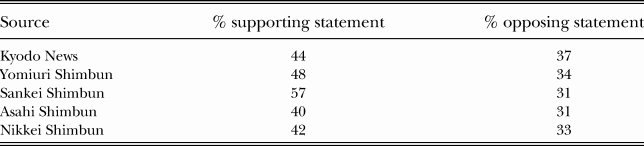
More recently (as shown in Table 5), a majority of people supported Shinzo Abe's Reference Abe2015 statement at the seventieth anniversary of the war's end, which upheld previous apologies. A Yomiuri Shimbun poll found that 72 percent supported the statement specifically for upholding previous apologies. Acceptance of apologies for the war was greater among the youth. Polls by Sankei Shimbun, the most conservative among the national newspapers, found 70 percent of men in their 20s supported the statement using the phrases: remorse, invasion, colonial rule, and apology (Sankei Shimbun 2015).
Public Reactions to Abe's August 2015 Statement on the Seventieth Anniversary of the War

During Shinzo Abe's tenure, Japanese people continued to support self-reflection and contrition for wartime violence. According to an Asahi Shimbun poll (2015), 74 percent of respondents approved of the apologetic statements given by Prime Ministers Murayama and Koizumi (at the fiftieth and sixtieth anniversaries of the war's end, respectively), with only 13 percent opposing. Observers argued that public opinion pushed Abe to issue a more contrite seventieth anniversary statement than many had expected from him (Smith Reference Smith2015). In sum, data about the public's willingness to remember and express regret for wartime violence suggest growing self-criticism—the opposite of rising nationalism.
Third, as described, we gathered and analyzed speeches and official statementsFootnote 9 by Japan's prime minister on August 15 (the anniversary of Japan's World War II surrender). We evaluated speeches and statements on August 15 every five years from 1960–2005, and every year from 2005–2018. In our coding we assessed nationalism as reflected in three categories: security threats, heroes and accolades, and self-criticism and war remembrance. Contrary to the claim of rising Japanese nationalism, leaders’ speeches reflect a noticeable trend in the opposite direction: growing self-criticism. Leader's speeches increasingly recognize other countries’ contributions to Japan and reflect increasing self-criticism.
Since 1960, speeches and statements by Japanese leaders did not discuss security threats. Speeches make no mention of security threats or enemies; the closest thing to this were brief statements by four prime ministers (Sato in 1965, Murayama in 1995, Fukuda in 2008 and Kan in 2010) that the world is sadly plagued by conflict, compared to the peace Japan enjoys.
Discussion of heroes and accolades reflects declining nationalism over time: showing both a declining focus on the military, and growing respect toward other countries. Earlier speeches praised Japan's war dead. For example, in 1965, Eisaku Sato said “the noble footprints of the three million war dead will forever shine on Japan's history and must be revered and thanked by the Japanese people.” Speeches by Sato (1970), Miki (1975), and Suzuki (1980) repeated gratitude for the war dead. In 1985, Nakasone credited Japan's peace and prosperity to all Japanese people; subsequent leaders in the 1990s and 2000s followed his lead. More recently, Japanese leaders since Koizumi (2006) referenced “three foundations” of Japan's success: the sacrifice of the war dead, the efforts of all Japanese people, and the friendship extended to Japan from other countries. Most subsequent prime ministers repeated this formulation.
Shinzo Abe, in his 2013 speech, reverted to thanking only the war dead for Japan's prosperity, but in his 2015 seventieth anniversary statement (danwa) returned to the more generous “three foundations” narrative, and credited peace to the sacrifices of all soldiers who fought in the war. He praised not only “the tireless efforts of our predecessors” but also “the goodwill and assistance extended to us that transcended hatred by a truly large number of countries.” Abe thanked those countries for their “tolerance,” which allowed Japan “to return to the international community in the postwar era” (Wall Street Journal 2015). In short, over time leaders credited Japan's achievements to civilians and well as other countries.
As for self-criticism and war remembrance, leaders’ speeches (mirroring trends in public opinion) increasingly acknowledged Japan's wartime violence and other countries’ suffering. In the 1993 national ceremony for the war dead, Hosokawa extended condolences to the victims of the war in other countries. In 1995, Murayama unequivocally apologized for the “irrefutable facts of history” in which “Japan, following a mistaken national policy … through its colonial rule and aggression, caused tremendous damage and suffering to the people of many countries, particularly to those of Asian nations.” In Koizumi's (Reference Koizumi2005) statement upon the sixtieth anniversary of the war's end, he apologized to victims using this same language. “Sincerely facing these facts of history,” he noted, “I once again express my feelings of deep remorse and heartfelt apology, and also express the feelings of mourning for all victims, both at home and abroad, in the war.” Leaders’ speeches from 2006 to 2012 (Koizumi, Abe, Fukuda, Aso, Kan and Noda) adopted the same language. More recently, Abe's seventieth anniversary statement invoked the fiftieth (1995) and sixtieth (2005) anniversary statements. These statements express respect for the fallen, mourn overseas victims of Japanese violence, commit to peace, and express “feelings of deep remorse” and “heartfelt apology.” Abe (Reference Abe2015) also discussed foreign victims of Japanese aggression. He invoked the “countless lives … lost among young people with promising futures”; the “numerous innocent citizens [who] suffered and fell victim to battles as well as hardships”; and the “women behind the battlefields whose honour and dignity were severely injured.”
In sum, our metrics do not support the claim of rising Japanese nationalism. Patriotism is strong and stable over time. While there is some evidence of Japanese nationalism (or, more accurately, a preference for Japan), this is accompanied by other evidence of increased self-criticism and empathy toward others’ suffering: the opposite of what scholars would call nationalism.
JAPANESE NATIONAL IDENTITY COMPARED TO OTHER COUNTRIES
In this section we measure the extent to which Japanese national identity might be changing relative to other countries. As noted, to evaluate this we compare Japan (using the same three metrics) to seven other liberal democracies.
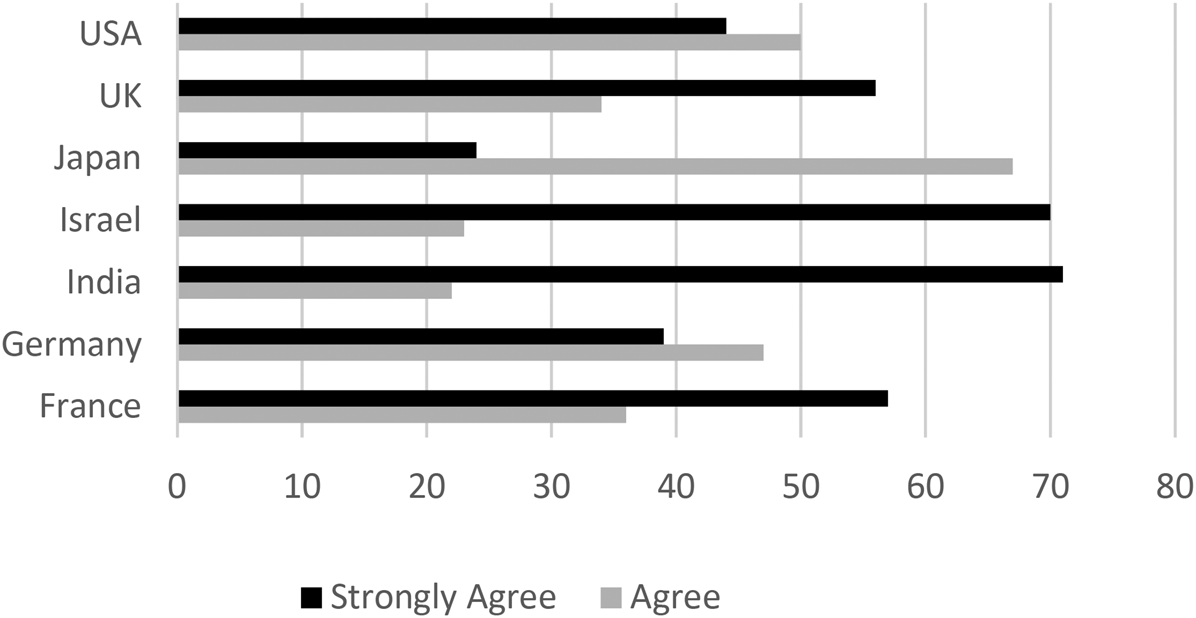
First, relative to these other countries, Japan exhibits a roughly similar level of national attachment and pride. About the same percentage of people agreed (“strongly agree” or “agree”) that they see themselves “as part of the [X] nation” or that they “feel attached to their country.”Footnote 10 Relative to Japan, other countries exhibit higher, often much higher, responses in the “strongly agree” category (particularly India, Israel, and the United States). See Figure 7.
National Attachment Across Countries: “I see myself as part of the X nation”
Data from: ISSP

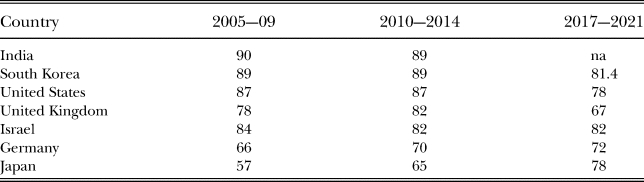
Regarding national pride, Japan appears low relative to the other countries (see Table 6).
Patriotism compared across countries: percentage of people who feel “very” or “quite” proud of their country

Data from: World Values Survey, various years
Note: World Values Surveys. Data from UK case from Katwala Reference Katwala2014, and from a 2004 survey conducted by HI Europe, see Wall Street Journal 2004. Data for Israel from Israeli Democracy Index (2012) and Dahaf, September 7, 2007, available at www.jewishvirtuallibrary.org/israeli-national-pride-polls. Expressions of national pride are higher among Israeli Jews than Israeli Arabs.
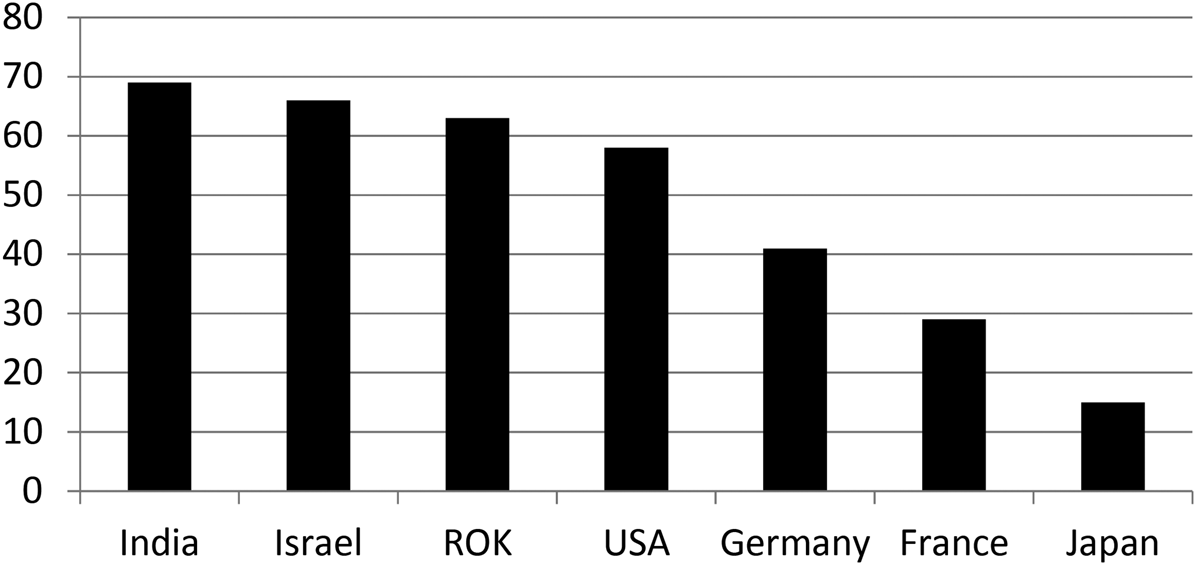
In terms of a willingness to defend one's country, Japanese levels were quite low; indeed, the comparative context shows Japan to be a remarkable outlier on this dimension. As shown in Figure 8, in the World Values Survey (2014), countries with a high percentage of “Yes” respondents included India (69 percent), Israel (66 percent), South Korea (63 percent), and the United States (58 percent). European countries were less willing, with “Yes” answers in Germany at 41 percent and in France at 29 percent. Japan was a dramatic outlier here with only 15 percent responding “Yes,” they would fight for their country.Footnote 11

Poll data on Japanese nationalism is mixed. Two polls reflect a higher sense of nationalism in Japan relative to other countries. In an ISSP poll Japan ranks relatively high in the extent to which respondents prefer to be a citizen of their own country relative to others. As noted earlier, polls show that Japanese people (88 percent) say they “prefer to be Japanese rather than a citizen of a different country” (ISSP 2013). This result puts Japan second among the countries in our comparison group (the highest was India at 90 percent, and then after Japan, the United States at 86 percent, South Korea (76 percent), Israel (74 percent), and the UK, France and Germany at 69, 64, and 63 percent respectively.
Furthermore, another ISSP poll shows that more Japanese people believe their country is “better than other countries.” In 1995, 84 percent of respondents agreed with this statement, putting Japan first in this category relative to the comparison countries. This number dipped in 2003 (with Japan falling to fifth place) but was back up to 86 percent (and first place) by 2013 (ISSP polls, various years).
Other public opinion data, however, do not reflect that Japanese nationalism is higher than in other countries. Notably, Japanese people do not say that they will “support their country even if it is in the wrong.” In 2013 only 18 percent of Japanese answered in the affirmative (down from 23 percent in 2003). This was not only falling but the lowest of the comparison group: India (63 percent), ROK (57 percent), Israel (48 percent), France (34 percent), the US (30 percent), and Germany (24 percent) (ISSP, various years).
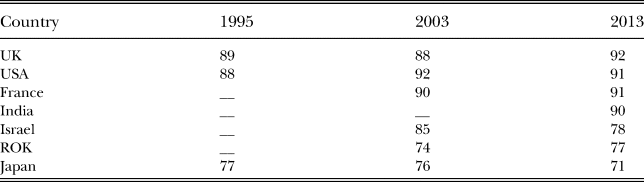
Furthermore, as Table 7 shows, Japanese pride in the country's history is not only falling but also the second-lowest in the comparison group. Japan's global ranking was sixteenth in 1995, dropping in 2003 to twenty-ninth place (where it remained in 2013).
Percentage of those who are proud of their country's history

Data from: ISSP
Note: The data are from ISSP (International Social Survey Programme) 1995, 2003 and 2013. The data are taken from the website, Global Japanese Data Ranking by Kenji Suzuki. http://dataranking.com/index.cgi?LG=e.
Second, public opinion data about war remembrance do not suggest that Japanese nationalism is high relative to other countries. Cross-national comparisons on this subject are difficult; public opinion polls in most other countries rarely even ask questions about war remembrance, which itself indicates its low salience in their national debates. A variety of data, however, paint a picture.
In the United States, a Gallup survey showed that 73 percent of Americans opposed an apology to Japan for the atomic bombings; 20 percent supported (Stokes Reference Stokes2015). In Israel, Palestinian demands for an Israeli apology for the 1948 expulsion—and the political unacceptability of such an apology in Israel—is one of several issues obstructing a settlement (Chatham House 2014). A poll in Israel—showing that half of the public today support “expelling or transferring” Arabs from the country—suggests that an apology for the 1948 Nakba is not soon forthcoming (Stokes Reference Stokes2016). In France, only 13 percent of French support the idea of a French apology to Algeria for the colonial era (Viscusi Reference Viscusi2012). When President Emmanuel Macron recently repudiated French actions there, some commentators noted that this “opened up a space for the recognition of France's past wrongs” (Saadia Reference Saadia2017); however, it also triggered outrage among conservatives (Chrisafis Reference Chrisafis2018; Stothard Reference Stothard2017). As for the United Kingdom, more British people express pride in the British history of colonization, and view the empire as a positive thing, than believe any apologies should be made (Stone Reference Stone2016).
By contrast, poll data (described earlier) show that the Japanese public increasingly supports acknowledging and even apologizing for past violence. The only country more self-critical is Germany: a remarkable outlier relative to the rest of the group (Berger Reference Berger2012). There, recent calls by a member of the German right—calling for “a 180-degree turn” away from Germany's “defeated” mentality, and greater attention to the country's own “national sacrifice”—“drew immediate condemnation from across the political spectrum … and were disowned by the national leadership of his own party” (Huggler Reference Huggler2017).
Third, in addition to public opinion data, we compared Japanese leaders’ speeches on August 15 with leader's speeches from the seven other countries. The speeches we analyzed were delivered on an important memorial or commemorative day: France (Armistice Day, November 11); Germany (Volkstrauertag, in November); India (August 15); Israel (Yom Ha'atzmaut, April/May); ROK (August 15); United Kingdom (November 11); and the United States (Memorial Day, May 31). We evaluate speeches every five years over the time period of 1985–2018. As in the Japanese case, we looked for evidence of nationalistic attitudes with respect to three themes: security threats and tensions, heroes and accolades, and self-criticism and war remembrance.
This analysis reveals that, along with French and German speeches, Japanese speeches are the least nationalistic of the group. Japan's speeches contrast with more nationalistic rhetoric in American, British, and Israeli speeches. We summarize our analysis of the speeches below, and discuss specifics from the speeches in the Appendix.
As noted, Japanese speeches did not discuss security threats or political tensions. Among other countries’ speeches, mentions of security threats varied significantly. South Korean and Indian speeches discussed relations with their rivals (North Korea, Pakistan respectively) in largely benign language. American speeches emphasized past threats and referred infrequently and obliquely to current ones. Early Israeli speeches discussed security threats in the most nationalistic (denigrating) terms, but over time grew less nationalistic.
As for heroes and accolades, Japanese speeches were also among the least nationalistic of the group. As noted earlier, in their praise of Japan's achievements over time, speeches adopted a less military-focused and more grateful, cosmopolitan tone. Other countries’ speeches varied widely, with some (American, British, and Israeli) praising their war dead. South Korea celebrated its people, who made economic growth possible, and lauded heroes who fought for independence from Japan. Indian speeches emphasized political heroes who fought for independence, most of all Mahatma Gandhi. As for France, earlier speeches emphasized the heroism of the French resistance in World War II. Over time, however, French speeches adopted a broader focus: praising the heroism of Allied soldiers and leaders. By far, the least nationalistic outlier is Germany, whose speeches celebrate not Germany but the Allied countries and soldiers who “liberated” Germany. French, German, and Japanese speeches—praising soldiers from other countries—thus reflect the least nationalism.
In terms of self-criticism and war remembrance, Japanese speeches were also among the least nationalistic. Japanese, French, and especially German speeches engaged in significant self-criticism. Over time, French speeches shifted from celebrating Marshal Pétain to lamenting French collaboration with the Nazis and the betrayal of French Jews. But only German and Japanese speeches expressed self-criticism for wartime violence toward other countries. Germany's frequent and detailed self-criticism makes it a notable outlier; speeches regularly denigrate the Nazi regime, apologize, and detail German atrocities against foreign victims.
South Korean speeches occasionally referenced mistakes by past leaders that created domestic problems, or singled out domestic heroes who had been forgotten, such as women; however, Korean speeches did not engage in self-criticism with respect to other countries. Speeches remembered independence from Japan, as well as the Korean War nationalistically as a triumph for the ROK, but also (less nationalistically) depicted the latter as a tragedy of “brother against brother.” Other countries’ speeches (India, Israel, United Kingdom, and the United States) did not engage in self-criticism. These countries remembered war in a more nationalistic fashion, honoring the contributions and triumphs of their soldiers.
In sum, Japanese speeches are among the least nationalistic of the countries examined. Speeches do not discuss (let alone denigrate) other countries as security threats; over the years, along with French and German speeches, Japanese speeches increasingly praised sacrifice and heroism in other countries. Only Japan and Germany engage in self-criticism of past violence against foreign victims. These data do not support the claim that Japanese nationalism is higher relative to other countries.
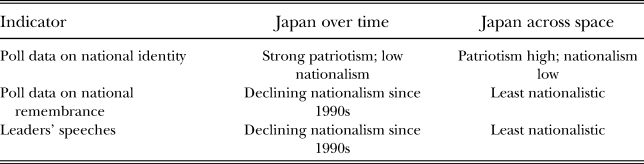
Overall, we do not find support for the argument that nationalism in Japan is rising, let alone rising at levels unusual compared to other countries. As Table 8 summarizes, Japanese patriotism is strong and stable over time, as reflected through longitudinal poll data related to national identity. Public opinion related to war remembrance, as well as leaders’ speeches on August 15, show increased empathy and acknowledgement of Japan's past violence and its neighbors’ suffering: namely, the opposite of what scholars would consider nationalism.
Measuring Japanese nationalism over time and space

DISCUSSION
Scholars might challenge our findings about Japanese national identity, arguing that other metrics would show that Japanese nationalism is on the rise.
UNFAVORABLE PERCEPTIONS = RISING NATIONALISM?
First, some scholars consider an “in-group's valuation of relevant out-groups” as a measurement of nationalism (Johnston Reference Johnston2017, 14). In the case of Japan, some scholars argue that worsening attitudes toward China and South Korea reflect rising Japanese nationalism (Nakano Reference Nakano2015, 161). To be sure, in recent years, the number of Japanese people who report “unfavorable” or “relatively unfavorable” views of China has risen from 42 percent in 2002 to 78 percent in 2018. In particular, those answering that their view of China was “very unfavorable” soared from 7 to 53 percent in 2014, dipping to 30 percent in 2018 (Pew Research Center 2018; Suzuki Reference Suzuki2015). Toward South Korea, Pew Research Center (2018) reports that only 21 percent of Japanese have favorable views.
We contend that using increased anti-Chinese or anti-Korean sentiment as evidence of growing Japanese nationalism is problematic. While increasingly negative perceptions of those countries could be evidence of a more nationalistic Japan, they could also be consistent with no change in Japanese national identity, and with the increased salience of bilateral disputes. Data in this article support the latter interpretation. In recent years, both Beijing and Seoul have pressured Tokyo on historical and territorial issues; Japanese respondents reference those issues to explain their negative views toward those countries. Toward South Korea, 75 percent of respondents cite Seoul's handling of history issues (Genron NPO and East Asia Institute 2015). Toward China, respondents cite Beijing's criticism of Japan over history issues (52 percent), increased territorial aggressiveness in the Senkaku/Diaoyu dispute (50 percent), and lack of respect for international law (55 percent) (Genron/China Daily 2014). Given that Japanese views of South Korea and China are strongly affected by historical and territorial disputes, they make a poor measurement of Japanese nationalism more broadly.
Indeed, as Japanese attitudes toward China and South Korea soured, Japanese attitudes toward other “relevant out-groups” did not (Linley Reference Linley and Kingston2016; Saaler Reference Saaler and Kingston2015). Japanese attitudes about many other countries are favorable, and growing more so; in recent years, Japanese feel increasingly positive toward India (up from 32 percent in 2008 to about 50 percent) (Japan Cabinet Office 2016; Pew Research Center, 2014), and toward Oceania and Southeast Asia (Japan Cabinet Office, 2013). More than 80 percent of Japanese say they feel close to the United States and almost 70 percent to European countries (Japan Cabinet Office 2016).
Furthermore, Japanese attitudes towards foreigners in general are growing more favorable. Attitudes about immigration are growing more welcoming; from 2010 to 2015, Japanese support for immigration nearly doubled, from 26 percent to 51 percent (Asahi Shimbun 2015). Abe's plans to admit foreign workers were supported by 54 percent of the Japanese public, with younger people (65 percent) particularly supportive (Ebuchi and Takeuchi Reference Ebuchi and Takeuchi2018). This number continues to rise, with 70 percent of Japanese saying more foreign workers were a good thing (Nikkei Asian Review 2020). Furthermore, a growing number of Japanese favor marriage with a foreigner: from 29 percent in 1988 to 56 percent in 2013; younger Japanese are more open to the idea, with 72 percent of young people in favor (Institute of Statistical Mathematics 2013). Today, “international marriages are rapidly becoming a normal aspect of society” (Nippon.com 2015). In sum, worsening Japanese attitudes toward China and South Korea are significant for several reasons; however as indicators of nationalism, they suffer from major problems of inference, and are contradicted by other data.
CONSERVATIVE ACTIVISM = RISING NATIONALISM?
Some scholars argue that activism by Japanese conservatives reflects rising nationalism. In an otherwise quiet city, visitors to Tokyo are shocked by the sound trucks used by far-right activists to blare their message. Protests (often against South Koreans) grab headlines. And recently, Japanese politicians have supported conservative study groups, criticized statements and other gestures that acknowledge Japan's past violence (such as the 1993 Kono Statement and landmark apologies by previous leaders), lamented the “Tokyo Trials view of history” as enervating for Japan, and more broadly have called for national pride (Abe Reference Abe2006; Nakano Reference Nakano2015; Saaler Reference Saaler and Kingston2015; Sugano Reference Sugano2016; Babb Reference Babb2013).
It may be true that activists and Japanese conservative politicians are increasingly advocating a nationalist agenda. Substantiating this claim would require distinguishing between patriotic and nationalistic rhetoric and activities, operationalizing these concepts, measuring them over time, and empirically demonstrating an increase in their frequency, intensity, or influence.
Regardless, our data show that to the extent that Japanese conservatives are trying to spread nationalist views, such efforts are not succeeding. Scholars who have analyzed public opinion data agree with our findings that “the Japanese public has not become more susceptible to right-wing propaganda” (Saaler Reference Saaler and Kingston2015, 172; Linley Reference Linley and Kingston2016, 128). Conservative activism often triggers pushback; Abe, for example, gave up his previously stated goal of overturning the 1993 Kono Statement; he issued a danwa in 2015 that (in deference to liberals and to other countries’ wishes) contained all of the elements of the previous danwa; and in 2015 agreed to apologize to and compensate the “comfort women” (BBC News 2015). Although Abe's earlier policies suggested that he favored a less contrite policy, he ultimately had to temper his policies. As a result, Abe has actually been attacked from the right; some of Abe's closest conservative supporters have blasted his government for its “leftist” policies on history (Nakanishi Reference Nakanishi2016; Lewis Reference Lewis2017).
TRIANGULATING RESULTS
Further confidence in our findings about national identity comes from our ability to triangulate them with other studies that evaluated different metrics. Analyzing newspaper editorials and speeches delivered at annual openings of the Japanese Diet, Boyd (Reference Boyd2012) found that the conservative narrative (that values the Emperor, moral education, and institutions such as Yasukuni shrine) has weakened significantly over time, showing greater awareness of global norms and sensitivity toward other countries.
Content analyses of newspaper editorials on August 15 reveal similar findings. Tsutsui (Reference Tsutsui2009, 1410–1411) argues that “the discourse on Asian victims has greatly increased in the past few decades,” and finds “growing sensitivity … about Japan's transgressions in Asia.” Tsutsui argues that progressives prevailed over conservative resistance, such that “acceptance of guilt for perpetrations seemed firmly established in the national master narrative.”
Studies of Japanese history textbooks also echo our findings. A comparative study found “Far from being nationalistic, Japanese textbooks seem the least likely to stir patriotic passions” and “tell no tales of battlefield heroism” (Snider Reference Snider2012; Shin and Sneider Reference Shin and Sneider2015). As we found, textbooks increasingly discuss Japan's wartime violence and foreign victims. Notes Burkh (Reference Bukh2007, 689), “the narrative on Japan's colonial past has grown thicker, in both a qualitative and quantitative sense.” Scholars notes that these changes generated pushback from conservatives, notably in the early 2000s (Tsutsui Reference Tsutsui2009; Nozaki Reference Nozaki2008; Bukh Reference Bukh2007; Cave Reference Cave2013). Nevertheless, they find that “substantial coverage remained in all mainstream textbooks” (Bukh Reference Bukh2007, 704; also Okamoto Reference Okamoto2001). In sum, previous studies of newspaper editorials, Diet speeches, and history textbooks reinforce our findings.
CONCLUSIONS
Amid growing dangers in East Asia—e.g., China's rise, North Korea's accelerated progress in its nuclear program, and questions about the future of the US–Japan alliance—many observers have remarked on important changes in Japan's national security orientation. However, despite frequent claims about Japan's “rising nationalism” and “remilitarization,” our article finds support for neither claim. Japan's military assertiveness remains low. Its military expenditure and size of military forces have remained consistently low over time. In other ways (i.e., its loosening of institutional constraints and its dispatch of peacekeepers), Japan has grown more assertive. But change has been very gradual: from a baseline of total prohibition, over a period of 70 years. Viewed cross-nationally, Japan is the least assertive country in the comparison set, and by far the least assertive of the great powers.
As for Japanese national identity, we find patriotism to be consistently high; as for “nationalism,” however, poll data are mixed. Some metrics suggest that Japanese people feel a sense of superiority, but other metrics show that nationalism is low (both relative to other countries, and over time). In poll data and leader's speeches, growing self-criticism and empathy toward other countries reflect the opposite of nationalist denigration.
These findings have important implications for debates about Japan and the region more broadly. East Asia is often depicted as a region where nationalism is on the rise. But our results, and the insights we incorporate from social identity theory, show how important it is for scholars to distinguish between the more benign patriotism and the more destabilizing nationalism (Wang and Qin Reference Wang and Qin2020; Johnston Reference Johnston2017).
In fact, our findings suggest the need for still further theoretical nuance. Scholars often associate feelings of superiority with nationalism—and thus with its toxic political effects. But findings from the Japanese case suggest that people can feel superiority (or more accurately, can prefer their country to others) absent denigration. In this formulation, the Japanese people like and appreciate other countries, but simply prefer their own. Thus our findings suggest that the nationalism literature currently lumps together a benign concept (a preference for one's country) with a malign one (denigration). Determining whether or not the malign one is driving the empirical result of increased risk of war requires further theoretical nuance and more empirical testing.
Our findings also have important implications related to America's growing national security focus on Asia. Some voices in both Asia and the United States caution American leaders against “enabling” Japanese nationalism and militarism (Richard Reference Richard2016; Stone and Kuznick Reference Stone and Kuznick2014). Such views remind us of Singaporean President Lee Kuan Yew's admonition long ago that encouraging Japanese military activity is like “giving liqueur chocolates to an alcoholic”: that “Whatever they do, they go to its limits” (Erlanger Reference Erlanger1991, 2). But our findings suggest that such fears are unfounded—that if Japan could be convinced to be a more active regional partner, trends in its national identity and security policy suggest it would be a responsible one.
Finally, scholars and policy makers should examine why our results differ so significantly from oft-heard views. In the case of scholars who characterize Japanese nationalism as rising, the source of the dispute is often alternative metrics (see, for example, Dudden Reference Dudden2015; Nakano Reference Nakano2015; Morris-Suzuki Reference Morris-Suzuki2015). In such cases the way forward for the field is more research and scholarly debate.
Another issue, however, is that in some countries, particularly China, talk of Japanese right-wing extremism or remilitarization is a strategic tool: used to weaken Japan and undermine American regional balancing. Talk, Johnston (Reference Johnston2013) notes in his study of the “China assertiveness” meme, is consequential (also Hopf Reference Hopf2010; Fierke Reference Fierke2002). Indeed, the “resurgent Japan” meme is coloring perceptions of a key regional actor, shaping regional views, and “potentially narrowing policy options available to decision makers.” “Talk,” in other words, constitutes another realm of strategic competition. Observers should thus not accept China's expressions of concern at face value—especially when those concerns are often strategically motivated to keep Japan weak and drive a wedge in regional balancing efforts (Crawford Reference Crawford2011).
The United States faced a similar consideration in the 1950s, when its support for West German rearmament prompted vociferous protests from the Soviet Union. The path that the United States adopted was wise; it helped West Germany rearm and build what was one of the most powerful military forces of that era—but the United States drew the line at nuclear weapons, partly to mollify the Soviets (Trachtenberg Reference Trachtenberg1999). But in East Asia today, such policy debates depend on an accurate assessment of both Japanese nationalism and military efforts.
ACKNOWLEDGEMENTS
The authors would like to thank many colleagues for valuable feedback provided in presentations and on drafts of this paper. For their particular support we thank Patrick Boyd, Bruce Dickson, Taylor Fravel, Alastair Iain Johnston, Adam Liff, Andrew Oros, Kathleen Powers, Sheila Smith, Koichi Nakano, and George Yin. For research assistance we are grateful to Shani Bartuvia, Charlotte Blatt, Angela Cai, Yoshifumi Ide, Yuki Onuma, Ji Hyun Lee, Seung Jae Lee, Charly von Solms, Mikaela Edigar, and Kalvin Fung.
FINANCIAL SUPPORT
We are grateful to the Waseda Institute for Advanced Study; JSPS KAKENHI Grant Number JP15KT0135; the Rockefeller Center for Public Policy and the Dickey Center for International Understanding, both at Dartmouth; for financial support.
CONFLICTS OF INTEREST
The authors declare none
SUPPLEMENTARY MATERIAL
For supplementary material accompanying this article, visit https://doi.org/10.1017/jea.2021.20