Introduction
Adam Smith and David Hume advanced different views of sympathy. They were aware of the difference. They even recognized the legitimacy of the view of the other. Each thinker, though, failed to author a coherent theory of sympathy that encapsulates his view with the view of the other. Such a coherent theory is necessary given that the two views amount to a contradiction, giving rise to what is called here the ‘Fellow-Feeling Paradox’.
Why should we care about sympathy? Smith's project is simple: He wants to ground the moral and social order on sentiments – within the broader context of European Enlightenment project, viz., to expel the Church as the foundational ground of the moral and social order. One payoff of the proposed solution of the Fellow-Feeling Paradox is to examine whether Smith's project is successful. To be successful, Smith must be shown to have advanced a coherent theory of sentiments and ethics – i.e., a theory that is free, or potentially free, from the Fellow-Feeling Paradox.
Another payoff of the resolution of the paradox is that it can assist neuroscientists, psychologists, and others to interpret the discovery of the ‘mirror neuron system’. Although it cannot be discussed here, this payoff is relevant given that the mirror neuron system is considered to be the seat of fellow-feeling.Footnote 1 , Footnote 2 In fact, different interpretations of the mirror neuron system have risen, paralleling the different interpretations of sympathy, as expressed in the Fellow-Feeling Paradox discussed here.Footnote 3 , Footnote 4
The Fellow-Feeling Paradox is simple. For Hume, sympathy is roughly about what can be called ‘mimicking’, where the spectator simply copies the emotion of the principal. The principal may, in turn, copy the copied emotion of the spectator, leading to the intensification and acceleration of the principal's (original) emotion/action. Such a mechanism underpins herd behavior, mob psychology, and informational cascades. So, for Hume, the emotions are contagious and, hence, diffuse in the population essentially without critical or cognitive processing.
While Smith acknowledges Hume's contagion mechanism, he rather regards sympathy, at first approximation, as about ‘understanding’. For Smith, understanding amounts to the concurrence of the emotion of the spectator with the emotion of the principal. Such concurrence takes place only if the spectator approves the pitch of the emotion of the principal. Such a pitch is usually higher than the spectator's pitch, which is expected given that the spectator is trying to sympathize with the principal, i.e., the original emotion. So, for Smith, understanding entails the attenuation of the original emotion of the principal, as the principal tries to gain the approval of the spectator by lowering the pitch of his or her own emotion.
To put the contradictory views of sympathy succinctly:
The Fellow-Feeling Paradox: If fellow-feeling, as Hume claims, escalates the original emotion of the principal, we have an anomaly: How could it also attenuate such emotion, i.e., act as ‘brake pedal’? Or, vice versa, if fellow-feeling, as Smith claims, attenuates the original emotion of the principal, we have an anomaly: How could it also escalate emotion, i.e., act as ‘accelerator pedal’?
This paper promises to solve the paradox.
1. Clarifications: Terms and Concepts
Some literature misses the difference between Smith and Hume on sympathy to the point of, surprisingly, treating Smith's theory as largely a replica of Hume's.Footnote 5 , Footnote 6 On the other hand, a growing number of writers have recognized the difference.Footnote 7 – Footnote 13 These writers emphasize that, for Smith, sympathy is about understanding that leads to judgment, while for Hume, sympathy is about mimicking that leads to the contagion of emotions.
The increasing popularity of the view that Smith's sympathy is about judgment is probably due to the new reading of Smith espoused in the ‘Introduction’ by the editors of the variorum edition of Smith's Theory of Moral Sentiments.Footnote 14 – Footnote 17 The editors dismiss the earlier scholarship of Smith's sympathy as exclusively about motivation, viz., benevolence (altruism).
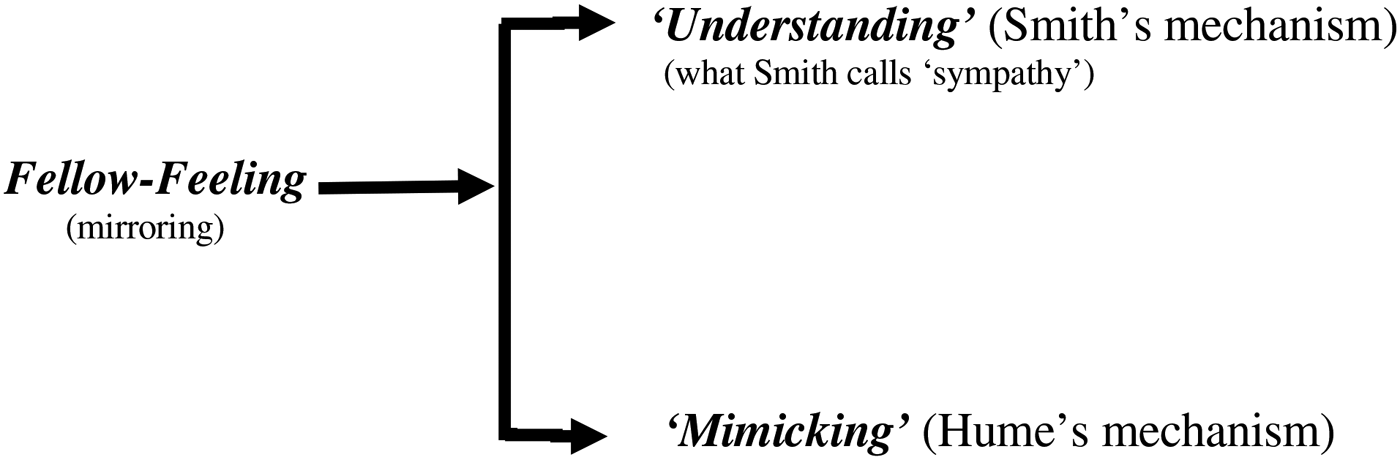
While Smith upheld both functions of sympathy,Footnote 18 this paper focuses on the function of sympathy as judgment. This paper uses the terms ‘fellow-feeling’, ‘copying’, and ‘mirroring’ interchangeably to provide a generic building-block of the emotion – the primitive from which to identify the difference between the two thinkers. This paper reserves the term ‘understanding’, which Smith called ‘sympathy’, to denote Smith's technical sense of fellow-feeling, while it reserves ‘mimicking’ to denote Hume's technical sense. Actually, matters are confusing: Hume and Smith use the same term ‘sympathy’ to denote both the generic and their respective technical senses. To make matters clear, as graphed in Figure 1, ‘fellow-feeling’ or ‘mirroring’ denotes, first, the primitive of copying or mirroring, as in the case of the spontaneous replication of a smile or a yawn, and, second, the respective two technical senses of fellow-feeling for both thinkers.
The Two-Tier Fellow-Feeling

This paper, to note, does not distinguish emotions from actions. It is actually impossible to draw a sharp line between the two. An emotion usually involves some bodily movement, although a limited one, while an action normally involves an emotion. It is best to see emotion as constricted action, whereas action is extensive emotion – and hence both lie along a continuum.
This paper does not delve into the philosophy of mind, especially the literature on ‘mindreading’ or ‘theory of the mind’.Footnote 19 , Footnote 20 One major debate in this literature is how spectators have access to, or the knowledge of the state of mind of others.Footnote 21 , Footnote 22 There are two major views, which are not necessarily exclusive of each other. One view, called ‘theory theory’, argues that we have – as a result of either innate capacities or/and learning – a theory about how the minds of others work. The other view, called ‘simulation’, argues that we know about the state of mind of others by putting ourselves in their situation. Robert Gordon is probably the first to link Smith's sympathy to the simulation view.Footnote 23 Gordon, though, faults Smith for failing to distinguish between two cases of simulation: First, the spectator may simply ‘psychs’ how the principal feels, which Gordon calls ‘empathy’ – which can be regarded as ‘limited understanding’ in the sense that it is free from judgment. Second, the spectator may form his or her own judgment of what the principal feels on the basis of how the spectator would feel if he or she were the principal, which Gordon calls ‘sympathy’ – which coincides with Smith's sense of sympathy. This sense is crucial for Smith because it is crucial for judgment. It allows the spectator to approve or disapprove of the emotion or state of the principal on the basis of how the spectator would feel in such a situation.
In contrast, in the case of empathy as exemplified in compassion, which does not involve judgment, the spectator adopts the feelings and emotions of the principal as they are – i.e., without contrasting them to what they supposed to be, i.e., judging them. As such, the spectator does not compare the evident feelings of the principal with what the spectator would feel in a similar station, i.e., with what they supposed to be. In empathy, stated differently, the spectator sustains and supports the feelings of the principal without judgment whether they are suitable to the cause or stimulus, i.e., whether they are justifiable in pitch.
Note, though, in empathy, as in the case of compassion, the spectator is not merely copying, as apparently the case in Hume's view, the emotions of the principal. One can surmise from Hume's notion of contagion, copying in Hume's view involves the following mechanism: The spectator uses the emotion of the observed other in order to recall his own excitement and emotions. It is as if the spectator does not really care what is happening to the observed other. Rather, the spectator is using the other to reflect and recall events or thoughts that have been experienced by the spectator's own station. That is, for Hume's mechanism, the spectator never travels, in the first place, to the station of the principal. This is not the case with Smith's sympathy. For Smith, the spectator departs his own station and examines the matter from the station of the principal. This means, if we apply the same notion to empathy, when the spectator empathizes with the principal's emotion, the spectator still transports him- or herself to the station of the principal and feels what the principal is feeling, but without contrasting it (judging) with what the spectator would be feeling. So, even if Smith adopts the distinction between empathy and sympathy, both involve traveling to the station of the principal, which is not the case with Hume's sense of fellow-feeling. This is why the empathy/sympathy distinction, while important for other purposes, is not pursued in this paper; the distinction is not relevant to the Smith/Hume's debate, i.e., the Fellow-Feeling Paradox. This paradox, as elaborated below, hinges on the issue of whether the spectator transports him- or herself to the station of the principal, or not. This issue is more fundamental than whether, if the spectator transports the self to the station of the principal, the spectator is involved only in empathy or, in addition, in sympathy.
Gordon advances the empathy/sympathy distinction for a purpose unrelated to the Fellow-Feeling Paradox. Gordon wants to establish that, in order to account for simulation and the theory of mind, Smith needs the distinction between empathy and sympathy. Darwall does not find Gordon's empathy/sympathy distinction ultimately viable.Footnote 24 , Footnote 25 Darwall argues that both moments, the psyching behind empathy and the judgment behind sympathy, are actually a single moment and better called ‘empathy’. He argues that Smith's theory is about empathy – and we should reserve the term ‘sympathy’ to denote caring or benevolence. Irrespective of the terminology, Darwall regarded Smith's theory as about empathy and, hence, a theory of simulation.Footnote 26 Even if Smith's theory is about empathy in the generic sense (i.e., it is not about benevolence/care), Brown,Footnote 27 Griswold,Footnote 28 and KhalilFootnote 29 concur with Gordon: It is unfortunate that Smith failed to distinguish understanding (which can be called ‘empathy’ in the narrower sense, i.e., it lacks judgment) and sympathy (i.e., it involves judgment).
Put in Gordon's terminology, there is certainly a difference between the psyching moment, as when the spectator understands why an abused wife erupted in the heat of the moment and killed her husband (manslaughter), and the judgment moment (which Smith called sympathy), as when the spectator nonetheless does not approve of the act since it lacks self-command. The abused wife could have exercised self-command and acted properly – such as tuning down the pitch of her emotion/action and seeking instead either divorce or legal protection. But the fact that Smith has failed to distinguish these two moments (understanding and sympathy) is not germane to the thesis of this paper, viz., the Fellow-Feeling Paradox. That is, the paradox stands irrespective of whether Smith conflated sympathy, which involves judgment, with understanding (empathy), which does not. So, there is no need for this paper to focus on the conflation, especially since other authors have documented it.
There is one analytical distinction that one can gleam from the above literature: One can distinguish, à la Gordon and many others, the two moments of empathy, and call them by whatever names (such as ‘empathy’ and ‘Smith's sympathy’) – while still setting them apart from benevolence/care à la Darwall and call such benevolence/altruism by whatever name (such as ‘care’ or ‘Darwall's sympathy’). That is, the question of how understanding leads to judgment is analytically independent of the question of how benevolence/care is separate from understanding/judgment.
The literature on philosophy of mind is ultimately couched in terms of the question concerning perception or knowledge: How do we perceive or comprehend the state of mind of others? Such comprehension actually includes scientific investigation. For instance, one can comprehend, i.e., in a scientific way, the emotions of rage and anger of many Germans in the 1920s, for being solely blamed for WWI, followed by the poor performance of the Weimar republic. One can use this comprehension to explain, at least partially, the sudden rise of national xenophobia and Nazism. However, the question concerning knowledge and comprehension does not correspond exactly with the question concerning sympathy. For instance, the comprehension or knowledge of the state of mind of many Germans in the 1920s does not entail understanding (in the sense of empathy) or sympathizing with (in the sense of morally supporting) Nazism.
Such a realization, viz., the difference between comprehension (which is the core of the scientific method) and sympathy/empathy may allow us, as Gordon also suggests, to avoid Smith's conflation of sympathy and understanding (empathy) without undermining Smith's theory. There seem to be three layers of perception: comprehension, empathy, and sympathy. One can comprehend hate speech, racist ideologies, and the origins of the Holocaust without empathizing with (i.e., understanding) racist ideologies such as Nazism. In addition, one can understand manslaughter (as the case of the abused wife), which entails comprehension, but does not entail necessarily sympathy (i.e., approval in Smith's sense). And finally, one can sympathize with divorce (i.e., approval in Smith's sense), which necessarily entails empathy and, correspondingly, comprehension.
Gordon and others, such as NanayFootnote 30 and Fleischaker,Footnote 31 argue that Smith's sympathy belongs to the current debate concerning the theory of mind. This literature is ultimately concerned with the correspondence of the spectators’ mind with the principal's. This is not the concern of Smith's sympathy and Smith's debate with Hume. So, the theory of mind is not a suitable framework to investigate the Fellow-Feeling Paradox.
The proper framework for the Smith/Hume disagreement is the question posed by many starting with Bernard MandevilleFootnote 32 to, as reviewed by Albert Hirschman,Footnote 33 the thinkers of the Scottish Enlightenment: What is the cement of human society if God is an absent landlord? That is, if we remove the church and the state from engineering the social order, and trust such order to the passions, would it be possible for economic prosperity and moral order to arise spontaneously? For Smith, given his notion of sympathy as a regulator of the emotions, sympathy can be trusted as the cement of the social order. In contrast, for Hume, sympathy cannot ultimately be relied on, as FleischackerFootnote 34 elaborates and argues. For Hume, moral principles are rather based on something else, and sympathy is introduced later as a mechanism that facilitates the transmission and communication of moral principles.
What is the ground of Hume's moral principles? This question is the subject of a huge literature,Footnote 35 which can be ignored given that the question falls far away from the focus of the paper. Stated briefly, though, in some places Hume appears as a utilitarian: The natural virtues and justice are recommended because they are for ‘the good of mankind’.Footnote 36 , Footnote 37 In other places, Hume appears as if he is a virtue ethicist who is concerned with satisfactions that express integrity and character.Footnote 38
Given that fellow-feeling is not the ground of moral principles for Hume, this paper does not discuss whether Hume resolves the Fellow-Feeling Paradox. This paper rather focuses on whether Smith resolves the paradox because, for Smith, fellow-feeling is the ground of moral principles. Put differently, the coherence of a theory of fellow-feeling is more crucial for Smith's project than for Hume's – which warrants the emphasis on Smith relative to Hume.
This paper argues that Smith was unable to resolve the paradox. This paper suggests a way to resolve the paradox by making a conceptual distinction. Figure 1, which clarifies the lexicon, also is based on the proposed solution of the Fellow-Feeling Paradox. The core thesis of this paper is that we need to distinguish between two tiers of fellow-feeling. In the first tier, the fellow-feeling is primitive, i.e., the emotion of the principal is simply replicated and copied by spectators, the building-block to which both thinkers subscribe. In the second tier, there is a more complex fellow-feeling than the primitive in the first tier. The difference between Smith and Hume lies in the second tier: the re-working and processing of the primitive phenomenon.
2. Hume's Critique of Smith
Hume defined sympathy as mere mirroring that usually leads to the escalation of emotions:
In general we may remark, that the minds of men are mirrors to one another, not only because they reflect each others emotions, but also because those rays of passions, sentiments and opinions may be often reverberated, and may decay away by insensible degrees. Thus the pleasure, which a rich man receives from his possessions, being thrown upon the beholder, causes a pleasure and esteem; which sentiments again, being perceiv'd and sympathiz'd with, encrease the pleasure of the possessor; and being once more reflected, become a new foundation for pleasure and esteem in the beholder.Footnote 39
Hume here acknowledges that mirroring can weaken the original signal – but usually when the signal is vague. Still, for Hume, sympathy involves non-reflective copying, where the signal is transferred from one person to another without critical judgment. In contrast, for Smith, the signal will necessarily become weaker because sympathy involves critical judgment that attenuates the original emotion.
The difference between the two thinkers is more complicated. Hume recognizes that sympathy may result in the attenuation of emotions – but not because sympathy involves critical judgment. For Hume, in case the content of the signal entails restraint, then what is being transferred non-reflectively leads to the attenuation of emotion. In fact, Hume uses his notion of sympathy as about copying to provide an account of habituation – what modern sociologists call ‘socialization’.Footnote 40 That is, for Hume, sympathy at first approximation involves the contagion mechanism – whose content can be whatever is the public norm or sentiment.
Smith recognizes Hume's contagion mechanism. And he may also recognize some cases of pain, such as hunger, where there is no attenuation of the original feeling of pain even when one represses the expression of pain.Footnote 41 But Smith ultimately maintains that sympathy is about understanding or critical judgment, i.e., the contagion mechanism of Hume must be of secondary importance. So, for Smith, the signal does not become weaker because the public attitude involves restraint. It rather becomes weaker because of the evaluative or judgmental function of sympathy.
Hume was surprised to learn about Smith's theory of sympathy in the first edition of Smith's Theory of Moral Sentiments (TMS). Upon hearing that Smith is preparing a new edition of TMS, Hume chided him in a famous letter dated 28th July 1759:Footnote 42
I am told that you are preparing a new Edition [2nd edition of Theory of Moral Sentiments] and propose to make some Additions and Alterations, in order to obviate Objections. I shall use the Freedom to propose one, which, if it appears to be of any Weight, you may have in your Eye. I wish you had more particularly and fully prov'd, that all kinds of Sympathy are necessarily Agreeable. This is the Hinge of your System, and yet you only mention the Matter cursorily in p. 20. Now it wou'd appear that there is a disagreeable Sympathy, as well as an agreeable: And indeed, as the Sympathetic Passion is a reflex Image of the principal, it must partake of its Qualities, and be painful where that is so. Indeed, when we converse with a man with whom we can entirely sympathize, that is, where there is a warm and intimate Friendship, the cordial openness of such a Commerce overpowers the Pain of a disagreeable Sympathy, and renders the whole Movement agreeable. But in ordinary Cases, this cannot have place. An ill–humord Fellow; a man tir'd and disgusted with every thing, always ennuié; sickly, complaining, embarass'd; such a one throws an evident Damp on Company, which I suppose wou'd be accounted for by Sympathy; and yet is disagreeable [emphasis in original].Footnote 43
In this paragraph, Hume is actually raising two challenges, which are detailed in the next two sections. First, Smith's notion of sympathy as being about judgment is misguided. This is especially the case since, if sympathy is about moral judgment, how can one explain why spectators (acting as judges) derive joy from watching tragedies? This is what came to be called the ‘paradox of tragedy’.
Second, if we accept Smith's notion that sympathy is about judgment, how can Smith account for Hume's mechanism? If sympathy attenuates the original feeling, as Smith insists, how can it also accelerate the original feeling, as Smith (following Hume) also acknowledges – this is the origin of the Fellow-Feeling Paradox.
3. Hume's First Challenge: Sympathy cannot be about Judgment
3.1 Smith: Solving the Paradox of Tragedy
Hume is challenging Smith on how the conversation ‘with a man [in grief] with whom we can entirely sympathize’ could give rise to joy occasioned by the ‘cordial openness of such a Commerce’ – to the extent that the joy ‘overpowers’ the original pain of the grief. This kind of joy might arise when the spectator is watching a tragedy, where the (disagreeable) sympathy with the grieving protagonist gives the spectator a sense of joy, which is paradoxical.
Hume had in mind the paradox of tragedy because he continues in the same letter:
It is always thought a difficult Problem to account for the Pleasure, receiv'd from the Tears and Grief and Sympathy of Tragedy; which wou'd not be the Case, if all Sympathy was agreeable. An Hospital wou'd be a more entertaining Place than a Ball.Footnote 44
Here, Hume admits that the agreeable emotion (joy) arising upon the experience of disagreeable emotion (grief), as in the case of watching a tragedy on the stage, is a ‘difficult problem’. It is a difficult problem or a paradox given Hume's view that fellow-feeling is nothing but mimicking. If fellow-feeling is just mimicking, the spectator should feel sad upon watching tragedy, and even sadder upon reflection. Upon reflection, the agreeable emotion (joy) should not arise, given Hume's view of fellow-feeling. The reflective emotion should simply copy the mimicking of the original emotion, and hence should be disagreeable when the original emotion is disagreeable.
But the joy of watching tragedy is also problematic for Smith, according to Hume. If sympathy is about judgment, why would the spectator, acting as a judge, experience joy from watching the misery of others? If such joy arises as a result of sympathy, the same sympathy that occasions the tears in the case that the original emotion is gloomy, as Smith argues, then people should, to be entertained, go to hospitals at least as often as they go to balls.
Hume tries to solve the paradox of tragedy by explaining the joy of watching tragedy as arising from the aesthetic quality of the play, a solution that is outside the parameters of this essay.Footnote 45 What concerns this essay is Smith's response to Hume's challenge, given Smith's view of sympathy.
For Smith, given his view of sympathy as being about judgment, he can easily solve the paradox of tragedy. For Smith, sympathy has always an agreeable effect, even when the original emotion is disagreeable. This thesis involves two steps: (i) how sympathy is about judgment, which may lead to the approval of original passion, and (ii) how such approval causes an emotion that is always agreeable irrespective of whether the original emotion is agreeable or disagreeable.
Concerning the first step, as Smith elaborates throughout Part I of TMS,Footnote 46 when the spectator understands the principal's emotion/action, the spectator is approving the pitch of the emotion/action as ‘proper’. Such understanding/approval entails that the behavior of the principal is proportional to the stimulus, where the stimulus is equivalent to what economists call ‘incentive’.Footnote 47 It is natural for the spectator, who is standing at a distance, to have more measured assessment of the cause or incentive, and hence, it is usually the case that the spectator's imagined reaction would be at a lower pitch than the principal's. If the principal's pitch is too high, the spectator cannot understand it, i.e., approve of it. So, for the principal to receive approval, he or she has to exercise what Smith calls ‘self-command’, i.e., lower the pitch so that it is proportional to the incentive, i.e., in ratio to the incentive.
Insofar as rationality is defined as the efficient or proper reaction to incentives, Smith's theory of sympathy or self-command is actually a theory of rational choice.Footnote 48 This may be a surprising statement. We should start by asking what is rational choice? One sense of rationality is actually choosing the optimal choice, i.e., to abide by the revealed preference axiom. When one succumbs to temptation, one is obviously violating the axiom. When the principal succumbs to an incentive and overreacts, in the heat of the moment, the principal is not reacting in proportion to the incentive. This is identical to the case of succumbing to temptation: The choice, insofar as it expresses dynamic inconsistency, does not express the principal's best option. The violation of the revealed preference axiom by the principal is seen clearly by the impartial spectator, who has a distanced and measured view of what the present self (the principal under the heat of the moment) is facing. Thus, it is to the principal's benefit for the principal to exercise self-command, i.e., follow the command of the impartial spectator. So, to seek the approval of an impartial spectator is a good mechanism (i.e., a commitment device) so that the principal can avoid temptation i.e., can avoid dynamic inconsistency.Footnote 49
To recapitulate Smith's sympathy mechanism, the spectator watches others and makes judgments via sympathy. Such judgments consist of ‘rules’ or ‘commands’ of what are the proper reactions to incentives. When the spectator becomes as well the principal, i.e., it is his or her turn to act, the spectator-principal turns around and complies with the rules of the spectator within the breast – i.e., the rules that he or she has generated from watching/judging others. Such behavior amounts to the exercise of the virtue of self-command.
Smith was aware of self-deception and self-serving bias, where one twists the rules when it becomes one's turn to act.Footnote 50 Smith reasoned that people enact ‘general rules’ to correct the self-serving bias.Footnote 51 While such qualification is important, it falls outside the scope of this paper.
In any case, we cannot technically state that Smith's sympathy causes directly the attenuation of emotion. The attenuation is rather a by-product of the condition of the spectator supplying sympathy: namely, the demander (the principal) must tune down the pitch of the emotion in order to receive sympathy (approval). So, only as short-hand, we can say that sympathy, i.e., the spectator's judgment, from a distance necessarily entails the ‘brake pedal’ function of sympathy.
Concerning the second step, as Smith argues,Footnote 52 the approval by the informed (i.e., impartial) spectator gives origin to satisfaction on the part of the principal: The principal derives good feeling from knowing that the pitch of reaction was proper. Such agreeable feeling arises from knowing that his or her original feeling was not in bad taste. Smith calls the sense of satisfaction from knowing that one is proper and tasteful ‘another source of satisfaction’ – i.e., it is in addition to the benefit of actually being proper and tasteful.
Let us call this other source of satisfaction ‘second-order sympathy’ and distinguish it from ‘first-order sympathy’.Footnote 53 Actually, Smith recognizes ‘first-order sympathy’ when he calls it ‘the first or principal source of our approbation’.Footnote 54 So, once an original emotion, whether joyful or sad, meets the spectator's approbation, such approbation amounts to first-order sympathy. Given the necessary condition of approbation is met, i.e., first-order sympathy takes place second-order sympathy (the other source of satisfaction) also takes place.
For instance, if the protagonist were distraught, and at the edge of committing suicide, simply because his or her pet bird managed to escape the birdcage, the spectator would not normally sympathize with such pain because he or she finds it disproportional or inappropriate. In this case, first-order sympathy (pain) would not arise and, hence, second-order sympathy (joy) would never emerge. In fact, the tragedy would most likely be a commercial failure. But if the protagonist were distraught to the point of committing suicide because his lover deserted him or her, the spectator might sympathize with the pain. In this case, first-order sympathy (pain) would arise and, hence, second-order sympathy (joy) would emerge.
In this light, for Smith, sympathy cannot be about mimicking or a ‘rubber stamping’ – where the spectator just simply copies what the principal feels. This follows from Smith's technical definition of sympathy, viz., as premised on approval. If the spectator finds the reaction of the principal not in proportion to the incentive, the spectator does not approve, i.e., there is no first-order sympathy. If there is no first-order sympathy, second-order sympathy cannot arise. So, given Smith's technical definition, sympathy (as second-order sympathy) is always agreeable – because it is a by-product whose necessary condition is the existence of first-order sympathy.
On the other hand, first-order sympathy can be agreeable or disagreeable. If the principal is sad, and the spectator approves the pitch of sadness, first-order sympathy is disagreeable. If the principal is joyful, and the spectator approves the pitch of joyfulness, first-order sympathy is agreeable.
If the principal receives first-order sympathy, the principal's feeling (whether agreeable or disagreeable) gets confirmed. Such confirmation occasions second-order satisfaction. But also the spectator (in this case, the viewer of a tragedy) experiences, as a by-product of first-order sympathy, a second-order sympathy. It arises from witnessing a proper emotion. In the case when the spectator is also the principal, as the actor reflects on his or her action and exercises self-command by listening to the spectator within the breast, the second-order sympathy of the spectator and of the principal is one and the same. Obviously, the goal of Smith's analysis is to explain the everyday case where the spectator is judging him- or herself, i.e., reflecting on him- or herself as the principal whose action needs to be assessed. But to reach this goal, Smith starts with the analysis as if the principal is seeking the approval of an external spectator, when in fact the principal is ultimately seeking self-approval.
The proposed distinction between first- and second-order sympathy can be found in Smith's TMS. It is his strategy of responding to Hume's challenge. In a footnote, added to the second edition of TMS, Smith states that his theory of sympathy already takes care of these ‘two things’, i.e., first- and second-order sympathy:
It has been objected to me that as I found the sentiment of approbation, which is always agreeable, upon sympathy, it is inconsistent with my system to admit any disagreeable sympathy. I answer, that in the sentiment of approbation there are two things to be taken notice of; first, the sympathetic passion of the spectator; and, secondly, the emotion which arises from his observing the perfect coincidence between this sympathetic passion in himself, and the original passion in the person principally concerned. This last emotion, in which the sentiment of approbation properly consists, is always agreeable and delightful. The other may either be agreeable or disagreeable, according to the nature of the original passion, whose features it must always, in some measure, retain.Footnote 55
Smith's distinction between first- and second order sympathy can easily solve the paradox of tragedy, a paradox that was a popular subject of debate among the Scottish Enlightenment of the 18th Century. Using the distinction between first- and second-order sympathy, the spectator would not experience joy (second-order sympathy) if the protagonist were showing enormous pain and such pain is unjustified, i.e., there is no first-order sympathy.
So, Smith's solution of the paradox of tragedy, as Arby Siraki observes, does not follow other solutions that rely on a supposed separation between art and reality.Footnote 56 According to such separation, the spectator may derive self-interested pleasure from being aware that he or she is far away from the danger threatening the protagonist; i.e., he or she is sitting safely in a theatre instead of being in harm's way. As Siraki argues, Smith actually does not erect a fence between artistic creations and everyday life.
3.2 Smith: Sympathy is more than Mirroring
On what basis does Smith take on the view of Hume, and argue that sympathy is about judgment? Actually, Smith anticipated Hume's challenge when he wrote the 1st edition of TMS. Smith commenced TMS, in the first chapter, by criticizing Hume's theory of sympathy as about mimicking and contagion. The early scholars of Smith, as the editors of the variorum Glasgow edition note,Footnote 57 did not realize the context of the first chapter, i.e., that it was a critique of Hume's theory. So, the early Smith scholars misunderstood Smith's wide-ranging examples of sympathy in the first chapter as a discussion of the motivation for benevolence/care. But the motive of benevolence/care has to wait to Part II of TMS, when Smith discusses the merit of action.
After the first paragraph of the first chapter of TMS, Smith has Hume's theory of sympathy as his target. Let us go through these important paragraphs, starting with the second one:
2nd paragraph: Smith points out a contradiction in Hume's position: if Hume is correct that sympathy is simply the copying of the emotions of others, this contradicts Hume's theory of knowledge. According to Hume, humans have no access to the minds of others. So, in the second paragraph, Smith asks the reader, while asking Hume, how could one copy the feelings of others if he has no access to his mind? That is, Smith exposes the contradiction of Hume's thought at the start of TMS. For Smith, sympathy is not copying, but rather arises from imagining ourselves in the station of others: we place ourselves in the station of the principal, and feel what he or she is feeling by exposing ourselves to the same incentives or dangers that are inflicting him or her in his or her station.
3rd paragraph: Smith demonstrates his view, in critique of Hume, ‘by many obvious observations, if it should not be thought sufficiently evident of itself’:
When we see a stroke aimed and just ready to fall upon the leg or arm of another person, we naturally shrink and draw our own leg or our own arm; and when it does fall, we feel it in some measure, and are hurt by it as well as the sufferer.Footnote 58
Smith is stating that we react to the danger that is about to befall the principal even before the principal is experiencing pain. This should not be the case if sympathy is à la Hume, i.e., about copying. Further, in same paragraph, Smith brings up the examples of our sympathy with the rope dancer, how squeamish people feel, or itchy in corresponding parts when they look at ‘the sores and ulcers which are exposed by beggars in the streets’ – even when the principal is not expressing such emotions. Again, this should not be the case if sympathy is about mimicking.
4th paragraph: Smith makes the same point, illustrating it by how we feel with the actors on stage. It is by bringing their case home through imagining what ‘should be the sentiments of the sufferer.Footnote 59
7th paragraph: Smith argues that, even if sympathy involves mimicking in some cases mentioned in the 6th paragraph (discussed below), sympathy in many cases does not involve mimicking. In these cases, the observed passions excite no sympathy unless we understand or become ‘acquainted’ with the cause of the passion:
This [i.e., Hume's mechanism of automatic copying], however, does not hold universally, or with regard to every passion. There are some passions of which the expressions excite no sort of sympathy, but before we are acquainted with what gave occasion to them, serve rather to disgust and provoke us against them. The furious behaviour of an angry man is more likely to exasperate us against himself than against his enemies. As we are unacquainted with his provocation, we cannot bring his case home to ourselves, nor conceive any thing like the passions which it excites.Footnote 60
This paragraph does not define the usage of the term ‘sympathy’ as exclusively about approbation. But Smith rarely defines terms so neatly. Nonetheless, as Smith proceeds in Part I of TMS, it becomes clear that he is interested in moral approbation and, hence, interested in the cases of sympathy (where the word ‘sympathy’ is used broadly in this paragraph to denote all cases of fellow-feeling) that involve moral judgment.
9th paragraph: Smith wastes no time and proceeds more explicitly detailing the kind of ‘sympathy’ (used broadly) that interests him, namely, the sympathy that involves moral approbation, where the spectator inquires about the cause of the emotion of the principal:
Even our sympathy with the grief or joy of another, before we are informed of the cause of either, is always extremely imperfect. General lamentations, which express nothing but the anguish of the sufferer, create rather a curiosity to inquire into his situation, along with some disposition to sympathize with him, than any actual sympathy that is very sensible. The first question which we ask is, What has befallen you? Till this be answered, though we are uneasy both from the vague idea of his misfortune, and still more from torturing ourselves with conjectures about what it may be, yet our fellow–feeling is not very considerable.Footnote 61
10th paragraph: Smith argues that sympathy is greatly contingent on understanding the ‘cause’ or the ‘situation which excites it [observed passion]’. Smith marshals his first example against Hume:Footnote 62 If sympathy were mere mimicking or the outcome of contagion, how could we feel the impact of an insult, even when the object of the insult might not have felt it or is even incapable of feeling it (in the case the person is insane, as discussed next):
Sympathy, therefore, does not arise so much from the view of the passion, as from that of the situation which excites it. We sometimes feel for another, a passion of which he himself seems to be altogether incapable; because, when we put ourselves in his case, that passion arises in our breast from the imagination, though it does not in his from the reality. We blush for the impudence and rudeness of another, though he himself appears to have no sense of the impropriety of his own behaviour; because we cannot help feeling with what confusion we ourselves should be covered, had we behaved in so absurd a manner [emphasis added].Footnote 63
11th paragraph: Smith advances his second example against Hume: if sympathy arises from simple mimicking, why do we feel sorrow towards people who suffer from the ‘loss of reason’. It must be the case that sympathy involves putting ourselves in the station of the principal and imagining what they would feel towards events if they were sane.
12th paragraph: Smith raises his third example against Hume: how can we explain the pain of a mother towards her sick infant, where the infant does not know or show the signs of the illness? Again, sympathy must be more than simple mimicking of what exists. It involves imagining what the infant would feel if it knew the danger that is facing.
13th paragraph: Smith raises his fourth example against Hume: how can we explain the sorrow we feel for the dead, when such dead people do not experience their own loss of life? It must be the case that sympathy involves imagining what the dead person would be enjoying were he or she still alive.
In this manner, Smith commences TMS with arguments and examples to make his point that sympathy involves imagining what others are or would be feeling, which is accomplished by considering the circumstances they face. Sympathy means feeling from the station of the principal, and involves the assessment of circumstances as the principal experiences them. Sympathy involves the evaluation of what exists in light of what the spectator judges to be the proper way to react to the given circumstances. Sympathy cannot be mirroring the principal's emotions without examining their cause, as Hume asserts.
4. Hume's Second Challenge: What about Sympathy as Contagion/Mirroring?
Concerning the second challenge, if we accept that sympathy is about judgment, how do we account for the fact that it is also about copying and the contagion of emotions?
One possible answer is that the two mechanisms take place side-by-side. To have two mechanisms should not entail a Fellow-Feeling Paradox. It could be simply the case that each mechanism is suited for a different sphere: While the judgment/attenuation mechanism is suited for the ‘moral sphere’, the copying/acceleration mechanism is suited for the ‘non-moral sphere’.
While this is a reasonable response to Hume, it ultimately begs the question. It entails that we already know the difference between the two spheres – when the promise of Smith's theory of moral sentiments is to explain different spheres of life on the basis of sentiments. Smith's theory, to be successful, cannot suppose what it is set up to explain; it cannot suppose some demarcated spheres. That is, the question remains: how and why some sympathy leads to attenuation (and hence we say that it acts in the ‘moral sphere’) while another kind of sympathy leads to acceleration (and hence we say that it acts in the ‘non-moral sphere’).
So, Hume is correct in challenging Smith: If you want to ground the social order on sentiments, how can the same sentiment, sympathy, give rise to two different mechanisms?
In his letter to Smith, which is quoted above, Hume states that in the ‘ordinary’ case of sympathy, we have the copying/contagion mechanism. In this case, sympathy with the disagreeable emotion of ill-humor generates a damp on company, i.e., further disagreeable emotion. Hume is not alone in thinking about sympathy as mere mimicking that may amplify the original emotion. Friedrich Nietzsche condemned Christianity on the same view of sympathy. For Nietzsche, Christianity promotes the mimicking of emotions, or what Nietzsche calls ’mitleiden’. Unfortunately, the German word ‘mitleiden’ is usually translated into ‘pity’ – whereas ‘pity’ denotes demeaning status or condescension. In any case, Nietzsche notes that Christianity gloats over the mimicking of emotions which may lead to the escalation of suffering that may push people into lethargy and depression:
Christianity is called the religion of pity. Pity stands in antithesis to the tonic emotions which enhance the energy of the feeling of life: it has a depressive effect. One loses force when one pities. The loss of force which life has already sustained through suffering is increased and multiplied even further by pity. Suffering itself becomes contagious through pity; sometimes it can bring about a collective loss of life and life-energy which stands in an absurd relation to the quantum of its cause (– the case of the death of the Nazarene).Footnote 64
In this second challenge, Hume is asking: How does Smith's view explain the phenomenon of reflexivity and escalation (i.e., the possibility of disagreeable sympathy)? If we accept Smith's notion of sympathy, how could a unified theory account for both kinds of mirroring? Hume is asking more by contrasting Smith's notion of sympathy (which has always agreeable effect, even when the original emotion is disagreeable) with his own view of sympathy (as ‘a reflex Image’ that amplifies the original emotion, which would always be disagreeable if the original emotion is disagreeable).
Hume contrasts, respectively, two different cases of originally disagreeable emotion. In the first case, a spectator sympathizes with a friend who is grieving because, e.g., he lost a son. Smith's sympathy would engender the agreeable emotion for the two reasons just mentioned. The second case, which Hume regarded as ‘ordinary’, is when ‘an ill–humord Fellow; a man tir'd and disgusted with every thing, always ennuié’ throws ‘an evident damp on company’. The mood of the ill-humored fellow spreads via mimicking, which Hume's ‘sympathy’ cannot attenuate. Hume's ‘sympathy’ rather accelerates the disagreeable emotion.
For Hume's ‘sympathy’, the company's mood is reflective of the original feeling. Such reflectivity means that the company's pitch can be higher, equal, or lower, than the principal's original pitch. It is justifiable to suppose that, on average, the reflectivity engenders equal replication of the original mood. There is no general regularity concerning reflectivity because it totally depends on the background or the disposition of the company. For Hume, the company is not Smith's impartial spectator who judges. If the company is a judge, i.e., an impartial spectator, the mood of the company must be, usually or naturally, lower than the pitch of the principal's emotion because, when one judges, as Smith argues, one is examining the original emotion relative to its cause. For Smith, since the cause is removed further from the spectator than from the principal, the spectator's pitch naturally or usually would be lower than the principal's pitch. In contrast, in Hume's ‘sympathy’, the company is not trying to judge the original emotion and, hence, pays no attention to the cause of the emotion. Thus, the company, on average, replicates the pitch of the original emotion. If, in turn, the principal is also reflective, i.e., following Hume's mechanism, he or she would replicate the equally high pitch of the spectator. So, the principal's original emotion is compounded, i.e., accelerated by the mere nature of reflectivity – where such reflectivity on average maintains the pitch of the original emotion. After a few rounds of reflection, a good original mood spirals into a celebrative mood, while a bad original mood spirals into a gloomy mood.
Fellow-feeling with someone who is ill-humored or in a bad mood amounts to mirroring that may escalate into gloom according to Hume. On the other hand, fellow-feeling with a grieving parent usually attenuates sadness (and may even engender joy in light of second-order sympathy discussed above) according to Smith.
Hume's mechanism can explain mob behavior, while Smith's cannot. This conclusion should not mean that Smith does not recognize mob psychology. For instance, Smith discusses how religious intolerance in Toulouse fueled a mob psychology that resulted in the execution of an innocent man in 1762.Footnote 65 Smith also notes how party-allegiance, what he calls ‘faction’, and ‘fanaticism’ tend to corrupt human action.Footnote 66 But Smith explains the mob psychology as the result of error in the mechanism of self-command, i.e., as the failure to keep the emotions in check (propriety). As such, Smith's tools of analysis cannot capture the issue of escalation of emotions per se, which in many social occasions can be desirable as Hume attests.
Smith's concept of sympathy is at once successful and deficient: While it captures the mechanism that leads to the attenuation of the original passion, it fails to explain the mechanism of the acceleration of the original passion. Hume's notion is also at once successful and deficient in reverse: While it cannot capture the attenuation mechanism in a systematic way as Smith,Footnote 67 it succeeds in capturing the escalation mechanism.
6. A Resolution of the Paradox
Smith acknowledges Hume's pathway when he discusses ‘mutual sympathy’ and, without being aware of it, when he discusses ‘peculiar sympathy’.
As for mutual sympathy, for Smith, humans seek amiability, sociability, and the pleasure derived from being in the company of others. This requires to be in-tune with each other's feelings, what he calls ‘mutual sympathy’. Such mutual sympathy involves Hume's mechanism, i.e., fellow-feeling as mimicking. Such mimicking affords the person the pleasure of friendship and the delight of being in the company of other fellow human beings, where there is no judgment of emotions involved. Such a pleasurable sociability, i.e., mutual sympathy, arises from the coincidence of the emotions that two or more people experience as a result of exposure, in a symmetrical way, to a common cause. So, such people stand in a symmetrical position since they try to equally enjoy or avoid the stimulus. For instance, people enjoy mutual sympathy when they laugh at the same joke or cry at the same pain.
As for ‘peculiar sympathy’, Smith regards it at the origin of social rank and political stratification.Footnote 68 Amazingly, Smith's ‘peculiar sympathy’ is hardly noticed by Smith scholars – and its family resemblance with Hume's mechanism is usually overlooked in the literature.Footnote 69 , Footnote 70 Smith reasons that humans have a great aspiration to succeed and reach distinction.Footnote 71 But most people, if not all, never reach the elusive ambition of becoming even greater than what they are. So, most people live ‘vicariously’ – which makes such sympathy peculiar and different from sympathy proper – the pleasures of others that seem to them more successful than themselves. While this phenomenon leads to the adulation of the rich and powerful, which Smith disliked, it also leads to social harmony based on allegiance to the state, which is crucial for the constitution of any sovereign entity.Footnote 72 In this discussion, Smith seems to be unaware of the link of ‘peculiar sympathy’ to Hume's mechanism. For people to live vicariously the pleasures of what they judge as higher rank others, they must imagine what they experience as happening to their own station. As such, they do not ultimately care about the propriety of the pleasure of the rich and powerful; they mainly desire to mimic such pleasure.
From a theoretical standpoint, though, Smith's acknowledgment of Hume's mechanisms in the working of ‘mutual sympathy’ and ‘peculiar sympathy’ is insufficient. Smith needs a meta-theory that can discern how and when the primitive of fellow-feeling can evolve into Smith's mechanism (i.e., sympathy or approval which would lead to the attenuation of original emotion) as opposed to evolving into Hume's mechanism (i.e., mimicking which, on average, usually leads to the acceleration of original emotion). That is, Smith still needs to show how the mimicking function is related to the understanding function that underpins sympathy. Otherwise, one would assert, as Smith did, that mob psychology is simply the outcome of unrestrained emotions that have failed to be attenuated via sympathy. This assertion begs the question: if sympathy is the ultimate mechanism, how can one discriminate the emotions that one should encourage to escalate, as in parties, when Smith's sympathy mechanism should not operate. The decision maker should first decide whether to allow the Smith mechanism or the Hume mechanism to take over – which begs for a meta-theory of decision making.
So, Smith's TMS advances two notions of sympathy – i.e., ignoring the benevolence/altruism function of sympathy: First, sympathy proper that is at the origin of self-command; Second, sympathy as mirroring à la Hume, i.e., fellow-feeling as mimicking, when Smith briefly discusses ‘mutual sympathy’ to denote friendship and ‘peculiar sympathy’ to denote the foundation of social rank and the political order. Smith never explicitly notes the difference among the terms ‘sympathy’, ‘mutual sympathy’, and ‘peculiar sympathy’ – which indicates that he lacked a general theory of fellow-feeling.
Without departing from Smith's text, one can provide a general theory of fellow-feeling, which promises to solve Smith's conundrum, i.e., the Fellow-Feeling Paradox. As shown in Figure 1, fellow-feeling (mirroring) is the primitive; it amounts to the spectator's image or copy of the emotion/action of the principal. The primitive can take two different pathways. The fellow-feeling can develop into sympathy, Smith's mechanism, if the spectator employs it to evaluate the propriety of the emotion/action of the principal. Alternatively, the fellow-feeling can develop into mimicking, Hume's mechanism, if the spectator employs it to excite one's own pleasure – either to gain amiability (mutual sympathy) or vicarious pleasure (peculiar sympathy). In either case, the spectator imagines the observed emotion/action as his own.